Providing Out-of-Band Connectivity to Mission-Critical IT Resources

How One Unified Platform Gives You More Control Over Branch Networking,

Branch networking comes with its own set of challenges that can get in the way of normal operations. As a network engineer, you’re tasked with preventing business disruptions while simultaneously scaling, troubleshooting, and managing network connections. This can be a daunting challenge that may lead to slow deployments, inevitable downtime, and unoptimized connectivity.

The good news is, Nodegrid was built from the ground up to address these major concerns with branch networking. Read on to see how our branch-in-a-box solution helps you scale, troubleshoot, and manage with one innovative system.


Make Branch Networking Easy to Secure and Scale

Consider the common challenges of scaling and adding branch locations to your enterprise network. You’re typically left to ship preconfigured devices to each site, which not only adds more time and cost, but more risk as well. What if these preconfigured devices get lost or end up in the wrong hands? Because they contain user accounts, passwords, and other sensitive information, having these devices get lost or stolen puts your network at greater risk of attack.

Once your devices successfully reach their destination, the real work begins. You need to manually set up all appliances at the location, which involves logging into each individually and making appropriate configurations. This takes even more of your time and money, and leaves you open to potential setbacks that can occur due to human error. What if your compliance documentation contains a mistake, or your IT personnel unknowingly repeat an error while deploying 10, 20, or even 50 new sites?

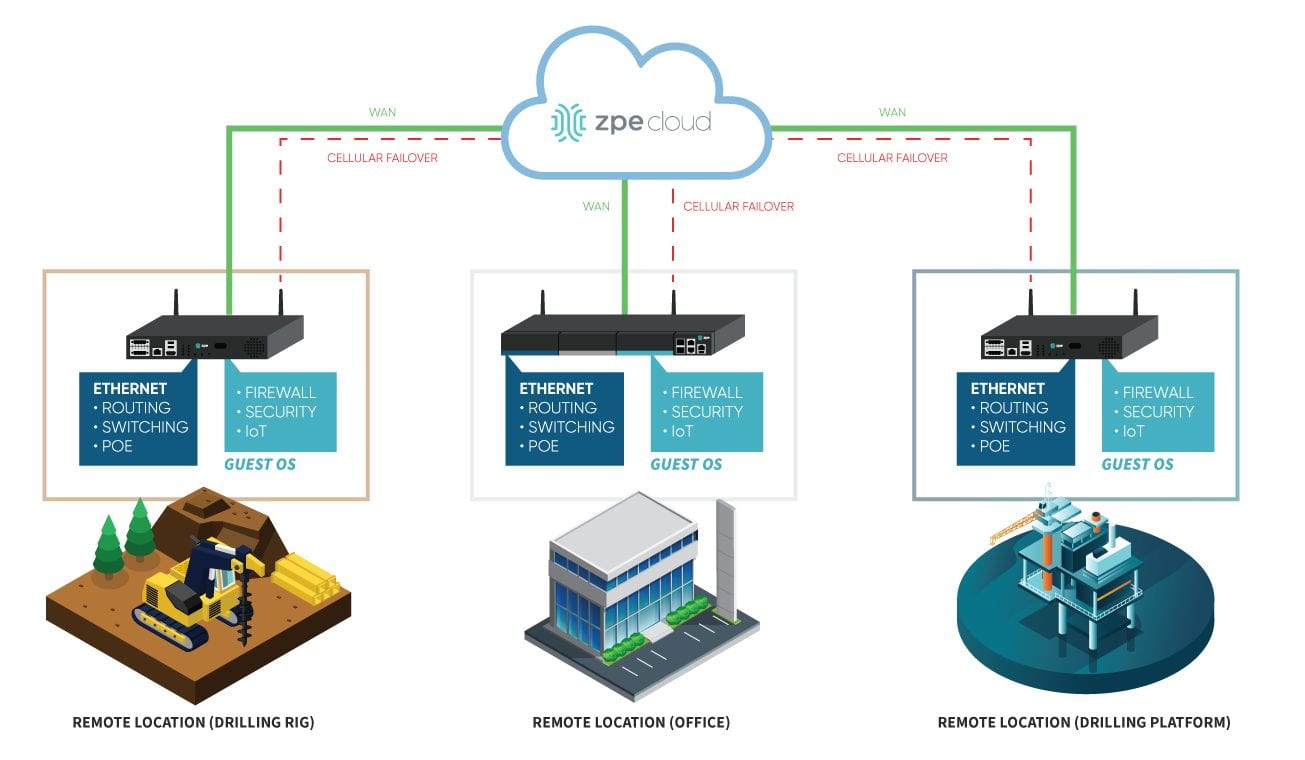
Nodegrid was made to address these concerns of security and scalability. Nodegrid appliances consolidate network functions, sport Linux OS for third-party application hosting, and feature ZPE Cloud connectivity.

When adding a new branch location, you don’t need to ship anything preconfigured. Ship bare-metal Nodegrid devices, which eliminates the threat of having your data lost or stolen, and simply plug them in. Zero touch provisioning means all configuration data can be automatically downloaded from ZPE Cloud, only when your devices are safely at their destination. This capability is even extended to devices that you connect to Nodegrid appliances.

Suddenly, backdoor security threats are no longer an issue, and neither is costly human error, since all your branch locations can be deployed consistently via the cloud.


Pinpoint Problems for Better Troubleshooting

Face it — troubleshooting issues could be a much more intuitive undertaking. But it’s difficult, mostly because of the sheer number of devices you deploy at each location. When something goes wrong, you probably refer to your spreadsheet that shows specific device information for each branch. From there, you might run through troubleshooting protocols to narrow the list of potentially problematic devices and what the issue might be, and then you can finally work toward a solution.

Nodegrid does away with all the hassle, because it uses consolidated devices and Nodegrid Manager software that pinpoints problems for you.

Nodegrid devices are powerful, featuring x86 64-bit architecture that accommodates third-party application hosting for cyber security, SD-WAN, firewalls, and more. For switching, routing, and computing, you need only a single Nodegrid device. This reduces potential points of failure so you can solve issues easier. On top of this, Nodegrid Manager is software that gives you a complete view of all your network-connected devices. It features alerts and notifications that let you know of problems before they occur. Together, Nodegrid’s hardware and software make it simple to pinpoint issues and prevent downtime.

Manage Using one Intuitive Platform

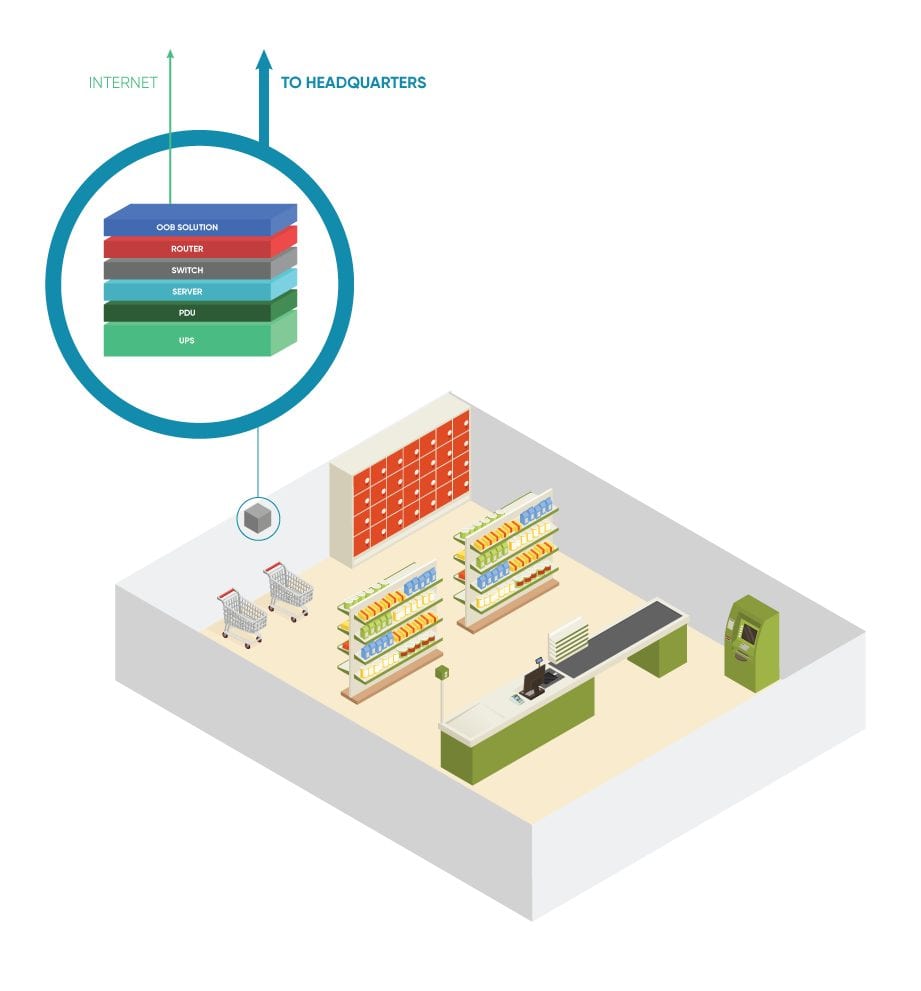
With many devices at each branch location, it’s likely that your hardware stack includes multiple vendors. This is part of achieving a right-fit solution for your enterprise, which can serve you well when looking at the bigger business picture.

But when you get down to the details of managing branch networking, this mishmash of vendors can be a nightmare. Each device has its own OS and interface, which can exhaust your staff. You need to spend time and money training them to become proficient with each. Still, even your best experts can become quickly fatigued when they’re forced to transition from device to device, interface to interface, protocol to protocol, and so on.

One of the best parts about Nodegrid is that it answers the question, “What if it could all be done using one tool?” That tool is Nodegrid Manager.

Nodegrid Manager shows you every device connected to your Nodegrid appliances, and features Guest OS that gives you total out-of-band control regardless of vendor. With one intuitive interface, you can control your entire infrastructure, get deeper visibility and insight into your network, and even extend features to bridge gaps between devices. It can all be done remotely as well, so you can manage and optimize your branch networking no matter where you are.

If you want a first hand look at all these benefits and more, schedule your Nodegrid demo today!
 

10 Things to Consider when Choosing a Branch Networking Solution

10 Things to Consider when Choosing a Branch Networking Solution

Branch networking is evolving. From the core to the edge, you need to consider so many factors, such as scalability, costs of deployment & maintenance, the speed of installation, and much more. What affects all these the most are the devices and tools you use, which are likely obsolete, sitting in silos, and unable to handle the smart infrastructure of the modern network.

Advanced solutions are now available, and you can apply them to your legacy systems as well as new data flows. From cloud & edge computing, to machine learning & AI, you can take advantage of new capabilities, simplify management, and turn your network into a powerful asset

As you consider branch networking solutions, here are 10 things to keep in mind:

1. How Easy is it to Deploy?

Think about the entire deployment. Can your smart hands see the job through, and keep devices up to date? Can you download automation scripts from the cloud for quick, consistent scaling? Do you have zero-touch provisioning via WAN (IPv4 and IPv6) on your side?

If not, imagine how satisfying it would be to plug in your devices, and then everything just works. That’s the type of solution to look for.

2. Does it Keep Everything Secure?

Branch devices could let intruders through the back door, leaving your data center vulnerable. What do you do if this happens and an unauthorized user wreaks havoc on your data center? Do you have a built-in firewall, and can you enforce continuous security via cloud-based configuration backup and restore? Are authentication and security features strong enough to make sure only the right users have access from authorized locations?

Don’t settle for weak security that’ll leave you scrambling after an attack. Consider only a branch solution that delivers total peace of mind.

3. Can you get Secure Access from Anywhere?

You typically need high-level management software to gain access to your infrastructure. With that in mind, do you have a comprehensive out-of-band solution and branch devices that you can orchestrate remotely? Does your solution give you a 360-degree view of your entire infrastructure, without the need to set up a VPN or gain access via your data center?

On-site support is costly and time-consuming. That means you need a solution that provides robust remote capabilities for easy, secure access from anywhere — using just your browser.

4. Does it Prevent Issues & Keep Business Running?

Reducing maintenance needs and expenses is critical to having a modern network deliver value to your business. Does your solution pinpoint issues before they happen? Does it offer data logging and automation capabilities to help you ensure uptime? Can it alert you to configuration changes and possible security risks, and give you the tools to keep up with your needs?

No matter what solution you’re looking for, business continuity should be your top priority.

5. Does it Protect your Data?

Protecting your data means more than setting up a firewall and a few security measures. You need complete protection to safeguard your network (and your business). Do your branch devices support the latest in data and hardware security, with TPM for storing certificates? Do you have encrypted storage, multi-side certificates, and TLS 1.3 encryption? How about protection for boot and BIOS passwords, and even a kill switch?

Your data should always be safe, and your branch solution is a major component in securing all information that goes through your network.

6. Does it Cut Costs & Consolidate?

No matter how many branch locations you have, you need to reduce costs and maximize available space. Does your solution offer multi-function branch devices that are power- and cost-efficient? Does it give you switching and routing capabilities, support for virtualized functions, and on-premise vCPE, firewall, VPN, compute, and storage capabilities? Does it provide you with a 24×7 virtual presence thanks to reliable cellular failover?

The most efficient branch solutions consolidate functions into a single device, letting you take advantage of reduced operational expenses and a smaller network stack.

7. Can you See its Performance?

You can’t optimize your network without knowing where to start. Does your solution collect critical data points and allow you to inspect data logs? Does it build an audit trail of actions, and visualize KPIs with an intuitive, easy-to-use dashboard?

You need to know how your network performs, and your solution should give you critical insights and tools to keep your infrastructure healthy.

8. Can you Scale Quickly & Easily?

For a modern network, your branch solution should be easy to replicate across many locations. Is it simple to deploy and provision? Will it grow as your business grows? Can you foresee the need to replace any devices, or will your solution help you scale even in the long run?

Whether you’re in IT, manufacturing, or retail, your branch solution needs to keep up with business no matter how far and wide you go.

9. Is it Truly Saving you Money?

When it comes to CAPEX and OPEX, you need to think long-term savings. Instead of getting excited over low initial costs, which usually come with additional expenses for training, maintenance, and more, think about how much it will cost over time. Will it need to be replaced often? Does it require anything else to run smoothly, and will it need frequent maintenance? Are there hidden fees or necessary add-ons to consider?

To maximize your savings, expect to pay more upfront for a true “set it and forget it” solution. In the long run, you’ll pay much less thanks to automation and other robust capabilities that minimize downtime and expenses.

10. Does it Work with Many Vendors?

Your network has devices from many vendors, which means your branch solution should work well with all of them. If it doesn’t, you’ll deal with ballooning time and cost expenses that will exhaust your staff and your business.

Look for a solution that streamlines the experience and gives you control with intuitive software. You’ll find an open-platform solution gives you seamless integration that helps you manage your entire infrastructure.


Bottom Line

If you’re in the market for a branch solution, get Nodegrid’s family of business-friendly hardware and software. Not only will you benefit from robust, consolidated devices, you’ll discover effortless network management that puts you in control no matter where you are.

Need More Information?

If you would like more information on how the Nodegrid family of Open Infrastructure Management Solutions address all the needs of Branch networks, contact a ZPE solution specialist.

Control More of Your Network with SD-Branch

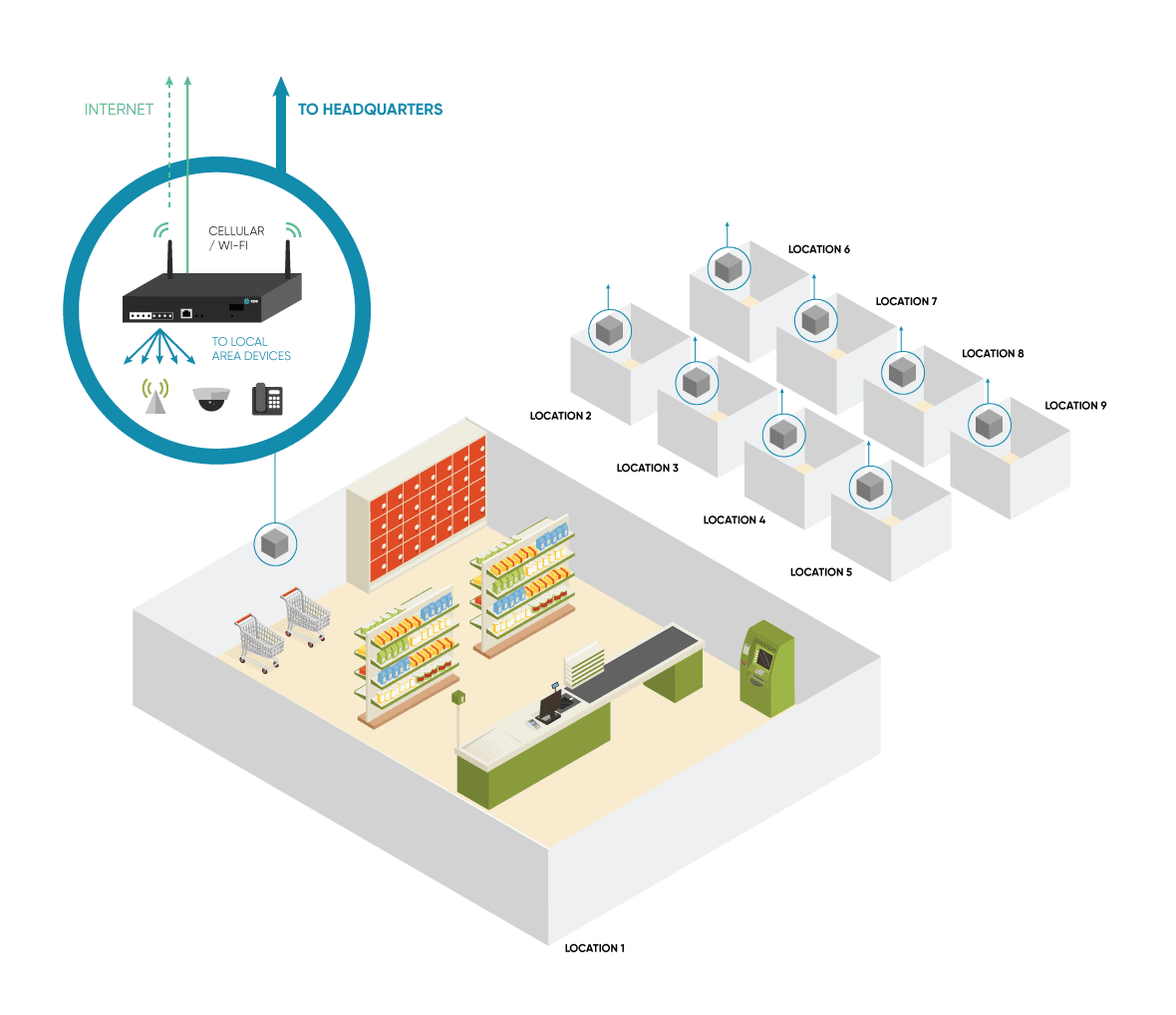
In recent years, SD-WAN has addressed enterprise networking challenges by virtualizing the components of traditional WANs. This software-defined approach offers greater reliability by using augmented connection types, improved traffic routing through increased network transparency, and added security over broadband pathways. In all, SD-WAN provides more operational agility thanks to simple, centralized network management that allows you to remotely view and control WANs. However, traditional SD-WAN technology applies to the larger network, and does not permeate into the LANs of your individual branch locations. This leads to ever-present issues regarding performance optimization, security, and visibility. These are only compounded by the fact that each branch typically must manage a complex array of boxes that can include servers, ethernet switches, Wi-Fi controllers, and other elements, all with their own unique operating systems and management consoles. Enter SD-Branch, the solution that simplifies WAN and LAN management by consolidating multiple network functionalities. SD-Branch integrates SD-WAN, routing, firewalls, security, and LAN functions in a single platform, giving you the advantage of even greater operational agility. SD-Branch helps monitor and manage all the devices within a branch, including printers, TVs, thermostats, and other IoT devices. Benefit from more efficient bandwidth use & improved QoS, hardened security, and granular visibility at the branch level. SD-Branch can be deployed in greenfield locations, or used to upgrade branch-office boxes in smaller branches.

How does it work, and what makes it better?

SD-Branch integrates SD-WAN, routing, firewalls, security, and LAN or Wi-Fi functions in one platform to provide centralized and unified network management. All of these are combined as virtual functions in a cloud-like NaaS model, which allows for automated management as well as services that can be easily adjusted as business needs change. Improve operational agility thanks to rapid deployment and provisioning, centralized management, and reduced hardware costs and operating expenses. IT teams can now rapidly deploy and provision a network branch-in-a-box, and remotely identify and remedy application slowdowns. This eliminates the need for IT personnel to physically visit branch locations for support purposes, which can significantly decrease operating expenses. And to further reduce costs, branch software can be deployed on specialized hardware that consolidates network functions. Using a single pane of glass, SD-Branch provides you with centralized management for all your branch locations.
Consider this business case: Your business has 100 office locations around the world, and each location uses an array of network devices. For network-related issues, your IT teams average 25 hours per month on-site at each location — performing troubleshooting tasks, updating devices, and addressing security breaches.

Standard Remote Location Deployment – Pre-ZPE Systems’ Nodegrid Solutions

100 locations x 25 hours = 2,500 hours every month While teams are on-site at these locations, they are unable to attend to more business-critical IT functions. Your organization loses 2,500 hours every month to basic networking tasks, which is time that could be spent caring for your business’ needs.

Remote Location Deployment – With ZPE Systems’ Nodegrid Solutions

SD-Branch significantly reduces the time needed to perform networking tasks, by virtualizing your networks’ separate functions and running them on a single platform. With centralized management, your IT teams can remotely view and control all of your organization’s SD-WANs and branches using a single interface. Are a location’s users experiencing Wi-Fi outages? Reboot the router remotely in seconds. Do employees suffer slower speeds due to a network password leak? Use SD-Branch to reset it and define access policies that allow only employees to use the network. Are casual video streaming and social media browsing sucking up valuable bandwidth? Set a rule to block specific sites altogether. Because SD-Branch allows you to see the activity within the branch, you can view and optimize each location’s network to suit your business needs. You get better operational agility using a system that consolidates functions and gives you control of your network via a single pane of glass.

What your SD-Branch is missing…

ZPE Systems offers a secure branch network solution with our Nodegrid family of products. Get a 24×7 remote virtual presence throughout your network thanks to our out-of-band (OOB) expertise, and take advantage of SASE capabilities for additional security. Coupled with the ZPE Cloud, Nodegrid provides you with a complete solution, from deploying an office-in-a-box, to easily and remotely managing your entire network infrastructure. Get in touch to discover how Nodegrid simplifies and secures your branches.

Let’s Talk SD-Branch and SASE

If you would like more information on how the Nodegrid family of Open Infrastructure Management Solutions brings a refreshing new solution to the branch, contact a ZPE solution specialist by giving us a call -or- sending us an email. We look forward to hearing from you.