Providing Out-of-Band Connectivity to Mission-Critical IT Resources

What Is Edge Networking, and Is It the Future?

We’re entering the era of edge networking

Edge networking is critical to the future. Organizations continue to expand, and analysts predict that the data center won’t be the only workhorse when it comes to enterprise networking. In fact, some estimate that in a couple years, more than 50% of data will be generated outside the data center or cloud.

Continue reading to learn more about the edge, why it’s the future, and how you can address four key components of edge networking.

What is the ‘edge’?

The edge includes systems that are close to where end devices and third party services interact with your network. Think IoT cameras, self-service kiosks, mobile apps, POS systems, and other things that interact at the last mile of your network.

What is edge networking?
With increasing focus on the edge comes confusion. This stems from the fact that edge networking is typically seen as something completely different than edge computing. That’s because they are technically very different, even though they are part of the same space.

Think of a traditional enterprise network setup. You have the data center at the core, and then branch offices distributed across different locations.

  • Edge networking refers to the tunnels that connect these branches to each other, to the data center, and to distributed cloud service applications.
  • Edge computing means putting parts of the core, such as data processing, storage, load balancing, etc. at or nearer to these branches.

However, the lines are blurring between these two as they are increasingly implemented together. For the sake of this blog post, we’ll combine them and refer to both using one term: edge networking.

There’s a growing need for edge networking

If 2020 was any indication, you likely know firsthand about the growing need for better edge networking capabilities. You may even still struggle with recent changes. You have to make sure your widespread network can handle rapid shifts in customer demand. You also need to accommodate your staff, who are likely no longer working from centralized office locations but instead from home or on the go. Connectivity is more distributed than it’s ever been, and 2020 was a catalyst for this growing trend.

You’ve witnessed this shift in the real world and faced new challenges of traditional enterprise network configurations. This is because the legacy core-to-edge infrastructure was not designed for such widespread networking. If you haven’t already, you will eventually experience significant drawbacks if you don’t move toward more ‘edgified’ infrastructure and solutions.

  • Drawback #1: Slowdowns — Imagine peak demand at your edge locations, and then multiply that by a factor of five, ten, or more. This is what the future has in store, and your traditional setup won’t be able to handle all of this data. With so much information flooding back to the core, your data center will become inundated trying to process it all. This means slowdowns, even catastrophic failures, that can take down both the customer experience and your staff’s ability to keep operations running.
  • Drawback #2: Security breaches — The threat landscape is constantly evolving. With more edge connections comes a greater attack surface, and if you continue using traditional solutions, you’ll have to be constantly mindful of your network’s security. Vulnerabilities will present themselves with your physical devices, virtual assets, and integrations, each of which may allow for exploitation across your network. This will force you to spend monumental sums of time and money trying to protect your business and your customers.
  • Drawback #3: Obsolete solutions — Edge networking is a young market, which means edge solutions will come and go. This volatility means you’ll need a network that can adapt fast, but traditional configurations are too rigid. If you standardize with one vendor’s solutions, you’re left locked into using only their offerings. This could easily leave you with obsolete solutions that will continue costing you.

These are just a few of the reasons why you need to adopt edge networking.

What does the future hold for edge networking?

Edge networking of the future will allow you to accommodate growing, constantly evolving requirements. But if you’re supposed to move away from the traditional setup, where the core consists of data center functions and the edge simply funnels data back to the core, what will networking look like?

  • The edge will become the data center. Because there are increasing requirements for responsive edge experiences, processing will be placed near or at the edge. This will allow you to relieve your data center while optimizing distributed connections for customers and staff.
  • Security will be built in. With an ever-growing network, you’ll have to accommodate more connections. Protecting your business and customer data will involve implementing security from the ground up. This will mean deploying hardware and software that will come with more built-in safeguards, and that will allow you to implement thorough protection through Zero Trust Security practices.
  • You’ll be more adaptable than ever. A volatile solutions market will force you to continually adapt. The firewall that’s perfect one day might be obsolete the next, and the same will be true for SD-WAN, management, machine learning, and other solutions. The key to this flexibility will be in having an infrastructure that emphasizes extensibility and software-defined networking.

Do you want a head start on the future of edge networking?

Download our ebook, The Future of Edge Networking, and discover four ways you can achieve the network of the future.

Investing in Out-of-Band Management to Reduce Risks

Case Study – Investing in OOB – Thumbnail 2

In the finance industry, network modernization protects the most confidential customer data. Whether for processing minor withdrawals & deposits, or recording asset transactions & real estate purchases, your network must be secure and reliable from the ground up. This is one of the biggest obstacles when trying to modernize.

Using traditional solutions forces you to overhaul your infrastructure and disrupt your business, or endure a very slow, piece-by-piece implementation. Either approach requires plenty of time, money, and resources. And without careful planning, you may end up with a solution that becomes obsolete sooner rather than later.

In this post, you’ll see why you need to focus on network modernization, and how it helped one of ZPE Systems’ finance customers protect their data.

What is network modernization?

Network modernization means updating your infrastructure and management tools, so that you can address current challenges and future requirements. This approach allows you to get the most out of your legacy solutions, while setting up a foundation that can help you adapt to change. Network modernization involves at least one of the following:

  • Deploying a solution that integrates in-depth control of legacy and modern systems
  • Eliminating points of failure using more resilient systems and streamlined architecture
  • Adopting extensible software or hardware that can accommodate changing needs

Why focus on network modernization?

When you adopt an approach that focuses on network modernization, you can realize many benefits even into the future. The most important thing to understand is that the more you modernize, the more benefits you’ll see. For example, if you focus solely on deploying new hardware, you may experience advantages at the onset but eventual diminishing returns without modernized software. And if you implement only newer software, you’ll run into the same issue due to the limited capabilities of your legacy hardware.

Network modernization is a multi-faceted concept, but comes with many benefits:

  • Using powerful, multi-function devices helps you save on deployment costs & efforts. You can replace many purpose-built appliances with a single box. This shrinks capital & shipping expenses, streamlines setup, and makes ongoing management much simpler.
  • Using an in-depth software solution for management helps you save on support expenses. You can control your legacy systems and extend functionalities to them, while giving IT teams remote access to your infrastructure layer. Instead of training on many UIs and dispatching technicians to troubleshoot issues, modernized software lets you control everything seamlessly from afar.
  • With an extensible solution, you get peace of mind knowing you can adapt to future requirements. Demands will continue to evolve (especially at the edge), and a flexible platform helps you accommodate changes. This could mean implementing the latest SD-WAN solutions, deploying compute power at the edge, or further reducing hardware stacks to meet business goals.
Finance-Diagram

Network modernization helps a large financial firm

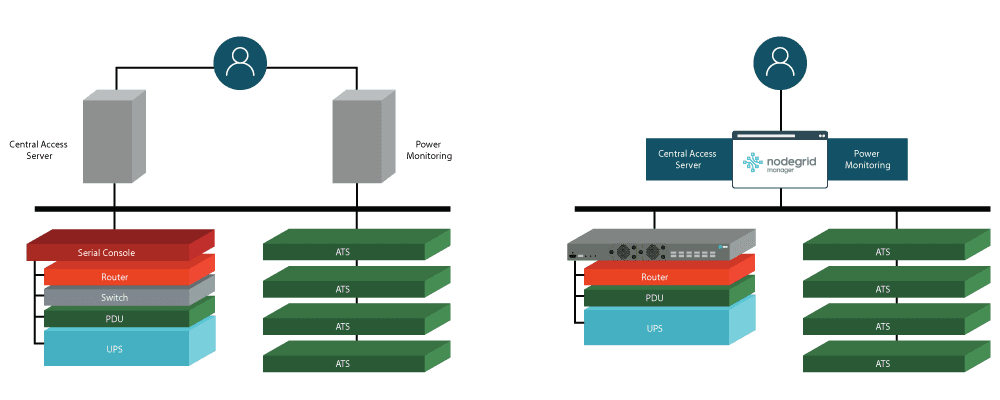
A major financial institution began to see weaknesses in their legacy system, and they knew that modernization was the solution. Their traditional infrastructure employed too many disparate systems that were difficult to manage, even to maintain everyday operations. Security and compliance issues were also developing, and to top it off, they would need to implement a new solution by taking a gradual approach.

For out-of-band management, they were using too many devices at the rack level. Their management solutions also lacked the ability to give them control over all their systems. Their servers and automatic transfer switches required separate gateways, which increased response times and made support difficult to manage.

So how were they able to replace these headaches with an efficient, cost-saving network? They used Nodegrid hardware and software to achieve a comprehensive network modernization solution.

For full details, read the case study.

It’s Time For a New Set of Tires

flat-tire-ktoine-flickr-1024×683

When your car needs new tires, or some other repair, (AND YOU KNOW IT) do you wait until you get a flat on the freeway, or break down and need a tow? Or do you (PROACTIVELY) take it to the shop for new tires or repairs before something happens that ends up costing you big bucks? And when you do take it to the shop, do you ask the repairman to use the oldest tires or parts they can find to make the repairs? I hope not.

Typically, waiting for tires, or components in your data center infrastructure to fail is not a best practice or good idea. Why? Because it ends up costing you more in both time and money to fix the problem or failure.

When physical components in your IT Infrastructure need to be upgraded or replaced, do you wait until they completely fail, or do you proactively upgrade or replace them? I’m guessing the latter. I’m also guessing this might not (for some reason) really apply to your Out-Of-Band (OOB) management practices. If it does, why haven’t I heard from you yet?

Aging Infrastructure


That said, when was the last time you actually looked at how old and in need of major repair or replacement your Out-Of-Band-Infrastructure (OOBI) really is? I’m willing to bet it’s been quite some time, if at all. You may not even know how bad it really is because of many other initiatives and distractions to focus on. If it’s not broke, don’t try and fix it, right? Or like very bald tires on your car, you keep hoping they won’t fail until you have time to replace them.

flickr-23279704@N00-3868462055-300×300

Either way, I get it. But I also know your OOBI is in need of a major overhaul, even if you don’t. Why? Because the OOB management solutions in use today are based on old methods and technologies. Bottom line, they need to be replaced sooner than later. Repairs are not an option. Why? Because trying to repair an OOBI with the same old out of date technologies, is like looking at a flat tire and saying, it’s only flat on the bottom. Existing OOB management solutions were designed and delivered based on old ideas, hardware, and technologies. Yes, that new in box console switch you just purchased is like an old set of tires. How reliable is that. Would you drive your new car with old low performance tires, or would you rather put newly made high performance all-season, all terrain tires with a very smooth ride (for roughly the same price) on your new car?

Dubious Guarantees


While you ponder that question, here are a few other things to consider about your OOB solution. Don’t be misled by claims, statements, or promises from big name vendors that haven’t done anything to improve their OOB management solutions. They don’t, and can’t scale to meet the OOB management requirements that exist today. Their OOB solutions haven’t been upgraded, re-architected, refreshed, re-designed or re-built to handle the demands of today’s data center infrastructures and environments. They’re limited in function and contain old, slow, and perhaps obsolete components. 

flickr-mnemophobe-685×1024

There have been numerous patches and failed attempts to modernize them over the years. But regardless of the updates and patches (rarely being provided), the products themselves haven’t been changed, updated, modified or new features added to meet the demands of the new technologies we now have in the data center. They don’t, and can’t scale across the enterprise. They haven’t been re-architected to provide a vendor neutral experience. They weren’t designed to be vendor agnostic. They aren’t extensible to easily support new and emerging technologies such as Open Stack, or Docker. They don’t scale or meet the demands of a converged infrastructure (CI) or hyper-scale globally distributed data centers. The ability to access and control both physical and virtual environments is not easily available or is limited in scope. In other words, unless the existing OOB management vendors build a completely new solution (at least 18 months to deliver) from the ground up to meet the requirements and demands associated with OOB management of TODAYS and TOMORROWS IT Infrastructures, they’re selling you old tires, and you’re buying them as if it weren’t a problem.

Balding Buzzwords


Also, don’t let them try and fool you by using fancy buzz words, or into believing features like failover to cellular is a save all. If you live in places prone to natural interference from earthquakes, tornados, hurricanes, flooding or other naturally occurring phenomena, you’ll be lucky if cell service still works in the aftermath. And if you believe the only real reason you need an OOB solution is to keep the network up and running, or to provide some type of network resilience through another hardware appliance you need to care and feed, I’ve got four old tires for sale. While network resilience is important, it’s only part of the equation and solution, especially when SDN or NFV come into play. Does your current or planned OOB solution support these environments? Can they scale and provide vital access and control of converged infrastructures (CI) or a highly distributed hyper-scale environment? Do they easily provide access and control of (ALL) in rack devices across a distributed branch office scenario? I seriously doubt it.


flickr-dennis-300×225


The Solution

There is however an answer. A solution that’s raised the bar in OOB management. It was designed from the ground up by OOB industry veterans who realized the OOB world was in need of a major overhaul. It’s vendor agnostic and provides a vendor neutral experience. It was developed and designed using the latest tools, techniques, software, and available hardware. It’s easily extensible to meet the demands of today’s, and tomorrow’s OOB management requirements in any size data center.

It provides aggregation of both the physical and virtual layers, as well as monitoring and data collection of vital indicators that can be extended to other higher level reporting or DCIM solutions.


It provides OOB access and control of network devices, compute, storage, virtual machines, power, UPS’s, SDN, NFV, and much more, for roughly the same price as the old and limited OOB solutions on the market today. And if that isn’t enough to peek your interest, ask your current or planned OOB provider if they support their competitions OOB solution and see what they say. If they say anything but no, run away as fast as you can. Better yet, come see ZPE Systems’ NodeGrid family of unmatched OOB management solutions based on the newest and latest technologies available. This is what customers told us they wanted from an OOB management solution, so that’s why we developed it.

One Last Thought

Can your existing OOB solution, or any other OOB solution you know of, provide a bridge for, or support of, another vendors OOB solution? NodeGrid does. This simply helps ease the transition from, and briefly extend the investment in your existing OOB solution, all while making an intelligently and brilliantly planned transition to NodeGrid for roughly the same price as the other WAY LESS capable OOB solutions.

See for yourself by contacting us today. Learning is free. Getting a flat isn’t.