Providing Out-of-Band Connectivity to Mission-Critical IT Resources

How to Reduce Data Center Carbon Footprints

Laptop,Keyboard,With,Plant,Growing,On,It.,Green,It,Computing
Data centers face a uniquely modern challenge when it comes to climate. Government estimates place data center energy consumption at 10 to 50 times the energy per floor space of a normal commercial building. These estimates are further complicated by tenuous statistics on water consumption, which is not universally reported. As the use of information technology grows, businesses can adopt practices aimed at reducing data center carbon footprints.

This article identifies three major areas of improvement to reduce data center carbon footprints.

  • Remote Management & Truck Rolls
  • Data Center Consolidation Strategies
  • DCIM Management Tools

Remote management cuts down on truck rolls


“Truck rolls” refers to the traditional model of troubleshooting problems at the data center, in which a technician would have to be physically there to examine the issue. This process is estimated to cost hundreds of dollars per visit and wreaks a devastating environmental impact to maintain—for example, instances where the technician would need to be flown out to get to the place. In many of these cases, that impact is made for no reason, as “no-fault found” (NFF) visits account for a staggering number of visits to centers.

For this reason, remote management capabilities are one of the primary keys to reducing data center carbon footprints. Instead of having to fly in a technician, network engineers can access the data center software from any remote location. By allowing network engineers to regulate data center issues remotely, they reduce the:

  • Need to have technicians physically brought into the center
  • Financial, time-consuming, and environmental burden 
  • Number of NFF visits since engineers can remotely check for these problems

Remote management tools have become remarkably popular due to the manageable ground they provide to data centers looking to mitigate the avoidable environmental costs of daily operations.

Data Center Infrastructure Consolidation


Bringing the data center online presents numerous questions—what is the best way to do it? What are the risks? What hardware or software assets does my data center have that might affect the consolidation process?

Network engineers need to overcome these challenges, but the good news is they have several options regarding data center consolidation. The first is straightforward cloud migrations (i.e., moving all the data in the center online, where it can be accessed and deployed more rapidly). This method offers the most direct path to reducing data center carbon footprints. However, the process of doing so is long (six months to two years) and potentially jeopardizes data being transferred if no fail-safes are being utilized. 

For this reason, data centers are taking a more moderate approach to the cloud. There are a few basic approaches to this model: network managers can work with a “public cloud” (such as Microsoft Azure or AWS Direct Connect) for enhanced reliability and agility in the face of necessary disaster recovery.

Whatever the method, there are three significant reasons to look at data center consolidation options. These include:

1. Reducing data center carbon footprints

The demand for data services is rising exponentially, according to the International Energy Agency global data centre electricity use in 2020 alone was 200-250 TWh, or around 1% of global final electricity demand. Consolidating your data centers means reducing the amount of hardware used at each physical location, where fewer machines will accomplish the work once done by many. Beyond the general energy consumption reduction inherent in this process, some data centers will also consolidate physical locations, resulting in fewer physical centers. 

2. Enterprise benefits

Data center consolidation means that enterprises will be able to save on the cost of buying new hardware. Similarly, it can reduce software licensing costs since everything is being moved onto fewer systems. A great example of this is how the federal government achieved substantial savings since it started consolidating its data centers in 2010, according to the Government Accountability Office (GAO) “19 of the 24 agencies reported achieving an estimated $2.8 billion in cost savings and avoidances from fiscal years 2011 to 2015.”

3. Improved efficiency

The more hardware a center has, the more possible points of failure. Data center consolidation reduces error by eliminating potentially problematic hardware before it starts to fail. Consolidation also eliminates possible entry points for potential threats to the center (both physically and in terms of cybersecurity), improving security. 

According to the Uptime Institute’s 2021 Global Data Center Survey, outages, while less extensive than in previous years, have become way more expensive. Over 60% of the respondents reported losing more than $100,000 to downtime. Of that 60%, 15% lost over $1 million.

Whatever the reason, the fact remains that these solutions reduce data center carbon footprints across the board. This places data migration as the most likely long-term option for data centers in the near future. Is also important to note that the ‘cloud’ is basically someone else’s data center, so once more companies migrate to the cloud, this will force cloud providers to rethink their data center configurations.

Reducing data center carbon footprints with DCIM tools

Although consolidation reduces carbon emissions produced by data centers, it is essential to note that data migration to the cloud will take time. In some cases, migration may not be a viable option—a company may not have the resources to afford the process, for example.

In this case, reducing data center carbon footprints focuses on fighting the heat generated by multitudes of servers, routers, and switches. Analyzing cooling, regulating energy consumption, and optimizing rack layout and configuration are all central challenges. 

  • Free air cooling (using cold external air to cool data centers) effectively reduces data center carbon footprints. Still, it requires building a center in a naturally cold place, which is not always realistic and can be very expensive to move.
  • Switching liquid cooling systems towards greywater sources (such as seawater) reduces the amount of potable water consumed by data centers. This also requires moving/building centers to places where fresh water is available.
  • Hot aisle/cold aisle configuration consists of facing server racks with heated exhausts towards air conditioner intake vents and rack fronts facing air conditioner outputs. This distributes heat and energy more effectively, but doesn’t reduce costs as much as other solutions.

All solutions outlined above require a constant stream of incoming data to help engineers evaluate what solutions work for their centers. It is advisable to consider first investing in equipment compatible with environmental sensors, which are instrumental in collecting such data. These tools aid network engineers both in planning their consolidation strategy and Sensors will help to monitor environmental conditions so that they can optimize their systems.

Help the environment, starting with your data center

Although data centers face this problem, there is a large variety of technological solutions. Remote management tools reduce the environmental impact of costly truck rolls, while DCIM tools like rack layouts and free air cooling mitigate the daily effect of data center operations. To be more specific for truck rolls, the environmental impact is fuel consumption and for normal operations, the impact is power consumption.

These tools can serve as a potential short-term fix while engineers look into cloud-based consolidation options like data migration, or even serve in the long term as they strive toward a net-zero center.

However you evaluate your technology strategy, you want to make sure you have the right tools in hand. ZPE’s Nodegrid offers robust remote management tools to reduce your truck rolls, reduce data center carbon footprints, and keep your engineers constantly connected to the status of your center. It similarly offers external sensors which provide you with critical data to adjust or reevaluate your approach, when necessary.

Learn more about how ZPE Nodegrid reduces data center carbon footprints.

Contact us today!
Contact Us

What Is a Colocation Data Center? Benefits and Best Practices

Cloud,Computing,Concept,Represented,By,A,Server,Room,,With,A

The colocation data center market saw huge growth during and after the COVID-19 pandemic, reaching a value of $76.8 billion in 2023 and showing no signs of slowing down. Companies continue to move away from on-premises deployment strategies due to the expense and hassle of maintaining a data center, or to improve their resilience in the face of increasing cyberattacks and natural disasters. This blog discusses the benefits of adopting a colocation strategy and describes the best practices for optimizing colocation data center resilience.

What is a colocation data center?

Colocation is the process of deploying and hosting your servers and other equipment in a third-party data center, known as a colocation data center. This allows you to use someone else’s high-tech facilities and infrastructure instead of building out everything in your own (on-premises) space. It’s called colocation because you co-locate your equipment there – you’re renting cabinet space in a shared facility with other customers instead of using your own dedicated space. That means you still get to use your own servers, storage devices, and other hardware, but you can rely on the colocation facility to provide redundant power, climate control, physical security, and network infrastructure.

What are the benefits of colocation?

Colocation offers several advantages over on-premises deployments, including:

Cost

In terms of up-front costs, spinning up a new colocation deployment is less expensive than deploying a new on-premises data center. While you still have to purchase and install your own in-rack tech stack, as well as pay for monthly rental fees, power, and internet, the colocation provider handles the setup and maintenance of the facility itself. That means you won’t have to worry about things like HVAC and physical security yourself, helping to reduce both upfront and recurring costs.

Compliance

With on-premises infrastructure, your organization is 100% responsible for data protection and compliance. Colocation providers have a shared responsibility approach, meaning they are partially liable for certain services while you’re only responsible for the remainder. While this helps reduce complexity on your end, it can also increase compliance risk. You might adhere to all necessary rules and regulations on your end, but the third-party colocation facility might not. If that happens, you’re ultimately responsible for any issues discovered during an audit, regardless of the offense’s source. That said, there are compliant colocation data centers that are certified as meeting strict, specific regulatory requirements, which is recommended for organizations in highly regulated industries like defense and healthcare.

Geographic distribution

Colocation data centers make it easier to extend your geographic reach by reducing the cost and work involved in spinning up new locations. Rather than building out an entirely new facility every time you want to expand, you simply rent space in an existing data center in your chosen region. This allows you to, for example, improve the performance of your services in a particular area to meet increasing customer demand, or deploy artificial intelligence solutions closer to branch offices and remote manufacturing sites.

Scalability

Scaling an on-premises data center is time-consuming and expensive because you may need to build out additional racks, install more HVAC, and increase your power draw, among other concerns. By comparison, colocation facilities typically handle much of the work involved in scaling their infrastructure, so all you need to do is install your hardware in the rack. Scaling a colocation deployment is faster and more cost-effective than on-premises, enabling you to meet surging demand without busting your budget.

Resilience

The scalability and geographic distribution of colocation data center deployments can ultimately improve network resilience, or the ability to keep delivering digital services during adverse events like natural disasters or ransomware attacks. It’s easier to deploy redundant services and backup solutions in multiple regions as well as build-out a resilience system with alternative infrastructure that can take over when primary systems fail. A colocation strategy can help you minimize downtime and meet stringent SLA requirements with less expense and hassle than on-premises deployments.

Best practices for colocation data center resilience

Colocation deployments lend themselves to greater resilience by virtue of their potential geographic distribution and scalability, but there are steps you can take to shore up your resilience even more. These include:

Automation

Infrastructure automation solutions like zero-touch provisioning (ZTP) make it easier to spin-up new servers and hardware to replace those that fail or are compromised in a ransomware attack. Automated configuration management solutions like Red Hat Ansible help prevent unauthorized changes or botched updates from compromising critical systems.

AIOps

Artificial intelligence for IT operations, or AIOps, uses advanced machine learning algorithms to monitor and protect data center infrastructure. AIOps solutions help detect potential maintenance issues before they cause failures, automatically generate and triage incidents, and identify threats with far greater accuracy than traditional firewalls.

Environmental monitoring

Colocation providers are responsible for maintaining optimal conditions in the data center, but sometimes HVAC systems malfunction or a natural disaster occurs to throw things out of balance. Environmental monitoring systems use sensors deployed around the rack to collect data on temperature, humidity, airflow, and more, giving remote IT teams a virtual presence in the colocation facility. This allows them to respond to changing conditions much faster, potentially avoiding equipment failures or long-term maintenance issues.

Out-of-band management (OOBM)

Out-of-band management (OOBM) involves separating the control plane for data center infrastructure and making it accessible on an alternative network. The OOBM network doesn’t rely on any production infrastructure, meaning it’ll stay accessible even if there’s a critical failure or ransomware attack. OOBM console servers (a.k.a., serial consoles) provide a convenient, centralized management platform for the control plane while keeping infrastructure management interfaces completely isolated from the production network, further enhancing colocation resilience.

Optimize your colocation data center with Nodegrid

Nodegrid OOBM serial consoles provide a vendor-neutral control plane for colocation data center infrastructure. Nodegrid can extend ZTP to other vendors’ devices as well as host third-party automation, security, and AIOps solutions. It supports a wide range of USB environmental sensors as well as legacy and mixed-vendor infrastructure devices.

Schedule a free demo to see Nodegrid colocation data center solutions in action.

3 Data Center Management Challenges—and How to Solve Them for Good

shutterstock_574000213

Data center infrastructure adds an extra layer of complexity to enterprise networks since you need to remotely manage hardware at scale. The network perimeter needs to extend across a geographical distance—which could be several miles or several continents—while maintaining your enterprise infrastructure’s visibility, security, performance, and availability. Accomplishing these goals is often a challenge for engineers.

However, every challenge is an opportunity to learn and improve. Here are the top three data center management challenges, and the proper solutions to avoid or overcome them for good, while optimizing your network infrastructure.

Top 3 data center management challenges and their solutions 

The challenge: Infrastructure monitoring and visibility

One of the most significant pain points for network engineers managing data center infrastructure is the difficulty of gaining complete, real-time monitoring and visibility of remote systems.

Different vendors may offer varying degrees of remote monitoring for their devices, but managing a patchwork of monitoring tools is time-consuming and can leave gaps in coverage. Even a minor issue with critical data center infrastructure can balloon into an enterprise-wide catastrophe if it’s left unnoticed for too long. For example, a database server generating redundant or unnecessary logs seems like no big deal at first. However, if those logs accumulate so much that the hard drive fills up and database operations fail, it could impact your enterprise applications, financial systems, and more. Because of this, it is essential to make sure nothing falls between the cracks.

The solution: Data center infrastructure management solutions

As the name suggests, a data center infrastructure management (DCIM) solution provides a centralized platform for managing data center infrastructure. DCIM is essentially a bird’s-eye view of physical and digital assets to track network traffic loads, hardware and VM performance, power usage, and environmental conditions in the data center in real-time. 

Additionally, DCIM consolidates all the data center devices under one management UI, allowing you to monitor and administer all systems in the same place efficiently. DCIM provides complete visibility of your data center infrastructure while simplifying and streamlining data center management for IT teams. To fully reap the benefits of DCIM, you should look for a solution that can seamlessly integrate both digital and physical assets, to have full visibility on your cloud-based and hardware-based infrastructure. 

The challenge: Data center network security

Just because the critical infrastructure is hosted in a secure data center doesn’t mean it is entirely safe from cyberattacks. Another common data center management challenge involves maintaining enterprise security policies and controls across one or more colocation sites. This can be especially difficult if you utilize managed services and provide access to data center employees or third-party vendors. 

According to a recent study, 74% of organizations who reported a breach say it resulted from giving third parties too much privileged access. You need a way to verify the identity and trustworthiness of any account trying to access data center resources, as well as apply enterprise security policies consistently across all your remote infrastructure.

The solution: Zero trust security with identity and access management (IAM)

The zero trust security methodology forces enterprises to rethink their approach to trust and authentication in their IT environment. Instead of operating under the assumption that all authorized users are trustworthy, zero trust assumes that every user, device, and application is unsafe until proven otherwise. Zero trust security uses identity and access management (IAM) solutions to verify identities, apply enterprise security policies, and restrict access to only the systems that are necessary for the task at hand. 

Zero trust security provides the framework to establish better data center network security through tighter security controls and precise security policies. An IAM solution is one of the key security controls that allow you to dynamically assess the identity and trustworthiness of data center staff, third-party vendors, and any other users or systems that access your data center resources. In that way, zero trust with IAM helps keep data center infrastructure secure.

The challenge: Performance and availability

Your ultimate data center management goal is to maintain the data center infrastructure’s high performance and availability so your organization can run as efficiently as possible. That can be incredibly challenging when managing geographically diverse data centers without local staff or managed services at every location. If a critical switch goes down at a data center 3,000 miles away, you need to get it back up and running fast—which means you don’t have time to fly an engineer to the other side of the country to get eyes on the problem.

The solution: Out-of-band management

Out-of-band (OOB) management separates the production network from the management plane, enabling you to remotely troubleshoot, monitor, and administer your data center infrastructure without needing a LAN or ISP connection. For example, using a separate network via 4G LTE cellular connection, you can reach routers, switches, and servers even without an IP address. Use OOB management to perform higher-level remote access and control tasks on multiple devices from one pane of glass. That means you can reboot devices, perform health checks, and troubleshoot connection problems remotely from anywhere in the world at any time. That’s how out-of-band management improves data center performance and availability.

Solving data center management challenges with the right solutions

Three of the biggest data center management challenges involve monitoring and securing your infrastructure while ensuring high performance and maximum availability. To overcome these challenges, you should invest in tools that provide data center infrastructure management (DCIM), zero trust security and identity and access management (IAM), and out-of-band (OOB) network management solutions like ZPE Systems’ Nodegrid.

Nodegrid is a vendor-neutral platform of hardware and software solutions to overcome your data center management challenges. Nodegrid’s serial consoles and management interface monitor and administer all your critical data center infrastructure and physical assets behind one pane of glass. Nodegrid also provides out-of-band management solutions to troubleshoot your network from anywhere in the world, even during an outage. Plus, you can use Nodegrid’s Zero Trust Security Framework to integrate zero trust principles and IAM providers with your data center management solutions.

To learn more about how ZPE Nodegrid can help you overcome the top data center management challenges, contact us today!

Learn more about how ZPE Nodegrid can help you overcome the top data center management challenges.

Contact us today!

Contact Us

Data Center Modernization Strategy: How to Streamline Your Legacy Environment

shutterstock_2030685674

The rapid development of data center infrastructure management (DCIM) tools leaves most software quickly becoming outdated. Consequently, it is replaced by the next trend on the market, after a short time. The use of such software following its “expiration” creates what is known as “legacy programs.”

Legacy programs are ones that a company implemented years ago and still use, despite being outdated or abandoned by the original makers. This means updates in security or integration options are limited or non-existent. As a result, they present several data center management challenges for network architects intent on staying reliable and reducing the need for human intervention.  

This blog will explain the importance of having a data center modernization strategy and provide a list of key considerations and actionable steps enterprises need to take to modernize their legacy systems. In addition, it will offer a couple of suggestions on where to start the modernization process. 

Challenges of a data center modernization strategy presented by legacy systems

Legacy systems create a critical challenge for companies looking to implement an efficient data center modernization strategy. Data centers often hang on to these programs due to staff familiarity. Still, the “convenience” they provide to employees masks a difficult-to-manage backend with the potential disaster for the network engineers using them; this is also why enterprises should prioritize modernizing their strategy. The obstacles presented by legacy systems include: 

  • Integration: Legacy systems are dated enough that they don’t work well with newer software.  
  • Security: Older software may not work well with modern security systems, leaving the data kept on them especially vulnerable to cyberattacks. 
  • Data storage: Pre-cloud software stores data in a company data silo, making it challenging to transfer legacy data when needed compared with newer software. 
  • Maintenance: Legacy systems may not have repair options available, forcing companies using them to go to expensive 3rd party maintenance vendors.

These setbacks are endemic to legacy systems found in data centers. We should, consequently, consider how enterprises can modernize them. Before we get into possible solutions for legacy systems, here are some additional considerations regarding use cases and maintenance in data center management.

Key considerations of legacy systems

Despite the pitfalls associated with legacy systems, many data centers still utilize them for various reasons. Maybe their strategy has worked just fine so far; perhaps their problems are minor, at most. In this way, it might be helpful to modernize the data center strategy as less a complete replacement and more as a comprehensive reformation.

Data centers hoping to hang on to their legacy systems might do so because:

  • Ease of use: The center’s network engineers are familiar with it, contributing to daily operations running smoothly (if it’s not broken, don’t fix it). 
  • Specific features: Perhaps this system offers something not available on newer systems that helps make running the center more efficient. 
  • Cost/benefit analysis: The center knows it needs to update, but the high cost of doing so constantly places it on the backburner.
  • Integration breakages: Updating one legacy system may create new issues and breakages with other legacy systems a data center might be using, leaving the company reluctant to modernize

All points are worth considering—for the many features legacy systems might lack, there are many reasons why a data center might want to hang on to one. For more information, we recommend further reading on legacy system considerations. Let’s move on and discuss what steps are most effective for a data center modernization strategy.

Data center modernization strategy

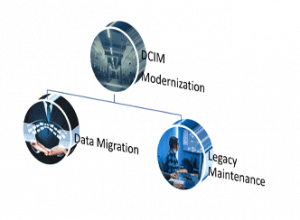
data center modernization strategySo far, we have discussed what a legacy system is, established the most significant data center management challenges, and presented some points against legacy modernization. While this information is essential for network engineers to understand, it only answers questions of “why” enterprises should modernize their strategy; yet to be answered is the question of “how.”

Listed below are two paths to modernizing data centers and some insights on what works best between them. 

Legacy maintenance

By their nature, legacy systems do not automatically integrate with newer software. However, this does not mean they’re unreachable. It is possible to purchase special equipment designed to integrate with legacy systems, such as ZPE’s Nodegrid Serial Console R-Series, and render them controllable from any web browser.

An option that allows network engineers to control and manage legacy systems this way offers advantages over traditional data migration paths:

  • Less expensive: Purchasing a single piece of hardware will cost less than upgrading all data center software. 
  • Faster: Following a brief setup, returning to a legacy system will take less time than a complete data migration method.
  • More user-friendly: Network engineers will be able to continue using programs they are familiar with instead of struggling to learn new tools.

It is also essential to understand that choosing an option like the R-series does not exclude data migration (discussed below) as a long-term solution. Both can be used in tandem, allowing for a seamless transition between systems, ensuring that staff can continue working without problems. This process, particularly when applied gradually over time, offers a smooth transition into a more streamlined data center. 

Data migration

The best long-term answer to these data center management challenges is migrating existing data from the legacy system onto a new program better suited to the ever-changing workplace. Data migration can be a difficult task, but it generally consists of a couple of steps:

  • Extracting existing data from the legacy system
  • Transitioning data to match new formats
  • Refining data to address quality issues
  • Verifying data to make sure the move goes as planned
  • Uploading data into a new system

The challenges with this approach involve high costs, significant time investment, and the risk of something going wrong with the migration path and endangering the data being migrated. Although data migration will likely play some part in a long-term modernization campaign, it does not necessarily need to be the centerpiece.

Streamlining your legacy environment with the right solutions 

Legacy systems do not have to be your worst nightmare. While modernization can be difficult and time-consuming, the current market offers multiple options to make it easier.

To summarize, the reason why data centers need an efficient modernization strategy is primarily for legacy systems. Mainly because these outdated programs are not adequately secured, do not integrate well, and often require third-party maintenance.

Legacy Maintenance or Data Migration are your best options for dealing with the data center management challenges presented by legacy systems. Suppose you are looking for more information on ZPE Systems’ data center management tools. In that case, the Nodegrid Serial Console R-Series helps to control your legacy system using only a browser. 

Want to learn more about data center modernization strategy?

Get in contact with us for more information, and start your journey today!

Contact Us

What Is the Network Edge, and How Do You Manage It? Watch Our Webinar

What is the network edge?

The network edge consists of systems that are not part of the data center. Think of a typical enterprise network: the data center is at the core, and then there are locations distributed across a market, area, or region, or even across the globe. These distributed locations are considered to be at the network edge, because they require infrastructure that connects them back to the data center and to the rest of the enterprise.

The network edge can cover everything from branch office locations, retail shops, and university campuses, to smart city infrastructures, factories, and faraway mining locations.

The network edge includes critical remote infrastructure

At the business-need level, the network edge must provide its customers with the appropriate experience. This can mean authenticating account info for ATM users, processing in-store transactions for shoppers, or providing real-time sensor readings to drilling crews. All of these require critical remote infrastructure to be in place.

Critical remote infrastructure includes the systems that can communicate with the data center, cloud, and/or other edge locations in order to provide the intended user experience.

Why is network edge infrastructure so important?

The network edge is part of the backbone of distributed enterprise. It’s what allows operations to happen quickly and efficiently outside of the data center. Having the right edge infrastructure in place means the difference between smooth operations that keep customers happy, and constant slowdowns and outages that hamper business growth or even lead to severe losses.

As an example, consider what can happen at a popular retailer’s newly-opened branch location. By using solutions that aren’t optimized for the edge, such as MPLS lines and many disparate devices, the customer experience can be very unresponsive. When it takes 20 minutes or more to check product availability, or several minutes just to process a purchase, the simple logistics slow down business and limit the amount of revenue that the day can bring. Even if shoppers don’t abandon their carts, slow infrastructure means slow business.

But with the right edge infrastructure in place, business changes dramatically. Processing tasks can be performed quickly at the edge instead of having to rely on slow MPLS lines to communicate back to HQ. Customers can get product updates in real time, and transactions can be completed in seconds. Optimized infrastructure is the key to meeting demand at the network edge.

Why you need the best edge network management tools

Just as critical as edge network infrastructure are the tools you use to manage it.

Having distributed locations poses challenges because of physical and geographic limitations. These challenges are only compounded as you deploy your edge farther away and in more remote locations. And with typical management solutions, you’re forced to spend monumental sums of time and money performing on-site support — for even the smallest troubleshooting tasks.

Consider this real-world example: an offshore drilling company requires strong connectivity, which means each rig needs a networking stack. Managing these stacks used to require on-site support, which came with extreme costs and risks. On-call IT teams had to be dispatched via helicopter, sometimes traveling more than 100 miles out to sea to simply cycle device power or install a firmware upgrade.

Luckily, the company deployed out-of-band management, which allowed them to gain remote control of their networking infrastructure. They no longer needed to spend thousands on support or put employees at risk. Their out-of-band solution let them perform even complex troubleshooting and recovery tasks from thousands of miles away.

Want to learn more about this customer and how you can save at the edge?

Watch our free webinar, Managing the Network Edge.

Webinar: Managing the Network Edge: Why your best practices need out-of-band management

Webinar: Managing the Network Edge

Not at Cisco Live? Join our free webinar

Setting up POPs, colocations, and remote networks is a lot of work, and ongoing maintenance sinks your resources. But out-of-band management and converged solutions give you on-demand control of your edge. Don’t worry about downtime — instantly respond and keep your critical infrastructure running.

Sign up using the form below. Our experts will show you:

  • Why you should focus on the edge
  • How out-of-band saves on response times & costs
  • How converged solutions add resilience to your edge


Win Apple AirPods!

Attend the webinar and you’ll be automatically entered into our Apple AirPods giveaway!

About our Speakers

Jim Wilson – ZPE Systems
VP Global Sales & Customer Success

Our moderator, Jim Wilson, knows how to make business succeed with better networking. For more than 25 years, Jim has taken a hands-on approach to help design out-of-band, failover, & other network solutions for global Fortune 500 companies. He led regional services for a major storage provider in the U.S., and his skillset in hardware & software prove invaluable to the success of ZPE’s customers.

Jim Wilson 1200×1588

Rene Neumann – ZPE Systems
EU Solutions Engineering Manager

Rene Neumann is the Solutions Engineering Manager at ZPE Systems. He has helped some of the largest companies in the world such as Amazon, Apple, Societe-Generale, and Exxon-Mobil rebuild customer satisfaction with better networking. His IT & data center expertise spans 22 years. Using ZPE’s powerful platform of consolidated devices and intuitive software, Rene continues to improve network architecture for companies across the globe.

ZPE Systems – Rene Neumann

Sven Launspach – Kaemi GmbH
CEO 

Sven Launspach is the founder and managing director of KAEMI GmbH, an integrated IT/OT infrastructure and managed service provider based in Berlin, Germany. One of KAEMI’s guiding principles is: “We take care of connectivity, so that the customer can concentrate entirely on its core business.” His expertise includes managed services, SD-WAN, multi-cloud applications, and NFV/SDN. As a Consultant previously, he has led digitization projects for Lufthansa, which saved millions of euros in operating costs. He is particularly in demand for sharing his thoughts in conferences and IT events. He is also managing director of Consultpool GmbH & Co. KG who offer high skill consulting especially for DAX companies.

Sven Launspach