Providing Out-of-Band Connectivity to Mission-Critical IT Resources

It’s Time For a New Set of Tires

flat-tire-ktoine-flickr-1024×683

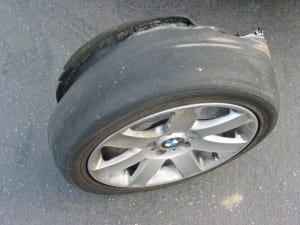
When your car needs new tires, or some other repair, (AND YOU KNOW IT) do you wait until you get a flat on the freeway, or break down and need a tow? Or do you (PROACTIVELY) take it to the shop for new tires or repairs before something happens that ends up costing you big bucks? And when you do take it to the shop, do you ask the repairman to use the oldest tires or parts they can find to make the repairs? I hope not.

Typically, waiting for tires, or components in your data center infrastructure to fail is not a best practice or good idea. Why? Because it ends up costing you more in both time and money to fix the problem or failure.

When physical components in your IT Infrastructure need to be upgraded or replaced, do you wait until they completely fail, or do you proactively upgrade or replace them? I’m guessing the latter. I’m also guessing this might not (for some reason) really apply to your Out-Of-Band (OOB) management practices. If it does, why haven’t I heard from you yet?

Aging Infrastructure


That said, when was the last time you actually looked at how old and in need of major repair or replacement your Out-Of-Band-Infrastructure (OOBI) really is? I’m willing to bet it’s been quite some time, if at all. You may not even know how bad it really is because of many other initiatives and distractions to focus on. If it’s not broke, don’t try and fix it, right? Or like very bald tires on your car, you keep hoping they won’t fail until you have time to replace them.

flickr-23279704@N00-3868462055-300×300

Either way, I get it. But I also know your OOBI is in need of a major overhaul, even if you don’t. Why? Because the OOB management solutions in use today are based on old methods and technologies. Bottom line, they need to be replaced sooner than later. Repairs are not an option. Why? Because trying to repair an OOBI with the same old out of date technologies, is like looking at a flat tire and saying, it’s only flat on the bottom. Existing OOB management solutions were designed and delivered based on old ideas, hardware, and technologies. Yes, that new in box console switch you just purchased is like an old set of tires. How reliable is that. Would you drive your new car with old low performance tires, or would you rather put newly made high performance all-season, all terrain tires with a very smooth ride (for roughly the same price) on your new car?

Dubious Guarantees


While you ponder that question, here are a few other things to consider about your OOB solution. Don’t be misled by claims, statements, or promises from big name vendors that haven’t done anything to improve their OOB management solutions. They don’t, and can’t scale to meet the OOB management requirements that exist today. Their OOB solutions haven’t been upgraded, re-architected, refreshed, re-designed or re-built to handle the demands of today’s data center infrastructures and environments. They’re limited in function and contain old, slow, and perhaps obsolete components. 

flickr-mnemophobe-685×1024

There have been numerous patches and failed attempts to modernize them over the years. But regardless of the updates and patches (rarely being provided), the products themselves haven’t been changed, updated, modified or new features added to meet the demands of the new technologies we now have in the data center. They don’t, and can’t scale across the enterprise. They haven’t been re-architected to provide a vendor neutral experience. They weren’t designed to be vendor agnostic. They aren’t extensible to easily support new and emerging technologies such as Open Stack, or Docker. They don’t scale or meet the demands of a converged infrastructure (CI) or hyper-scale globally distributed data centers. The ability to access and control both physical and virtual environments is not easily available or is limited in scope. In other words, unless the existing OOB management vendors build a completely new solution (at least 18 months to deliver) from the ground up to meet the requirements and demands associated with OOB management of TODAYS and TOMORROWS IT Infrastructures, they’re selling you old tires, and you’re buying them as if it weren’t a problem.

Balding Buzzwords


Also, don’t let them try and fool you by using fancy buzz words, or into believing features like failover to cellular is a save all. If you live in places prone to natural interference from earthquakes, tornados, hurricanes, flooding or other naturally occurring phenomena, you’ll be lucky if cell service still works in the aftermath. And if you believe the only real reason you need an OOB solution is to keep the network up and running, or to provide some type of network resilience through another hardware appliance you need to care and feed, I’ve got four old tires for sale. While network resilience is important, it’s only part of the equation and solution, especially when SDN or NFV come into play. Does your current or planned OOB solution support these environments? Can they scale and provide vital access and control of converged infrastructures (CI) or a highly distributed hyper-scale environment? Do they easily provide access and control of (ALL) in rack devices across a distributed branch office scenario? I seriously doubt it.
 

flickr-dennis-300×225


The Solution

There is however an answer. A solution that’s raised the bar in OOB management. It was designed from the ground up by OOB industry veterans who realized the OOB world was in need of a major overhaul. It’s vendor agnostic and provides a vendor neutral experience. It was developed and designed using the latest tools, techniques, software, and available hardware. It’s easily extensible to meet the demands of today’s, and tomorrow’s OOB management requirements in any size data center.

It provides aggregation of both the physical and virtual layers, as well as monitoring and data collection of vital indicators that can be extended to other higher level reporting or DCIM solutions.


It provides OOB access and control of network devices, compute, storage, virtual machines, power, UPS’s, SDN, NFV, and much more, for roughly the same price as the old and limited OOB solutions on the market today. And if that isn’t enough to peek your interest, ask your current or planned OOB provider if they support their competitions OOB solution and see what they say. If they say anything but no, run away as fast as you can. Better yet, come see ZPE Systems’ NodeGrid family of unmatched OOB management solutions based on the newest and latest technologies available. This is what customers told us they wanted from an OOB management solution, so that’s why we developed it.

One Last Thought

Can your existing OOB solution, or any other OOB solution you know of, provide a bridge for, or support of, another vendors OOB solution? NodeGrid does. This simply helps ease the transition from, and briefly extend the investment in your existing OOB solution, all while making an intelligently and brilliantly planned transition to NodeGrid for roughly the same price as the other WAY LESS capable OOB solutions.

See for yourself by contacting us today. Learning is free. Getting a flat isn’t.

NodeGrid With Monitoring And Dashboard Available

Although we imagine you enjoy getting exercise, we want to make sure that you and your crew don’t have to walk around manually resetting servers, virtual machines and routers at the data center or NOC on a daily basis. Our Nodegrid family of out-of-band (OOB) hardware and software makes fast remote hands data center troubleshooting easy and reliable, without affecting production network traffic.

ZPE Systems helps data center system administrators maintain a firm hand on the out-of-band tiller with the Nodegrid OOB infrastructure management family comprising of Nodegrid Serial Console, Nodegrid [CI] converged infrastructure management appliance and Nodegrid Manager virtual OOB control appliance.

Nodegrid includes monitoring and dashboard features to complement Nodegrid’s existing vendor-neutral out-of-band access and control capabilities.

Nodegrid Monitoring continuously measures critical data points of all managed devices in your data centers and network operations centers. Nodegrid monitors devices over IPMI, SNMP, SSH and other protocols. Nodegrid knows how your devices are doing regarding power draw, temperature and other critical data center environment variables, and displays the data in one central view.

Monitoing and Dashboard

Nodegrid brings built-for-scale monitoring to distributed environments with continuous collection, storage and indexing of local data points. Indexing avoids clogging networks with heavy database synchronization. Simply search for data cross your cluster and retrieve it only when you need it via shared indexes. Nodegrid lets your distributed environments collect monitoring data independently.

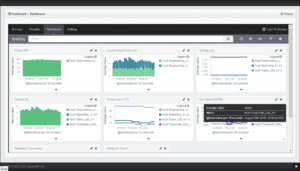
The new Nodegrid Dashboard provides:

  • One view of global data center IT device “metabolism” metrics – power usage and more
  • Easy to use templates for power, current, voltage, fan speed and more – user customizable
  • Fast searching of monitored devices by location, business unit or any custom search field
  • Beautiful visualizations of all managed device metrics

Nodegrid continues to pack many excellent out-of-band IT management features including:

  • Secure in-band and out-of-band access to numerous vendors’ IT devices including: VM, Server, IPMI Service Processor, Networking, Storage, Serial Console and Power
  • On premise (local) and cloud (remote) device management
  • HTML5 remote console access for mobile, tablet, desktop
  • Docker optimized for apps integration and 64-bit Linux shell for powerful scripting
  • Vendor-neutral power management: Cyclades/Avocent, Raritan, ServerTech, Emerson, APC

The Nodegrid Monitoring & Dashboard package license is available immediately for all three Nodegrid products.

Contact a ZPE Systems Representative for a quick look!

Learn About the World’s Fastest Serial Console Switch

What moves faster than bottled water in a desert?
The world’s fastest, smartest serial console!

If you’re planning an upgrade, refresh, or new deployment of serial consoles, there’s never been a better time. We designed and built NodeGrid Serial Console using the latest available hardware and software technologies. The world’s fastest serial console switch packs more storage and memory, plus many other valuable features, than any competing product from Avocent/Emerson, Digi, Lantronix, Opengear, Raritan or Uplogix.


8 Industry Leading Reasons You’ll Love NodeGrid Serial Console:

  1. Super fast CPU, RAM and flash storage leave the competition behind – up to 5X faster CPU than all competing brands
  2. Fastest port speeds of any like device on the market @ 115,200 bps per port – up to 4X faster than competitors
  3. Most concurrent users of any like device on the market: 1,000 – at least 3X more than our competitors
  4. Zero touch provisioning
  5. Bare metal boot capability
  6. Failover to cellular provider of your choice
  7. 16, 32, 48 and 96 serial port models with AC/DC power
  8. Linux OS, direct shell access, 64-bit 3.x kernel

We invite you to test drive our new NodeGrid Serial Console. NSC is not only the world’s fastest serial console switch but also the first-to-market with dual/quad-core Intel CPUs, bare metal booting, system configuration security checksum and Docker app capabilities.

Request a NodeGrid Serial Console evaluation today!

ZPE Systems Joins the VMware Technology Alliance Partner Program

ZPE Systems Joins the VMware Technology Alliance Partner Program


FREMONT, CA, May 5, 2015 — ZPE Systems, Infrastructure Redefined, today announced it has joined the VMware Technology Alliance Partner (TAP) program. Members of the TAP program collaborate with VMware to deliver innovative solutions for virtualization and cloud computing.   The diversity and depth of the TAP ecosystem provides customers with the flexibility to choose a partner with the right expertise to satisfy their unique needs.

“We welcome ZPE Systems as a valued member of the VMware TAP program,” said Howard Hall, senior director, Alliances, VMware. “This membership means customers can take full advantage of a streamlined virtualization and cloud infrastructure experience. VMware provides an online marketplace, VMware Solution Exchange (VSX), where customers can learn more about ZPE Systems’ collaboration with VMware and our continued goal commitment to developing breakthrough technologies that can transform business.”

“ZPE Systems is proud to join the TAP Program to collaborate with VMware on providing customer focused virtualization management solutions,” said CEO Arnaldo Zimmermann. “With VMware as an engineering partner, customers can rest assured that our NodeGrid Manager platform is robust, leading edge and VMware ready. We look forward to a productive partnership with VMware.”

The VSX is an online virtualization and cloud infrastructure marketplace that provides customers with a single point of entry to discover, evaluate, and rate business solutions.

ZPE Systems product information, collateral and other assets are listed within the online VMware Solution Exchange.

With thousands of members worldwide, the VMware TAP program includes best-of-breed technology partners with the shared commitment to bring the best expertise and business solutions for each unique customer environment.

About ZPE Systems, Inc.

ZPE Systems is the data center industry’s first provider of Software Defined Infrastructure to manage physical and virtual IT devices. The company’s NodeGrid platform simplifies access and control of compute, network, storage and power infrastructures. NodeGrid Manager provides vendor-neutral OOB management of IT devices. NodeGrid Serial Console enables OOB access & control of serial devices. NodeGrid [CI] protects converged infrastructure. NodeGrid Flex and NodeGrid Bold control devices at the edge of the network. NodeGrid USB provides a high-density USB type C mobility development cycle environment. NodeGrid Service Processor secures IPMI management ports and IoT devices.

ZPE provides smart, consolidated IT management solutions that reduce downtime and CAPEX/OPEX. The company is headquartered in Fremont, California with resellers in Japan, UK, Germany, Netherlands, Brazil and India. ZPE Systems, the ZPE logo and NodeGrid are registered trademarks or trademarks of ZPE Systems. Other company and product names may be trademarks of their respective owners.


Press Contact

ZPE Systems, Inc.
Alvin Chan, Marketing Manager
510-298-3022
alvin.chan@zpesystems.com

5 Ways to Find Data Center Devices Using NodeGrid Serial Console

How Does Natural Language Search Help Me Find IT Devices in the Data Center?

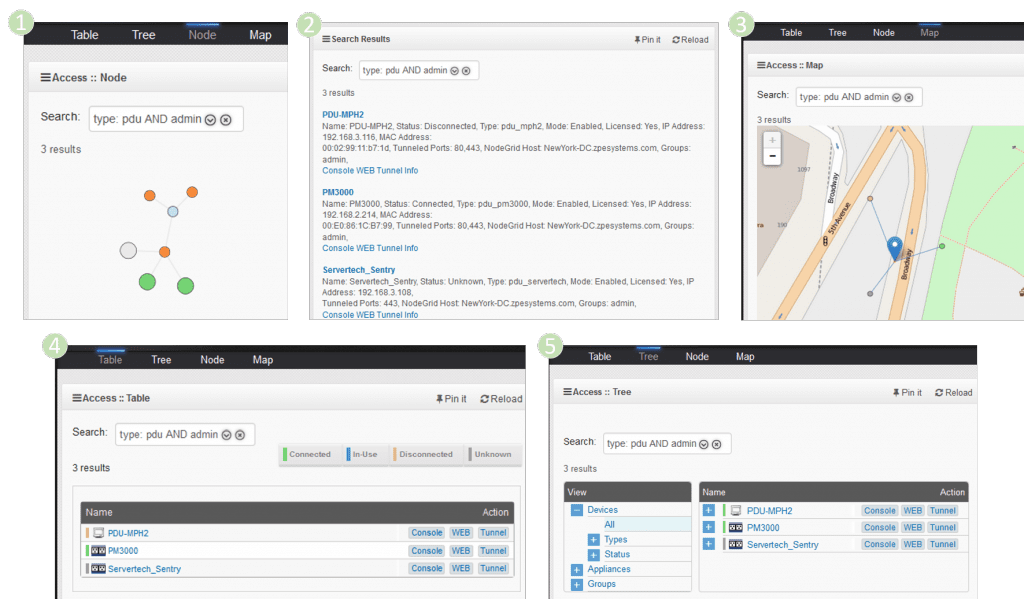
By using NodeGrid Serial Consoles in standalone or cluster configuration, it’s easy to find physical servers, routers and switches, storage and power devices – with one search bar and five different views for all your serial console devices. Viewing options include table, tree, node, geo map and web search result views.

When connected together, it’s easy to search across clusters of NodeGrid Serial Console serial ports. Log into one NSC server to quickly find and access devices plugged into any other NSC server. This is also true for standalone NSC servers.

The NodeGrid platform is dynamically in sync with your environment. Newly added devices are automatically discovered, indexed and immediately available to the rest of your centralized console management nodes and authorized users.

Simple and Easy to Use

Everyone knows how to search. It’s easy to find devices by searching for standard and custom field data (including groups, such as “admin” group), IP addresses or a specific device. For example, you can type in:

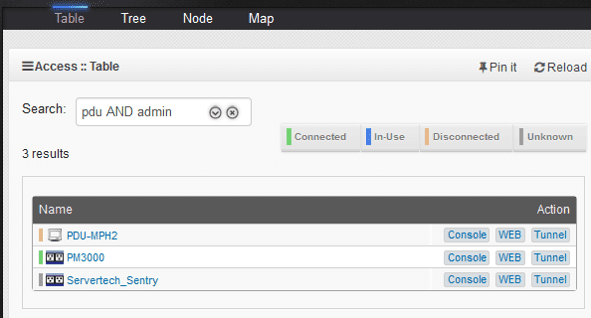
“pdu AND admin” (or another phrase)

And you’ll see this:

Users can add searchable custom fields and data to any serial device attached to NodeGrid Serial Console. NodeGrid’s search engine displays real-time device results on the fly, based on all standard and custom fields. All of your organization’s data center devices are quickly and easily searchable by anyone logging into the NodeGrid platform. Search results are automatically saved into your search bar history for later reference.

If You Like It, Pin It

In addition, you can “pin” your favorite default view and each time you return to the Access main screen, you’ll see your devices in the preferred view.

Correlate Dynamic Device Information

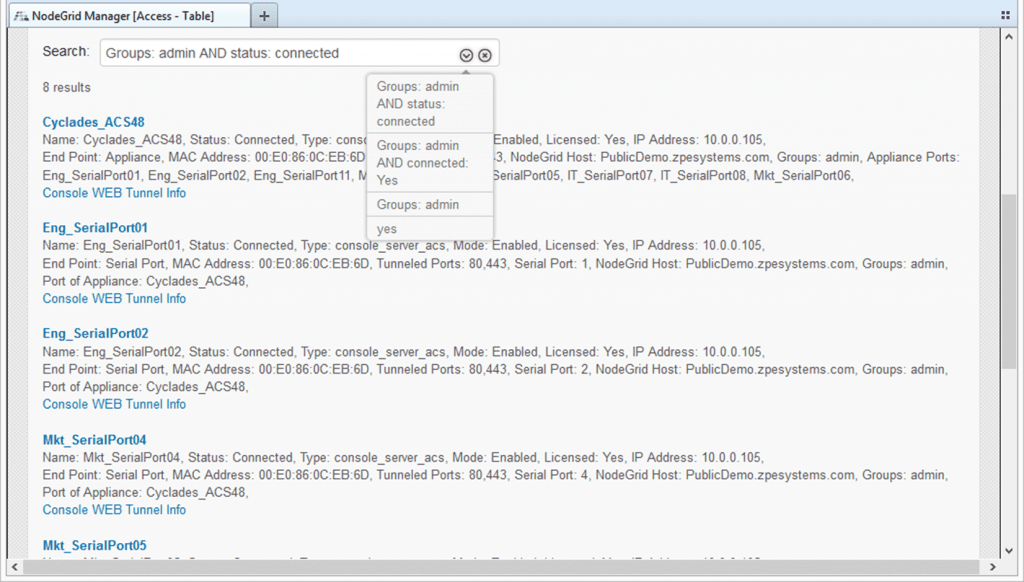
Using keyword search and complex logic (AND, OR, NOT, and more) you can find IT equipment based on single or multiple device properties.

You can search for “Groups: admin AND status: connected” to find all devices which belong to the admin group AND are connected (on and reachable).

No Device Left Behind

Unless you never plugged them in in the first place, there’s no way you won’t be able to find your devices with our five views and web search capability. We all have different ways of doing things, and so our product reflects this and helps your team members perform at their best.

Work Fast

Every device view and search result view includes all buttons you need to immediately access device information, the console, secure tunnel or native web portal. No need to have two browser windows open, or click back to get to a control panel for the device you’ve just found.

Fiery Performance

Because NSC crawls and re-indexes its database periodically, users quickly find new and modified devices practically on demand. Because clustered NSCs only share the index of your device pools, there is minimal CPU load on your clustered NSCs. There is also reduced network load.

Cost savings

Everyone knows how to use search engines and graphical dashboards. Why not search for data center assets the same way and save time doing so? Time is money. There’s no more need to use spreadsheets or dig through inane levels of organizational trees to track devices.

In Our Next Installment…

Find out how NodeGrid Serial Console’s Yocto and Docker container capabilities benefit IT managers and users.

Have questions or want to evaluate a NodeGrid Serial Console unit for your lab environment? Contact us, we’re here to help.