Providing Out-of-Band Connectivity to Mission-Critical IT Resources

NodeGrid With Monitoring And Dashboard Available

Although we imagine you enjoy getting exercise, we want to make sure that you and your crew don’t have to walk around manually resetting servers, virtual machines and routers at the data center or NOC on a daily basis. Our Nodegrid family of out-of-band (OOB) hardware and software makes fast remote hands data center troubleshooting easy and reliable, without affecting production network traffic.

ZPE Systems helps data center system administrators maintain a firm hand on the out-of-band tiller with the Nodegrid OOB infrastructure management family comprising of Nodegrid Serial Console, Nodegrid [CI] converged infrastructure management appliance and Nodegrid Manager virtual OOB control appliance.

Nodegrid includes monitoring and dashboard features to complement Nodegrid’s existing vendor-neutral out-of-band access and control capabilities.

Nodegrid Monitoring continuously measures critical data points of all managed devices in your data centers and network operations centers. Nodegrid monitors devices over IPMI, SNMP, SSH and other protocols. Nodegrid knows how your devices are doing regarding power draw, temperature and other critical data center environment variables, and displays the data in one central view.

Monitoing and Dashboard

Nodegrid brings built-for-scale monitoring to distributed environments with continuous collection, storage and indexing of local data points. Indexing avoids clogging networks with heavy database synchronization. Simply search for data cross your cluster and retrieve it only when you need it via shared indexes. Nodegrid lets your distributed environments collect monitoring data independently.

The new Nodegrid Dashboard provides:

  • One view of global data center IT device “metabolism” metrics – power usage and more
  • Easy to use templates for power, current, voltage, fan speed and more – user customizable
  • Fast searching of monitored devices by location, business unit or any custom search field
  • Beautiful visualizations of all managed device metrics

Nodegrid continues to pack many excellent out-of-band IT management features including:

  • Secure in-band and out-of-band access to numerous vendors’ IT devices including: VM, Server, IPMI Service Processor, Networking, Storage, Serial Console and Power
  • On premise (local) and cloud (remote) device management
  • HTML5 remote console access for mobile, tablet, desktop
  • Docker optimized for apps integration and 64-bit Linux shell for powerful scripting
  • Vendor-neutral power management: Cyclades/Avocent, Raritan, ServerTech, Emerson, APC

The Nodegrid Monitoring & Dashboard package license is available immediately for all three Nodegrid products.

Contact a ZPE Systems Representative for a quick look!

Learn About the World’s Fastest Serial Console Switch

What moves faster than bottled water in a desert?
The world’s fastest, smartest serial console!

If you’re planning an upgrade, refresh, or new deployment of serial consoles, there’s never been a better time. We designed and built NodeGrid Serial Console using the latest available hardware and software technologies. The world’s fastest serial console switch packs more storage and memory, plus many other valuable features, than any competing product from Avocent/Emerson, Digi, Lantronix, Opengear, Raritan or Uplogix.


8 Industry Leading Reasons You’ll Love NodeGrid Serial Console:

  1. Super fast CPU, RAM and flash storage leave the competition behind – up to 5X faster CPU than all competing brands
  2. Fastest port speeds of any like device on the market @ 115,200 bps per port – up to 4X faster than competitors
  3. Most concurrent users of any like device on the market: 1,000 – at least 3X more than our competitors
  4. Zero touch provisioning
  5. Bare metal boot capability
  6. Failover to cellular provider of your choice
  7. 16, 32, 48 and 96 serial port models with AC/DC power
  8. Linux OS, direct shell access, 64-bit 3.x kernel

We invite you to test drive our new NodeGrid Serial Console. NSC is not only the world’s fastest serial console switch but also the first-to-market with dual/quad-core Intel CPUs, bare metal booting, system configuration security checksum and Docker app capabilities.

Request a NodeGrid Serial Console evaluation today!

5 Ways to Find Data Center Devices Using NodeGrid Serial Console

How Does Natural Language Search Help Me Find IT Devices in the Data Center?

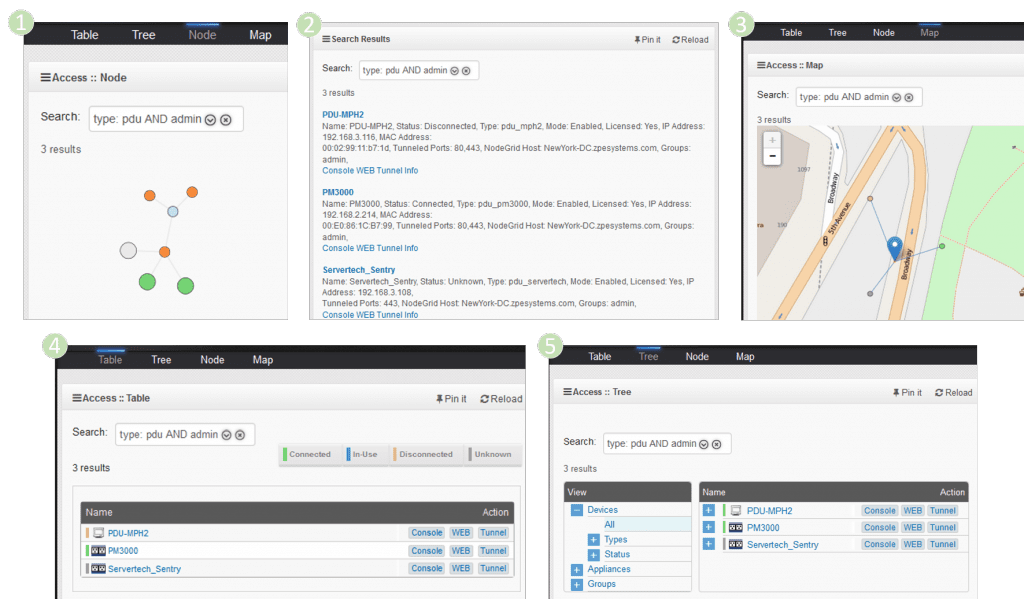
By using NodeGrid Serial Consoles in standalone or cluster configuration, it’s easy to find physical servers, routers and switches, storage and power devices – with one search bar and five different views for all your serial console devices. Viewing options include table, tree, node, geo map and web search result views.

When connected together, it’s easy to search across clusters of NodeGrid Serial Console serial ports. Log into one NSC server to quickly find and access devices plugged into any other NSC server. This is also true for standalone NSC servers.

The NodeGrid platform is dynamically in sync with your environment. Newly added devices are automatically discovered, indexed and immediately available to the rest of your centralized console management nodes and authorized users.

Simple and Easy to Use

Everyone knows how to search. It’s easy to find devices by searching for standard and custom field data (including groups, such as “admin” group), IP addresses or a specific device. For example, you can type in:

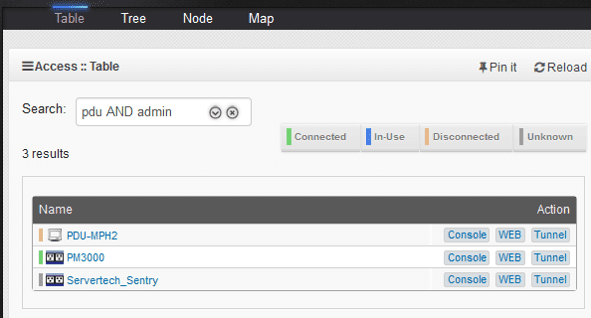
“pdu AND admin” (or another phrase)

And you’ll see this:

Users can add searchable custom fields and data to any serial device attached to NodeGrid Serial Console. NodeGrid’s search engine displays real-time device results on the fly, based on all standard and custom fields. All of your organization’s data center devices are quickly and easily searchable by anyone logging into the NodeGrid platform. Search results are automatically saved into your search bar history for later reference.

If You Like It, Pin It

In addition, you can “pin” your favorite default view and each time you return to the Access main screen, you’ll see your devices in the preferred view.

Correlate Dynamic Device Information

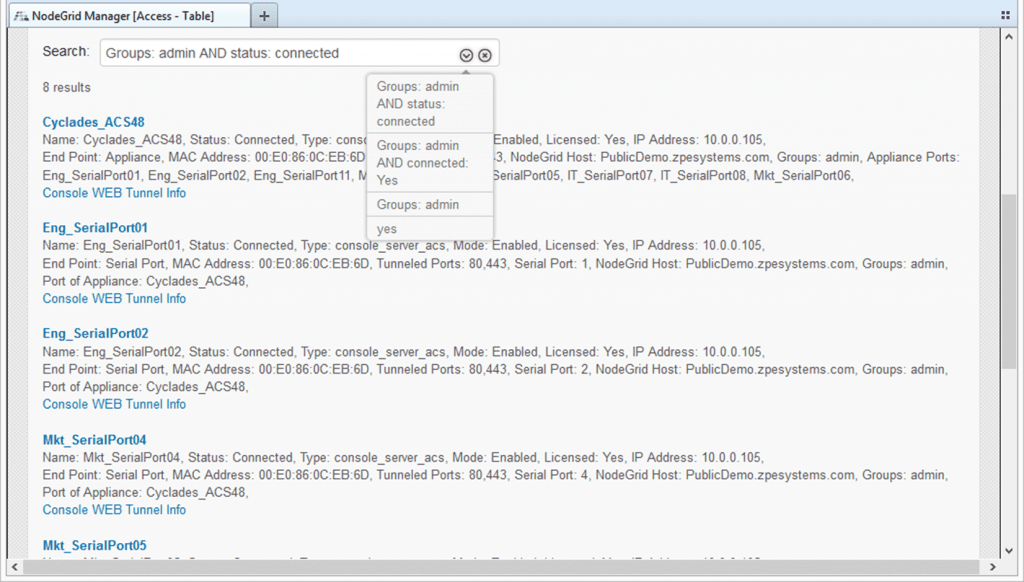
Using keyword search and complex logic (AND, OR, NOT, and more) you can find IT equipment based on single or multiple device properties.

You can search for “Groups: admin AND status: connected” to find all devices which belong to the admin group AND are connected (on and reachable).

No Device Left Behind

Unless you never plugged them in in the first place, there’s no way you won’t be able to find your devices with our five views and web search capability. We all have different ways of doing things, and so our product reflects this and helps your team members perform at their best.

Work Fast

Every device view and search result view includes all buttons you need to immediately access device information, the console, secure tunnel or native web portal. No need to have two browser windows open, or click back to get to a control panel for the device you’ve just found.

Fiery Performance

Because NSC crawls and re-indexes its database periodically, users quickly find new and modified devices practically on demand. Because clustered NSCs only share the index of your device pools, there is minimal CPU load on your clustered NSCs. There is also reduced network load.

Cost savings

Everyone knows how to use search engines and graphical dashboards. Why not search for data center assets the same way and save time doing so? Time is money. There’s no more need to use spreadsheets or dig through inane levels of organizational trees to track devices.

In Our Next Installment…

Find out how NodeGrid Serial Console’s Yocto and Docker container capabilities benefit IT managers and users.

Have questions or want to evaluate a NodeGrid Serial Console unit for your lab environment? Contact us, we’re here to help.

Why NodeGrid Serial Console has an x86-64 CPU and More Memory Than Traditional Console Servers

ZPE Systems Recently Released the World’s First 64-bit x86 CPU Based Serial Console Server with Faster Processing Speeds and More RAM and Storage Than All Legacy Vendors’ Consoles. Hip sysadmins and Data Center Operators Know Why. Here’s the Skinny on Why we Chose to use Multi-core 64-bit Intel CPUs in our Beefed Up Serial Console Server.

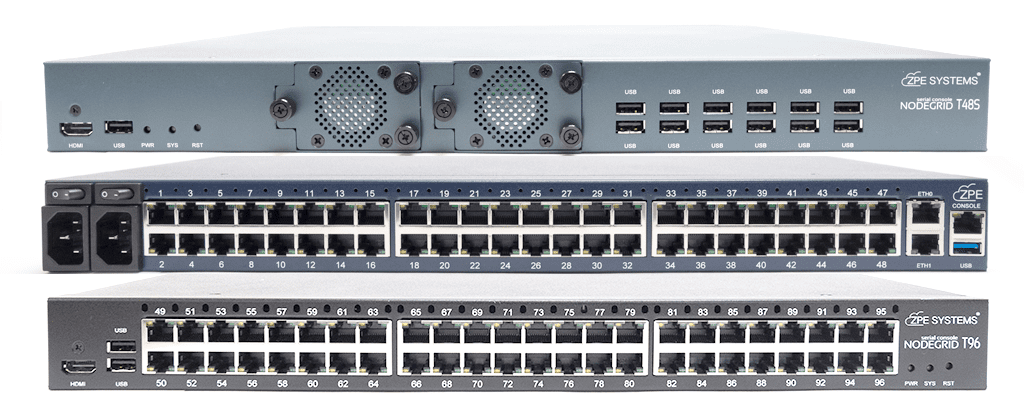
ZPE Systems NodeGrid Serial Console T48

Performance

Servers with dual-core x86-64 CPUs can handle more simultaneous operations, users and I/O faster, even with the same Gigabit Ethernet connections, as older, less robust console servers. Faster CPU cycles can handle more simultaneous connections and other user defined workloads in addition to console routing and monitoring tasks. Faster = lower MTTR, greater productivity, new vistas of additional productivity, higher ROI.

Common platform for users, developers, OS and application availability

Given that the NodeGrid Serial Console runs on the x86-64 platform, IT managers and users can expect the same management and maintenance experience they have with their existing x86 based servers.

Common development environment: x86 SDKs, SDEs and Yocto

Developers benefit from a wide variety of readily downloadable x86 software development kits and environments. We chose Yocto for our NodeGrid Serial Console SDK so customers always have the latest updates, packages, and DIY customization capabilities at their fingertips.

The latest, greatest software – Docker and more

Likewise on the x86 platform, users can take advantage of newer technologies such as Docker. In our case, we provide a Docker container optimizable server right out of the box. Run nearly any Docker app on NodeGrid Serial Console to immediately extend server functionality.

Security patches available sooner

Using the open industry standard Intel CPU you don’t need to wait for 3rd party kernel patches from other chip makers such as ARM, Freescale, Motorola, etc. In some cases, it might even be possible to apply patches before official firmware updates are available.

Peripherals

The standard x86 platform makes it easy to add peripherals to further extend NodeGrid Serial Console capabilities. Using one USB 3.0 port and two USB 2.0 ports, it’s easy to add cellular dial-up, Wi-Fi and Bluetooth or additional external storage, just to name a few. Simply add the associated drivers.

Greater storage

Having 36 Gigabytes of storage allows users to run hundreds of apps and store lots of data and audit logs if needed. Local storage capacity can be increased via extra USB storage devices.

Cost savings

Using an open industry standard Intel CPU allows us to pass along cost savings to our customers while significantly improving user response and processing capabilities.

The whole is greater than the sum of its parts

NodeGrid Serial Console comes preloaded with all the standard features you’d expect, and several industry firsts. On their own, these are all great reasons to buy our new NodeGrid Serial Console to refresh your data center’s IT management infrastructure. Together, they’re a no brainer.

Part 2: Why Build a 96-Port NodeGrid Serial Console?

This is the second of a multi-part series of posts about our new NodeGrid Serial Console product. Why we built it, how we decided on which features to include and why, and more, which we’ll cover in future installments.

Part 2: Why Build a 96 Port NodeGrid Serial Console?

Previously we began a blog series unveiling our reasons for building a bigger, brand new serial console server. In this post we discuss the significance of including 96 ports in a next generation console server.

A high port density serial console server meets several objectives. The first objective is simplified in-band and out-of-band (OOB) management. A second is flexible management. The third is financial, labor and environmental cost savings – both direct (CapEx) and indirect (OpEx, work hours, rack space, and potential energy savings). Our new console server helps data centers better manage their environments by meeting the demands of growth and change occurring in the data center space.

NodeGrid Serial Console helps simplify infrastructure management. Data centers are continually increasing density and targeting lower PUE, and need robust tools to manage growing IT device farms. Multi-core servers are being miniaturized and shoved into 1U rack trays, whether six servers or more. At this point, a 48 port console server no longer meets the objectives of the largest console server consumers. Hence, IT managers realize immediate benefits being able to manage more devices per individual console server with a higher port count unit.

Doing console management in 1U for twice the number of devices also implies using only one IP address instead of two, further conserving network resources and reducing mental clutter. With one console server instead of two, there is only one box to configure – therefore, less time spent on configuration and fewer devices to buy and manage in your data center if you typically host hundreds of console servers.

NodeGrid Serial Console meets flexible management objectives by allowing for greater flexibility in rack configuration / design in general, due to its higher port density. By using one console server instead of two, data center managers can reclaim 1U for other uses. Increasingly, data centers and colos use “pods” of readymade server rack clusters for incremental and faster build outs. Also, the 96-port console server opens up a new use case of back-to-back rack configurations – enabling further modularity and scaling ability.


Challenges/Costs vs Advantages

A higher port count console server requires a faster CPU and more memory to maintain high performance per port. This leads us to a financial challenge: how to keep costs low for our customers in light of NodeGrid Serial Console’s high end CPU and memory capabilities.

The reason our brand new serial console with the latest technologies is price-competitive with yesterday’s console servers still being sold on the market by competitors is that we’re using mass market industry standard chips and boards. NodeGrid Serial Console uses Intel’s 64-bit x86 chips instead of niche market chips, so we rolled the mass market scale pricing advantage into our new offerings.

We also offset the higher cost of our newer, beefier dual-core Intel CPU by spreading the cost out among twice as many serial ports for a lower CPU-cost-per-port. And remember, you only need one 96-port serial console now instead of two 48-port consoles – more cost savings.

Additional costs are gained by using open, modular hardware standards and an identical form factor across all NodeGrid Serial Console units. Even our lower port count boxes (16, 32, 48 port editions) benefit from the latest technologies at a lower cost. Data center managers can now benefit from our higher port count serial consoles with the latest hardware at an extremely competitive price. Everyone wins.

So there you have it. For our next installment we’ll disclose why we chose to build a serial console server with a fast dual-core Intel CPU instead of the usual ARM or PowerPC based system – and what this means. In addition, we’ll cover the rationale for shipping our server with a huge flash hard drive.

Part 1: Our Motivation Behind NodeGrid Serial Console

This is the first part of a serialized exploration of our new NodeGrid Serial Console™ product. Why we built it, how we decided on which features to include and why, and more, which we’ll cover over the coming weeks.

The overall answer is to help data centers better manage their environments and take advantage of the latest technologies, replace hardware that was built over a decade ago, and help customers meet the demands of growth and change occurring in the data center.

Since delivering NodeGrid Manager, our Software Defined Infrastructure management solution for access and control of both physical and virtual multi-vendor data center hardware, it wasn’t a huge leap for us to develop to an embedded Linux appliance. We identified a market need for a new console server built with current technologies based on customer requests, interviews, RFPs, and the increasing density of racks and virtualization.

With our unique background as the A-Team of console management, we believe there are further contributions we can make in the area of IT infrastructure management. At our first startup over a decade ago we led a wave of innovation within the console server industry, winning many awards along the way. Now we’re bringing a new wave of innovation to the console world, modernizing and changing the industry again. ZPE Systems is an agile company with deep experience in console server design, manufacturing, deployment, and responding quickly to customer requests.

So there you have it. We’ll be back next week with our next installment – why we chose to build a serial console server with 96 ports instead of the usual 4, 8, 16, 32 and 48 ports.

Read more on the NodeGrid Serial Console and give us a call if you have questions we haven’t answered already.