Providing Out-of-Band Connectivity to Mission-Critical IT Resources

DigiCert: improving critical network infrastructure for 50% less work

DigiCert Inc logo

Critical network infrastructure drives business. Like a system of roadways, it determines how efficiently communications move to and from your organization. This affects everything such as the speed of customer banking transactions, to the reliable access IT support teams have to maintaining enterprise resources.

The problem is, complexity can easily bog down your critical network infrastructure. When this happens, user experiences can lag at ATMs and checkout lines, and IT teams can be cut off from providing off-site support. When you’re a company such as DigiCert, who serves nearly 90% of Fortune 500 companies, slowdowns and failures simply aren’t an option.

In this post, we’ll discuss some of the challenges of critical network infrastructure, and show you why DigiCert chose Nodegrid to streamline operations.

Critical network infrastructure challenges

One of the overarching challenges to critical network infrastructure is the volume of complexity. When you have several data center locations and many branch sites distributed globally, even a little bit of complexity can scale out of control. So what contributes to this? Having so many devices and solutions.

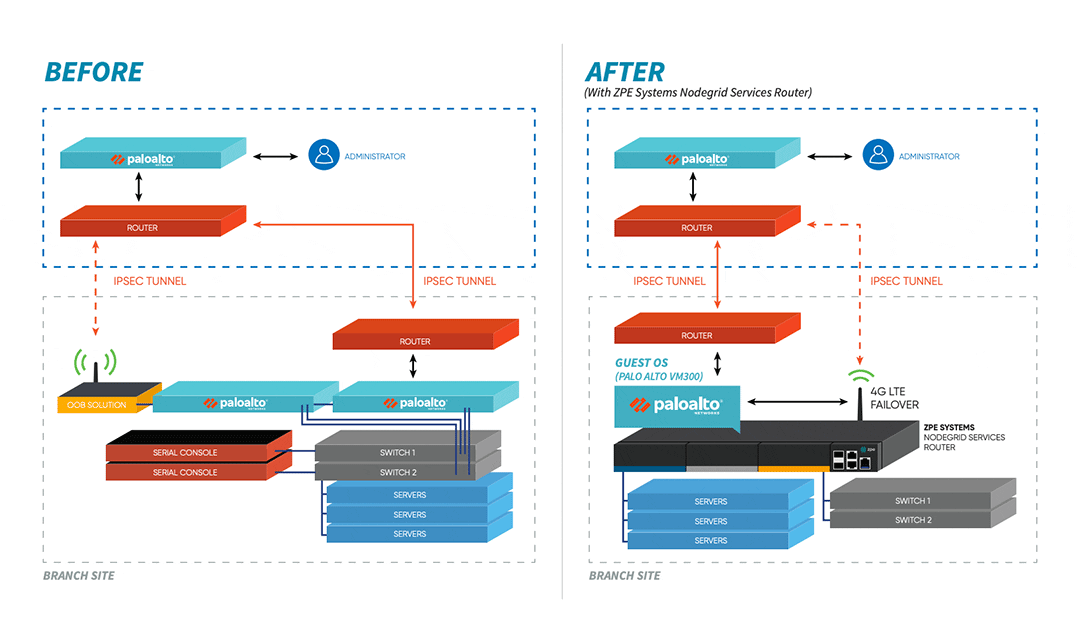
For DigiCert, every location required a large stack of essential devices. These included servers, switches, routers, out-of-band hardware, and cellular failover boxes. Managing these proved slow, as each came from a different vendor and had its own management protocols and interface. When support tickets came in, backlogs mounted as teams struggled with Mean Time To Innocence (MTTI) and root cause analyses. Licensing, updating, and maintaining their most important systems was a major time sink at the data center and branch. In short, DigiCert’s critical network infrastructure was demanding too much time and too many resources to be sustainable.

This inflated infrastructure also brought more points of failure, which were difficult to pinpoint and resolve. DigiCert lacked a centralized management solution, so they had to devote more effort to troubleshooting whether the current issue lied within a bad server configuration, an overheating device, or a faulty router.

The company also lacked peace of mind regarding remote out-of-band management access. Occasionally, support teams would be unable to troubleshoot and resolve problems remotely. This typically resulted in on-site visits to the data center, where the only solution would be to gain direct console port access to specific devices. This only added to their IT burden and grew the complexity of their operations.

How Nodegrid radically improved DigiCert’s critical network infrastructure

Eliminating critical network infrastructure complexity can seem like a daunting bridge to cross. Consolidating your physical infrastructure can be an enormous task all by itself, much less implementing centralized management and reliable out-of-band.

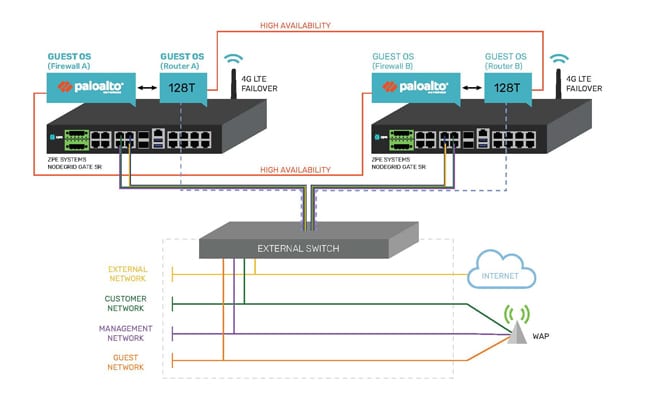
But for DigiCert, ZPE Systems’ Nodegrid and ZPE Cloud made it simple to achieve all this — while helping the company maintain an impenetrable security posture. They were able to deploy multiple services on a single Nodegrid device, which reduced their hardware footprint by a 4-to-1 ratio. They hosted their Palo Alto security solutions directly on the Nodegrid appliance, and set up 4G/LTE for connection redundancy. In total, they achieved a redundant configuration by using two Nodegrid devices at each location, instead of the 6-8 that they previously required.

To learn more about this implementation, download the full case study. You’ll explore the all-in-one Nodegrid solution that exceeded DigiCert’s requirements, slashed their workload 50%, and helped them achieve near 100% network uptime.

3 Ways Your Critical Remote Infrastructure Is Costing You

It’s easy to imagine all the ways that downtime can throw a wrench into your critical remote infrastructure operations. Things like scaling, service outages, and tedious management are just part of the job. No matter how much these stand in the way of business, there’s not much that you can do about them, right?

Not quite. In this post, we’ll explore three reasons your complex critical remote infrastructure is costing you, and how Nodegrid is the simple solution that helps you save.

If you’re short on time, here’s a two-minute video explaining how you can cut through the complexity of managing your network.

Deploying critical remote infrastructure

You’re probably familiar with long deployment times for your critical remote infrastructure. Manually provisioning and setting up networks consumes a lot of time and resources. The obvious costs here are the staff wages and device shipping expenses; however, the not-so-obvious cost is the business opportunity that you miss. The longer it takes you to deploy, the longer your location goes without meeting demand or generating revenue.

How can you minimize this cost? By using zero touch provisioning.

Zero touch provisioning uses automation to automatically configure and build your networks. Instead of putting staff on site to manually set up each device in your stack, you can instruct even unskilled staff to simply plug in and boot your devices. Zero touch provisioning does the rest of the work and can bring you online in hours.

Not all zero touch provisioning is the same, though. Most vendors only allow you to use it for their devices or products, which means unless you standardize on their offerings, you’re going to be limited in terms of what systems and services you can automatically deploy. On top of this, you still need to pre-configure devices and put sensitive info at risk, as well as perform manual orchestration and firmware updates.

This is where Nodegrid sets itself apart. Because it features the vendor-neutral Nodegrid OS, it allows you to use your choice of automation tools as well as build custom scripts to orchestrate across devices and environments. This means you can use true zero touch provisioning that extends to every part of your infrastructure — from configuring end devices from different vendors, to bootstrapping VMs, activating service licenses, and setting up your entire network. It offers airtight security as well, because you can completely provision bare-metal devices via ZPE Cloud.

When it comes to your critical remote infrastructure, Nodegrid is your go-to solution for fast, complete, and secure network deployments.

Keeping critical remote infrastructure online

How often does your critical remote infrastructure go offline? When it does, you can suffer losses at a rate of $5,000 or more per minute, according to Gartner. And this only covers the monetary portion. You also need to consider the reputation damage, degradation of trust, and decreased customer satisfaction that result from sudden outages.

If you’re familiar with redundant solutions, you know that these can be a life saver — but on the other hand, they come with two times the number of solutions that you need to purchase, deploy, and manage.

You typically need to deploy two boxes for each function you wish to add redundancy to, and connect them in a high availability configuration. In other words, two firewalls, two routers, two SD-WAN boxes, etc. All this means the initial and ongoing burden of redundancy can be…off-putting.

However, Nodegrid devices feature a powerful hypervisor that allows you to deploy virtualized network functions (VNFs). The onboard, multi-core Intel CPU and Linux-based Nodegrid OS provide you with enough resources to spin up VMs, guest operating systems, applications, and Docker containers directly on Nodegrid appliances. Instead of spending tons of money on more devices that clutter your infrastructure and management efforts, you can host firewalls, virtual routers, SD-WAN solutions, and custom and third-party solutions on one box. You can easily shrink a redundant setup of six devices into two Nodegrid boxes.

Beyond covering your network services with redundancy, Nodegrid also gives you built-in 5G/4G LTE connectivity available via two and four SIM cards, respectively. You don’t have to worry about a main line outage taking down an entire office or store location. Nodegrid automatically switches to your backup cellular connections, so you can keep critical remote infrastructure online and operations running.

Responding to critical remote infrastructure problems

It can be difficult to manage critical remote infrastructure because it’s, well, remote. You may have store locations that are very far away from any skilled IT staff. Or you may operate in an industry such as utilities or oil and gas, where you have critical components distributed across power grids or offshore drilling platforms.

Unless you have a robust remote management tool in place, you’re losing time and money responding to problems. This also means the user experience suffers and is difficult to optimize.

For your business, the losses can start to pile up even before an issue is reported. Your efforts are pulled into managing and dispatching IT teams for on-site support, while users and customers put up with poor network performance or even complete outages.

But when you use Nodegrid and ZPE Cloud, you gain in-depth management capabilities that allow you to fully support your network from a distance. You can save significantly on operational costs by reducing or eliminating the need to roll support trucks. That’s because ZPE Cloud gives you a complete view of your distributed infrastructure, and gives you convenient remote access to manage all your solutions. Use your browser to securely connect without a VPN. You can instantly troubleshoot issues and even reboot devices from thousands of miles away.

Want more tactics to help you reduce downtime?

Watch our free webinar to see how you can cut downtime 50% or more using a Fortune 500 strategy.

Secure Access Service Edge For an Oil & Gas Provider

Secure Access Service Edge is a new concept that’s transforming the edge network. SASE delivers more flexible and secure network access, so your business can adapt to drastic changes and accommodate a distributed workforce.

Want to see it in action? Here’s a 90-second explainer video to help you visualize business with SASE.

In a nutshell, SASE delivers a ton of benefits:

  • SASE combines networking and security in a cloud environment. This means you don’t have to backhaul traffic through your main enterprise firewall, which causes slowdowns and degraded performance. Instead, you can deliver safe network access directly to users, which makes it easy to connect from anywhere. At the same time, this lets your main network breathe so business can continue without interruptions or lagging network speeds.
  • SASE is identity-driven. This means network connectivity is tied to users instead of to specific devices or access points. So when changes force you to accommodate remote work or distributed staff, your IT teams don’t have to be burdened configuring countless laptops, smartphones, tablets, etc. Your workers can simply pick up and go, and connect to your network even using their own devices or public access points.
  • SASE converges network functions for secure and easy management. Accommodating a more agile edge network used to require adding purpose-built solutions to your stack. This made a nightmare out of deploying and scaling, and management became more complex because each solution came with its own UI, architecture, requirements, etc. With SASE, you can virtualize all your essential functions. This helps reduce your stack to make scaling simple, and centralizes functions so IT staff can manage your network in one place.

Why is SASE better with Nodegrid?

Nodegrid provides a SASE platform that’s unlike other solutions on the market. This owes to all-in-one devices and the 64-bit, Linux-based Nodegrid OS. With more speed and compute power, Nodegrid offers even more flexibility through virtualization, capable of running multiple guest operating systems (guest OS) and directly hosting your choice of applications.

Nodegrid also supports automation and zero touch provisioning. In order to deploy new locations, just install your Nodegrid devices, and then provisioning can be executed automatically. This significantly increases security, since you can ship 100% unconfigured devices and then provision only when they’re under your control. This also saves on deployment resources, because you don’t have to send specialized IT staff to each site for time-consuming, manual setup tasks.

How does Nodegrid deliver SASE in the real world?

A global oil & gas provider needed to streamline their edge networking solutions.

Their hardware stack consisted of many devices that were difficult to deploy and manage. This was a major hurdle for the company, considering their remote sites were very limited by physical space constraints. Additionally, support costs continued to rise and IT staff were dispatched to fix even minor issues.

The company needed a streamlined solution that was more space- and energy-efficient, and that could also maintain a high availability environment. Nodegrid was the only platform that could meet all their needs.

Want to learn how the company cut their stack in half, maintained a secure & highly-available environment, and saved on support?

Case Study: SD-Branch for a Digital Security Leader

SD-Branch delivers some major advantages over traditional SD-WAN capabilities. Where typical software-defined approaches fall short at the branch level, SD-Branch picks up the slack to help you see and do much more.

In case you need to catch up, here’s a 90-second video showing some ways you can benefit from using SD-Branch.

If you’re super short on time, the advantages boil down like this:

  • SD-Branch lets you see inside your branch locations, by combining SD-WAN, routing, security, and all your network functions
  • You can see & control on a granular level, including activity for IoT devices, cameras, laptops, & all clients on your branch networks
  • You get more operational agility with a system that centralizes your infrastructure management & lets you take control remotely

Now that you’re caught up, you might be wondering…

How does Nodegrid make SD-Branch better?

Nodegrid gives you SD-Branch capabilities and a lot more. All-in-one Nodegrid devices, like the Nodegrid Services Router (NSR), reduce your stack thanks to the ability to handle many network functions in a single box. Support for automation and containerization via tools like Puppet, Ansible, Docker, and Kubernetes takes your orchestration and management capabilities to an entirely new level. It gets even better with out-of-band management that you can use even during an outage (thanks to cellular failover). Nodegrid hardware and software are vendor neutral, too, which means you can adapt your network to your changing business needs.

Sounds Pretty Awesome. But How Does it Work in the Real World?

See What SD-Branch Brings to a Leading Digital Security Company

Cellular-Failover-Diagram

When a digital security enterprise, whose offices span the globe, needed help with their complex network infrastructure, they chose ZPE Systems’ Nodegrid. The powerful NSR solution relieved many of their branch network headaches, and even extended additional benefits to their data center operations. Their large, cumbersome stacks were replaced by a streamlined, all-in-one solution that made management easy, provided reliable backup via cellular, and leveraged the world-class security of Palo Alto Networks’ next-gen firewalls. Ready for the details?

Download the Case Study