Providing Out-of-Band Connectivity to Mission-Critical IT Resources

ZPE Systems Announces Nodegrid Serial Console Plus, a High-density, Cellular-enabled Serial Console for Datacenters and Critical Remote Locations


NSCP2
NSCP

Fremont, CA, June 22, 2021 – ZPE Systems adds to their lineup of datacenter infrastructure management solutions with the Nodegrid Serial Console Plus (NSCP). Like previous generations of Nodegrid Serial Console, the NSCP is a high-density appliance that streamlines infrastructure management at scale, now with the added benefits of built-in 5G/4G LTE cellular and Wi-Fi for increased availability. Organizations can stop juggling separate cellular and out-of-band devices, and can instead get these capabilities in one NSCP device.

Featuring up to 96 serial ports, built-in 5G/4G LTE and Wi-Fi capabilities, 2 SFP+ and 2 GbE ports, and Intel x86-64bit CPU, the NSCP gives network admins, service providers, and customers reliable, centralized management of their large-scale datacenter environments and critical remote infrastructures.

The world’s largest tech and financial companies already use the Nodegrid Serial Console Plus, and organizations implementing the NSCP can expect secure deployments using the hardware-encrypted disk; automated and simplified management that scales to millions of nodes; and increased availability through optional Wi-Fi and 5G/4G LTE backup connections from their choice of carriers.

“Nodegrid Serial Console Plus is the perfect solution for adding resilience to datacenters, colocations, and critical remote infrastructure locations,” says Arnaldo Zimmermann, Co-founder and CEO of ZPE Systems. “Our customers — including the largest companies in the world — love how easy it is to deploy one solution that gives them everything needed for refreshes or new installs. There’s no shopping for additional failover or out-of-band devices. The NSCP puts all that into a single, 1U box.”

NSCP is four times faster than the previous generation of Nodegrid Serial Console, and includes Nodegrid OS v5.2, the latest version of ZPE’s secure, Linux-based operating system.

Nodegrid OS v5.2 automates scaling with support for zero touch provisioning and containerization using Docker, Kubernetes, and LXC containers. The operating system also accommodates failover and out-of-band management through a variety of link types, including via the built-in 5G/4G LTE module. Nodegrid OS v5.2 improves upon previous releases with features that include:

  • Flexible automation via Ansible Server native integration, with support for Ansible, Chef, Puppet, Python, and RESTful scripts in addition to CLI options
  • Added security via enhanced UEFI Secure Boot with self-encrypted disk in all platforms
  • Easier extensibility via improved management of guest operating systems, NFV layer, and Docker containers
  • More traceability via geofencing, with self-guard notifications and actionable protection
  • Better connectivity via support for WireGuard tunnels, in addition to IPsec
  • Improved accessibility via new cloud applications available on ZPE Cloud

Nodegrid OS v5.2 also seamlessly integrates with the company’s management products: Nodegrid Manager, for centralized control of datacenter clusters; and ZPE Cloud, for secure, cloud-based management of distributed remote networks.

Nodegrid Serial Console Plus and Nodegrid OS v5.2 are now available. To place an order or learn more, visit the Nodegrid Serial Console Plus product page.

About ZPE Systems, Inc.

ZPE Systems frees enterprises from today’s networking challenges.

Nodegrid’s Intel-based serial consoles & modular services routers deliver power to datacenter & branch applications, while the Linux-based Nodegrid OS replaces vendor lock-in with limitless flexibility. With ZPE Cloud for fast & secure provisioning, this platform streamlines networking using virtualization, prevents downtime using automation, and offers convenience via remote management capabilities.

Intel-based serial consoles & modular services routers deliver unparalleled power to datacenter & branch applications, while the Linux-based Nodegrid OS replaces vendor lock-in with limitless flexibility. With ZPE Cloud for fast & secure provisioning, it’s the only networking platform to streamline the stack using virtualization, prevent downtime using automation, and offer convenience using in-depth remote management capabilities.

ZPE collaborates with best-in-class technology partners, to add value by integrating with SD-WAN, firewall, IoT, and other solutions. The world’s top companies trust ZPE Systems to provide advanced out-of-band management, Secure Access Service Edge (SASE) platforms, and SD-Branch networking.

Top companies trust ZPE Systems to provide advanced out-of-band management, Secure Access Service Edge (SASE) platforms, and SD-Branch networking.

ZPE Systems is based in Fremont, California with offices worldwide. Visit ZPE Systems website at
www.zpesystems.com.

Shifting Gears: How Network Automation Drove an Auto Company to the Cloud

Case Study – Moving Data Center to the Cloud

Network automation and zero touch provisioning are more than luxuries. They’re quickly becoming the powertrain of business, helping you meet growth demands and keep up with important opportunities. These technologies also prove invaluable to making sure everyday tasks don’t hold you back, regardless of the environment you’re using.

By adopting automation, you can quickly realize its time- and cost-saving benefits that transform your networking capabilities — whether you’re using a traditional client-server architecture, or a cloud-based configuration.

In this blog entry, you’ll see how Nodegrid accelerated one car company’s drive to the cloud, and how network automation helped them seamlessly shift gears.

But first, here’s a recap of network automation.

Network automation employs software to help eliminate manual management tasks. This can help with routine work, such as device discovery or firmware updates, to more in-depth processes that are part of configuration management jobs. Automation helps with every aspect of networking, including improving the test lab environment, streamlining deployments, and reducing the workload for ongoing support and maintenance.

The beauty of automation is that you can use it at any scale you like. This can mean implementing something as simple as a few workflow commands that assist with device discovery and mapping, or as extensive as automating configuration tasks for a zero touch provisioning approach.

Why are companies racing to adopt network automation?

Network automation improves business in the same way that engines improve transportation. This simple analogy highlights the benefits of automated network tasks and processes, so let’s break it down.

Without modern machines, we rely entirely on manual input to move from point A to point B. Stamina and endurance are crucial, and so is the ability to think critically in the event that unexpected adversity crosses your path (i.e. storms, injuries, bears). Even if you’re in tip-top shape physically and mentally, relatively short ventures can drag on because your input drives the entire trip. Everything seems like a marathon.

And this is how manual networking feels. Discovering devices, installing security patches, monitoring data usage, updating firmware — all these tasks and more rest on your shoulders, and it’s up to you to carry them to completion. There’s little time, if any, to do anything besides focus on your arduous (non)adventure.

When you introduce engine-driven transportation such as a turbocharged sports car or tuned up off-road vehicle, you can easily go anywhere. Your mechanized chariot of horsepower converts your most minor input into forces that lurch you toward your destination. As for your stamina, endurance, and time, you save it all — even as you power through torrential rains or traverse over rocky mountainsides.

Automation transforms networking in the same way. You no longer have to heavily focus on every task and process, and can instead set your gaze on what’s beyond the horizon.

  • Deployment — Network automation lets you automate configuration tasks and set up zero touch provisioning. This means that you can save a ton of time and money getting new sites configured and online. Instead of having staff perform extensive manual provisioning duties, you can just install your devices and let zero touch provisioning build your network automatically.
  • Support & OPEX — For ongoing network support, automation continues to deliver time and cost savings. You don’t have to manually address every patch installation, firmware upgrade, or other issue. This means fewer truck rolls and more time for staff to focus on critical business needs.
  • Maintenance — Nothing helps you maintain uptime like autonomous networking. With automation, you can set up scripts for a self healing network, and create alerts & notifications that let you know when critical issues occur.

How does Nodegrid supercharge network automation?

Network automation brings you major benefits, and Nodegrid delivers even more. That’s because Nodegrid is an open platform that lets you take advantage of automation, regardless of which vendor solutions you’re currently using. This flexible solution helps you:

  • Customize using third-party automation tools & solutions of your choice, including in-house scripts and software.
  • Extend automation and zero touch provisioning to end devices, even those that don’t support automation.
  • Control devices remotely — from anywhere — no matter which vendors or manufacturers you deploy.

Here’s how Nodegrid put an auto company’s migration on cruise control.

For a major automobile manufacturer, a private cloud network model was necessary to help them meet their business needs. The challenge, however, would be in finding a solution that could integrate with their automation-heavy environment. They also required a solution that could provide reliable and comprehensive out-of-band access to their data centers, along with tools that could support collaboration with their heavily involved NetOps & DevOps teams.

With an already fatigued IT staff, the traditional approach was a roadblock nearly impossible to pass. Manually migrating and provisioning would burn too much time and effort, and pull network personnel away from keeping everyday operations in motion.

But when the company discovered Nodegrid, they realized that they could put deployment and management on cruise control.

By deploying the Nodegrid Serial Console S Series, the auto manufacturer had a powerful engine to drive their private cloud adoption.

Download the full case study below to discover all the benefits

ZPE Systems Announces the New Edge Transformation Partner Program

Edge Transformation Partner Program

Fremont, CA, March 31, 2021 – ZPE Systems, Inc., a leading innovator of network devices and cloud-based infrastructure management solutions trusted by the world’s top companies, officially launched the Edge Transformation Partner Program. This program is designed for enterprise solution providers and integrators interested in differentiating their offering for distributed branch, edge, campus, and colocation applications.

In order to expand an already growing partner ecosystem, this program features a drastically different engagement model and incentive structure to help partners build a profitable Nodegrid practice.

According to ZPE Systems’ CEO and Co-Founder Arnaldo Zimmermann, “Together, Palo Alto Networks virtual’ firewalls and our Nodegrid SR solutions give customers a secure and streamlined infrastructure, with centralized management that puts everything in one place — firewalls, servers, routers and even power controls.”

ZPE Systems is a customer first culture, so driving partner and customer success is the cornerstone of the Edge Transformation Partner Program. ZPE Systems emphasizes partner quality over quantity, with recruiting practices based on technical competency and strategic commitment. In return, partners leverage proven differentiators for cloud and edge networking, and can deliver customers the highest ROI.

As enterprises continue to expand beyond the data center, they must retire legacy solutions and optimize performance at edge networks. ZPE Systems’ Nodegrid platform helps partners modernize customer networks, with all-in-one solutions that are easy to deploy, secure, and manage — a growing requirement at the edge. Delivering the best ROI is a top priority, and partners can unlock endless value-add opportunities using Nodegrid’s modular hardware, extensible software, and integrated ZPE Cloud platform.

Partners can take advantage of emerging, best-in-class technologies thanks to ZPE Systems’ strategic alliances. These include partnerships with industry leaders such as Intel, Palo Alto Networks, Cisco, VMware, and others who help guide networking into the future.

“Our channel strategy is to recruit a small number of solution providers and strategic partners who are interested in developing their brand and capabilities around ZPE Systems’ Nodegrid ecosystem,” says Steven Jehring, ZPE Systems’ head of Channel and Strategic Partners. “Our priority is to create the best customer experience, and our enterprise edge platform makes this simple. It enables solution providers to offer complete implementations that are fully integrated with leading technologies from our strategic partners and alliances.”

For complete details of the Edge Transformation Partner Program, or to submit an application, please visit partners.zpesystems.com.

About ZPE Systems, Inc.

ZPE Systems frees enterprises from today’s networking challenges.

Cumbersome environments, frequent downtime, and inefficient management are no match for ZPE Systems’ Nodegrid, a vendor-neutral platform that lays the groundwork for open networking. Created by visionary engineers, Nodegrid’s patented hardware, software, & cloud offerings empower companies to transform their networks into business value creators.

Intel-based serial consoles & modular services routers deliver unparalleled power to datacenter & branch applications, while the Linux-based Nodegrid OS replaces vendor lock-in with limitless flexibility. With ZPE Cloud for fast & secure provisioning, it’s the only networking platform to streamline the stack using virtualization, prevent downtime using automation, and offer convenience using in-depth remote management capabilities.

ZPE collaborates with best-in-class technology partners, to add value by integrating with SD-WAN, firewall, IoT, and other solutions. The world’s top companies trust ZPE Systems to provide advanced out-of-band management, Secure Access Service Edge (SASE) platforms, and SD-Branch networking.

Based in Fremont, California, and with offices in Ireland, India, and Brazil, ZPE Systems is ready to help enterprises take the work out of networking.

Visit the ZPE Systems website to explore Nodegrid.
www.zpesystems.com

What Is Edge Networking, and Is It the Future?

We’re entering the era of edge networking

Edge networking is critical to the future. Organizations continue to expand, and analysts predict that the data center won’t be the only workhorse when it comes to enterprise networking. In fact, some estimate that in a couple years, more than 50% of data will be generated outside the data center or cloud.

Continue reading to learn more about the edge, why it’s the future, and how you can address four key components of edge networking.

What is the ‘edge’?

The edge includes systems that are close to where end devices and third party services interact with your network. Think IoT cameras, self-service kiosks, mobile apps, POS systems, and other things that interact at the last mile of your network.

What is edge networking?

With increasing focus on the edge comes confusion. This stems from the fact that edge networking is typically seen as something completely different than edge computing. That’s because they are technically very different, even though they are part of the same space.

Think of a traditional enterprise network setup. You have the data center at the core, and then branch offices distributed across different locations.

  • Edge networking refers to the tunnels that connect these branches to each other, to the data center, and to distributed cloud service applications.
  • Edge computing means putting parts of the core, such as data processing, storage, load balancing, etc. at or nearer to these branches.

However, the lines are blurring between these two as they are increasingly implemented together. For the sake of this blog post, we’ll combine them and refer to both using one term: edge networking.

There’s a growing need for edge networking

If 2020 was any indication, you likely know firsthand about the growing need for better edge networking capabilities. You may even still struggle with recent changes. You have to make sure your widespread network can handle rapid shifts in customer demand. You also need to accommodate your staff, who are likely no longer working from centralized office locations but instead from home or on the go. Connectivity is more distributed than it’s ever been, and 2020 was a catalyst for this growing trend.

You’ve witnessed this shift in the real world and faced new challenges of traditional enterprise network configurations. This is because the legacy core-to-edge infrastructure was not designed for such widespread networking. If you haven’t already, you will eventually experience significant drawbacks if you don’t move toward more ‘edgified’ infrastructure and solutions.

  • Drawback #1: Slowdowns — Imagine peak demand at your edge locations, and then multiply that by a factor of five, ten, or more. This is what the future has in store, and your traditional setup won’t be able to handle all of this data. With so much information flooding back to the core, your data center will become inundated trying to process it all. This means slowdowns, even catastrophic failures, that can take down both the customer experience and your staff’s ability to keep operations running.
  • Drawback #2: Security breaches — The threat landscape is constantly evolving. With more edge connections comes a greater attack surface, and if you continue using traditional solutions, you’ll have to be constantly mindful of your network’s security. Vulnerabilities will present themselves with your physical devices, virtual assets, and integrations, each of which may allow for exploitation across your network. This will force you to spend monumental sums of time and money trying to protect your business and your customers.
  • Drawback #3: Obsolete solutions — Edge networking is a young market, which means edge solutions will come and go. This volatility means you’ll need a network that can adapt fast, but traditional configurations are too rigid. If you standardize with one vendor’s solutions, you’re left locked into using only their offerings. This could easily leave you with obsolete solutions that will continue costing you.

These are just a few of the reasons why you need to adopt edge networking.

What does the future hold for edge networking?

Edge networking of the future will allow you to accommodate growing, constantly evolving requirements. But if you’re supposed to move away from the traditional setup, where the core consists of data center functions and the edge simply funnels data back to the core, what will networking look like?

  • The edge will become the data center. Because there are increasing requirements for responsive edge experiences, processing will be placed near or at the edge. This will allow you to relieve your data center while optimizing distributed connections for customers and staff.
  • Security will be built in. With an ever-growing network, you’ll have to accommodate more connections. Protecting your business and customer data will involve implementing security from the ground up. This will mean deploying hardware and software that will come with more built-in safeguards, and that will allow you to implement thorough protection through Zero Trust Security practices.
  • You’ll be more adaptable than ever. A volatile solutions market will force you to continually adapt. The firewall that’s perfect one day might be obsolete the next, and the same will be true for SD-WAN, management, machine learning, and other solutions. The key to this flexibility will be in having an infrastructure that emphasizes extensibility and software-defined networking.

Do you want a head start on the future of edge networking?

Download our ebook, The Future of Edge Networking, and discover four ways you can achieve the network of the future.

Investing in Out-of-Band Management to Reduce Risks

Case Study – Investing in OOB – Thumbnail 2

In the finance industry, network modernization protects the most confidential customer data. Whether for processing minor withdrawals & deposits, or recording asset transactions & real estate purchases, your network must be secure and reliable from the ground up. This is one of the biggest obstacles when trying to modernize.

Using traditional solutions forces you to overhaul your infrastructure and disrupt your business, or endure a very slow, piece-by-piece implementation. Either approach requires plenty of time, money, and resources. And without careful planning, you may end up with a solution that becomes obsolete sooner rather than later.

In this post, you’ll see why you need to focus on network modernization, and how it helped one of ZPE Systems’ finance customers protect their data.

What is network modernization?

Network modernization means updating your infrastructure and management tools, so that you can address current challenges and future requirements. This approach allows you to get the most out of your legacy solutions, while setting up a foundation that can help you adapt to change. Network modernization involves at least one of the following:

  • Deploying a solution that integrates in-depth control of legacy and modern systems
  • Eliminating points of failure using more resilient systems and streamlined architecture
  • Adopting extensible software or hardware that can accommodate changing needs

Why focus on network modernization?

When you adopt an approach that focuses on network modernization, you can realize many benefits even into the future. The most important thing to understand is that the more you modernize, the more benefits you’ll see. For example, if you focus solely on deploying new hardware, you may experience advantages at the onset but eventual diminishing returns without modernized software. And if you implement only newer software, you’ll run into the same issue due to the limited capabilities of your legacy hardware.

Network modernization is a multi-faceted concept, but comes with many benefits:

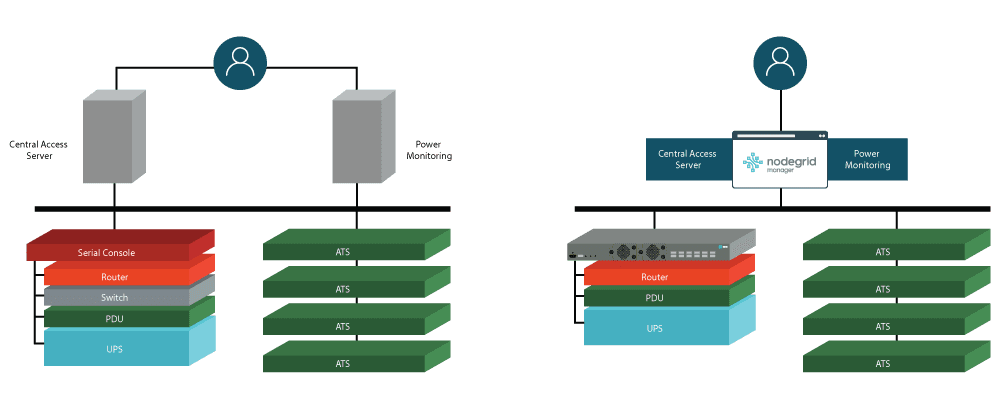
  • Using powerful, multi-function devices helps you save on deployment costs & efforts. You can replace many purpose-built appliances with a single box. This shrinks capital & shipping expenses, streamlines setup, and makes ongoing management much simpler.
  • Using an in-depth software solution for management helps you save on support expenses. You can control your legacy systems and extend functionalities to them, while giving IT teams remote access to your infrastructure layer. Instead of training on many UIs and dispatching technicians to troubleshoot issues, modernized software lets you control everything seamlessly from afar.
  • With an extensible solution, you get peace of mind knowing you can adapt to future requirements. Demands will continue to evolve (especially at the edge), and a flexible platform helps you accommodate changes. This could mean implementing the latest SD-WAN solutions, deploying compute power at the edge, or further reducing hardware stacks to meet business goals.
Finance-Diagram

Network modernization helps a large financial firm

A major financial institution began to see weaknesses in their legacy system, and they knew that modernization was the solution. Their traditional infrastructure employed too many disparate systems that were difficult to manage, even to maintain everyday operations. Security and compliance issues were also developing, and to top it off, they would need to implement a new solution by taking a gradual approach.

For out-of-band management, they were using too many devices at the rack level. Their management solutions also lacked the ability to give them control over all their systems. Their servers and automatic transfer switches required separate gateways, which increased response times and made support difficult to manage.

So how were they able to replace these headaches with an efficient, cost-saving network? They used Nodegrid hardware and software to achieve a comprehensive network modernization solution.

For full details, read the case study.

Why You Need to Adopt Edge Networking

What does edge networking mean to your enterprise? Does it mean fast service delivery to hundreds of remote locations? Or smooth networking & security for your work-from-home staff?

When your organization uses strong edge networking capabilities, you can adapt well into the future no matter how much you need to scale. This allows you to save time & money, allocate resources efficiently, and provide reliable connectivity across your enterprise.

Click the link below to hear John Paul Kang, one of ZPE Systems’ Solutions Architects, discussing edge networking and the benefits it brings to business.

Edge Networking Podcast-1 400×250

If you’re short on time, read this post for a glimpse of what’s in the podcast.

What exactly is edge networking?

Edge networking is how distributed locations connect back to an enterprise’s main systems.

Traditional enterprise network setups employ a main data center, which is at the core of the network, and then distributed locations, which are at the edge. Edge networking refers to the systems and infrastructure that connect these edge locations back to the core.

If you think about a centralized network, the edge is what is located at the fringe or periphery.

Is edge networking different from edge computing?

Absolutely.

Again, looking at a traditional, centralized enterprise network, you can see that all of the computing and storage happens at the core. This core is what processes all of the information, including everything that comes from the enterprise’s edge networks.

Edge computing, however, is essentially distributing some of the core’s processes to the edge, in order to alleviate the core’s workload. Instead of having all computing workloads, application services, and data storage take place at the core, these processes (or parts of them) are handled near the edge. Once the edge computing systems process the information, it’s then the job of edge networking to transfer the information back to the core (if necessary).


Use edge networking & computing to overcome challenges

Edge networking brings a lot of benefits to the business, and it’s easy to understand why organizations are evolving their edge capabilities. The easiest way to realize its advantages is by comparing it to the conventional methods of centralized networking.

In traditional network configurations, you put a lot of strain on your core systems. This is because you have to backhaul all of your edge traffic to the core for processing. The results? Bottlenecking, slowdowns, and increased risk of bringing your network (and business) to a standstill.

Just imagine you and some friends using a funnel to fill a bucket with marbles. To represent traditional networking, all of you would essentially put your marbles into the same funnel. This would lead to plenty of waiting and likely cause a jam or stoppage, which would require you to manually troubleshoot and fix.

But with better edge networking, you can decentralize and redistribute your workload. Using this cloud-based model, you no longer need to backhaul traffic or bog down your core systems. You can move your critical networking and security functions to the edge. Paired with edge computing, you get more balanced workloads and efficient bandwidth usage for faster speeds, more responsiveness, and improved performance across the board.

Back to the bucket of marbles analogy. To represent better edge networking, you would not only have a single funnel at the core, but also individual funnels around the periphery. Instead of dumping all the marbles into the center, you would be able to take advantage of the outer funnels to achieve a more efficient system free of frequent stoppages.

Having better edge networking capabilities means you can overcome a lot of the challenges of a centralized system.

Edge networking comes with some obstacles

Implementing more robust edge networking isn’t without hurdles. You’ll need to face a few challenges associated with:

  • Physical distance — It can be difficult to put people and equipment on site when locations are isolated. This becomes increasingly challenging when you have very remote branches.
  • Staff limitations — Response times can drag on for days or weeks depending on the staff (or lack thereof) you have. You may have very few skilled IT team members on site, or even none at all.
  • Accessibility & downtime — Edge networks can be incredibly difficult to access, which means downtime comes with more risk and potentially severe consequences.

Get over these obstacles using new technologies

To improve your edge networking capabilities and get past the inherent challenges, use some of the latest and most innovative technologies:

  • Secure Access Service Edge — SASE puts networking and security in the cloud, so you can give your workers reliable network access even from thousands of miles away.
  • Zero touch provisioning — Use this in conjunction with the cloud, and you can significantly decrease the need for any staff presence at your remote sites. Zero touch provisioning uses automation to help scale and provision without manual input, and with the cloud, you can respond instantly to troubleshoot issues, perform configuration management tasks, provision, and more — no matter how far away you are from the site.
  • Remote out-of-band — If you deploy a comprehensive out-of-band management solution, you get peace of mind knowing that you can access your sites with ease. Use a solution that lets you achieve redundancy through connections like broadband, cellular, satellite, and others, and that also gives you in-depth control of your branch networks.

Want to learn more about the edge? Browse our blog
Take a look at some of our other posts to learn more about edge networking. Get a closer look at SASE, zero touch provisioning, and remote out-of-band, and see how you can strengthen your edge capabilities.