Providing Out-of-Band Connectivity to Mission-Critical IT Resources

Maintain Uptime With a Reliable Data Center and Business Continuity

The data center and business continuity — these go hand-in-hand, as one relies so heavily on the other. Because your data centers are mission critical, an outage can bring down your network and your business. But taking control of your data centers can be more than a hassle, especially if you use traditional out-of-band management (OOB) solutions.

In this article, you’ll explore some major shortcomings of common OOB, how they interfere with business continuity, and what ZPE Systems’ Nodegrid does to restore your peace of mind.

Challenges Involving the Data Center and Business Continuity

You Need to Stay Close.

For network maintenance and management, traditional out-of-band solutions force you to keep staff close to the data center. Not only is this because you need to perform routine tasks, such as monitoring power or opening shells for customers, but also because you need a reliable response in the event that your network faces major disruption. Otherwise, issues can result in you spending sums of time and money to put staff on-site, sometimes requiring late night wakeup calls and expensive round-trip airfare.

You Need Many Devices.

Rack space and energy consumption are at a premium when it comes to data center computing. But by nature, data centers require many appliances just to handle all necessary functions. Introducing OOB management typically involves adding even more devices, which steals more rack space, power, and money from your business. And with traditional OOB solutions, you usually end up with a rigid and complicated system that makes your job that much more difficult. Resolving most issues involves a lengthy administration protocol due to your enormous stack.

You Need Lots of Time.

When scaling and managing via traditional OOB solutions, time isn’t on your side. To deploy a new location, you need to risk shipping preconfigured devices that contain sensitive configuration data. Once you pass this first hurdle, you then need to put staff on-site to manually set up these devices, which can take weeks. Finally, your ongoing management of data center infrastructure involves juggling many vendor-specific consoles and interfaces. If you need to make quick adjustments or pinpoint a failed device, you’re forced to invest more time navigating a complex stack.

Nodegrid Improves Management of the Data Center and Business Continuity

Restore Uptime From Anywhere.

Nodegrid lets you untether staff from the data center’s physical location, and instead gives them the freedom to perform tasks 100% remotely. When you need to adapt to sudden work-from-home guidelines, or restore connectivity after a 3am outage, Nodegrid lets you thanks to flexible out-of-band management. It uses broadband links and 4G/LTE cellular to provide you with more speed than traditional OOB solutions, and you can even take control fo power management. No more midnight flights just to reboot devices — cycle power remotely and rest easy.

Save space and power

Nodegrid’s consolidated devices address the data center’s need for less — less occupied rack space, and less consumed energy. The all-in-one appliances handle network, compute, storage, and power functions, and also feature a blazing fast x86 64-bit architecture that supports direct third-party application hosting. For out-of-band management, you can connect via many common serial or digital interfaces, and even get a reliable cellular connection for backup. Nodegrid’s efficient devices free up rack space, consume less energy, and help you resolve issues faster.

Scale and manage fast

Nodegrid makes scaling quick and easy. With patented, all-in-one devices, cloud-based flexibility via ZPE Cloud, and Nodegrid Manager software, you can deploy and manage in minutes. Instead of shipping sensitive devices to your new location, you just need to send a bare-metal Nodegrid appliance. Once it’s safely at your new data center, simply plug it in and watch it work. ZPE Cloud delivers zero touch provisioning that’s secure, automatic, and consistent. For ongoing management, use this cloud connectivity coupled with Nodegrid Manager to get a full, in-depth view of your network infrastructure. Alerts and notifications pinpoint potential issues, and you can employ automation tools via Ansible, Puppet, Chef, and others for self-healing and repair.

Nodegrid keeps you secure with two-factor authentication and single sign-on. For added convenience and improved management, Nodegrid also comes with a screen- and session-sharing feature that lets you collaborate with others in real time. You can team up with your experts to find and fix issues fast.

If you want to see Nodegrid’s next gen out-of-band solution for the data center, schedule a demo now.
How One Unified Platform Gives You More Control Over Branch Networking,

Branch networking comes with its own set of challenges that can get in the way of normal operations. As a network engineer, you’re tasked with preventing business disruptions while simultaneously scaling, troubleshooting, and managing network connections. This can be a daunting challenge that may lead to slow deployments, inevitable downtime, and unoptimized connectivity.

The good news is, Nodegrid was built from the ground up to address these major concerns with branch networking. Read on to see how our branch-in-a-box solution helps you scale, troubleshoot, and manage with one innovative system.


Make Branch Networking Easy to Secure and Scale

Consider the common challenges of scaling and adding branch locations to your enterprise network. You’re typically left to ship preconfigured devices to each site, which not only adds more time and cost, but more risk as well. What if these preconfigured devices get lost or end up in the wrong hands? Because they contain user accounts, passwords, and other sensitive information, having these devices get lost or stolen puts your network at greater risk of attack.

Once your devices successfully reach their destination, the real work begins. You need to manually set up all appliances at the location, which involves logging into each individually and making appropriate configurations. This takes even more of your time and money, and leaves you open to potential setbacks that can occur due to human error. What if your compliance documentation contains a mistake, or your IT personnel unknowingly repeat an error while deploying 10, 20, or even 50 new sites?

Nodegrid was made to address these concerns of security and scalability. Nodegrid appliances consolidate network functions, sport Linux OS for third-party application hosting, and feature ZPE Cloud connectivity.

When adding a new branch location, you don’t need to ship anything preconfigured. Ship bare-metal Nodegrid devices, which eliminates the threat of having your data lost or stolen, and simply plug them in. Zero touch provisioning means all configuration data can be automatically downloaded from ZPE Cloud, only when your devices are safely at their destination. This capability is even extended to devices that you connect to Nodegrid appliances.

Suddenly, backdoor security threats are no longer an issue, and neither is costly human error, since all your branch locations can be deployed consistently via the cloud.


Pinpoint Problems for Better Troubleshooting

Face it — troubleshooting issues could be a much more intuitive undertaking. But it’s difficult, mostly because of the sheer number of devices you deploy at each location. When something goes wrong, you probably refer to your spreadsheet that shows specific device information for each branch. From there, you might run through troubleshooting protocols to narrow the list of potentially problematic devices and what the issue might be, and then you can finally work toward a solution.

Nodegrid does away with all the hassle, because it uses consolidated devices and Nodegrid Manager software that pinpoints problems for you.

Nodegrid devices are powerful, featuring x86 64-bit architecture that accommodates third-party application hosting for cyber security, SD-WAN, firewalls, and more. For switching, routing, and computing, you need only a single Nodegrid device. This reduces potential points of failure so you can solve issues easier. On top of this, Nodegrid Manager is software that gives you a complete view of all your network-connected devices. It features alerts and notifications that let you know of problems before they occur. Together, Nodegrid’s hardware and software make it simple to pinpoint issues and prevent downtime.

Manage Using one Intuitive Platform

With many devices at each branch location, it’s likely that your hardware stack includes multiple vendors. This is part of achieving a right-fit solution for your enterprise, which can serve you well when looking at the bigger business picture.

But when you get down to the details of managing branch networking, this mishmash of vendors can be a nightmare. Each device has its own OS and interface, which can exhaust your staff. You need to spend time and money training them to become proficient with each. Still, even your best experts can become quickly fatigued when they’re forced to transition from device to device, interface to interface, protocol to protocol, and so on.

One of the best parts about Nodegrid is that it answers the question, “What if it could all be done using one tool?” That tool is Nodegrid Manager.

Nodegrid Manager shows you every device connected to your Nodegrid appliances, and features Guest OS that gives you total out-of-band control regardless of vendor. With one intuitive interface, you can control your entire infrastructure, get deeper visibility and insight into your network, and even extend features to bridge gaps between devices. It can all be done remotely as well, so you can manage and optimize your branch networking no matter where you are.

If you want a first hand look at all these benefits and more, schedule your Nodegrid demo today!


3 Reasons Why Your Business Needs Out-of-Band Management

Tech Brief - Out-of-Band Management 101

Out-of-band management is an essential tool that should be part of your business continuity strategy.

But What Exactly is Out-of-Band, or OOB?

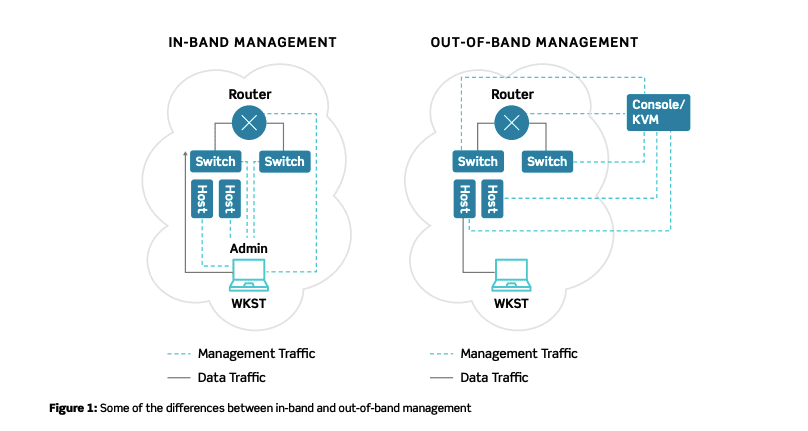
Your network is comprised of many devices and solutions, and it allows your organization to carry out normal operations. To gain access to your hardware and infrastructure, you typically might use an in-band connection, which relies on the production network.

Out-of-band management uses a completely separate network that’s dedicated strictly to managing infrastructure. So if you need to reboot a router, collect data for regulatory compliance, or adjust QoS settings due to traffic changes, OOB makes it possible — even if your production network is down.

IT admins across the globe love OOB for its exclusive connectivity and extended capabilities. See for yourself with these 3 reasons why your business needs out-of-band management.

Here’s a brief look at how OOB helps keep your network up and running from anywhere.

Network Infrastructure Diagram - In-Band vs. Out-of-Band

Restore Uptime Fast From Anywhere

One of the biggest benefits of OOB is that it gives you the ability to restore uptime faster.

Think about this scenario: on the other side of the world, one of your most isolated sites loses connectivity. If you don’t have OOB, you need to troubleshoot on-site, which means finding the right support staff, spending time & money on travel, and making a host of other arrangements — all while the site continues to suffer from downtime. To add insult to injury, what if the fix is as simple as rebooting a device? You spent thousands in support costs and lost uptime just for someone to flip a switch.

Out-of-band management gives you remote control of your devices, which allows you to troubleshoot from anywhere and resolve issues without being on-site. And if you choose a complete solution, like ZPE Systems’ Nodegrid, you can even cycle power from thousands of miles away.

Get Unified Control of Our Network

To manage your infrastructure without OOB, you need to juggle many interfaces, protocols, and UIs specific to each device. This can require you to invest loads of time and resources into support, considering you need to train staff on how to use the different pieces of your infrastructure.

But with OOB, you can remotely manage everything with one tool. Support staff won’t get overwhelmed or fatigued switching from device to device, and instead can easily control it all from one platform — whether it’s networking, compute, storage, or power.


Manage More Functions

Hardware consolidation is on the rise, which means fewer devices are responsible for controlling more functions. Routing, switching, serving, and more are being crammed into single appliance offerings. This is great for boosting efficiency and reducing your footprint. But with everything, there’s a tradeoff.

In this case, issues can have a greater effect on your network and take down several functions at once. If one of your consolidated devices fails and you don’t have out-of-band, you need on-site staff who can troubleshoot issues across the board. However with out-of-band management, you can troubleshoot and control all your network functions and applications remotely using a single tool.

Did you know: OOB lets you put your best people on the job, no matter how far away they are from your network devices. And with a solution like Nodegrid, you get screen- and session-sharing features, so your top experts can collaborate in real time to keep your network running.

Overall, out-of-band management supports business continuity by giving you more control over your network infrastructure. It helps you quickly recover from and prevent downtime, gives you one simple tool to make management easy, and puts you in charge of all your network functions.

Download the Tech Brief


How Network Automation Improves Out-of-Band Management

Business Continuity: Why Better Networking Helps you Weather the Storm

The Role of Out-of-Band Management

Even with an adequate out-of-band (OOB) management path established, managing your network infrastructure can still leave you wanting more efficiency across the board. The good news is, network automation can help you improve your OOB operations, and ultimately your business continuity efforts.

Here’s a brief look at how network automation helps you do away with loads of busywork and lets you scale with ease.

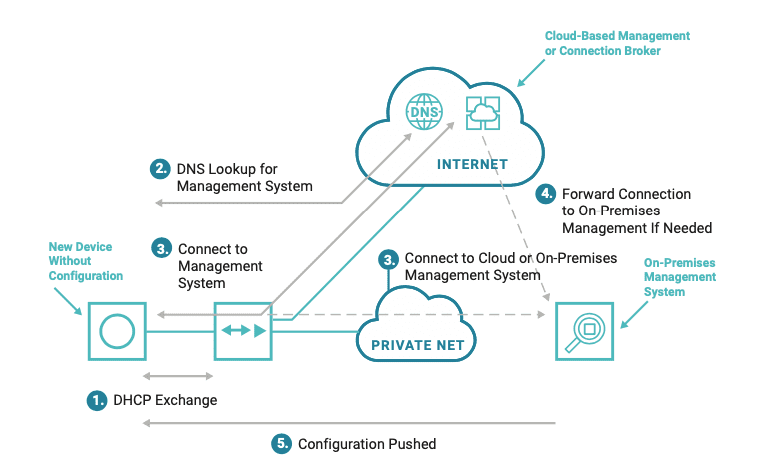
How Zero Touch Provisioning (ZTP) Works

Network Automation Streamlines Business

Nearly 50% of organizations plan to make investments in network automation. The biggest benefits it brings to the table is that it helps streamline processes and fosters more autonomous networking.

Your IT professionals undoubtedly spend plenty of time and effort performing repetitive tasks and manual procedures. These can include routine updating, patching, and data logging, or more involved processes like provisioning resources for new employees.

By introducing network automation to your out-of-band management solution, you can become more efficient and productive with tasks that are completed on their own.

  • Automated, error-free workflows perform tasks faster and eliminate human error.
  • Downtime can be prevented with automatic health monitoring and self-healing.
  • You can standardize compliance by automating policy enforcement and management.

Not only does network automation streamline processes to free up staff for more critical needs, but it also allows for more autonomous networking. With the right orchestration tools, you can introduce programmatic behavior to support network activities like load balancing and provisioning.  Instead of involving staff in these activities, which can be inefficient and pose the risk of human error, automation can handle the job quickly and consistently.

You no longer need to keep pulling critical personnel into these tasks, because automation keeps your networking running like a well-oiled machine.


Zero Touch Provisioning Makes Scaling Easy

Scaling can be a challenge without automation. Typically, you need to manually configure devices for deployment, which can leave you open to security threats, repeated human errors, and unreliable provisioning. It doesn’t matter whether you’re expanding your operation by adding 10 sites or 100 sites — having to manually deploy each location increases the potential for error, which can have major consequences now or in the future.

But thanks to zero touch provisioning (ZTP), scaling is secure, consistent, and accurate.

ZTP involves scripting and automation that allow devices to be configured automatically. Developing and testing ZTP in a lab environment is crucial to fine tuning before putting it into play on production networks. This, however, is one of the strengths of automation. It allows you to ensure that your scripts are set up correctly, and then you can deploy quickly and consistently at scale.

ZTP is typically performed for data center locations, however ZPE Systems offers ZTP via the cloud for deploying remote sites and branch offices.

Download the Tech Brief

The Role of OOB Management – Today and into the Future

In this 5 1/2 minute video Scott D. Lowe, CEO of ActualTech Media, talks about the importance of Out-of-Band Management to keep organizations’ IT up and running from anywhere even when your IT team isn’t available. He talks through some of the benefits of automation in OOBM and how using an alternate communications path enables functions to engage more quickly and precisely resulting in:

  • Reduced complexity of network infrastructure, increasing efficiency, and shortening deployment times
  • Improved business continuity as consistent higher levels of service are delivered and failures are detected proactively
  • Greater business agility by expediting time to market when deploying new applications and services, improving ROI

He touches on how network automation supports programmatic behavior of network activities, which is on the forefront of AI, machine learning, IoT, and advanced data analytics. Zero touch provisioning provides speed, accuracy, scalability needed for legal and regulatory compliance. OOBM is helping organizations provide a consistent and coherent view of their network health, stability, and performance.