Providing Out-of-Band Connectivity to Mission-Critical IT Resources

Home » Minimize Impact of Disruptions » Data Center Resilience

Enhancing IT Operations with AI and Out-of-Band (OOB) Management

Thumbnail – Enhancing IT Ops with AI & out-of-band

You don’t really understand your infrastructure until it stops responding.

Not when dashboards are green or when alerts are quiet. But when you lose access to a core device, the network path disappears, and suddenly all your “tools” depend on the very thing that just failed.

That’s the moment most traditional IT operations fall apart.

Over time, I’ve realized that two things fundamentally change how you operate in those moments:

AI that helps you understand what’s happening, and Out-of-Band (OOB) access that lets you actually do something about it.

Individually, they’re useful. But together, they completely change how you operate.


The Reality of AI: Visibility Without Access is Useless

AI has made huge strides in IT operations. It can analyze logs faster than any human, correlate events across systems, and surface issues you might not catch until it’s too late.

But there’s one big problem no one talks about enough: insight doesn’t fix outages.

You can know exactly what failed, and still be locked out of the device you need to fix.

That’s where OOB comes in. OOB gives you a path that doesn’t depend on the production network. When everything else breaks, it’s the one door that still opens.

And when you have both intelligence and access, you stop being stuck even when these worst-case scenarios happen.


Where AI Shows Up In My Work

In my role supporting IT infrastructure and network operations, the combination of AI and OOB directly improves how I manage incidents, maintain systems, and ensure business continuity.

1. When Something Breaks and You Don’t Have Time To Guess

Most incidents start with a lot of noise. Alerts pile up, metrics spike, and the systems all tell different stories.

AI helps cut through that noise and chaos. It highlights what’s abnormal, correlates signals, and points you in a direction that’s useful.

Then, instead of trying to reach a device through a broken network path (or waiting for someone on-site), you can go straight in through the out-of-band path. You don’t have to put up with delays or workarounds. You see the issue and you act on it right away.


2. When The Network Is Down – And That’s The Whole Problem

This is the scenario that exposes every weakness in traditional remote access. VPNs fail, jump hosts become unreachable, and monitoring tools go dark.

Suddenly, you’re blind and locked out at the same time.

With OOB, that doesn’t happen.

You still have direct access to your routers, switches, firewalls, and servers, because your management path isn’t tied to the outage. That means you can:

Out of band management for MSPs and remote recovery

Now layer AI on top of that.

Instead of reacting manually, you can trigger recovery actions based on known patterns. The system identifies the issue, and you either validate or let automation handle it.

That’s what makes the difference between minutes and hours.


3. When Alerts Become a Problem

At scale, alerts are their own kind of outage. So many can come in, make too much noise, and become easy to ignore or shift way down on the priorities list.

AI helps filter out what actually matters. It learns patterns, reduces false positives, and prioritizes what needs attention now.

That by itself is valuable. But combined with OOB, it becomes actionable.

You’re getting alerts that matter now, and a way to immediately respond to them regardless of the network’s state.

That changes how teams operate under pressure.


4. When You See The Failure Coming

Some of the best outages are the ones that never happen.

AI is getting better at spotting early signals, like hardware behaving slightly off, configs drifting, and performance degrading in subtle ways.

Little problems you wouldn’t normally catch until they turn into really big problems.

With OOB access, you don’t have to wait. You can step in early to:

  • Validate configurations
  • Apply patches
  • Fix issues before they impact production

And you can do it without disrupting live traffic. That’s where operations shifts from reactive to intentional.


5. When Security Incidents Get Complicated

Security events don’t follow clean paths. If a system is compromised, your primary network might not be trustworthy anymore. Access could be restricted or intentionally cut off.

That’s where OOB becomes more than a convenience. It becomes your control point.

You can isolate systems, investigate directly, and respond without relying on potentially compromised infrastructure.

AI helps detect the threat.

OOB gives you a way to contain it.

Without both, response slows down and risk increases.


The Shift Most Teams Don’t Plan For

Teams like to assume their tools will be there when they need them. Why wouldn’t they be, right?

But outages don’t work like that.

The very systems you depend on, like monitoring, remote access, and automation, often rely on the same network that just failed.

That’s the blind spot, and that’s what AI and out-of-band solve.

  • AI improves how you understand problems
  • OOB ensures you’re never locked out of fixing them

When you combine the two, you stop operating in a reactive loop of:

Detect Wait → Recover

And move toward:

Detect → Access → Resolve (immediately)


What You Can Do: Build Your OOB Network

After enough outages, you start to see the pattern. It’s not about having better tools. It’s about having tools that still work when everything else doesn’t.

AI helps you see what’s happening faster and more clearly. OOB ensures you’re never cut off from the systems you need to fix.

Together, they make IT operations resilient in the moments that actually matter. And those moments are the ones people remember.

Here are some helpful resources to start building your out-of-band network.

Get In Touch With Us!

If your environment depends on high uptime, fast response, and remote visibility, Nodegrid is the solution that incorporates AI with out-of-band management.

Use the form below to contact us and let’s talk about your network resilience goals.

How to Overcome the Top Network Failure Scenarios That Break MSP Remote Access

How to Overcome the Top Network Failure Scenarios

Managed service providers rely on remote access to keep customer environments running. VPNs, jump hosts, and centralized access tools make it possible to manage infrastructure across dozens or hundreds of sites without leaving the operations center.

But during outages, these tools can become part of the problem. When remote access depends on the production network, even routine failures can cut off the access engineers need to fix issues. What should be a quick recovery turns into a prolonged outage that requires on-site intervention.

Here are some of the most common failure scenarios MSPs face, and a look at the architecture that helps overcome them.


Routing Failures

Many routing failures stem from human error. According to 2025 research from the Uptime Institute, almost 40% of organizations suffered a major outage due to human error in the last three years. If a core router experiences a misconfiguration, control-plane crash, or routing instability, the network paths that connect engineers to the environment may disappear entirely.

Common examples include:

  • BGP route leaks or policy errors that remove upstream connectivity
  • OSPF adjacency failures that break internal routing between segments
  • VRF or VLAN misconfigurations that isolate management subnets
  • Routing table corruption during firmware upgrades

In these situations, VPN sessions drop immediately because the path between the engineer and the VPN gateway no longer exists. Worse, the router responsible for the failure may be fully operational from a hardware perspective and all it needs is a configuration correction. But engineers can’t gain remote console access to make this correction.

What should have been a 30-second configuration rollback becomes a multi-hour recovery effort.


Firewall Policy Errors

Firewall misconfigurations are one of the most common causes of remote access loss. Modern firewalls enforce highly automated policies through orchestration systems, policy templates, or automated compliance updates. These systems are great for consistency, but they introduce new failure modes.

A few examples include:

  • A security policy update accidentally blocking VPN management traffic
  • A zone-based firewall rule preventing internal device access
  • A NAT configuration error breaking inbound VPN connections
  • An automated policy sync overwriting existing allow rules

A lot of times, the firewall itself remains online and functional. The only issue is a misconfigured rule. Because the firewall sits directly in the remote access path, it becomes unreachable (just like the router we mentioned in the previous example). Engineers may be able to confirm the outage through monitoring systems, but without access to the firewall CLI or console, there is no way to correct the configuration remotely.


WAN or ISP Outages

Many MSP environments rely on customer WAN circuits to provide remote management access. Failures on these circuits cut remote connectivity regardless of the health of the internal infrastructure. Fiber cuts, for example, are one of the most common causes of outages that last 48 hours or longer.

Common scenarios include:

  • Carrier fiber cuts (looking at you, backhoe operators 😜)
  • Last-mile circuit failures at branch locations
  • ISP routing incidents causing upstream blackholing
  • DDoS mitigation events that disrupt inbound traffic


Backhoe Excavator

Image: Behold, the natural predator of fiber cables.

Customer networks may still be operating internally. Devices are running, servers are responding, and monitoring systems might still be collecting metrics locally. But engineers outside the network have no path into the environment. Even simple recovery actions like restarting an edge router or verifying a routing table may require on-site access.


Authentication Infrastructure Failures

Jump host environments depend on centralized authentication systems such as Active Directory, LDAP directories, or identity federation platforms. When these go down, engineers get locked out of their own management infrastructure.

This can happen due to:

  • Active Directory replication failures
  • Expired domain controller certificates
  • LDAP service crashes
  • Identity provider outages affecting SSO login flows

Engineers can probably still reach the jump host in these scenarios, but they can’t log in because authentication fails. The result is the same: engineers can see the problem, but they can’t access the systems required to fix it.


DNS and Management Service Failures

Another subtle failure mode occurs when core infrastructure services degrade. Many management environments rely on DNS resolution, certificate validation, or internal service discovery mechanisms.

If DNS services fail or management service endpoints become unavailable:

  • Jump hosts may not resolve device hostnames
  • SSH connections fail due to certificate validation errors
  • Automation platforms lose connectivity to managed infrastructure

The devices themselves may still be reachable, but the tools engineers rely on stop working.


The Pattern Behind These Failures

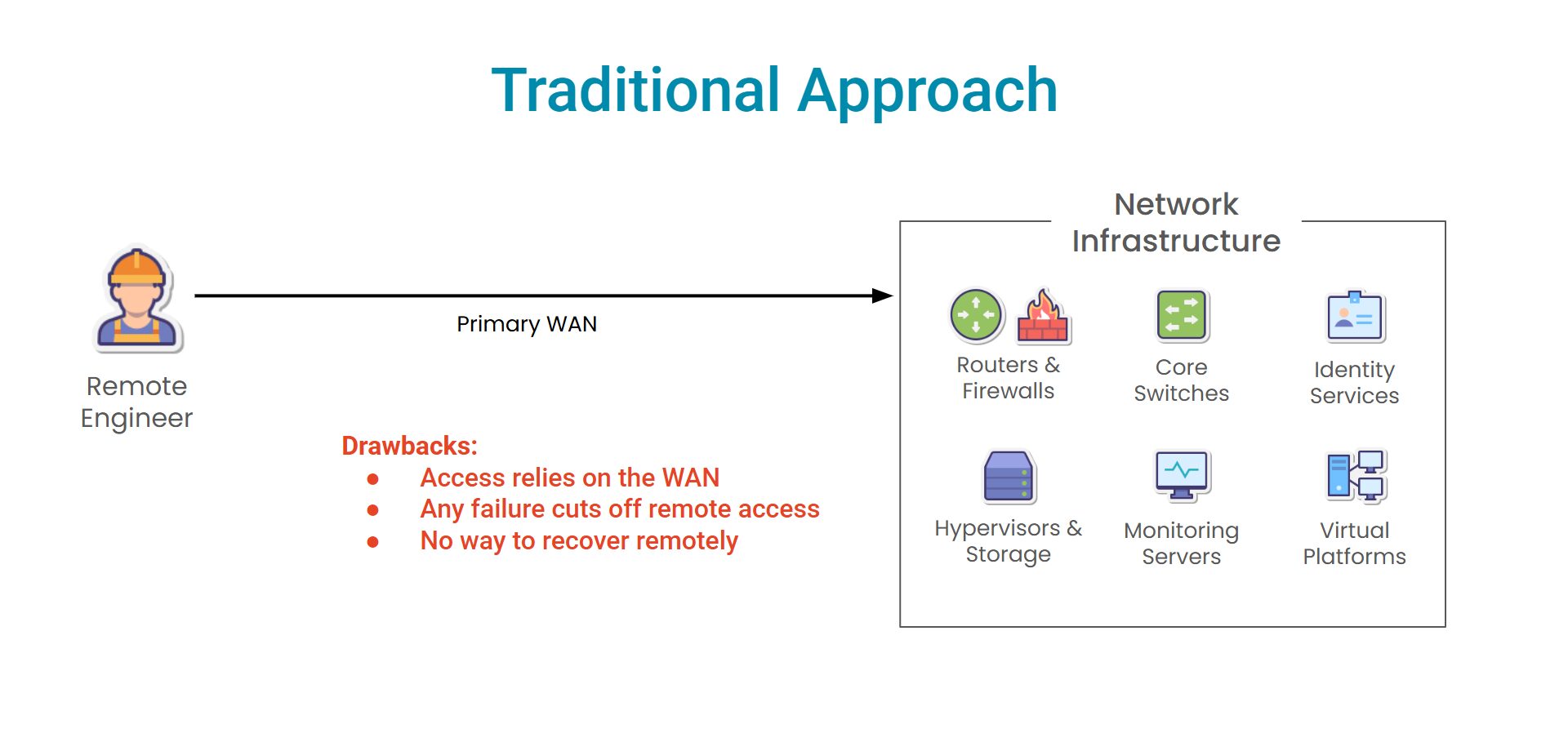
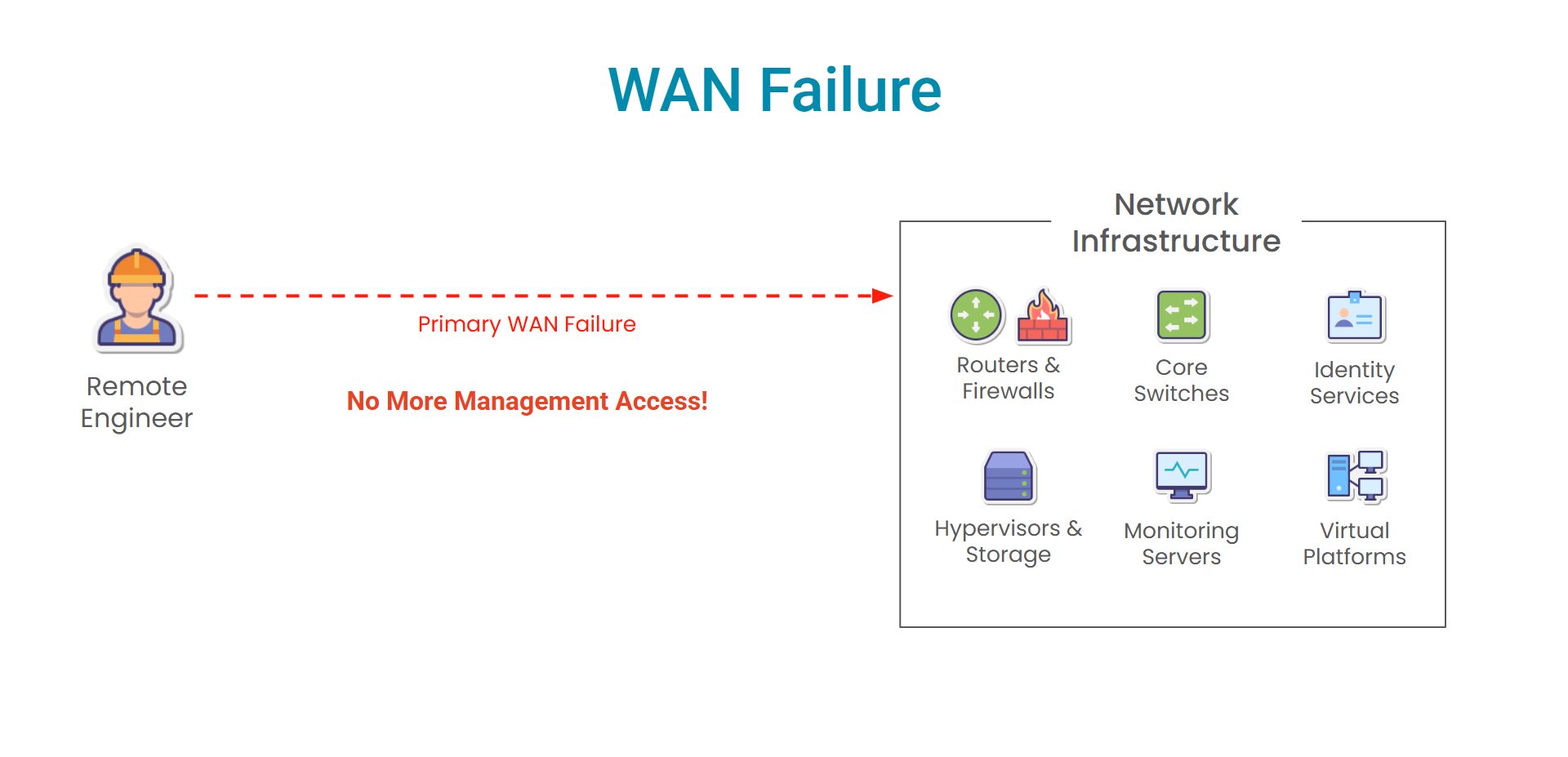
These scenarios might seem unrelated, but they all share the same root issue: remote access depends on the production network.

When that network fails, whether due to routing, security, WAN, or service issues, engineers lose the ability to reach the infrastructure they need to fix. That’s when recovery slows down, truck rolls and labor costs increase, and SLA risks rise.

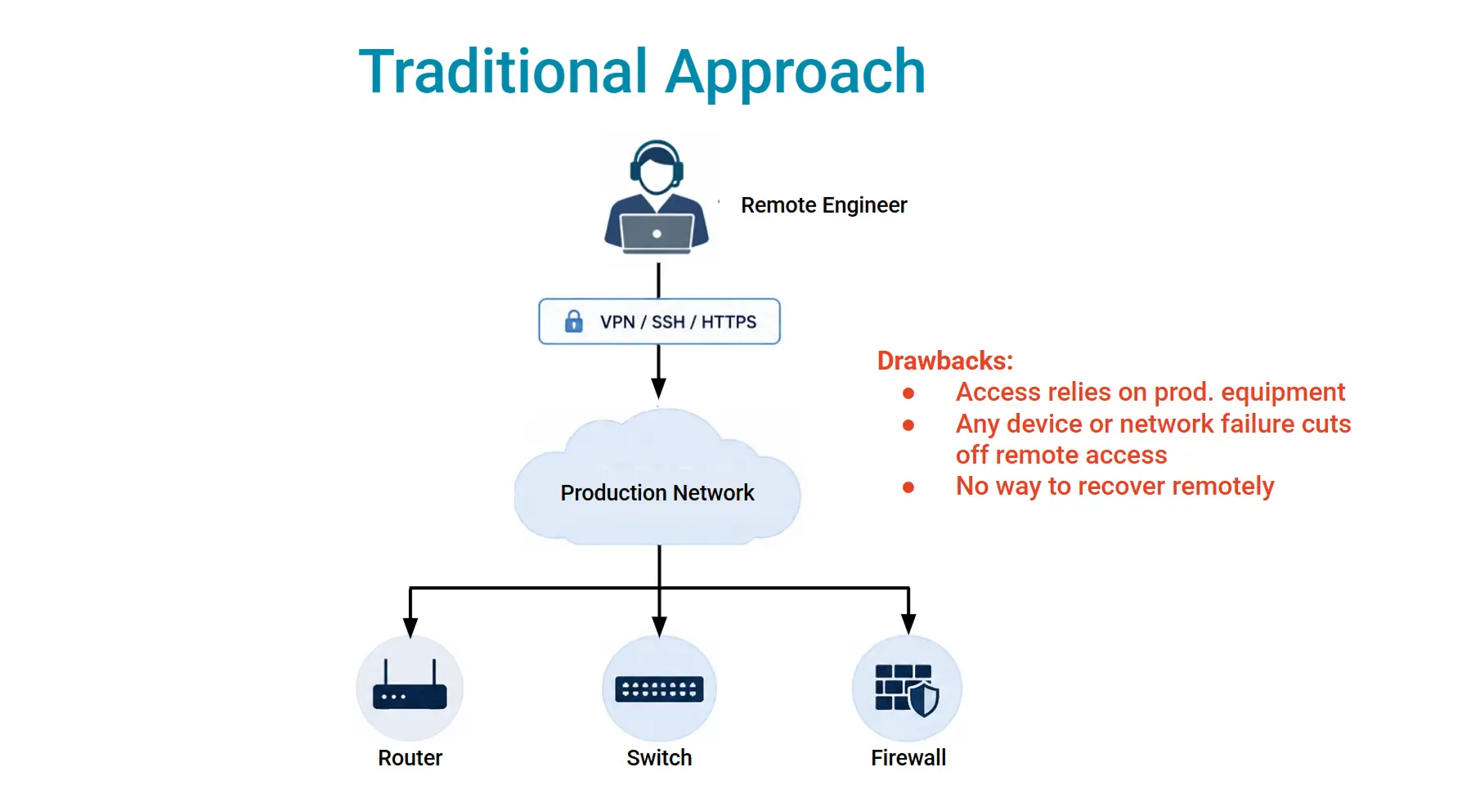
In-band management relies on the network

Image: When remote management access depends on the production network, outages cut off both links, leaving engineers unable to remotely recover.

What should be routine incidents turn into operational disruptions. Engineers are unable to gain remote console access for recovery, and any tools running on the production network become useless. The only way to bring the network back online is to put engineers on site.


How To Overcome The Top Network Failure Scenarios

VPNs and jump hosts are effective, and they’re useful tools for day-to-day operations. But, MSPs won’t be able to overcome these top network failure scenarios if they rely on VPNs and jump hosts as the only path to critical infrastructure.

The key is being able to maintain access even when the production network goes down.

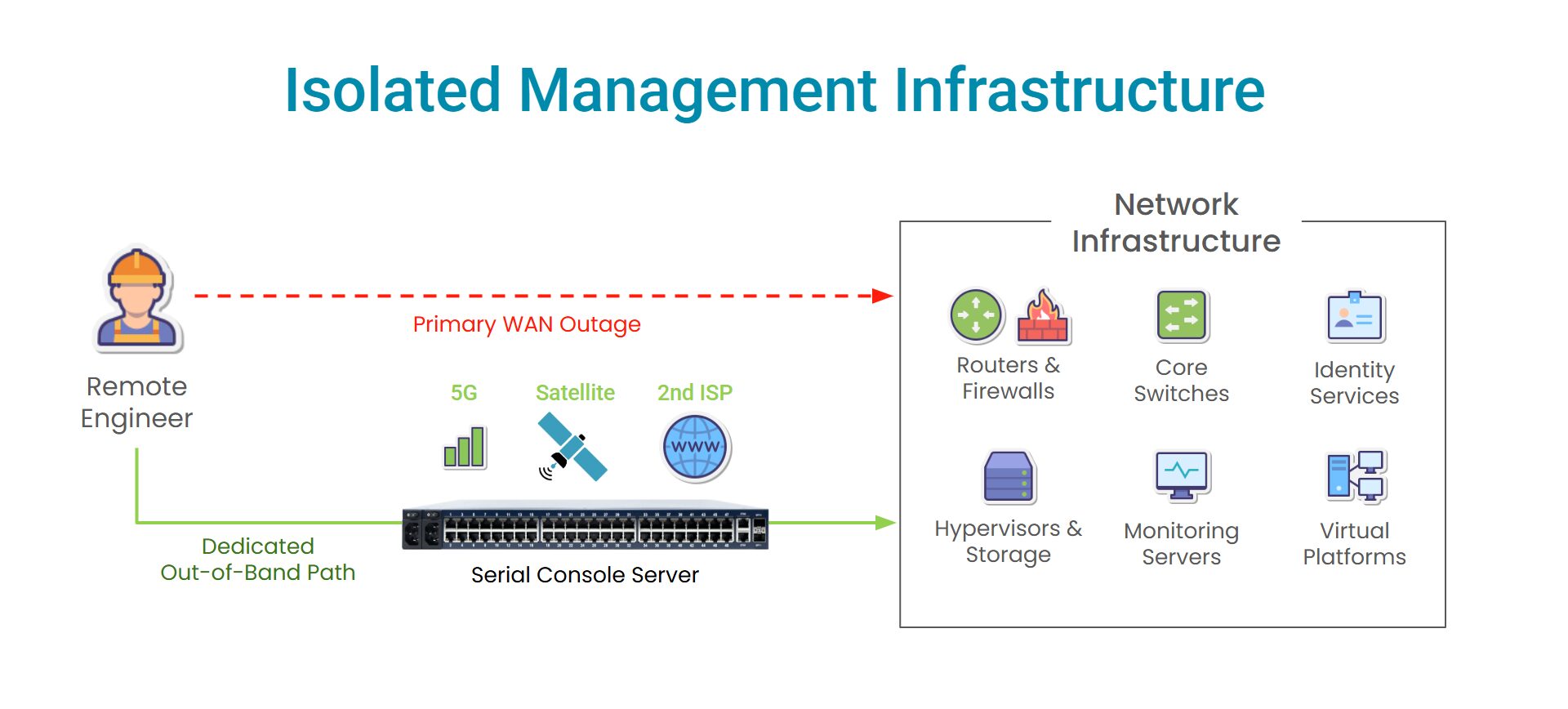
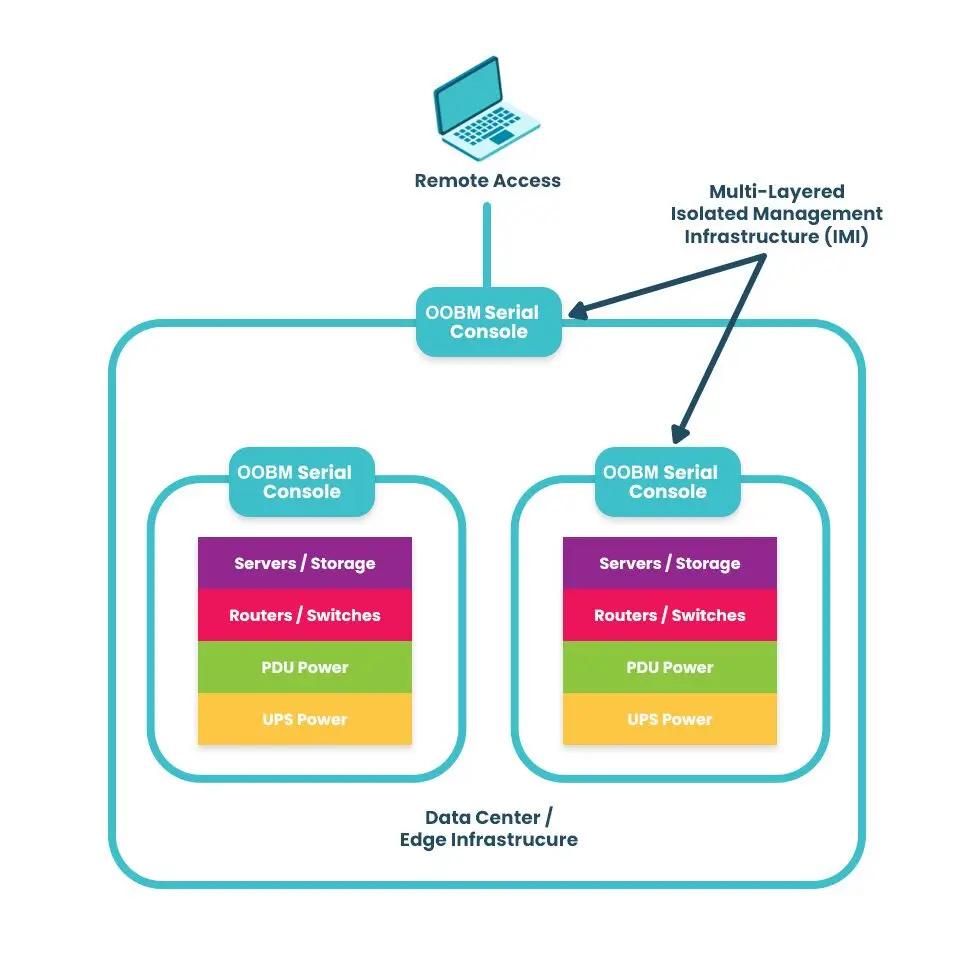
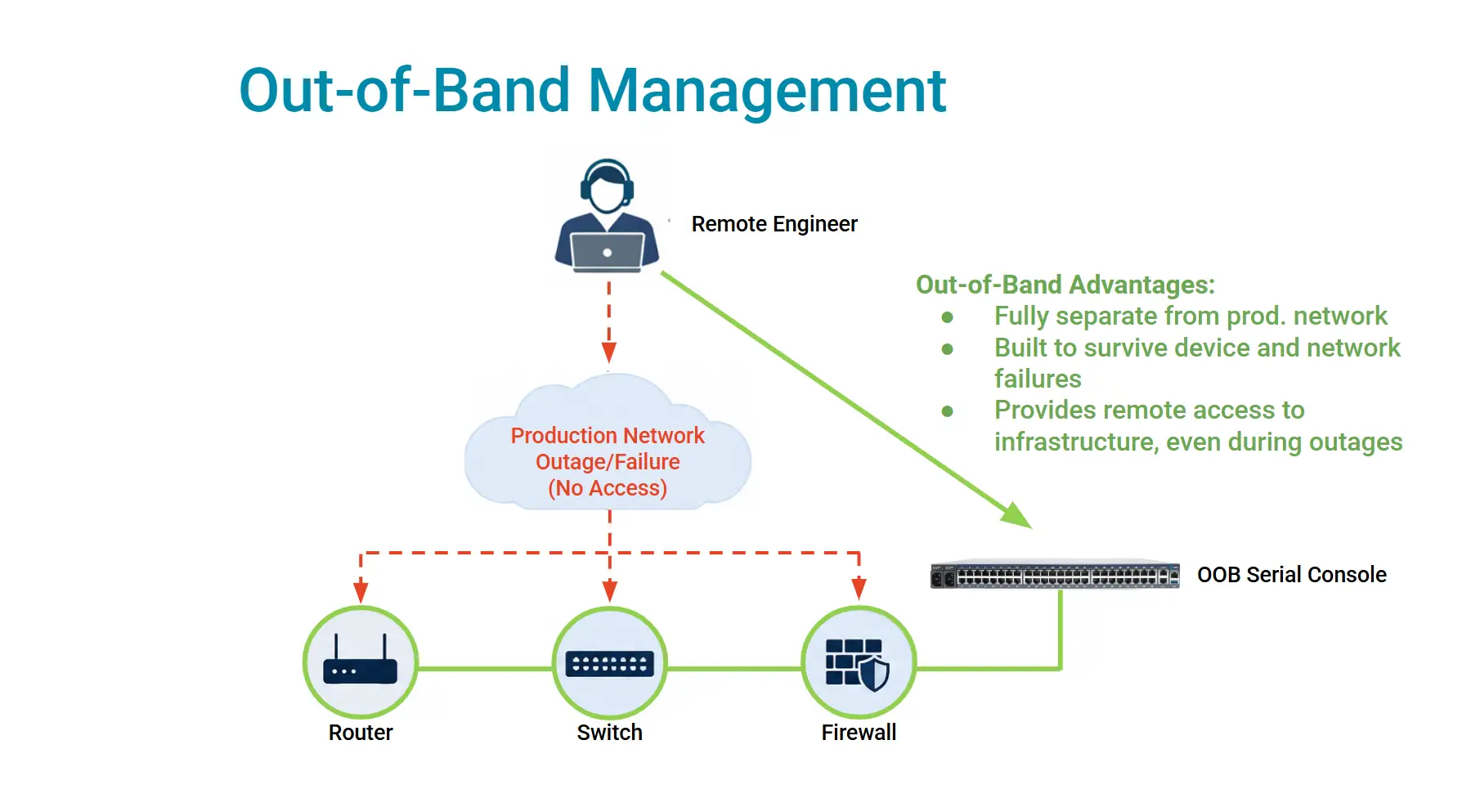
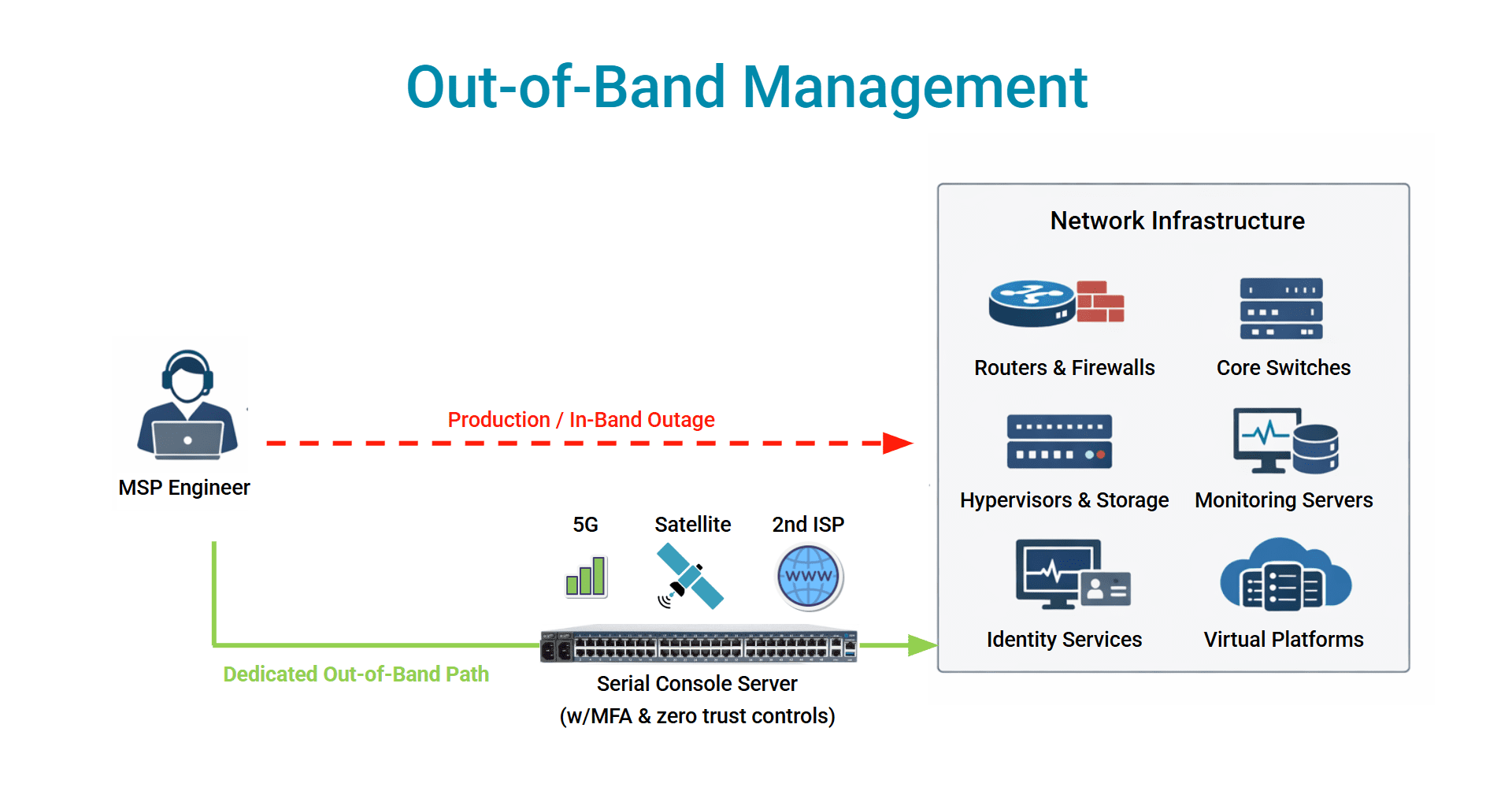
This is where out-of-band (OOB) and isolated management infrastructure (IMI) come into play. These create a completely separate remote access path that remains available no matter what kind of outages happen on the production network.

Out-of-band guarantees MSP remote access

Image: A dedicated out-of-band management path ensures engineers can remotely access their infrastructure, even when there’s a complete outage on the production network.


What Can Engineers Do With Out-of-Band?

Modern OOB and IMI setups allow engineers to see what’s going on and act, no matter what’s happening on the production network.

This dedicated management path means MSP teams can:

  • Access device consoles directly, even if routing is broken
  • Perform config rollbacks on routers and firewalls after failed changes
  • Power-cycle/reboot equipment remotely (no on-site help needed)
  • Troubleshoot WAN failures from inside the network
  • Maintain access to infrastructure during ISP outages or authentication failures

Outages that would normally drag on for hours can now be resolved in minutes from the NOC. Check out our demonstration video to see what this looks like in action!

Calculate the Impact of MSP Network Failures

The most important question to ask is: can your engineers still reach the infrastructure when the network itself is down?

If the answer is no, it’s time to calculate how much these failure scenarios are costing in truck rolls, labor, and SLA penalties.

Use the MSP Downtime Cost Worksheet to quantify your exposure and see how much faster recovery could improve your margins.

ZPE Systems named Fastest Growing Vendor by Stock in the Channel

Fremont, Calif. — November 27, 2025 — ZPE Systems is proud to be named the Fastest Growing Vendor: Technology and Storage by Stock in the Channel, a leading platform for IT channel procurement and vendor analytics. 

This award highlights ZPE Systems’ rapid growth and strong momentum as organizations modernize their network infrastructure and management solutions. ZPE’s ongoing expansion across enterprise, service provider, and hyperscale environments reflects the increasing demand for ZPE’s vendor-agnostic out-of-band management platform, which simplifies operations and strengthens resilience. 

With ZPE Systems now part of Legrand, a global leader in electrical and digital infrastructure solutions, customers have a one-stop shop for end-to-end infrastructure, from power and racks to connectivity, out-of-band management, and cloud orchestration. This integration ensures customers benefit from world-class support, unified procurement, and a stronger portfolio designed to meet the demands of modern, distributed, and AI-driven networks. 

“We’re honored to bring home the award for Fastest Growing Vendor in Technology and Storage,” said Mark Thomas, Channel Manager EMEA & APAC. “This award shows the trust our partners and customers place in ZPE Systems as they navigate increasingly complex environments and the very demanding requirements of AI architectures. Now as part of Legrand, we’re even better positioned to deliver comprehensive infrastructure solutions and exceptional value. 

ZPE Systems – Mark Thomas

ZPE Systems continues to deepen relationships across the channel, empowering partners with the Nodegrid platform for infrastructure management. Nodegrid provides customers with the industry’s most secure and complete remote out-of-band access, delivered through a combination of multi-function Nodegrid Serial Consoles, Nodegrid Services Routers, and ZPE Cloud SaaS for global infrastructure management. Nodegrid has become the go-to platform for enterprises seeking to reduce risk, accelerate deployments, and increase visibility across the entire network management lifecycle. 

ZPE Systems extends its gratitude to Stock in the Channel for this recognition, and most importantly, to our partners, customers, and Channel Team for helping to achieve this milestone. We look forward to continuing our mission to deliver innovative management solutions that support the world’s most critical networks. 

Want to become a partner? Visit our Partner Portal to sign up! 

Explore our full product lineup and product selector tool below. 

ISPs: What Happens When You Can’t Reach the Console?

Imagine the scenario from our last article: It’s 2am, a core router just went down, and customers in three regions have your phone ringing off the hook. You try SSH. No response. You ping through the management VLAN. Again, nothing.

What about the console port? This is your last lifeline to see what’s happening under the hood. But when you can’t reach it remotely, recovery slows to a crawl. What should have been a quick fix is now turning into hours of downtime, unhappy customers, and potential SLA penalties.

Things can really spiral out of control for ISPs who depend on their production networks for management. Let’s look at the biggest technical hurdles and business impacts that crop up, and the approach ISPs are taking to make sure they’re always in control.


The Problems When Console Access Is Gone

1. Recovery Turns Into a Road Trip

Technical hurdle: No console access means your only option is to dispatch engineers to the site, plug in manually, and perform recovery by hand.

Business impact: Each truck roll burns thousands of dollars, drags engineers away from other projects, and extends downtime. Customers lose trust and SLA penalties are suddenly on the table.

2. Small Outages Turn Into Big Problems

Technical hurdle: A single misconfigured update or failed device can have a snowball effect when you don’t have console visibility. You can’t isolate the fault quickly, and the blast radius grows.

Business impact: What could have been a quick local fix becomes a regional outage that puts business networks and enterprise accounts at risk.

3. Security and Compliance Take a Back Seat

Technical hurdle: In an emergency, teams know that they have to fix the problem fast. This means they’re likely to cut corners exposing management ports to the internet or using outdated console servers that have weak security.

Business impact: These shortcuts open the door to ransomware and compliance failures that could cost much more than the immediate outage.

ZPE Systems – ISP – When management relies on production

Diagram: When management access depends on the production network, teams can’t recover from outages without going on-site to manually restore services.

The Technical Fix: Out-of-Band & IMI

It’s common to route management traffic through production networks. But this creates a “shared fate” problem: when production goes down, management goes with it.

ZPE Systems created the best practices that are used today and now recommended by CISA, the NSA, and the FBI. Here are the two critical components that fix the “shared fate” problem:


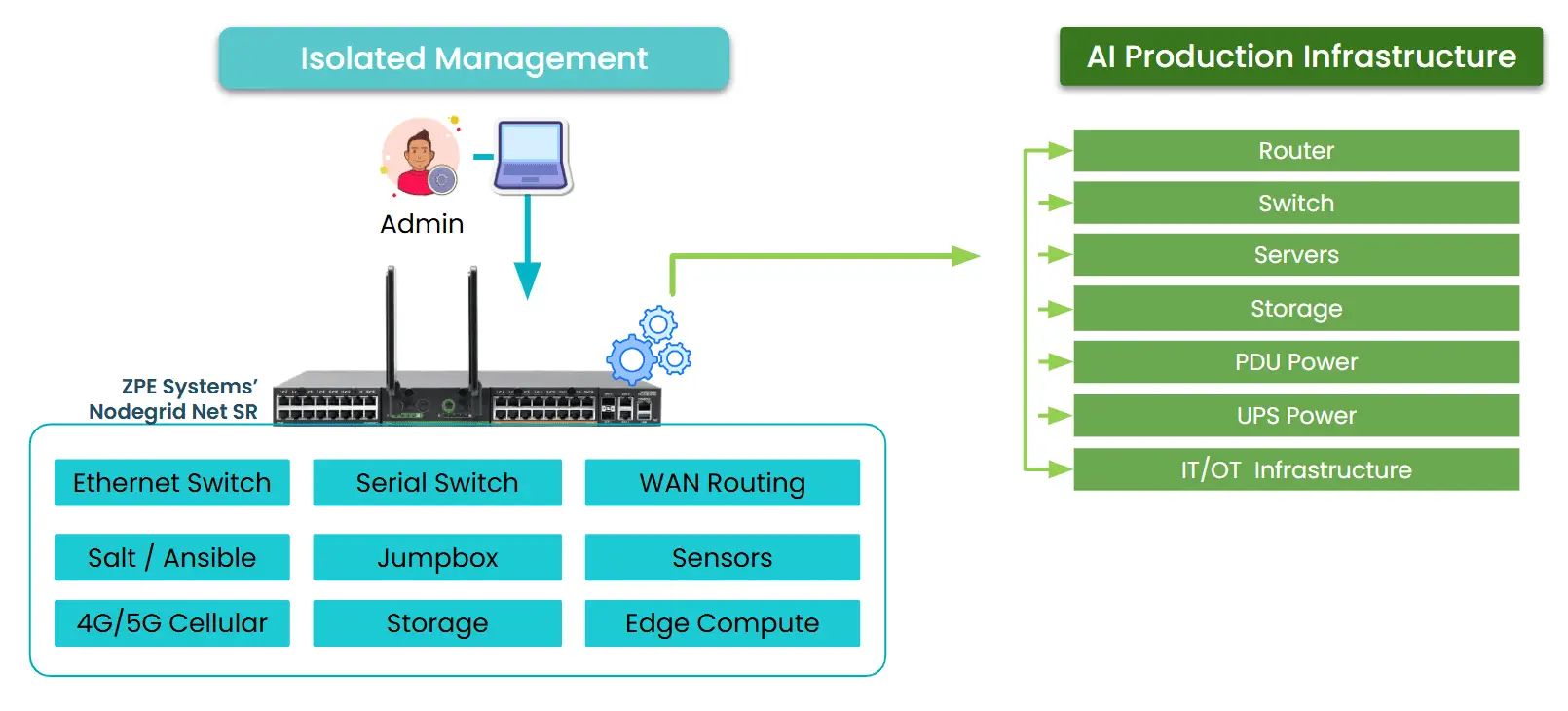
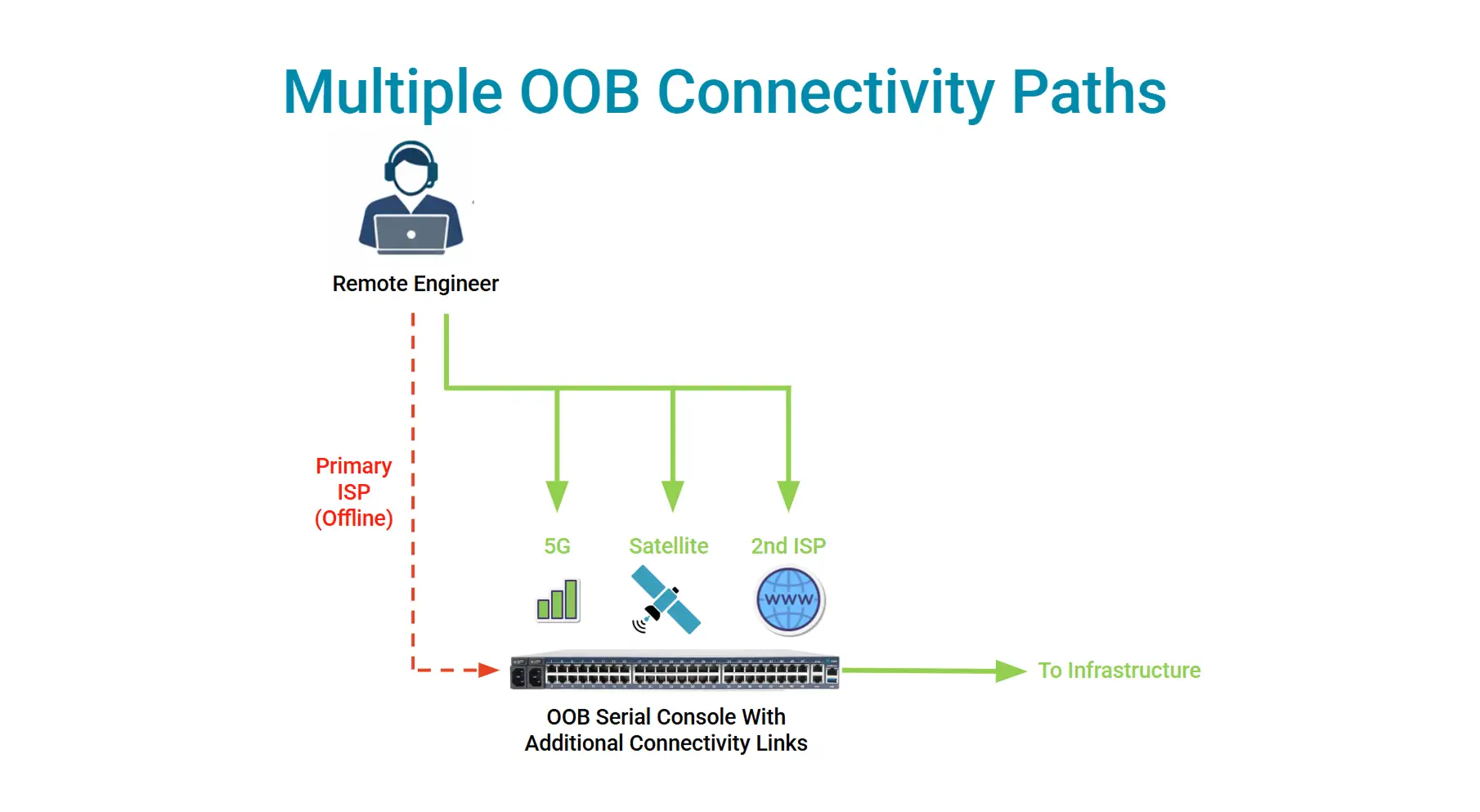
  • Out-of-Band: Provides alternate connectivity (5G, satellite, secondary fiber) so you always have a way to connect to your devices, even if they’re thousands of miles away.
  • Isolated Management Infrastructure: Physically and logically separates management from production, enforcing zero trust controls to keep attackers out, limit lateral movement, and accelerate ransomware recovery.
ZPE Systems – ISP – Out-of-band aids in fast recovery

Diagram: Out-of-band provides a fully isolated management infrastructure with dedicated 5G, satellite, and other links that ensure remote access even when production networks go offline.

OOB and IMI ensure management access is always on, always secure, and always independent. Instead of rolling a truck and waiting hours for services to be restored, you can use your dedicated out-of-band path to instantly access sites from your browser. Nodegrid gives you complete, low-level remote control of devices as if you’re physically connected, so you can recover in minutes. This is critical for ISPs.


Why ZPE Systems’ Nodegrid Is Ideal for ISPs

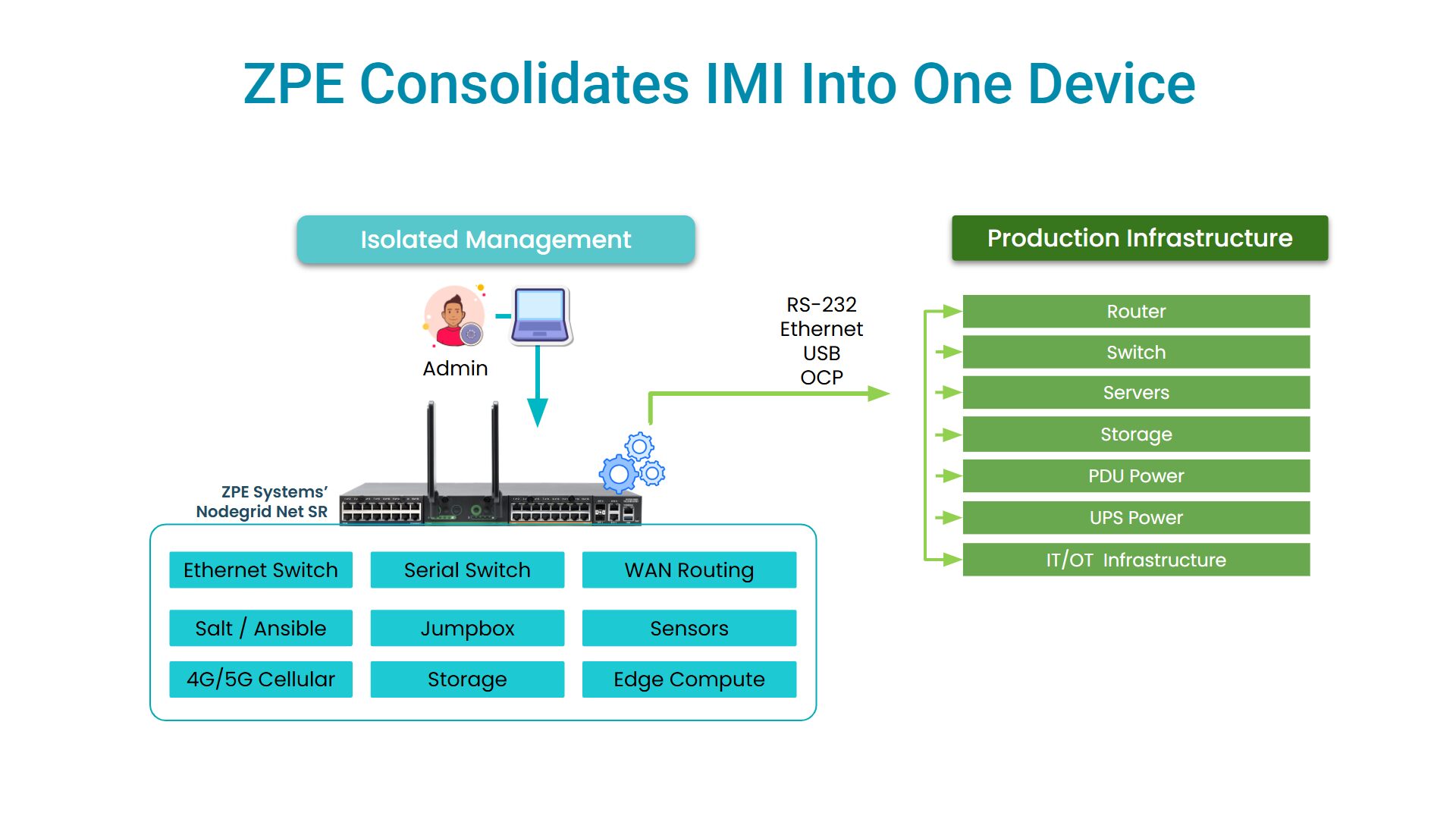
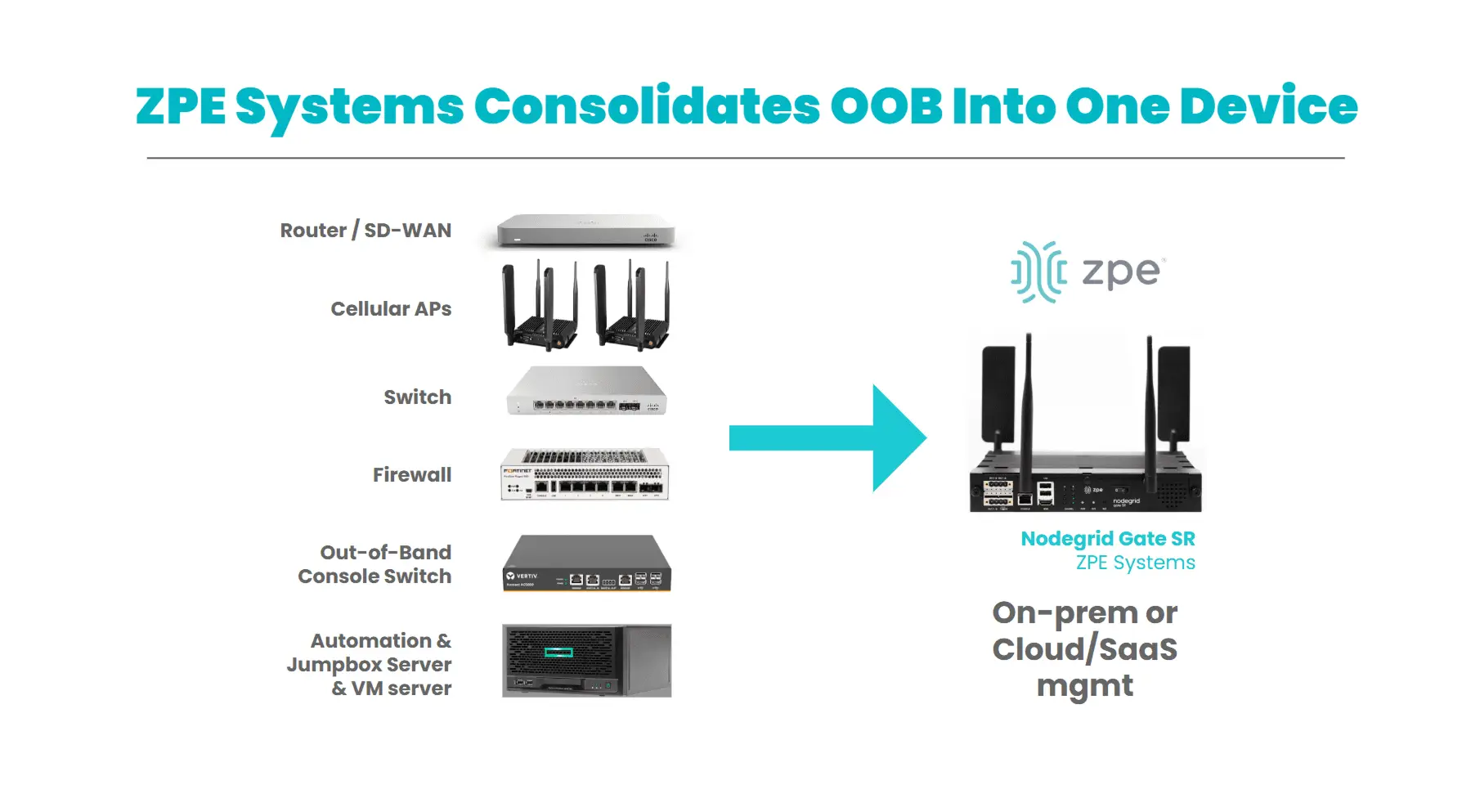
Nodegrid is built specifically to give ISPs resilient, secure, and scalable management by combining all the functions of OOB and IMI into one device. This pairs with ZPE Cloud or on-prem Nodegrid Manager to give ISPs full remote access, visibility, and control of their distributed sites.

ZPE Systems – ISP – Nodegrid consolidates OOB into one device

Image: ZPE Systems’ Nodegrid devices consolidate more than six management functions into one device, and pair with ZPE Cloud or Nodegrid Manager for holistic remote control of ISP fleets.

Whether you’re a Tier 1 operating backbone POPs, or a Tier 3 keeping local last-mile hubs online, Nodegrid gives you benefits including:

  • Always-on console access via 5G/LTE, Starlink, or secondary fiber.
  • Zero trust enforcement with RBAC, MFA, and continuous verification.
  • FIPS 140-3 certified encryption for airtight security.
  • Centralized policy control with ZPE Cloud or on-prem Nodegrid Manager.
  • Device consolidation: console server, LTE modem, Ethernet switch, and security gateway in one appliance.

More ISPs are realizing these benefits and switching to Nodegrid using an approach that doesn’t require them to disrupt services. Take the Internet Association of Australia, for example. They were able to perform a nationwide rollout of Nodegrid at 35 POPs while maintaining 100% uptime, removing 70 devices from the management stack, and saving $17,500/month in costs. Read the IAA case study for full details, including diagrams and photos.


Here’s How To Deploy Nodegrid With Zero Downtime

There’s a lot at stake when you can’t reach the console during a failure or outage. But Nodegrid helps you quickly resolve those 2AM wakeup calls with secure remote access to all your systems.

To help you, we put together this Zero-Downtime Migration Checklist. Download this guide to see every step — from assessing infrastructure needs, to designing the right solution and validating after migration — and how you can deploy the most resilient ISP network management solution.

Out-of-Band Management vs FMEA: Bridging IT Recovery with Risk Mitigation

Ahmed Algam – OOB vs FMEA

Out-of-Band Management vs FMEA: Bridging IT Recovery with Risk Mitigation

By Ahmed Algam

When it comes to mission-critical infrastructure, failure isn’t a possibility, it’s an eventuality. That’s why tools like FMEA (Failure Mode and Effects Analysis) exist in product validation and operational reliability.

But in IT, identifying risks isn’t enough. You have to be able to recover from them.

Let’s talk about where FMEA theory meets OOB (Out-of-Band) practice.

What is FMEA?

FMEA is a structured approach used to answer:

  • What can fail? (Failure Mode)
  • What happens if it does? (Effect)
  • How likely is it to occur?
  • How well can we detect or respond?
  • What actions can reduce risk?

Each failure scenario is scored across three dimensions:

  • Severity – How bad is the impact?
  • Occurrence – How likely is it to happen?
  • Detection – How easily can it be caught before causing damage?

The goal: Mitigate or eliminate high-risk scenarios before they cause downtime.

Where Out-of-Band Management Comes In

Now apply FMEA to IT infrastructure. Picture this:

  • A router that locks up after a patch
  • A firewall pushed with a bad config
  • A top-of-rack switch that loses uplink
  • A server stuck in BIOS after reboot

If your management tools are all in-band, you’re blind.

But with OOB, you keep access even when the network goes dark, using:

  • 4G/5G LTE fallback
  • Serial console access
  • IPMI, Redfish, or BIOS-level control
  • Out-of-band logging and alerting

How OOB Scores on the FMEA Scale

FMEA Parameter Out-of-Band Impact
Failure Mode Network, power, or OS-level outage
Effect Production outage, loss of remote access
Detection OOB alerts via console logs, PDU telemetry, heartbeat monitoring
Occurrence Reduced with safe, controlled remote management
Severity Reduced since recovery actions are possible remotely
Control Remote reboot, BIOS/IPMI access, serial console, file upload

Real-World FMEA Meets Out-of-Band Management

One customer thought they had OOB covered. They plugged a 4G modem into their Cisco router to allow remote access in case of failure.

But when the router failed, their “OOB” path failed with it because their monitoring agent was installed inside the network.

Once we showed them how to move the agent to the true OOB path (outside the primary network), it was an immediate “aha!” moment.

In FMEA terms:
They reduced Occurrence and improved Detection just by separating in-band from out-of-band.

Check out some more real-world stories like this one by reading my other article, 3 Real Lessons in Network Resilience.

Design for Recovery with ZPE

At ZPE Systems, we believe resilience starts with visibility and control, even when everything else fails. That’s the purpose of our Nodegrid platform:

  • Secure, isolated access to remote infrastructure
  • Cellular, Wi-Fi, and wired failover for real redundancy
  • Integrations with top monitoring and automation platforms
  • Smart, adaptive OOB architecture built to support FMEA-driven design

If Your FMEA Requires Recovery, We Can Help!

If your environment depends on high uptime, fast response, and remote visibility, Nodegrid is your bridge between failure analysis and real recovery.

Use the form below to contact us and let’s talk about your FMEA goals.

Yes, You Can Have A Complete Out-of-Band Management Solution In One Device!

Vishal Gupta – Out-of-band in one device

Out-of-Band (OOB) management used to be a last resort, a ‘break glass’ tool for gaining access to failed IT. But many organizations are now realizing that out-of-band is a strategic weapon that can do much more than get them out of a jam. It can help patch systems within 48 hours, test config changes and firmware updates, and monitor infrastructure health to prevent failures and stay proactive.

But there’s one big problem that stops teams from putting together an out-of-band infrastructure: there are too many devices to piece together and manage.

Traditionally, teams have built OOB environments using multiple devices from different vendors:

  • Routers provided secure connectivity and routing logic.
  • WAN routers served as modular access points.
  • Cellular devices offered LTE/5G backup and remote cellular access when wired networks failed.
  • Serial console servers were added to gain terminal-level access to switches, firewalls, and other appliances.
  • Firewalls or VPN concentrators (for security-conscious teams) were deployed to secure management plane access through encrypted tunnels.
Devices required for OOB
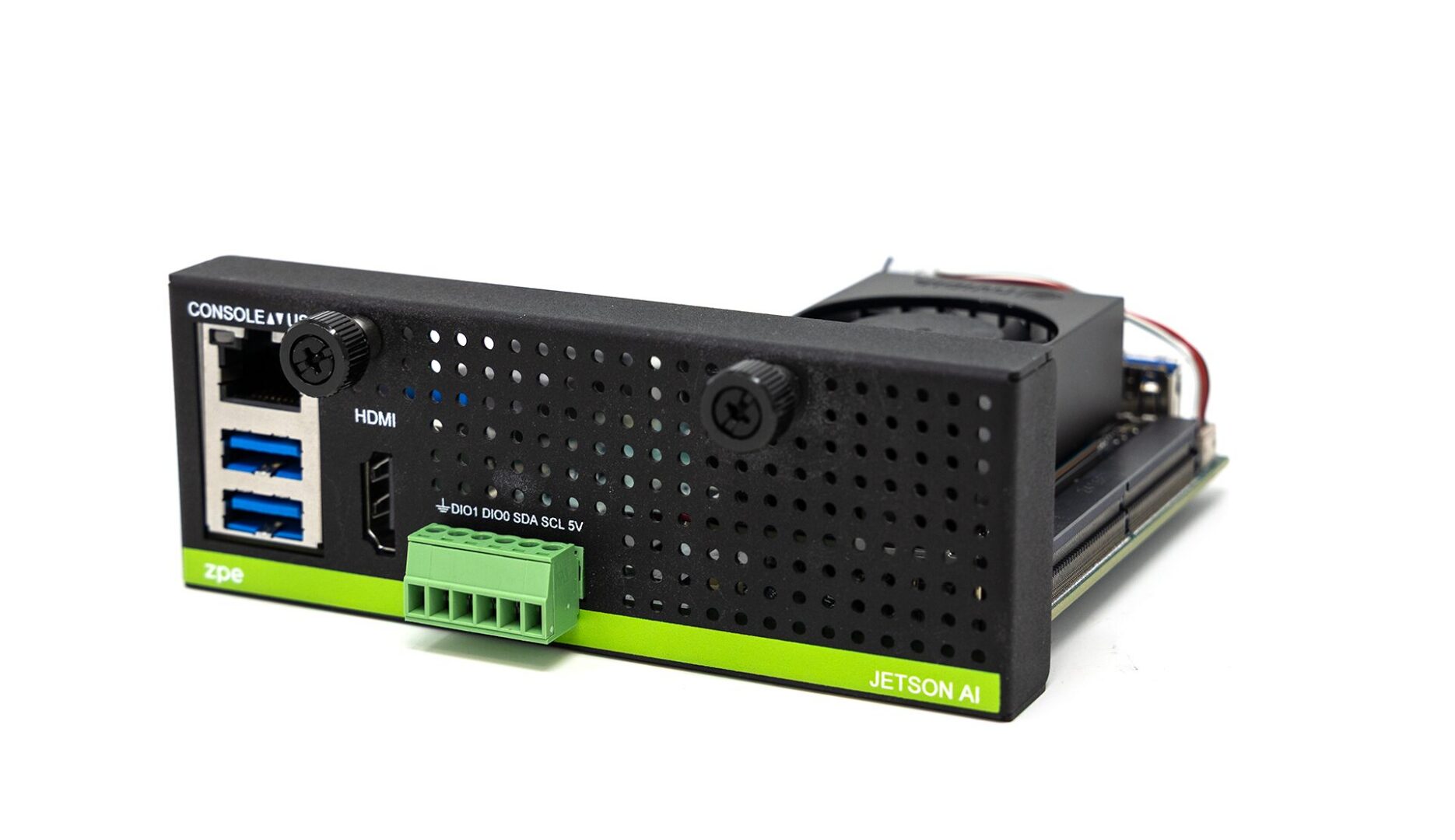
And this handful of infrastructure provides only basic remote access for troubleshooting or recovery. For teams who want to become proactive, they need additional devices like automation servers, Ethernet switches, computing, and storage. This stitched-together model is unsustainable in modern IT environments because it adds complexity that teams can’t manage.

The Complexity of Multi-Device OOB Environments

For teams managing a few sites, juggling devices may be feasible. But when there are dozens, hundreds, or thousands of locations, the cracks begin to show:

1. Operational Complexity

Every device has its own OS, firmware, and configuration syntax. Pushing a global policy change like updating SSH access rules or hardening TLS settings requires custom playbooks for each platform. Over time, this increases the risk of misconfigurations and creates blind spots in security audits.

2. Troubleshooting Bottlenecks

When a site goes dark, support teams need rapid access to console ports, environmental telemetry, and WAN connectivity diagnostics. But a fragmented toolset makes root-cause analysis a game of guesswork – Did the router fail? Does the modem have signal? Is the serial port offline?

3. Inefficient Use of Space and Power

Remote cabinets and edge environments have very limited (if any) rack space. You might have 1RU or less of space, but three devices that need to be installed. Even if you get crafty and manage to squeeze them in, having multiple devices increases power draw, thermal output, and points of failure. This isn’t scalable, especially in cramped environments like cell towers, retail stores, or substations.

4. Increased Procurement and Support Costs

Assembling out-of-band networks from multiple vendor devices simply makes more work for procurement teams, who face long lead times and inconsistent licensing models. But that’s just the beginning. Costs pile up when you need to maintain this infrastructure. It’s extremely expensive to have a separate contract for each cellular device at every location, for example, which can easily add up to hundreds of thousands of dollars every year. Or, having third-party maintenance contracts for existing devices that have gone EOL.

Why Teams Dream of a Single-Box Solution

Remember when the smartphone hit the market? Rather, when it became commonplace and developers started making an app for everything? There were so many single-function devices  and items that you didn’t need anymore – phone, alarm clock, digital camera, calculator, notepad, mp3 player, flashlight – the list goes on.

Networking and IT teams are dreaming of something similar for their infrastructure. At every expo and conference in recent years, we talked with thousands of people who said that out-of-band adds too much extra equipment (and work) that they don’t want to deal with.

So, what do they want? Something that “just works,” according to those we talked to recently at RSA Conference 2025. They want to be able to deploy one box that securely comes online, can be configured remotely/automatically, and doesn’t require a bunch of other devices for automation or computing or cellular. Here are some popular wish-list use cases:

  • Remote Sites & Branch Offices: A single appliance that can offer serial access to critical equipment, cellular WAN failover, and environmental monitoring in space-constrained sites.
  • Colocation Data Centers: One platform that combines console access, VPN tunneling, and rack telemetry to reduce hardware costs and footprints.
  • Industrial & OT Environments: Ruggedized devices with extended temperature ranges, shock resistance, and power redundancy ideal for energy, utilities, and manufacturing.

Imagine their surprise when we say, “That’s our box. We do what nobody else can.”

ZPE Systems’ Nodegrid is Single-Box Out-of-Band Management and More

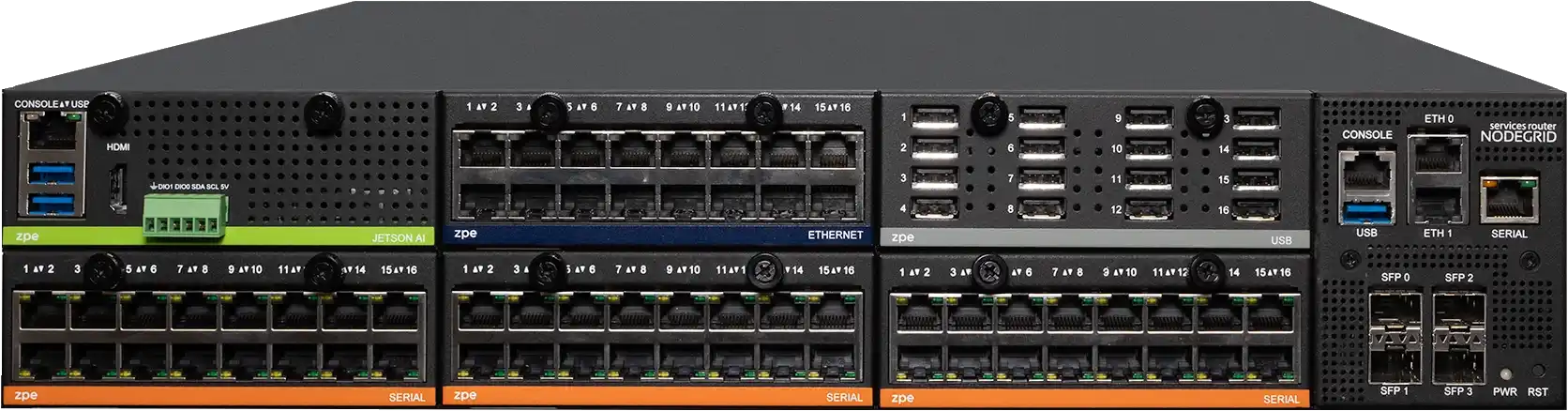
ZPE Systems developed this all-in-one capability and offers devices in a variety of sizes, up to 1RU. This platform is called Nodegrid and it combines the many functions we discussed, plus the ability to host third-party apps/tools, run Ansible and custom automation, and provide centralized management via on-prem deployment or ZPE Cloud connection.

ZPE Combines all the functions of OOB into one device

All-in-One Capabilities

One Nodegrid device handles all the functions of traditional, dedicated devices, including:

  • Serial console server (for direct access to routers, switches, firewalls)
  • Cellular modem (LTE/5G with dual SIM failover)
  • Ethernet routing and switching
  • Secure VPN or SD-WAN capability
  • USB out-of-band storage or keyboard-video-mouse (KVM) options

On top of these, Nodegrid runs VMs, Docker containers, apps, and automation solutions. It replaces up to nine traditional devices and fits neatly in 1RU or less of space.

Here’s how our customer Vapor IO used Nodegrid to free up 5RU and automate their deployments. Read Vapor IO case study .

Centralized Management and Policy Enforcement

Administrators can deploy and manage thousands of units through a single orchestration platform, via Nodegrid Manager (on-prem) or ZPE Cloud (SaaS). This lets them easily enforce access policies, audit activity, and automate firmware updates without relying on disparate interfaces.

Isolated Management Infrastructure Best Practices

Nodegrid provides what is called Isolated Management Infrastructure (IMI), which is an industry best practice for maintaining resilience. Unlike traditional out-of-band, which relies in part on production systems, IMI creates a completely separate management network that remains accessible and online even if the production network completely fails. This lets teams access and recover their systems during an active cyberattack or outage. IMI has been used by hyperscalers for more than a decade and is now being written into new laws around the world.

Hardened Security

The Nodegrid and ZPE Cloud platform have the industry’s highest security. You can read the full security assurance document that covers the hardware, software, and cloud security features, as well as the third-party certifications. Here are some of the highlights: secure boot, signed OS, self-encrypted disk, three Synopsys validations, ISO27001, FIPS 140-3, SOC 2 Type 2.

Automation-Ready

Nodegrid integrates with Ansible, Terraform, and Python APIs, enabling Infrastructure-as-Code (IaC) workflows and automated responses to network incidents. Automation can run natively on the Nodegrid device, or stored in ZPE Cloud and pushed down where needed.

Schedule a Demo

The days of piecing together out-of-band solutions are coming to a close. The overhead, security gaps, and physical constraints are driving a clear trend: simplify the edge, secure the core, and consolidate the tools.

ZPE Systems helps you do all three of these. To get hands-on with our products or chat with an engineer about your specific use case, schedule a demo at the link below.

Schedule a Demo


See Nodegrid in Action!

Senior Sales Engineer Marcel van Zwienen put together this 20-minute video giving you a first-hand look at Nodegrid’s interface. He shows you how ZPE Cloud makes it easy to monitor, troubleshoot, and update devices even if they’re thousands of miles away. Don’t miss it!

Watch Video

Marcel van Zwienen gives a walkthrough of ZPE Cloud for remote device management.