Providing Out-of-Band Connectivity to Mission-Critical IT Resources

ZPE Systems, Chatsworth Products Collaborate to Provide Network Managers with Out-of-Band Outlet Control and Monitoring Capabilities
ZPE Systems + Chatsworth Products

ZPE Systems, Chatsworth Products Collaborate to Provide Network Managers with Out-of-Band Outlet Control and Monitoring Capabilities

ZPE Systems’ Solution Now Fully Integrates with eConnect® Power Distribution Units to Automate Network Management in Remote Sites

Fremont, CA, April 21, 2020 – ZPE Systems, the industry’s first provider of an Open Infrastructure Management Solution™ for in-band/out-of-band access and control of network, compute, storage and power devices for physical and virtual IT Infrastructures, announces today advanced integration of Chatsworth Products’ (CPI) eConnect® Power Distribution Units (PDU).

The integration brings a unified solution to provide network and facility teams out-of-band access for cabinet-level power, environmental and access control parameters, allowing them to build out an automation plan that helps create a self-sufficient, self-healing environment, particularly in edge sites.

ZPE’s Nodegrid® Infrastructure Management Platform integration with CPI’s eConnect PDUs brings application programming interface (API) connectivity, indirect Command Line Interface (CLI), activity dashboards, actionable data and more to CPI’s line of eConnect PDUs. With the integration, customers will benefit from advanced outlet control and monitoring capabilities.

“ZPE is pleased to collaborate with a leading PDU manufacturer that has such a successful track record in solving unique challenges in cabinet-level power monitoring and access control,” says Arnaldo Zimmermann, Cofounder and CEO of ZPE Systems.

Now, customers can monitor and collect outlet data, and execute scripts according to parameters to automate and self-heal network environments, giving them a 360 view of their networking environment, all from within a single, vendor-neutral infrastructure management solution. Through Nodegrid, eConnect PDUs gain API ties and webhooks for additional automation, as well as indirect CLI access to the PDU itself for additional extensibility.

“The integration with eConnect PDUs grants Nodegrid customers access to a robust intelligent PDU solution. CPI’s eConnect PDUs have the highest operating temperature range in the industry and allow for dramatic savings in networking costs with the Secure Array® IP consolidation technology,” Zimmermann adds. “Networking and facilities teams can do more than just monitor and manage, with Nodegrid they can now automate based on thresholds and data parameters—our support for actionable data means much more efficient network/facilities management.”

“Nodegrid’s robust and reliable infrastructure management capabilities are superior, and add many benefits for customers trying to manage assets in hybrid environments. We are excited to join forces and provide customers with an extensive visualization capability, allowing the PDUs to be managed through the same interface that could be used to manage compute and storage devices,” says Ashish Moondra, Sr. Product Manager at CPI.

Customers can expect to see the ZPE and CPI integration options within Nodegrid starting today. more information on ZPE’s Nodegrid Infrastructure Management platform, visit www.zpesystems.com. For more information on eConnect PDUs, visit www.chatsworth.com/power.

About ZPE Systems, Inc.

ZPE Systems is rethinking the way networks are built and managed by providing software-defined, vendor-neutral infrastructure management and networking solutions.

ZPE Systems’ Nodegrid® platform consolidates, organizes, and simplifies the need for a complete remote access and control solution; Nodegrid solutions address the OOB management needs of the data center, unifies edge networking environments, manages converged infrastructure and provides intelligent automation. ZPE’s smart, consolidated IT management solutions reduce downtime, deliver OPEX savings, and extend the reach of IT workforces.

ZPE’s global headquarters is located in Fremont, California with offices throughout the US and globally in Ireland, India, Brazil and Japan.

ZPE Systems, the ZPE logo and Nodegrid are registered trademarks of ZPE Systems, Inc.

To learn more, visit www.zpesystems.com.


About Chatsworth Products

Chatsworth Products (CPI) is a global manufacturer of products and solutions that protect your ever-growing investment in information and communications technology for IT and industrial automation applications. With decades of experience engineering thermal, power and cable management solutions for the data center, enterprise networking and industrial enclosure markets, CPI is well positioned to provide you with unequaled application expertise, customer service and technical support, as well as a global network of industry-leading distributors.

CPI is listed with the General Services Administration (GSA) under Federal Supply Schedule IT 70. Products are also available through GSA Advantage and through Government Wide Acquisition Contracts (GWACs), including GSA Connections and NITAAC-ECS III (www.chatsworth.com/gov).

To learn more, visit www.chatsworth.com.
Shield Your Business with Secure Access Service Edge (SASE)

Secure Access Service Edge (SASE) is quickly evolving how enterprises offer secure connectivity. As the modern workforce becomes increasingly distributed, you need to accommodate more branch locations and remote workers. This is especially important given the global coronavirus crisis at hand, which has forced most employees out of the office and made working from home the new normal.

That means you’ve probably got a few very crucial questions on your mind, like:

  • Can you achieve business continuity?
  • Will your traditional network be enough?
  • Can you provide a connection that keeps workers safe?

No matter how long it takes to get back to yesterday’s normal, SASE gives you the power to safely connect your entire workforce.

What is Secure Access Service Edge?

SASE is networking and security delivered via the cloud. It’s identity driven and supports all edges, giving your users safe and reliable access to your network no matter where they are.

SASE addresses the need for more secure and flexible connectivity. Traditional networking wasn’t made for a distributed staff base, leaving you with restricted access that’s slow and vulnerable. Without SASE, you need to backhaul traffic through your main network’s firewall, creating a bottleneck that bogs down business with reduced speeds and frequent delays. Remote connections also remain open to threats due to thinner security measures.

In a nutshell, legacy solutions limit your network to specific locations and devices. And until now, adding agility meant piling on more applications and devices to your already complex stack.

Why is SASE Better for Remote Work?

It’s not difficult to imagine how drastically SASE improves your business. Just look back at recent weeks and consider how your traditional system handled the sudden exodus of your employees. Were they able to pick up and seamlessly get back to work at their homes? Or were your IT staff scrambling to put together a mishmash of solutions, with many employees still struggling to get up to speed?

SASE is better because it lets employees connect from anywhere, and it secures them (and your business) with robust capabilities, all delivered via the cloud.

Instead of making your staff jump through hoops just to take their work away from the office, SASE packs everything they need into the cloud. They’re no longer tethered to their specific workstation or a carefully configured laptop, and can now simply connect to your network from anywhere for secure access to physical and cloud resources.

How does SASE Make Management Easier?

For everything from SD-WAN and traffic management, to firewalling and cybersecurity, SASE brings you control and flexibility via a converged software stack. Instead of using loosely-coupled point solutions that are costly to manage, you can control all of your networking and security functions from one place. Access is no longer bound to specific locations, and your IT staff can manage your entire network even from across the globe.

Your business’ resources and users are all connected to one agile platform, with end-to-end security and capabilities that meet your needs no matter how business changes.

So when a global pandemic forces your staff to go 100% remote, you don’t need to struggle to configure individual point solutions and threaten your business’ productivity. With SASE, you can configure and adapt your infrastructure as needed, and roll out changes across your network. Adjust access policies, QoS, firewalling, and more from the cloud, so you can keep business running through any challenge.

Get Nodegrid for Total SASE Flexibility

Nodegrid offers a truly innovative SASE platform that delivers more flexibility and peace of mind.

Our patented x86 64-bit architecture gives you Guest OS access that supports virtualized applications, which you can deploy directly on Nodegrid devices. You can tailor your networking and security solutions by deploying WAN accelerators, additional firewalls, and more. And you can take advantage of Nodegrid’s modularity for a solution that’s fully customized to your needs.

Nodegrid also features built-in automation that streamlines deployment and scaling, so you can easily set up SASE and connect your entire organization. Coupled with reliable 4G/LTE failover and out-of-band management that gives you in-depth control of SD-WAN, security, and third-party applications, Nodegrid is the only solution to unleash total flexibility for your network.

Now’s the time to offer secure access for everyone in your business. Get in touch to schedule your SASE demo today.

Make Management More Secure and Easy with Single Sign-On

Managing many network devices and applications can be a chore, and a lot of this stems from having to manually authenticate with each. You typically need to keep a spreadsheet containing your different credentials (or run the risk associated with having one set of credentials across the board). And until now, Nodegrid offered this typical experience. But you no longer need to be left with a juggling act when it comes to managing your network. That’s because Nodegrid now supports single sign-on (SSO).

What is Single Sign-On?

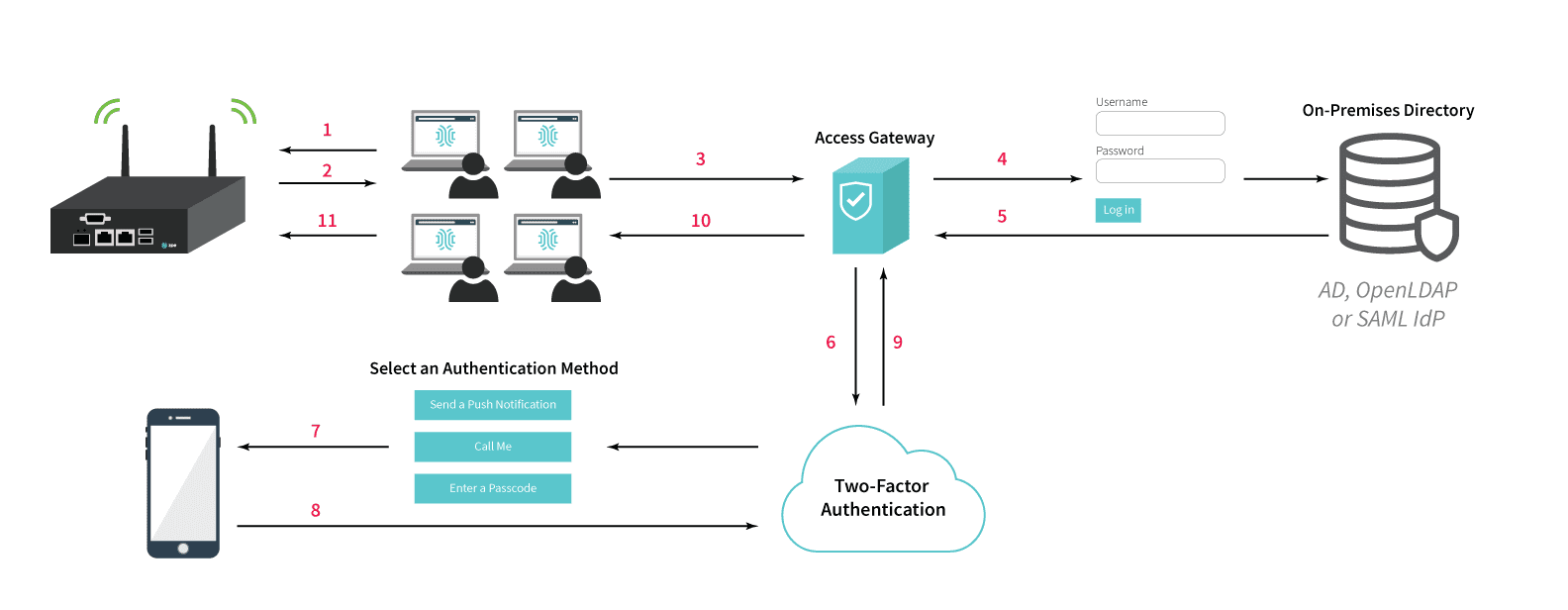
Single sign-on allows you to authenticate with multiple applications simultaneously, using only a single set of credentials. It’s like having one key that opens every door in the house! Once you successfully sign in to an application, you’re automatically signed in to all other connected applications. SSO allows you to access Nodegrid appliances and applications with ease, and you can seamlessly navigate back and forth without having to get bogged down by sign-in screens.

Benefits of Single Sign-On

SSO offers much more ease-of-use and increases security. Before SSO, you needed to keep track of many unique credentials. When managing appliances and applications, this forced you to sign into each individually. Aside from presenting you with frequent obstacles that slowed you down, this also left you to deal with the hassle of resetting or retrieving credentials if you forgot or lost them. You’d have to put in more time and effort to update your spreadsheet, and then get used to using your updated credentials (which often led to more resetting and retrieving). Now, you only need one set of credentials to sign in to everything. This means that you no longer need a lengthy spreadsheet with many usernames and passwords, and you don’t need to be frequently slowed down by having to sign in to each application separately. You also don’t need to worry about compromising security by trying to create easy-to-remember credentials, or by frequently going through password reset/retrieval protocols. If you do forget your credentials, one reset is all you need to get back up and running. And for network administrators, SSO simplifies user administration. Admins no longer need to add, remove, or modify users on separate applications. Nodegrid now puts convenient control in one place, so administration actions are consolidated and go into effect across all user access points.

Why use SSO with Nodegrid?

Nodegrid’s single sign-on currently integrates with many popular identity providers. These include Duo, Ping Identity, and Okta.
Nodegrid also uses the industry-standard Security Assertion Markup Language (SAML), so you can easily integrate with any identity provider who supports SAML 2.0. Single sign-on is easy to configure, and provides more convenient, secure access to applications and appliances. To get the most streamlined and safe experience with Nodegrid, consider taking full advantage with SSO.

10 Things to Consider when Choosing a Branch Networking Solution

10 Things to Consider when Choosing a Branch Networking Solution

Branch networking is evolving. From the core to the edge, you need to consider so many factors, such as scalability, costs of deployment & maintenance, the speed of installation, and much more. What affects all these the most are the devices and tools you use, which are likely obsolete, sitting in silos, and unable to handle the smart infrastructure of the modern network.

Advanced solutions are now available, and you can apply them to your legacy systems as well as new data flows. From cloud & edge computing, to machine learning & AI, you can take advantage of new capabilities, simplify management, and turn your network into a powerful asset

As you consider branch networking solutions, here are 10 things to keep in mind:

1. How Easy is it to Deploy?

Think about the entire deployment. Can your smart hands see the job through, and keep devices up to date? Can you download automation scripts from the cloud for quick, consistent scaling? Do you have zero-touch provisioning via WAN (IPv4 and IPv6) on your side?

If not, imagine how satisfying it would be to plug in your devices, and then everything just works. That’s the type of solution to look for.

2. Does it Keep Everything Secure?

Branch devices could let intruders through the back door, leaving your data center vulnerable. What do you do if this happens and an unauthorized user wreaks havoc on your data center? Do you have a built-in firewall, and can you enforce continuous security via cloud-based configuration backup and restore? Are authentication and security features strong enough to make sure only the right users have access from authorized locations?

Don’t settle for weak security that’ll leave you scrambling after an attack. Consider only a branch solution that delivers total peace of mind.

3. Can you get Secure Access from Anywhere?

You typically need high-level management software to gain access to your infrastructure. With that in mind, do you have a comprehensive out-of-band solution and branch devices that you can orchestrate remotely? Does your solution give you a 360-degree view of your entire infrastructure, without the need to set up a VPN or gain access via your data center?

On-site support is costly and time-consuming. That means you need a solution that provides robust remote capabilities for easy, secure access from anywhere — using just your browser.

4. Does it Prevent Issues & Keep Business Running?

Reducing maintenance needs and expenses is critical to having a modern network deliver value to your business. Does your solution pinpoint issues before they happen? Does it offer data logging and automation capabilities to help you ensure uptime? Can it alert you to configuration changes and possible security risks, and give you the tools to keep up with your needs?

No matter what solution you’re looking for, business continuity should be your top priority.

5. Does it Protect your Data?

Protecting your data means more than setting up a firewall and a few security measures. You need complete protection to safeguard your network (and your business). Do your branch devices support the latest in data and hardware security, with TPM for storing certificates? Do you have encrypted storage, multi-side certificates, and TLS 1.3 encryption? How about protection for boot and BIOS passwords, and even a kill switch?

Your data should always be safe, and your branch solution is a major component in securing all information that goes through your network.

6. Does it Cut Costs & Consolidate?

No matter how many branch locations you have, you need to reduce costs and maximize available space. Does your solution offer multi-function branch devices that are power- and cost-efficient? Does it give you switching and routing capabilities, support for virtualized functions, and on-premise vCPE, firewall, VPN, compute, and storage capabilities? Does it provide you with a 24×7 virtual presence thanks to reliable cellular failover?

The most efficient branch solutions consolidate functions into a single device, letting you take advantage of reduced operational expenses and a smaller network stack.

7. Can you See its Performance?

You can’t optimize your network without knowing where to start. Does your solution collect critical data points and allow you to inspect data logs? Does it build an audit trail of actions, and visualize KPIs with an intuitive, easy-to-use dashboard?

You need to know how your network performs, and your solution should give you critical insights and tools to keep your infrastructure healthy.

8. Can you Scale Quickly & Easily?

For a modern network, your branch solution should be easy to replicate across many locations. Is it simple to deploy and provision? Will it grow as your business grows? Can you foresee the need to replace any devices, or will your solution help you scale even in the long run?

Whether you’re in IT, manufacturing, or retail, your branch solution needs to keep up with business no matter how far and wide you go.

9. Is it Truly Saving you Money?

When it comes to CAPEX and OPEX, you need to think long-term savings. Instead of getting excited over low initial costs, which usually come with additional expenses for training, maintenance, and more, think about how much it will cost over time. Will it need to be replaced often? Does it require anything else to run smoothly, and will it need frequent maintenance? Are there hidden fees or necessary add-ons to consider?

To maximize your savings, expect to pay more upfront for a true “set it and forget it” solution. In the long run, you’ll pay much less thanks to automation and other robust capabilities that minimize downtime and expenses.

10. Does it Work with Many Vendors?

Your network has devices from many vendors, which means your branch solution should work well with all of them. If it doesn’t, you’ll deal with ballooning time and cost expenses that will exhaust your staff and your business.

Look for a solution that streamlines the experience and gives you control with intuitive software. You’ll find an open-platform solution gives you seamless integration that helps you manage your entire infrastructure.


Bottom Line

If you’re in the market for a branch solution, get Nodegrid’s family of business-friendly hardware and software. Not only will you benefit from robust, consolidated devices, you’ll discover effortless network management that puts you in control no matter where you are.

Need More Information?

If you would like more information on how the Nodegrid family of Open Infrastructure Management Solutions address all the needs of Branch networks, contact a ZPE solution specialist.

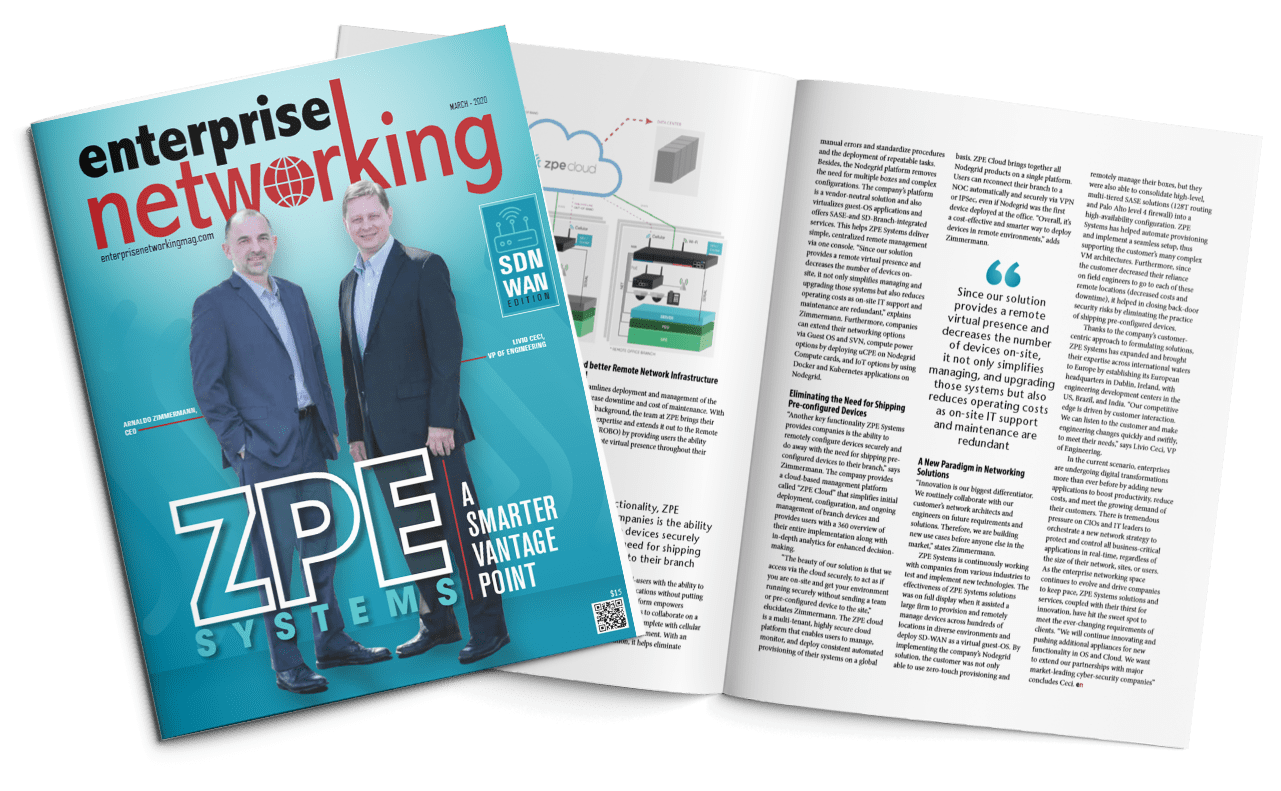
ZPE Systems – A Smarter Vantage Point

ZPE Systems – A Smarter Vantage Point

Today, as broadband services have become more reliable and cost-effective, companies are shifting from expensive MPLS links to SD-WAN, which promises firms more agile, dynamic, and inexpensive branch-office connectivity that doesn’t lose its quality of service. Enterprises can define the traffic steering rules for each application, centralized monitoring, and analytics to support deployments and reduce management complexities in sites. However, the managing, deploying, and provisioning of remote offices as companies strive to shift from MPLS lines to SD-WAN has become an expensive and time-consuming process. Traditional SD-WAN requires pre-configuration and is not capable of zero touch provisioning/deployment at the final location. This limits the deployment and scalability of remote offices and branch locations and typically requires specialized personnel on-site to aid in the implementation of the network.

That being said, it is a tedious task to manage one or more appliances such as servers, switches, access points, and more at each branch as every single appliance has its own unique operating systems and management tools. These require manual updates and configuration changes, adding complexity as teams try to manage devices from different vendors. In short, companies spend too much time performing manual, inefficient, and repetitive processes to support their network hardware and software. Also, the lack of visibility of the total deployment with no centralized management, clustering, or absence of search capabilities to track changes in the network adds to the company’s woes.

Although the enterprise network solutions market is replete with companies that purport to solve the problem—one company, ZPE Systems, provides the vantage point. ZPE Systems offers secure hardware-and software-based remote access and control to bridge the gap between existing legacy systems and emerging technologies by supporting data center, SD-Branch, and edge networks with an integrated infrastructure platform—a single pane of glass interface. The company was the first solution provider to offer an “Open Infrastructure Management Solution” for in-band and out-of-band access and control of the network, compute, storage, and power devices in both physical and virtual IT Infrastructures. “Using a single pane of glass (ZPE Systems integrated infrastructure platform) that supports automation and provisioning, you can keep your network secure, up to date, and, most of all—running smoothly through otherwise costly outages,” states Arnaldo Zimmermann, CEO of ZPE Systems.

Why you need better Remote Network Infrastructure Management!

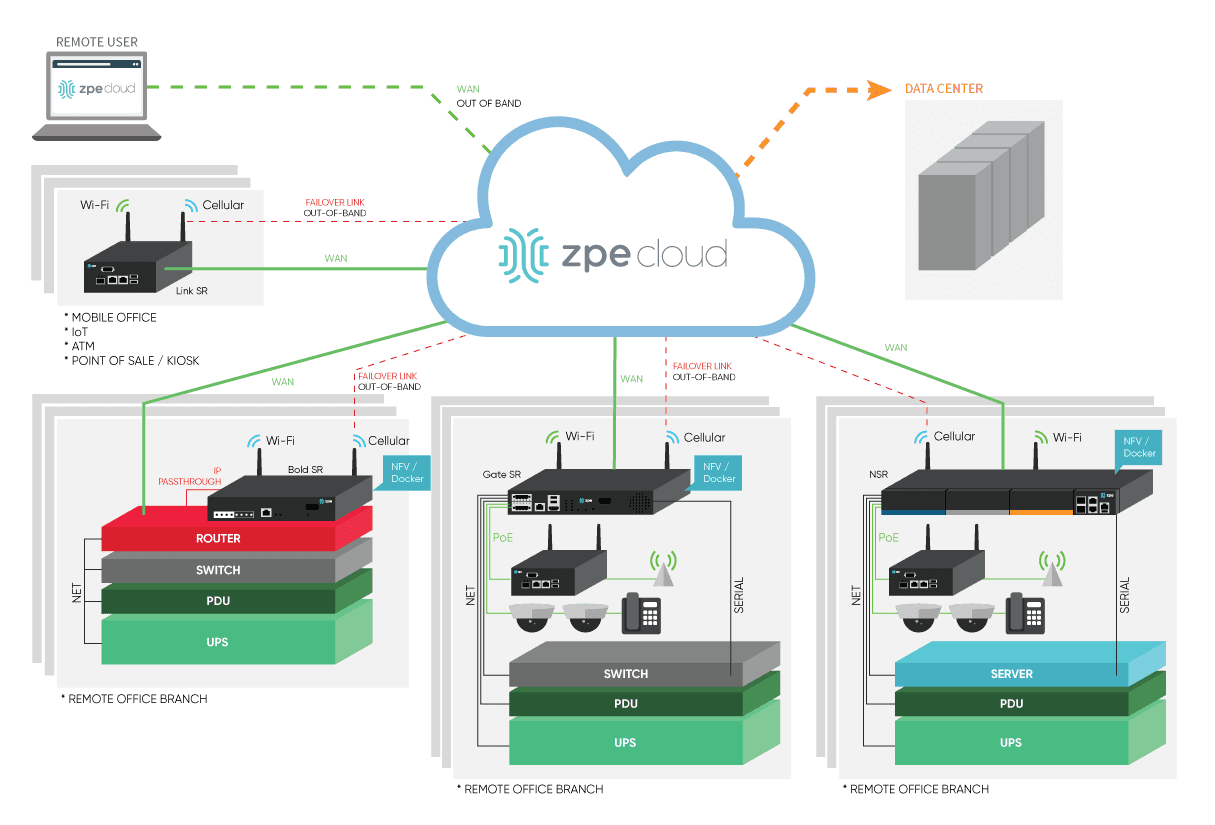
ZPE Systems streamlines deployment and management of the SD-Branch to decrease downtime and cost of maintenance. With a strong data center background, the team at ZPE brings their Out-of-Band (OOB) expertise and extends it out to the Remote Office/Branch Office (ROBO) by providing users the ability to establish a 24×7 remote virtual presence throughout their network.

ZPE System’s Nodegrid provides end-users with the ability to provision and deploy devices in remote locations without putting specialized staff on-site. The Nodegrid platform empowers SD-Branch, SASE, Firewall, and IoT partners to collaborate on a symbiotic network and OOB environment, complete with cellular failover, network clustering, and cloud management. With an automation feature built into the solution, it helps eliminate manual errors and standardize procedures and the deployment of repeatable tasks. Besides, the Nodegrid platform removes the need for multiple boxes and complex configurations. The company’s platform is a vendor-neutral solution and also virtualizes guest-OS applications and offers SASE-and SD-Branch-integrated services. This helps ZPE deliver simple, centralized remote management via one console. “Since our solution provides a remote virtual presence and decreases the number of devices onsite, it not only simplifies managing and upgrading those systems but also reduces operating costs as on-site IT support and maintenance are redundant,” explains Zimmermann. Furthermore, companies can extend their networking options via Guest OS and SVN, compute power options by deploying uCPE on Nodegrid Compute cards, and IoT options by using Docker and Kubernetes applications on Nodegrid.

Eliminating the Need for Shipping Pre-configured Devices

“Another key functionality ZPE Systems provides companies is the ability to remotely configure devices securely and do away with the need for shipping pre- configured devices to their branch,” says Zimmermann. The company provides a cloud-based management platform called “ZPE Cloud” that simplifies initial deployment, configuration, and ongoing management of branch devices and provides users with a 360 overview of their entire implementation along with in-depth analytics for enhanced decision making.

“The beauty of our solution is that we access via the cloud securely, to act as if you are on-site and get your environment running securely without sending a team or pre-configured device to the site,” elucidates Zimmermann. The ZPE cloud is a multi-tenant, highly secure cloud platform that enables users to manage, monitor, and deploy consistent automated provisioning of their systems on a global basis. ZPE Cloud brings together all Nodegrid products on a single platform. Users can reconnect their branch to a NOC automatically and securely via VPN or IPSec, even if Nodegrid was the first device deployed at the office. “Overall, it’s a cost-effective and smarter way to deploy devices in remote environments,” adds Zimmermann.

A New Paradigm in Networking Solutions

“Innovation is our biggest differentiator. We routinely collaborate with our customer’s network architects and engineers on future requirements and solutions. Therefore, we are building new use cases before anyone else in the market,” states Zimmermann.

ZPE Systems is continuously working with companies from various industries to test and implement new technologies. The effectiveness of ZPE Systems solutions was on full display when it assisted a large firm to provision and remotely manage devices across hundreds of locations in diverse environments and deploy SD-WAN as a virtual guest-OS. By implementing the company’s Nodegrid solution, the customer was not only able to use zero-touch provisioning and remotely manage their boxes, but they were also able to consolidate high-level, multi-tiered SASE solutions (128T routing and Palo Alto level 4 firewall) into a high-availability configuration. ZPE Systems has helped automate provisioning and implement a seamless setup, thus supporting the customer’s many complex VM architectures. Furthermore, since the customer decreased their reliance on field engineers to go to each of these remote locations (decreased costs and downtime), it helped in closing back-door security risks by eliminating the practice of shipping pre-configured devices.

Thanks to the company’s customer centric approach to formulating solutions, ZPE Systems has expanded and brought their expertise across international waters to Europe by establishing its European headquarters in Dublin, Ireland, with engineering development centers in the US, Brazil, and India. “Our competitive edge is driven by customer interaction. We can listen to the customer and make engineering changes quickly and swiftly, to meet their needs,” says Livio Ceci, VP of Engineering.

In the current scenario, enterprises are undergoing digital transformations more than ever before by adding new applications to boost productivity, reduce costs, and meet the growing demand of their customers. There is tremendous pressure on CIOs and IT leaders to orchestrate a new network strategy to protect and control all business-critical applications in real-time, regardless of the size of their network, sites, or users. As the enterprise networking space continues to evolve and drive companies to keep pace, ZPE Systems solutions and services, coupled with their thirst for innovation, have hit the sweet spot to meet the ever-changing requirements of clients. “We will continue innovating and pushing additional appliances for new functionality in OS and Cloud. We want to extend our partnerships with major market-leading cyber-security companies” concludes Ceci.

I Want to Learn More About Nodegrid