Providing Out-of-Band Connectivity to Mission-Critical IT Resources

SASE & Zero Trust: How They Come Together to Improve Network Security

shutterstock_1908952546

How do secure access service edge (SASE) and zero trust work together to improve network security? Simply put, SASE works by deploying security via the cloud, and zero trust deploys security in the least privileged access method.

Networking trends have heavily shifted in favor of SASE following the shift to remote work. Gartner predicts that 60% of businesses will adopt or begin to adopt a SASE-oriented model for their company by 2025. Let’s discover more about how SASE and zero trust work together to benefit large enterprise networks.

SASE and zero trust defined

The rise of SASE has made it one of the most talked-about terms in the world of networking, but defining it in simple terms has proved challenging for some. Palo Alto Networks defines SASE as a convergence of several protocols into a cloud-based interface, including wide area networking (WAN), cloud access security broker (CASB), firewall as a service (FWaaS), data loss protection (DLP), and zero trust. 

SASE uses edge computing to solve the inherent bandwidth issues caused by the in-and-out traffic of proxy connections to SaaS programs via the company data center. SASE allows companies to apply their security measures to these programs, preventing possible security leaks and mitigating them when they do happen.

SASE’s emphasis on applied proxy security is due to zero trust architecture, which has recently gained popularity. Traditional models have used a “castle & moat” approach, installing firewall protection around a business’s network perimeter. These models assume, however, that devices within the network are inherently trustworthy. Zero trust architecture never changes these protocols to make such an assumption, demanding that the user or device provide credentials regardless of circumstance. Learn more about the SASE model’s key use cases and benefits and the zero trust security benefits for large companies. 

How SASE and zero trust work together

The new focus on proxy connections is what truly defines both SASE and zero trust. Whereas the company data center used to act as the nerve cluster of business operations, that role has now been fundamentally decentralized and relegated to many smaller data paths coming from remote locations. 
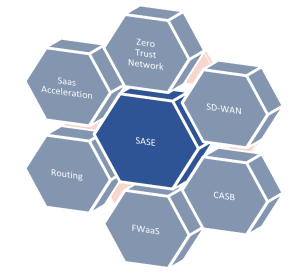
SASE: Zero Trust, SD-WAN, CASB, FWaaS, Routing, and SaaS Acceleration.This decentralization means an increased reliance on programs found in the cloud, as it offers the most convenient access for employees working from home. This is the ultimate goal of SASE; the use of edge computing to redirect traffic from the data center to the cloud, easing the traffic flow.

2020 saw a rise in cybercrime due to an increased dependency on unprotected (or poorly protected) cloud and remote access programs during the pandemic—the FBI reported a 75% increase in daily cybercrimes by June. This exposed a dire need for protocols that offer security rules. Zero trust architecture provided precisely this opportunity, using SASE’s emphasis on edge computing to issue company protections from proxy locations onto cloud-based services.

However, zero trust security doesn’t just provide multiple checkpoints for potential users in a network; it also restricts user access once checkpoints have been cleared. Think of your enterprise network like a concert—the ticket gets you into the venue, but if you want to access the VIP or backstage areas, you need to clear additional checkpoints with an ID badge or backstage pass. With zero trust security, users and devices only gain access to the specific resources they’ve authenticated to—they’ll need to prove their identity and verify their privileges if they want to move to any other area of your network.

These security protocols are critical to successful SASE implementation, as it allows companies to implement their security protocols for SaaS programs and mitigate potential leaks when they do happen. Together, they provide the best of both worlds, allowing for a decentralized network model that still provides the security needed for such a model to exist. It is precisely this balance between access and safety that makes SASE and zero trust what you need to shield your business as you continue to accommodate remote work and distributed users.

Why does my company need both SASE and zero trust?

A SASE network implementation lacking zero trust principles is left drastically exposed to potential cyberattacks. For example, the lack of internal protection ensures that a more extensive information leak could happen.

Consider what would happen if you implemented SASE without zero trust, and a hacker used a compromised account to connect to one of your cloud applications. In addition to stealing the data available in that cloud app, they could potentially jump to other edge resources using the same username and password, or even find an access point to your primary enterprise network. The more lateral movement that account has on your network, the more sensitive data they could exfiltrate. Additionally, the absence of intensive logs ensures that these leaks will consume a great deal of time and energy as network managers attempt to locate and neutralize threats when they arise.

On the other hand, while it’s never a bad idea to put extra measures in place to secure your data, the purpose of zero trust is to handle edge computing access to cloud-based SaaS applications. Zero trust is a welcome addition to your existing security stack and removes the necessity of having a centralized model.

Talking about SASE and zero trust individually makes the two of them sound as though they are mutually exclusive; they aren’t. Zero trust security is one of many programs integral to the successful implementation of SASE. This listing of the key SASE components gives more context regarding how these systems work together.  

Implementing SASE and zero trust protocols

The advantages these two protocols offer companies stem from the way they are used together. When combined, SASE and zero trust allow companies to recenter their business models around a proxy structure. This new model gives employees the flexibility of working from home while ensuring that sensitive information remains safeguarded against ransomware and cyber attacks. Palo Alto Networks cites that the advantages of combining SASE & zero trust are: 

  • Stronger network security
  • Streamlined network management
  • Reduced costs of deploying security at scale
  • A single, holistic view of the whole network

The final benefit listed above is worth further consideration. Instead of viewing your company’s systems as individual pieces, conversion to the SASE model allows you to view your company’s network through a single lens. This helps to streamline your business model even further, making you that much more competitive in the workplace of tomorrow.

We encourage you to read Gartner’s roadmap for SASE convergence for more information. 

Ready to begin your conversion to SASE?

Our products page boasts several options to get you started. Contact us for further questions and get started today! 

Contact Us

The Importance of Micro-Segmentation for Zero Trust Networks

shutterstock_1920245057

As workloads, applications, and data move to the cloud and business operations expand to include branch offices, remote data centers, and work-from-home staff, how do you define your network security perimeter? With zero trust networks, you don’t have to.

Zero trust security doesn’t follow the old “castle and moat” strategy of assuming everything on an internal network is safe and creating one large security perimeter (or moat) to protect it. Instead, zero trust security follows the principle of “never trust, always verify.” Any user, device, or application that requests access to a sensitive network resource needs to verify its identity and prove its trustworthiness, whether they’re 3,000 miles away or in a cubicle down the hall.

To implement zero trust security, shrink your focus from one large network perimeter to the individual systems and services that need protection. And to do that, you need network micro-segmentation. Let’s discuss micro-segmentation for zero trust networks, how it works, and its importance.

What is micro-segmentation for zero trust networks?

Traditional network security perimeters need to encompass the entire enterprise and edge network to protect all data, accounts, devices, and applications. Not only do you need to extend the perimeter to include cloud and remote resources, but you also need security controls at that perimeter to account for every single vulnerability. You may end up with a bloated, expensive patchwork of appliances and services that are a hassle to manage across platforms. Even worse, the difficulty of managing such a large perimeter could leave gaps in security coverage.

Instead, a zero trust network focuses on breaking down the perimeter into a series of smaller micro-perimeters around the necessary resources needing protection. You use micro-segmentation to logically separate network data, applications, assets, and services so that you can then implement the specific security policies and controls needed to secure each of those segments. To ensure maximum protection without impacting productivity, you can address specific security vulnerabilities, access needs, and interdependencies of each micro-segment.

The importance of micro-segmentation for zero trust networks

You can’t implement a zero trust network without micro-segmentation for the following reasons:

1. Granular access policies. 

When micro-segmenting a network, you can create exact policies dictating who and what can access each segment. This means you can apply for the least privilege access, granting users and devices access to only the bare minimum network resources they need to accomplish their tasks. Using the principle of least privilege helps you control lateral movement within a network in the event of a breach. 

For example, during a recent attack on Microsoft Exchange servers, hackers gained access to compromised email accounts. If one of those compromised accounts had unrestricted network access, it could have been used to cripple an enterprise network. However, if that compromised account only had the least-privileged access, the hacker would be limited to the specific applications and files that particular user had rights to access, and couldn’t jump to more critical systems and servers.

2. Targeted security controls.

A micro-perimeter of security controls protects each zero trust network micro-segment. This means you can develop each micro-perimeter to specifically target the security risks and vulnerabilities of the resources in that micro-segment. Protecting a file server in a local office requires different tools and policies than you would use to protect an enterprise application hosted in a public cloud. 

For on-premises systems, you’re responsible for physical security (e.g., biometric locks on doors, CCTV security cameras in the data center, etc.) as well as network and endpoint security, for example. In a public cloud, you share some responsibility with your provider. Still, you also have to worry about securing API connections, extending identity management to your edge, and other cloud-specific concerns. Zero trust micro-segmentation ensures you can always apply the proper security controls for the job.

3. Establishing identities and trust.

To follow the principle of “never trust, always verify,” you need to establish the identity and trustworthiness of an account or device before it can access any network or cloud resources. This is much easier to do if a network is micro-segmented because you can incorporate zero trust identity and access management (IAM) into the micro-perimeters. You get greater visibility and control over how trust is established for individual applications and data, which means you can ensure your security policies are applied correctly.

For example, just because an entry-level employee has access rights to a cloud-based accounting app doesn’t mean they should have the same access to the on-premises financial database. However, an SQL service account might require the same level of access to both. When you microsegment your network and implement IAM controls at each micro-perimeter, you can ensure that your granular security policies prevent unnecessary and unauthorized access while allowing critical services and accounts to access the resources they need.

In short, micro-segmentation is the foundation upon which to build a zero trust network. Dividing an enterprise and edge network into micro-segments allows you to implement specific security policies and controls, verify identities, and establish trust for the individual resources you’re trying to protect.

How to implement micro-segmentation 

Now that you understand why micro-segmentation is essential, you’re ready to apply it to your enterprise zero trust network. Depending on your security requirements, business goals, and existing infrastructure, you can use various strategies and tools to micro-segment a network. Here are a few best practices to keep in mind:

  1. Start by mapping existing network traffic flows and interdependencies. You don’t want to accidentally create a micro-perimeter that isolates an enterprise application from a critical data source, for example.


  2. Identify every “protect surface” or network resource that needs to be defended and then use your traffic flow and interdependency map to inform how you micro-segment the network around each protect surface.
  3. Consider using a vendor-neutral zero trust framework that integrates your IAM solution, next-generation firewall, and other zero trust network technologies to simplify network management.

You can’t implement a zero trust security strategy without network micro-segmentation. Micro-segmentation allows you to establish specific security policies and controls. It also makes it easier to verify the identity of the users, devices, applications, and other entities on your enterprise network.

Nodegrid’s open platform simplifies micro-segmentation for zero trust networks

To implement micro-segmentation for zero trust networks, you should look for a zero trust framework that integrates all your security controls and technologies to provide one simplified management interface. For example, ZPE Systems has partnered with providers like Okta and Palo Alto Networks to deliver the Nodegrid Zero Trust Security Framework Foundation. 

Nodegrid allows you to consolidate all your zero trust network management into one unified control panel. You can also use the Nodegrid solution to manage your remote and branch infrastructure with out-of-band network management and software-defined wide area network (SD-WAN) technology.

Want to learn more about how ZPE Systems can help you implement micro-segmentation for zero trust networks?

Contact us or call 1-844-4ZPE-SYS.

Contact Us

What Are the Key Zero Trust Security Principles?

shutterstock_497278348

Perimeter-based security is no longer sufficient for today’s enterprise network. You may even struggle to define your network perimeter anymore, mainly if you use cloud infrastructure, have remote data centers and branch offices, or rely on “Internet of Things” (IoT) devices in the field. Zero trust security addresses the weaknesses in a perimeter-based strategy by focusing on protecting and securing your users, devices, and services wherever they may be located.

The methodology of zero trust security is “never trust, always verify.” That means you operate under the assumption that no network entities should be trusted, whether they’re inside or outside the enterprise network. To implement this strategy, you must understand the key zero trust security principles and how they work together to protect your enterprise.

What are the key zero trust security principles?

For a successful zero trust security implementation, your enterprise should follow these four key principles:

1. Define your protect surface, not your perimeter

The first key principle of zero trust security involves shrinking your focus from the network perimeter to the individual systems and services you need to protect.

Traditional perimeter-based security strategies require you to identify and defend an attack surface—the sum of all the potential vulnerabilities and access points that a hacker could use to breach your network. You then need to create and maintain a perimeter around your entire network, with security policies and controls that account for every possible weakness.

However, as your enterprise networks expand to include remote data centers, public cloud platforms, work-from-home employees, and other complications, your attack surface grows more complex. How do you create and defend a perimeter that large, and how can you possibly account for every network vulnerability with one set of security policies and controls? With zero trust security, you don’t have to.

Instead, you need to define your protect surface in a zero trust security strategy—each specific network entity you need to protect from an attack. A protect surface should fall under one of these four categories, known by the acronym DAAS:

  • Data: The sensitive, proprietary, or legally regulated data that you need to keep private. You should identify and classify your data based on its value (to your company and hackers) and relative sensitivity so you can implement the right security policies and controls to protect it. The best way to do so is with data discovery tools that automatically index, classify, and organize data according to your requirements.
  • Applications: The applications that introduce security vulnerabilities to your network, contain proprietary code, or process sensitive data. You also need to protect and map all application interdependencies (e.g., databases, enterprise servers, third-party integrations, etc.) to ensure your security controls don’t break anything or leave any weaknesses unaccounted for. Automation is also recommended for this task—you can use application dependency mapping software to identify and trace interdependencies on your network.
  • Assets: The devices that connect to your enterprise network. In addition to inventorying your users’ laptops, cell phones, and other desktop devices, you also need details on every point-of-sale terminal, security camera, and IoT device. No matter how small or inconsequential a device is, if it touches your network, you need to know what it is so you can protect it. You’ll also need device details such as the serial number and firmware version to verify its identity with your zero trust security controls. You should employ an automated device discovery tool to find all the devices on your network and collect the necessary information.
  • Services: The business-critical services that a hacker could take down to cripple your networks, such as DNS, DHCP, and Active Directory. Hackers can also use these services to gain access to other areas of your network with more valuable data—for example; a recent report found that 79% of companies experienced DNS attacks in 2019. If you’re following network management best practices, you should already monitor these services, which makes this step easier. Otherwise, you need to invest in and implement a comprehensive infrastructure and network monitoring solution. You simply can’t adopt a zero trust security strategy without complete visibility on your entire enterprise infrastructure.

Defining your protect surface is the first principle of zero trust security because you simply cannot apply any of the following components without this information. Once you’ve done that, you can move on to principle No. 2.

2. Apply micro-segmentation and micro-perimeters

The second principle of zero trust security is segmenting your network as much as possible, and then you can apply highly specific security policies and controls in your micro-perimeters.

After you’ve defined your DAAS, mapped interdependencies, and identified the individual vulnerabilities and access points that need to be protected, you can determine how you’ll segment your network. Look at which items can be logically sorted together based on who or what needs access to them, which security controls are required to protect them, and how they interact with other resources inside and outside your enterprise. Then, you’ll create your micro-perimeters around each network segment.

The goal is to create policies and controls that are highly precise to the DAAS you’re protecting. You should use the principle of least privilege (PoLP) to inform your policies. PoLP states that network entities should only receive the permissions necessary to perform their function. This ensures that a compromised account can only access limited resources on your network, which reduces the amount of potential damage a hacker could do to your network.

You’ll need advanced firewalling technology to create your micro-segments and micro-perimeters and to enforce your policies. For example, you could use a firewall as a service (FWaaS) solution that takes all the next-generation firewall functionality and makes it available as a cloud-based software platform. You can use FWaaS to manage your zero trust micro-perimeters across your entire enterprise network, including in the cloud and remote data centers.

These first principles focus on how to implement a zero trust security strategy. Next, we’ll look at the principles involved in actively using a zero trust security strategy in your enterprise.

3. Assess trust dynamically and consistently

As previously stated, the foundation of zero trust is “never trust, always verify.” This means any time an account wants to access a network resource, you need to verify their identity and trustworthiness first. You must assess their reliability dynamically based on the context of the situation. Is this a standard time for this user to be online? Are they in a geographic location that makes sense in this situation? Has this account been involved in any suspicious behavior elsewhere on your network? You need to consistently apply the same criteria every time this account tries to access a network resource, whether they’re in the home office or traveling abroad.

To apply this level of scrutiny to all your network entities, you’ll likely need an identity and access management (IAM) solution that incorporates user and entity behavior analytics (UEBA). UEBA establishes a baseline for the expected behavior of users and network entities, so it can then spot unusual or risky activity and report it. Your zero trust IAM and firewall solutions can then use that information to assess the trustworthiness of the entity requesting access.

4. Monitor and optimize constantly

As mentioned above, you can’t implement zero trust security without complete visibility on every part of your enterprise network. You need monitoring tools to discover your DAAS, track the traffic flow between micro-perimeters, and verify that security policies and controls are being applied correctly, for example.

A zero trust security architecture can be very challenging to monitor because networks are so distributed and highly segmented. To ensure full visibility on every micro-segment, you need a monitoring solution that employs automation and machine learning to ease the burden on your engineers. For example, security orchestration, automation, and response (SOAR) solutions can detect security incidents, identify root causes, and apply or recommend remediations without any human intervention.

Some unified zero trust security solutions include monitoring functionality or recommend integrations that address these challenges. However, one of the benefits of zero trust security for enterprises is that you can often use your existing tools and infrastructure without needing an expensive upgrade. So, if you’re already using SIEM (security information and event management) or another automated network management solution, you can likely achieve the level of visibility you need.

Lastly, you should always look for opportunities to optimize your zero trust security strategy. With your monitoring logs and analyses, you should be able to spot any weaknesses or other issues with your micro-perimeters, policies, and controls. It is also necessary to keep building out your zero trust architecture as you add or change applications, infrastructure, and workloads. Additionally, you should keep an eye out for ways to smooth and optimize the process of creating new network segments and micro-perimeters.

Applying key zero trust security principles in your enterprise

Though zero trust security is powerful enough to protect modern enterprise networks from cyberthreats, the strategy can be broken down into four key principles. Abandon the idea of a large network perimeter and focus instead on identifying the individual data, applications, assets, and services you must protect. Larger enterprises need a heavily segmented zero trust architecture, with precise security policies and controls creating a micro-perimeter around each segment. With these policies and controls, you must dynamically and consistently assess the trustworthiness of every network entity and constantly monitor and optimize your zero trust network.

Applying these key zero trust security principles in your enterprise is much easier with a unified platform that integrates all your tools, features, and controls behind one pane of glass, like ZPE Cloud. Not only does ZPE Cloud provide vendor-neutral integrations with zero trust tools like Okta and Duo, but you can also use it to manage your entire infrastructure whether on-prem or in the cloud. ZPE Systems also offers the Nodegrid line of network management solutions for remote out-of-band network management, SD-WAN, and secure access service edge (SASE) to complement your zero trust security architecture.

Learn more about how ZPE Systems can help you apply zero trust security principles in your enterprise.

Book a free demo or contact us anytime. 

Contact Us

How to Implement a Zero Trust Security Strategy in an Enterprise Environment

shutterstock_1913848855

Large enterprises may be hesitant to adopt zero trust security because it may seem too disruptive to their business. However, cyberattacks on businesses continue to increase, costing affected enterprises an average of $3.92 million per breach, so it’s clear that traditional security strategies aren’t working anymore.

Even the President has addressed the need for heightened cybersecurity in an executive order explicitly requiring federal agencies to implement zero trust security policies and recommending that other organizations do the same.

The good news is, implementing a zero trust security strategy doesn’t require the dramatic, expensive network overhaul that many enterprises fear. Adopting a zero trust architecture is a gradual (and frequently cost-efficient) process that, when done correctly, requires minimal downtime and business disruption. Let’s look at the implementation process step-by-step and discuss some tips and best practices to ensure a smooth transition to zero trust security.


How to implement a zero trust security strategy in an enterprise environment

The foundation of zero trust security is the principle of “never trust, always verify.” Rather than creating a security perimeter around your network and assuming that everyone within that perimeter is safe, with zero trust security, you must verify everyone (and everything) that tries to connect to a resource, whether they’re inside or outside.

Implementing a zero trust security strategy in an enterprise environment is iterative, not something you should try to do all at once. Breaking your strategy into a series of small, repeatable steps allows you to improve upon the process as you and your team gain experience with zero trust principles and technologies.

Step 1: Define a protect surface

Older cybersecurity strategies usually focus on defining and defending an attack surface—the sum of all the potential points where an attacker could breach the network. This involves creating a security perimeter around your entire network and trying to keep sensitive data and vulnerable systems as far away from that perimeter as possible. The problem with this approach is that our networks are growing more extensive and more complex, increasing the attack surface and making it more challenging to identify and define every potential entry point.

In a zero trust security strategy, you should instead focus on defining a protect surface or each specific item that needs to be safeguarded from attack. A protect surface should include the data, applications, assets, and services—known as DAAS—that are most critical for your enterprise to protect from attack.

  • Data: You should identify and classify your data based on how important it is to your organization, how valuable it would be to hackers, and whether it’s subject to regulations like HIPAA or PCI.
  • Applications: You need to determine which applications use sensitive data or proprietary code that may be of value to an attacker.
  • Assets: You must create a detailed inventory of all your devices—not just laptops and cell phones, but also point-of-sale terminals, manufacturing equipment, IoT devices, and other network-connected assets—so you know what to include in your protect surface.
  • Services: You should identify all business-critical network services that need to be protected, such as Active Directory, DHCP, and email.

Rather than having one large attack surface to protect, you will have multiple smaller protect surfaces to focus on. Remember, implementing a zero trust security strategy is an iterative process, so it’s best to focus on one protect surface at a time. Once you define a protect surface, you will be able to move the required zero trust security controls as close as possible to create a micro-perimeter.

Doing so allows you to create individual security policies and procedures that are limited in scope to the specific requirements of that data, application, asset, or service. You can use network segmentation to granularly control and monitor traffic to a micro-perimeter and strictly limit which users and resources can request access. Defining a protect surface is thus an essential first step for implementing a zero trust security strategy for your enterprise’s DAAS.

Step 2: Map DAAS interdependencies

Once you’ve defined a protect surface, you need to map its traffic flows and interdependencies. You should document how specific resources interact with each other so that you can work these interdependencies into the security policies and controls of the micro-perimeter. Essentially, mapping your DAAS interdependencies allows you to safeguard a protect surface without accidentally breaking any related applications, services, or workflows.

Step 3: Construct the zero trust network architecture

There isn’t a perfect zero trust network design that you should strive to achieve—each zero trust network is customized completely around the protect surfaces. So, after you have defined a protect surface and documented traffic flows and interdependencies, you can build out your zero trust network architecture.

This involves implementing a micro-perimeter using the security controls you planned out in the previous steps. For example, you could use a next-generation firewall to segment your network based on a defined protect surface, create a micro-perimeter around that segment, and monitor traffic and enforce access control on all layers on the OSI model. This model is also known as the Open Systems Interconnection model and is a reference model for how applications communicate over a network. A traditional firewall only protects layers one through four (physical, data link, network, and transport). In contrast, a next-generation firewall also protects your upper stack (session, presentation, and application).

Step 4: Establish zero trust policies

Once you have implemented your zero trust architecture, you need to create zero trust security policies for the protect surface. You should use the “Kipling Method” to determine access, which means asking the following questions:

  1. Who should have access to this resource?
  2. What application is being used to access this resource?
  3. When is the resource being accessed?
  4. Where is this resource located?
  5. Why does the resource need to be accessed?
  6. How should you allow access to this resource?

Remember, you’re creating zero trust security policies for each protect surface and micro-perimeter, so you want to get as granular as possible to ensure only safe, known traffic and communication are permitted.

Step 5: Monitor and optimize

The final step is to monitor the protect surface and conduct frequent log reviews to ensure zero trust operations run smoothly. You should continuously monitor all user and device communication into and out of your new micro perimeter. This will allow you to detect and remediate potential latency, performance issues, and bugs, as well as create baselines for normal behavior. These baselines will make it easier in the future for your security teams and threat detection tools to spot unusual activity that could indicate a breach.

You’ll use the information you gain from monitoring and logging to improve the next iteration of your zero trust security implementation, as well as to continuously optimize your zero trust architecture. By focusing on one protect surface at a time, you can gradually expand your zero trust strategy to iteratively encompass more data, applications, assets, and services until you’ve transitioned your entire network to a zero trust security strategy with minimal disruption to your enterprise.


Additional tips for implementing a zero trust security strategy


shutterstock_1678402276

Assess your zero trust security capabilities

One of the most significant benefits of zero trust security is that it doesn’t require an expensive or disruptive technology overhaul to achieve. Instead, the goal is to augment your existing network architecture as much as possible using zero trust tools, policies, and procedures. Because of this, it is recommended that you start by assessing the zero trust capabilities of your existing architecture and tools, so you can identify the gaps in your zero trust readiness and avoid spending money on solutions you don’t need or already have.

Identity and access management

Many enterprises find that their zero trust readiness is hampered by deficient identity and access management (IAM). It is challenging to implement a zero trust security strategy without investing in a unified IAM solution that specifically supports zero trust principles and security controls. You should look for a centralized platform that supports zero trust IAM requirements like single sign-on (SSO), multi-factor authentication (MFA), and passwordless authentication, like Okta, for example.

Data discovery and classification.

Identifying the data that needs to be protected as part of your DAAS is much easier when you use the data discovery and classification tool. No matter what business you’re in, your enterprise is likely processing a vast amount of data every day, making it very challenging to manually identify, locate, and prioritize the data you need to protect. There are various specialized data discovery and classification tools that work across multiple industries, but you may find that one of your existing technology solutions already includes data discovery features, such as Azure Data Protection.


Implementing the ideal zero trust security strategy

Your enterprise’s transition to a zero trust architecture will be a gradual process, and it will need to be repeated every time you add a new protect surface to your network. Every time you expand your zero trust architecture, you should refine and optimize the implementation process which will help your security grow progressively stronger.

By following this iterative process and implementing the right tools and technologies, your enterprise can implement a zero trust security strategy that supports your business goals and keeps your network protected.

Want to learn more?

Contact us to learn more about how ZPE Systems can simplify your zero trust security strategy with Nodegrid’s Zero Trust framework.

Contact Us

Zero Trust Security for IoT: How to Secure Your Network

Zero trust and IoT concepts connected in an optical network

The internet of things (IoT) is driving companies to rethink how they secure their networks. When you introduce unmanaged, internet-connected smart devices to your network, you’re also introducing many new potential access points for malicious actors to breach your security.

  • For example, hackers frequently target IoT smart devices like security cameras, printers, or even smart coffee machines that are forgotten about or left unsecured, then use those devices as a gateway to the rest of your network. That’s where zero trust security for IoT can help.

Zero trust is a relatively new security model based on the principle of “never trust, always verify.” Unlike a traditional castle-and-moat security architecture, in which the users and devices within a network’s perimeter are automatically trusted, zero trust requires the verification of all users and devices every single time they connect, even from inside the “moat.”

Some enterprises have already adopted zero trust security for their users, but it can also apply to IoT devices. Here are the best practices and considerations for implementing zero trust security for IoT.

Best practices of implementing Zero Trust Security for IoT

There are essential practices, challenges, and considerations you need to be aware of before implementing zero trust security for IoT, including:

Starting with the basics

Before you apply zero trust to IoT smart devices, you need a solid foundation in the basics of zero trust security for users. These are the fundamental requirements for managing zero trust security for users:

  • First, implementing a zero trust methodology requires a culture shift within your organization, which can be a gradual process. You will need to create and apply robust administrative policies governing network access and permissions and train your IT teams and end-users on following those policies.
  • Second, you need to implement the tools and technologies required to verify user identities, obtain visibility on any devices those users connect to the network and make automatic access decisions using real-time risk analysis.

Expanding Zero Trust Security to IoT

After establishing zero trust security for your users and their devices, you need to expand it to include unmanaged, non-user devices. To do so, you need zero trust identity management tools to register devices and issue credentials automatically and to provide passwordless authentication.

Device visibility

To successfully employ zero trust security for IoT, you need complete visibility into all your devices. First, you need to discover and inventory all your IoT devices, including those at remote branch locations. You should track device information such as serial numbers, software and firmware versions, and operating system configurations. You also need to assess and log the security risk profile of each IoT device that connects to your network, so you know which security controls to apply.

When performance issues or bugs start to occur frequently, it could be a sign of malware or a security breach; additionally, a device that’s not functioning properly could be more vulnerable to attack. To establish and maintain zero trust security for IoT, you need device health monitoring that can automatically detect issues and flag them for remediation. Some advanced solutions can also automatically block an affected device from further connection attempts or automatically execute remediation tasks without human intervention.

Many IoT device management platforms offer device visibility functionality – for example, Azure, Google, and AWS all include discovery and monitoring features as part of their IoT offerings. Some endpoint security solutions,, include IoT device monitoring and security features, so you may want to evaluate your current security platform to see if you can add or activate this functionality. Or, since you’re implementing an entirely new security methodology to your IoT environment, you may want to look into a zero trust security and monitoring solution that’s designed specifically for IoT, such as Palo Alto Networks IoT Security.

Principle of least privilege (PoLP)

Zero trust security is used frequently in conjunction with the principle of least privilege (PoLP), which states that any user or device should only receive the bare minimum access privileges required to complete their job functions. To implement PoLP for IoT, you must determine the minimum amount of network access needed for each device to perform its functions and then limit its potential privileges accordingly. One way to achieve this is by implementing identity and access management (IAM) tools and policies that support zero trust and PoLP for devices.

In addition to PoLP, zero trust security frequently uses device segmentation. Essentially, you fence IoT devices into zones, only allowing them to request access to network resources within their assigned zone. Additionally, segmenting your IoT devices will enable you to create micro-perimeters, another cornerstone of zero trust security.

Essentially, each network segment gets a specific set of security controls and policies designed around the individual needs and risk profile of the IoT devices in that zone. Those controls and policies create a micro-perimeter that protects your IoT devices and limits their network access. This means you’re also limiting the amount of damage that hackers can cause to your network if one of those devices is compromised. One popular tool for creating network segments, establishing micro-perimeters, and monitoring and controlling access requests and network traffic is a next-generation firewall.

Security monitoring

Last but certainly not least, you need security monitoring for all of your IoT devices. With unmanaged smart devices, you need to ensure that security issues can be detected and remediated automatically. It might be days or weeks before a human comes into contact with one of those devices. For example, several years ago, attackers could breach a casino’s network security by hacking a smart sensor in a fish tank – the kind of device that employees don’t usually think about or work with regularly.

There are various zero trust security monitoring solutions designed specifically for IoT, like Palo Alto Networks’ IoT Security mentioned earlier. You can also use devices such as intrusion detection and prevention systems (IDS/IPS) or next-generation firewalls to monitor devices and network traffic. In addition to monitoring, your zero trust security solution for IoT needs to incorporate as much automation as possible so threats can be detected, isolated, and remediated even if nobody’s around to push a button or unplug a device manually.

The challenge of implementing Zero Trust Security for IoT

One of the biggest reasons zero trust security initiatives eventually fail is that adherence tends to drop off as soon as it becomes inconvenient. This is especially true for zero trust security with IoT. Maintaining zero trust for remote, unmanaged devices can be logistically challenging.

That’s why so many of the best practices involve using specialized tools to automate and simplify the management of zero trust security for IoT. In conclusion, the simpler it is to manage, the more likely you are to maintain it.

ZPE Systems Nodegrid can help you overcome the challenges of zero trust security for IoT.

Want to learn more? Contact us today or visit our products page for more information on how ZPE Systems Nodegrid can simplify your zero trust security for IoT deployments.

Contact Us

Zero Trust Architecture: What to Know About the Latest Cybersecurity Executive Order and How to Implement It

Without a zero trust architecture in place, your business might suffer a setback of $4 million or more due to cybercrime. That’s how much the Colonial Pipeline recently paid out after hackers shut down their oil delivery infrastructure and held its restoration for ransom (reference at bottom). The reality is, this is just a drop in the bucket when it comes to risks and losses overall, but it’s why cybersecurity and zero trust are again in the national spotlight.

On May 12, the President acknowledged the importance of protecting public and private sectors from incidents like these, by signing an executive order to improve the nation’s cybersecurity. One of the order’s main callings is for organizations to adopt a zero trust architecture.

Zero Trust Architecture

 In this post, we’ll examine some goals of this executive order and how it seeks to improve cybersecurity for both public and private entities.

But first, let’s recap zero trust and why it’s critical to protecting more than just sensitive data.

What is zero trust architecture?

A zero trust architecture is made up of systems that verify every user, device, application, etc. that tries to access a business’ IT resources. In networking, this involves creating micro-segments or perimeters within each network, and continuously verifying who and what is granted access.

The philosophy behind zero trust architecture is fundamentally this: trust nothing, because threats are everywhere, always.

Here’s a brief rundown of zero trust’s guiding principles:

  • Always verify — Treat every user, device, application, etc. as untrusted, and always verify to determine access.
  • Deny by default — Assume that your environment is already under attack, and continuously monitor for anomalies and malicious activities.
  • Grant least-privilege access — Allow users, devices, applications, etc. access to only the minimum resources needed to perform their jobs.

Zero trust isn’t a turnkey solution, nor does it rely on a single technology. Instead, it involves transforming network security by taking a holistic approach to safeguard every network interaction. This includes implementing hardware, software, and virtual solutions built with security in mind — from Trusted Platform Modules (TPMs), to multi-factor authentication and user access rights — as well as transforming security processes in your organization.

For a closer look at zero trust architecture and its origins, read our previous post.

Does zero trust architecture matter that much?

Zero trust architecture is key to protecting both public and private sector organizations. Though it can be more difficult to measure how attacks impact less tangible things like public safety or brand reputation, the cybersecurity risks are apparent just by looking at monetary losses.

In 2020, cybercrime cost businesses and consumers billions of dollars in the United States alone. In California for example, total financial losses reported as a result of cybercrime totaled more than $621 million, with leading types of crime including phishing, extortion, data breach, identity theft, and misrepresentation, among others. Other states including Colorado, Ohio, and New York ranked with staggeringly high losses as well, which ranged from $100 million to over $400 million.

Aside from causing financial damages, cyberattacks can open the door to allowing very sensitive info to fall into the wrong hands, which can jeopardize public safety and economic stability. Just imagine what malicious actors could do with classified government information or access to public or private infrastructure.

  • In early 2020, the major IT firm SolarWinds was attacked by hackers using malicious code. They successfully created a backdoor to access information and systems belonging to 18,000 SolarWinds customers, which include Fortune 500 companies and government agencies. The attackers were able to spy on customers and infect even more with malware.
  • In early 2021, hackers attacked on-prem versions of Microsoft Exchange Server using zero day exploits (flaws that haven’t yet been patched by the vendor). They were able to access email accounts and install web shell malware that gave them ongoing admin access to victims’ servers. It’s reported that more than 250,000 organizations have been affected worldwide.
  • In May 2021, hackers gained access to the Colonial Pipeline and shut down oil delivery. For six days, the 5,500-mile-long pipeline was offline. Because it carries 45% of the fuel used on the U.S. East Coast, fuel prices skyrocketed before a $4.4 million ransom payment was made to unlock the compromised systems and restore fuel flow.

These attacks and others could have been prevented — or at least dramatically reduced through better containment — with zero trust architecture in place.

For example, if a hacker attempted to embed malicious code into a device, this device would already be trusted in a traditional network security model. This implicit trust would allow the malicious code to go unnoticed, giving the hacker remote access to sensitive information and systems. But with zero trust architecture, implicit trust is eliminated. In this example, the hacker might still be able to remotely access the device, but micro-segmentation would deny access to other devices, and continuous monitoring and analytics would alert company staff to the anomalous activity. In essence, zero trust would contain the threat and help the organization pinpoint the system that requires attention, without having to suffer potentially catastrophic losses.

For all of these reasons, comprehensive cybersecurity is a must-have for organizations. The President’s executive order aims to help catalyze the rapid adoption of better cyber protection methods such as zero trust.

What does the cybersecurity executive order do?

The Executive Order on Improving the Nation’s Cybersecurity seeks to improve protection for federal government networks, and in turn encourage private entities to do the same for their own networks. To achieve these goals, the executive order focuses on three major areas:

  • Removing barriers to threat information sharing Until now, contractual barriers often prevented companies from sharing information with the government about cyber threats that compromised their security. The executive order removes these barriers, and also requires companies to share information regarding security breaches that could impact government networks.
  • Bringing stronger cybersecurity standards to the federal government
    Systems have historically become compromised due to outdated security models and best practices. The executive order seeks to modernize cybersecurity for the federal government, through the adoption of secure cloud services, zero trust architecture, and multi-factor authentication and encryption. The order attaches a specific time period (see below) by which federal agencies must develop plans for implementing these approaches.
  • Improving software supply chain security
    Software is inevitably shipped with vulnerabilities that can pose significant danger of being exploited. The executive order combats this by establishing baseline security standards for software developed and sold to the government. The order calls for the creation of a pilot program for an ‘energy star’ type of label that will allow organizations to easily determine whether software has been created securely. Additionally, the order creates a concurrent public-private process to foster secure software development; incentivizes the market with federal procurement; and requires developers to maintain greater software visibility and make security data publicly available.

Specifically regarding zero trust, the order states that within 60 days, the head of each federal agency must develop a plan to implement zero trust architecture. The order also states that within 90 days, the Cybersecurity and Infrastructure Security Agency (CISA) must assist the Secretary of Homeland Security and the Administrator of General Services to develop a federal cloud-security strategy and issue appropriate guidance to government-wide agencies. In all, these efforts will modernize the federal government’s cybersecurity as agencies move to cloud services and require more comprehensive network protection.

With the federal government leading the charge, the President hopes that private sector organizations will follow by implementing their own zero trust architectures and best practices. The executive order encourages these efforts through additional steps and resources, which include:

  • Creating a review board— The order calls for the creation of a cybersecurity safety review board. This board will be responsible for analyzing cyber incidents and making concrete recommendations that will improve security.
  • Creating a playbook — The order requires the creation of a standard playbook for responding to cyber incidents. This playbook will ensure government agencies can take uniform steps to identify and mitigate threats, and will also serve as a template for private sector entities to create their own playbooks.
  • Enabling better detection — The order calls for enabling government-wide endpoint detection, response systems, and information sharing to improve detection of cybersecurity incidents on government networks.
  • Creating log requirements— The order calls for improving investigative and remediation capabilities, through the creation of cybersecurity event log requirements for federal departments and agencies.

How can you implement zero trust?

Remember that implementing a zero trust architecture isn’t as simple as deploying a piece of hardware or software. Because the threat landscape is constantly evolving, you need to take a holistic approach in transforming your security from the inside out. Despite the risks that seem to loom larger with every passing day and make you anxious to fortify your networks, keep in mind that achieving zero trust is a gradual process. Here are some tips to help you overcome common challenges:

Think processes

  • Implement gradually — Zero trust is a reimagining of your network security model, so you need to implement it gradually at the process level. This will help you identify what needs urgent attention while also preventing you from making widespread changes that can create security gaps.
  • Perform routine maintenance — From a security standpoint, your requirements are constantly changing (adding customers, adjusting user access rights, etc.). Routine maintenance ensures that you don’t leave vulnerabilities on your network when, say, a new customer requires user group access, or one of your employees moves to a different department.
  • Consider employee productivity — If you’re a little too ambitious to implement zero trust, you could end up causing issues that affect your employees’ ability to do their jobs. Again, take time to gradually implement your zero trust architecture, so that you don’t inadvertently lock out an entire department or blacklist the wrong mail server.
Think technologies

  • Zero trust equipment and applications — Without the right infrastructure components in place, zero trust is only an idea. Bring it to life by deploying equipment and applications that can enforce multi-factor authentication, verify identities, and allow access only as needed.
  • Identity and access management for all equipment — A critical component of zero trust is being able to determine who needs access to your infrastructure. Because you need to limit admission on a need-to-know basis, your design and security teams need the appropriate tools that will allow them to map user access, and also precisely identify users and applications.
  • Complete and cloud-enabled security stack — Gone are the days of simply plugging into firewall devices for total security. With cloud models and distributed networks and staff, you need end-to-end security offered by segmentation capabilities, and also solutions such as Secure Access Service Edge (SASE). These give you the ability to provide secure, least-privilege access, whether users try to connect from HQ or using airport Wi-Fi on another continent.
  • Infrastructure edge platform to isolate, and connect it all — In order to bring everything together and remain in control of your solutions, you need a robust and secure edge platform. Not only will this help you securely fuse together your zero trust architecture components, but it will provide you with protected out-of-band management of your infrastructure. A truly powerful edge platform will also accommodate additional workloads to help detect, analyze, and automatically respond to threats.

Get serious about these zero trust technologies

With cyberattacks on the rise, tomorrow is too late to start thinking about zero trust architecture. Recent executive action means it’s time to get serious about fortifying networks and the sensitive data they handle. Read our next post for a deeper dive into the technologies that can save you from crippling ransomware and malicious attacks.

ZeroTrust-1

Questions? Contact us with your concerns about zero trust or to see a free demo.