

Modern networks are sprawling. Think about all the data centers, branch offices, edge locations, retail sites, and remote industrial environments that organizations need operating 24/7. Supporting these with apps and services requires vast networking infrastructure. But here’s the thing: the network is more critical now than it’s ever been, meaning downtime can be a major problem.
A single WAN outage, configuration error, device failure, or ISP issue can leave IT teams without access to critical infrastructure. Their access path and tools become useless. What should be a quick remote fix turns into hours of travel and on-site troubleshooting.
Why does this happen? Because many organizations still rely on traditional management – where remote access depends on the production network – and this architecture was never designed for today’s distributed environments. It leaves engineers cut off from the infrastructure they need at the exact time they need it most.
This is where out-of-band (OOB) management changes everything. OOB is an independent management layer separate from the production network. Engineers use this for secure access to infrastructure, even if there’s a device failure, routing error, ISP outage, or other downtime scenario. Out-of-band access is the foundation for resilient network operations because it helps organizations maintain visibility, accelerate recovery, and reduce downtime across distributed environments.
Best Practices for Deploying Out-of-Band Infrastructure
Deploying a proper out-of-band infrastructure requires more than just adding remote console access. The most effective deployments design for resilience, scalability, and operational simplicity from the beginning. Here are some best practices to follow when building your OOB network.
1. Separate the Management Network from the Production Network
We can’t say it enough: production networks are not management networks.
In traditional environments, remote management depends entirely on the production network itself. Engineers connect to routers, switches, firewalls, and servers using protocols like SSH or HTTPS. But they do this over the same WAN links and routing infrastructure they are responsible for maintaining. Which means that when the production network fails (for any number of reasons), those remote management paths also disappear with it. Visibility and control vanish when they’re needed most.
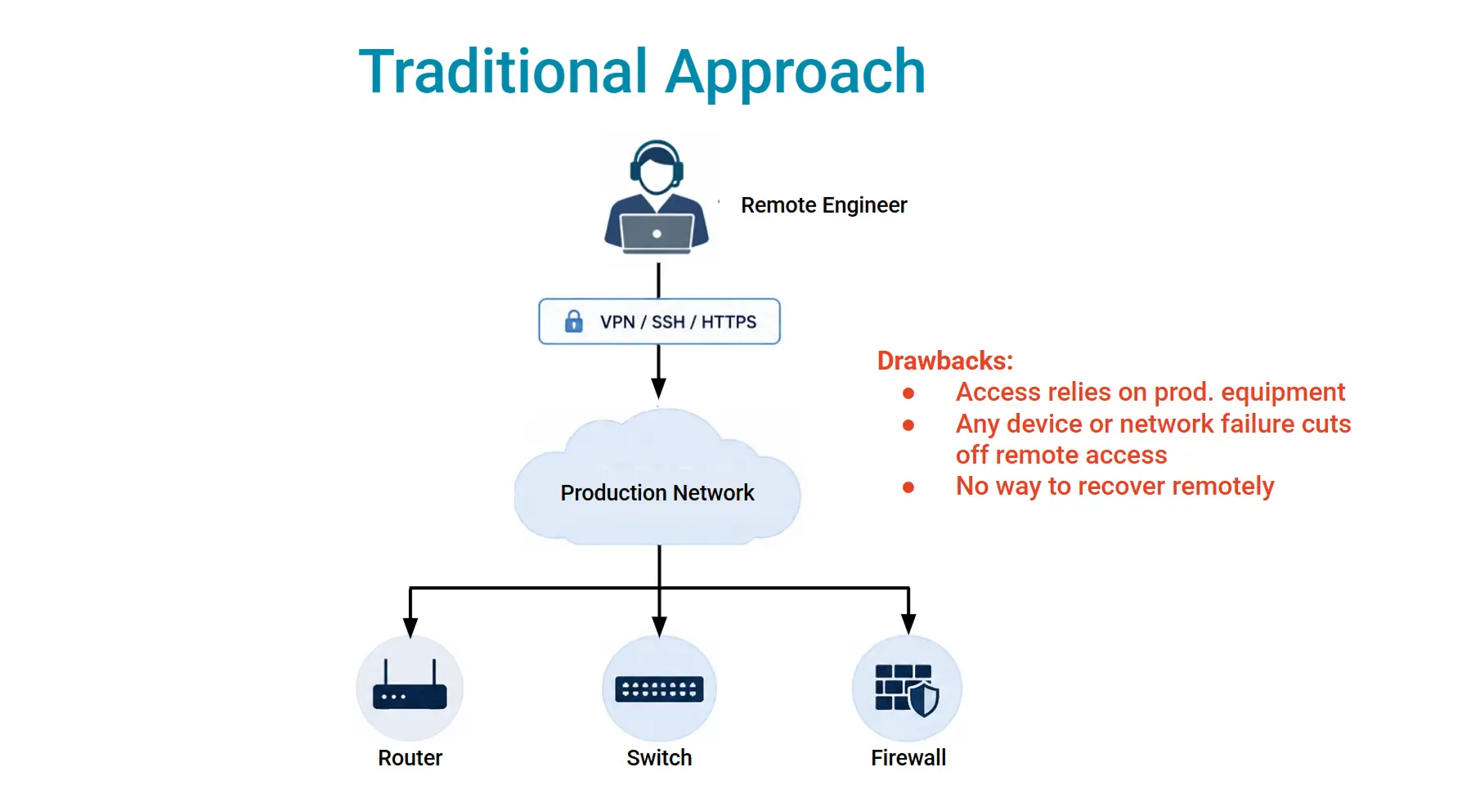
Image: Traditional remote management architectures rely on the production infrastructure, which is the exact infrastructure that needs to be managed.
Out-of-band management improves resilience by creating a management layer that remains accessible when the primary network experiences problems. When building your out-of-band network, follow the best practice of logically and physically separating it from production. This is what’s known as Isolated Management Infrastructure (IMI), and it’s what modern OOB designs incorporate to ensure admin access in worst-case scenarios.
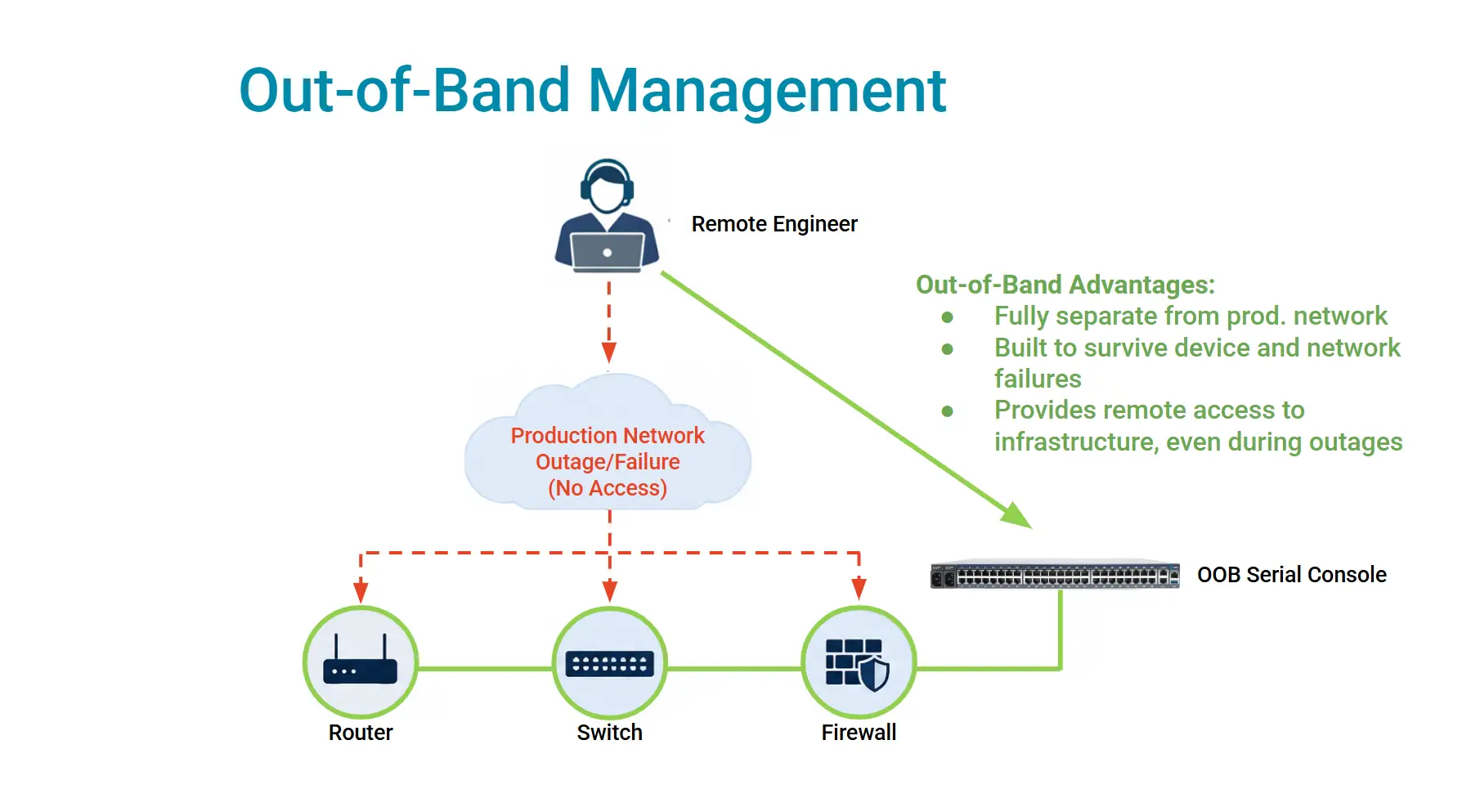
Image: Out-of-band management is built to withstand production network outages, and provides full remote access to infrastructure, even if the production network is completely offline.
2. Deploy More Than One Connectivity Path At Every Site
Having an out-of-band network is a great start. But, having only one connection can leave engineers hamstrung. If the OOB path suffers a WAN or ISP failure, admin access is cut off and sites become unreachable. Downtime lasts longer because restoring service requires a truck roll and on-site troubleshooting.
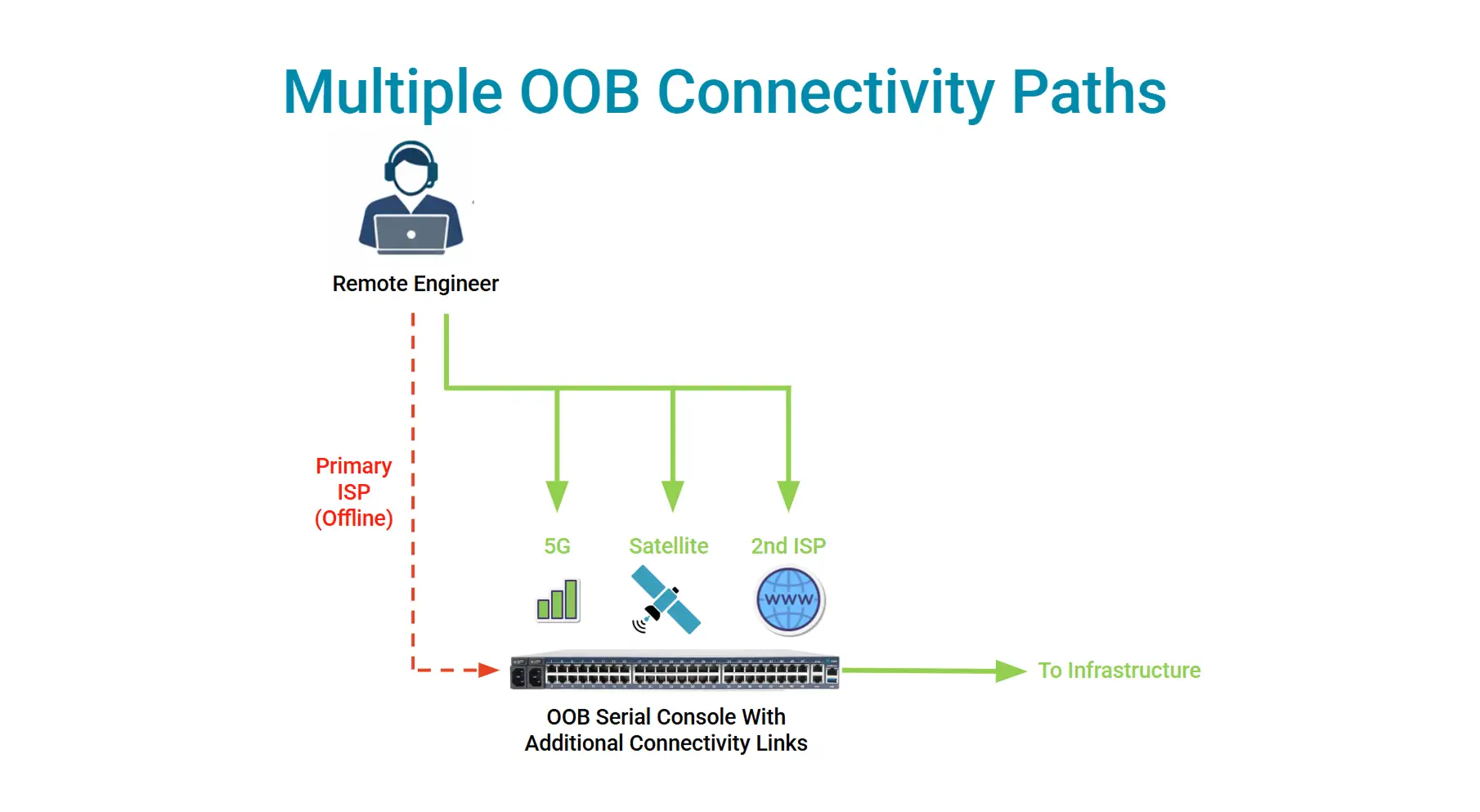
Image: Modern out-of-band management networks design for connectivity failures, and employ one, two, or even three backup link types (like 5G, satellite, secondary ISP, etc.).
Modern OOB networks are isolated, and just as importantly, they employ more than one type of connection. When building your out-of-band network, the goal is to ensure you maintain management access no matter what. Deploy multiple OOB access links at every site, like 5G, satellite, MPLS, etc. These layers of connectivity significantly improve recovery times and practically eliminate the need for truck rolls during incidents.
3. Standardize Infrastructure and Centralize Management
It’s difficult to manage sprawling networks when every site has bespoke configurations or tools, separate VPN connections, manual device inventories, etc. This approach is not sustainable in distributed environments because it slows down troubleshooting and creates operational bottlenecks/inefficiencies.
Imagine an engineer logging into devices one-by-one across different tools and interfaces – while juggling IP addresses and credentials for everything – and having to bring services back online ASAP during a severe outage.
Standardizing infrastructure and centralizing management eliminates this complexity by creating a consistent operating model across every site. Instead of managing devices through disconnected tools, spreadsheets, and manual processes, teams get a unified architecture for accessing, monitoring, and controlling infrastructure.
When designing your out-of-band network, the goal is to simplify operations at scale. Look for solutions that replace IP address spreadsheets and fragmented workflows with a centralized, intuitive interface. Prioritize platforms that eliminate manual configuration processes and instead enable zero-touch provisioning and standardized deployment templates. Consistent visibility and control across locations helps you troubleshoot faster, recover from outages efficiently, and operate a distributed network without complexity.
4. Reduce Hardware Sprawl Where Possible
Traditional out-of-band deployments involve multiple standalone devices for routing, failover, console access, and security. This approach works, but it creates unnecessary complexity at remote sites. More hardware means more power consumption, more rack space requirements, and more management overhead.
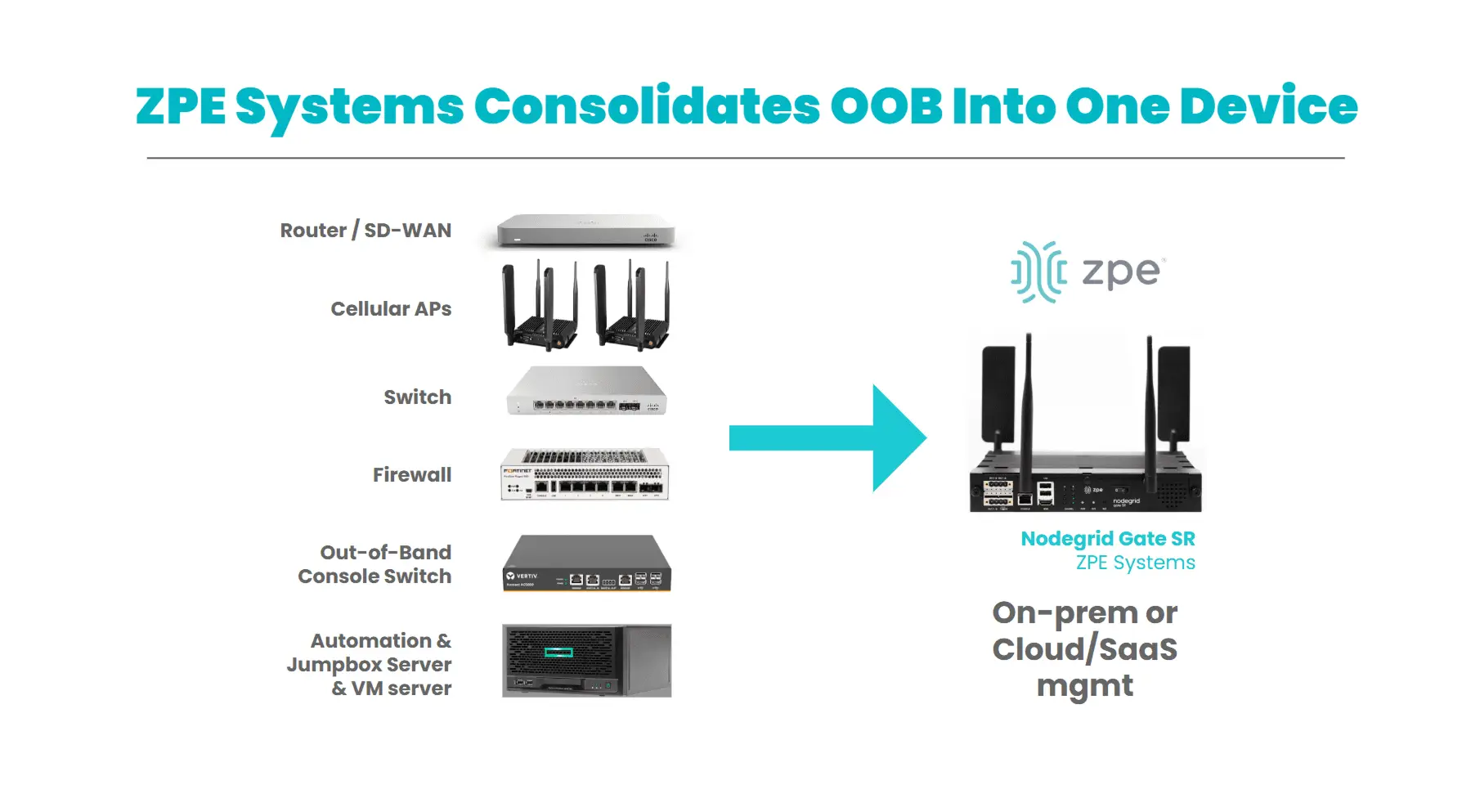
Simplicity helps with resilience, and modern OOB architectures design around this principle. When building your out-of-band network, reduce hardware sprawl as much as possible by consolidating functions. Look for devices that can handle routing, switching, cellular failover, and more in a single rack unit or less. This makes it much easier to deploy, maintain, and scale your out-of-band infrastructure.
5. Continuously Test Failure Scenarios
Having the resilience strategy and architecture in place is only part of the solution. Outages have a way of upending even the most meticulous plans. Failover processes, recovery workflows, and remote access procedures can behave radically different during actual incidents than they do during normal operations, so regular testing is a must.
Testing helps to identify gaps and fixes instead of discovering these during a real-world scenario. Just imagine scrambling during an outage because incorrect APN settings are preventing 5G connectivity, or expired certificates are blocking remote connections, or outdated firmware is causing compatibility issues.
Once your out-of-band network is built, make sure to regularly validate that engineers can access infrastructure during failure scenarios. You’ll gain the confidence that your out-of-band environment will perform as expected when it matters most.
Get Help Evaluating Your Environment
Connect with a ZPE engineer to discuss your current environment and see how to close any resilience gaps in your architecture. Get in touch using the form.
Build a Resilient Out-of-Band Network With These Resources
Out-of-band infrastructure provides the independent access layer required to reduce downtime, accelerate recovery, and maintain visibility during outages. But deploying an effective OOB strategy needs to account for connectivity, security, and scalability. We compiled these resources to help you build your resilient out-of-band network.