Providing Out-of-Band Connectivity to Mission-Critical IT Resources

Home » Edge Computing » Page 9

What Is Hybrid Cloud Infrastructure: Expectations vs. Reality

what is hybrid cloud infrastructure

Hybrid cloud deployments allow you to combine the best features of public cloud, private cloud, and on-premises infrastructure. But what exactly goes into hybrid cloud infrastructure, and how is it achieved? In this blog, we’ll compare the expectations of a hybrid cloud to the realities of implementation and provide advice on overcoming these challenges.

What is hybrid cloud infrastructure?

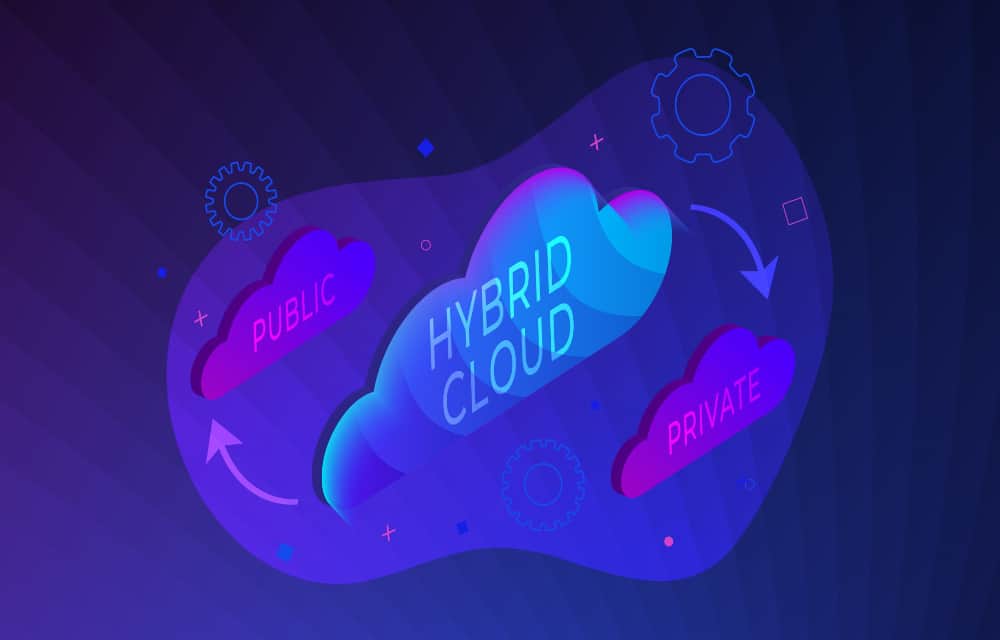
Hybrid cloud infrastructure involves using a combination of public cloud, private cloud, and on-premises data center environments. True hybrid cloud architecture allows you to move workloads back and forth among these environments safely and securely.

  • A public cloud is what most people think of when they hear cloud computing. Public cloud services are decoupled from the underlying infrastructure and delivered as a web-based application or platform. The actual compute resources are shared amongst many other customers. Examples of a public cloud include Microsoft 365 and Google Apps.
  • Private cloud infrastructure is owned and managed by a third-party provider, but other customers do not share the hardware you use. You rent dedicated storage and compute resources, but have no physical access to or control over the infrastructure. Examples of a private cloud include Microsoft Azure and Amazon Virtual Private Cloud (VPC).
  • An on-premises data center is a data center that your organization has complete control over. It may or may not be on the same premises as your headquarters office. Not all hybrid cloud infrastructures include on-premises environments—only public and private clouds are required.

The public cloud offers many benefits for enterprises, such as scalability and cost savings. However, organizations frequently need greater control over certain data and resources. For example, any company working with healthcare information, or providing services to the federal government, must follow strict privacy and security regulations. That’s why many organizations opt to keep some of their resources in on-premises data centers or private clouds.

That said, keeping these resources isolated from your public cloud services, applications, and data is not always feasible. There’s a need for interoperability and orchestration of workloads among mixed architectures. In a hybrid cloud infrastructure, there is a virtual service that acts as a managed “bridge” between different environments. This allows you to move workloads, applications, data, and other resources around as needed to ensure peak performance without compromising security.

Hybrid cloud infrastructure: expectations vs. reality

The expectation for hybrid cloud infrastructure is that all of your systems, services, and applications will work together seamlessly. Your data and other resources will be portable, so you can move them from one cloud to another without compatibility issues or other headaches. Most importantly, you’ll have a centralized, web-based platform to orchestrate workloads across your heterogenous environment. The reality of hybrid cloud, however, is often much more complicated.

Vendor lock-in

One major hurdle to implementing a hybrid network environment is closed ecosystems. Vendor lock-in can prevent your legacy on-premises solutions from interoperating with cloud hardware and software, and vice-versa. Data and applications designed for traditional infrastructure may be incompatible with cloud platforms. And not only do these systems all need to communicate and work together, but you also need an orchestration platform that can dig its hooks into disparate vendor solutions and control them equally.

Issues with vendor interoperability could force you to rebuild your entire stack just to enable hybrid orchestration. To get around this expensive and time-consuming challenge, you need a hybrid cloud infrastructure orchestration platform that’s based on an open architecture for true vendor neutrality. This will allow you to manage workloads across cloud and legacy environments without replacing the systems and software already in place.

Infrastructure complexity

Hybrid cloud infrastructure reduces the number of physical servers and storage devices you’re responsible for, so you might assume this will reduce the complexity of your network operations. This isn’t necessarily the case. The virtual and physical hardware responsibility is shifted to the cloud vendor, but your team will still need to know how to configure, monitor, and maintain all your cloud services.

In a hybrid cloud infrastructure, there are often many different platforms from different vendors. That means you need people who are experts in all these systems. Plus, you’ll also need a more complex network architecture to support a seamless hybrid cloud environment. That often means purchasing more boxes from more vendors, which your team must also learn to configure and maintain.

One way to reduce the complexity of your hybrid cloud infrastructure is by consolidating your networking stack. For example, you can use high-density serial console switches that provide out-of-band (OOB) management interfaces, network failover, environmental monitoring, and network switching. Similarly, you can look for modular, multi-function devices that allow you to create a custom box that includes all the specific hardware and functionality you need.This will reduce the number of devices in your rack and provide administrators with a single platform to manage all this functionality.

Spiraling costs

Cloud services are often less expensive to deploy and scale than on-premises infrastructure. Instead of a large up-front cost to purchase and install new hardware solutions, you typically pay a smaller recurring fee. When you need more resources, you simply upgrade your services for additional cost without needing to buy and configure more hardware.

The issue is that these recurring fees can begin to snowball over time, especially if you keep increasing your contract. Many cloud services often come in bundles or packages, meaning you can’t just pick and choose the functionality you need a la carte. So, you could end up paying for features you don’t even need.

Plus, you’ll incur additional costs if you need to rebuild part or all of your on-premises stack to enable hybrid cloud orchestration. The same goes for the networking technology that’s required for hybrid integrations. These expenses can be reduced by following the advice above—using a completely vendor-neutral hybrid cloud orchestration platform. Plus, consolidating and streamlining your infrastructure in as many ways as possible, such as with the hardware itself, but also with the software and management layers. For example, an OS allows you to easily/seamlessly integrate many different solutions, and a management platform allows you to manage everything from a normalized UI—rather than having to spend money on many different specialists.

Implementing a hybrid cloud infrastructure is often more challenging than organizations expect. However, by using vendor-neutral solutions and consolidating your tech stack, you can avoid vendor lock-in, reduce the complexity of your infrastructure, and keep costs in check.

Ready to simplify hybrid cloud infrastructure?

The Nodegrid infrastructure management solution from ZPE Systems enables true hybrid cloud orchestration. Nodegrid’s open architecture and vendor-neutral hardware can get its hooks into all your legacy, on-premises, and cloud solutions, so you have total control over your hybrid environment. With the ZPE Cloud management platform, you can monitor and orchestrate your entire infrastructure from behind one pane of glass.

Plus, Nodegrid’s consolidated networking hardware can help you reduce the complexity of your tech stack while still delivering all the features and functionality you need. Some of the world’s biggest tech companies are benefiting from this, by using Nodegrid to deploy and manage their hybrid infrastructures.

What is hybrid cloud infrastructure, and how can Nodegrid help you achieve it? 

Contact ZPE Systems to learn more.
Contact Us

How to Use a Cloud Managed Gateway Router to Optimize OT Automation

cloud managed gateway router

The right cloud managed gateway router simplifies edge network management and unlocks remote access to operational technology (OT). In this blog, we’ll explain what OT automation is, how to manage it with a gateway router, and what to look for in an ideal solution.

What is operational technology (OT)?

Operational technology, or OT, controls equipment interacting with the physical world. The term is used to differentiate these systems and devices from information technology (IT), focused on non-physical data computing.

OT manages the physical equipment used for industrial manufacturing, water and energy utilities, medical procedures, building management, and other physical processes.

Some examples of operational technology include:

  • Programmable logic controller (PLC) – Controls assembly lines, industrial machines, robotic devices, and other manufacturing processes.
  • Supervisory control and data acquisition (SCADA) – A control system for high-level supervision of industrial machines and processes, including PLCs.
  • Building management system (BMS) and Building automation system (BAS) – manage a building’s mechanical and electrical equipment such as lighting and HVAC.

OT facilitates industrial automation, by reducing manual intervention required to control and optimize physical technology. OT automation systems are traditionally isolated from IT networks, running on specialized industrial computers. However, modern OT systems are converging with IT to allow operators to manage them via network-connected PC or even from a cloud platform.

Using a cloud managed gateway router to optimize OT automation

Frequently, OT devices operate outside your main headquarters, in remote facilities such as factories, warehouses, data centers, and branch offices. In the past, that meant you needed operational technology installed at each location, with operators on-site to monitor OT automation computers. However, IT/OT convergence enables you to connect operational technology to edge network gateway routers, facilitating remote control via specialized software or a cloud-based application.

Gateway routers connect remote facilities to WAN or SD-WAN architectures, providing seamless and secure access to enterprise network resources. They also provide administrators with access to monitor and manage edge network routing and security. Some gateway routers also function as serial console routers, which means they can be used to directly manage the devices connected to them—including operational technology. A cloud managed gateway router with serial console capabilities gives administrators the ability to control remote networking and OT systems anywhere.

One of the issues with remote OT automation is that it may consist of several different systems and applications. For example, a managed service provider (MSP) may need to control HVAC, power distribution, security systems, and other infrastructure for many different clients using a variety of OT computers. They may even have some old analog gauges in place which they monitor with a cheap IoT camera.

Each of these disparate OT systems has its own application or cloud portal that operators must learn, configure, and manage, which is inefficient and creates risk of human error. A vendor-neutral cloud managed gateway router can solve this problem by bringing all your OT applications together under one unified platform.

What to look for in a cloud managed gateway router

Not all cloud managed gateway routers are optimized for OT automation. Let’s examine what an ideal solution looks like.

 Hardware

The gateway router itself should use high quality hardware, and it should integrate with high quality operational technology hardware as well. You should secure the router hardware with features like cryptographic modules and geofencing to prevent tampering if the devices are stolen or intercepted in transit. A vendor neutral gateway router also needs to support various hardware connections such as RS-232, RJ-45, USB, and IPMI so you can ensure compatibility with your various OT systems, including analog and IoT solutions.

 Operating System

The OS that runs on the cloud managed gateway router should be hardened and frequently patched to prevent hackers from exploiting vulnerabilities. The provider will update an ideal solution, so you don’t have to constantly stay abreast of all new security vulnerabilities or keep on top of the vendor’s patch schedule. A vendor neutral gateway router should run on an open, Linux-based OS to allow easy integrations with OT software.

 Zero touch provisioning

Zero touch provisioning (ZTP) allows you to automatically deploy device configurations over a network connection. A cloud managed gateway router should have ZTP capabilities both for itself and for other connected devices. This eliminates the need for pre-staging so that you won’t risk a configured device falling into the wrong hands during shipping. It also reduces the need for engineers to travel on-site to install and configure new devices, saving time and money.

 Connectivity

The gateway router’s primary job is to provide remote systems and users with a reliable connection to the enterprise network, ideally using SD-WAN technology. It should also provide a dedicated out-of-band (OOB) management connection, so administrators have reliable access to control and troubleshoot the remote network. An ideal solution includes high-speed failover via 4G/5G to ensure seamless connectivity for both administrators and end-users.

OOB provisioning and management

Provisioning and changing device configurations over the production network is risky. There’s always the chance that a configuration mistake could take the whole network offline. That’s another reason why a cloud managed gateway router should provide an OOB network connection, so you can deploy and modify device configurations without affecting the production network.

 Orchestration

A cloud managed gateway router should provide orchestration so you can coordinate automated tasks and workflows across all your OT systems. This brings all OT applications together behind one pane of glass, facilitating efficient management and powerful optimization. End-to-end OT automation at the edge is only possible with a truly vendor-neutral gateway router that supports integrations with your choice of OT solutions, automation tools, and scripting languages.

A cloud managed gateway router with these features will empower efficient OT automation at the edge.

Why choose the Nodegrid cloud managed gateway router solution?

The Nodegrid line of cloud managed gateway routers delivers powerful edge network management optimized for operational technology automation. Features like secure zero touch provisioning and gen 3 OOB management support efficient and low-risk operational technology deployments while ensuring constant availability. Nodegrid’s vendor-neutral hardware, operating system, and cloud-based management platform can integrate all your OT solutions for true end-to-end orchestration.

Learn more about edge network orchestration:

→  Simplifying Network Edge Orchestration with a Single Platform
→  Edge Computing Trends to Expect in the Post-Covid World
→  Out-of-Band Is a Lifesaver for Critical Edge Networking. Here’s Why…

Learn more about the Nodegrid cloud managed gateway router.

Call 1-844-4ZPE-SYS or  Contact us online!

Contact Us

Edge Computing Trends to Expect in the Post-Covid World

Analyst,Working,With,Business,Analytics,And,Data,Management,System,On

Over the last years, IT professionals have placed a larger focus on edge computing for businesses as they have increasingly turned to remote work in response to Covid-19. Because of this shift, network engineers are developing new use cases for edge computing in some unforeseen fields.

In this article, we discuss six trends you should keep an eye on, including:

  1. Edge computing in agriculture
  2. 5G edge computing
  3. Fog computing
  4. Kubernetes
  5. Retail
  6. SASE and SSE

Edge computing in agriculture

The success of the Internet of Things (IoT) in domestic and industrial spheres with concepts like the smart home or inventory tracking has opened the door for more extensive applications.

Recently, engineers have applied IoT to the agricultural sector to improve crop production and fight food scarcity. The applications here include;

  • Tracking animals
  • Optimizing fertilizer use
  • Analyzing soil quality
  • Monitoring crop growth and water usage.

Utilizing sensors and actuators to trigger generalized devices automates many routine tasks on the farm, allowing farmers more efficient use of their land. Similarly, it provides them with needed analytics they can use to plan further development on land that they seek to expand their operation.

5G edge computing

Although we tend to think of the transition to 5G in terms of consumer benefits and cell phones, the improved speeds of 5G offer new opportunities for the IT sector. There is still plenty of time and effort required before this comes to fruition; implementing 5G over the last year has brought with it several challenges:

  • Varying speeds depend on the provider
  • Lack of infrastructure such as 5G nodes
  • The need for technology with 5G integration

Like any other technology, edge computing is restricted by the physical limitations of what hardware and software can do. With the improved speed that 5G offers compared to 4G, edge computing will be opened up to new use cases requiring the ability to analyze large amounts of data in near real-time. For example, self-driving cars require the ability to quickly process information gathered by external sensors to navigate traffic successfully.

The size of the global edge computing market will explode to $61.14 billion by 2028—a compound annual growth rate of 38.4%—according to Grand View Research. “It’s quite evident that 5G and its probable benefits have the potential to create a powerful network based on the technology that is expected to reorganize the industry architecture,” the company reports.

Fog computing

Although the movement to the cloud has long been touted as the ultimate data storage solution, network engineers have noted that the massive amount of data being transferred online has proven to be too much even for the cloud. This veritable traffic jam of information has led to slower connections for remote users. Enter fog computing; by storing data in decentralized locations, fog computing provides a computing layer between the cloud and the network edge.

Fog computing shortens the distance between points and makes data more secure. As remote work becomes more of a reality for a growing number of workers, we expect fog computing to become more of a mainstay in how we use technology daily. The benefits of fog computing are larger than just individual; however, businesses can use fog computing technology to monitor everyday functions like temperature, waste disposal, and power consumption.

Kubernetes

One of the major challenges to effective edge computing is getting the software to run reliably when moving it from one environment to another. Kubernetes makes it possible to run data-heavy applications from the network edge, reducing the strain on the cloud infrastructure. It also brings these capabilities as close as possible to the end-user. These systems:

  • Reduce latency
  • Balance global load balancing
  • Reduce bandwidth

Kubernetes also focuses on scalability; the pods and nodes used for small businesses, for example, may similarly be smaller and more manageable than those used for large enterprises. This brings large workloads closer to the user themselves and ensures that they have solutions properly sized for their needs.

Retail

The retail sector has seen a great deal of growth in online sales; however, most retail sales still happen in stores. This multi-billion-dollar industry has been progressively turning to edge computing in recent years to assist in both. The need for edge computing in retail is primarily motivated by the growing need to harness the explosion of data in their stores. By bringing their computing to individual stores, retailers gain the ability to:

  • Analyze sales data for more effective promotions and discounts
  • Constructively manage inventory
  • Increase store security with alert notifications triggered by sensor devices

Real-time updates offer retailers a greater deal of maneuverability in the post-covid era, alerting them to potential problems before they grow to an unmanageable state. This results in heightened employee productivity, improved customer experience, and reduced costs.

SASE and SSE

Secure Access Service Edge (SASE), as well as its corollary Security Service Edge (SSE), have become the mainstay of edge computing during the pandemic due to the sudden intense need for remote working capabilities. These edge computing solutions bring the network closer to the user, removing the strain from overworked data centers having to process large amounts of data.

SASE is the architecture that companies want to achieve. SSE is an essential component of this, as well as Access. SSE + A = SASE. Without SASE, traffic has to be backhauled through the data center so the main firewall can secure it, but this causes slowdowns and poor user experiences. With SASE, traffic can stay connected and secured via the cloud without passing through the data center.

Edge Computing Trends Connect The World

New edge computing trends focusing on agriculture, remote work, or data storage offer more avenues and applications for existing technology. These new technologies ensure that, when the post-covid era comes, technology will emerge ready to take on whatever challenges it brings.

We at ZPE have been working with large and small enterprises for years, covering edge computing trends tailored to clients of every size. Our products are designed to be scalable for any needs, meaning that they can grow with you every step of the way.

Let’s have a conversation.

Reach out to us today for a consultation to see what ZPE can do for you.

Contact Us