Providing Out-of-Band Connectivity to Mission-Critical IT Resources

Out-of-Band Is a Lifesaver for Critical Edge Networking. Here’s Why …

OOBM is a Life Saver 400×250-01

The edge of the network is where local area networks make their connections to the edge of the Internet and to wide-area networks. Thus, edge networking serves edge computing, which brings computation and storage resources closer to the locations where it’s needed to help improve response times and reduce long-haul bandwidth consumption and associated costs.

In other words, the edge includes systems that are close to endpoint devices on your networks, and where third-party services may interact with them. This includes such things as typical end-user devices (PCs, tablets, smartphones, and so on), as well as Internet of Things (IoT) devices (sensors, cameras, and so forth), self-service kiosks, mobile apps, POS systems, and other systems and services active in the so-called “last mile” of a network.

Understanding Edge Networking and Computing

Devices at the edge are different from networks at the edge. Devices at the edge attach to the outermost reaches of your networks so they can connect to and use apps, services, storage, and data as their needs dictate. Edge networks, on the other hand, describe the connections and tunnels that connect branch and remote office locations to each other, to your data centers, and to distributed cloud-based applications and services. Edge computing involves providing resources and services normally found at the network core (especially in a data center) closer to the network edge so that users can consume compute, storage, data, load balancing, and more quickly and efficiently. A good general way to describe such processing and its location is to call it all “edge networking.”

Learn more about the challenges of Edge Networking and some real-world examples in this 14 minute podcast.
Edge Networking Podcast-1 400×250

How Out-of-Band Plays into Edge Networking

Various kinds of technologies can make critical remote infrastructure more reliable, resilient, and robust. This helps to keep that infrastructure running, and helps ensure a better experience to those who must rely upon it to be secure, available, and efficient. Such technologies include:

Analysts estimate that by 2023, over half of all data generated in enterprises will come from locations outside the data center or the cloud. That means from edge networking facilities of all kinds, close to the action. That’s where workers are working, devices are acquiring data, transactions get processed, and so forth and so on. How does out-of-band (usually abbreviated OOB) play into this situation and related management and control scenarios?

OOB provides a separate communications connection to the infrastructure that supports and controls edge networking. Historically, OOB connections have used slow, narrow-bandwidth connections via phone lines or similar technologies (X.25, ISDN, and so forth) to connect to devices, so they can be accessed, inspected, updated, repaired, restarted, and more. Nowadays, wireless links such as 4G and 5G, and wired long-haul networking technologies such as Metro and Carrier Ethernet offer higher bandwidth, more capability, and direct support for TCP/IP.

By design, OOB is separate and disjointed from production networks. It will often rely on separate interfaces and media (and even service providers) to provide a “way in” to key devices for management and control, even if (or when) production networks go down. OOB tools let IT professionals manage and troubleshoot edge networking devices even when they aren’t otherwise accessible. Then, they can be reset, repaired, updated, or simply restarted to put them (and the infrastructures they support, including compute, storage, and network resources) back to work quickly and easily.

Good OOB management tools and facilities also support automated monitoring and response, so that simple repairs and corrections may be applied without requiring human operators to get involved. This permits enterprises to monitor performance and respond quickly to slowdowns and outages that might otherwise affect user productivity, or impede key data flows. The same tools and capabilities also support improved security posture, with the ability to remediate or work around threats and vulnerabilities as they’re discovered.

In general, OOB management and control provide the tools and technologies needed to make the most out of edge networking and its compute, storage, and network capabilities. As more and more activity moves to edge networking environments, enterprises need to maximize their productivity and usability, provide the best performance and user experiences, and manage security and data protection. OOB offers the “right stuff” to do all these things both affordably and well.
ebook-Edge-Networking-Cover 650×400

Ready for a deeper dive into edge networking? Read our free ebook:

Critical Remote Infrastructure and Why It Matters

Companies are finding it challenging, and sometimes difficult, to adjust to remote work. But “work from anywhere” (WFA) isn’t just a passing fancy, nor is it likely to subside even when the world emerges from the other side of the pandemic. An untethered workforce, in and out of the office, is likely to be part of whatever normal working conditions means from now on. Thus, it’s essential to recognize that success depends on your network as a crucial business and access component, and as the lifeline through which work acts and moves.

Remote Work 1200×628

Keeping an enterprise connected—especially to remote workers, and to customers and partners—is necessary to keep the business running, productive, and profitable. Traditional networking solutions were built for heavy-duty use, but under controlled in-office situations and conditions. Today, operating and managing remote infrastructure is key to supporting WFA and normal business operations and success. There will be changes involved that involve new ideas and approaches, along with new habits and instincts to develop and call upon.

Understanding Critical Remote Infrastructure

Critical remote infrastructure includes edge computing facilities, remote and branch offices, and other locations away from data centers and headquarters where the company network must have access. In short, any infrastructure elements that deliver remote access—including WAN links, routers and switches, servers and storage, plus hyperconververged infrastructure components—must keep running for a modern company to keep working and conducting its business. If all such elements are visible and easily manageable, companies will be able to remain profitable and productive even when employees and customers are scattered around the globe.

How Technology Supports Critical Remote Infrastructure

Various kinds of technologies can make critical remote infrastructure more reliable, resilient, and robust. This helps to keep that infrastructure running, and helps ensure a better experience to those who must rely upon it to be secure, available, and efficient. Such technologies include:

  • Out-of-band management
  • Failover networks
  • Secure access tools

In the sections that follow, each of these technologies is explained, and its relevance to maintaining a working critical remote infrastructure explored.

Advanced Out-of-Band Management

Advanced out-of-band (OOB) management solutions can bring OOB networking into the 21st century. Where dial-up or ISDN is slow, old-fashioned, and insecure, modern, OOB technologies let companies perform management tasks from anywhere. This fits today’s WFA world nicely, because IT staff are as likely to be working from home as anyone and everyone else.

An advanced OOB solution uses a separate and secure management path that’s isolated from all other networks. In days of yore, OOB connections used slow, narrow-bandwidth connections to connect to devices, so they could be accessed, inspected, updated, repaired, and more. Modern OOB runs over wireless links such as 4G and 5G, or wired long-haul networking technologies such as Metro and Carrier Ethernet. Thus, modern OOB offers higher bandwidth, more capability, and direct support for conventional, well-known and -used protocols (e.g. the TCP/IP stack).

Modern OOB lets companies respond quickly and efficiently to incidents or outages, and get the job done expeditiously and securely for routine maintenance and upkeep. Not only is the OOB network protected from unwanted traffic and attack, it also provides rapid access to the management network via full-speed broadband connections. Because advanced OOB makes network management convenient and efficient to any location, it’s ideally suited to keep critical remote infrastructure running at its best and most secure.

See what we’re talking about (in less than 2 min.) in this intro video explaining data continuity with OOBM.

Cellular-Based Network Failover

If elements of critical remote infrastructure go down or become unavailable, a business will suffer from lost productivity as remote workers are idled or isolated from vital apps, data, and services. Worst case, restoring connections can take hours or days, as work simply ceases. Modern remote networks can employ cellular failover to prevent such downtime. If the main connection drops, a failover-equipped network switches to an always-ready cellular connection (3G, 4G, or even 5G) to maintain network continuity and accessibility.

Capable cellular links provide companies with freedom of choice. They can decide which wireless carriers to employ, and can even elect multiple backups. It’s reasonable to think of such capability as a kind of “connectivity insurance.” In fact, most cellular carriers deliver 99% reliability or better, so the odds are highly in favor that your failover will work.

Keep Workers Working Using Secure Access Service Edge

Remote workers need equipment, connections, identity and access authorization, and more to enjoy a successful work experience away from the office. Secure Access Service Edge (SASE) is a transformative technology that bypasses traditional hassles involved in remote work setups. It moves networking and security into the cloud so users benefit from safe connectivity wherever they’re located, through SASE’s nearby points of presence.

Also, SASE uses an identity-driven security model. Employees need not rely on special hardware; instead, they can access the network using their own smartphones, tablets, desktop PCs, or other web-capable devices. In fact, SASE offers employees flexible, always-available network access. At the same time, it frees up your own enterprise links for business-critical traffic. If you deploy a modern SASE solution, you can keep your staff connected and your remote workers working.

Check out these blog posts for more tips on remote work: “6 IT Solutions to Implement Right Now for More Effective Remote Work” and “Managing a Remote Team.”

Advanced Out-of-Band Management for a Major Media Provider

Out-of-band management brings critical connectivity to your network infrastructure. As a secure way to access your systems, out-of-band (OOB) helps you troubleshoot issues, patch devices, and maintain uptime with more control of your network.

Here’s a 90-second video explaining how OOB helps you prevent data center disruptions.

Out-of-band also delivers crucial capabilities far beyond the data center. When coupled with cellular failover connectivity, you can deploy OOB solutions to take control of your most remote sites. In fact, one major media provider took advantage of OOB & cellular failover by implementing Nodegrid at their rural locations. Continue reading to find out more.

Out-of-Band; Cellular Failover Bring Big Benefits

  • With a secure OOB path and modern connection speeds, you can establish a reliable and fast access path to your networks. You don’t have to juggle delicate admin protocols or put up with slow modems & phone lines. Instead, you can respond instantly to issues and mitigate downtime.
  • OOB allows you to cut down on support costs and effort. Without a comprehensive solution, you’re forced to put staff on-site for issues large and small. This means spending time & money collaborating staff schedules, setting up travel arrangements, and coordinating support timelines & resources. But OOB lets you put your best people on the job instantly, even if they are thousands of miles away from the network location. Just imagine turning a three-day hassle into a three-minute job.
  • Using cellular failover, you can get reliable backup connectivity for your production and management networks. This boosts the resilience of your support efforts, and at the same time helps you maintain steady customer satisfaction levels.

How Does Nodegrid Make Out-of-Band Better?

Nodegrid brings advanced out-of-band capabilities to organizations across the globe. Whereas traditional OOB solutions involve modems, phone lines, and vendor-specific UIs, Nodegrid features OOB that’s simple fast. That’s because ZPE Systems’ innovation-driven engineers focused heavily on the drawbacks of legacy solutions, and created out-of-band that’s easy to deploy & use.

You can roll out Nodegrid on your existing system without any overhaul. Just deploy the standalone ISO image and get a view of your network infrastructure, no matter which vendor solutions you use. To make management simple, Nodegrid Manager comes standard and gives you a clean, unified UI to control all your network devices, both physical and virtual. You can access your OOB network securely from your browser, whether you’re using a desktop, laptop, or mobile device.

Nodegrid’s advanced out-of-band is supported by broadband connection, and is also accessible via cellular. This gives you added peace of mind knowing that if your main connection goes down, you can keep your networks running and maintain management access via cellular failover. For even more redundancy and reliability, Nodegrid devices support up to 4 SIM slots, giving you backups for your backups.

Who Uses Nodegrid’s Advanced Out-of-Band?

A large media company required a strong defense from downtime. A major obstacle, however, was the fact that the enterprise served very rural areas that could be difficult to support.

For each service area, the provider deployed hardware stacks consisting of legacy solutions. When issues presented themselves, the company’s reputation hinged on how quickly they could restore service. Oftentimes this was no small feat, because they required a technician to be dispatched for troubleshooting. After lengthy travel times (upwards of hours, in some cases), the technician would connect their service computer which would allow support staff to remote-in via dial-up connection.

To uphold their reputation and customer satisfaction levels, the media provider needed to slash their response times and support costs with a more efficient out-of-band solution.

The company deployed Nodegrid, which delivered the capabilities they needed along with strong cellular connectivity and backup.

Want to learn more about Nodegrid’s advanced out-of-band? Download the case study now!

What Is the Network Edge, and How Do You Manage It? Watch Our Webinar

What is the network edge?

The network edge consists of systems that are not part of the data center. Think of a typical enterprise network: the data center is at the core, and then there are locations distributed across a market, area, or region, or even across the globe. These distributed locations are considered to be at the network edge, because they require infrastructure that connects them back to the data center and to the rest of the enterprise.

The network edge can cover everything from branch office locations, retail shops, and university campuses, to smart city infrastructures, factories, and faraway mining locations.

The network edge includes critical remote infrastructure

At the business-need level, the network edge must provide its customers with the appropriate experience. This can mean authenticating account info for ATM users, processing in-store transactions for shoppers, or providing real-time sensor readings to drilling crews. All of these require critical remote infrastructure to be in place.

Critical remote infrastructure includes the systems that can communicate with the data center, cloud, and/or other edge locations in order to provide the intended user experience.

Why is network edge infrastructure so important?

The network edge is part of the backbone of distributed enterprise. It’s what allows operations to happen quickly and efficiently outside of the data center. Having the right edge infrastructure in place means the difference between smooth operations that keep customers happy, and constant slowdowns and outages that hamper business growth or even lead to severe losses.

As an example, consider what can happen at a popular retailer’s newly-opened branch location. By using solutions that aren’t optimized for the edge, such as MPLS lines and many disparate devices, the customer experience can be very unresponsive. When it takes 20 minutes or more to check product availability, or several minutes just to process a purchase, the simple logistics slow down business and limit the amount of revenue that the day can bring. Even if shoppers don’t abandon their carts, slow infrastructure means slow business.

But with the right edge infrastructure in place, business changes dramatically. Processing tasks can be performed quickly at the edge instead of having to rely on slow MPLS lines to communicate back to HQ. Customers can get product updates in real time, and transactions can be completed in seconds. Optimized infrastructure is the key to meeting demand at the network edge.

Why you need the best edge network management tools

Just as critical as edge network infrastructure are the tools you use to manage it.

Having distributed locations poses challenges because of physical and geographic limitations. These challenges are only compounded as you deploy your edge farther away and in more remote locations. And with typical management solutions, you’re forced to spend monumental sums of time and money performing on-site support — for even the smallest troubleshooting tasks.

Consider this real-world example: an offshore drilling company requires strong connectivity, which means each rig needs a networking stack. Managing these stacks used to require on-site support, which came with extreme costs and risks. On-call IT teams had to be dispatched via helicopter, sometimes traveling more than 100 miles out to sea to simply cycle device power or install a firmware upgrade.

Luckily, the company deployed out-of-band management, which allowed them to gain remote control of their networking infrastructure. They no longer needed to spend thousands on support or put employees at risk. Their out-of-band solution let them perform even complex troubleshooting and recovery tasks from thousands of miles away.

Want to learn more about this customer and how you can save at the edge?

Watch our free webinar, Managing the Network Edge.

Webinar: Managing the Network Edge: Why your best practices need out-of-band management

Webinar: Managing the Network Edge

Not at Cisco Live? Join our free webinar

Setting up POPs, colocations, and remote networks is a lot of work, and ongoing maintenance sinks your resources. But out-of-band management and converged solutions give you on-demand control of your edge. Don’t worry about downtime — instantly respond and keep your critical infrastructure running.

Sign up using the form below. Our experts will show you:

  • Why you should focus on the edge
  • How out-of-band saves on response times & costs
  • How converged solutions add resilience to your edge


Win Apple AirPods!

Attend the webinar and you’ll be automatically entered into our Apple AirPods giveaway!

About our Speakers

Jim Wilson – ZPE Systems
VP Global Sales & Customer Success

Our moderator, Jim Wilson, knows how to make business succeed with better networking. For more than 25 years, Jim has taken a hands-on approach to help design out-of-band, failover, & other network solutions for global Fortune 500 companies. He led regional services for a major storage provider in the U.S., and his skillset in hardware & software prove invaluable to the success of ZPE’s customers.

Jim Wilson 1200×1588

Rene Neumann – ZPE Systems
EU Solutions Engineering Manager

Rene Neumann is the Solutions Engineering Manager at ZPE Systems. He has helped some of the largest companies in the world such as Amazon, Apple, Societe-Generale, and Exxon-Mobil rebuild customer satisfaction with better networking. His IT & data center expertise spans 22 years. Using ZPE’s powerful platform of consolidated devices and intuitive software, Rene continues to improve network architecture for companies across the globe.

ZPE Systems – Rene Neumann

Sven Launspach – Kaemi GmbH
CEO 

Sven Launspach is the founder and managing director of KAEMI GmbH, an integrated IT/OT infrastructure and managed service provider based in Berlin, Germany. One of KAEMI’s guiding principles is: “We take care of connectivity, so that the customer can concentrate entirely on its core business.” His expertise includes managed services, SD-WAN, multi-cloud applications, and NFV/SDN. As a Consultant previously, he has led digitization projects for Lufthansa, which saved millions of euros in operating costs. He is particularly in demand for sharing his thoughts in conferences and IT events. He is also managing director of Consultpool GmbH & Co. KG who offer high skill consulting especially for DAX companies.

Sven Launspach

Investing in Out-of-Band Management to Reduce Risks

Case Study – Investing in OOB – Thumbnail 2

In the finance industry, network modernization protects the most confidential customer data. Whether for processing minor withdrawals & deposits, or recording asset transactions & real estate purchases, your network must be secure and reliable from the ground up. This is one of the biggest obstacles when trying to modernize.

Using traditional solutions forces you to overhaul your infrastructure and disrupt your business, or endure a very slow, piece-by-piece implementation. Either approach requires plenty of time, money, and resources. And without careful planning, you may end up with a solution that becomes obsolete sooner rather than later.

In this post, you’ll see why you need to focus on network modernization, and how it helped one of ZPE Systems’ finance customers protect their data.

What is network modernization?

Network modernization means updating your infrastructure and management tools, so that you can address current challenges and future requirements. This approach allows you to get the most out of your legacy solutions, while setting up a foundation that can help you adapt to change. Network modernization involves at least one of the following:

  • Deploying a solution that integrates in-depth control of legacy and modern systems
  • Eliminating points of failure using more resilient systems and streamlined architecture
  • Adopting extensible software or hardware that can accommodate changing needs

Why focus on network modernization?

When you adopt an approach that focuses on network modernization, you can realize many benefits even into the future. The most important thing to understand is that the more you modernize, the more benefits you’ll see. For example, if you focus solely on deploying new hardware, you may experience advantages at the onset but eventual diminishing returns without modernized software. And if you implement only newer software, you’ll run into the same issue due to the limited capabilities of your legacy hardware.

Network modernization is a multi-faceted concept, but comes with many benefits:

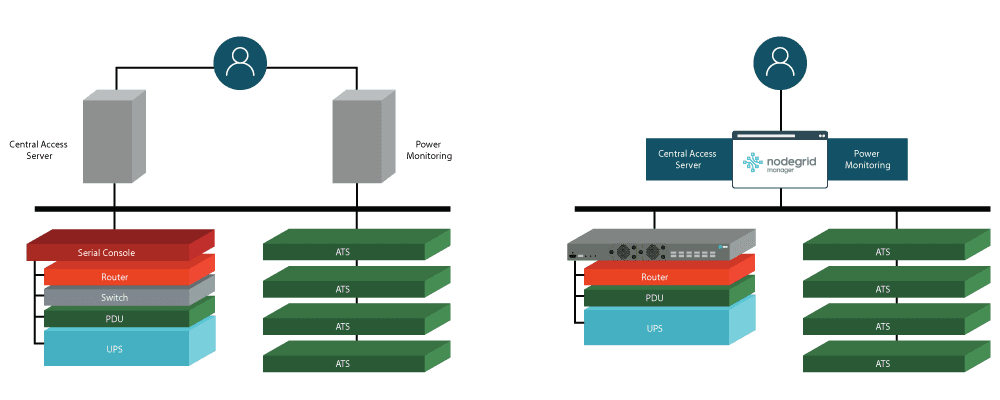
  • Using powerful, multi-function devices helps you save on deployment costs & efforts. You can replace many purpose-built appliances with a single box. This shrinks capital & shipping expenses, streamlines setup, and makes ongoing management much simpler.
  • Using an in-depth software solution for management helps you save on support expenses. You can control your legacy systems and extend functionalities to them, while giving IT teams remote access to your infrastructure layer. Instead of training on many UIs and dispatching technicians to troubleshoot issues, modernized software lets you control everything seamlessly from afar.
  • With an extensible solution, you get peace of mind knowing you can adapt to future requirements. Demands will continue to evolve (especially at the edge), and a flexible platform helps you accommodate changes. This could mean implementing the latest SD-WAN solutions, deploying compute power at the edge, or further reducing hardware stacks to meet business goals.
Finance-Diagram

Network modernization helps a large financial firm

A major financial institution began to see weaknesses in their legacy system, and they knew that modernization was the solution. Their traditional infrastructure employed too many disparate systems that were difficult to manage, even to maintain everyday operations. Security and compliance issues were also developing, and to top it off, they would need to implement a new solution by taking a gradual approach.

For out-of-band management, they were using too many devices at the rack level. Their management solutions also lacked the ability to give them control over all their systems. Their servers and automatic transfer switches required separate gateways, which increased response times and made support difficult to manage.

So how were they able to replace these headaches with an efficient, cost-saving network? They used Nodegrid hardware and software to achieve a comprehensive network modernization solution.

For full details, read the case study.