Providing Out-of-Band Connectivity to Mission-Critical IT Resources

Home » Uncategorized » Page 5

Você sabe quanto custa para a sua empresa um servidor fora do ar?

Quando o seu servidor para de responder, está “fora do ar”, toda sua empresa sofre as consequências e fica “fora do ar”

Não é a apenas a área de TI que está com problemas, mas sim a empresa inteira pois os e-mails podem parar de serem enviados e recebidos, talvez justamente na hora de um pregão eletrônico ou de responder um RFP. Se o seu sistema de e-commerce pode estar fora do ar, suas vendas online estão impactadas.

Todos os funcionários estão parados, aguardando não tão pacientemente o retorno do servidor.

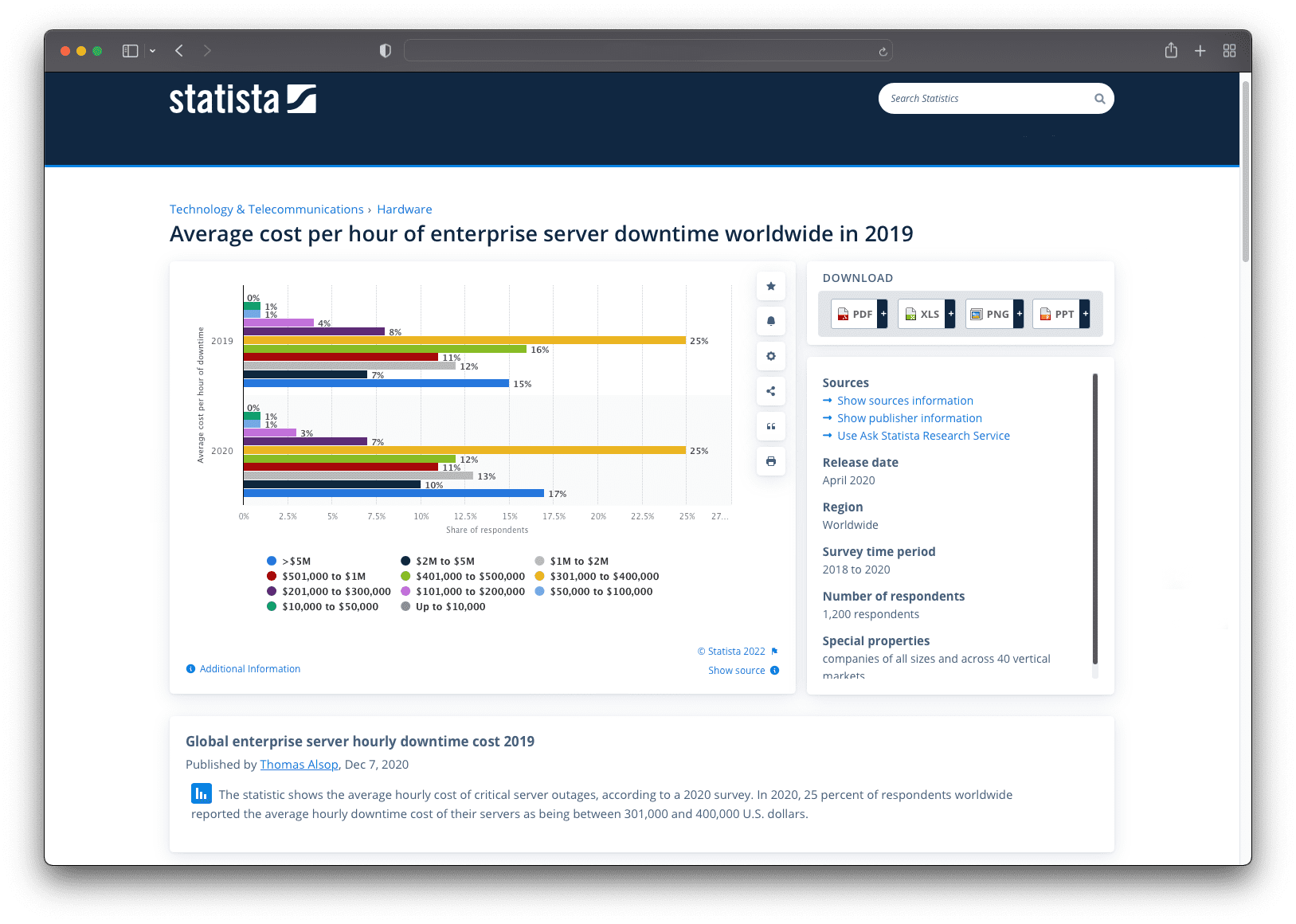
De acordo com uma pesquisa em 2020, 25% dos entrevistados relataram que o custo médio devido a inatividade e interrupções críticas de servidores estava entre $301.000 e $400.000 dólares americanos.

Statista

Fonte: Statista.com

Você então pode mencionar: – Basta reiniciar o servidor e estará tudo ok?! Pode ser, mas nem sempre isso é tão simples e fácil.

Lembre-se, normalmente estes fatos ocorrem em horários ou em dias incomuns e muitas equipes não estarão disponíveis para atendimento local.

Quais são os custos de mão de obra para o tempo de inatividade da rede? Um artigo de Kasia Subieta mostra uma maneira de calculá-lo:

Custo da mão de obra = P x E x R x H.

  • P = número de pessoas afetadas
  • E = porcentagem média de que são afetados
  • R = custo médio do funcionário por hora
  • H = número de horas de interrupção

Então o que fazer?

Uma solução para isso é a gerência OUT OF BAND, ou solução FORA DA REDE.

Mas o que é isso?

A solução OUT OF BAND, permite acesso remoto a toda sua infraestrutura de TI acessando a console dos equipamentos, permitindo acesso seguro e uma gerência eficaz. Se torna muito efetiva, mesmo quando a sua rede IP está comprometida e sem acesso, em casos de DDOS ou até, lembrando-se das “telas azuis” dos computadores, onde o dispositivo esta à ligando mas não respondendo a comandos.

Tradicionalmente nestes casos, precisamos deslocar um técnico para fazer um acesso local, perdendo-se tempo e performance da rede. No caso de uso de sistemas ZPE, podemos ter uma acesso remoto via IP ou rede celular 4G/5G LTE, teremos uma comunicação segura ao “core” do equipamento abrindo uma porta de comunicação para acesso da equipe de TI, que poderá atuar na gestão direta dos devices da rede, independente da marca do produto ou do vendor existente.

A ZPE SYSTEMS possui soluções OUT OF BAND e permite o acesso e gestão remota e eficientes de todos os seus equipamentos de rede visualizando quaisquer dispositivos (servidores, roteadores, switchs, smart PDU, UPS, Storage, etc) em um único painel de gerenciamento, aumentando a segurança na gerência e ampliando a confiabilidade e performance de sua rede.

Conheça mais a ZPE SYSTEMS no www.zpesystems.com/products

Top Data Center Infrastructure Management (DCIM) Trends of 2022

shutterstock_2075585047(1)

Data center infrastructure management (DCIM) keeps evolving to address enterprises’ changing goals, requirements, and concerns. We spoke with DCIM sales engineers to find out which pain points are on their customer’s minds, and which emerging technologies their enterprises are currently excited about:

  • Providing 24/7 remote access with a virtual presence.
  • Consolidating infrastructure for simpler management.
  • Strategically automating DCIM workflows and equipment.

This blog will discuss why enterprises implement these DCIM tools and technologies and provide the best advice about using them within your data center environment.

The Top 3 DCIM trends of 2022

Remote DCIM

The Covid-19 pandemic has accelerated the existing trend towards remote DCIM with minimal on-site staff. Many organizations are cutting budgets and downsizing their staffing, and many  of the people they keep on board are working remotely. If you don’t have subject matter experts physically at your data centers, you need to be able to deploy, manage, and troubleshoot your infrastructure remotely.

One way to ensure you have 24/7 remote access to your data center infrastructure is with out-of-band (OOB) management. OOB separates the network management plane from the data plane and provides a dedicated connection to your management device, which means you always have access to your infrastructure even if there’s an ISP outage. A complementary component to having a virtual presence  is environmental monitoring, which uses sensors to detect temperature, humidity, tampering, and other data center conditions.

When an on-site visit is unavoidable, remote DCIM helps you determine the root cause of the issue beforehand so you can ensure you already have the parts and tools you need to fix it. Doing so prevents your engineers from making multiple trips or wasting time diagnosing problems on-site. Remote DCIM not only allows you to efficiently monitor and manage data center infrastructure, but it also helps minimize the amount of time and money spent traveling to remote sites to troubleshoot and fix issues.

Consolidated solutions

One of the biggest challenges in DCIM is dealing with many different appliances, solutions, and vendors. This means engineers and technicians need to be trained in deploying, managing, and troubleshooting all these disparate solutions. Vendor lock-in may prevent all these systems from working together or integrating with a central DCIM tool, which means engineers have to jump from box to box to monitor issues or perform maintenance. Plus, there’s the hassle of license management, and different vendor contracts coming up for renewal at different times.

That’s why many organizations are moving towards consolidated DCIM solutions with all-in-one devices. Instead of looking for best-of-breed solutions for routing, out-of-band access, infrastructure management, server/compute, and other data center devices, you can get all of these functions rolled-up into a single box. An all-in-one data center solution is like the Swiss Army Knife of DCIM—it may not be the absolute best at any one feature, but you get all the tools you need in one device.

Another way that organizations overcome vendor lock-in and infrastructure complexity is through vendor-neutral DCIM platforms. With an open-architecture platform, you can integrate all your disparate devices and solutions into one centralized control panel. This increases the ease and efficiency of your engineers to manage your entire data center infrastructure.

All-in-one devices and vendor-neutral DCIM platforms both help reduce the complexity of your data center infrastructure, saving you time, money, and frustration.

DCIM automation

Many organizations are beginning or continuing their DCIM automation initiatives in 2022. Some examples of the data center management workflows that are frequently automated include:

  • Power load balancing and management
  • VM (virtual machine) deployment and management
  • Environmental monitoring and analysis
  • Network load balancing
  • Issue remediation

DCIM automation reduces the amount of time your engineers spend performing tedious, repeatable, and manual tasks. This, in turn, reduces the risk of human error, so you can ensure optimal performance and uptime in your data center.

Often, organizations make the mistake of automating the low-hanging fruit first (whichever tasks are easily automated by their chosen solution) rather than analyzing and prioritizing DCIM workflows based on what will help them achieve their specific business goals. This may not make DCIM any easier or more efficient for them in the long run. Other enterprises assume that DCIM automation is an all-or-nothing proposition that requires orchestration and highly complicated scripts and tooling. This leaves them feeling too intimidated to even begin their automation efforts.

DCIM automation doesn’t have to be difficult. Suppose you start with a complete understanding of your data center infrastructure and which workflows are most critical to your business. In that case, you can then automate them in the order that’s most beneficial to your team and your enterprise. And it doesn’t need to happen all at once—you can begin by creating a simple script to handle a single process, then move on to using technology like zero touch provisioning (ZTP) to automatically configure new data center devices. It is important to use DCIM devices and solutions that provide all the automation capabilities you need without locking you into a single vendor’s ecosystem or feature roadmap. This way, your automation initiatives can scale with you in exactly the way you need them to.

When you take the right approach, DCIM automation can help your organization run more efficiently to save time and resources.

In 2022, many enterprises are prioritizing remote DCIM solutions that give them a 24/7 virtual presence in their data center. They’re also consolidating their data center infrastructure with all-in-one solutions that provide centralized monitoring and management. Finally, organizations are looking for ways to automate DCIM workflows without adding to the complexity of their data center infrastructure and management.

Achieve your DCIM goals in 2022 with Nodegrid

Nodegrid is an innovative data center infrastructure management platform that can help you stay ahead of DCIM trends in 2022 and beyond.

shutterstock_2129974520(1)
The Nodegrid Serial Console delivers remote OOB management of up to 96 connected devices in a single 1U rack-mounted device, ensuring you have 24/7 access to monitor and manage your data center infrastructure. Nodegrid’s modular design means you can create a customized data center management solution with all the functionality you need in one box. You can also use Nodegrid’s environmental monitoring sensors to keep an eye on environmental conditions in your rack, even from thousands of miles away.

Any data center infrastructure connected to a Nodegrid box can be deployed, managed, and monitored from one consolidated software platform—Nodegrid Manager for fully on-premises deployments, or ZPE Cloud for hybrid and cloud-based infrastructure.

Finally, Nodegrid enables and simplifies DCIM automation through features like zero touch provisioning and network scripting support. With the vendor-neutral, Linux-based Nodegrid OS, you can automate and orchestrate your data center infrastructure without vendor lock-in hampering your efforts. Nodegrid allows you to create a completely customized automation architecture using third-party tools like Ansible, Docker, and RESTful.

Want to learn more about DCIM? Read our Q&A with a 20-year DCIM expert.

See how Nodegrid can help you take advantage of DCIM trends in 2022.

Contact ZPE Systems to view a free demo.

Contact Us

Automating Your Network Operations Does Not Have to Be Difficult

automating your network operations

The importance of network automation is clear—you can reduce human error, create more efficient workflows, and streamline operations. However, many enterprises delay their automation efforts because of how challenging the process can be.

Fortunately, automating your network operations does not have to be difficult if you start with a comprehensive plan and implement the right tools and solutions.


Best practices for automating your network operations

1. Automate what you need versus what you can

Start your automation journey by identifying and prioritizing the most beneficial workflows for your business to automate. It may seem easier to choose whatever automation tools are provided by your existing vendors and then try to make them work with your infrastructure. However, that could lead you to follow the automation path that’s best for your vendors, versus the path that’s best for your particular use cases and requirements.  Though the former approach may seem simpler in the short-term, it will reduce the overall success of your automation efforts and make it harder to achieve your goals.

You need a full understanding of all the components that make up your network infrastructure so you can accurately identify and prioritize which devices, processes, and applications to automate in which order. Then, you need to ensure your automation solution can get its hooks into every aspect of your infrastructure, including things like environmental monitoring sensors, PDUs (power distribution units), and other devices that may not be part of your initial orchestration framework. Automating your network operations based on what you need, versus what’s easiest, will ultimately save you time and effort in reaching your automation goals.

This ultimately means that every enterprise’s path to automation should look a little different. However, below are some recommendations for network operations, workflows, and tasks to automate.


2. Automate device provisioning

Device provisioning is often a time-consuming, tedious task, which makes it prone to human error—and a prime candidate for automation. There are a couple of common ways to automatically spin up new infrastructure, including:

Zero touch provisioning (ZTP): Devices enabled with ZTP automatically download and execute configurations over the network, allowing you to deploy routers, switches, console servers, and other appliances with very little human intervention. This is especially beneficial for remote infrastructure at colocation facilities, branch offices, warehouses, and other locations where you may not have IT staff available to install and configure devices on-site.

Infrastructure as Code (IaC): IaC uses software abstraction to separate infrastructure configurations from the underlying hardware. This allows you to write configurations as repeatable scripts that you can deploy and manage automatically. You can also use IaC orchestration tools like RedHat Ansible to store and automatically execute configuration scripts for all your infrastructure devices from one central control panel.

Automating the device provisioning process with ZTP and IaC will streamline your network operations by increasing the speed and accuracy with which you can spin up new resources.


3. Automate WAN and Branch management

Managing WAN (wide area network) and branch networks can be very challenging without automation. Often, you don’t have on-site staff to monitor and troubleshoot networking equipment. You also need to back-haul all remote traffic through your primary firewall to apply security policies and controls, which creates bottlenecks on the network and reduces productivity. Plus, every new site you add will further increase the complexity of your enterprise network.

One way to automate WAN and branch management is through software-defined wide area networking, or SD-WAN. SD-WAN decouples the WAN management plane from the underlying hardware and, similarly to IaC, abstracts it as software. This makes it easier to introduce automation to your WAN management. For example, you can use SD-WAN intelligent routing to separate cloud-destined traffic and divert to a cloud-based security stack such as Security Service Edge (SSE), reducing bottlenecks and improving performance. Automating your WAN and branch management through SD-WAN reduces the challenge of distributed network management.


4. Automate with NetDevOps

DevOps is a popular paradigm that combines software development and IT operations departments into one collaborative team to streamline software releases. NetDevOps takes this a step further by integrating network management into the equation. NetDevOps focuses on operationalizing processes by using a systematic approach to automating and orchestrating network management, development, and operations tasks.

NetDevOps automation uses technologies like IaC and SD-WAN but takes things a step further by integrating them with DevOps tools like code repositories, test automation, and CI/CD (continuous integration/continuous delivery). This allows your entire IT department to function together as one efficient unit, eliminating bottlenecks between teams and streamlining product releases.

  Want to learn more? Read What is NetDevOps? The Definitive Guide

Automating your network operations does not have to be difficult if you start with a robust plan that focuses on your organization’s unique environment, requirements, and capabilities. Often, enterprises start with automatic device provisioning because it’s a tedious and repeatable process. WAN and branch management is another good candidate for automation because it can have a large impact on overall network performance. Finally, for development-focused organizations, the NetDevOps methodology integrates DevOps tools and processes into network automation efforts to create more efficient software release cycles.


Automating your network operations is easier with the right solution

Not all network automation platforms offer the same capabilities, features, or level of control. For example, many solutions don’t allow integrations with popular IaC tools like Ansible, Chef, and Puppet. If your platform isn’t vendor-neutral, you’re going to find it challenging to create a fully-integrated NetDevOps environment using code repositories, IaC, and test automation. For true end-to-end automation, you need a platform that can get its hooks into every piece of your infrastructure, or else you’ll end up with a bloated patchwork of solutions that’s difficult to orchestrate and optimize.

ZPE Systems delivers a vendor-neutral network automation platform that doesn’t suffer from any of these limitations. Our Zero Pain Ecosystem can “say yes” to any device, system, or service you add to your network, ensuring you’re able to automate what you need, when you need it. With features like secure zero touch provisioning, SD-WAN, and even SD-Branch, you can automatically deploy and manage your infrastructure from behind one pane of glass. And, all ZPE solutions integrate with leading third-party automation tools, giving you end-to-end automation with consolidated, centralized orchestration.

Automating your network operations is easier with ZPE Systems. But don’t take our word for itsee our solution in action by requesting a free demo today.

ZPE Systems Announces TD SYNNEX Partnership to Bolster Growth Strategy

ZPETDS2

Fremont, CA  March 17, 2022 — ZPE Systems Inc., a leader in network infrastructure management and orchestration solutions, today announced a partnership with TD SYNNEX (NYSE: SNX), a leading global distributor and solutions aggregator for IT ecosystems. This agreement gives partners access to ZPE’s Intel-based Gen 3 out-of-band serial consoles & modular services router gateways, to serve large enterprises and MSPs with a platform for 3rd party applications and end-to-end automation for datacenter & branch edge deployments.

Legacy fixed-function devices do not meet modern requirements for scaling, automating, and securing enterprise networks, due to interoperability issues and closed architectures. As customers struggle against security and downtime-inducing network challenges, this partnership will enable them to deploy ZPE’s platform to address disaster recovery, human error, and ransomware, using their choice of best-of-breed vendor solutions. ZPE’s cloud managed Linux-based Nodegrid® is an open platform of programmable hardware and software that extends the capabilities of infrastructure, connectivity, and cybersecurity teams.

“Cyber and physical systems are increasingly connected,” said Reyna Thompson, Senior Vice President, Product Management at TD SYNNEX. “This means organizations across all verticals are now calling for a networking platform that enables them to mix and match the solutions that work best for their use case. This partnership strengthens our portfolio. Customers can now deploy ZPE’s platform to integrate the physical and virtual solutions they need, to make their networks secure, reliable, and easy to use.”

The Linux-based Nodegrid OS, which runs on every Nodegrid Serial Console and Services Router device, enables multi-vendor freedom in IT. This allows infrastructure, connectivity, and cybersecurity teams to deploy and manage their choice of hardware, software, and SaaS solutions — from cooling and smart PDUs, to switches and servers, to NGFWs, SD-WAN and SASE integrations. The Nodegrid platform integrates with new and existing infrastructure, providing secure out-of-band access, NetDevOps automation capabilities, and enterprise-grade security that address modern business demands.

“Teaming up with TD SYNNEX is a huge value add to ZPE ​​Systems’ Edge Transformation Partner Program,” said Steven Jehring, Vice President, Global Sales, ZPE Systems. “This gives partners greater financing options, while customers get more freedom to choose a partner that’s right for them. TD SYNNEX’s world-class support, pre-sales services, and global fulfillment capabilities will be instrumental in accelerating partner sales and transforming customer networks at the data center and edge.”

To learn more or become a ZPE Systems partner, visit partners.zpesystems.com.

Read the source version on Business Wire.

Customer strategies in Ukraine to protect privacy and IP

ZPEUkraine (1)

How autonomous decommissioning via out-of-band has become essential to disaster recovery for edge deployments in uncertain geographies

To say there’s instability in Eastern Europe would be a drastic understatement. Russia continues its attacks on many fronts in Ukraine, displacing millions of Ukrainians who are now left with an uncertain future. Security is on everyone’s mind, and while many have answered the call to arms and stand ready with AK-74 in hand, others recognize that defending Ukraine involves shielding IT infrastructure and intellectual property from cyberattacks.

For this, some of ZPE Systems’ customers are using an unlikely defense: out-of-band management. Despite recent attacks using wiper malware and DDoS to take down government websites, organizations are able to use generation 3 out-of-band to decommission their sites in order to protect their data against adversaries who have boots on the ground.

In this post, we’ll examine the current issues surrounding compromised edge sites and what organizations are doing right now to shield their intellectual property (IP).

What’s at stake?

Many companies have critical IT infrastructure distributed across countries, regions, and continents. This infrastructure consists of networking gear and edge compute equipment, such as servers, switches, routers, and other end devices. These are responsible for connecting users and customers to essential services, processing and storing sensitive data, and running intellectual property such as proprietary operating systems, applications, and network certificates.

All of these are essential to supporting normal business operations and the customers they serve.

For example, telco companies rely on their infrastructure of cell tower sites, fiber cable lines, and their connected hardware and software to provide voice networks and Internet service. These companies run intellectual property within their infrastructure. In many cases, this intellectual property includes software that can cover a range of types and uses, from multi-protocol access proxies that enable IT admins to remotely manage edge network clusters, to analytics applications that track data usage for media delivery and customer experience optimization.

These companies are also responsible for handling sensitive data. For administrative purposes, billing, and compliance, these companies use devices that process and store personal identifying information for customers, including names, addresses, birth dates, etc.

All of this is what is at stake when faced with disaster. This is why it’s important to have the proper disaster recovery plan and tools in place, and mitigate the risk of losing sensitive information or having it fall into the wrong hands.

What disaster looks like

Every enterprise and government organization should assess their level of risk regarding equipment deployed at the edge. Risks can come from geographical and geopolitical factors — such as tornadoes or flooding during seasons of inclimate weather, or regional instability during times of international conflict.

Imagine you’re in charge of a corporate or government organization. One day you stop receiving pingbacks from your edge sites, and you suddenly find that you’re cut off from these locations.

There’s no network. There’s no access. And like many organizations currently struggling in Ukraine, you’re simply no longer in control of what happens to your data.

What do you do now?

Your sensitive user credentials, customer information, and intellectual property are in jeopardy, and possibly being stolen by adversaries.

Could you have prevented this?

Disaster recovery: Autonomous decommissioning to stop data theft

Part of an adequate disaster recovery plan involves having hermetic and autonomous operations, down to the device level. In the case that you need to go into disaster recovery mode, consider all of the information that needs to be wiped at your locations:

  • Servers need to be wiped
  • Disks and partitions need to be wiped
  • Disks need to be overwritten so data can’t be recovered
  • Switches and supporting infrastructure need their configurations wiped

The problem is that since you’re cut off and unable to remotely access this equipment, you can’t perform these tasks.

However, ZPE’s customers are currently using our programmable out-of-band infrastructure for this exact use case. It’s being called ‘autonomous decommissioning’, and it combines network automation with manual commands to essentially perform the inverse of launching network sites. This process is being used to protect IP and personal identifying information from falling into the wrong hands.

How does it work?

With our generation 3 serial consoles and services routers co-located at data center and critical edge locations, customers are able to connect all of their equipment to the out-of-band network. Receiving pingbacks at regular intervals from HQ signals that all is well at these sites.

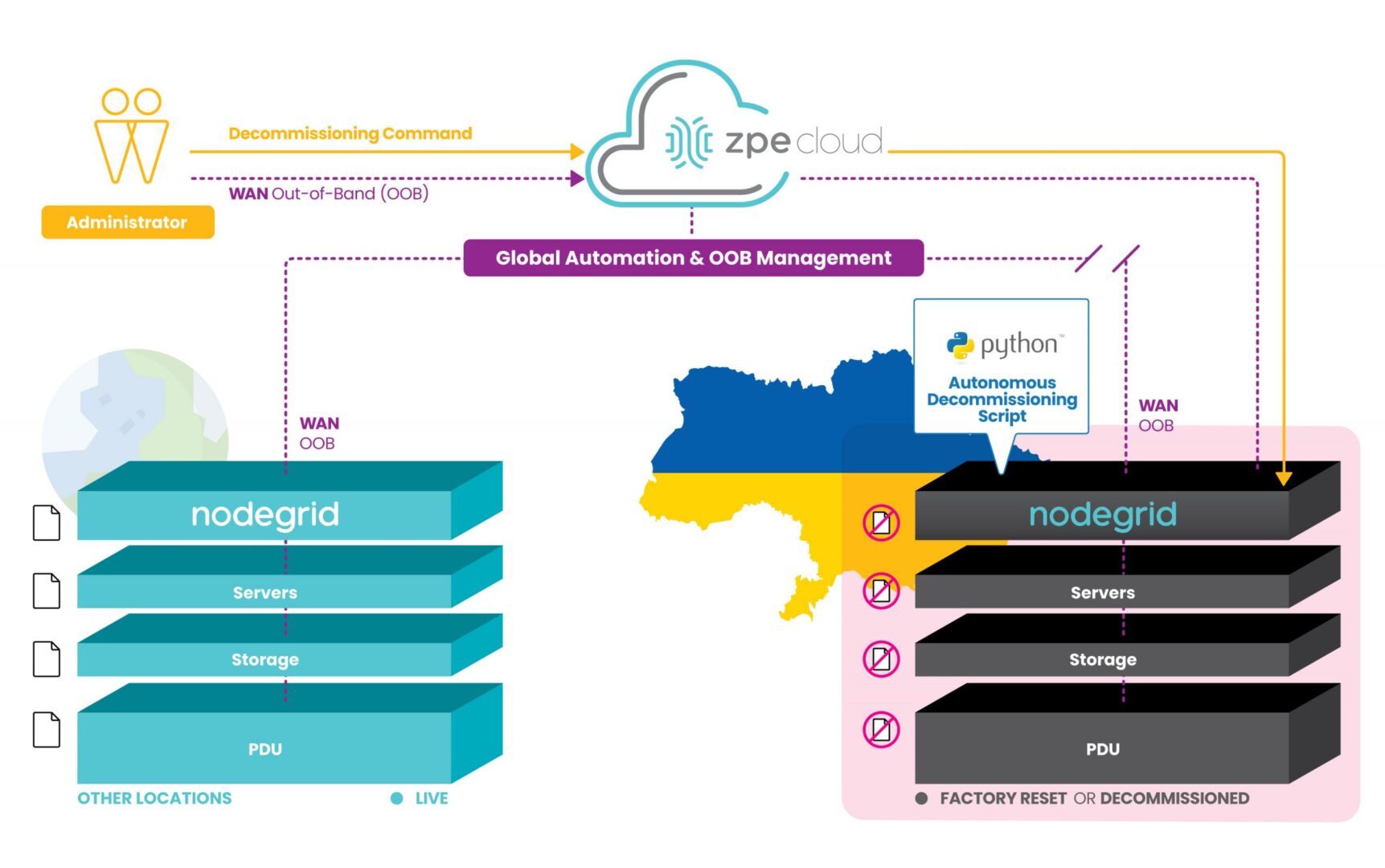
Due to instability in the region, some sites are becoming compromised and cut off from HQ. When this happens, the infrastructure goes into disaster decommissioning mode, and ZPE’s devices serve as on-prem automation workers which help remote IT admins to begin wiping the entire infrastructure.

Autonomous decommissioning network diagram

These devices are hooked into every piece of equipment, and they’re able to receive automated scripts and manual commands from remote admins to push decommissioning tasks to all connected gear. The ZPE device is then able to have its own configuration wiped and returns to its initial ‘seed of life’ mode, in which it awaits further instructions until the connection is restored to HQ. Once this connection is restored, Nodegrid waits for instructions to rebuild the infrastructure following the immutable infrastructure framework.

This autonomous decommissioning prevents data from being stolen by adversaries. By wiping all data and returning to its seed-of-life state, it also keeps the environment’s configurations secure. That’s because the devices no longer contain any configuration information once they’ve been wiped, and configurations can only be restored once an authenticated connection is reestablished with HQ.

Check out a live demo at ONUG!

See how to automate without anxiety to combat cyberattacks. Join us Thursday, April 28 at 11:10am EST at ONUG for a live demo. Click here to register or get your free virtual pass.

ZPE Systems named Rahi Partner of the Year

ZPE Systems has been named Rahi’s 2021 Partner of the Year. The company outperformed more than 400 Rahi partners by excelling at revenue attainment, customer satisfaction, and support, among other important performance factors.

ZPE Systems' CEO Arnaldo Zimmermann accepts the award for Rahi Partner of the Year

ZPE Systems’ CEO and Co-founder Arnaldo Zimmermann accepted the award, and was joined on stage by ZPE’s VP of Products & Marketing, Koroush Saraf, and Rahi’s VP of Global Marketing & Business Development, Martin Bach.

Rahi’s CEO Tarun Raisoni said: “ZPE has been a longstanding partner and always brings tremendous value to Rahi and our customers. This year they exceeded their already exceptional performance standards. All of their teams are incredibly knowledgeable and committed, which is without a doubt what contributed to their high revenue attainment and customer satisfaction scores. ZPE Systems is a power player that enables our entire organization, and we look forward to continued success alongside them.”

According to Rahi, the Partner of the Year is recognized for ‘consistently meeting customer expectations through dedication, teamwork, technology, and a commitment to excellence.’ Rahi’s selection criteria weighs a partner’s yearly performance based on several metrics, and ZPE was chosen based on:

  • High revenue attainment
  • Consistently high customer satisfaction scores
  • Low RMAs
  • A widely relevant technology portfolio
  • Responsive engineering services
  • Exceptional deliverability, fulfillment, and back-end support

“2021 was another difficult year due to Covid,” said Arnaldo Zimmermann. “But I’m extremely proud of our dedication to supporting partners like Rahi. I’m accepting this award on behalf of Engineering, Operations, Business Development, and every team within ZPE, because everyone did their part to ensure this success.”

To learn more or become a ZPE Systems partner, visit partners.zpesystems.com.