Providing Out-of-Band Connectivity to Mission-Critical IT Resources

Why You Need to Adopt Edge Networking

What does edge networking mean to your enterprise? Does it mean fast service delivery to hundreds of remote locations? Or smooth networking & security for your work-from-home staff?

When your organization uses strong edge networking capabilities, you can adapt well into the future no matter how much you need to scale. This allows you to save time & money, allocate resources efficiently, and provide reliable connectivity across your enterprise.

Click the link below to hear John Paul Kang, one of ZPE Systems’ Solutions Architects, discussing edge networking and the benefits it brings to business.
Edge Networking Podcast-1 400×250

If you’re short on time, read this post for a glimpse of what’s in the podcast.

What exactly is edge networking?

Edge networking is how distributed locations connect back to an enterprise’s main systems.

Traditional enterprise network setups employ a main data center, which is at the core of the network, and then distributed locations, which are at the edge. Edge networking refers to the systems and infrastructure that connect these edge locations back to the core.

If you think about a centralized network, the edge is what is located at the fringe or periphery.

Is edge networking different from edge computing?

Absolutely.

Again, looking at a traditional, centralized enterprise network, you can see that all of the computing and storage happens at the core. This core is what processes all of the information, including everything that comes from the enterprise’s edge networks.

Edge computing, however, is essentially distributing some of the core’s processes to the edge, in order to alleviate the core’s workload. Instead of having all computing workloads, application services, and data storage take place at the core, these processes (or parts of them) are handled near the edge. Once the edge computing systems process the information, it’s then the job of edge networking to transfer the information back to the core (if necessary).


Use edge networking & computing to overcome challenges

Edge networking brings a lot of benefits to the business, and it’s easy to understand why organizations are evolving their edge capabilities. The easiest way to realize its advantages is by comparing it to the conventional methods of centralized networking.

In traditional network configurations, you put a lot of strain on your core systems. This is because you have to backhaul all of your edge traffic to the core for processing. The results? Bottlenecking, slowdowns, and increased risk of bringing your network (and business) to a standstill.

Just imagine you and some friends using a funnel to fill a bucket with marbles. To represent traditional networking, all of you would essentially put your marbles into the same funnel. This would lead to plenty of waiting and likely cause a jam or stoppage, which would require you to manually troubleshoot and fix.

But with better edge networking, you can decentralize and redistribute your workload. Using this cloud-based model, you no longer need to backhaul traffic or bog down your core systems. You can move your critical networking and security functions to the edge. Paired with edge computing, you get more balanced workloads and efficient bandwidth usage for faster speeds, more responsiveness, and improved performance across the board.

Back to the bucket of marbles analogy. To represent better edge networking, you would not only have a single funnel at the core, but also individual funnels around the periphery. Instead of dumping all the marbles into the center, you would be able to take advantage of the outer funnels to achieve a more efficient system free of frequent stoppages.

Having better edge networking capabilities means you can overcome a lot of the challenges of a centralized system.

Edge networking comes with some obstacles

Implementing more robust edge networking isn’t without hurdles. You’ll need to face a few challenges associated with:

  • Physical distance — It can be difficult to put people and equipment on site when locations are isolated. This becomes increasingly challenging when you have very remote branches.
  • Staff limitations — Response times can drag on for days or weeks depending on the staff (or lack thereof) you have. You may have very few skilled IT team members on site, or even none at all.
  • Accessibility & downtime — Edge networks can be incredibly difficult to access, which means downtime comes with more risk and potentially severe consequences.

Get over these obstacles using new technologies

To improve your edge networking capabilities and get past the inherent challenges, use some of the latest and most innovative technologies:

  • Secure Access Service Edge — SASE puts networking and security in the cloud, so you can give your workers reliable network access even from thousands of miles away.
  • Zero touch provisioning — Use this in conjunction with the cloud, and you can significantly decrease the need for any staff presence at your remote sites. Zero touch provisioning uses automation to help scale and provision without manual input, and with the cloud, you can respond instantly to troubleshoot issues, perform configuration management tasks, provision, and more — no matter how far away you are from the site.
  • Remote out-of-band — If you deploy a comprehensive out-of-band management solution, you get peace of mind knowing that you can access your sites with ease. Use a solution that lets you achieve redundancy through connections like broadband, cellular, satellite, and others, and that also gives you in-depth control of your branch networks.

Want to learn more about the edge? Browse our blog
Take a look at some of our other posts to learn more about edge networking. Get a closer look at SASE, zero touch provisioning, and remote out-of-band, and see how you can strengthen your edge capabilities.
Optimize Edge Networking With This Free Guide to Out-of-Band, SD-Branch, & More

GG2 – branch and edge networking

Edge networking continues to grow as a vital component to business. With more people working remotely, whether from home, in the field, or on the road, it’s now critical to have a network that goes wherever your people go. And achieving that kind of connectivity is becoming easier by the day, as companies like ZPE Systems carry on innovating new technologies to accommodate secure, on-the-go networking.

Traditional network architectures are becoming obsolete, simply because they can’t offer flexibility at the edge. Their rigid systems and protocols restrict both IT and non-IT staff from accessing the resources they need, when they need them. This has only spurred the evolution of better edge networking, and now many companies operate remotely 100-percent of the time.

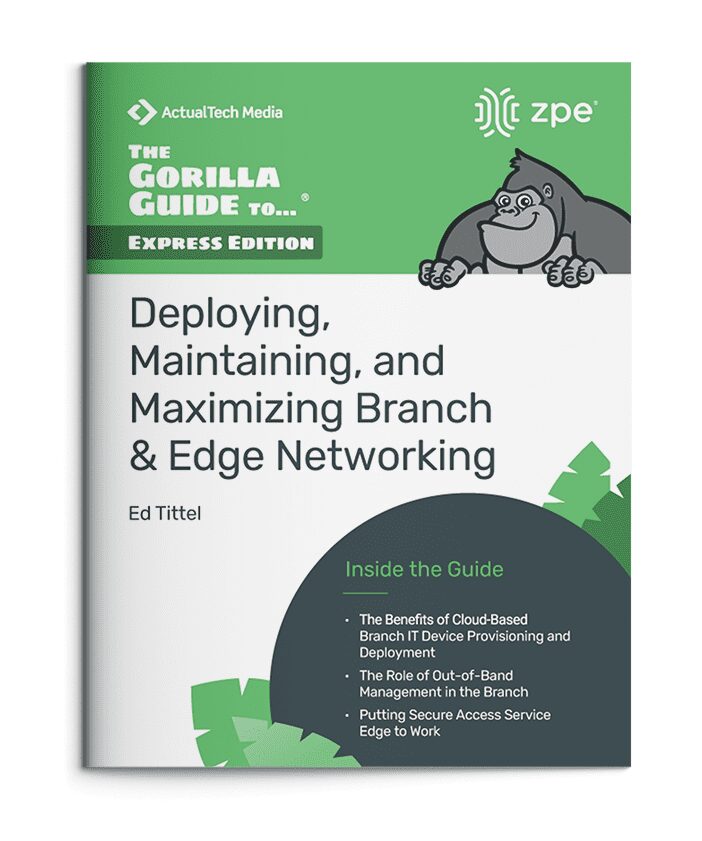
Even if your goal isn’t to fully migrate your workforce out of the office, you can reap major benefits from strengthening your edge networking capabilities. That’s why you need to get our free Gorilla Guide to Deploying, Maintaining, and Maximizing Branch & Edge Networking. Keep reading to learn more.

What are some crucial edge networking capabilities & their benefits?

Think of a few ideal capabilities you’d like your business network to have.

  • Do you want to give full remote access to IT and network staff?
  • Do you want to gain in-depth visibility & control of branch networks?
  • Do you want to deliver safe, reliable connectivity where your workers go?
The good news is, you can get all these and more when you use an open, cloud-enabled edge networking platform like Nodegrid. Here’s how you can benefit:

  • You can make easy work of every deployment thanks to cloud-based provisioning. If you need to set up a new branch network, even at a very isolated location such as an offshore drilling platform, the cloud gives you push-button simplicity. You don’t have to preconfigure devices or put staff on-site to manually provision the stack. You can ship boxes that are 100% unconfigured, which gives you complete security, and then simply boot your devices. The cloud does everything for you using zero touch provisioning, so you can sit back and watch your network build itself.
  • You don’t have to put IT staff on-site in order to troubleshoot network issues, fix configuration errors, and restore uptime. You can take advantage of remote out-of-band management and cloud-based provisioning. These allow you to fulfill all of your network administration duties from afar. When a router goes offline or a software version needs to be rolled back, you can respond quickly and remediate the problem — even from thousands of miles away. These technologies work together so you can maintain branch networks without breaking a sweat.
  • You can optimize your branch networks by taking advantage of software-defined branch (SD-Branch) capabilities. Traditionally, SD-WAN gives you control of only what goes to and from your branch networks. But with SD-Branch, you can see and control WANs and LANs, with comprehensive capabilities that let you access what goes on inside each location. SD-Branch lets you manage at a granular level. Not only can you adjust traffic priorities and specific device settings, but you can also manage all the clients connected to your network. This means that you don’t need to dispatch support teams for troubleshooting or management, so you can save time & money on operations.
  • You can deliver pick-up-and-go networking by using Secure Access Service Edge. SASE is a new model that combines networking and security in the cloud, and delivers them to users wherever they need secure network access. It’s also identity driven to provide even more flexibility. For remote and on-the-go workers, you no longer need to allocate resources to configure company laptops or other devices. Because SASE ties network access to a user’s identity, you can let them connect from anywhere using any device. With SASE, business can continue seamlessly no matter what change you need to adapt to.

Why download our free guide?

For details about how you can improve your edge networking abilities, get our free Gorilla Guide to Deploying, Maintaining, and Maximizing Branch & Edge Networking. It shows you:

  • Why you need cloud provisioning — Discover how a cloud-based approach to provisioning gives you valuable benefits, such as hardened security and effortless deployments.
  • How the cloud makes out-of-band better — See how to easily maintain branch locations with the cloud on your side, from remote troubleshooting to configuration management.
  • Best practices for optimizing branch networks — Learn how to deploy and optimize your distributed networks, and take advantage of in-depth SD-Branch for total network control.
  • Why you need to get SASE — Explore Secure Access Service Edge and how it transforms the edge with nimble networking & security, for business that goes wherever your employees go.

It’s never been more critical to give your edge networking capabilities a boost. Now’s your chance to improve business agility with a free download, the Gorilla Guide to Deploying, Maintaining, and Maximizing Branch & Edge Networking.

ZPE Systems Recognized as 2020-2021 Intel Winners’ Circle Member

ZPE-Partner-Image

Fremont, CA, January 11, 2021 – ZPE Systems, Inc., a leading provider of network infrastructure management solutions, has been recognized by Intel Corporation as a 2020-2021 Winners’ Circle Member for driving digital innovations that simplify and accelerate network transformation. This partnership furthers both companies’ commitment to bringing advancements to networking, and demonstrates an aligned vision to strengthen the capabilities offered to end users.

ZPE Systems met the Winners’ Circle recognition criteria by: demonstrating a commitment to network transformation and digitization; packaging joint solutions that are primed for go-to-market deployments; partnering with other networking ecosystem members to foster growth and success; and discovering market insights and trends. To fulfill these criteria, ZPE Systems has continued broadening its strategic alliances with partners such as Palo Alto Networks, who is also a Winners’ Circle Member. Palo Alto Networks’ applications such as Prisma Access and VM-Series virtual firewalls have been pre-validated for seamless integration with ZPE Systems’ Nodegrid solutions.

All of ZPE Systems’ devices come standard with multi-core Intel CPUs. This includes the Nodegrid Serial Console, which is the industry’s fastest serial device capable of supporting third-party applications, automation, and 1,000+ concurrent sessions. ZPE Systems also uses Intel CPUs in the Nodegrid SR family of services routers, including in the Nodegrid Services Router (NSR). The NSR is an open-infrastructure device that supports network function virtualization, Docker containers, out-of-band management, and other functions, with Intel-powered compute expansion modules that allow customers to scale their capabilities exactly to their requirements.

“When we decided to enter the hardware market, choosing Intel for our products was a no-brainer,” says ZPE Systems’ CEO and Co-founder, Arnaldo Zimmermann. “The ability to quickly run many simultaneous tasks is one of the reasons why we continue to put Intel technology in our devices. This new partnership will allow us to accelerate innovation for our hardware and software offerings.”

To discover more about ZPE Systems’ partnership with Intel and Palo Alto Networks, register for our free webinar. On January 12, see how our combined offering delivers flexible, secure edge networking & SD-Branch capabilities.

Read the official press release here.

About ZPE Systems, Inc.

ZPE Systems frees enterprises from today’s networking challenges.

Intel-based serial consoles & modular services routers deliver unparalleled power to datacenter & branch applications, while the Linux-based Nodegrid OS replaces vendor lock-in with limitless flexibility. With ZPE Cloud for fast & secure provisioning, it’s the only networking platform to streamline the stack using virtualization, prevent downtime using automation, and offer convenience using in-depth remote management capabilities.

ZPE collaborates with best-in-class technology partners, to add value by integrating with SD-WAN, firewall, IoT, and other solutions. The world’s top companies trust ZPE Systems to provide advanced out-of-band management, Secure Access Service Edge (SASE) platforms, and SD-Branch networking.

Based in Fremont, California, and with offices in Ireland, India, and Brazil, ZPE Systems is ready to help enterprises take the work out of networking.

Visit the ZPE Systems website to explore Nodegrid.

www.zpesystems.com


About Intel Corporation

Intel (Nasdaq: INTC) is an industry leader, creating world-changing technology that enables global progress and enriches lives. Inspired by Moore’s Law, we continuously work to advance the design and manufacturing of semiconductors to help address our customers’ greatest challenges. By embedding intelligence in the cloud, network, edge and every kind of computing device, we unleash the potential of data to transform business and society for the better. To learn more about Intel’s innovations, go to newsroom.intel.com and intel.com.

7 Reasons Why We Put Intel CPUs in the Nodegrid Serial Console

Intel® CPUs power many of the computers we use today. These include everything from personal desktops and laptops, to high performance computing clusters that aggregate power to solve major global issues. So when choosing a suitable processor to build into our Nodegrid Serial Console, Intel was the obvious choice. In this post, we’ll go over 7 reasons why we put Intel CPUs in the NSC.

But before we get into the details, let’s review some basics.

Besides Intel CPUs, What Else is Available?

There are mainly two types of CPUs, or processors, available today: x86 (such as Intel’s offerings) and ARM. Though they serve a variety of purposes and can have some overlapping applications, x86 processors are typically deployed when speed & power are main concerns. Meanwhile, ARM processors are used in implementations geared toward minimizing power consumption and maximizing battery life.

The way these types of processors work is based on their underlying instruction set. x86 CPUs take advantage of the Complex Instruction Set Computer (CISC), which is able to process complex instructions that are crammed into a single line. ARM-based CPUs, on the other hand, use the Reduced Instruction Set Computer (RISC), which processes simple instructions over a span of multiple lines.

As for the advantages, x86 processors are able to perform more tasks rapidly, while ARM processors are able to consume less power and maximize energy efficiency. The main drawbacks include more power consumption for the x86 CPU, and slower speeds for the ARM CPU.

This is why purpose-built appliances, such as modems & routers, typically employ an ARM-based processor, while highly demanding devices such as desktops & servers use an x86 CPU.

In a nutshell, this is why we chose the multi-core Intel CPU for the Nodegrid Serial Console. But here’s a more detailed breakdown of the reasons for our choice.

Performance is Key

The Nodegrid Serial Console is designed to maximize speed and capabilities. Using x86 Intel CPUs, we created the world’s fastest 1U serial console that doesn’t compromise on performance. This processor allows for more simultaneous operations, more users, and more input/output than ARM-based CPUs. In terms of real-world benefits, this blazing fast processor means quicker CPU cycles that help customers complete more tasks, reduce MTTR, and increase their ROI.

Commonality Helps Users and Developers

Many existing servers use x86-based CPUs. Naturally, we wanted Nodegrid to integrate seamlessly for both users and developers. The Intel-based processor promises a common platform that these users are already accustomed to. They don’t have to worry about application incompatibilities or slowdowns, nor do they have to spend time learning new systems. The x86 CPU provides a management and maintenance experience that users are familiar with, so they can maintain OS & application availability.

Customization Through a Common Dev Environment

Our Intel-based devices are a perfect platform to deploy custom solutions. The x86 CPU allows developers to benefit from a variety of readily-downloadable SDKs and environments. The Nodegrid Serial Console’s SDK comes with Yocto, which means customers always have the latest updates, packages, and DIY customization capabilities. No more waiting for third-party fixes or workarounds, because customers can create solutions that meet their unique requirements.

Docker

Because the x86 platform is capable of robust performance, Nodegrid allows users to leverage Docker containers and deploy virtualized solutions. With regards to Docker, the Nodegrid Serial Console is optimizable right out of the box so customers can get the most functionality out of a single device.

Availability of Security

When it comes to open networking, the Intel CPU is the industry standard, which means customers get security patches as soon as they’re available. They don’t have to be left vulnerable waiting for third-party kernel patches from other chip makers. With an x86-based device, customers remain safe with up-to-date security, and in some cases can even apply patches before official updates are available.

Peripheral Support Via Multiple Interfaces

Part of designing a more powerful serial console was having the ability to support a variety of peripherals. The Nodegrid Serial Console features USB 3.0 and USB 2.0 ports, allowing customers to connect an array of add-on devices. They’re no longer limited by a single-purpose appliance that comes with minimal additional ports. With the NSC, customers can extend the box’s functionality by adding cellular, Wi-Fi, storage, and other peripherals.

Greater Storage

With power and speed at the core of the Nodegrid Serial Console, we needed to incorporate enough drive space. We built the NSC with 32GB of storage, along with 4GB of RAM. Not only can it store plenty of data, but it also has a healthy amount of memory to accommodate running more apps and functions. And if 32GB isn’t enough, customers can connect external drives via USB for even more local storage capacity.

This list is made up of 7 compelling reasons why we chose x86 Intel CPUs for our devices. However, there’s an 8th reason that we love to share…

Cost Savings That We Pass to Customers

By choosing the readily-available x86 CPU, we pass powerful processing along with cost savings to customers every day. Because we think having the world’s best serial console shouldn’t be prohibitively expensive.

ZPE Systems is an Intel Network Builders Winners’ Circle Partner

Intel

Driving digital innovations and network transformation are visions we closely share with Intel. That’s why ZPE Systems has been recognized as a Winners’ Circle Member and Solution Plus Partner. Together, we offer go-to-market solutions that cultivate customer success and enrich our partner ecosystem with innovative networking technologies.

We partner with Intel to transform networking. See how we do the same with our other partners by visiting our Strategic Alliances page.

See How Nodegrid’s Out-of-Band Eliminated EBRC’s Single Points of Failure

European Business Reliance Centre, or EBRC, requires out-of-band management capabilities to keep business running. As a managed services provider, EBRC helps companies outsource their IT efforts and acts as a one-stop shop for organizations in finance, healthcare, security, and other industries. The company employs hundreds of IT experts who maintain critical infrastructures and applications, from data center hosting to cloud computing.

Because service agreements and customer satisfaction rely on high levels of availability, EBRC must ensure that they have the tools in place to prevent downtime and disruptions. This is where out-of-band management comes into play.

What’s the Role of Out-of-Band Management?

Out-of-band management allows support teams to access their network infrastructure. Instead of relying on the production, or in-band network, out-of-band uses a completely separate network path. This helps lock out potential security attacks, and also provides access that doesn’t rely on the main network. This is important for network engineers and administrators, because they can gain secure control of their infrastructure even in the event of an outage.

How Does Nodegrid Improve Out-of-Band Management?

Nodegrid improves out-of-band management by allowing remote access to physical & virtual assets. Because it’s vendor neutral, companies can deploy Nodegrid’s out-of-band regardless of which vendor solutions they currently use or plan to use. Finally, Nodegrid provides secure remote management via WAN links and a variety of connection types, including broadband, cellular, satellite, and others.

What Are the Advantages of Using Nodegrid’s Out-of-Band?

Nodegrid’s out-of-band helps companies preserve customer satisfaction and boost efficiency of their network support efforts.

Whereas typical out-of-band solutions require slow phone lines, modems, and even on-site intervention, Nodegrid allows IT teams to gain fully remote control of their systems. Device outages, interruptions, or attacks no longer need to leave organizations paralyzed by downtime or scrambling to dispatch technicians to all affected sites. With Nodegrid, teams can respond instantly whether the problem occurred in a data center rack, branch MDF, or virtual environment.

Nodegrid also allows companies to do away with the limited control offered by traditional solutions. Support teams can use Nodegrid’s out-of-band to gain granular visibility and control over their distributed networks. This means that when a password needs to be reset, a firmware upgrade needs to be installed, or a device even needs to be rebooted, IT staff can perform these critical tasks efficiently from afar.

All of these advantages equate to streamlined operations and savings on management. But don’t take our word for it. Watch this 90-second clip featuring EBRC’s Michel Ackerman, who describes the convenience and simplicity that Nodegrid brought to the European MSP.