Providing Out-of-Band Connectivity to Mission-Critical IT Resources

Home » Case Studies » Page 4

Improving Network Design for a Major Online Retailer

Out-of-band management is a critical component of network design. Instead of using one of your main networks for administrative tasks, out-of-band (OOB) gives you admin access via a completely separate path. In this blog, you’ll learn about how one of the world’s largest online retailers implemented OOB, and how Nodegrid brought a few major surprises to the table.

Why consider out-of-band in network design?

How you approach network design depends on your industry, business goals, customers, and many other factors. However, enterprises across the spectrum implement out-of-band because it’s crucial to keeping networks running.

Out-of-band (OOB) gives you an isolated access path to your network’s assets. When it’s time to make routine updates, implement configuration changes, or address network threats, OOB is your secure line for administration. You don’t have to put your main network at risk or interrupt service. And with modern OOB solutions like Nodegrid, you can give support staff convenient remote access. No more rolling a truck for issues like resetting a password or updating firmware — you can do it all even from half a world away.

Here’s a recap video explaining Out-of-Band Management:

Along with OOB, you should also think about automation and consolidation when considering network design. Together, these three solutions bring you significant benefits like time and cost savings:

  • Out-of-band gives you remote access to your infrastructure. Think about no longer having to roll a truck every time a device needs to be rebooted, a patch installed, or a configuration rolled back. This can save you tremendously on support costs, boost response times, and help you maintain network & business continuity.
  • Network automation lets you automate critical tasks. When it comes to deploying new locations, you can take advantage of zero touch provisioning and get a network that builds itself. This helps you allocate resources more efficiently (i.e. let staff provision remotely instead of having to coordinate expensive travel plans & on-site work). You can also automate ongoing tasks and even non-routine work, saving you even more time & money on support.
  • Consolidation using all-in-one devices helps you save on CAPEX, rack space, and energy. Instead of having to deploy several devices to deliver failover, Wi-FI access, switching, routing, etc., you can use consolidated appliances. This can significantly reduce your stack, deployment costs, and support expenses.

How does Nodegrid improve network design?

ZPE Systems’ Nodegrid is pioneering network design capabilities that weren’t available until just a few years ago. And as you’ll see with this case study, we’re reinventing networking with possibilities that network engineers only dreamed of until recently.

Nodegrid’s advanced out-of-band gives you remote access without slow modems and phone lines. It takes advantage of fast broadband over WAN, and is even supported by cellular failover paths. So even if all your other network connections suffer an outage, Nodegrid’s out-of-band gives you continuous access to your infrastructure.

Nodegrid also supports custom automation via the most popular automation tools. Not only can you use zero touch provisioning and make configuration management a breeze, but you can also deploy your own in-house applications for seamless integration.

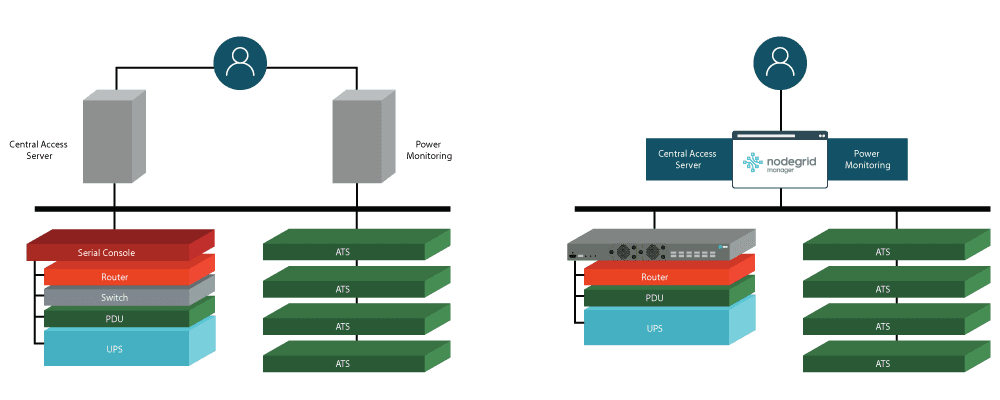
On top of all this, Nodegrid features all-in-one devices that let you wield the power of consolidation. In fact, you can replace up to six devices using the Nodegrid Services Router, which is a powerful appliance for converged infrastructure and features capabilities like switching, routing, cellular failover, and more.

But don’t just take our word for it.

Here’s how Nodegrid improved a major retailer’s network design

When a Fortune 500 business needed out-of-band at its distribution centers, they were faced with drawbacks. Traditional thinking meant they would install a network switch and an out-of-band device at each MDF. But Nodegrid came along and completely reimagined their network design.

Instead of wasting rack space, energy, and CAPEX & OPEX by implementing a traditional solution, the Nodegrid Services Router was deployed and helped save across the board. Without expanding their stack, the e-commerce giant got an all-in-one device with serial and networking capabilities that allowed them to gain full control of MDFs and IDF closets.

Out-of-band and consolidation were vital components of the implementation. But a major key would be seamless integration with the company’s automation-heavy environment. Nodegrid’s open, automation-friendly platform fit right into their network, and they deployed their proprietary kick-off application with ease.

Want to get the full story? You’ll get the details about how Nodegrid streamlined network design to deliver savings, convenient management, and customer satisfaction.

Download the case study now!

Retail Cost Savings Using Network Consolidation

When it comes to infrastructure, network consolidation is becoming a must-have. This is especially true in hyper converged architectures, where streamlining operations means the difference between profitability and major losses. Combining systems and reducing the number of disparate solutions helps you achieve an efficient network that supports your business goals — whether it means speeding up the customer experience, decreasing points of failure, saving on support costs, or anything in between.

With legacy infrastructure configurations, you’re forced to deploy purpose-built appliances that add complexity. This complexity is reflected not only by your physical topology, but also by your management practices, system integrations, and end-user experiences. No matter what industry you’re in, you can unwind your tangled enterprise network and reap many benefits using a consolidated solution.

In this entry, you’ll explore network consolidation and why a global retailer could no longer do business without the advantages it offers.

Network consolidation means simpler networking

Network consolidation is a straightforward concept that you can implement on several levels.

If you draw a layout of your hardware configurations, your legacy setups most likely resemble intricate webs. Network traffic must travel along many paths and stop at each hardware node for processing. Heavy user loads can easily bog down your system, especially because your legacy devices don’t come with processors built for performance.

But when you consolidate, you can implement multi-function devices and replace many disparate appliances. Instead of having a complicated stack comprised of switches, routers, firewall boxes, modems, and other devices, you can get a powerful solution that combines all these into one.

Consolidating can also involve taking advantage of virtualization to simplify your infrastructure. You can deploy applications, run VMs or Docker containers, use automation tools, and more. You can cut complexity and further reduce your hardware stack by virtualizing your environments.

For management purposes, you can also consolidate your efforts using software that unifies your different solutions. This involves deploying tools to centralize your control, so you don’t have to juggle unique management UIs and vendor-specific software.

Retail Diagram O

Network consolidation comes with many benefits

When you adopt all-in-one hardware, your deployments become simple, fast, and cost effective. You save on capital expenses and shipping costs, and you don’t have to configure and provision an array of separate devices. If you also use zero touch provisioning, deployments become plug ’n play simple. You only need someone to physically install and boot your boxes, and your sites automatically come online in minutes. On top of this, your user experiences become smoother because your network is streamlined with appliances that are more powerful.

Virtualization also speeds up the customer experience thanks to more efficient integrations and service chaining. You can closely integrate solutions to boost efficiency, without being held back and forced to make changes at the hardware level. You can provide an experience that’s responsive, even during increased traffic flows and heavy workloads.

If you consolidate management with a unified software tool, your IT teams can do away with cumbersome administration protocols and practices. They no longer need to be dispatched to perform on-site maintenance or perform lengthy troubleshooting to find problems. A centralized management suite helps pinpoint issues and offers remote control for instant response times. Use it in conjunction with all-in-one hardware, and you don’t need to waste time connecting to check on non-problematic devices. You know exactly where to focus your efforts, while your software tool gives you unified control of all your integrated solutions — from SD-WAN, to routing, switching, security, and more.

How does a large retailer benefit from network consolidation?

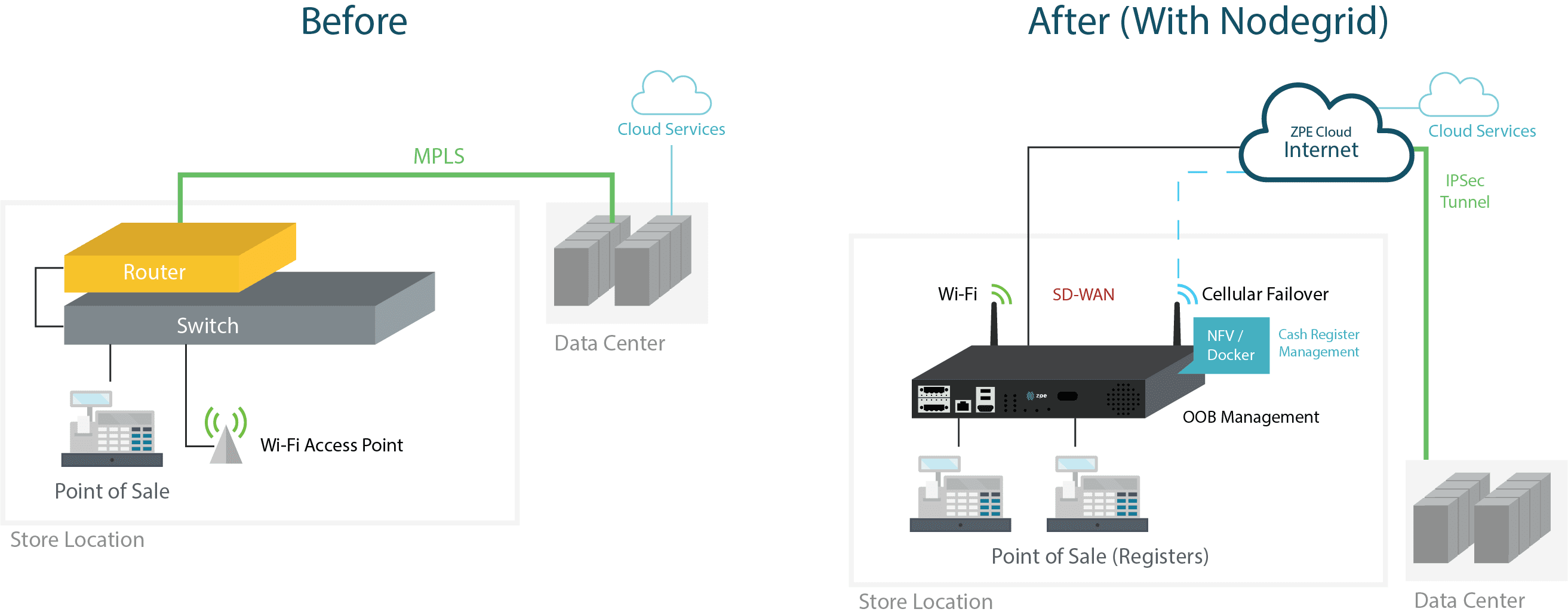
When a global retailer’s costs began to skyrocket, their network was to blame. They knew that in order to maintain profitability, they needed to move away from their legacy infrastructure configuration. This consisted of MPLS lines at each branch location, with separate devices for switching, routing, and security.

Their customer experience was unresponsive, and came with long transaction times and even longer checkout lines. Disruptions exacerbated everyday operations, forcing technicians to be dispatched to set up LTE modems while MPLS connections were restored.

Their network was costing too much money to maintain, and their poor customer experience led to too much lost revenue.

But a single Nodegrid solution allowed them to achieve network consolidation and leave behind all of these problems. They streamlined their hardware stack at each location, and allowed IT teams to support their networks with extreme efficiency.

Investing in Out-of-Band Management to Reduce Risks

Case Study – Investing in OOB – Thumbnail 2

In the finance industry, network modernization protects the most confidential customer data. Whether for processing minor withdrawals & deposits, or recording asset transactions & real estate purchases, your network must be secure and reliable from the ground up. This is one of the biggest obstacles when trying to modernize.

Using traditional solutions forces you to overhaul your infrastructure and disrupt your business, or endure a very slow, piece-by-piece implementation. Either approach requires plenty of time, money, and resources. And without careful planning, you may end up with a solution that becomes obsolete sooner rather than later.

In this post, you’ll see why you need to focus on network modernization, and how it helped one of ZPE Systems’ finance customers protect their data.

What is network modernization?

Network modernization means updating your infrastructure and management tools, so that you can address current challenges and future requirements. This approach allows you to get the most out of your legacy solutions, while setting up a foundation that can help you adapt to change. Network modernization involves at least one of the following:

  • Deploying a solution that integrates in-depth control of legacy and modern systems
  • Eliminating points of failure using more resilient systems and streamlined architecture
  • Adopting extensible software or hardware that can accommodate changing needs

Why focus on network modernization?

When you adopt an approach that focuses on network modernization, you can realize many benefits even into the future. The most important thing to understand is that the more you modernize, the more benefits you’ll see. For example, if you focus solely on deploying new hardware, you may experience advantages at the onset but eventual diminishing returns without modernized software. And if you implement only newer software, you’ll run into the same issue due to the limited capabilities of your legacy hardware.

Network modernization is a multi-faceted concept, but comes with many benefits:

  • Using powerful, multi-function devices helps you save on deployment costs & efforts. You can replace many purpose-built appliances with a single box. This shrinks capital & shipping expenses, streamlines setup, and makes ongoing management much simpler.
  • Using an in-depth software solution for management helps you save on support expenses. You can control your legacy systems and extend functionalities to them, while giving IT teams remote access to your infrastructure layer. Instead of training on many UIs and dispatching technicians to troubleshoot issues, modernized software lets you control everything seamlessly from afar.
  • With an extensible solution, you get peace of mind knowing you can adapt to future requirements. Demands will continue to evolve (especially at the edge), and a flexible platform helps you accommodate changes. This could mean implementing the latest SD-WAN solutions, deploying compute power at the edge, or further reducing hardware stacks to meet business goals.
Finance-Diagram

Network modernization helps a large financial firm

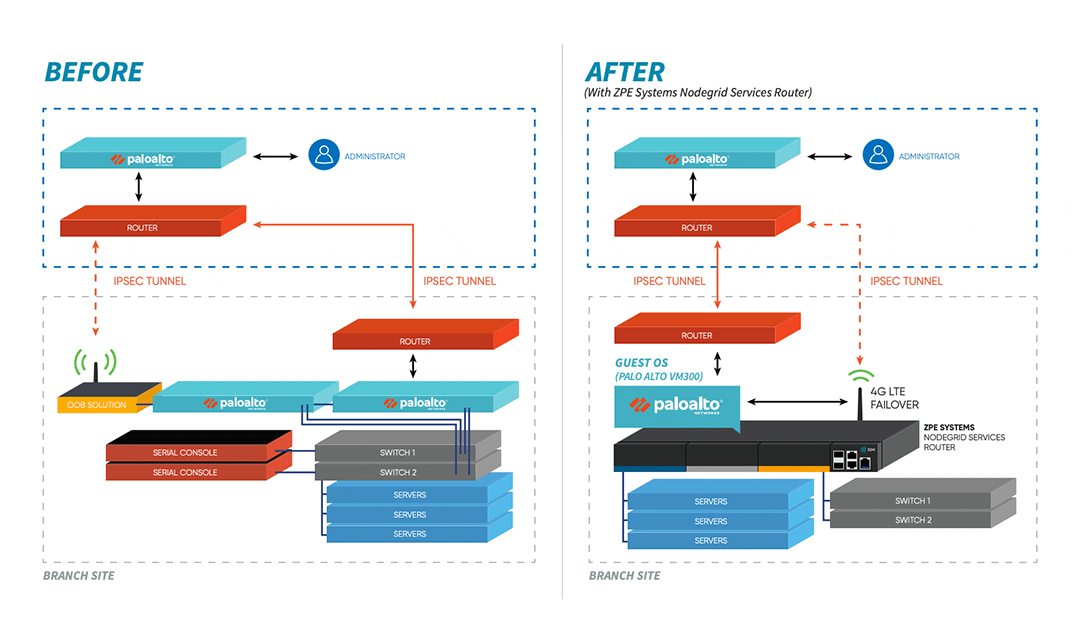
A major financial institution began to see weaknesses in their legacy system, and they knew that modernization was the solution. Their traditional infrastructure employed too many disparate systems that were difficult to manage, even to maintain everyday operations. Security and compliance issues were also developing, and to top it off, they would need to implement a new solution by taking a gradual approach.

For out-of-band management, they were using too many devices at the rack level. Their management solutions also lacked the ability to give them control over all their systems. Their servers and automatic transfer switches required separate gateways, which increased response times and made support difficult to manage.

So how were they able to replace these headaches with an efficient, cost-saving network? They used Nodegrid hardware and software to achieve a comprehensive network modernization solution.

For full details, read the case study.

See How Nodegrid’s Out-of-Band Eliminated EBRC’s Single Points of Failure

European Business Reliance Centre, or EBRC, requires out-of-band management capabilities to keep business running. As a managed services provider, EBRC helps companies outsource their IT efforts and acts as a one-stop shop for organizations in finance, healthcare, security, and other industries. The company employs hundreds of IT experts who maintain critical infrastructures and applications, from data center hosting to cloud computing.

Because service agreements and customer satisfaction rely on high levels of availability, EBRC must ensure that they have the tools in place to prevent downtime and disruptions. This is where out-of-band management comes into play.

What’s the Role of Out-of-Band Management?

Out-of-band management allows support teams to access their network infrastructure. Instead of relying on the production, or in-band network, out-of-band uses a completely separate network path. This helps lock out potential security attacks, and also provides access that doesn’t rely on the main network. This is important for network engineers and administrators, because they can gain secure control of their infrastructure even in the event of an outage.

How Does Nodegrid Improve Out-of-Band Management?

Nodegrid improves out-of-band management by allowing remote access to physical & virtual assets. Because it’s vendor neutral, companies can deploy Nodegrid’s out-of-band regardless of which vendor solutions they currently use or plan to use. Finally, Nodegrid provides secure remote management via WAN links and a variety of connection types, including broadband, cellular, satellite, and others.

What Are the Advantages of Using Nodegrid’s Out-of-Band?

Nodegrid’s out-of-band helps companies preserve customer satisfaction and boost efficiency of their network support efforts.

Whereas typical out-of-band solutions require slow phone lines, modems, and even on-site intervention, Nodegrid allows IT teams to gain fully remote control of their systems. Device outages, interruptions, or attacks no longer need to leave organizations paralyzed by downtime or scrambling to dispatch technicians to all affected sites. With Nodegrid, teams can respond instantly whether the problem occurred in a data center rack, branch MDF, or virtual environment.

Nodegrid also allows companies to do away with the limited control offered by traditional solutions. Support teams can use Nodegrid’s out-of-band to gain granular visibility and control over their distributed networks. This means that when a password needs to be reset, a firmware upgrade needs to be installed, or a device even needs to be rebooted, IT staff can perform these critical tasks efficiently from afar.

All of these advantages equate to streamlined operations and savings on management. But don’t take our word for it. Watch this 90-second clip featuring EBRC’s Michel Ackerman, who describes the convenience and simplicity that Nodegrid brought to the European MSP.

Secure Access Service Edge For an Oil & Gas Provider

Secure Access Service Edge is a new concept that’s transforming the edge network. SASE delivers more flexible and secure network access, so your business can adapt to drastic changes and accommodate a distributed workforce.

Want to see it in action? Here’s a 90-second explainer video to help you visualize business with SASE.

In a nutshell, SASE delivers a ton of benefits:

  • SASE combines networking and security in a cloud environment. This means you don’t have to backhaul traffic through your main enterprise firewall, which causes slowdowns and degraded performance. Instead, you can deliver safe network access directly to users, which makes it easy to connect from anywhere. At the same time, this lets your main network breathe so business can continue without interruptions or lagging network speeds.
  • SASE is identity-driven. This means network connectivity is tied to users instead of to specific devices or access points. So when changes force you to accommodate remote work or distributed staff, your IT teams don’t have to be burdened configuring countless laptops, smartphones, tablets, etc. Your workers can simply pick up and go, and connect to your network even using their own devices or public access points.
  • SASE converges network functions for secure and easy management. Accommodating a more agile edge network used to require adding purpose-built solutions to your stack. This made a nightmare out of deploying and scaling, and management became more complex because each solution came with its own UI, architecture, requirements, etc. With SASE, you can virtualize all your essential functions. This helps reduce your stack to make scaling simple, and centralizes functions so IT staff can manage your network in one place.

Why is SASE better with Nodegrid?

Nodegrid provides a SASE platform that’s unlike other solutions on the market. This owes to all-in-one devices and the 64-bit, Linux-based Nodegrid OS. With more speed and compute power, Nodegrid offers even more flexibility through virtualization, capable of running multiple guest operating systems (guest OS) and directly hosting your choice of applications.

Nodegrid also supports automation and zero touch provisioning. In order to deploy new locations, just install your Nodegrid devices, and then provisioning can be executed automatically. This significantly increases security, since you can ship 100% unconfigured devices and then provision only when they’re under your control. This also saves on deployment resources, because you don’t have to send specialized IT staff to each site for time-consuming, manual setup tasks.

How does Nodegrid deliver SASE in the real world?

A global oil & gas provider needed to streamline their edge networking solutions.

Their hardware stack consisted of many devices that were difficult to deploy and manage. This was a major hurdle for the company, considering their remote sites were very limited by physical space constraints. Additionally, support costs continued to rise and IT staff were dispatched to fix even minor issues.

The company needed a streamlined solution that was more space- and energy-efficient, and that could also maintain a high availability environment. Nodegrid was the only platform that could meet all their needs.

Want to learn how the company cut their stack in half, maintained a secure & highly-available environment, and saved on support?

SD-Branch for a Digital Security Leader

SD-Branch delivers some major advantages over traditional SD-WAN capabilities. Where typical software-defined approaches fall short at the branch level, SD-Branch picks up the slack to help you see and do much more.

In case you need to catch up, here’s a 90-second video showing some ways you can benefit from using SD-Branch.

If you’re super short on time, the advantages boil down like this:

  • SD-Branch lets you see inside your branch locations, by combining SD-WAN, routing, security, and all your network functions
  • You can see & control on a granular level, including activity for IoT devices, cameras, laptops, & all clients on your branch networks
  • You get more operational agility with a system that centralizes your infrastructure management & lets you take control remotely

Now that you’re caught up, you might be wondering…

How does Nodegrid make SD-Branch better?

Nodegrid gives you SD-Branch capabilities and a lot more. All-in-one Nodegrid devices, like the Nodegrid Services Router (NSR), reduce your stack thanks to the ability to handle many network functions in a single box. Support for automation and containerization via tools like Puppet, Ansible, Docker, and Kubernetes takes your orchestration and management capabilities to an entirely new level. It gets even better with out-of-band management that you can use even during an outage (thanks to cellular failover). Nodegrid hardware and software are vendor neutral, too, which means you can adapt your network to your changing business needs.

Sounds Pretty Awesome. But How Does it Work in the Real World?

See What SD-Branch Brings to a Leading Digital Security Company

Cellular-Failover-Diagram-628LI

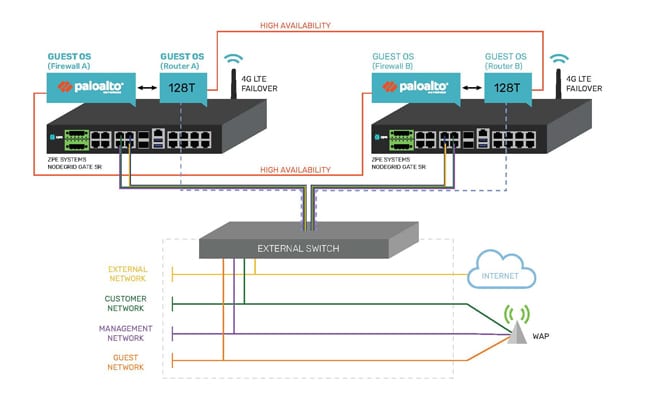
When a digital security enterprise, whose offices span the globe, needed help with their complex network infrastructure, they chose ZPE Systems’ Nodegrid. The powerful NSR solution relieved many of their branch network headaches, and even extended additional benefits to their data center operations. Their large, cumbersome stacks were replaced by a streamlined, all-in-one solution that made management easy, provided reliable backup via cellular, and leveraged the world-class security of Palo Alto Networks’ next-gen firewalls. Ready for the details?