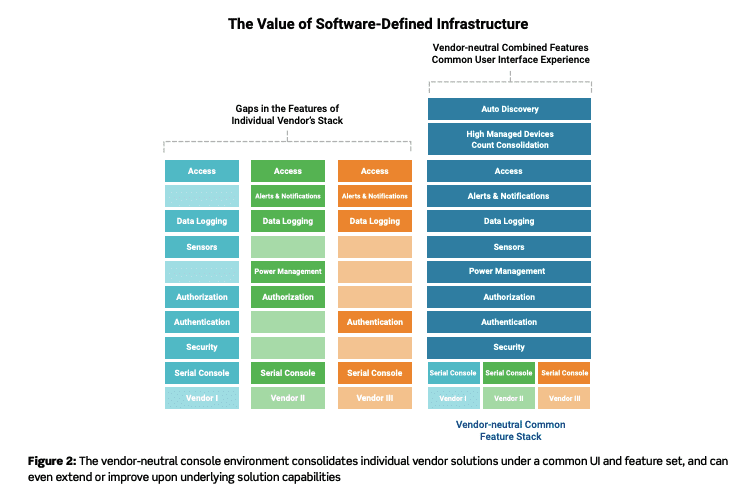
Out-of-band management (OOB) and business continuity go hand-in-hand. If set up properly, your OOB network should provide safe, reliable, always-ready access to your critical infrastructure components. Even when there’s not an outage, OOB is the key to optimizing your network — from troubleshooting issues, to maintaining speed & availability to all your users.
OOB is essential to branch and satellite IT sites, where specialized personnel might only occasionally drop in. With this in mind, ZPE Systems’ Nodegrid platform offers OOB that’s far beyond ordinary:
Take advantage of secure access technologies, including non-VPN access links that work over any available WAN
Use zero touch provisioning for hands-off, automatic deployments — for even your most remote locations
Set up automation using popular tools & languages, for help with management of branch offices
Get ZPE Cloud for even more flexibility and remote management capabilities
You can’t control the weather, a pandemic, or natural disasters. But you can control network uptime with remote out-of-band management from ZPE Systems.
Time and money hinge on your network. So what happens when you lose connectivity at a site halfway across the globe? Traditional out-of-band management (OOB) is slow and expensive, forcing you to put staff on-site while downtime swallows up your resources. ZPE Systems’ Nodegrid does away with these time-consuming headaches to bring you a business-friendly solution, i.e., remote OOB.
Get Remote Control, No Overhaul Needed
Nodegrid is vendor neutral, so you can take total control of your existing infrastructure. Simply deploy your Nodegrid appliance, connect your devices, and get remote OOB throughout your network — no overhaul needed.
Restore Uptime Fast Yesterday
Network outages can cost $100,000+ per hour. Though you can’t predict when or how they’ll happen, you can equip your organization to recover fast. Remote OOB with Nodegrid lets you troubleshoot issues and restore connectivity even to your most faraway locations. The intuitive interface with normalized controls streamlines your user experience. There’s no more admin fatigue from switching between vendor-specific software. You can also implement automation to monitor network health, pinpoint issues, and fix problems before they happen.
Failure? Not an Option
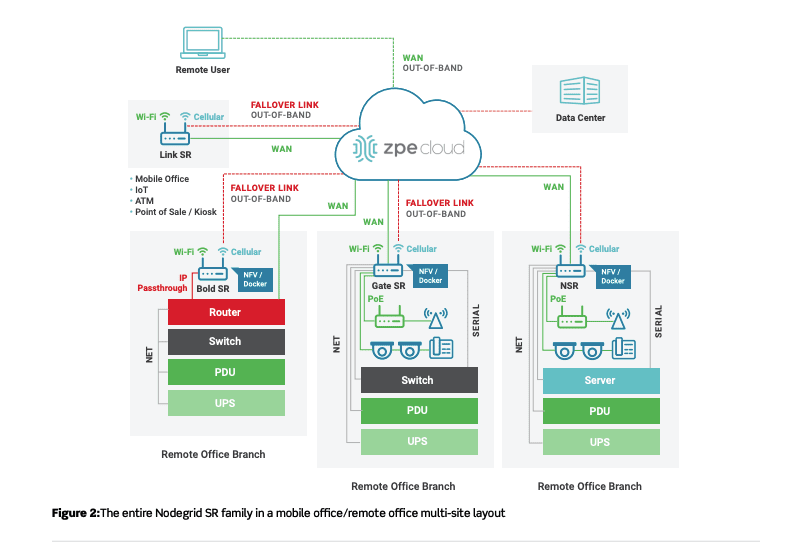
For even more protection against outages, Nodegrid features cellular failover that supports all major carriers. These dual-SIM modules attached to the powerful Nodegrid Services Router (NSR), act as insurance policies for your WAN coverage. When your main line goes down, you’ve got two wireless backups that are automatic and seamless.
Put Power at Your Fingertips
A clean and easy-to-use interface is the tip of the iceberg when using Nodegrid. Our all-in-one devices feature x86 64-bit architecture, multi-core Intel processors, and a Linux-based OS. It’s a perfect combination that gives you the flexibility to deploy Docker containers and virtualized network functions directly on Nodegrid appliances. Get full remote control of everything, starting from SD-WAN, to firewall, cybersecurity, and even power cycling. Screen- and session-sharing features let you put your experts on the job no matter how distributed your IT teams are.
It’s rough out there. But no matter how long it takes to get back to normal, ZPE Systems is here to bring normal back to your network. Contact us to see how you can have business continuity and keep it, too.
The cloud — it’s great for delivering services and applications that are crucial to your business. It can help your continuity efforts by providing SASE solutions where you need most, and it can also make deploying new locations easy with zero touch provisioning. But when it comes to out-of-band management, having cloud-based capabilities gives you even more power to efficiently maintain branch deployments.
Make Branch Deployments More Secure
When you’re setting up a new location, the cloud adds a layer of security not typical of common branch deployments. Normally, you need to preconfigure or pre-stage devices before shipping them to their final destination. This leaves your sensitive data vulnerable to being lost or stolen. Shipping unconfigured devices is one way to address this problem, but this means you’ll have to send specialized IT staff on-site to manually set up your appliances.
With the cloud, you can skirt both of these scenarios. Instead of risking sensitive info or dealing with extensive, on-site configuration, the cloud lets you provision remotely. This means that you can ship bare-metal or plain-vanilla devices, and fully configure them via the cloud only after they’ve safely reached the location.
Control Access From a Central Location
Cloud-based maintenance allows you to control network access from a centralized location. You can implement appropriate security measures, adjust policy settings, and grant permissions only to authorized engineers and administrators. Even before you set up a new branch deployment, you can determine access rights for your IT personnel.
During and after deployment, your staff can remotely install, configure, and manage branch networks using the cloud. From the security of the NOC, your network personnel can perform definition, testing, and staging, and then deploy new locations when business is ready.
If you choose a comprehensive solution such as Nodegrid with ZPE Cloud, you can get secure access that’s more flexible. ZPE’s solution allows you to go without a VPN, and instead lets you securely connect via browser window or mobile app. You don’t have to be tethered to specific gateways or portals — simply gain access to your network from any device.
Perform Routine (and Non-Routine) Maintenance
With branch deployments, a cloud-based management platform simplifies maintenance across the board. Even if you’re using a comprehensive out-of-band solution, you might still be limited to performing routine tasks on-site. These can include installing patches, adjusting traffic settings, and making policy and configuration changes to keep your network optimized. And for non-routine tasks, such as troubleshooting outages or securing backdoor vulnerabilities, time-consuming work is needed at the physical location.
But with the cloud, you can work remotely to keep your infrastructure working properly. With a secure and isolated out-of-band connection, the cloud allows you to perform all your routine tasks off-site. You can reset passwords, update firmware, schedule maintenance intervals, and roll out configuration changes to locations no matter how isolated they are.
When you need to perform critical recovery and repair activities, you can also use the cloud. Troubleshoot remotely and deploy scripts for network health monitoring and self healing. With proper testing and preparation, the cloud allows you to streamline your maintenance operations for tasks large and small.
Discover How Nodegrid and ZPE Cloud Can Help
For out-of-band management of branch deployments, Nodegrid and ZPE Cloud deliver a secure, flexible solution. ZPE uses industry-leading protocols to connect your staff to remote locations. You can maintain branch networks with in-depth, SD-Branch visibility, and use session- and screen-sharing to collaborate in real time. ZPE Cloud supports zero touch provisioning and automation, so you can deploy and manage every branch with more efficiency. Read the complete tech brief to see how the cloud improves your network edge capabilities
Your out-of-band (OOB) network can make scaling more bitter than sweet. Growing your business comes with exciting new opportunities, and you know how to set up your OOB connections for proper network management. But if you’re still using traditional deployment methods, just the thought of opening a new location can take the wind out of your sails.
Challenges With Typical Out-of-Band Network Deployment
There are a lot of moving pieces that you need to coordinate when deploying remote or branch locations. You typically spend a lot of time and money preparing the physical devices that make up your stack. On top of this, you need to orchestrate your IT support staff so they can work on-site to perform necessary tasks, like installing, configuring, updating, etc. All of this leads to scaling that’s more rigid than nimble, which can slow down your business operations.
Prepping Your Stack and Coordinating Staff
Traditional deployment protocols involve plenty of manual configuration. If you ship unconfigured devices to the new location, you need to put IT staff on-site to manually configure and install every component in your stack. This can be very time consuming and costly. Also, the more your deployment relies on manual input from IT personnel, the more chances there are for issues or failures to arise as the result of human error.
To help with this, you could preconfigure devices before sending them to their destination. However, this could add costs if you need to ship these appliances multiple times (for example, from HQ to the staging location to the final destination). When you also consider the fact that preconfigured devices contain sensitive information, you’re risking your data’s security.
What Would you do if your devices get sent to the wrong location?
Can you incur the costs of multiple shipments, especially if you’re shipping through customs and/or over long distances?
And what protocols are in place to address lost or stolen devices?
Whichever procedure you choose to follow, you’ll also need to involve IT staff once your appliances have arrived at the destination. This presents its own set of challenges, because you’ll have to coordinate schedules, set up travel arrangements, and in some cases maintain an on-site staff presence full-time or part-time. Initial deployment can take days or weeks, even if the work goes smoothly with the right people on the job.
Overall, traditional out-of-band network deployment at remote locations presents issues like:
Security risks
Increased potential for human error
Heavy reliance on staff
These issues make scaling difficult, and even more so when you need to deploy distant, isolated locations. Luckily, recent developments have taken advantage of the cloud’s flexibility, and now you can address these problems for smoother deployments.
Use the Cloud for Smooth Out-of-Band Network Deployments
Thanks to the cloud, you can eliminate major challenges during branch deployments. Using the right solution allows you to gain comprehensive visibility and control over your remote out-of-band networks. You can easily set up each location and maintain ongoing management with little or no on-site staff presence.
The cloud adds convenience and peace of mind to your deployments:
Better security — A proper cloud solution allows you to deploy using secure, encrypted connections. In addition, the cloud allows you to perform configuration and provisioning tasks remotely. You no longer need to ship preconfigured devices containing sensitive data, and instead can send plain-vanilla or bare-metal appliances. The cloud helps you set up these appliances only when they’re safely under your control.
Fewer errors — Cloud-based solutions allow you to deploy using automation and scripting tools. Of course, you’ll need to thoroughly configure and test in a lab to ensure proper setup. However, this means you can find and eliminate human errors before deploying to branch locations. And should you need to resolve an issue at multiple sites, the cloud allows you to automatically troubleshoot problems and implement fixes remotely.
Easier on staff — Zero touch provisioning means deployments require little IT staff involvement. Some solutions, such as ZPE Cloud, only require someone to physically plug in and install devices. There’s no more need to coordinate specialized staff for on-site configuration and provisioning. Even inexperienced personnel can plug in appliances, which then connect to your NOC and self-configure right out of the box.
Cloud-based solutions streamline your out-of-band network deployments, especially at remote locations. There’s even more that’s available to keep your network secure, stable, and flexible, detailed in the complete tech brief.
The IT industry is rapidly growing. In 2020, spending on IT services reached almost $952 billion worldwide, with software accounting for the largest percentage of spending. However, while companies spend more on software, there’s one key thing they need to spend on — out-of-band connectivity and management.
In-Band vs. Out-of-Band Management
In-Band Management entails managing network devices via the LAN, HTTPS, or the web browser. Out-of-band management (OOBM), on the other hand, does not rely on LAN. Instead, it uses a secure and solitary network to ensure networking devices such as switches and routers stay connected.
Why Your Business Needs OOBM
In-Band Management is inexpensive and easy to implement since it only requires one network. Conversely, out-of-band connectivity and management can be costly and more complex to implement. So why should you consider OOBM over in-band?
1. Cheaper Over Time
The initial cost of OOBM can be relatively high, but it may be cheaper in the long term. While in-band management is cheaper to implement, it is more prone to outages. System outages are costly. Moreover, they are often time-consuming to sort out since technicians may be required on-site. OOBM networks are less prone to system outages. As a result, they can save your business a significant amount of money in the long run.
2. Enforced Security
Security breaches are on the rise. In 2020, it was estimated that companies lost an average of $3.86 million thanks to them. Many times, they happen due to cyberattacks from hackers. Networks that use in-band management are at a higher risk of getting compromised because if a hacker infiltrates the network, the whole network is at risk. Out-of-band connectivity and management, on the other hand, offer better network security. Unlike in-band, OOBM enables specific administrators to manage networking devices without disrupting the normal workflow. Administrators can manage devices and restrict access to the network to prevent security breaches.
3. Limit Access
If you’ve outsourced a third party to manage some of your network devices, you should consider out-of-band connectivity and management. With OOBM, you’ll be able to take control of your network and prevent the third party from accessing sensitive information on it.
4. Maintain Uptime
In-band networks are more susceptible to downtime. Downtime is costly. An hour of it can cost an average of $260,000. Your business cannot afford to lose that much money. Out-of-band connectivity and management can ensure your business does not experience downtime. Unlike in-band, OOBM can give you the ability to restart devices that have gone offline remotely. Overall, it’s better for troubleshooting and network automation.
Your business cannot afford downtime. Dispatching technicians to data centers to address downtime issues is costly and time-consuming. You cannot afford to allow hackers to access or destroy sensitive information either. That’s why you need to invest in out-of-band connectivity and management. While it may be expensive at first, the long-term benefits make it a worthwhile investment. Are you considering investing in OOBM for your business or making the switch to it? For professional assistance, contact ZTE Systems to learn more.
3 Ways the Cloud Improves Out-Of-Band Management at the Branch
For decades, out-of-band management (OOB) has been supporting business continuity needs for organizations of all sizes. It’s a crucial tool for deploying new locations, setting traffic rules, optimizing connectivity, and so much more. OOB offers an exclusive path to your network so you can control your infrastructure without relying on production networks.
But modern technology advancements have allowed the scope of networking to expand well beyond the data center. This means that the enterprise infrastructure is more distributed than ever, with branch locations throughout the globe. One problem that organizations face is how to manage such a widely distributed network.
This is where the cloud comes in. Not only does it provide better OOB in data center environments, but also for managing your entire network, even at the branch level.
Here’s How the Cloud Delivers Better Out-Of-Band Management at the Branch:
Deploy Faster and More Secure
The cloud accommodates zero touch provisioning (ZTP), which essentially offers scaling with little or no human intervention. Instead of shipping preconfigured devices that require manual setup and extensive user input, you can ship plain-vanilla devices that can be automatically configured. Not only does this keep you safe from potential security threats (as unconfigured devices don’t contain any data to be stolen), but also allows you to have plug-n-play simplicity when scaling. Just connect your devices to the network, and the cloud does the rest.
Get a Full Network View
A cloud-based environment can provide a 360-degree view of your network. This can include even your most remote branch locations. Aside from offering more convenient scaling, the cloud gives you in-depth visibility of devices connected to your network, even if they’re across the globe. If you implement a robust SD-Branch solution as well, you can also see the activity inside each branch — including for connected IoT devices, cameras, laptops, and others.
Take More Control
On top of faster, more secure scaling and in-depth branch network visibility, the cloud provides remote access to your out-of-band management path. Once you’ve successfully provisioned and deployed a new location, you can use the cloud for maintenance, troubleshooting, and management. You can adjust access policies, tailor QoS settings, block specific domains, and much more, all from the safety of your network operations center (NOC). Additionally, cellular connectivity can provide you with reliable backup to your OOB network, so you can manage your infrastructure even during an outage.
Use Nodegrid With ZPE Cloud
Nodegrid’s consolidated devices give you complete control of your network, with out-of-band capabilities you’ve never seen before. One of Nodegrid’s biggest strengths is that it offers all of these cloud benefits using ZPE Cloud.
Deploy quickly with zero touch provisioning, and manage all of your devices with the help of a strong cloud platform. The reliability of 4G/LTE cellular failover keeps your business running, and an innovative ‘Reset’ button lets you reconnect devices to ZPE Cloud without hassle.
Read the full tech brief if you want to explore more benefits of using the cloud with your out-of-band management strategy.
ZPE Systems delivers innovative solutions to simplify infrastructure managment at the datacenter, branch, and edge.
Learn how our Zero Pain Ecosystem can solve your biggest network orchestration pain points.



 The IT industry is rapidly growing. In 2020, spending on IT services reached almost $952 billion worldwide, with software accounting for the largest percentage of spending. However, while companies spend more on software, there’s one key thing they need to spend on —