

Designing AI infrastructure that engineers can recover when things break
AI infrastructure is expanding fast across enterprise networks. GPU clusters are powering model training, while edge inference systems process data in real time across industries like finance, manufacturing, retail, and telecommunications. Most AI environments are working well from the perspective of the computing infrastructure.
But with many deployments scaling beyond centralized data centers and into distributed edge environments, network engineers are facing a familiar problem: How do you maintain control when failures happen?
This is an important question to address because AI environments amplify the operational impact of failures. Large GPU clusters, distributed edge locations, and latency-sensitive workloads all depend on reliable network connectivity. When something breaks, recovery becomes just as important as redundancy.
AI Infrastructure Places Different Demands on the Network
Traditional enterprise applications are generally tolerant of brief interruptions. A user might reconnect to an application or retry a transaction without significant impact. But AI workloads are much less forgiving.
Large language model (LLM) training, distributed inference pipelines, and real-time analytics depend on continuous communication between compute, storage, and networking resources. Interruptions have a ripple effect because modern AI environments rely on:
- GPU clusters connected by high-bandwidth Ethernet or InfiniBand fabrics
- East-west traffic that exceeds traditional north-south application flows
- Distributed storage systems supplying training data
- Kubernetes orchestration platforms scheduling GPU workloads
- Edge inference nodes continuously exchanging telemetry with centralized systems
For example, a failed top-of-rack switch, an incorrect routing policy, or a misconfigured spine switch can isolate entire GPU pools from storage or orchestration services. Even if the compute nodes remain operational, workloads stall while engineers work to restore connectivity.
For network engineers, resilience is now a job of ensuring the infrastructure remains observable, accessible, and recoverable especially when failures occur.
Understanding the Different Network Planes
Before we go further, it helps to distinguish between three separate but closely related parts of the network, which will help understand where failures happen and their effects:
Production (or data) plane: carries application traffic, including AI training data, inference requests, storage traffic, and user communications. For example, when you submit a prompt to an AI application, the production plane is what carries your prompt, the model’s responses, and supporting data.
Control plane: runs the protocols that determine how traffic moves through the network, including BGP, OSPF, EVPN, VXLAN, spanning tree, and other routing and switching functions. Think of this like the network’s navigation system. The control plane decides the best path for traffic to take, but it doesn’t carry the traffic itself.
Management plane: provides the interfaces engineers use to monitor, configure, and recover infrastructure. This includes SSH, HTTPS, APIs, SNMP, serial console access, intelligent PDUs, and out-of-band management. This is the path that engineers use to log into devices, push config changes, and recover systems during an outage.
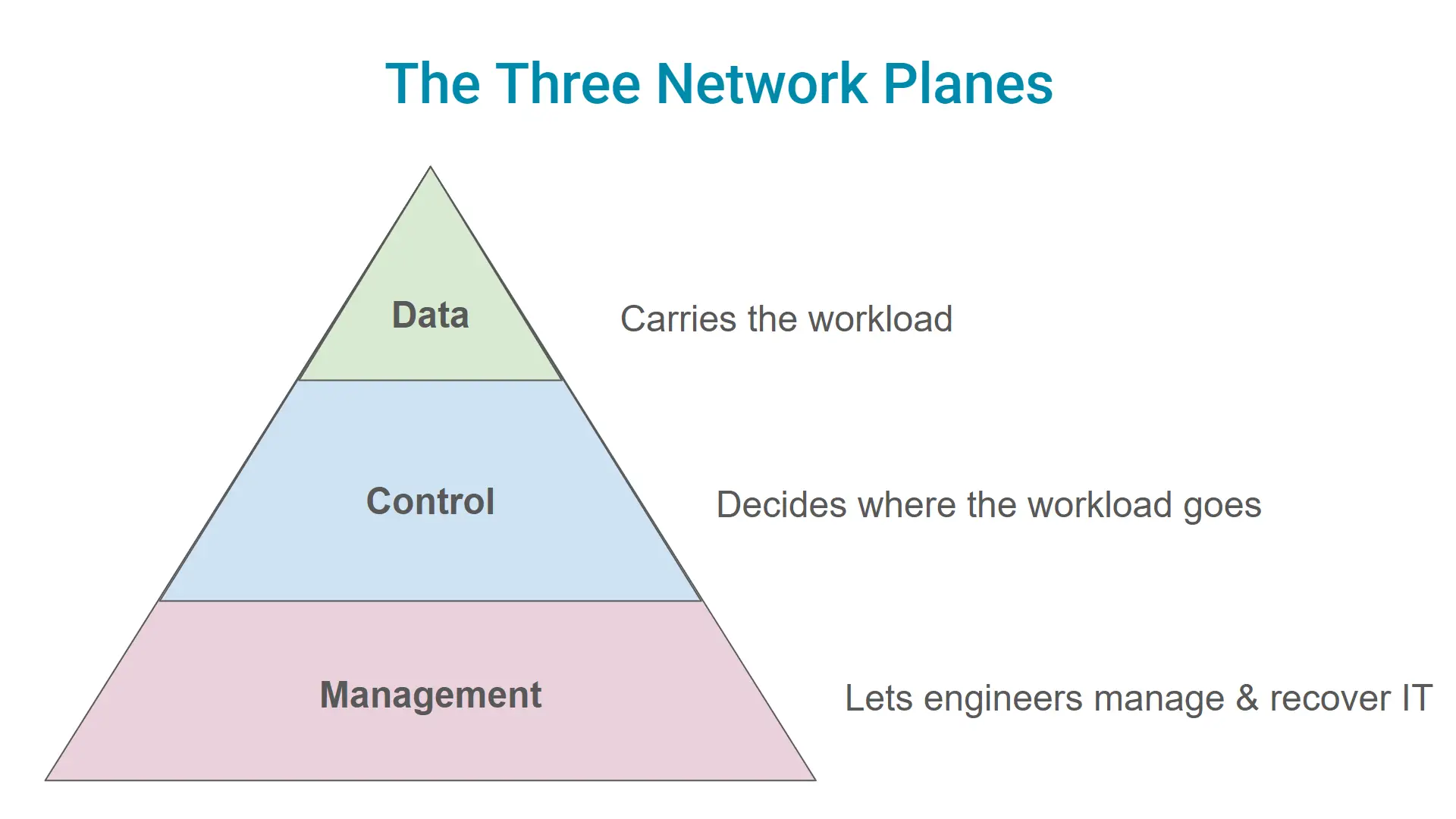
Image: The three network planes: The data plane, which carries the workload; the control plane, which decides where the workload goes; and the management plane, which gives engineers access to manage and recover equipment.
Where AI Infrastructure Failures Actually Happen
Control Plane Failures That Disrupt The Management Plane
Not every outage begins with a hardware failure. In fact, a lot of incidents originate in the control plane with:
- BGP policy mistakes
- OSPF adjacency failures
- EVPN/VXLAN configuration errors
- VLAN or VRF misconfigurations
- ACL changes that unintentionally block management traffic
These issues may leave routers, switches, and servers fully operational but unreachable over the production network. If management traffic shares the same infrastructure as application traffic, engineers lose SSH, API, and monitoring access right when they need it most.
This is why it’s important to completely separate the management network from the production network (more on this below).
Automation Mistakes That Create a Big Blast Radius
Infrastructure-as-Code (IaC) and network automation are great for improving consistency, but they also increase the blast radius of configuration errors. A single Ansible playbook, Terraform deployment, or automation workflow can unintentionally affect hundreds of devices simultaneously.
When that happens, engineers need a recovery path that does not depend on the production network remaining operational. This is one of the reasons out-of-band management continues to be standard practice in hyperscale and service provider environments.
GPU Clusters That Are Left Idle
AI infrastructure is built around the most expensive compute resources in the data center. Experts project global AI investments to exceed $1 trillion in 2026, and it’s easy to see why. A single GPU server can cost hundreds of thousands of dollars, and production AI clusters often consist of dozens or hundreds of these systems working together.
Model training requires GPUs to operate as a coordinated cluster. If a network issue isolates part of the cluster or prevents nodes from communicating with storage or orchestration platforms, the training job stalls or fails altogether. Even though the GPUs are powered on, they’re no longer doing productive work.
In inference environments, the impact is different but just as significant. An unreachable edge AI node that stops processing camera feeds, sensor data, or real-time transactions reduces application performance or forces workloads to fail over to other locations.
Idle hardware is just the beginning of the costs. Organizations also lose productive compute time, delay model development, miss service-level objectives (SLOs), and increase operational overhead while engineers work to restore connectivity.
No infrastructure is immune to failures, so eliminating every outage isn’t realistic. The goal instead is to minimize Mean Time to Recovery (MTTR) by giving engineers immediate access to diagnose and recover systems, so expensive GPU resources spend more time running workloads and less time waiting for someone to restore the network.
Addressing a Common Question About AI
One common response to conversations about AI resilience is: “Our AI infrastructure is already working fine. Why do we need to change anything?”
It’s a valid question. After all, if it ain’t broke…
But this underscores something we’ve been talking about for years. It’s not about redesigning networks that already work just fine. It’s about building the ultimate safety net that’ll save you from the growing operational risks of scaling your infrastructure.
Managing a GPU cluster inside a data center is completely different than managing a fleet of AI systems spread across hundreds of remote sites. Engineers need to retain visibility and control when the inevitable routing mistake, WAN outage, or misconfig happens. Resilience needs to be built into the architecture.
Resilience Should Be Built Into AI Architecture
The networking industry has spent decades designing highly available production networks through redundant links, resilient routing protocols, and fault-tolerant hardware. AI infrastructure deserves the same level of attention, but redundancy alone isn’t enough.
Traditional high-availability designs focus on strengthening the production and control planes. Equally important is strengthening the management plane and being able to confidently answer this question: “When an engineer loses connectivity to a remote GPU cluster at 2am, what path do they have to recover it?”
If the answer depends on the production network coming back first, the architecture still has a single point of failure. This is why it’s key to fully separate management from production. This isolation lets engineers diagnose, control, and recover AI infrastructure exactly when it matters most.
So, “Why do we need to change anything?” It’s not really about changing the architecture. It’s more about adding an alternate management path that lets you recover systems even if the production network is down.
That’s where out-of-band and IMI come in.
IMI: The Evolution of Out-of-Band
Out-of-band management is usually thought of as a console server attached to a few routers, meant to give engineers backup access in case the main network goes down. But modern out-of-band — what’s called Isolated Management Infrastructure (IMI) — has much more operational capability, including the ability to fully rebuild systems.
An IMI includes:
- Serial console access to routers, switches, firewalls, storage arrays, and GPU servers
- Independent Ethernet management interfaces
- 5G/LTE or satellite connectivity for WAN independence
- Remote power management through intelligent PDUs
- Secure jump-host capabilities with centralized authentication
- Automated recovery workflows triggered by monitoring platforms
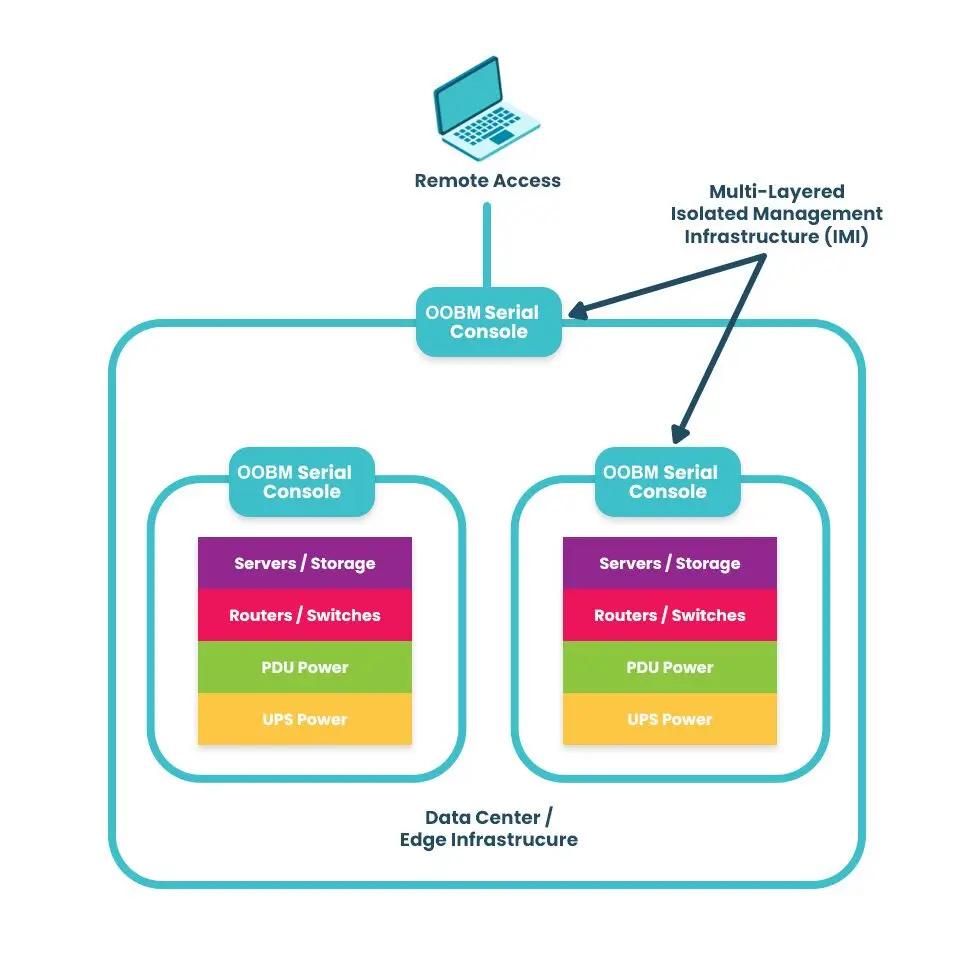
Image: Isolated Management Infrastructure provides the operational capabilities to fully rebuild and restore networking systems, even if the network is offline.
This creates a management plane that remains operational regardless of whether the production network is available. So instead of having to rebuild connectivity before troubleshooting can begin, engineers can connect via 5G/LTE or satellite to immediately investigate logs, inspect device health, restore configurations, or power-cycle failed systems.
ZPE is Essential to Resilient Architecture
ZPE’s solutions are an essential component of resilient network architecture. They’re used by many organizations as an independent operational layer alongside the production network. At each AI or edge site, one ZPE Nodegrid device can aggregate management access for routers, spine and leaf switches, firewalls, GPU servers, storage, PDUs, and hypervisor/compute platforms.
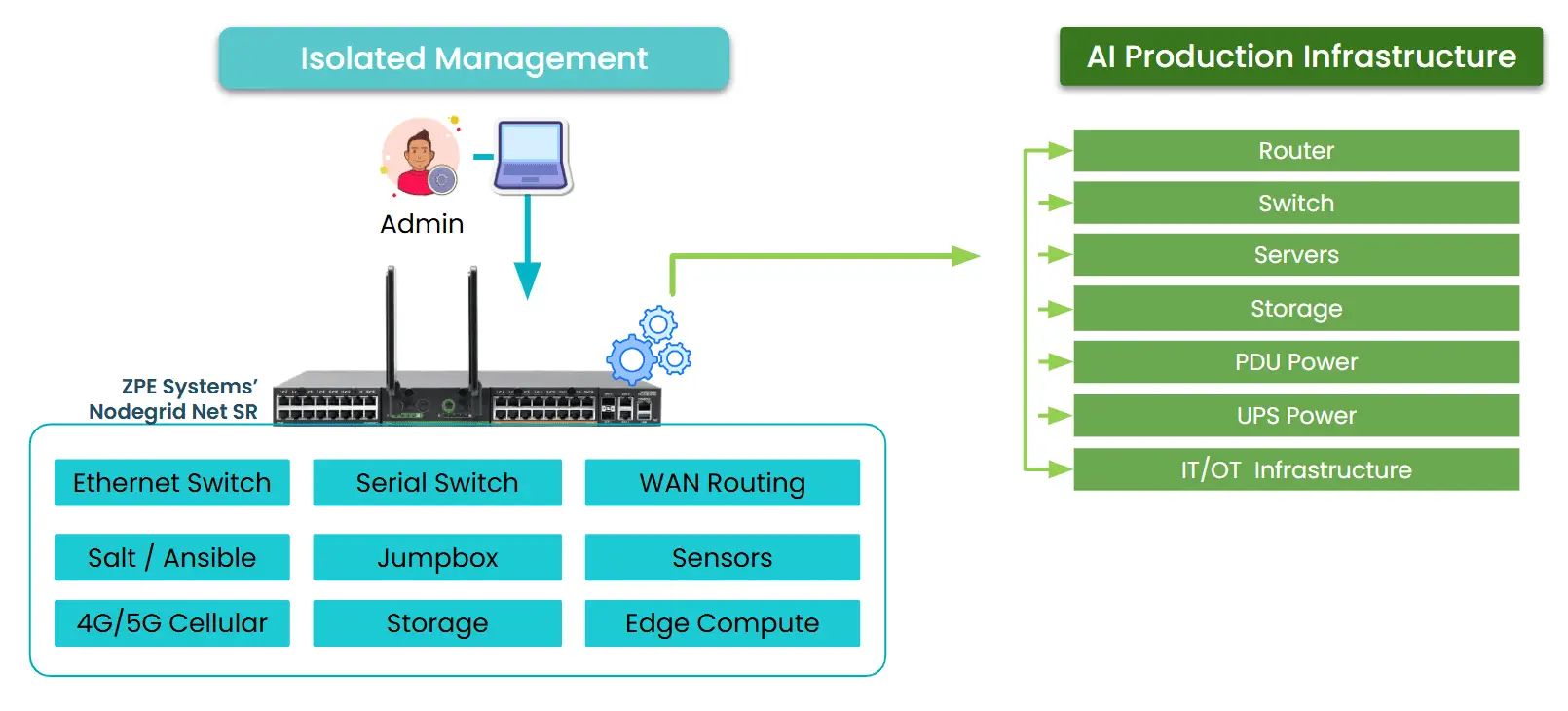
Image: ZPE’s solutions consolidate multiple functions into a single device and aggregate management access to a variety of AI production infrastructure, with the ability to connect via RS-232, Ethernet, USB, and OCP interfaces.
This IMI gives engineers secure access during routing failures, WAN outages, failed software upgrades, config errors, and many other outage scenarios. Nodegrid devices can also host virtualized functions (like routing and firewalls) to help further consolidate the overall tech stack. This gives organizations a consistent operational model no matter how many AI sites they have or where their workloads are deployed.
Download the Blueprint for AI Resilience
Want to see how these principles fit together? Download the Network Resilience Blueprint to learn a practical framework for designing an infrastructure that’s easy to manage, quick to recover, and built for today’s distributed AI and edge environments.
Get in Touch For a Demo of AI Resilience
Our engineers will walk you through the best practices and show you Nodegrid’s capabilities first-hand. See how easy it is to point, click, and manage your distributed AI fleet. Fill out the form to get started.