Providing Out-of-Band Connectivity to Mission-Critical IT Resources

Home » Archives for August 2024

ZPE Cloud – Centralized IT Infrastructure Management and Orchestration

Dashboard

Summary

ZPE Cloud centralizes global fleet management under a single UI. With Nodegrid devices connected to ZPE Cloud, IT teams get a bird’s-eye view of their critical IT infrastructure, regardless of its location. This provides full remote management capabilities for data center, branch, and edge networking equipment. Here are just a few of the benefits of using ZPE Cloud:

  • Fast, repeatable deployments using zero touch provisioning
  • Minimize outages with instant remote access for troubleshooting and remediation
  • Optimize system health using sensors and Nodegrid Data Lake

Read the full document using the button below.

See ZPE Cloud in action with this video demo

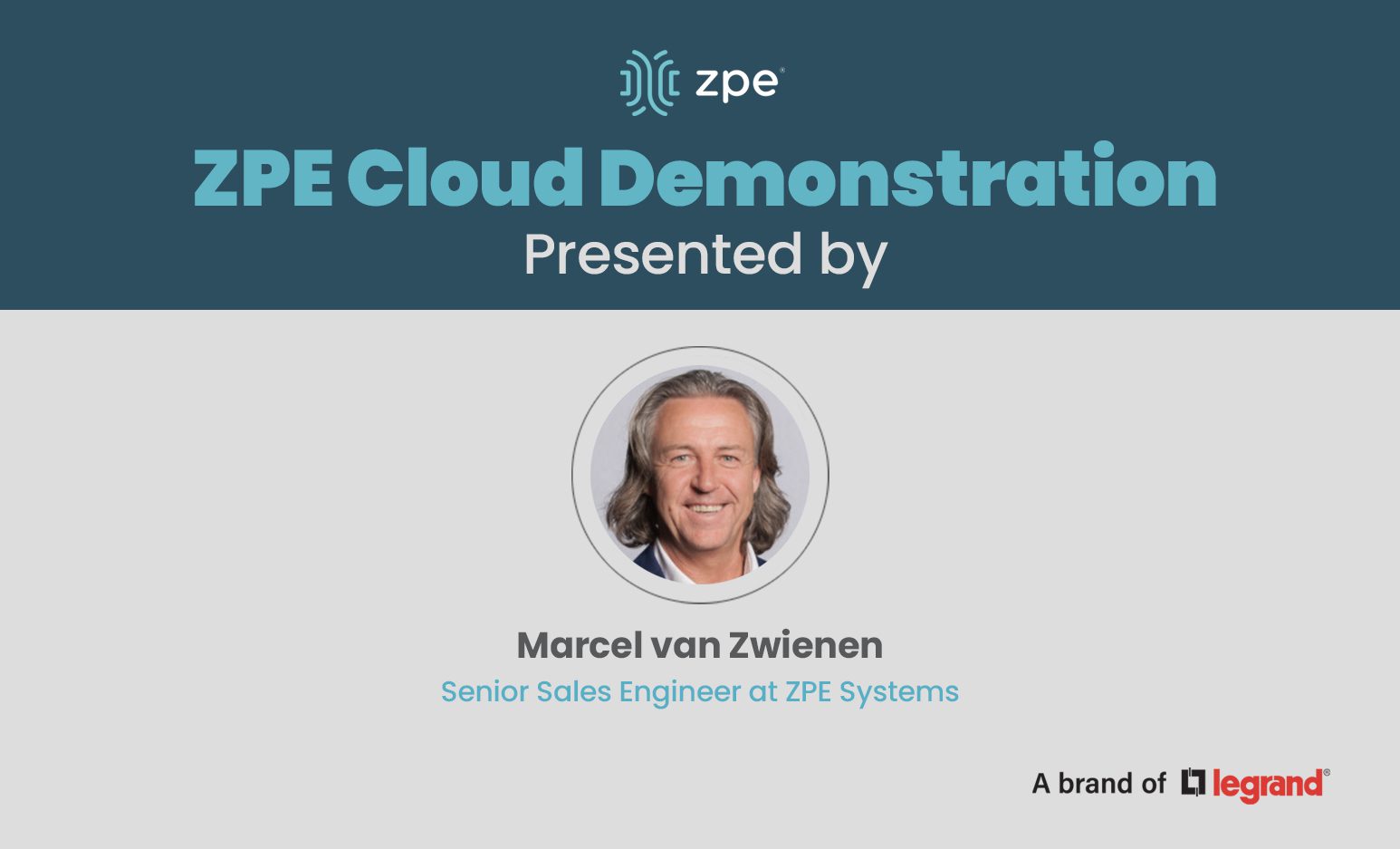
Senior Sales Engineer Marcel van Zwienen gives you a hands-on demo of ZPE Cloud in this video. Watch Marcel take you from signing in to gaining remote access for troubleshooting, to showing how to apply configuration changes automatically across device fleets. Watch now at the link below.

Marcel van Zwienen gives a walkthrough of ZPE Cloud for remote device management.

Run your own Kubernetes or a cloud instance in a physical box with Nodegrid

Home » Archives for August 2024

Webinars & Presentations

James Cabe and Twain Taylor discuss out-of-band management, resilience systems, and the flexible Nodegrid platform offered by ZPE Systems. Their discussion covers the requirements and end goals of use cases including critical utilities resilience, AI, and edge computing.

Watch James’ other video presentation where he discusses resilience for cities and critical infrastructure.

Check out James’ analyses of recent high-profile outages and cyberattacks, including the CrowdStrike outage, and the MOVEit, MGM, and Ragnar Locker hacks.

The CrowdStrike Outage: How to Recover Fast and Avoid the Next Outage

Dissecting the MGM Cyberattack: Lions, Tigers, & Bears, Oh My! (zpesystems.com)

The Biggest Ransomware Attack You Haven’t Heard of…Yet (zpesystems.com)

Breaking Down The 2023 Ragnar Locker Cyberattacks (zpesystems.com)

Visit the Amazic webpage to listen to more podcasts covering networking and operations.

ZPE Systems delivers innovative solutions to simplify infrastructure managment at the datacenter, branch, and edge.

Learn how our Zero Pain Ecosystem can solve your biggest network orchestration pain points.

Watch a Demo Contact Us

Video Wall

VIDEOCONFERENCIA – JAMES CABE – ZPE SYSTEMS

Home » Archives for August 2024

Webinars & Presentations

James Cabe (CISSP) presents at the 9th American Digital Tech & Business Conference in Mexico. James discusses the challenges to achieving cyber resilience and why human error is a contributing factor.

Watch now to see James discuss social engineering, the major players in the hacking space,, and the vulnerable systems that are being targeted, including utilities, energy, and pharmaceuticals.

To learn about how to build an Isolated Recovery Environment, as mentioned in James’ presentation, read our walkthrough article and download the guide here How to build an isolated recovery environment (IRE) – ZPE Systems

Check out James’ breakdowns and analyses of recent high-profile cyberattacks, including the MOVEit, MGM, and Ragnar Locker hacks.

Dissecting the MGM Cyberattack: Lions, Tigers, & Bears, Oh My! (zpesystems.com)

The Biggest Ransomware Attack You Haven’t Heard of…Yet (zpesystems.com)

Breaking Down The 2023 Ragnar Locker Cyberattacks (zpesystems.com)

ZPE Systems delivers innovative solutions to simplify infrastructure managment at the datacenter, branch, and edge.

Learn how our Zero Pain Ecosystem can solve your biggest network orchestration pain points.

Watch a Demo Contact Us

Video Wall

ZPE Systems – Supply Chain Security Assurance

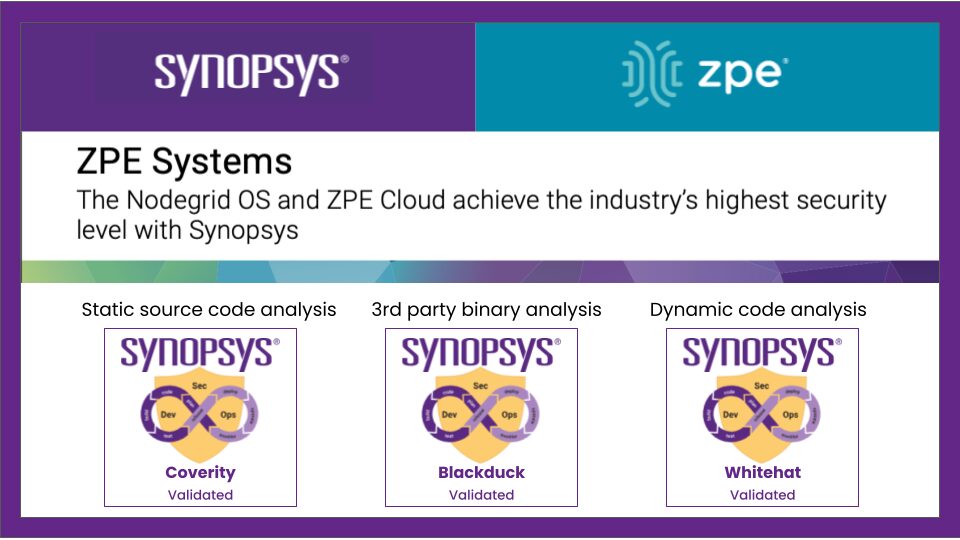
Synopsys and ZPE validation

Summary

At ZPE Systems, we take the security of our supply chain very seriously. While we do not publicly disclose specific details about the members of our supply chain, we ensure that every step of our product lifecycle—whether it involves hardware, software, or cloud offerings—is safeguarded through a comprehensive, layered security approach. We strictly adhere to compliance with government regulations, including any restrictions on the use of technology by enterprises due to regulatory mandates.

Our value chain security is designed with the following key objectives:

  • Secure Development, Manufacturing, and Deployment: ZPE Systems solutions are developed, manufactured, and deployed within securely controlled environments. We use only ZPE Systems-approved
    processes, tools, and components throughout these stages to ensure the integrity of our solutions.
  • Prevention of Malware and Rogue Materials: Our processes are designed to prevent the introduction of any malware or unauthorized raw materials that could compromise the functionality of our products.
  • Counterfeit Prevention: Our build and deployment processes are structured to make it extremely difficult for malicious actors to produce counterfeit solutions. By securing every stage of development, we protect our products from being altered or replicated in unauthorized ways.

Read the full 3-page guide now for a comprehensive look at ZPE’s supply chain security.

Data Center Scalability Tips & Best Practices

Data center scalability is the ability to increase or decrease workloads cost-effectively and without disrupting business operations. Scalable data centers make organizations agile, enabling them to support business growth, meet changing customer needs, and weather downturns without compromising quality. This blog describes various methods for achieving data center scalability before providing tips and best practices to make scalability easier and more cost-effective to implement.

How to achieve data center scalability

There are four primary ways to scale data center infrastructure, each of which has advantages and disadvantages.


4 Data center scaling methods

Method Description Pros and Cons
1. Adding more servers Also known as scaling out or horizontal scaling, this involves adding more physical or virtual machines to the data center architecture. ✔ Can support and distribute more workloads

✔ Eliminates hardware constraints

✖ Deployment and replication take time

✖ Requires more rack space

✖ Higher upfront and operational costs

2. Virtualization Dividing physical hardware into multiple virtual machines (VMs) or virtual network functions (VNFs) to support more workloads per device. ✔ Supports faster provisioning

✔ Uses resources more efficiently

✔ Reduces scaling costs

✖ Transition can be expensive and disruptive

✖ Not supported by all hardware and software

3. Upgrading existing hardware Also known as scaling up or vertical scaling, this involves adding more processors, memory, or storage to upgrade the capabilities of existing systems. ✔ Implementation is usually quick and non-disruptive

✔ More cost-effective than horizontal scaling

✔ Requires less power and rack space

✖ Scalability limited by server hardware constraints

✖ Increases reliance on legacy systems

4. Using cloud services Moving some or all workloads to the cloud, where resources can be added or removed on-demand to meet scaling requirements. ✔ Allows on-demand or automatic scaling

✔ Better support for new and emerging technologies

✔ Reduces data center costs

✖ Migration is often extremely disruptive

✖ Auto-scaling can lead to ballooning monthly bills

✖ May not support legacy software

It’s important for companies to analyze their requirements and carefully consider the advantages and disadvantages of each method before choosing a path forward. 

Best practices for data center scalability

The following tips can help organizations ensure their data center infrastructure is flexible enough to support scaling by any of the above methods.

Run workloads on vendor-neutral platforms

Vendor lock-in, or a lack of interoperability with third-party solutions, can severely limit data center scalability. Using vendor-neutral platforms ensures that teams can add, expand, or integrate data center resources and capabilities regardless of provider. These platforms make it easier to adopt new technologies like artificial intelligence (AI) and machine learning (ML) while ensuring compatibility with legacy systems.

Use infrastructure automation and AIOps

Infrastructure automation technologies help teams provision and deploy data center resources quickly so companies can scale up or out with greater efficiency. They also ensure administrators can effectively manage and secure data center infrastructure as it grows in size and complexity. 

For example, zero-touch provisioning (ZTP) automatically configures new devices as soon as they connect to the network, allowing remote teams to deploy new data center resources without on-site visits. Automated configuration management solutions like Ansible and Chef ensure that virtualized system configurations stay consistent and up-to-date while preventing unauthorized changes. AIOps (artificial intelligence for IT operations) uses machine learning algorithms to detect threats and other problems, remediate simple issues, and provide root-cause analysis (RCA) and other post-incident forensics with greater accuracy than traditional automation. 

Isolate the control plane with Gen 3 serial consoles

Serial consoles are devices that allow administrators to remotely manage data center infrastructure without needing to log in to each piece of equipment individually. They use out-of-band (OOB) management to separate the data plane (where production workflows occur) from the control plane (where management workflows occur). OOB serial console technology – especially the third-generation (or Gen 3) – aids data center scalability in several ways:

  1. Gen 3 serial consoles are vendor-neutral and provide a single software platform for administrators to manage all data center devices, significantly reducing management complexity as infrastructure scales out.
  2. Gen 3 OOB can extend automation capabilities like ZTP to mixed-vendor and legacy devices that wouldn’t otherwise support them.
  3. OOB management moves resource-intensive infrastructure automation workflows off the data plane, improving the performance of production applications and workflows.
  4. Serial consoles move the management interfaces for data center infrastructure to an isolated control plane, which prevents malware and cybercriminals from accessing them if the production network is breached. Isolated management infrastructure (IMI) is a security best practice for data center architectures of any size.

How Nodegrid simplifies data center scalability

Nodegrid is a Gen 3 out-of-band management solution that streamlines vertical and horizontal data center scalability. 

The Nodegrid Serial Console Plus (NSCP) offers 96 managed ports in a 1RU rack-mounted form factor, reducing the number of OOB devices needed to control large-scale data center infrastructure. Its open, x86 Linux-based OS can run VMs, VNFs, and Docker containers so teams can run virtualized workloads without deploying additional hardware. Nodegrid can also run automation, AIOps, and security on the same platform to further reduce hardware overhead.

Nodegrid OOB is also available in a modular form factor. The Net Services Router (NSR) allows teams to add or swap modules for additional compute, storage, memory, or serial ports as the data center scales up or down.
Want to see Nodegrid in action?

Watch a demo of the Nodegrid Gen 3 out-of-band management solution to see how it can improve scalability for your data center architecture.

Watch a demo