Providing Out-of-Band Connectivity to Mission-Critical IT Resources

Home » Archives for Luiz Barbieri

Out-of-Band Deployment Best Practices

OOB Deployment Best Practices

Modern networks are sprawling. Think about all the data centers, branch offices, edge locations, retail sites, and remote industrial environments that organizations need operating 24/7. Supporting these with apps and services requires vast networking infrastructure. But here’s the thing: the network is more critical now than it’s ever been, meaning downtime can be a major problem.

A single WAN outage, configuration error, device failure, or ISP issue can leave IT teams without access to critical infrastructure. Their access path and tools become useless. What should be a quick remote fix turns into hours of travel and on-site troubleshooting.

Why does this happen? Because many organizations still rely on traditional management – where remote access depends on the production network – and this architecture was never designed for today’s distributed environments. It leaves engineers cut off from the infrastructure they need at the exact time they need it most.

This is where out-of-band (OOB) management changes everything. OOB is an independent management layer separate from the production network. Engineers use this for secure access to infrastructure, even if there’s a device failure, routing error, ISP outage, or other downtime scenario. Out-of-band access is the foundation for resilient network operations because it helps organizations maintain visibility, accelerate recovery, and reduce downtime across distributed environments.


Best Practices for Deploying Out-of-Band Infrastructure

Deploying a proper out-of-band infrastructure requires more than just adding remote console access. The most effective deployments design for resilience, scalability, and operational simplicity from the beginning. Here are some best practices to follow when building your OOB network.


1. Separate the Management Network from the Production Network

We can’t say it enough: production networks are not management networks.

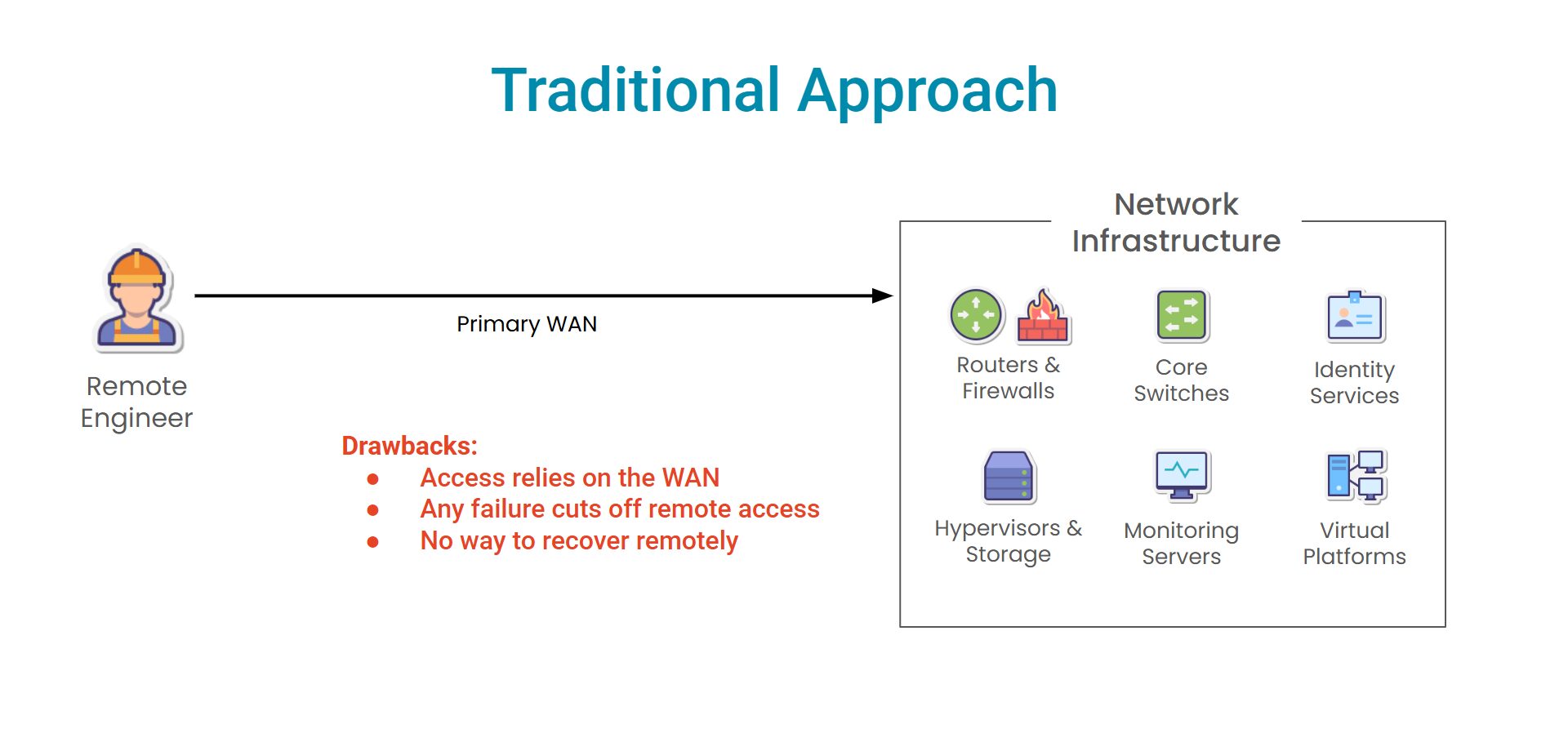
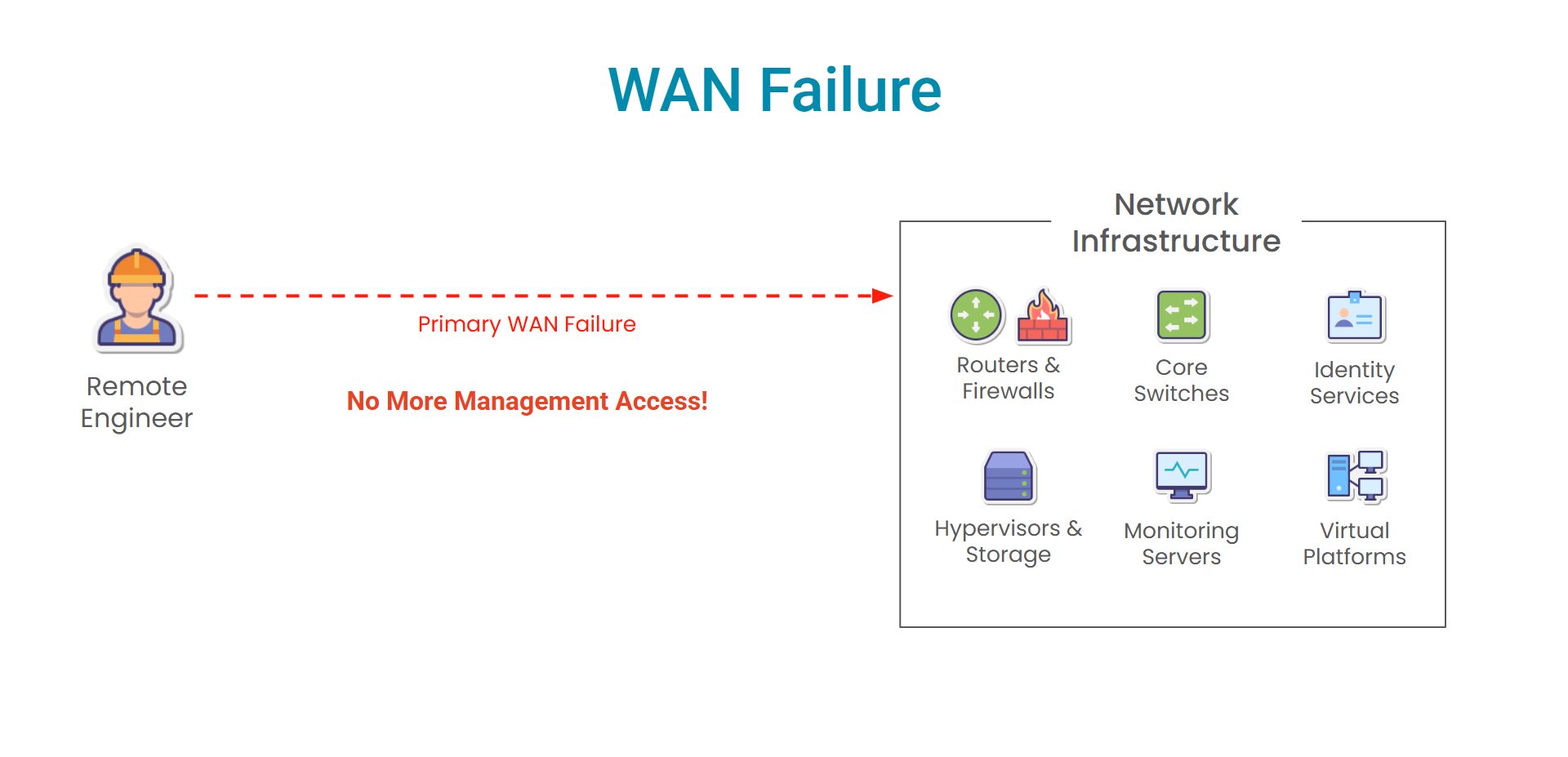
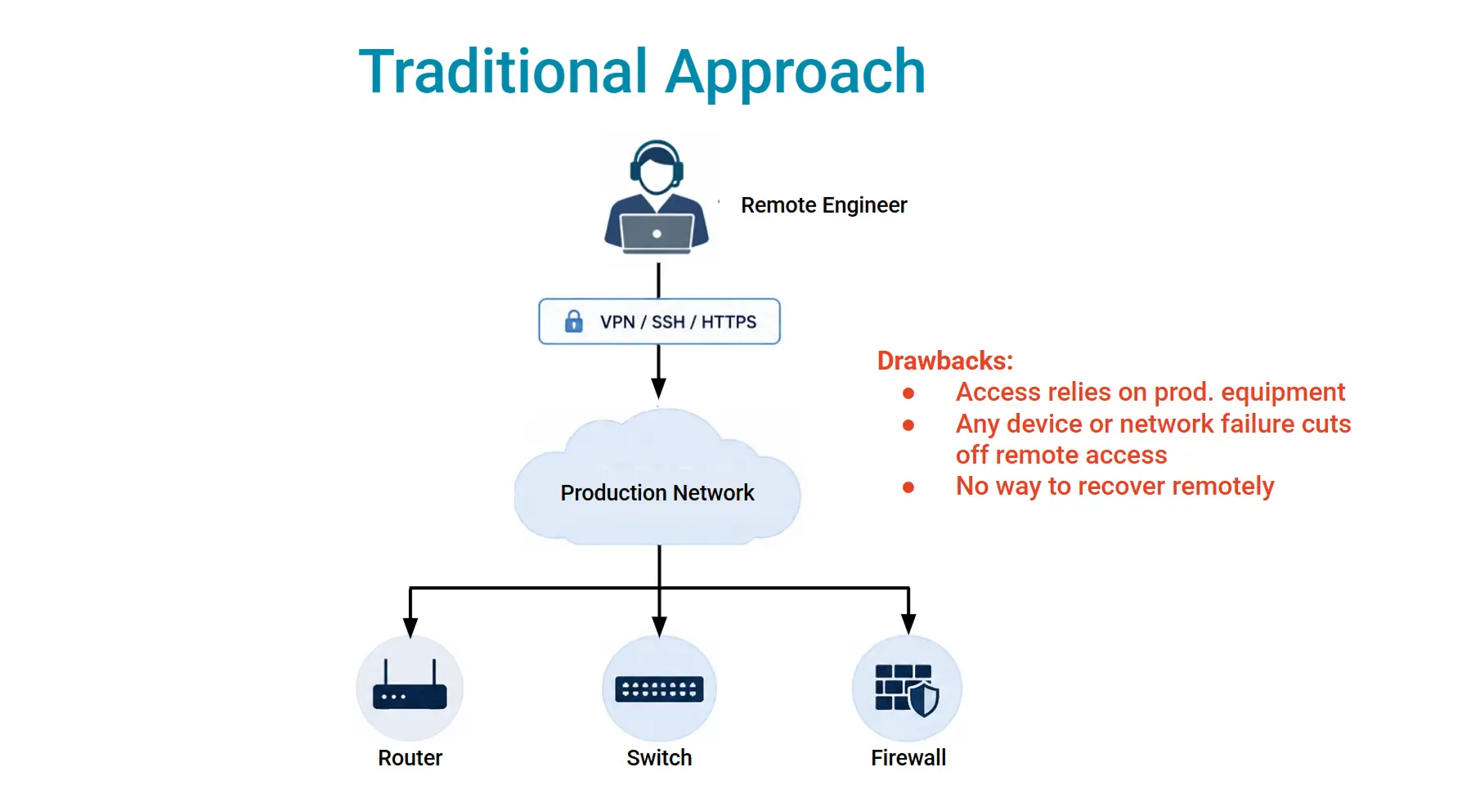
In traditional environments, remote management depends entirely on the production network itself. Engineers connect to routers, switches, firewalls, and servers using protocols like SSH or HTTPS. But they do this over the same WAN links and routing infrastructure they are responsible for maintaining. Which means that when the production network fails (for any number of reasons), those remote management paths also disappear with it. Visibility and control vanish when they’re needed most.


Traditional Approach – Diagram

Image: Traditional remote management architectures rely on the production infrastructure, which is the exact infrastructure that needs to be managed.

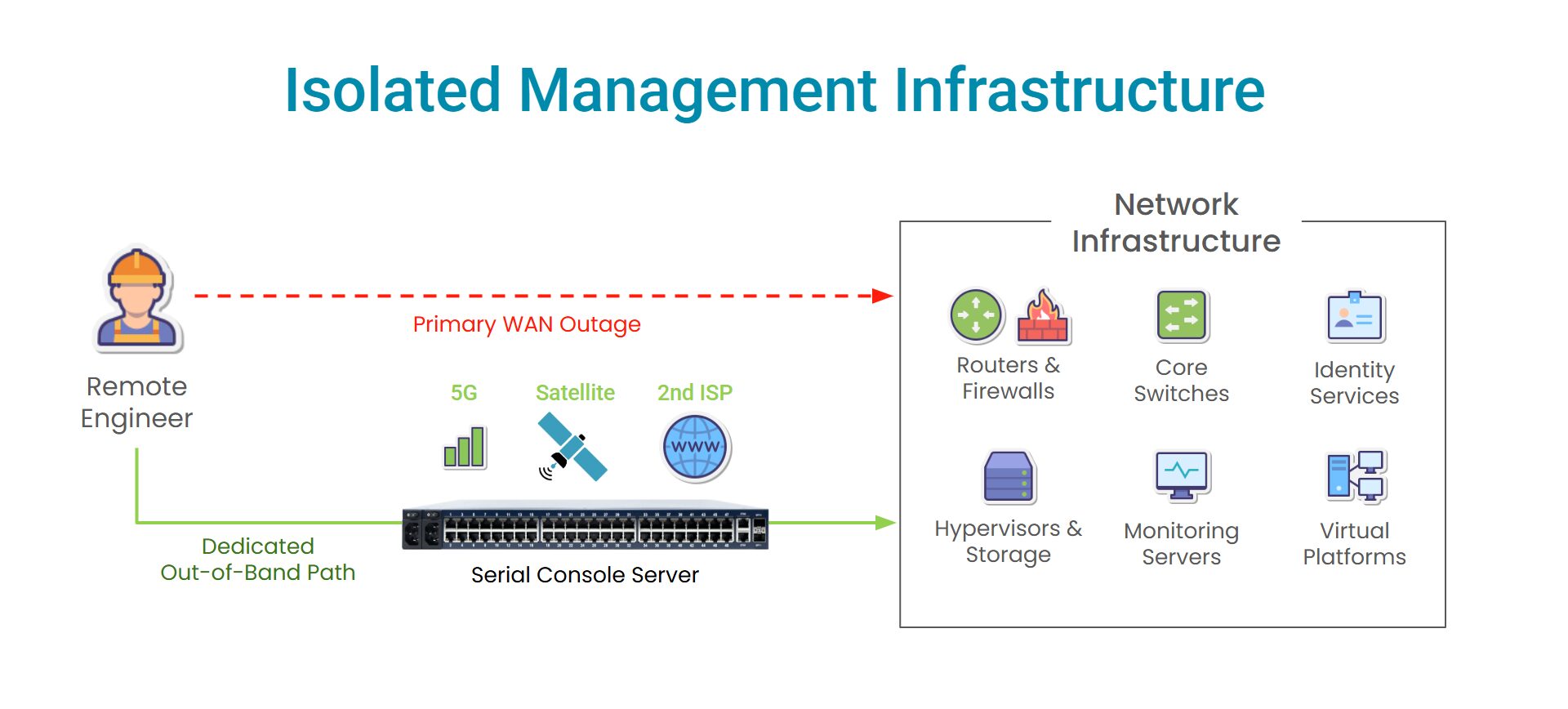
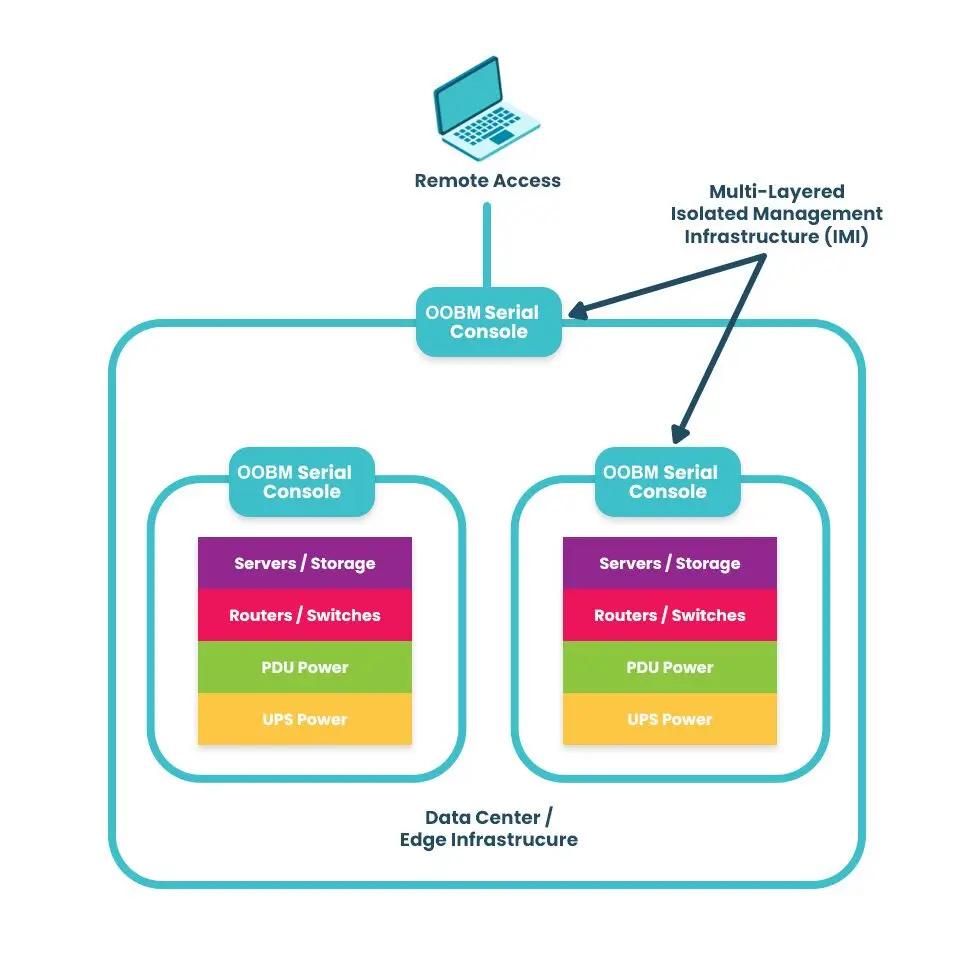
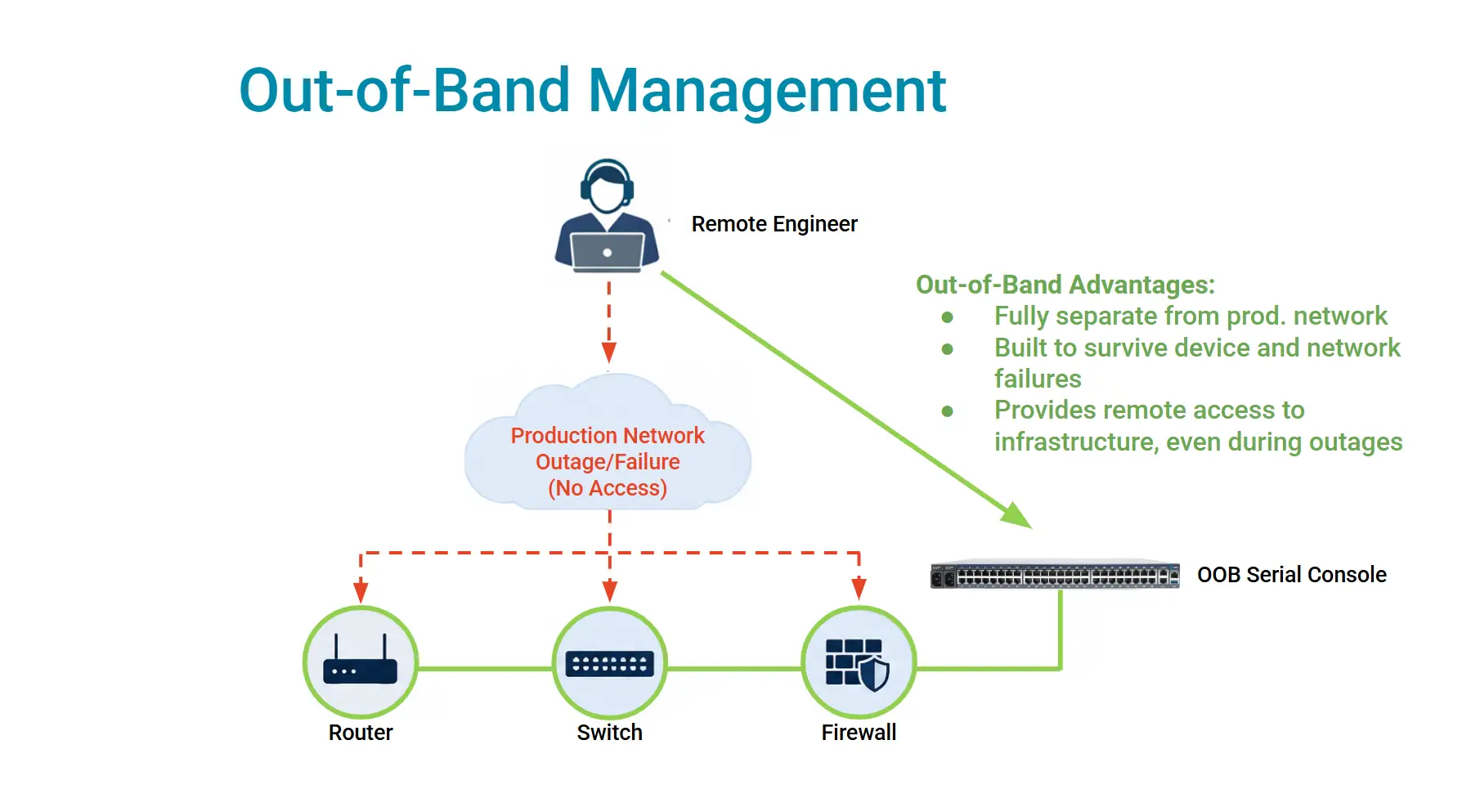
Out-of-band management improves resilience by creating a management layer that remains accessible when the primary network experiences problems. When building your out-of-band network, follow the best practice of logically and physically separating it from production. This is what’s known as Isolated Management Infrastructure (IMI), and it’s what modern OOB designs incorporate to ensure admin access in worst-case scenarios.

Out-of-Band Management – Diagram

Image: Out-of-band management is built to withstand production network outages, and provides full remote access to infrastructure, even if the production network is completely offline.


2. Deploy More Than One Connectivity Path At Every Site

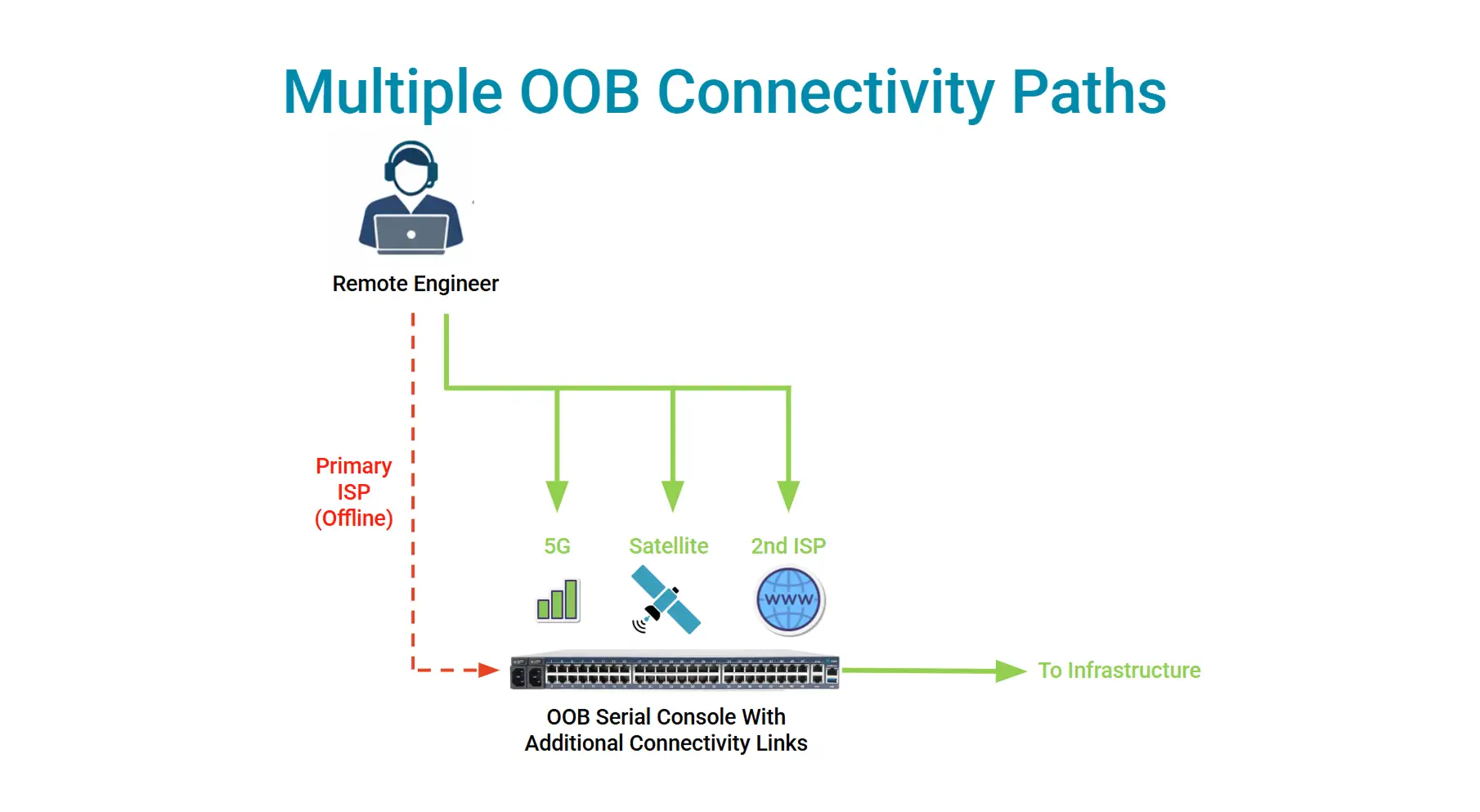
Having an out-of-band network is a great start. But, having only one connection can leave engineers hamstrung. If the OOB path suffers a WAN or ISP failure, admin access is cut off and sites become unreachable. Downtime lasts longer because restoring service requires a truck roll and on-site troubleshooting.

Multiple OOB Connectivity Paths – Diagram

Image: Modern out-of-band management networks design for connectivity failures, and employ one, two, or even three backup link types (like 5G, satellite, secondary ISP, etc.).

Modern OOB networks are isolated, and just as importantly, they employ more than one type of connection. When building your out-of-band network, the goal is to ensure you maintain management access no matter what. Deploy multiple OOB access links at every site, like 5G, satellite, MPLS, etc. These layers of connectivity significantly improve recovery times and practically eliminate the need for truck rolls during incidents.


3. Standardize Infrastructure and Centralize Management

It’s difficult to manage sprawling networks when every site has bespoke configurations or tools, separate VPN connections, manual device inventories, etc. This approach is not sustainable in distributed environments because it slows down troubleshooting and creates operational bottlenecks/inefficiencies.

Imagine an engineer logging into devices one-by-one across different tools and interfaces – while juggling IP addresses and credentials for everything – and having to bring services back online ASAP during a severe outage.

Standardizing infrastructure and centralizing management eliminates this complexity by creating a consistent operating model across every site. Instead of managing devices through disconnected tools, spreadsheets, and manual processes, teams get a unified architecture for accessing, monitoring, and controlling infrastructure.

When designing your out-of-band network, the goal is to simplify operations at scale. Look for solutions that replace IP address spreadsheets and fragmented workflows with a centralized, intuitive interface. Prioritize platforms that eliminate manual configuration processes and instead enable zero-touch provisioning and standardized deployment templates. Consistent visibility and control across locations helps you troubleshoot faster, recover from outages efficiently, and operate a distributed network without complexity.

4. Reduce Hardware Sprawl Where Possible

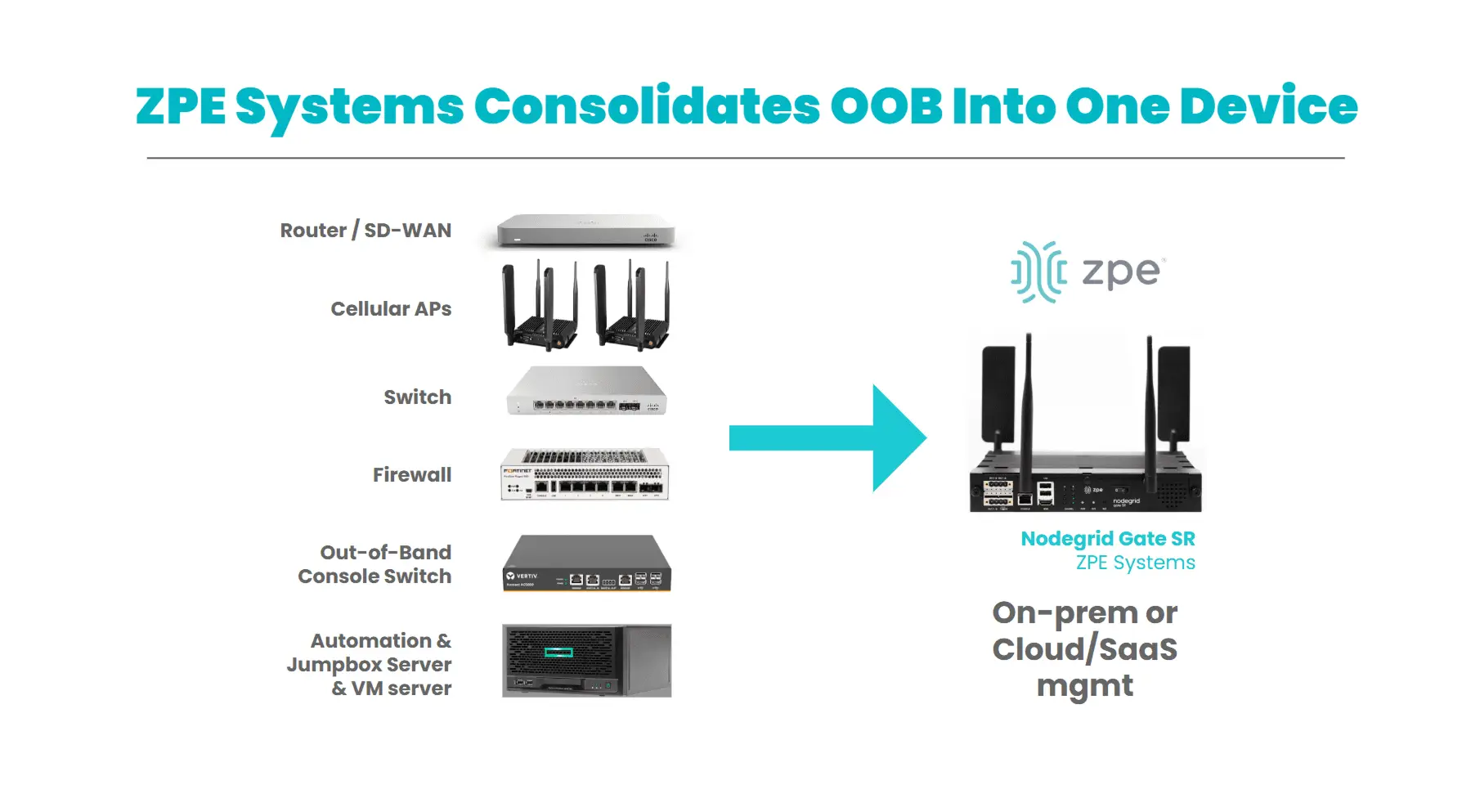
Traditional out-of-band deployments involve multiple standalone devices for routing, failover, console access, and security. This approach works, but it creates unnecessary complexity at remote sites. More hardware means more power consumption, more rack space requirements, and more management overhead.

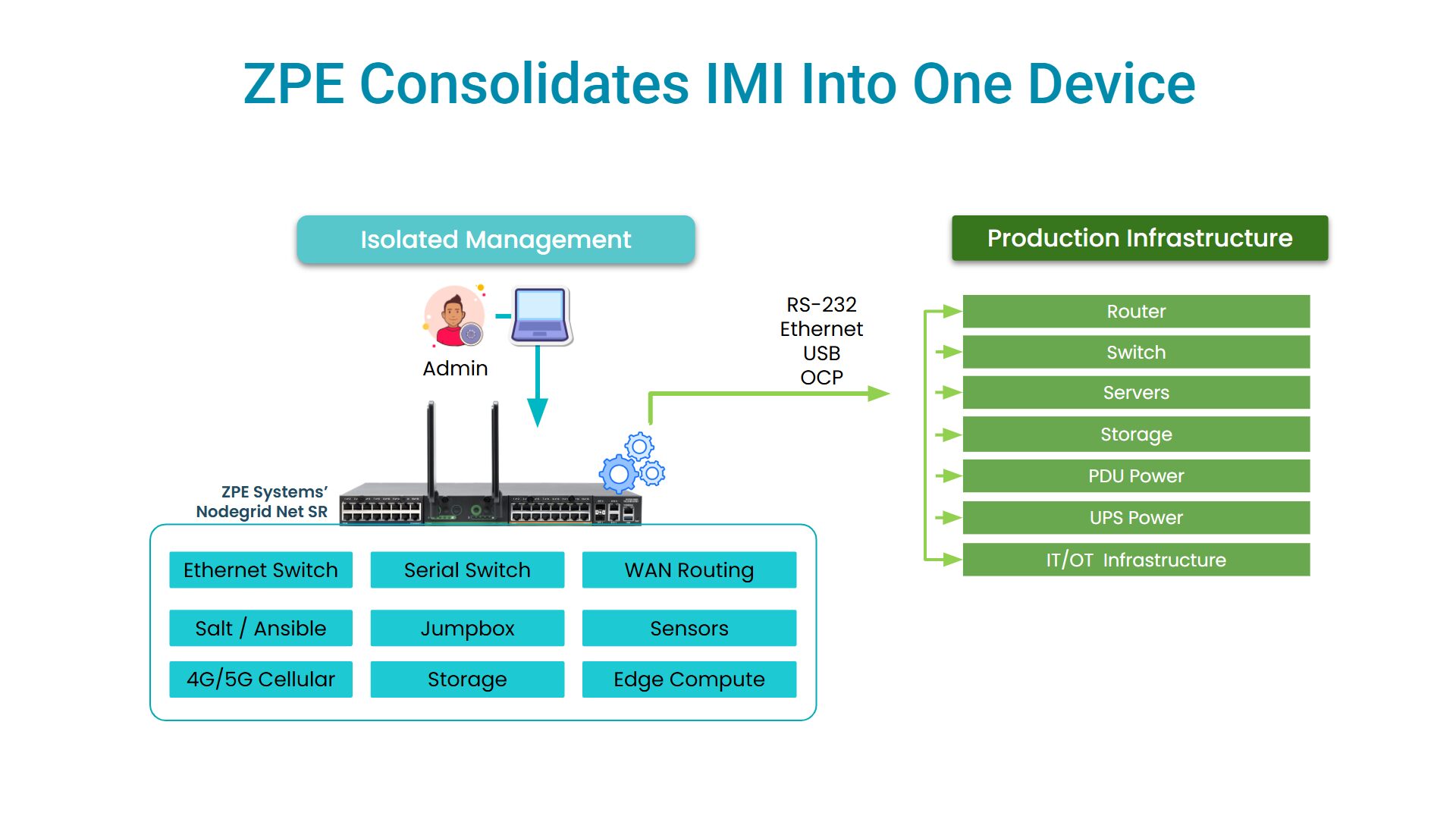
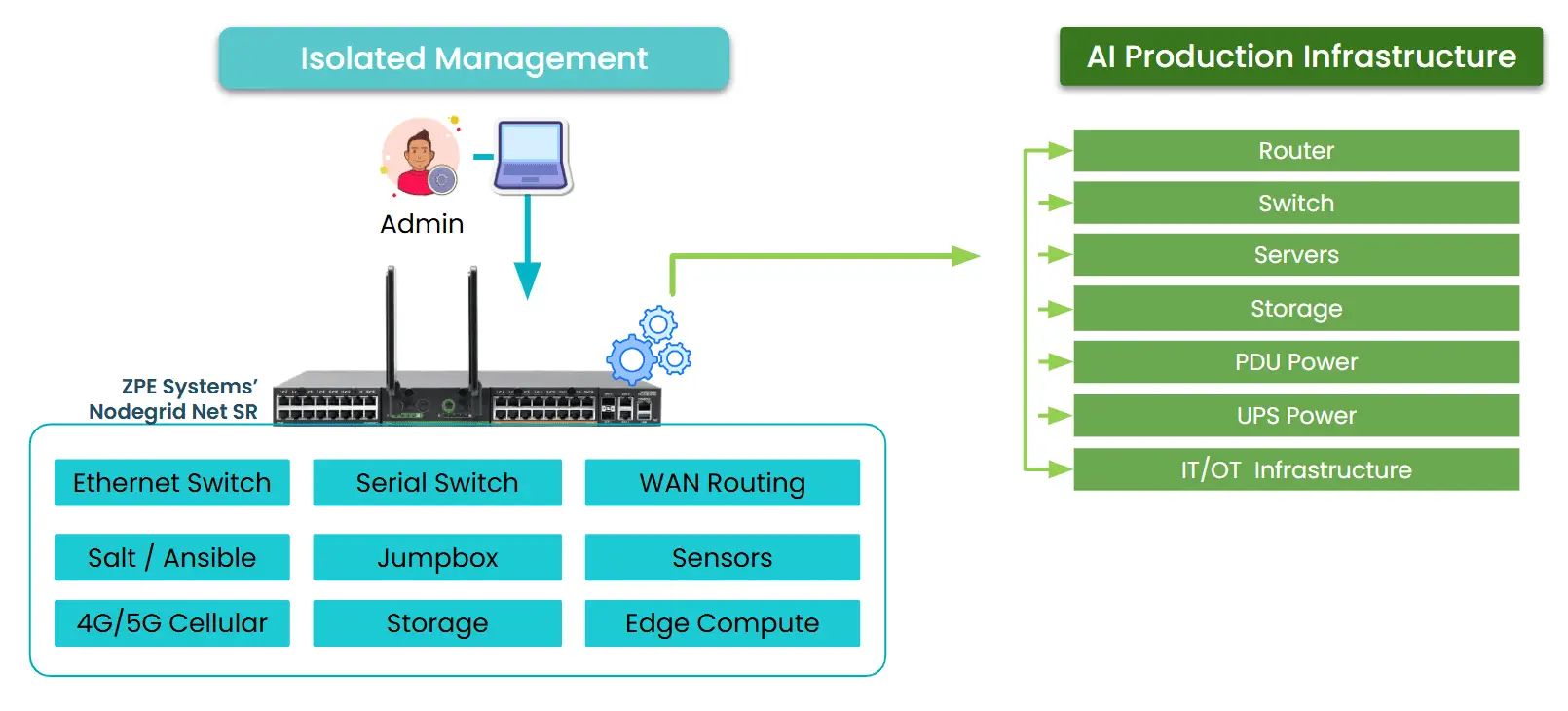
Consolidates OOB Into One Device
Image: Modern out-of-band devices, such as ZPE Systems’ Nodegrid Services Routers, are capable of combining many functions, like routing, switching, cellular, out-of-band, and more into a single appliance.

Simplicity helps with resilience, and modern OOB architectures design around this principle. When building your out-of-band network, reduce hardware sprawl as much as possible by consolidating functions. Look for devices that can handle routing, switching, cellular failover, and more in a single rack unit or less. This makes it much easier to deploy, maintain, and scale your out-of-band infrastructure.


5. Continuously Test Failure Scenarios

Having the resilience strategy and architecture in place is only part of the solution. Outages have a way of upending even the most meticulous plans. Failover processes, recovery workflows, and remote access procedures can behave radically different during actual incidents than they do during normal operations, so regular testing is a must.

Testing helps to identify gaps and fixes instead of discovering these during a real-world scenario. Just imagine scrambling during an outage because incorrect APN settings are preventing 5G connectivity, or expired certificates are blocking remote connections, or outdated firmware is causing compatibility issues.

Once your out-of-band network is built, make sure to regularly validate that engineers can access infrastructure during failure scenarios. You’ll gain the confidence that your out-of-band environment will perform as expected when it matters most.

Get Help Evaluating Your Environment

Connect with a ZPE engineer to discuss your current environment and see how to close any resilience gaps in your architecture. Get in touch using the form.

Build a Resilient Out-of-Band Network With These Resources

Out-of-band infrastructure provides the independent access layer required to reduce downtime, accelerate recovery, and maintain visibility during outages. But deploying an effective OOB strategy needs to account for connectivity, security, and scalability. We compiled these resources to help you build your resilient out-of-band network.


ZPE Systems Introduces NSR 2U and NVIDIA Jetson Expansion Card, Combining AI Acceleration, Networking, and Infrastructure Resilience

Nodegrid Net Services Router 2U

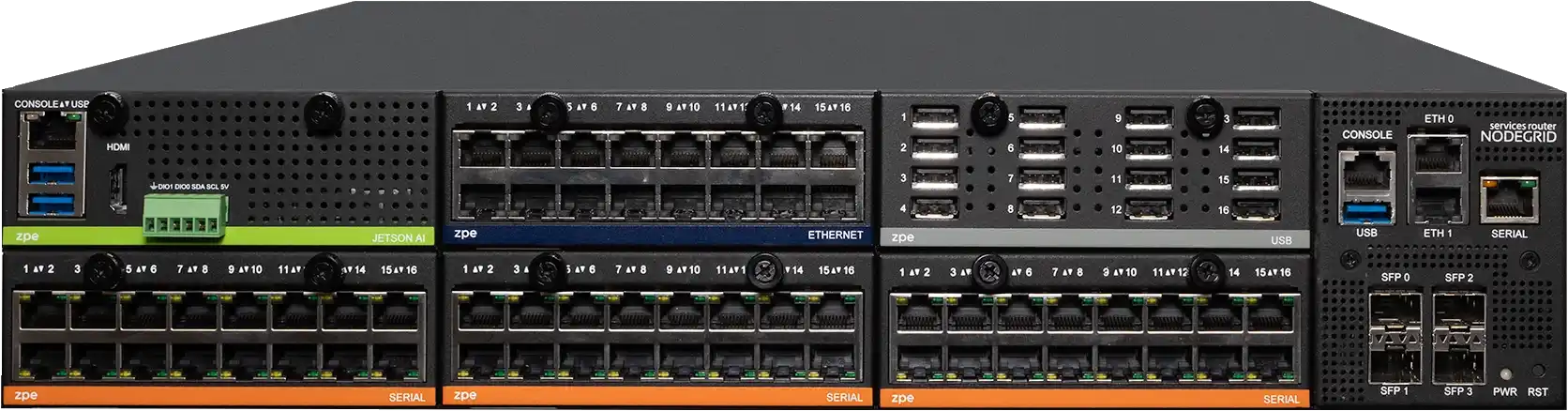
Las Vegas, NV — June 1, 2026 – At Cisco Live 2026, ZPE Systems (a brand of Legrand) today announced the Nodegrid Net Services Router™ 2U (NSR 2U), a modular, next-generation x86 platform that consolidates routing, network services, and out-of-band (OOB) management into a single, centrally managed system for distributed and edge environments.

As organizations expand AI workloads across edge and distributed environments, infrastructure teams face growing operational complexity, rising downtime risks, and limited visibility during outages. The NSR 2U addresses these challenges by combining networking, AI acceleration, compute, and integrated out-of-band management into a single resilient platform.

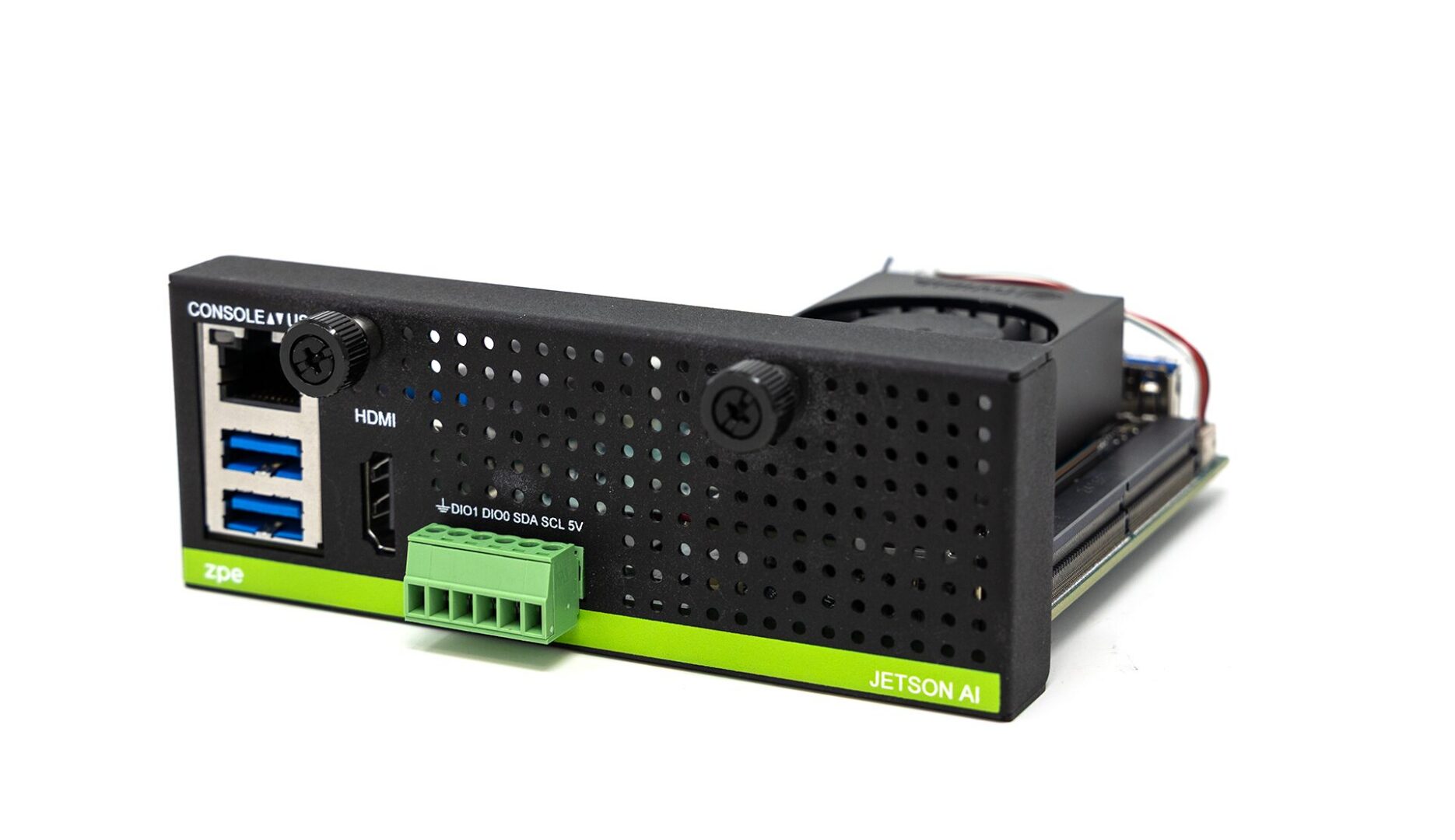
Jetson—NSR-Card—Front-Angled

Alongside the new platform, ZPE Systems is introducing the NVIDIA Jetson AI Expansion Card for NSR—backward compatible with both NSR and NSR 2U—enabling customers to run edge AI inference and acceleration directly on the device at the edge without adding external servers or operational complexity.

The NSR 2U represents a significant leap in performance, modularity, and serviceability, providing organizations with a future-ready foundation for secure, scalable, and automated infrastructure operations.

The combination of AI acceleration and integrated OOB management enables organizations to build infrastructure that can both detect issues intelligently, and also remain reachable and recoverable during failures. Setting a new industry standard, the solution is the first platform to combine networking, edge AI, compute, and recovery in one system, providing a resilient, AI-ready solution that keeps infrastructure running during primary network outages.

“Our customers are managing increasingly complex remote sites with minimal on-site staff and told us they needed a single platform that could do it all from anywhere. The NSR 2U is that platform — and with the NVIDIA Jetson Expansion Card, it brings AI-powered network operations to the edge,” said Vishal Gupta, Director of Product Management, ZPE Systems. “It’s the most capable Nodegrid appliance we’ve ever built, driven entirely by customer demand.”

A New Standard for Edge, Cloud, and Data Center Infrastructure

The NSR 2U is purpose-built to consolidate networking, compute, and management into a single platform capable of running diverse workloads across edge, cloud, and data center environments.

It supports a wide range of functions, including high-performance switching, security services, WAN optimization, containerized applications, and resilient out-of-band access, all within a unified system.

Its 2U architecture, combined with 10 expansion slots, upgraded compute, and a next-generation switching fabric, gives organizations the flexibility to build and scale infrastructure based on their exact requirements, without overprovisioning or deploying multiple appliances.

This makes the NSR 2U ideal for distributed enterprises, retail and remote locations, service providers, and converged infrastructure (CI) deployments.

AI at the Edge: Introducing the NVIDIA Jetson AI Expansion Card for NSR

The newly launched NVIDIA Jetson AI Expansion Card for NSR brings GPU‑powered intelligence directly into the Nodegrid ecosystem. Designed for both the NSR and NSR 2U platforms, this card enables customers to run AI/ML workloads where they matter most: close to data sources, users, and critical infrastructure.

This new module allows organizations to:

  • Run real‑time inference for security analytics, anomaly detection, and predictive maintenance
  • Deploy AI‑driven automation for network optimization and event correlation
  • Process video, sensor, and telemetry data locally to reduce cloud dependency
  • Consolidate AI, networking, and OOB management into a single, compact platform

By integrating NVIDIA Jetson into the NSR architecture, ZPE Systems eliminates the need for separate edge AI devices, reducing cost, complexity, and power consumption while enabling resilient, AI-driven infrastructure operations that remain manageable and recoverable even during outages.

With the NSR 2U and NVIDIA Jetson, ZPE Systems is redefining infrastructure operations for the AI era by bringing networking, intelligence, and resilience together into a single platform.

Explore the NSR 2U and NVIDIA Jetson Card by visiting the links below. Explore product specs, download the data sheet, and set up a demo to get hands-on with these new products!

Enhancing IT Operations with AI and Out-of-Band (OOB) Management

Thumbnail – Enhancing IT Ops with AI & out-of-band

You don’t really understand your infrastructure until it stops responding.

Not when dashboards are green or when alerts are quiet. But when you lose access to a core device, the network path disappears, and suddenly all your tools depend on the very thing that just failed.

That’s the moment most traditional IT operations fall apart.

Over time, I’ve realized that two things fundamentally change how you operate in those moments:

AI that helps you understand what’s happening, and Out-of-Band (OOB) access that lets you actually do something about it.

Put these together and they completely change how you operate.


The Reality of AI: Visibility Without Access is Useless

AI has made huge leaps in IT operations. It can analyze logs faster than any human, correlate events across systems, and let you know about issues you might not catch until it’s too late.

But there’s one big problem no one talks about enough: insight doesn’t fix outages.

You can know exactly what failed and still be locked out of the device you need to fix.

That’s where OOB comes in. OOB gives you a path that doesn’t depend on the production network. When everything else breaks, it’s the one door that still opens.

When you have both intelligence and access, you stop being stuck even when these worst-case scenarios happen.


Where AI Shows Up In My Work

In my role supporting IT infrastructure and network operations, the combination of AI and OOB directly improves how I manage incidents, maintain systems, and make sure everything keeps running.

1. When Something Breaks and You Don’t Have Time To Guess

Most incidents start with a lot of noise. Alerts pile up, metrics spike, and the systems all tell different stories.

AI helps cut through that noise and chaos. It highlights what’s abnormal, correlates signals, and points you in a direction that’s useful.

Then, instead of trying to reach a device through a broken network path (or waiting for someone on-site), you can go straight in through the out-of-band path. You don’t have to put up with delays or workarounds. You see the issue and you act on it right away.


2. When The Network Is Down – And That’s The Whole Problem

This is the scenario that exposes every weakness in traditional remote access. VPNs fail, jump hosts become unreachable, and monitoring tools go dark.

Suddenly, you’re blind and locked out at the same time.

With OOB, that doesn’t happen.

You still have direct access to your routers, switches, firewalls, and servers, because your management path isn’t tied to the outage. That means you can:

Out of band management for MSPs and remote recovery

Now layer AI on top of that.

Instead of reacting manually, you can trigger recovery actions based on known patterns. The system identifies the issue, and you either validate or let automation handle it.

You fix the issue within minutes instead of waiting hours to regain control.


3. When Alerts Become a Problem

Alerts become their own kind of outage. So many can come in, make too much noise, and become easy to ignore or shift way down on the priorities list.

AI helps pull the signals from the noise. It learns patterns, reduces false positives, and prioritizes what needs attention now. Combine this with OOB and it becomes actionable.

You’re getting alerts that matter now, and a way to immediately respond to them regardless of the network’s state. This changes how teams operate under pressure, especially when there’s so much noise that risks putting teams into a state of analysis paralysis.


4. When You See The Failure Coming

Some of the best outages are the ones that never happen.

AI is getting better at spotting early signals, like hardware behaving slightly off, configs drifting, and performance degrading in subtle ways.

Little problems you wouldn’t normally catch until they turn into really big problems.

With OOB access, you don’t have to wait. You can step in early to:

  • Validate configurations
  • Apply patches
  • Fix issues before they impact production

And you can do it without disrupting live traffic. The way you operate shifts from reactive to intentional.


5. When Security Incidents Get Complicated

Security events don’t follow clean paths. If a system is compromised, your primary network might not be trustworthy anymore. Access could be restricted or intentionally cut off.

That’s where OOB becomes your control point.

You can isolate systems, investigate directly, and respond without relying on potentially compromised infrastructure.

AI helps detect the threat. OOB gives you a way to contain it.

Without both, response slows down and risk increases.


The Shift Most Teams Don’t Plan For

Teams like to assume their tools will be there when they need them. Why wouldn’t they be, right?

But outages don’t work like that.

The very systems you depend on, like monitoring, remote access, and automation, often rely on the same network that just failed.

That’s the blind spot, and that’s what AI and out-of-band solve.

  • AI improves how you understand problems
  • OOB ensures you’re never locked out of fixing them

When you combine the two, you stop operating in a reactive loop of:

Detect Wait → Recover

And move toward:

Detect → Access → Resolve (immediately)


What You Can Do: Build Your OOB Network

After enough outages, you start to see that better tools don’t always make things better. It’s more about having tools that still work when everything else doesn’t.

AI helps you see what’s happening faster and more clearly. OOB ensures you’re never cut off from the systems you need to fix.

Together, they make IT operations resilient in the moments that actually matter. And those moments are the ones people remember.

Here are some helpful resources to start building your out-of-band network.

Get In Touch With Us!

If your environment depends on high uptime, fast response, and remote visibility, Nodegrid is the solution that incorporates AI with out-of-band management.

Use the form below to contact us and let’s talk about your network resilience goals.

rednesp Selects ZPE Systems to Deliver Always-On, High-Performance Research Connectivity

Thumbnail – rednesp case study

rednesp is São Paulo’s Research and Education Network, serving more than 20 universities, research institutions, and innovation centers across Brazil. rednesp provides critical network infrastructure for the scientific community, meaning uptime and performance are key.

Operating a research and education network at scale, however, comes with unique challenges. End users need to have reliable connectivity for performing experiments and simulations, and they need a high-performance network for transferring large datasets and running distributed workloads. Any outage could disrupt innovative work and potentially delay scientific breakthroughs. For rednesp, this means having total operational control over the infrastructure, and ZPE Systems’ out-of-band is the only solution that can live up to their needs.

Read the case study now to see how ZPE’s independent management plane, rapid recovery, and centralized control deliver the always-on, high-performance connectivity that rednesp’s community depends on.

DOWNLOAD THE CASE STUDY

How to Overcome the Top Network Failure Scenarios That Break MSP Remote Access

How to Overcome the Top Network Failure Scenarios

Managed service providers rely on remote access to keep customer environments running. VPNs, jump hosts, and centralized access tools make it possible to manage infrastructure across dozens or hundreds of sites without leaving the operations center.

But during outages, these tools can become part of the problem. When remote access depends on the production network, even routine failures can cut off the access engineers need to fix issues. What should be a quick recovery turns into a prolonged outage that requires on-site intervention.

Here are some of the most common failure scenarios MSPs face, and a look at the architecture that helps overcome them.


Routing Failures

Many routing failures stem from human error. According to 2025 research from the Uptime Institute, almost 40% of organizations suffered a major outage due to human error in the last three years. If a core router experiences a misconfiguration, control-plane crash, or routing instability, the network paths that connect engineers to the environment may disappear entirely.

Common examples include:

  • BGP route leaks or policy errors that remove upstream connectivity
  • OSPF adjacency failures that break internal routing between segments
  • VRF or VLAN misconfigurations that isolate management subnets
  • Routing table corruption during firmware upgrades

In these situations, VPN sessions drop immediately because the path between the engineer and the VPN gateway no longer exists. Worse, the router responsible for the failure may be fully operational from a hardware perspective and all it needs is a configuration correction. But engineers can’t gain remote console access to make this correction.

What should have been a 30-second configuration rollback becomes a multi-hour recovery effort.


Firewall Policy Errors

Firewall misconfigurations are one of the most common causes of remote access loss. Modern firewalls enforce highly automated policies through orchestration systems, policy templates, or automated compliance updates. These systems are great for consistency, but they introduce new failure modes.

A few examples include:

  • A security policy update accidentally blocking VPN management traffic
  • A zone-based firewall rule preventing internal device access
  • A NAT configuration error breaking inbound VPN connections
  • An automated policy sync overwriting existing allow rules

A lot of times, the firewall itself remains online and functional. The only issue is a misconfigured rule. Because the firewall sits directly in the remote access path, it becomes unreachable (just like the router we mentioned in the previous example). Engineers may be able to confirm the outage through monitoring systems, but without access to the firewall CLI or console, there is no way to correct the configuration remotely.


WAN or ISP Outages

Many MSP environments rely on customer WAN circuits to provide remote management access. Failures on these circuits cut remote connectivity regardless of the health of the internal infrastructure. Fiber cuts, for example, are one of the most common causes of outages that last 48 hours or longer.

Common scenarios include:

  • Carrier fiber cuts (looking at you, backhoe operators 😜)
  • Last-mile circuit failures at branch locations
  • ISP routing incidents causing upstream blackholing
  • DDoS mitigation events that disrupt inbound traffic


Backhoe Excavator

Image: Behold, the natural predator of fiber cables.

Customer networks may still be operating internally. Devices are running, servers are responding, and monitoring systems might still be collecting metrics locally. But engineers outside the network have no path into the environment. Even simple recovery actions like restarting an edge router or verifying a routing table may require on-site access.


Authentication Infrastructure Failures

Jump host environments depend on centralized authentication systems such as Active Directory, LDAP directories, or identity federation platforms. When these go down, engineers get locked out of their own management infrastructure.

This can happen due to:

  • Active Directory replication failures
  • Expired domain controller certificates
  • LDAP service crashes
  • Identity provider outages affecting SSO login flows

Engineers can probably still reach the jump host in these scenarios, but they can’t log in because authentication fails. The result is the same: engineers can see the problem, but they can’t access the systems required to fix it.


DNS and Management Service Failures

Another subtle failure mode occurs when core infrastructure services degrade. Many management environments rely on DNS resolution, certificate validation, or internal service discovery mechanisms.

If DNS services fail or management service endpoints become unavailable:

  • Jump hosts may not resolve device hostnames
  • SSH connections fail due to certificate validation errors
  • Automation platforms lose connectivity to managed infrastructure

The devices themselves may still be reachable, but the tools engineers rely on stop working.


The Pattern Behind These Failures

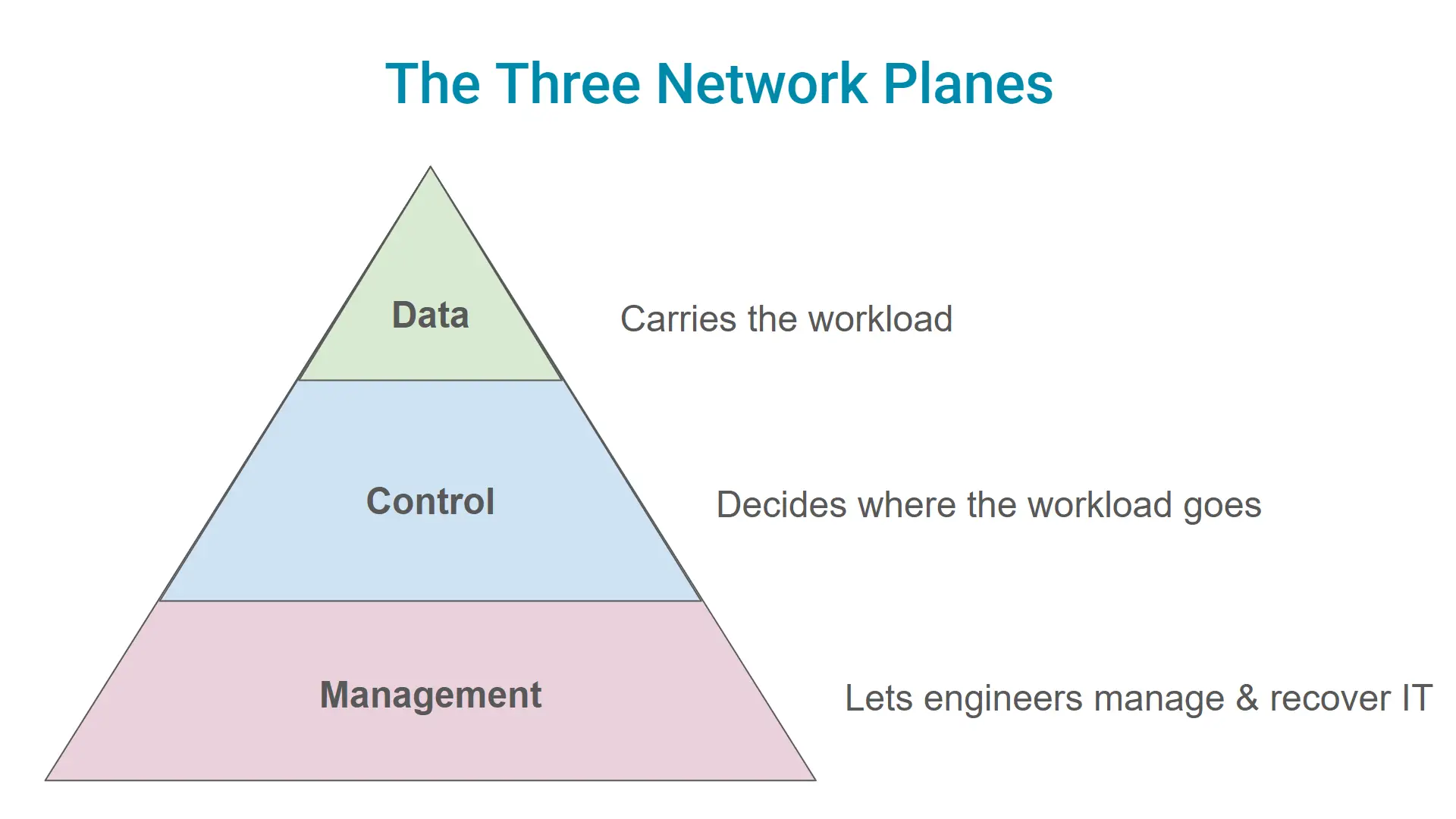
These scenarios might seem unrelated, but they all share the same root issue: remote access depends on the production network.

When that network fails, whether due to routing, security, WAN, or service issues, engineers lose the ability to reach the infrastructure they need to fix. That’s when recovery slows down, truck rolls and labor costs increase, and SLA risks rise.

In-band management relies on the network

Image: When remote management access depends on the production network, outages cut off both links, leaving engineers unable to remotely recover.

What should be routine incidents turn into operational disruptions. Engineers are unable to gain remote console access for recovery, and any tools running on the production network become useless. The only way to bring the network back online is to put engineers on site.


How To Overcome The Top Network Failure Scenarios

VPNs and jump hosts are effective, and they’re useful tools for day-to-day operations. But, MSPs won’t be able to overcome these top network failure scenarios if they rely on VPNs and jump hosts as the only path to critical infrastructure.

The key is being able to maintain access even when the production network goes down.

This is where out-of-band (OOB) and isolated management infrastructure (IMI) come into play. These create a completely separate remote access path that remains available no matter what kind of outages happen on the production network.

Out-of-band guarantees MSP remote access

Image: A dedicated out-of-band management path ensures engineers can remotely access their infrastructure, even when there’s a complete outage on the production network.


What Can Engineers Do With Out-of-Band?

Modern OOB and IMI setups allow engineers to see what’s going on and act, no matter what’s happening on the production network.

This dedicated management path means MSP teams can:

  • Access device consoles directly, even if routing is broken
  • Perform config rollbacks on routers and firewalls after failed changes
  • Power-cycle/reboot equipment remotely (no on-site help needed)
  • Troubleshoot WAN failures from inside the network
  • Maintain access to infrastructure during ISP outages or authentication failures

Outages that would normally drag on for hours can now be resolved in minutes from the NOC. Check out our demonstration video to see what this looks like in action!

Calculate the Impact of MSP Network Failures

The most important question to ask is: can your engineers still reach the infrastructure when the network itself is down?

If the answer is no, it’s time to calculate how much these failure scenarios are costing in truck rolls, labor, and SLA penalties.

Use the MSP Downtime Cost Worksheet to quantify your exposure and see how much faster recovery could improve your margins.