Providing Out-of-Band Connectivity to Mission-Critical IT Resources

How to Implement Zero Trust for OT

zero trust for ot
Enterprise security teams traditionally focus on IT networks, but operational technology (OT) security is just as important. OT comprises equipment that interacts with the physical world, such as sensors, temperature gauges, and motors, as well as the systems used to control that technology. Attacks on OT systems have a huge impact on business operations and customers, often causing more devastation than an IT breach. For example, an attack on an oil pipeline’s control systems could shut down production for weeks and affect millions of people in the region.

“Zero trust” is a security methodology designed to reduce the risk of attack through network segmentation, granular access policies, and advanced security technologies. Many organizations use zero trust to protect their IT networks, but it’s just as critical to the safeguarding of operational technology. This post defines zero trust security before explaining how to implement zero trust for OT.

Table of Contents:

What is zero trust for OT?

According to recent research by Barracuda Networks, more than 90 percent of manufacturing organizations saw cyberattacks hit their production or energy supply in 2021 alone. OT is a frequent target because of how devastating an attack can be on business operations and because it often lacks the same security policies and controls that protect IT infrastructure. To solve this problem, teams need to apply zero trust security principles, policies, and technology to their OT networks. The zero trust security methodology follows the motto “never trust, always verify.” That means operating under the assumption that no users or devices should be trusted, even if they’re logging in from within the main office. Achieving a zero-trust architecture means segmenting IT and OT networks and creating micro-perimeters of highly specific security policies and controls to protect each segment. Zero trust often uses advanced security technologies like AIOps and machine learning to enforce those policies, identify subtle signs of compromise, and quickly resolve security incidents.

How to implement zero trust for OT

Let’s discuss the requirements and best practices for implementing zero trust for OT.

Isolate critical systems with segmentation

Zero trust requires custom-tailored security policies and controls to protect specific network resources. That means network teams must logically segment the network based on which resources need to be protected by which policies and technologies, a practice known as micro-segmentation.
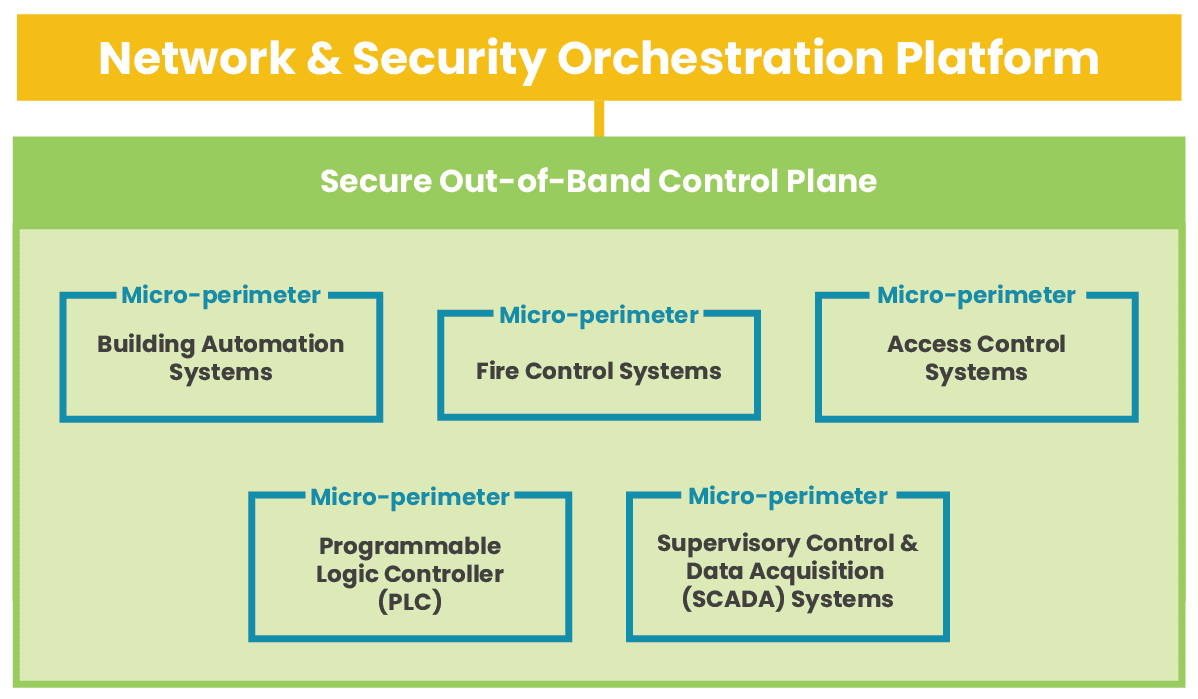
OT is often grouped together into a single micro-segment under the assumption that all OT needs the same protection. However, not all OT is created equally, especially in the eyes of a would-be attacker. For example, a programmable logic controller (PLC) gives cybercriminals control over manufacturing processes, but compromising an access control system lets them physically infiltrate the building. Some organizations take zero trust even further by using nano-segmentation to isolate individual systems, applications, or containers to create extremely effective micro-perimeters to address specific vulnerabilities.

Micro- and nano-segmentation are the backbone of a zero-trust architecture, enabling the creation of micro-perimeters using granular access policies and security controls customized for the protected resources.

Create and enforce strong security policies

Zero trust security policies determine who can pass through each micro-perimeter and who can access each OT resource. These policies should follow a least-privilege approach, meaning everyone gets the bare minimum privileges required to complete their workflows and nothing more. The best practice is to use role-based access control (RBAC), categorizing individual accounts based on their role (e.g., system administrators or machine operators) and giving each role least-privilege access to the resources required for that job.

The best way to create and enforce zero trust security policies is with an identity and access management (IAM) solution. A zero-trust IAM solution monitors each micro-perimeter to verify the identities of all accounts requesting access and attempts to establish an account’s trustworthiness using methods like two-factor authentication (2FA). Some advanced IAM solutions even use machine learning technology like user and entity behavior analytics (UEBA) to monitor account activity on the network and spot anomalous behavior that could indicate compromise.

  • IAM = Identity and Access Management: Creates and deploys policies, verifies identities, and establishes trustworthiness.
  • 2FA = Two-Factor Authentication: Requires an additional form of identity verification (besides the username and password), such as a code sent to an authorized mobile device.
  • UEBA = User and Entity Behavior Analytics: Uses machine learning to monitor account activity, creates baselines for normal behavior, and identifies anomalies that could mean an account is compromised.

Strong, granular security policies and zero-trust IAM solutions help protect OT by limiting account privileges and preventing compromised accounts from accessing network resources.

Leverage advanced security technologies

There are additional security technologies that support or enhance zero trust for OT. For example, a next-generation firewall (NGFW) makes network segmentation easier and includes advanced features such as application-aware filtering and deep-packet inspection. Secure access service edge (SASE) delivers zero trust security solutions to the network edge, safeguarding OT at remote branch sites with the same policies and controls as the central enterprise network. AIOps uses artificial intelligence for better threat detection and faster incident recovery.

Organizations use advanced security technologies to fortify micro-perimeters, extend zero trust to the edge, and gain enhanced detection and recovery capabilities.

Implement zero trust for OT with Nodegrid

Zero trust security protects operational technology using network segmentation to create micro-perimeters of strong security policies and advanced security technologies custom-tailored to each individual resource’s requirements and vulnerabilities. Achieving zero trust is typically a long and tedious process because of how many solutions and devices you must deploy.

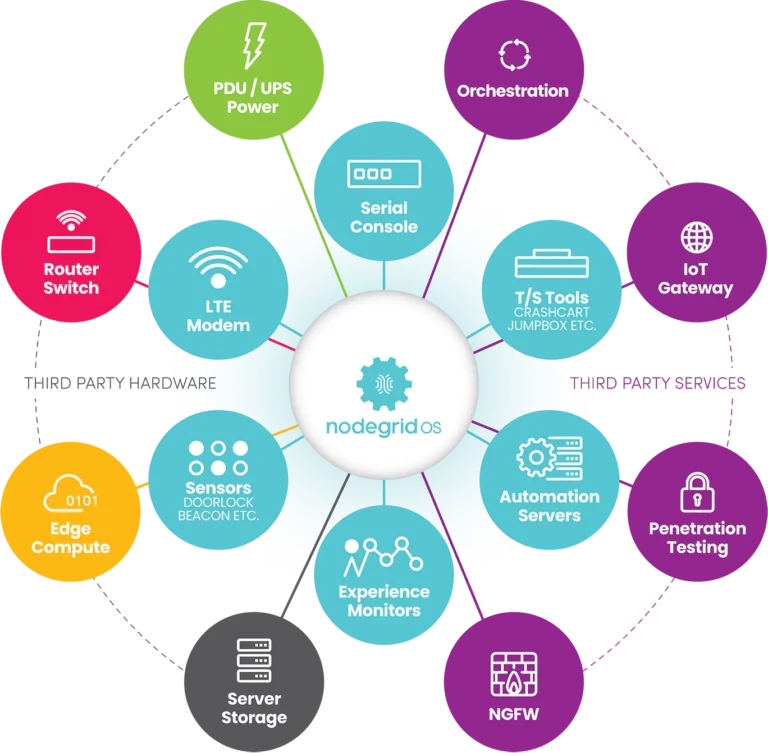
The Nodegrid solution from ZPE Systems alleviates this challenge by providing a vendor neutral platform capable of hosting and deploying all your zero trust security technologies. For example, Nodegrid network edge routers deliver all the networking capabilities required to spin up an OT branch and can directly host your choice of third-party security solutions. Nodegrid reduces hardware expenses by consolidating network functionality onto fewer devices while unifying network and security management under a single umbrella for greater operational efficiency.

In fact, Nodegrid is an entire Services Delivery Platform that you can deploy anywhere in your network architecture to host your critical third-party SaaS (software as a service) solutions. That means you can create a customized branch-in-a-box that combines gateway routing, switching, out-of-band (OOB) management, NGFW, SASE, infrastructure automation, and more in a single device.

Ready to Learn More?

Contact ZPE Systems to learn more about implementing and enhancing zero trust for OT with the Nodegrid Services Delivery Platform.

Contact Us

IoT in Finance Industry and Security Challenges

IoT in Finance Industry and Security Challenges
The Internet of Things (IoT) drives new innovations in the finance industry by empowering organizations to harvest more data, improve operational efficiency, and provide better customer service. However, adding dozens of low-touch devices to the network’s edge creates major security, privacy, and compliance challenges.

This post discusses how to take advantage of IoT in the finance industry by overcoming security challenges with automation, secure platforms, and vendor-neutral orchestration

IoT in the Finance Industry: Security Challenges and Solutions

The challenge: Unpatched, out-of-date IoT devices are easier to compromise for harvesting sensitive data.

The solution: Automated patch management using vendor-neutral management platforms that can dig their hooks into multi-vendor IoT.

The challenge: Unsecured remote management interfaces can be used by cybercriminals to access IoT devices and data.

The solution: Secure management hardware and software protected by robust security features like self-encrypted disk (SED) and two-factor authentication (2FA).

The challenge: It’s difficult to enforce security and privacy policies on remote IoT devices that process regulated financial data at the edge of the network.

The solution: A vendor-neutral security orchestration platform that extends Zero Trust Security policies and controls to multi-vendor IoT at the edge.

The challenge: It’s difficult to troubleshoot and resolve security incidents involving remote IoT devices without expensive, time-consuming truck rolls.

The solution: Secure out-of-band (OOB) management solutions that integrate with (or even directly host) third-party automation and AIOps tools.

The challenge: A lot of complexity is involved in gaining holistic security coverage over a distributed, multi-vendor financial network without leaving any gaps.

The solution: A vendor-neutral platform that unifies security and network management for the entire architecture behind a single pane of glass.


IoT in the finance industry: security challenges and solutions

There were over 10.54 million global IoT cybersecurity attacks in December 2022 alone. In the finance industry, a breach can result in significant consequences, including regulatory fines and irreparable reputational damage, which means IoT security must be a top priority. Let’s discuss the specific security challenges of using IoT in the finance industry.

Challenge #1: Keeping IoT devices up-to-date

IoT typically uses low-touch, set-it-and-forget-it devices, so they’re deployed around the network’s edge and receive little interaction from operators or technical staff. For example, IoT devices collect sensitive financial data from ATMs, self-service payment kiosks, and smartphone applications with little-to-no human oversight. That makes it easy for network teams to forget about operating system (OS) and software updates, especially when dozens or thousands of IoT devices are in use.

In fact, a recent report found that teams wait an average of 205 days to patch their infrastructure. This is a frightening statistic given that out-of-date software is rife with vulnerabilities just waiting to be exploited by cybercriminals looking for valuable financial data.

Solution: Automated patch management

Automating patches is the best way to ensure they’re installed on time. For example, many IoT device management systems provide dashboards where admins can see IoT device versioning information at-a-glance, manually deploy or roll-back updates, or create automated schedules/triggers to deploy those updates without manual intervention. However, most of these platforms only work within specific vendor ecosystems, which limits your capabilities. The best practice is to use a vendor-neutral IoT device management platform that can dig its hooks into multi-vendor IoT devices. This will ensure that critical IoT devices like credit card payment readers are kept secure and up-to-date.


A vendor-neutral IoT device management platform with automated patch management ensures that all devices are kept up-to-date and no vulnerabilities fall between the cracks.

Challenge #2: Securing remote management interfaces

Network admins typically work from a centralized location, which means they remotely access and manage IoT deployments at the branch and edge using jump boxes or serial consoles. If these remote management devices and interfaces aren’t adequately secured, malicious actors could use them to access IoT data and move laterally to other sensitive resources on the network. However, many admins deploy jump boxes without onboarding them with IT, which means they’re not added to security monitoring software and don’t have enterprise policies or controls applied. Serial consoles, on the other hand, often lack the advanced security features and integrations needed to protect them from cybercriminals.

Solution: Secure management hardware and software

The newest generation of serial consoles includes robust hardware security features and supports advanced authentication methods to safeguard remote management interfaces from compromise. A 3rd generation – or Gen 3 – serial console has onboard security features like a self-encrypted disk (SED), secure boot, BIOS protection, and geofencing, so malicious actors can’t access a stolen device. In addition, it supports SAML 2.0 authentication (via integrations with providers like Okta and Ping) and other advanced authentication methods to prevent unauthorized access to its software.


A Gen 3 serial console solution uses robust onboard security features and third-party security integrations to protect management hardware and interfaces.

Challenge #3: Complying with data privacy regulations

In a highly-regulated industry like finance, organizations must keep track of which people and devices can access sensitive data and ensure that permissions are granted on a least-privilege basis. Typically, achieving this level of granular control requires applying strict Zero Trust Security policies to every device and user accessing the network, including IoT devices at the edge. However, extending enterprise security policies and controls to the edge is difficult in a distributed, heterogeneous environment due to vendor lock-in.

For example, some branch networking solutions don’t support integrations with third-party identity management tools, forcing you to use their built-in access management settings. That means admins must manually recreate their Zero Trust data access policies in the router settings at every single branch and ensure they’re kept up-to-date.

Solution: Vendor-neutral Zero Trust Security orchestration

A centralized Zero Trust Security orchestration platform allows admins to deploy and manage security policies and controls across the network from a single place. A vendor-neutral platform can extend policy enforcement and other vital security controls to any device or application on the network. For example, you can apply the same Zero Trust data policies to all branch routers in the entire architecture to ensure consistent enforcement.  Such a platform makes compliance easier because financial organizations gain greater control over data access privileges and monitoring for IoT devices deployed anywhere in the world.


A vendor-neutral Zero Trust Security orchestration platform simplifies IoT data compliance by providing a centralized control panel to deploy and manage security policies across the entire distributed network architecture.

Challenge #4: Quickly resolving IoT security incidents

When malicious actors compromise an IoT device, financial organizations must act quickly to avoid regulatory fees and reputational damage. However, these devices are often deployed in remote, hard-to-reach locations with no technical or security staff nearby, such as in rural or island communities. That means problems require an expensive, time-consuming truck roll to resolve. Even with a team on-site, manual root cause analysis (RCA) and recovery efforts take a lot of time and effort, increasing both the duration and the expense of incidents.

Solution: Secure OOB with automation and AIOps support

The solution to this IoT security challenge involves out-of-band serial consoles and automation.

  • Out-of-band (OOB) serial consoles create a dedicated control plane to manage, troubleshoot, and recover remote devices and infrastructure. Admins access this control plane via alternative network interfaces that don’t rely on the production network at all. This means teams can still reach remote IoT devices even if the ISP goes down or the LAN is compromised by ransomware. The best practice is to use a Gen 3 serial console with advanced security features, as discussed above.
  • Automation and AIOps streamline the incident resolution process by automating RCA and recovery workflows. A Gen 3 OOB serial console solution can integrate or even directly host third-party automation and AIOps tools, ensuring teams always have remote access to their recovery toolkit during an outage or breach.


A secure, Gen 3 OOB serial console ensures 24/7 remote access to edge IoT deployments and supports automation and AIOps for faster security incident resolution.

Challenge #5: Gaining holistic security coverage

A distributed financial services network with many branches, ATMs, edge sites, and IoT devices has a large attack surface, so it requires several different security solutions to cover all potential vulnerabilities. Gaining complete security coverage over every IoT device in every location means deploying many appliances, each of which needs to be installed, patched, and managed, adding a lot of complexity to network and security operations and further increasing the attack surface. The need to orchestrate so many moving pieces increases the risk that security teams will make mistakes and prevent organizations from operating efficiently.

Solution: Unified, vendor-neutral security orchestration

A vendor-neutral security orchestration platform unifies a company’s security solutions and workflows under a single management umbrella. For example, the Nodegrid platform from ZPE Systems can dig its hooks into other vendors’ security appliances and virtual solutions, giving security analysts a holistic overview of the entire architecture from a single centralized portal. Teams can use Nodegrid to orchestrate firewalls, identity and access management (IAM), patches, secure access service edge (SASE), and more.

Nodegrid’s hardware can even directly host third-party security applications for a streamlined, consolidated branch deployment. You can use the Nodegrid platform to build a complete DCIM (data center infrastructure management), network management, and automation orchestration solution, streamlining operations with a truly unified experience.

A vendor-neutral security orchestration platform provides holistic security coverage while reducing complexity, which prevents human error and increases operational efficiency.

IoT in the finance industry and security challenges

Deploying IoT in the finance industry comes with security challenges, including patch management, unsecured management interfaces, policy enforcement, incident resolution, and complexity. The Nodegrid platform provides finance industry solutions to help you overcome each of these challenges, including:

A truly vendor-neutral platform that unifies security, network, and infrastructure management behind a single pane of glass for holistic coverage.

Ready to Learn More?

To learn more about deploying IoT in the finance industry and overcoming security challenges with Nodegrid, contact ZPE Systems.

Contact Us

Best Intel NUC Alternatives

Intel NUC Alternatives

Service providers often struggle with the hybrid nature of their business. Even as they transition more towards a consumable service-based model that’s decoupled from traditional hardware solutions, there’s still a need for some sort of box to be deployed physically at a customer’s premises. Providers frequently rely on COTS (Common Off The Shelf) hardware to reduce costs and simplify the deployment process.

One commonly used COTS device is the Intel NUC, or “Next Unit of Computing,” which is a small appliance-like mini computer. Some service providers utilize Intel NUC devices as jump boxes, while others use them as a platform to deploy their services on-site. While these mini-computers are relatively inexpensive and easy to install, they create added security risks and management headaches that service providers need to be aware of.

This post highlights the challenges and security risks involved in relying on Intel NUC devices before discussing enterprise-grade Intel NUC alternatives that solve these problems.

Table of contents:


Why is Intel NUC so popular in IT infrastructure?

Managed Service Providers (MSPs) and Managed Security Service Providers (MSSPs) often use Intel NUC jump boxes to remotely access the control plane of critical client infrastructure. These mini PCs typically run bare bones software to reduce licensing costs, which means they are unpatched, unmonitored, and unsecured. This lack of oversight and management makes Intel NUCs popular access points for hackers to breach client networks.

Why consider Intel NUC alternatives?

Service providers like to use Intel NUC boxes because they’re cheaper, faster to install, and take up less space than a full PC or server. NUCs are often deployed without antivirus, monitoring agents, or other security software installed, which excludes them from the service provider’s security coverage. Plus, clients are frequently unaware that these devices are in their racks accessing their infrastructure, so they don’t access them in security and compliance audits. Other Intel NUC challenges include:

  • Lack of centralized management – Each Intel NUC is an island that’s managed and accessed individually, which makes it impossible to efficiently deploy updates, install new tools, or monitor for problems.
  • Insecure, unpatched OS – Operating systems and software contain thousands of potential vulnerabilities that hackers can exploit, so a lack of monitoring and patch management creates a huge security risk.
  • No hardware security – Intel NUC boxes lack any hardware security, which means someone could steal the device and use it to deploy malware or access client resources – or even just pawn the hardware.
  • Regulatory issues – When providers use unmanaged jump boxes to access client infrastructure, they expose their customers to potential noncompliance with privacy laws like HIPAA that require strict data access controls.
  • Affects insurance eligibility – Using an unsecured Intel NUC may also disqualify customers from receiving cybersecurity insurance benefits in the event of a successful breach.

While Intel NUCs are a quick and inexpensive way for MSPs, MSSPs, and other service providers to remotely access client infrastructure, they also make it easier for cybercriminals to breach enterprise networks. To reduce the attack surface without increasing the cost, hassle, or footprint of deploying jump boxes, you need an enterprise-grade solution that combines networking functions, security, and remote out-of-band access to the control plane to eliminate the need for a separate device.

Intel NUC alternatives from ZPE Systems

The Nodegrid product line from ZPE Systems simplifies the tech stack in data centers and network closets with all-in-one infrastructure management solutions. Nodegrid devices roll up gateway routing, switching, Wi-Fi, and 5G/4G/LTE out-of-band management to cut down on the number of boxes in the rack. They’re also enterprise solutions, which means they can be onboarded with your security team and covered by your monitoring, intrusion detection, antivirus, and other security controls.

In addition, all Nodegrid boxes are protected by hardware security features such as BIOS protection, self-encrypted disk (SED), UEFI Secure Boot, and Signed OS. Plus, Nodegrid’s hardware and software are completely vendor-neutral, allowing easy integrations with third-party security solutions and SAML 2.0 authentication. Nodegrid can even directly host other vendors’ security software to further reduce your tech stack.

Key Nodegrid features


All Nodegrid Devices Include:

Key features

Strong Out-of-band management integration

Extensible applications with virtualization and containers

Zero Touch Provisioning (ZTP) over the WAN

Vendor-neutral, unified management via ZPE Cloud/Nodegrid Manager

Modern x86-64bit Linux Kernel

Extended automation based on actionable data

Failover to 4G/5G/LTE & Wi-Fi

Power control and monitoring

Orchestration support via Puppet, Chef, Ansible, RESTful

Security

BIOS protection

TPM 2.0

UEFI Secure Boot

Signed OS

Self-Encrypted Disk (SED)

Geofencing

X.509 SSH certificate support, 4096-bit encryption keys

Selectable cryptographic protocols for SSH and HTTPS (TLSv1.3)

Selectable cypher suite levels: high, medium, low, custom

SSL VPN (Client and Server)

IPSec, Wireguard, and Strongswan with support for multi-sites

Local, AD/LDAP, RADIUS, TACACS+, Kerberos, authentication

SAML support via DUO, OKTA, Ping Identity

Local, backup-user authentication support

User-access lists per port

Group/role-based authorization: AD/LDAP, RADIUS, TACACS+

Fine grain and role-based access control

Firewall – IP packet and security filtering, IP forwarding support

MD5 / SHA System Configuration Checksum™

System event syslog

Custom security settings

Strong password enforcement

Two-Factor Authentication with RSA and DUO

Networking

IPv4 / IPv6 Support

Embedded Layer 2 switching

VLAN

Layer 3 Routing

BGP

OSFP

RIP

QoS

DHCP (Client and Server)

RIPv1, RIPv2

VXLAN

DDNS

NTP

To learn more about the benefits of Nodegrid’s Intel NUC alternatives, contact ZPE Systems.

Nodegrid product comparison

The Nodegrid family of network edge routers delivers secure, Gen 3 OOB management for reliable remote access to distributed customer sites like branch offices or manufacturing centers.

Nodegrid Service Delivery Platform Family


Link SR

Bold SR

Hive SR

Gate SR

Net SR

Mini SR

CPU

X86-64bit Intel 

X86-64bit Intel

X86-64bit Intel 

X86-64bit Intel 

X86-64bit Intel 

X86-64bit Intel 

Cores

2

4 or 8

4 or 8

2, 4 or 8

2, 4, 8 or 16

4

Guest VM

1

1

1-2

1-3

1-6

1

Guest Docker

2+

2+

2+

2+

2+

2+

Storage

16GB – 128GB

32GB – 128GB

16GB – 128GB

32GB – 128GB

32GB – 128GB

14GB SED

Additional Storage

Up to 4TB

Up to 4TB

Up to 4TB

Up to 4TB

Up to 4TB

Wi-Fi

Yes

Yes

Yes

Yes

Yes

Yes

Cellular modem

1

1-2

1-2

1-2

1-6

1

5G

Yes

Dual 5G

Dual 5G

6x 5G

Sim slots

2

4

4

4

12

1

Serial Console Switch

1

8

Via USB

8

16-80

Via USB

Network

1x Gb ETH 1x SFP

5x Gb ETH

2x GbE ETH 2x 10 Gbps

4x 10/100/1000/2.5 Gbps RJ-45

2x SFP 5x Gb ETH

4x 1Gb ETH PoE+

2x 1Gb ETH 2x SFP+ Multiple expansion cards

2x 1Gb ETH

Data Sheet

Download

Download

Download

Download

Download

Download

The Nodegrid family of Intel NUC alternatives from ZPE Systems can help MSPs and MSSPs ensure secure, reliable remote management access to customer infrastructure without increasing costs.

Ready for a Demo?

To see one of ZPE’s Intel NUC alternatives in action, request a free Nodegrid demo! Request a Demo

What Is a Zero Trust Gateway?

What Is a Zero Trust Gateway(2)
The constant threat of cyberattacks has made network security a top priority for companies in every sector, with Gartner predicting that global cybersecurity spending will reach $188 billion in 2023. However, security continues to get more challenging due to factors like a rise in remote work, an increasing reliance on touchless internet of things (IoT) devices, and the overall decentralization of enterprise networks. It’s hard to create a secure perimeter around the enterprise when its users, devices, applications, and data could be anywhere in the world.

The zero trust security methodology addresses this challenge by shrinking the focus from one large security perimeter and instead creating smaller “micro-perimeters” around each individual resource that needs defending. It’s called zero trust because it follows the principle of “never trust, always verify.” That means each user and device needs to verify its identity and prove its trustworthiness before it can penetrate the micro-perimeter. So, for example, if a cybercriminal uses stolen credentials to log into the enterprise network, they have to pass through many different security checkpoints to see or access any sensitive resources, which increases the likelihood they’ll get caught before excessive damage is done.

One way to implement micro-perimeters and apply zero trust security policies is with a device called a zero trust gateway. This post discusses the technologies that make up a zero trust gateway and explains how they work together to defend enterprise networks.

What is a zero trust gateway?

A zero trust gateway is a device that sits at the edge of the network – or at the top of the rack – and applies zero trust security policies and controls to traffic flowing in either direction. The gateway can be a dedicated security appliance, but it’s often more cost- and space-effective to use a multi-functional device that combines security, networking, and infrastructure management in a single box.

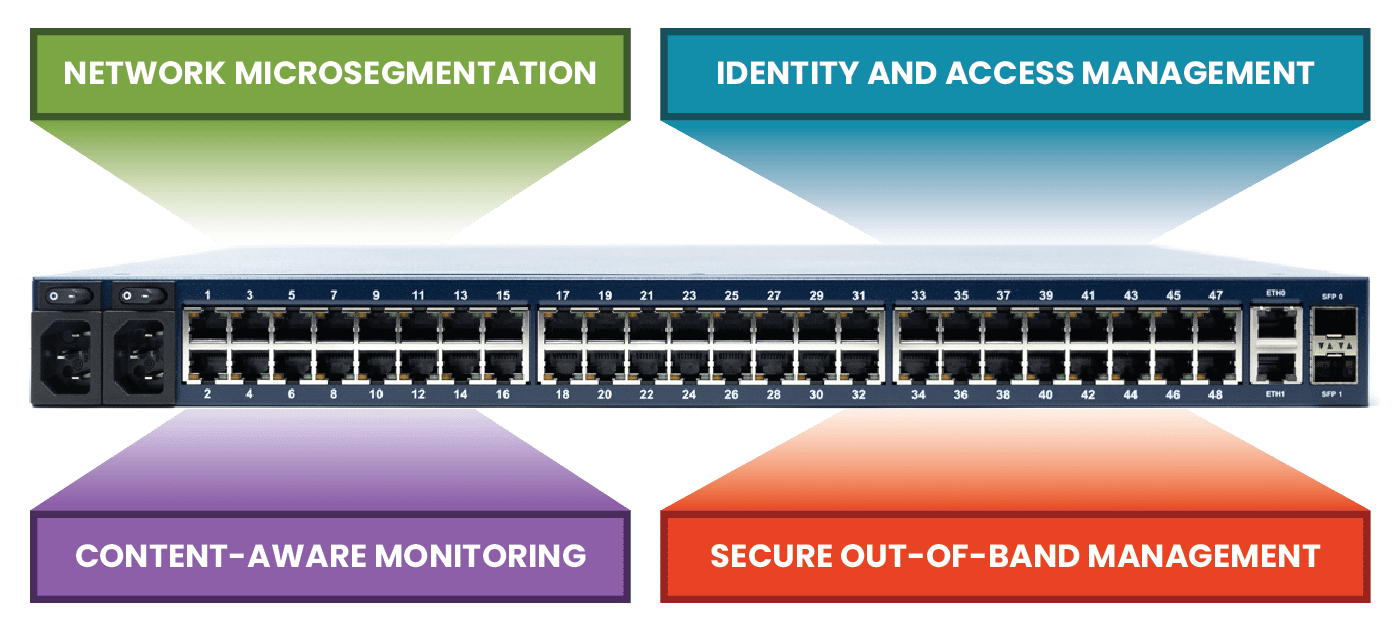
Some of the key features used in an all-in-one zero trust gateway include network micro-segmentation, identity and access management, context-aware monitoring, and secure out-of-band management. There are a small number of mature solutions that deliver all of these features off-the-shelf, but they lock you into their small solution ecosystem and limited feature roadmap. A better approach is to start with a vendor-neutral platform that lets you host and integrate your choice of security applications to create a fully customized zero trust gateway. Let’s walk through how each of these security technologies works and how to combine them into a bespoke zero trust gateway solution.

To see an example of a vendor-neutral zero trust gateway at work, request a demo of the Nodegrid solution from ZPE Systems.

Request a Demo

Network micro-segmentation

A zero trust micro-perimeter is made up of granular access control policies and security controls that are custom-tailored to the specific vulnerabilities and requirements of resources they’re defending. For example, an on-premises database containing sensitive financial records needs different policies than a cloud-based application that doesn’t process any personal information. To implement micro-perimeters, resources first need to be logically organized based on their sensitivity level, who needs access to them, and what their interdependencies are.

Network micro-segmentation is used to separate resources based on these criteria so that micro-perimeters can then be applied. For a device to be considered a zero trust gateway, it must support VLAN micro-segmentation and be able to apply access control rules consistently across all micro-segments.

Identity and access management

In a zero trust architecture, user and device permissions should be limited to only what’s necessary to perform their job role. For example, an HR account used to manage employee records shouldn’t have access to customer financial data, and vice versa. Access policies should be specific to individual micro-segments and resources and need to be applied to all users and devices consistently, no matter where they’re logging in from. That means a remote user should follow the same authentication steps and have the same permissions as they would if they logged in at the office.

For a large enterprise network, this is only achievable with a centralized identity and access management (IAM) solution. An IAM provides a single platform from which to create, manage, and apply security policies. A zero trust IAM also enables best practices like single sign-on (SSO) and two-factor authentication (2FA).

A zero trust gateway needs to integrate with your chosen IAM provider to ensure that policies are applied to both production traffic and management traffic. Some vendor-neutral gateway solutions can even directly host and run third-party IAM solutions, providing a more integrated experience and saving rack space.

Context-aware monitoring

Many successful cyberattacks use stolen credentials gained through phishing schemes and other social engineering tactics. For example, Mailchimp was recently attacked by malicious actors using credentials stolen from employees through social engineering. It’s difficult to detect and contain such an attack because the criminal looks like an authorized user. However, careful monitoring often reveals suspicious behavior, such as logging in from an unusual IP address or time zone, making multiple access requests to areas of the network they don’t usually visit, or transferring abnormally large quantities of data.

User and entity behavior analytics, or UEBA, uses machine learning technology to monitor and analyze account activity on the enterprise network. UEBA creates a baseline of “normal” behavior for individual accounts so it can detect any anomalous activity. UEBA integrates with other security and monitoring solutions, such as IAM and firewalls, so it can compare data from various sources to make more informed decisions. This is one of the ways that zero trust security verifies the trustworthiness of accounts trying to access sensitive resources, making UEBA a critical component of zero trust gateways.

Secure out-of-band (OOB) management

Admins need a fast and reliable way to access remote infrastructure for management, troubleshooting, and recovery. For example, it’s common for a single data center management team to be responsible for customer equipment in multiple DCs distributed around the world for redundancy. These admins can’t physically go on-site every time a firmware update fails or a device loses its IP address. That’s why they rely on remote out-of-band (OOB) management; remote OOB management creates a separate network just for management traffic that doesn’t rely on the production LAN. Admins access the OOB network using a dedicated management device, like a jump box or a serial console server.

This management device is a tempting target for cybercriminals, as gaining control of that device will give them complete control over the connected infrastructure. One way to protect the OOB network is by using a zero trust gateway with integrated management ports. For example, the Nodegrid Net Services Router (NSR) is a modular zero trust gateway that can be customized to connect to any type of device that needs to be managed or secured. The NSR comes with gateway routing and switching capabilities, an embedded firewall, and hardware security features like secure boot and a self-encrypted disk. Nodegrid is also completely vendor-neutral, which means it can directly host or integrate with your choice of third-party security solutions, including next-generation firewalls (NGFWs) and zero trust technologies like identity and access management and UEBA.

The NSR is a modular, open platform upon which to build a fully customized zero trust gateway for large data center deployments. The Nodegrid product line from ZPE Systems also includes a variety of serial console solutions and integrated all-in-one gateway routers to support other use cases, such as edge computing sites, branches, and automated IoT deployments.

A zero trust gateway helps organizations implement micro-perimeters of specific policies and controls to defend sensitive data and other valuable resources. A vendor-neutral, integrated solution like the Nodegrid Serial Console Plus from ZPE Systems makes it possible to combine zero trust security with networking and management functionality to create a streamlined, cost-effective zero trust gateway deployment.

Ready to learn more about Zero Trust Gateway?

To learn more about deploying Nodegrid as a zero trust gateway in your enterprise, contact ZPE Systems today.

Contact Us

ZPE Systems’ Services Delivery Platform accelerates time-to-market

Zero Pain Ecosystemedit

ZPE Systems’ Services Delivery Platform accelerates time-to-market with any app, anytime, anywhere

IT teams can deliver instant business value with the on-demand services delivery architecture

Fremont, CA, April 25, 2023 — ZPE Systems’ Services Delivery Platform is IT’s ‘easy’ button for delivering instant business value. Instead of deploying dedicated NGFW hardware and Intel® NUCs, ZPE’s Intel-based platform runs 3rd party apps at remote locations delivered via ZPE Cloud app marketplace. This speed and flexibility simplify global service delivery and fleet management for manufacturing, healthcare, finance, and other industries, where any app can be automatically deployed from the cloud.

Why is this important?

Private-cloud and on-prem services must run on dedicated systems, which causes infrastructure sprawl. This complexity pulls IT teams away from generating revenue, recovering from outages, and stopping ransomware attacks. Their job becomes managing low-level infrastructure and inefficient delivery pipelines. The Services Delivery Platform alleviates this by giving them the speed and flexibility to:

  • Secure remote locations with cloud-deployed pen test agents & other services
  • Segment edge networks regardless of interface type
  • Eliminate supply chain risks with hardened devices
  • Shrink attack surfaces with swift centralized patch management
  • Collapse device stacks into 1RU or less using virtual services

Services Delivery Platform apps and services

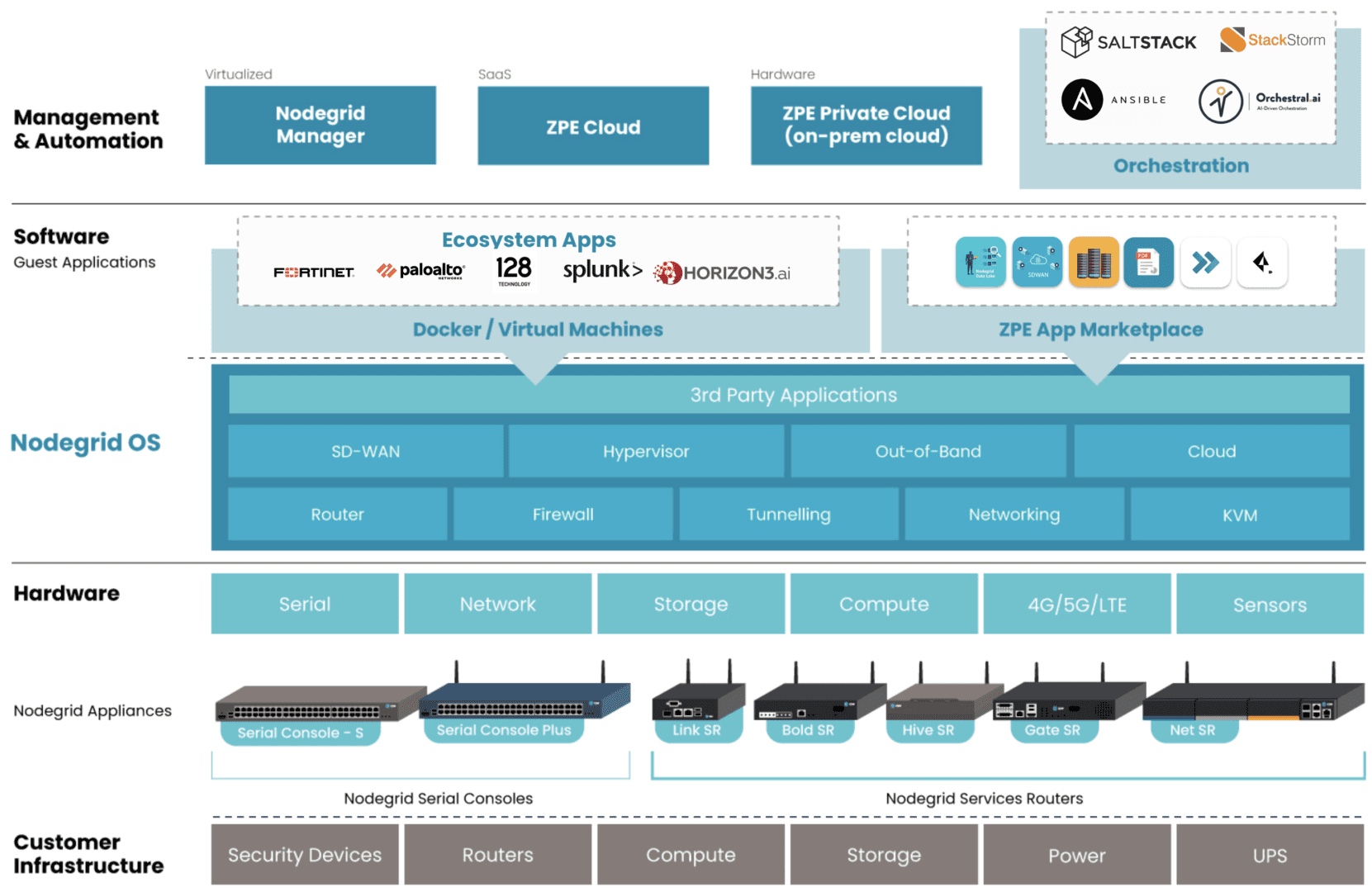
Graphic: ZPE’s Services Delivery Platform is represented as blue blocks. Examples of 3rd-party hosted apps are represented in white blocks under Ecosystem Apps.

The Services Delivery Platform brings to life Gartner’s concept of platform engineering. This platform-as-a-service model allows admins to tailor environments with the right apps for SD-WAN, NGFW, pen testing, and other functions, without battling vendor lock-in or changes in security posture. They also gain a consistent management experience across private-cloud and on-prem solutions.

Teams typically avoid platform engineering because there are no best practices for creating the proper control plane management network on secure devices.

ZPE Systems worked with Big Tech to define these best practices, which enterprises can now apply to private-cloud colo and edge deployments using the Services Delivery Platform. This establishes the resilient control plane management network and platform engineering component, both on a single, multi-function device connected to the cloud.

Enterprises accelerate revenue generation, reduce outage costs, and stop ransomware attacks using this architecture.

How does it work?

Nodegrid edge routers bring dedicated LAN and WAN links through multiple interface types (serial, ethernet, USB, IPMI). These create a secure control plane — a Double-RingTM management architecture — while eliminating the hardware attack surface with security features including TPM 2.0, encrypted disk, geofencing, and fully-signed Nodegrid OS.

This network is the foundation of the Services Delivery Platform. Along with hosting the management network, Nodegrid devices directly run VMs, containers, and any choice of app using the onboard multi-core Intel CPU and Linux-based Nodegrid OS. This OS also extends automation across environments and devices to give teams end-to-end activation and chaining of SASE, NGFWs, SD-WAN, and any cloud or on-prem solution.

“I’ve been in ops for a long time. Most of your day is spent just figuring out how to get your environments to work right,” says James Cabe, Director, Technical Alliances at ZPE Systems. “The Services Delivery Platform is a game-changer. The whole thing sits right on the Nodegrid box and you can switch or swap out services whenever you need to. Just choose what you want to deploy and go. It’s all done via separate control plane with no attack surface and no exposure to the Internet.”

Where can I find more information?

Go to zpesystems.com/services-delivery-platform to learn more about the Services Delivery Platform.

If you’re attending RSA Conference April 24-27, visit ZPE Systems at booth 4125 between north and south halls and ask for a demo.  Use this code for free RSA expo pass: 52EZPESYSXP

Why Cybersecurity-as-a-Platform (CaaP) is the Future of Holistic Security | ZPE Systems

cybersecurity platform zpe

A cybersecurity platform provides a unified interface from which to manage multiple security tools and controls. Traditionally, these platforms only work within a single vendor’s ecosystem of products. However, a new type of solution, called Cybersecurity-as-a-Platform (or CaaP), allows you to integrate your choice of third-party, multi-vendor solutions. In this blog, we’ll discuss the challenge of managing a complex cybersecurity environment and explain how CaaP can help.

Why Cybersecurity-a-a-Platform (CaaP) is the future of holistic security

Modern network security is rapidly evolving and expanding to deal with the increasing sophistication and frequency of cyberattacks. According to the Oracle and KPMG Cloud Threat Report from 2020, the average organization uses over 100 discrete cybersecurity controls. Often these tools come from many different vendors and perform many different functions, requiring specialized training to use each one effectively. This creates a highly complex cybersecurity environment that’s prone to human error.

In addition, there’s a lack of interoperability between products, meaning tools are often disjointed and working independently of each other rather than as a cohesive system. There’s also no centralized control or visibility over these independent solutions, which means administrators need to log in to each one to configure, monitor, and manage their functionality.

This leaves teams without a big-picture overview of their cybersecurity environment, making it impossible to achieve a complete security posture. This need for centralized management and monitoring of discrete security products led to the development of unified cybersecurity platforms.

What is a cybersecurity platform?

A cybersecurity platform is a software solution—typically, but not always, cloud-based—which unifies an ecosystem of security tools and controls behind one management interface. In the past, this has usually been vendor-specific (e.g., Trend Micro providing a single platform from which to manage their own security products). However, this type of platform leaves you locked in to whatever features and functionality are included by the cybersecurity vendor, or their chosen integration partners.

That leaves organizations with one of two choices:

1. Stay within that ecosystem and accept that they may have gaps in their coverage due to a lack of needed functionality. In this case, this means sacrificing the security of their network and systems for the convenience of using a single management system.

2. Add on additional products that must be managed outside of that platform, creating more management complexity for security administrators. In this case, this means sacrificing efficiency and interoperability in the hopes of improving overall security.

In either scenario, the organization is hurting its security posture by making compromises. A better solution is to choose a platform that gives you the freedom to combine the best security products and tools for your unique environment under one convenient management umbrella.

What is Cybersecurity-as-a-Platform (CaaP)?

Cybersecurity-as-a-Platform (CaaP) provides a vendor-agnostic interface from which to control a vast and complicated cybersecurity ecosystem. CaaP doesn’t care who you bought your security tools from or how you plan to use them—it provides the platform from which to integrate, manage, and monitor every component of your cybersecurity toolkit. This includes creating unified dashboards and visualizations that combine data from all your different security monitoring and analytics solutions, so you can get a complete picture of your cybersecurity environment.

How CaaP enables holistic cybersecurity

A unified Cybersecurity-as-a-Platform solution benefits businesses by:

  Reducing data overload – Security analysts must monitor and act on data from a wide variety of sources, including intrusion detection systems (IDS), firewalls, and security information and event management (SIEM) solutions. With so much data to sort through to filter out the false positives from the real threats, analysts can easily become overwhelmed and allow issues to fall through the cracks.

CaaP unifies the data from these individual sources and gives teams a single dashboard from which to view and analyze events. Plus, CaaP supports integrations with tools that can automatically analyze, filter, and remediate security incidents, reducing the risk of human error and freeing up security teams to work on high-priority issues.

  Simplifying security management – It’s very difficult (if not impossible) for a single security analyst to become an expert in 100+ different products, each of which has its own interface, nomenclature, compatibility issues, etc. Plus, simply logging into every one of these tools on a regular basis takes a significant amount of time, making it far too easy for analysts to neglect or forget critical security systems.

With the right Cybersecurity-as-a-Platform, analysts can integrate all their security tools into one common platform, reducing the number of discrete solutions they need to learn, maintain, and support. This both reduces the risk of human error and reduces the workload on overwhelmed security teams.

  Improving security posture – The more complex a system is, the more prone it is to failure. A cybersecurity strategy that relies on the continued operation and effectiveness of over 100 individual moving parts is more likely to fail because an issue with even one of those tools could lead to a breach. Plus, without a centralized view of how these parts work together, there’s no way to get a complete picture of an organization’s security posture.

CaaP gives analysts the ability to monitor and maintain all their security tools in one place, so they can see alerts about new vulnerabilities, apply patches, and more. They can also ensure all these tools are working together as expected so there are no gaps in coverage, and see data and visualizations about the security of the organization as a whole.

Adopt the CaaP approach to security with ZPE Systems

Cybersecurity-as-a-Platform is a unified, tightly integrated solution that rolls up a vast ecosystem of security tools behind one pane of glass. CaaP is the future of holistic security because it empowers efficient security monitoring and management while providing a complete overview of an organization’s security posture. True CaaP, like the Nodegrid solution from ZPE Systems, is completely vendor-neutral. This gives you the freedom to bring in your choice of cybersecurity solutions and automation tools, so you get the best features, functionality, and performance for your unique environment.

Want to learn more about cybersecurity platforms with Nodegrid?

Contact ZPE Systems today!

Contact Us