SD-Branch delivers some major advantages over traditional SD-WAN capabilities. Where typical software-defined approaches fall short at the branch level, SD-Branch picks up the slack to help you see and do much more.
In case you need to catch up, here’s a 90-second video showing some ways you can benefit from using SD-Branch.
If you’re super short on time, the advantages boil down like this:
SD-Branch lets you see inside your branch locations, by combining SD-WAN, routing, security, and all your network functions
You can see & control on a granular level, including activity for IoT devices, cameras, laptops, & all clients on your branch networks
You get more operational agility with a system that centralizes your infrastructure management & lets you take control remotely
Now that you’re caught up, you might be wondering…
How does Nodegrid make SD-Branch better?
Nodegrid gives you SD-Branch capabilities and a lot more. All-in-one Nodegrid devices, like the Nodegrid Services Router (NSR), reduce your stack thanks to the ability to handle many network functions in a single box. Support for automation and containerization via tools like Puppet, Ansible, Docker, and Kubernetes takes your orchestration and management capabilities to an entirely new level. It gets even better with out-of-band management that you can use even during an outage (thanks to cellular failover). Nodegrid hardware and software are vendor neutral, too, which means you can adapt your network to your changing business needs.
Sounds Pretty Awesome. But How Does it Work in the Real World?
See What SD-Branch Brings to a Leading Digital Security Company
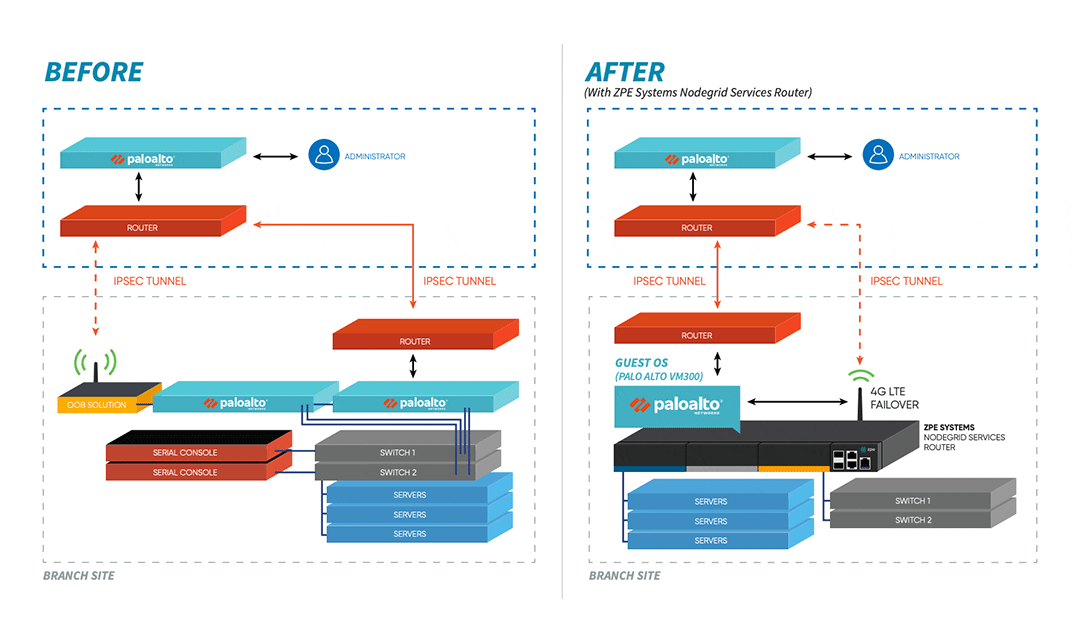
When a digital security enterprise, whose offices span the globe, needed help with their complex network infrastructure, they chose ZPE Systems’ Nodegrid. The powerful NSR solution relieved many of their branch network headaches, and even extended additional benefits to their data center operations. Their large, cumbersome stacks were replaced by a streamlined, all-in-one solution that made management easy, provided reliable backup via cellular, and leveraged the world-class security of Palo Alto Networks’ next-gen firewalls. Ready for the details?
Fremont, CA, August 21, 2020 – Today, ZPE Systems, Inc., a leading solutions provider for network infrastructure management solutions, announced an integration with Palo Alto Networks to provide enhanced networking, out-of-band management and security capabilities to branch locations for customers, including those with very remote locations.
The integration combines ZPE Systems’ Nodegrid hardware and management software with Palo Alto Networks VM-Series virtual firewalls. ZPE Systems’ Nodegrid platform with Palo Alto Networks VM-Series allows enterprises to consolidate and customize their network infrastructure, while safeguarding their traffic with the advanced security of a virtual firewall. Customers benefit from flexible, reliable network management and connectivity, along with proven protection for in-band and out-of-band paths.
ZPE Systems’ Nodegrid Services Router (NSR) solutions come in a variety of form factors for various applications, resulting in a network stack that’s easy to deploy, scale and manage even in isolated and obscure locations. These NSR solutions provide additional value thanks to reliable backup connections via 4G LTE cellular failover, which give redundancy to connected devices while improving rapid response and Mean Time to Innocence (MTI).
According to ZPE Systems’ CEO and Co-Founder Arnaldo Zimmermann, “Together, Palo Alto Networks virtual’ firewalls and our Nodegrid SR solutions give customers a secure and streamlined infrastructure, with centralized management that puts everything in one place — firewalls, servers, routers and even power controls.”
“With this integration, customers can extend their network security with VM-Series and add our SD-WAN and IoT Security subscriptions that can be managed from a single interface, plus deploy Wi-Fi with ZPE Systems’ NSR solution,” said Mukesh Gupta, Vice President of Product Management, VM Series at Palo Alto Networks. “This enables organizations to have universal customer premises equipment capabilities, known as uCPE, to help protect their branch locations.”
ZPE Systems is rethinking the way networks are built and managed by providing software-defined, vendor-neutral infrastructure management and networking solutions.
ZPE Systems’ Nodegrid® platform consolidates, organizes, and simplifies the need for a complete remote access and control solution; Nodegrid solutions address the OOB management needs of the data center, unifies edge networking environments, manages converged infrastructure and provides intelligent automation. ZPE’s smart, consolidated IT management solutions reduce downtime, deliver OPEX savings, and extend the reach of IT workforces.
ZPE’s global headquarters is located in Fremont, California with offices throughout the US and globally in Ireland, India, Brazil and Japan.
ZPE Systems, the ZPE logo and Nodegrid are registered trademarks of ZPE Systems, Inc.
Secure Access Service Edge (SASE): It’s one of those new-ish IT acronyms that many folks have heard about, but far fewer have actually used or really even understand it. But if you have remote and branch office (ROBO) infrastructure as part of your operations, you will need to know about it—and sooner rather than later.
As its name implies, it helps secure your network edge. But SASE provides much more than secure connectivity and remote access—it also provides add-ons to edge devices that can bring hyper converged infrastructure (HCI) capabilities to branch offices.
Edge computing lifts the lid on local computing capabilities, and can support local data acquisition, filtering, and clean-up before sending data into the cloud or data center location for further aggregation and analysis. This is particularly useful for locations where large volumes of data may be collected at the edge.
Cloud Safety
SASE provides networking and security to ROBO locations via the cloud. SASE is identity-driven and supports all edge locations. Users can identify themselves at the edge, and establish proper credentials and access controls before they access WAN or Internet connections. This helps give users safe, reliable access to the organization’s network no matter where they might be located.
SASE also addresses important needs for more secure, flexible connectivity in the field. Traditional networking is neither designed nor built to accommodate a widely distributed staff base. Nor is it well-adapted to cope with a plethora of BYOD devices (personal computers, laptops, notebooks, tablets, and smartphones), any or all of which may be used to access corporate resources such as email, collaboration tools, tele- or video-conferencing, and so forth. Too often, this puts remote workers at a disadvantage, encumbered with slow, restricted network access with less-than-industrial strength security.
Without SASE, organizations must backhaul traffic through their main network’s firewall. This creates a bottleneck that bogs down productivity with reduced speeds, frequent delays, and occasional interruptions of service. Remote connections may be more open to threats, owing to thinner, less comprehensive security measures.
Simply put, legacy solutions limit networks to specific locations and devices. Until recently, adding agility or extra capability meant adding to an already complex stack of applications and devices. In stark contrast, SASE beats legacy solutions because it lets employees connect from anywhere. It also protects those employees (and your organization) through its robust security capabilities delivered via the cloud.
Location Freedom
Instead of forcing staff to expend extra effort to work remotely, SASE packs everything they need into the cloud. Because the cloud is accessible anywhere there’s an Internet link, workers need not remain tethered to a specific workstation or a custom-configured laptop. Instead, they can use any device to enjoy secure access to the physical and cloud resources that SASE provides.
Whereas remote legacy solutions require a lot of setup, such as installing proper laptop software, adjusting network settings, establishing reliable VPN links, and more, SASE lets staff authenticate locally and seamlessly pick up the software, services, and configurations they need.
SASE offers comprehensive control and flexibility through its converged software stack for everything from SD-WAN and traffic management, to firewall and security. It also eliminates any need for discrete or loosely coupled point solutions that take extra time and money to learn, buy, and maintain.
Instead, SASE lets organizations control all networking and security functions through a single, consistent console. Also, access is no longer bound to specific locations, so IT staff can manage the entire network from wherever they happen to be—even across the globe.
SASE Flexibility and Power
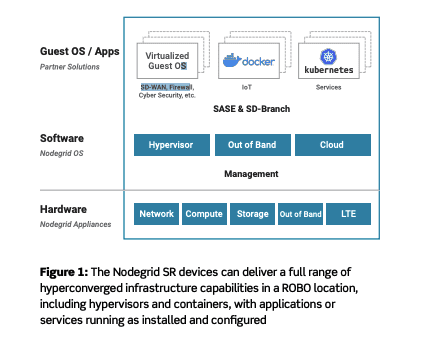
Not all SASE solutions are created equal, so exercise care when researching vendors. ZPE Nodegrid supports a comprehensive SASE platform you can deploy to the network edge, for more flexibility and edge computing power. Nodegrid’s patented 64-bit architecture supports guest OS runtime environments. In turn, those guest OSes support virtualized applications, so organizations can deploy them directly on Nodegrid SR devices.
Thus, organizations can craft and tailor network security solutions by deploying WAN accelerators (which have both central office and branch office components), additional firewalls, anti-malware and content filtering solutions, and more. In addition, Nodegrid’s modularity means that organizations can customize solutions for specific branch or remote office requirements with very little added effort and expense.
Nodegrid: Your Ready-to-Run SASE Platform
ZPE Nodegrid allows organizations to take advantage of flexible, secure ROBO connectivity and capability. Organizations can add applications and services to properly equipped Nodegrid SR devices in the branch to support IoT, data acquisition and analysis, local services and applications, enhanced security, and more.
Nodegrid’s built-in automation also helps to streamline deployment and scaling. This makes SASE easy to set up and use across an entire organization, including HQ, data center, and ROBO locations. With its 4G/LTE failover (5G solutions are on the way) and OOBM, organizations gain in-depth control over SD-WAN, security, and third-party applications and services. Nodegrid offers complete flexibility to your organization’s network. Learn more in our latest tech brief: Branch Out-of-Band Management is Deployed. Now what?
Deploying Your Branch Network is a Physical Ordeal
Typically, deploying a branch network involves sending lots of equipment and staff to each satellite location. This is easier said than done, as anyone with any experience can tell you that it can be quite a monumental undertaking. That’s because there are many pieces to set into motion (figuratively and literally).
For starters, you need to define the location’s networking needs, and then develop a plan to set up your devices appropriately. When you’re ready, you need to ship your stacks of equipment to the location, which can take plenty of time and cost a lot of money, especially if the site is isolated.
You also need to define your staff needs and coordinate schedules. Putting the right personnel on-site subjects you to travel times and expenses, which can increase substantially even with minor delays.
Juggling all this can make it extremely difficult to stick to your timelines.
Managing the Branch Pulls Your Resources Away
Once you have all your devices and personnel on-site, all essential duties must be performed at the location. This includes not only your initial set up, but also for ongoing maintenance and management.
Installing, configuring, and provisioning your branch network requires staff to connect to each device. Using the command line interface (CLI) and other tools, they need to perform the tedious tasks that come with manually configuring every component in the stack.
The same goes for troubleshooting issues and managing the location going forward. If a critical issue arises, an outage occurs, or a change must be made, you need to put staff on-site. To keep the branch running, it’s imperative that you maintain some sort of physical staff presence at or near the location, which pulls them away from more critical business duties.
Scaling Doesn’t Scale Well
Deploying one branch network can be a challenge when you follow the typical methods. So what happens when you try to set up three, four, five — or fifteen — new locations?
As you can imagine, the logistics involved can make for a very hairy business situation, one that can bog down your resources and devour your budgets. Think of how costly it could be sending a dozen locations’ worth of equipment through customs, on top of the travel expenses necessary for many teams of specialized staff.
In short, scaling without the right tools and practices requires you to devote heaps of time and resources.
The Good News is, Nodegrid Makes it Easy
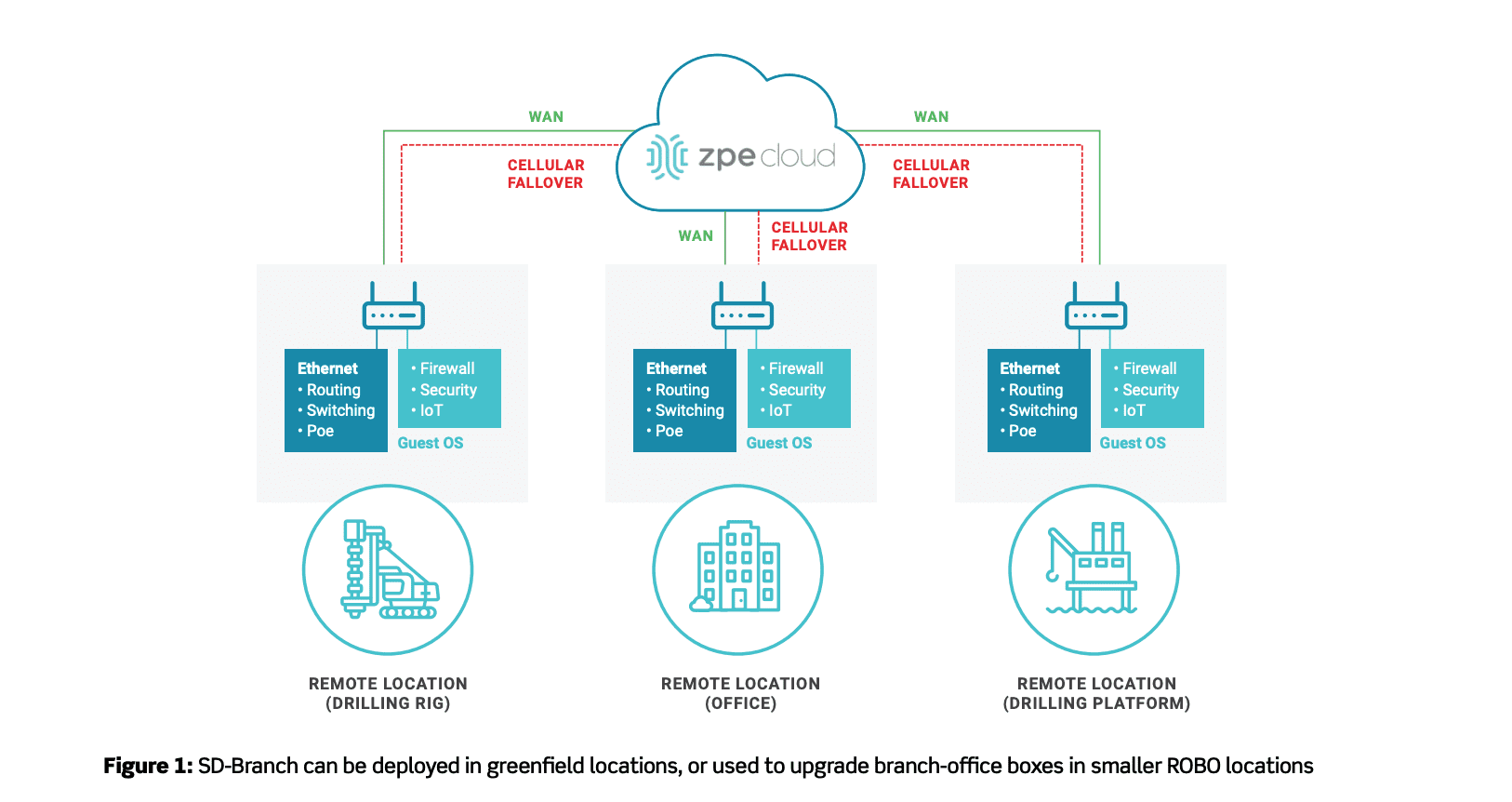
ZPE Systems’ Nodegrid platform was built for branch networking. It includes everything you need to deploy, manage, and scale your branch networks. Features like all-in-one devices and intuitive software cut your stack in half (or more), while ZPE Cloud makes configuration management quick and easy.
Secure Access Service Edge transforms edge networking. See how ZPE Systems — a leading innovator in network infrastructure management — introduces even more capabilities to this cloud-based solution.
What is Secure Access Service Edge?
Secure Access Service Edge, or SASE (‘sassy’), is a new concept that’s disrupting traditional edge networking. SASE combines networking and security services in the cloud, to deliver both wherever you need them. This means bringing safe access to every edge of your network, whether it’s to your most remote branch locations, or to on-the-go users traveling across the globe.
“SASE provides flexible, on-demand edge networking that keeps users protected no matter where they are…”– Jordan Baker, Sr. Technology Writer + IT Nerd
The Problem
Organizations are more distributed than ever, forcing you to backhaul traffic through your data center and main enterprise firewall. This leaves you dealing with several crippling issues, like:
Slowed speeds due to bottlenecking
Frequent delays from service-chaining latencies
Balancing connectivity vs security, especially at remote sites
Cumbersome scaling that requires loads of time & resources
The Solution
With SASE, you get a cloud-based solution that delivers safe and reliable access as close to users as possible. SASE combines network services such as SD-WAN, bandwidth aggregation, and NaaS with security solutions like FWaaS, Cloud SWG, and VPN. It delivers all these via an identity-driven, cloud-based model and allows users to connect from anywhere, while your main network can regain smooth operation. In short, SASE untethers your network edge so users can connect wherever they go:
Eliminate bottlenecking with agile security
Get fast service using tightly-coupled virtualized functions
Deliver reliable & secure access anywhere, thanks to the cloud
Scale on demand using built-in automation support
Why Use SASE?
Traditionally, scaling involves deploying complex stacks of networking and security solutions. Every device in your stack requires careful provisioning, which drags down a lot of your resources and complicates your ability to bring new locations online. But with SASE, you can deploy fewer devices thanks to a converged, cloud-based stack. Because your critical functions are no longer served by individual devices, you get the flexibility to scale on demand.To manage your network, SASE simplifies your job because it is a converged software stack in the cloud. You don’t need to deal with cumbersome, on-site management or a mishmash of loosely-coupled point solutions. Your IT staff can manage your network remotely because access is no longer bound to certain locations. Your SASE platform connects your network resources and allows you to access them all from one place.
ZPE Systems Gives You Even More Flexibility
ZPE Systems’ Nodegrid family of hardware and software provide you with an innovative SASE network management platform.Nodegrid features consolidated, all-in-one devices that reduce your stack and your hardware footprint. The patented x86 64-bit architecture lets you host virtualized applications as well. Instead of having to juggle third-party hosting solutions, you can deploy network functions directly on Nodegrid appliances.Nodegrid is also vendor neutral, giving you the freedom to tailor your solutions to your needs. You don’t have to compromise based on a specific vendor’s offerings. Instead, choose the combination of SD-WAN, firewall, cybersecurity, and other applications that suit you, no matter which vendors they’re from. The built-in Nodegrid software gives you an additional layer of convenience, providing a single interface that normalizes control of all your solutions. You can perform updates, maintenance, and other tasks across your network, all using one intuitive tool.To top it off, ZPE’s Nodegrid devices support automation using popular tools such as Ansible, Python, JSON, Bash, and others. You can streamline scaling, and even set up zero touch provisioning to automate every deployment. Nodegrid appliances are also modular so you can adapt more easily to your business’ changing needs. Remote out-of-band management capabilities enhance your visibility and control, while dual-cellular failover keeps you more resistant to outages and helps you maintain business continuity.Article originally featured in CIO Review
COVID-19 meant even the largest companies had to figure out remote work. And they had to adjust fast, not only to stay afloat and maintain business continuity, but also to establish a “new normal” that made them more responsive to change.
Aside from adapting their networks to accommodate a distributed workforce, most companies were left to contemplate one crucial component: best practices for managing a remote team.
We sat down with ZPE Co-Founder and VP of Engineering, Livio Ceci. Livio has more than 15 years of experience managing teams spread across the globe, and he’s offered some important advice you can use right now.
Stay Human
Because of COVID-19, every business interaction we have is through the computer screen. It might seem easy to become somewhat detached from your teams, but maintaining emotional intelligence is more important than ever with a remote workforce.
Apart from adjusting to any new cultural or language barriers you’re faced with, remember to help employees achieve a healthy work/life balance. Especially now, things are a little heavy on the life side, but your staff members want to continue to contribute and provide value to your company. Show employees that you sympathize with them, and in return, they’ll prove their commitment to you.
Here are a few things to keep in mind:
Establish trust — Remote or not, keeping promises goes a long way when it comes to establishing good relationships. When you say you’re going to do something, follow through by doing it. Send those account details on time, start sourcing the additional help you promised, and make sure everyone gets the new software you purchased.
Communicate clearly — Now there’s more standing between you and your teams, so miscommunication is more likely to happen. Make sure you and your employees are asking enough questions so that nothing gets lost in translation.
Talk about life — Of course you want to be as efficient as possible with your time. But part of establishing strong relationships is talking about what’s going on in people’s lives. Ask Marisol how her kids are adjusting to school at home, check in on Farook’s emergency roof repair, and celebrate Rajiv’s fifth anniversary.
Cover the Basics
If you’re new to working remotely, you’re probably well aware of the differences between the office and your home environment. There can be a ton of distractions at home, from the TV, to family, to chores, and it might be difficult for you to be productive. Before you can manage your distributed teams, you need to be able to focus, which means taking care of these work-from-home basics:
Set up a dedicated workspace — Limit distractions by setting up a space designated as your office. Use a room that is away from high-traffic areas in your home, so that you can focus on your tasks throughout the day.
Make sure your Wi-Fi is strong — Connectivity is crucial to remote work, but you might find it’s limited in certain areas of your home — including where you set up your workspace. Double-check your connection speed and strength to make sure it holds up, and consider upgrading or extending your Wi-Fi if necessary. The last thing you want is to suddenly drop off during an important video conference.
Block background noise — If you live near others or with family, you know that noise happens. One of the easiest ways block it out is by investing in a decent headset and microphone. You can also change your office by adding noise-blocking foam or insulation. Once you are able to cancel out noisy distractions, you and your team will be able to focus on your work.
Have the right hardware & software — From a laptop to a webcam, to mission-critical software, you need adequate tools to do your job effectively. Make sure you have everything you need so that you can be as productive as you used to be from the regular office.
Use the Right Tools
Going off the previous point, using the right tools is essential to managing a remote team. Not only do you need the right hardware and software, but you also need everyone to be on the same page for efficient, productive work. Communication and collaboration are key to business continuity.
There are many communication platforms available, and you’ll likely use a combination of tools because each has its own strengths. You’ll have different needs depending on your organization, but your ability to perform relies heavily on how you stay in touch with your teams every day. Instant messaging tools such as Slack can help you stay organized and chat with the right people, while video conferencing platforms like Zoom allow you to have meetings and conference calls.
In the office, you may have used a physical board to collaborate and track productivity. Now that you’re doing it all in a virtual environment, consider using tools like Jira or Asana to keep tabs on work. These allow you to easily manage tasks, set priorities, and delegate responsibilities.
Sharing tools are also invaluable to working remotely. These include file sharing platforms like SharePoint and knowledge base programs like Confluence, which allow you to easily collaborate on files and documents. And if software development is a large part of your organization, you’re probably already aware of the benefits that something like GitHub brings to the table. In a remote work environment, it’s now more crucial than ever and provides the version control hosting you need.
Pro tip: Keep your company’s info secure
Having the right tools in place helps you stay productive. But you also need to make sure your company’s info stays safe.
Use proper security measures to protect your data, and implement backup protocols that help you restore data in case issues arise.
Keep your code and other intellectual property on-prem to minimize vulnerabilities.
For your employees, give them only the minimum number of permissions necessary to do their job.
At ZPE, one of the ways we securely access our data and infrastructure is by using ZPE Cloud. Existing customers are eligible to get a free 3-month trial.
Focus on Goals
From everyday meetings, to task-specific goals, being able to focus greatly improves your ability to manage. But when you’re in charge of steering the ship while your crew is spread across the globe, it’s challenging. You might struggle to assign priorities, and deliverables might be vastly different than what you expected. Complicating things even more is the anxiety that can come with not being able to check in on what everyone is doing. You might feel like you’re not in control.
All you need to do is adjust your thinking. Just because you’re no longer in the office and can’t see the work getting done in front of you, doesn’t mean it’s not getting done. So, focus on the goals — not the activity.
When you consider everything that goes into working remotely — from time zone differences, to technical issues or sudden emergencies — it’s not effective to keep wondering, “Is Tabitha working right now on the latest feature we discussed?” Not only does it distract you from your own tasks, but it can lead you toward micro-managing, whichlowers trust and morale.
Instead, focusing on the goals and outcomes allows you to exercise the trust that you and your teams have established.
Here are some tips from Livio to help you and others focus on your goals:
Set expectations — Communicate what’s to be expected, so that everyone has a clear picture of what to shoot for. And when things change, make sure to update everyone involved. This goes for everything from meetings to deliverables, to big-picture stuff like new releases and prototypes. Are the presentation materials due Wednesday at 5pm Pacific? Which features should be released with version 1.4? Will the new admin start on Tuesday or Thursday? Check in regularly to make sure that everyone is on the same page.
Prioritize — Obviously, more important things should be at the top of everyone’s priority list, while minor things should be assigned a lower priority. This helps to keep expectations clear and make sure the focus remains on the appropriate goal.
Assign smaller deliverables — This one’s mostly for engineering teams, but can also be applied across various disciplines. By assigning smaller deliverables (and shorter sprints), near-term goals are easier to focus on and accomplish, which ultimately contribute to the end goal.
Hold regular meetings — Frequently go over expectations, deliverables, announcements, and other important topics, either via conference call or video chat.
Have an agenda — When it comes to business, and especially focusing on goals, make sure you have an agenda that you can share with others. Having a clear agenda makes for efficient use of everyone’s time, keeps the focus on appropriate tasks and outcomes, and limits distractions, whether you’re preparing for a meeting or finishing up the week’s sprint.
Pro tip: Set priorities straight
When considering expectations and task priorities for remote teams, ask, “How does this contribute to the end goal?” This helps you break down each piece of work into smaller chunks, so that you can delegate appropriately.
Stay Committed
Do you know what’s driving timelines? Answer: your commitment.
Whether your projects are short-term, long-term, or both, your commitment to them is what will keep you and your teams on track to reach your goals. When it comes to software development projects, Livio shares a few best practices:
Make two major releases per year (give or take one, depending on the project scope).
Develop a cycle that calls for a short time-to-market, with one small release per month.
Test, test, test! Set yourself up for continuous integration that ensures only stable code is committed.
Pro tip: What about the unexpected?
Over the years, Livio has found that the unexpected is the biggest disruptor to even the most meticulous plans. Whether it’s a critical bug or an urgent, last-minute request from the client, unforeseen hurdles always complicate the development process. To combat this, Livio suggests building in extra time from the beginning. This helps you adjust to abrupt changes or issues without having to alter more (or all) of your plans.
No matter how permanent our new normal may be, you can make the most of managing a remote team. If it’s a pandemic, natural disaster, or human error that threatens continuity, take this advice to keep business running even with a distributed workforce.
There’s More to Come
We’ve got one goal: to help you transform your business’ network into a value center. Sign up for news and updates for more free tips and advice about out-of-band, SASE, SD-everything, and more!
ZPE Systems delivers innovative solutions to simplify infrastructure managment at the datacenter, branch, and edge.
Learn how our Zero Pain Ecosystem can solve your biggest network orchestration pain points.