Providing Out-of-Band Connectivity to Mission-Critical IT Resources

The Future of Data Centers: Overcoming the Challenges of Lights-Out Operations

Future of lights-out data centers

In a recent article, Y Combinator announced its search for startups aiming to eliminate human intervention in data center development and operation. While one half of this vision seems focused on automating the design and construction of data centers, the other half – focused on fully automating operations (a.k.a. “lights-out”) – is already a reality. ZPE Systems and Legrand are enabling enterprises to achieve this kind of operation by providing the best practices that are already in use in hyperscale data centers for lights-out management.

The Need for Lights-Out Data Centers

The growth of cloud computing, edge deployments, and AI-driven workloads means data centers need to be as efficient, scalable, and resilient as possible. The challenge is that because there is so much infrastructure to manage, the buildout and operation of these data centers becomes very costly and time consuming.

Diane Hu, a YC group partner who previously worked in augmented reality and data science, says, “Hyperscale data center projects take many years to complete. We need more data centers that are created faster and cheaper to build out the infrastructure needed for AI progress. Whether it be in power infrastructure, cooling, procurement of all materials, or project management.”

Dalton Caldwell, a YC managing director who also cofounded App.net, adds, “Software is going to handle all aspects of planning and building a new data center or warehouse. This can include site selection, construction, set up, and ongoing management. They’re going to be what’s called lights-out. There’s going to be robots, autonomously operating 24/7. We want to fund startups to help create this vision.”

In terms of ongoing management and operations, bringing this vision to life will require organizations to overcome several significant problems:

  1. Rising Operational Costs: Staffing and maintaining on-site engineers 24/7 is costly. Labor expenses, training, and turnover increase operational overhead.
  2. Human Error and Downtime: Human error is the leading cause of downtime, so having manual processes often leads to costly outages caused by typos, misconfigurations, and slow response times.
  3. Security Threats: Physical access to data centers increases the risk of insider threats, breaches, and unauthorized interventions.
  4. Remote Site Management: Managing geographically distributed data centers and edge locations requires staff to be on-site. What’s needed is a scalable and efficient solution that lets staff remotely perform every job, outside of physically installing equipment.
  5. Sustainability and Energy Efficiency: On-site workers have specific heating/cooling needs that must be met in order to comfortably perform their jobs. Reducing human presence in data centers enables better energy management, which can lower carbon footprints and reduce cooling requirements.

The Roadblocks to Lights-Out Data Centers

Despite the obvious benefits, organizations struggle to implement fully autonomous data center operations. The obstacles include:

  • Legacy Infrastructure: Many enterprises still rely on outdated equipment that lacks the necessary integrations for automation and remote control. Adding functions or capabilities typically means deploying more physical boxes, which increases costs and complexity.
  • Network Resilience and Connectivity: Traditional in-band network management fails during outages, making it difficult to troubleshoot and recover remotely. Without complete separation of the management network from production networks, organizations are unable to achieve true resilience from errors, outages, and breaches.
  • Integration Challenges: Implementing AI-driven automation, OOB management, and cybersecurity protections requires seamless interoperability between different vendors’ solutions.
  • Security Concerns: A fully automated data center must have robust access controls, zero-trust security frameworks, and remote threat mitigation capabilities.
  • Skill Gaps: The shift to automation necessitates retraining IT staff, who may be unfamiliar with the latest technologies required to maintain a hands-off data center.

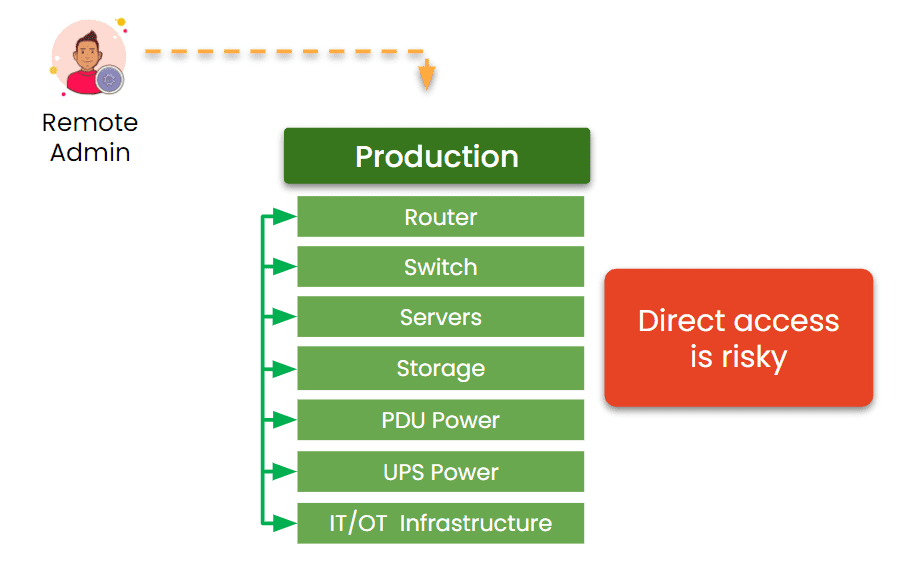
Direct remote access is risky

Image: The traditional management approach relies on production assets. This makes it impossible to achieve resilience, because production failures cut off remote admin access.

How ZPE Systems is Powering Lights-Out Operations

ZPE Systems is already helping companies overcome these challenges and transition to lights-out data center operations. As part of Legrand, ZPE is a key component in a total solution offering that includes everything from cabinets and containment to power distribution and remote access. By leveraging out-of-band management, intelligent automation, and zero-trust security, ZPE enables enterprises to manage their infrastructure remotely and securely.

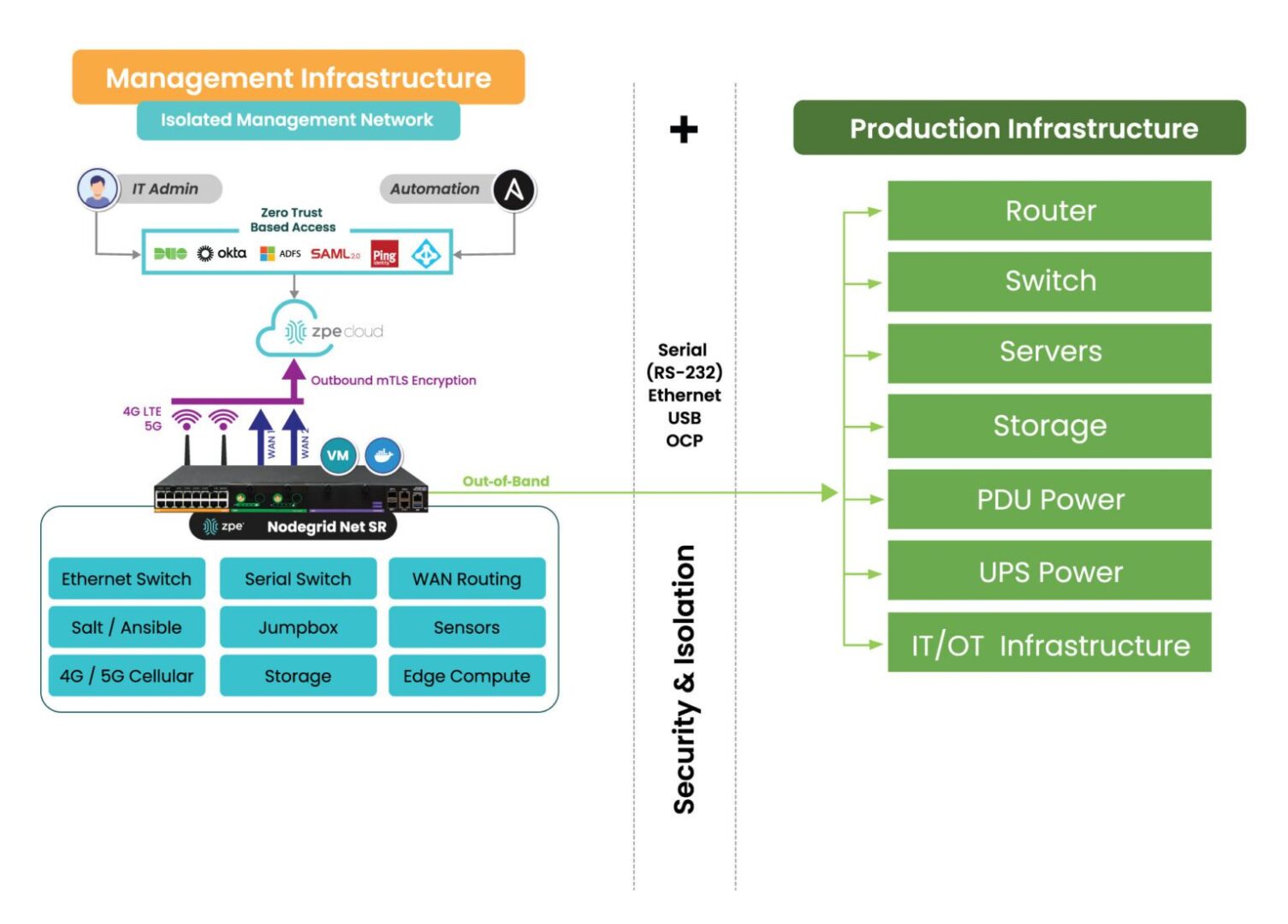
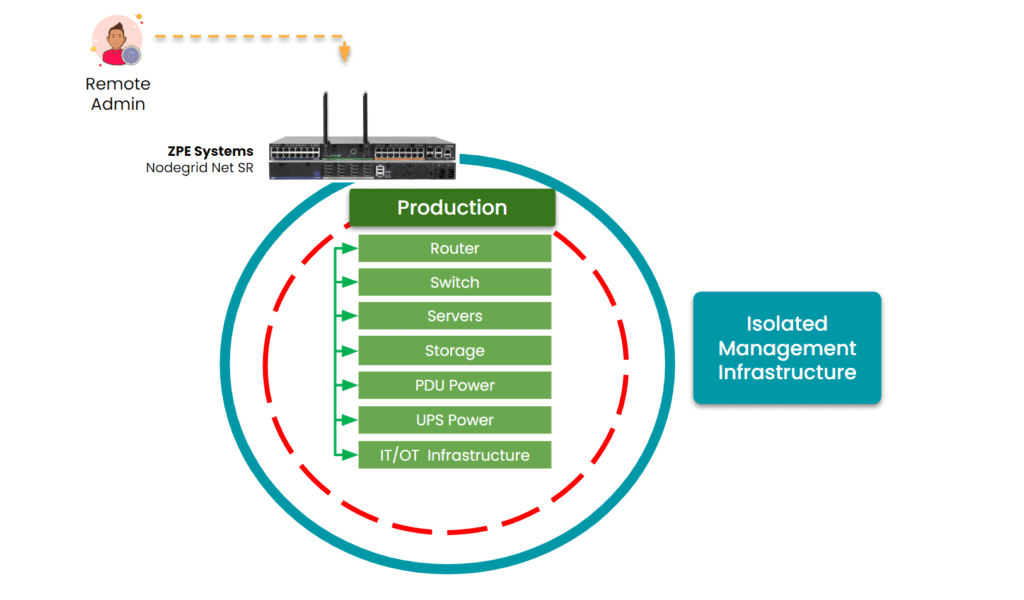
Isolated Management Infrastructure is critical to lights-out data center operations.

Image: ZPE Systems’ Nodegrid creates an Isolated Management Infrastructure. This gives admins secure remote access, even when the production network fails or suffers an attack.

Key benefits of this management infrastructure include:

  • Reliable Remote Access: ZPE’s OOB solutions ensure secure access to critical infrastructure even when primary networks fail. This is made possible by ZPE’s Isolated Management Infrastructure (IMI), which creates a fully separate management network. This single-box solution helps organizations achieve lights-out operations without device sprawl.
  • Automated Remediation: ZPE’s platform hosts third party applications, Docker containers, and AI and automation solutions. Organizations can leverage data about device health, telemetry, environmentals, and in-band performance, to resolve issues fast and prevent downtime.
  • Hardened Security: ZPE’s solutions are built with security in mind, from local MFA, to self-encrypted disk and signed OS. ZPE also has the most security certifications and validations, including SOC2 Type 2, FIPS 140-3, and ISO27001. Read our full supply chain security assurance pdf.
  • Multi-Vendor Integration: ZPE is the only drop-in solution that works across diverse environments, regardless of which vendor solutions are already in place. This makes it easy to deploy IMI and the resilience architecture necessary for achieving lights-out operations.
  • Comprehensive Data Center Solutions: With Legrand’s full suite of data center infrastructure, organizations benefit from a fully integrated approach that ensures efficiency, scalability, and resilience.

Lights-out data centers are an achievable reality. By addressing the key challenges and leveraging advanced remote management solutions, enterprises can reduce operational costs, enhance security, and improve efficiency. As part of Legrand, ZPE Systems continues to lead the charge in enabling this transformation for organizations across the globe.

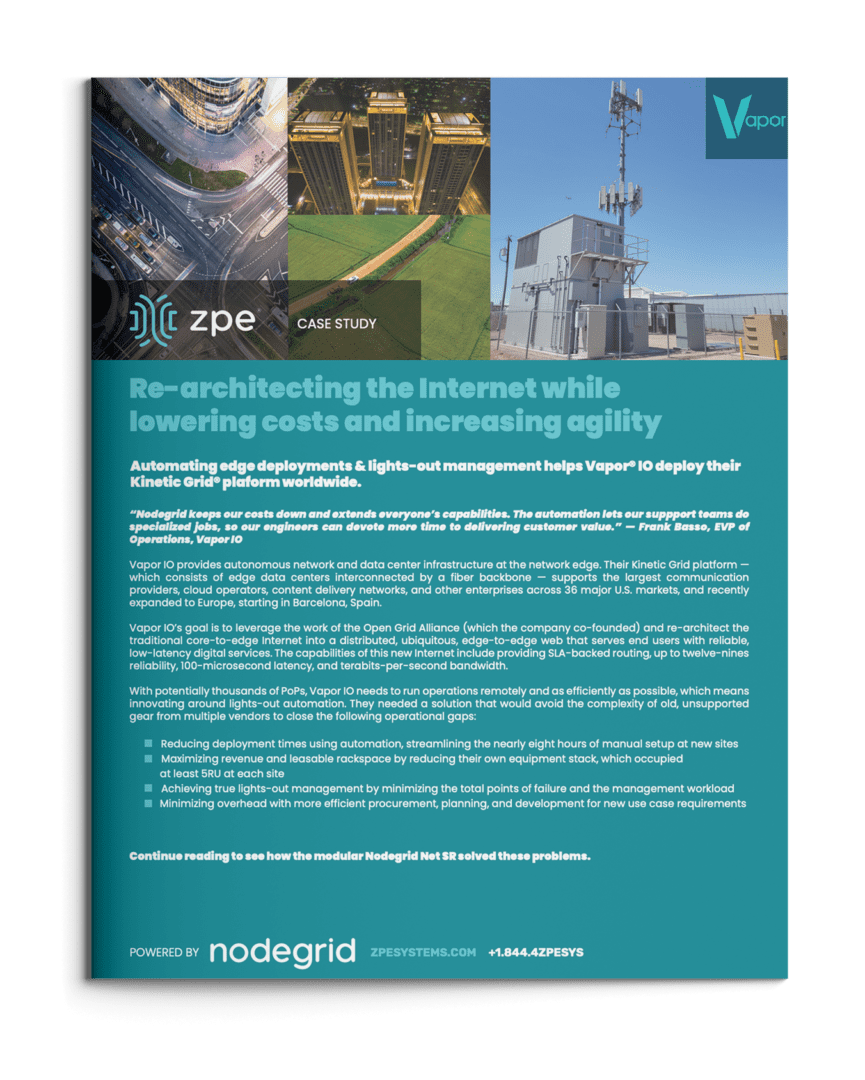
See How Vapor IO Achieved Lights-Out Operations with ZPE Systems

Vapor IO is re-architecting the internet. They deploy micro data centers at the network edge, serving markets across the U.S. and Europe. When they needed to achieve true lights-out operations, they chose ZPE Systems’ Nodegrid. Find out how this solution reduced deployment times to just one hour and delivered additional time and cost savings. Download the full case study below.

Get in Touch for a Demo of Lights-Out Data Center Operations

Our engineers are ready to walk you through lights-out operations. Click below to set up a demo.

Why Out-of-Band Management Is Critical to AI Infrastructure

Out-of-Band Management for AI

Artificial intelligence is transforming every corner of industry. Machine learning algorithms are optimizing global logistics, while generative AI tools like ChatGPT are reshaping everyday work and communications. Organizations are rapidly adopting AI, with the global AI market expected to reach $826 billion by 2030, according to Statista. While this growth is reshaping operations and outcomes for organizations in every industry, it brings significant challenges for managing the infrastructure that supports AI workloads.

The Rapid Growth of AI Adoption

AI is no longer a technology that lives only in science fiction. It’s real, and it has quickly become crucial to business strategy and the overall direction of many industries. Gartner reports that 70% of enterprise executives are actively exploring generative AI for their organizations, and McKinsey highlights that 72% of companies have already adopted AI in at least one business function.

It’s easy to understand why organizations are rapidly adopting AI. Here are a few examples of how AI is transforming industries:

  • Healthcare: AI-driven diagnostic tools have improved disease detection rates by up to 30x, while drug discovery timelines are being slashed from years to months.
  • Retail: E-commerce platforms use AI to power personalized recommendations, leading to a revenue increase of 5-25%.
  • Manufacturing: AI in predictive maintenance can help increase productivity by 25%, lower maintenance costs by 25%, and reduce machine downtime by 70%.

AI is a powerful tool that can bring profound outcomes wherever it’s used. But it requires a sophisticated infrastructure of power distribution, cooling systems, computing, GPUs, servers, and networking gear, and the challenge lies in managing this infrastructure.

Infrastructure Challenges Unique to AI

AI environments are complex, with workloads that are both resource-intensive and latency-sensitive. This means organizations face several challenges that are unique to AI:


  1. Skyrocketing Energy Demands: AI racks consume between 40kW and 200kW of power, which is 10x more than traditional IT equipment. Energy efficiency in the AI data center is a top priority, especially as data centers account for 1% of global electricity consumption.
  2. Cost of Downtime: AI systems are especially vulnerable to interruptions, which can cause a ripple effect and lead to high costs. A single server failure can disrupt entire model training processes, costing enterprises $9,000 per minute in downtime, as estimated by Uptime Institute.
  3. Cybersecurity Risks: AI processes sensitive data, making AI data centers prime targets for attack. Sophos reports that in 2024, 59% of organizations suffered a ransomware attack, and the average cost to recover (excluding ransom payment) was $2.73 million.
  4. Operational Complexity: AI environments rely on a diverse set of hardware and software systems. Monitoring and managing these components effectively requires real-time visibility into thermal conditions, humidity, particulates, and other environmental and device-related factors.

The Role of Out-of-Band Management in AI

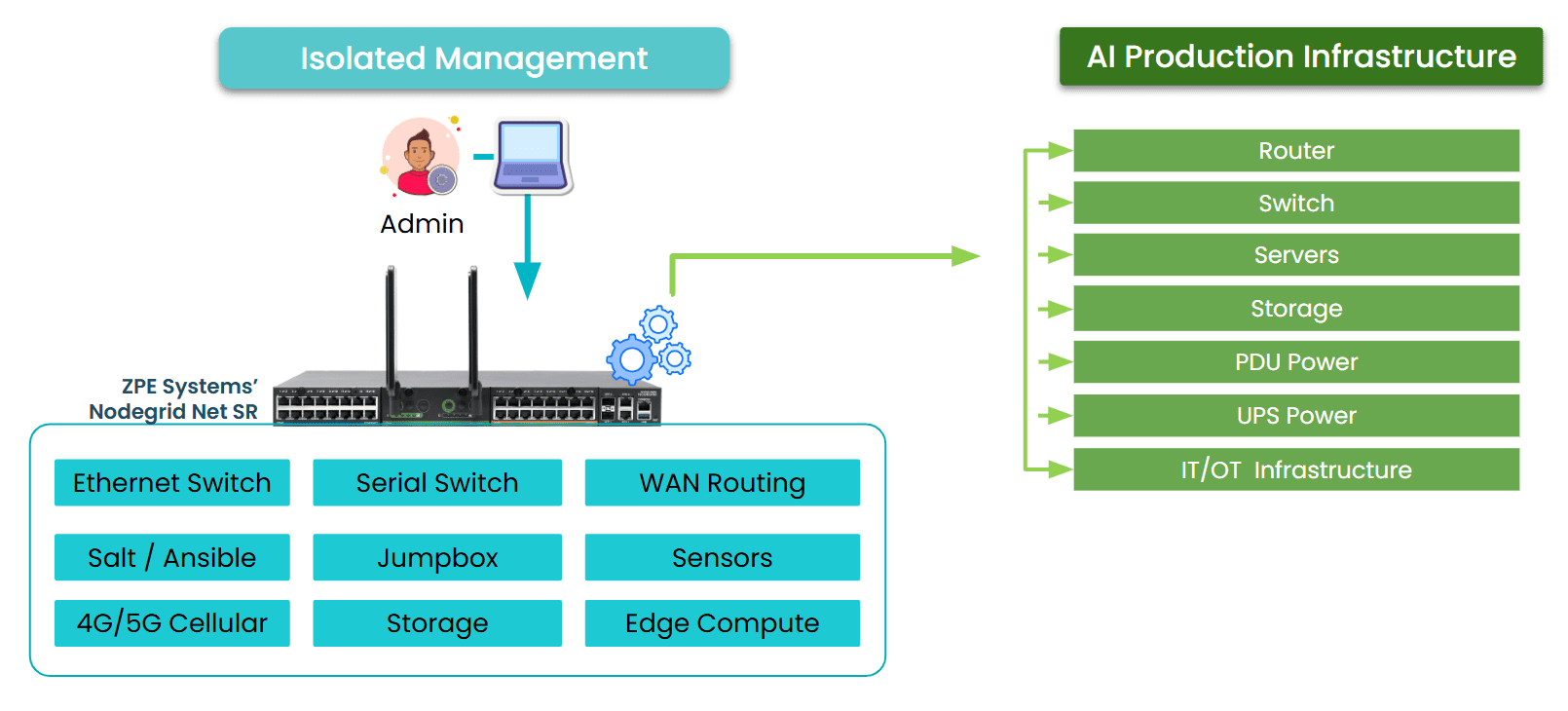
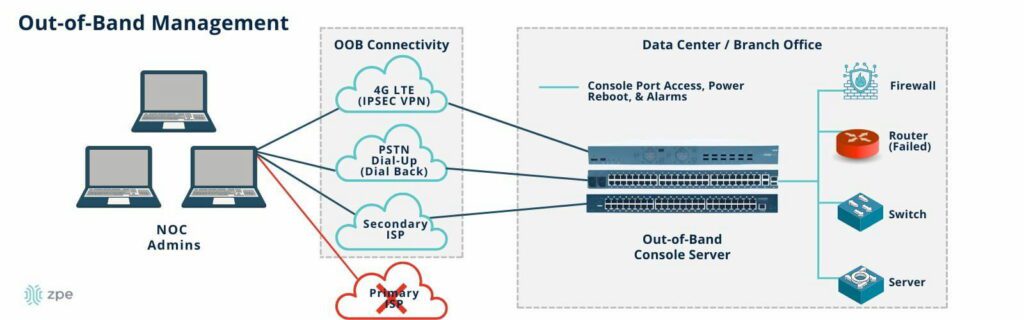
Out-of-band (OOB) management is a must-have for organizations scaling their AI capabilities. Unlike traditional in-band systems that rely on the production network, OOB operates independently to give teams uninterrupted access and control. They can remotely perform monitoring and maintenance tasks to AI infrastructure, troubleshooting, and complete system recovery even if the production network goes offline.


How OOB Management Solves Key Challenges:

  • Minimized Downtime: With OOB, IT teams can drastically reduce downtime by troubleshooting issues remotely rather than dispatching teams on-site.
  • Energy Efficiency: Real-time monitoring and optimization of power distribution enable organizations to eliminate zombie servers and other inefficiencies.
  • Enhanced Security: OOB systems isolate management traffic from production networks per CISA’s best practice recommendations, which reduces the attack surface and mitigates cybersecurity risks.
  • Operational Efficiency: Remote monitoring via OOB offers a complete view of environmental conditions and device health, so teams can operate proactively and prevent issues before failures happen.

Use Cases: Out-of-Band Management for AI

There’s no shortage of use cases for AI, but organizations often overlook implementing out-of-band in their environment. Aside from using OOB in AI data centers, here are some real-world use cases of out-of-band management for AI.

1. Autonomous Vehicle R&D

Developers of self-driving technology find it difficult to manage their high-density AI clusters, especially because outages delay testing and development. By implementing OOB management, these developers can reduce recovery times from hours to minutes and shorten development timelines.

2. Financial Services Firms

Banks deploy AI to detect and combat fraud, but these power-hungry systems often lead to inefficient energy usage in the data center. With OOB management, they can gain transparency into GPU and CPU utilization. Not only can they eliminate energy waste, but they can optimize resources to improve model processing speeds.

3. University AI Labs

Universities run AI research on supercomputers, but this strains the underlying infrastructure with high temperatures that can cause failures. OOB management can provide real-time visibility into air temperature, device fan speed, and cooling systems to prevent infrastructure failures.

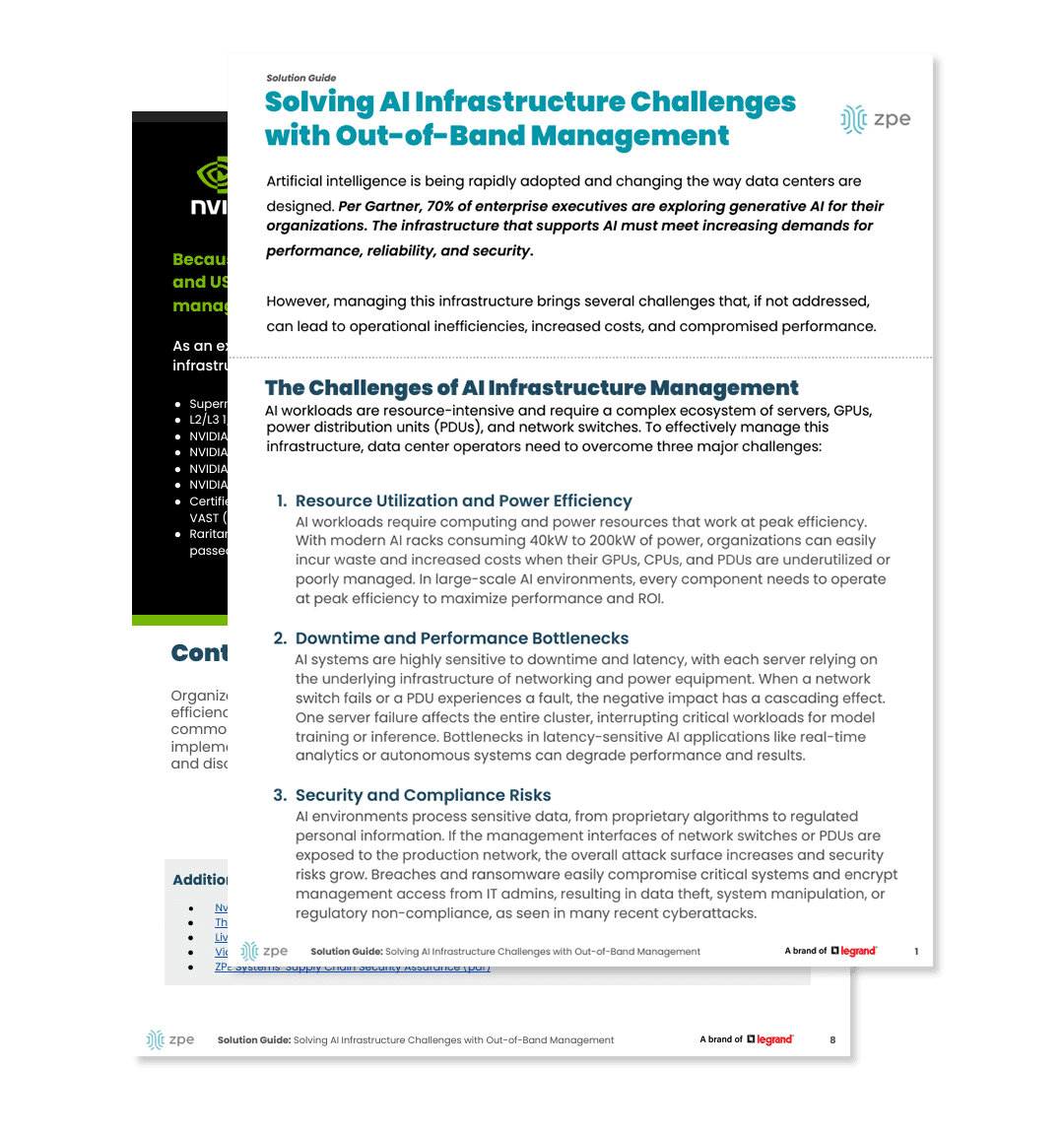
Download Our Guide, Solving AI Infrastructure Challenges with Out-of-Band Management

Out-of-band management is the key to having reliable, high-performing AI infrastructure. But what does it look like? What devices does it work with? How do you implement it?

Download our whitepaper Solving AI Infrastructure Challenges with Out-of-Band Management for answers. You’ll also get Nvidia’s SuperPOD reference design along with a list of devices that integrate with out-of-band. Click the button for your instant download.

Lantronix G520: Alternative Options

The G520 is a series of cellular gateways from Lantronix designed for industrial Internet of Things (IIoT), security, and transport use cases. While it provides redundant networking capabilities, it lacks critical resilience features such as out-of-band management (OOBM). This guide explains where the G520 falls short and why it matters before describing alternative options that deliver multi-functional IIoT capabilities and network resilience.

Why consider Lantronix G520 alternatives?

The Lantronix G520 is a cellular gateway that provides network connectivity, failover, and load balancing for IoT devices. However, it lacks serial console management capabilities, which means you need a separate device for remote management and OOBM. Out-of-band management is a crucial technology that separates the network control plane from the data plane to prevent breaches of management interfaces. OOBM also improves resilience by using a dedicated network (like cellular LTE) that gives remote teams a lifeline to recover from equipment failures, network outages, and breaches.

Percepxion G520

G520 gateways are managed with the Percepxion cloud platform, while cellular data plans and VPN security are managed separately with the cloud-based Connectivity Services software. These software solutions cannot be extended with third-party integrations, so teams must manage two separate Lantronix platforms and use separate software for monitoring, security, etc. Closed software also prevents teams from utilizing third-party automation and orchestration and creates a lot of management complexity, increasing the risk of human error and reducing operational efficiency.

G520 hardware also lacks extensibility due to an ARM architecture and tiny 256MB Flash storage. This essentially makes it a single-purpose device, with organizations needing to deploy additional appliances to run edge workloads, security applications, and other third-party software. There’s another IIoT gateway solution that combines edge networking capabilities with OOBM, the ability to run or integrate third-party applications, and a unified, extensible cloud management platform that extends automation and orchestration to all the devices in your deployment.

Nodegrid alternatives for the G520

Nodegrid is a line of vendor-neutral, edge networking solutions from ZPE Systems. The closest alternative to the Lantronix G520 is the Nodegrid Mini Services Router (or Mini SR)

Nodegrid Mini SR vs. Lantronix G520


Nodegrid Mini SR

Lantronix G520

CPU

x86-64bit Intel Processor

600 MHz ARM-based CPU 

Guest OS

1

0

Docker Apps

1-2

0

Storage

16GB SED

256MB Flash

Wi-Fi

Yes

Yes

Cloud Management

ZPE Cloud

Lantronix Percepxion, Connectivity Services

Cellular 

Dual-SIM

Dual-SIM

Serial

Via USB

No

Network

2 x 1Gb ETH

1 x 10/100 ETH

The Mini SR is a compact, fanless edge gateway small enough to be easily installed in any industrial environment. In addition to gateway, networking, and failover capabilities, the Mini SR provides OOBM for all connected devices, turning it into an IoT device management solution. Nodegrid’s OOBM completely isolates IoT management interfaces and ensures they’re remotely available 24/7 even during ISP outages and ransomware infections.

Mini-SR-Rear

The Mini SR and all connected devices are managed with ZPE Cloud, an intuitive platform that’s easily extensible with third-party integrations for infrastructure automation, edge security, SCADA software, and much more. The best part is that ZPE Cloud is a unified solution that gives administrators a single-pane-of-glass management experience for convenience and efficiency. 

Mini-SR-Diagram-980×748

The Mini SR and all other Nodegrid hardware solutions run on the vendor-neutral, Linux-based Nodegrid OS and come with robust Intel architectures. As a result, they can host Guest OS and even Docker containers for third-party applications, reducing the need for additional hardware appliances in cramped industrial environments. The Mini SR is an all-in-one solution that reduces edge expenses and complexity while improving resilience and operational efficiency.

Other Nodegrid alternatives for the Lantronix G520

Depending on your use case, you may have other reasons to consider G520 alternatives, such as the need for a complete serial console management solution, or the desire to run artificial intelligence (AI) workflows at the edge without deploying expensive single-purpose GPUs. Luckily, the Nodegrid line has solutions for every edge use case and pain point.

Comparing Nodegrid SRs

Nodegrid Mini SR Nodegrid Gate SR Nodegrid Hive SR Nodegrid Link SR Nodegrid Bold SR Nodegrid Net SR
Potential Use Cases Edge IoT, IIoT, OT, and IoMD (Internet of Medical Devices) deployments Branch service delivery and AI Distributed branch and edge sites like manufacturing plants Branch, IoT, and M2M (Machine-to-Machine) deployments Branch and edge deployments like telecom, retail, and oil & gas Large branches, edge data centers
CPU x86-64bit Intel Processor x86-64bit Intel Processor x86-64bit Intel Processor x86-64bit Intel Processor x86-64bit Intel Processor x86-64bit Intel Processor
Guest OS 1 1-3 1-2 1 1 1-6
Docker Apps 1-2 1-4 1-3 1-2 1-2 1-4
Storage 16GB SED 32GB – 128GB 16GB – 128GB 16GB – 128GB 32GB – 128GB 32GB – 128GB
Secondary Additional Storage Up to 4TB Up to 4TB Up to 4TB Up to 4TB Up to 4TB
PoE+ Output Yes Yes
Wi-Fi Yes Yes Yes Yes Yes Yes
ZPE Cloud Support Yes Yes Yes Yes Yes Yes
Cellular (Dual-SIM) 1 1-2 1-2 1 1-2 1-4
Serial Via USB 8 8 1 8 16-80
Network 2 x 1Gb ETH 2 x SFP+, 5 x Gb ETH, 4 x 1Gb ETH PoE+ 2x GbE ETH, 2x 10 Gbps, 4x 10/100/1000/2.5 Gbps RJ-45 1 x Gb ETH 1 x SFP 5 x Gb ETH 2 1Gb ETH, 2 SFP+, Multiple Cards
GPIO 2 DIO, 1 OUT, 1 Relay 2 DIO, 2 OUT
Power Single Single or Redundant Single Single Single Single or Redundant
Data Sheet Download Download Download Download Download Download

Get a complete IIoT solution with Nodegrid

The Nodegrid Mini SR improves upon the Lantronix G520 by consolidating edge networking capabilities and offering a vendor-neutral platform to host and integrate all your third-party applications. Schedule a demo to see Nodegrid in action!

Opengear Lighthouse Appliances: Alternative Options

The Opengear OM2200 Lighthouse Appliance.


Lighthouse appliances are Opengear’s out-of-band management (OOBM) solutions for data center and branch deployments. Lighthouse refers to the on-premises software application used to monitor and control Opengear-connected infrastructure devices.

Opengear Lighthouse appliances are good second-generation solutions, but they suffer from a few major limitations that prevent organizations from fully automating and securing the control plane. This guide explains why you might consider Lighthouse alternatives before providing third-generation OOBM options from ZPE Systems that improve upon the four most popular Opengear models.

Why consider Lighthouse alternatives?

Lighthouse appliances are second-generation (or Gen 2) out-of-band management solutions that suffer from three major limitations:

  1. Much of their automation capabilities, such as Docker container hosting and Python scripts, are locked behind an upgraded version of Lighthouse.
  2. They do not support two-factor authentication (2FA) or SAML 2.0 authentication.
  3. Lighthouse appliances are not truly vendor-neutral, only supporting certain integrations and requiring software license upgrades for some capabilities.

These factors prevent teams from fully automating and securing their control plane. A lack of automation, security, and the ability to host third-party tools on the OOB network also limits an organization’s network resilience.

The Nodegrid platform from ZPE Systems fills these gaps with an open, Gen 3 architecture that enables end-to-end automation using powerful, all-in-one devices protected with robust on-board security features.

Nodegrid alternatives for Lighthouse appliances

ZPE Systems offers a wide range of Nodegrid appliances to meet almost any business need or use case. This guide highlights four Nodegrid models that serve as direct replacements for – or alternatives to – Opengear Lighthouse appliances.

Opengear CM8100 alternative: Nodegrid Serial Console Plus

The CM8100 is Opengear’s high-density appliance for large data center deployments. The Nodegrid Serial Console Plus (NSCP) improves upon the CM8100 in several key ways:

  • The NSCP provides up to 96 managed serial ports in a 1U appliance, unlike the CM8100’s 96-port model which takes up two units of rack space.
  • Its Intel x86 CPU and 4GB of RAM provide enough processing power to easily run 3rd-party Docker and VM apps while supporting 1,000+ concurrent serial sessions, beating out the CM8100’s ARM CPU and 2GB of RAM.
  • It supports automation out of the box and extends zero-touch provisioning and other automation to legacy and mixed-vendor infrastructure, unlike Lighthouse which requires an enhanced license for most automation.
  • Several NSCP models have dual-SIM cellular slots for failover and OOBM, but none of the CM8100 models support cellular.
  • It supports a wide range of USB environmental monitoring sensors to help control conditions in remote data centers.
  • Unlike the CM8100, it comes with robust security features like BIOS protection and GPS geofencing and also supports SAML 2.0 authentication.

Comparison Table: CM8100 Lighthouse Appliance vs. Nodegrid Serial Console Plus


Nodegrid NSCP Opengear CM8100
Serial Ports 16 / 32 / 48 / 96x RS-232 16 / 32 / 48 / 96x RS-232
Network Interfaces 2x SFP+

2x ETH

1x Wi-Fi (optional)

2x Dual SIM LTE (optional)

2x ETH
Additional Interfaces 1x RS-232 console

2x USB 3.0 Type A

1x HDMI Output

1x RS-232 console

2x USB 3.0

CPU Intel x86_64 Quad-Core ARM Cortex-A9 1.6 GHz Dual-Core
Storage 32GB SSD (upgrades available) 32GB eMMC
RAM 4GB DDR4 (upgrades available) 2GB DDR4
Environmental Monitoring Any USB sensors
Form Factor 1U Rack Mounted 1U Rack Mounted (up to 48 ports)

2U Rack Mounted (96 ports)

Opengear OM2200 alternative: Nodegrid Serial Console S Series

The OM2200 console server has software-selectable serial ports that allow administrators to manage devices with straight or rolled RS-232 pinouts for mixed legacy and modern infrastructures. The Nodegrid Serial Console S Series serves as a direct alternative that offers a few key advantages:

  • The S Series has auto-sensing ports, further streamlining the management of mixed architectures.
  • It comes with 14 high-speed managed USB ports, compared to the OM2200’s 8 USB ports.
  • As with the NSCP, it supports automation out of the box, has cellular options (via USB connections to cellular modems), can use USB environmental sensors, and provides comprehensive security for the control plane.

Comparison Table: OM2200 Lighthouse Appliance vs. Nodegrid Serial Console S Series


Nodegrid S Series

Opengear OM2200

Serial Ports

16 / 32 / 48x Software Selectable RS-232

14x USB-A serial

16 / 32 / 48x Software Selectable RS-232

8x USB 2.0 serial

(OM2224-24E) 24x Software Selectable RS-232 and 24x Managed Ethernet

Network Interfaces

2x1Gbps or 2x ETH

2x SFP+ or 2x ETH

1x V.92 modem (select models)

Additional Interfaces

1x RS-232 console

1x USB 3.0 Type A

1x HDMI Output

1x RS-232 console

1x Micro USB

2x USB 3.0

CPU

Intel x86_64 Dual-Core

AMD GX-412TC 1.4 GHz Quad-Core

Storage

32GB SSD (upgrades available)

64GB SSD

RAM

4GB DDR4 (upgrades available)

8GB DDR3

Environmental Monitoring

Any USB sensors

Form Factor

1U Rack Mounted

1U Rack Mounted 

Opengear CM7100 alternative: Nodegrid Serial Console Core Edition

The CM7100 is the previous generation of the CM8100 appliance, and it comes with several price-saving options (like smaller storage and RAM configurations) that make it popular for simple break-fix OOBM access to remotely troubleshoot and recover from issues.

ZPE Systems offers the NSCP Core Edition, a more stripped-down version of the Nodegrid Serial Console Plus. It improves upon the CM7100 in a few important ways:

  • The NSCP-CE comes with analog modem and dual-SIM cellular options for network failover and OOBM, unlike the CM7100.
  • Like the other Nodegrid models, it supports a wide range of environmental sensors, while the CM7100 supports specific sensors for smoke, water leaks, and vibration.
  • As with the other Nodegrid models, it supports automation via ZPE Cloud, has cellular options, and provides comprehensive security for the control plane.

Comparison Table: CM7100 Lighthouse Appliance vs. Nodegrid Serial Console Core Edition


Nodegrid NSCP-CE Opengear CM7100
Serial Ports 16 / 32 / 48 / RS-232 16 / 32 / 48 / 96x RS-232
Network Interfaces 2x SFP ETH
1x Analog modem (optional)


2x 5G/4G LTE (optional)

2x ETH
Additional Interfaces 1x RS-232 console

2x USB 3.0 Type A

1x RS-232 console

2x USB 2.0

CPU Intel x86_64 Dual-Core Armada 370 ARMv7 800 MHz
Storage 16GB Flash (upgrades available) 4-64GB storage
RAM 4GB DDR4 (upgrades available) 256MB-2GB DDR3
Environmental Monitoring Any USB sensors Smoke, water leak, vibration
Form Factor 1U Rack Mounted 1U Rack Mounted (up to 48 ports)

2U Rack Mounted (96 ports)

Opengear ACM7000 alternative: Nodegrid Gate Services Router

The ACM7000 Resilience Gateway provides gateway routing and OOBM for smaller deployments in branch and edge locations. The Nodegrid platform includes six multi-functional branch services routers available in various form factors and configurations to meet the needs of any organization. The Gate SR in particular makes an excellent replacement for the ACM7000 because it offers:

  • Up to 4TB of storage to run up to 3 Guest OSes or 4 Docker applications.
  • Optional dual-SIM 5G/4G cellular, while the ACM7000 only supports 4G LTE.
  • The option for an embedded Nvidia Jetson Nano processor capable of running AI workloads, like those for computer vision, alongside traditional applications.
  • Support for a wide range of environmental sensors, while the ACM7000 supports specific sensors for external water, smoke, and dry contact.
  • Support for automation out of the box as well as comprehensive control plane security.

Comparison Table: ACM7000 Lighthouse Appliance vs. Nodegrid Gate Services Router


Nodegrid Gate SR

Opengear ACM7000

Serial Ports

8x RS-232

4 / 8x RS-232

Network Interfaces

2x SFP ETH

1x Wi-Fi (optional)

2x Dual SIM LTE (optional)

2 / 4x ETH

1x Single SIM LTE

Additional Interfaces

1x RS-232 console

4x ETH Switch

4x PoE ETH Switch

2x USB 3.0 Type A

2x USB 2.0 Type A

1x RS-232 console

4x USB 2.0

CPU

Intel x86_64 Dual-Core

Armada 370 ARMv7 800 MHz

Storage

16GB Flash (upgrades available)

4GB storage

RAM

4GB DDR4 (upgrades available)

256MB DDR3

Environmental Monitoring

Any USB sensors

Smoke, water leak, vibration

Form Factor

1U Rack Mounted

1U Rack Mounted

Ready to upgrade to a Gen 3 OOBM appliance?

The Nodegrid platform from ZPE Systems offers third-generation automation, control, and security for the ultimate network resilience, improving upon Opengear’s outdated architecture. But we know that replacing Lighthouse appliances and other console servers takes a lot of effort. That’s why ZPE now offers a complete package of budget-friendly products and engineering services to help. Click here to see how we simplify the upgrade process.

What is FIPS 140-3, and Why Does it Matter?

A lock representing cybersecurity, with the title What is FIPS 140-3 and why does it matter?

Handling sensitive information is a responsibility shared by so many organizations. Ensuring the security of data, whether in transit or at rest, is not only critical for maintaining the trust of end users and customers, but is often a regulatory requirement. One of the most reliable ways to secure data within network infrastructure is by implementing FIPS 140-3-certified cryptographic solutions. This certification, which was developed by the National Institute of Standards and Technology (NIST), serves as a benchmark for robust encryption practices, enabling organizations to meet high security standards and ensure regulatory compliance.

Let’s explore what it means to have FIPS 140-3 certification, why it matters, and its key applications in network infrastructure.

What is FIPS 140-3 Certification?

The Federal Information Processing Standard (FIPS) 140-3 certification is a stringent, government-endorsed security standard that sets guidelines for cryptographic modules used to protect sensitive data. It includes requirements for securing cryptographic functions within hardware, software, and firmware. The certification process rigorously tests cryptographic solutions for security and reliability, ensuring that they meet specific criteria in data encryption, access control, and physical security.

There are four levels of FIPS 140-3 certification, each adding layers of protection to help secure information in various environments:

  • Level 1: Ensures basic encryption standards.
  • Level 2: Adds tamper-evident protection and role-based authentication.
  • Level 3: Provides advanced tamper-resistance and strong user authentication.
  • Level 4: Offers the highest level of security, including physical defenses against tampering.

FIPS 140-3 certification ensures that an organization’s network infrastructure meets high standards for cryptographic security. This is important for protecting sensitive information against cyber threats as well as fulfilling regulatory requirements.

Why FIPS 140-3 Certification Matters

1. Meeting Regulatory Compliance Requirements

FIPS 140-3 certification is often required by regulatory bodies, especially in sectors like government/defense, healthcare, and finance, where sensitive data must be protected by law. Here are a few industry-specific regulations that FIPS 140-3-certified modules help with:

  • Defense: DFARS, NIST SP 800-171
  • Healthcare: HIPAA
  • Finance: PCI-DSS
  • Energy: NERC CIP
  • Education: FERPA

Compliance with FIPS 140-3 also makes it easier for organizations to meet audit requirements, reducing the risk of fines or penalties for security lapses.

2. Strengthening Customer Trust

End users and customers expect that their data is handled with care and protected against breaches. By using FIPS 140-3-certified solutions, organizations can demonstrate their commitment to securing customer data with recognized, government-endorsed security standards. FIPS certification is a valuable trust signal, showing customers that their information is being managed with the highest level of protection available.

3. Protecting Against Emerging Cyber Threats

Relying on uncertified or outdated cryptographic solutions increases the risk of data breaches. FIPS 140-3-certified solutions are tested to withstand advanced attacks and tampering, which is an important safeguard against threats that continue to evolve in complexity. Certified modules help prevent unauthorized access to sensitive data, whether through intercepted communications, phishing, or other cyber threats.

FIPS 140-3 certification gives assurance, especially for organizations that handle high volumes of data, that they have adequate encryption to protect against sophisticated attacks.

4. Ensuring Business Continuity and Operational Resilience

According to IBM’s Cost of a Data Breach Report 2024, data breaches now cost $4.88 million (global average), with healthcare being the most costly at $9.8 million per breach. The financial impact is staggering, but the ongoing operational disruption and recovery efforts determine whether an organization can fully bounce back from a breach. With FIPS 140-3 certification, there’s an added layer of resilience to an organization’s infrastructure, which reduces the likelihood of breaches and ensures a secure base for maintaining continuity (such as through an Isolated Recovery Environment). By implementing FIPS-certified encryption, businesses can minimize downtime, maintain access to encrypted systems, and recover more smoothly from potential incidents.

5. Gaining a Competitive Advantage in Security-Conscious Markets

Organizations that follow rigorous data security standards are more likely to gain the trust of clients, stakeholders, and customers, especially in industries where security is non-negotiable. Organizations that adopt FIPS 140-3-certified infrastructure can differentiate themselves as having a reputation for security, which can be a competitive advantage that attracts customers and partners who value data protection.

Key Applications of FIPS 140-3 in Network Infrastructure

For organizations managing large amounts of customer data, FIPS 140-3-certified solutions can be applied to several critical areas within network infrastructure:

  • Network Firewalls and VPNs: FIPS-certified encryption ensures that data moving across networks remains private, protecting it from interception by unauthorized users.
  • Access Control Systems: Identity-based access controls with FIPS-certified modules add another layer of security to protect against unauthorized access to sensitive data.
  • Out-of-Band Management: Using FIPS 140-3-certified encryption in OOB management ensures the same stringent security level for OOB traffic as for in-band network traffic.
  • Data Storage and Backup: FIPS-certified encryption secures data at rest, protecting stored customer information from unauthorized access or tampering.
  • Cloud and Hybrid Environments: For companies using cloud or hybrid environments, FIPS-certified encryption helps protect data across multiple infrastructure layers, ensuring consistent security whether data resides on-premises or in the cloud.

Discuss FIPS 140-3 With Our Network Infrastructure Experts

FIPS 140-3 certification gives organizations the ability to reassure customers, meet compliance requirements, and protect critical data across every layer of the network. Get in touch with our network infrastructure experts to discuss FIPS 140-3, isolated management infrastructure, and other resilience best practices.

Explore FIPS 140-3 for Out-of-Band Management

Read about 7 benefits of implementing FIPS 140-3 across your out-of-band management infrastructure. This article discusses the benefits it brings to remotely accessing devices, protecting against physical attacks, and securing edge infrastructure.

7 Security Benefits of Implementing FIPS 140-3 for Out-of-Band Management

ZPE Systems -FIPS 140-3

Out-of-band (OOB) management is essential for maintaining control over critical network infrastructure, especially during outages or cyberattacks. This separate management network enables administrators to remotely access, troubleshoot, and recover production equipment. However, managing network devices outside the main data path also brings unique security challenges, as these channels often carry sensitive control data and system access credentials.

Implementing FIPS 140-3-certified encryption within OOB systems can help organizations secure this vital access path to ensure that management data can’t be intercepted or manipulated by unauthorized actors. Here’s how FIPS 140-3 certification can enhance the security, reliability, and compliance of your out-of-band management.

What is FIPS 140-3 Certification?

FIPS (Federal Information Processing Standard) 140-3 is a high-level security standard developed by the National Institute of Standards and Technology (NIST). It specifies rigorous requirements for cryptographic modules used to protect sensitive data. FIPS 140-3 certification covers everything from data encryption to user authentication and physical security. For out-of-band management, FIPS 140-3 certification ensures that cryptographic components in hardware, software, and firmware meet stringent data security standards.

By implementing FIPS-certified solutions, organizations can ensure their OOB management is resilient against modern cyber threats, protecting both the control channels and the sensitive data they carry. Here are seven security benefits of implementing FIPS 140-3 for out-of-band management.

7 Security Benefits of Implementing FIPS 140-3 for Out-of-Band Management

1. Secure Encryption of Management Traffic

OOB management often involves remote access to routers, switches, servers and other critical devices. FIPS 140-3 certification guarantees that all cryptographic modules used in these systems have been rigorously tested to secure data in transit. Encrypting management traffic is crucial to prevent interception or manipulation by unauthorized users, particularly for tasks such as command execution, configuration updates, and device monitoring.

With FIPS-certified encryption, companies can protect OOB traffic between management devices and network components, so that only authorized administrators have access to sensitive system commands and device settings.

2. Enhanced Authentication and Access Control

OOB management solutions typically support different user roles, each with its own access privileges. FIPS 140-3-certified modules, like ZPE Systems’ Nodegrid, feature multi-factor authentication (MFA) to control who can initiate OOB management sessions. Certified solutions also include secure key management practices that prevent unauthorized access, ensuring that only verified users can control and modify network devices.

These protections mean FIPS-certified solutions help mitigate the risk of unauthorized users accessing high-value assets. This is especially important during ransomware recovery efforts, when teams need to launch a secure, Isolated Recovery Environment to combat an active attack in a compromised environment.

3. Protection Against Tampering and Physical Attacks

Many organizations deploy IT infrastructure in locations where physical device security is lacking. For example, remote colocations, unmonitored drilling sites, or rural health clinics can easily expose network infrastructure to device tampering. FIPS 140-3 certification mandates tamper-evident and tamper-resistant features to protect the cryptographic modules used in OOB systems. OOB solutions like ZPE Systems’ Nodegrid provide robust protection against tampering, with features including:

  • UEFI secure boot: Prevents the execution of unauthorized software during the boot process.
  • TPM 2.0: Ensures secure key generation and storage, so only authorized software can run.
  • Secure erase: Allows for deletion of all data from storage, so no data can be recovered from devices that have been tampered with.

These features prevent unauthorized individuals from physically accessing OOB equipment to intercept or modify management traffic. In remote and edge locations, FIPS-certified cryptographic modules provide robust protection against physical attacks, making it harder for adversaries to compromise OOB management pathways.

4. Compliant and Secure Logging of Access Activities

Because OOB management systems provide access to critical equipment, organizations need transparency into OOB users and their management activities. This means logging and auditing are essential to maintaining security and compliance. FIPS 140-3-certified modules support secure logging of all management activities, creating a clear audit trail of access attempts and security events. These logs are stored securely to prevent unauthorized users from altering or erasing them, providing valuable insights for security monitoring and incident response.

Secure logging is not only critical for monitoring access but also necessary for meeting regulatory compliance. FIPS 140-3 ensures that OOB management systems can satisfy audit requirements, making compliance easier and protecting organizations from potential regulatory penalties.

5. Meeting Regulatory Requirements in Sensitive Environments

Many industries handle sensitive data, especially government, healthcare, and finance. For organizations in these industries, it’s often mandatory to use FIPS-certified cryptographic solutions. FIPS 140-3 certification helps OOB management systems align with federal security regulations and standards like HIPAA and PCI-DSS. By deploying FIPS-certified encryption, organizations can comply with these standards, streamline audits, reduce the risk of regulatory penalties, and reinforce trust with customers.

6. Consistent Security Across Main and OOB Networks

It’s easy for organizations to focus mostly on securing the main network, while overlooking the security protections that they employ on their out-of-band network. FIPS-certified solutions help establish consistent security standards across both paths. This is especially important in protecting against lateral attacks, where hackers infiltrate one network and are then able to jump to the other. In cases where attackers gain access to one segment of the network, matching security protocols across the main and OOB networks prevents them from moving laterally into sensitive management channels.

Using FIPS 140-3-certified encryption across both networks also strengthens the organization’s ability to monitor, manage, and control devices, even when the primary network is under threat.

7. Securing Remote and Edge Devices

For organizations with remote infrastructure, such as telecom and retail, OOB management is critical for managing network devices in distant locations. However, these environments often lack the physical security of centralized data centers, making them vulnerable to tampering. FIPS-certified solutions ensure that all communication with remote OOB devices is encrypted, which protects management data from unauthorized access.

FIPS 140-3 certification also supports the resilience of IoT and edge devices, which often require OOB management for secure monitoring, patching, and configuration.

Implement the Most Secure Out-of-Band Management with ZPE Systems

Security in Layers

ZPE Systems’ Nodegrid is the industry’s most secure out-of-band management solution. Not only do we carry FIPS 140-3, SOC 2 Type 2, and ISO27001 certifications, but we also feature a Synopsys-validated codebase and dozens of security features across the hardware, software, and cloud layers. These are all part of a multi-layered, secure-by-design approach that ensures the strongest physical and cyber safeguards.

Download our pdf to explore more of our security assurance.

See FIPS-Certified Out-of-Band in Action

Our engineers are ready to walk you through our industry-leading out-of-band management. Use the button below to set up a 15-minute demo and explore FIPS 140-3 security features first-hand.