Providing Out-of-Band Connectivity to Mission-Critical IT Resources

Simplifying Retail Network Management

Retail network management is visualized with interconnecting icons of networked retail services displayed in front of a retail warehouse

Fast and reliable networks are critical to the success of retail operations. Without network access, stores can’t process payments, handle customer data, or update inventory, which makes outages highly disruptive. According to a recent study, downtime could cost over $300,000 per hour in lost business, which is why it’s crucial that admins have the necessary tools to effectively monitor, manage, and optimize retail networks. This blog discusses some of the specific challenges involved in retail network management and how the right edge gateway solution can help overcome these difficulties.

Retail network management challenges

Managing a retail network comes with unique challenges, especially as the size and geographical distribution of the organization grows. Examples of these challenges include:

  1. Extending fast, reliable connectivity to the entire store for payment processing machines, inventory scanners, and other crucial devices. This is especially challenging in big box stores and other locations with large footprints as well as service-based chains with mechanics’ bays, drive-thrus, and other outdoor or semi-outdoor devices.
    .
  2. Maintaining optimal environmental conditions for networking equipment that’s often installed in closets, storage rooms, warehouses, and other out-of-the-way locations. The priority is typically to keep these devices hidden from customers, so they’re kept in areas that may not be climate controlled and may not have staff physically checking them every day. This increases the risk of environmental issues (like heat and humidity) causing a device failure and means no one is likely to notice the issue until it’s too late.
    .
  3. Remotely troubleshooting and recovering from issues without any on-site technicians. If the ISP connection, WAN, or LAN go down, there’s often no way to remotely access on-site equipment to diagnose and fix the problem. That means network outages require truck rolls to solve, with stores losing money waiting for technicians to travel on-site.
    .
  4. Efficiently monitoring and managing a distributed retail network architecture made up of many different network solutions and platforms. The lack of centralized management increases the risk of human error and makes it difficult to preemptively address potential problems or optimize the speed and performance of the network.

Retail network management teams need a robust solution that addresses these particular challenges. For example, they need small and powerful network devices that use centralized management to reduce management complexity. They also need a way to monitor environmental conditions and recover from outages without having to be on-site.

Simplifying retail network management

Now, let’s discuss how a robust branch gateway solution can help organizations address these challenges.

Compact, all-in-one networking

The layout of a retail store is carefully planned to ensure an optimal experience for customers, which means networking devices need to be as unobtrusive as possible. The ideal branch gateway for retail is compact and combines multiple networking functions, reducing the number of devices that need to be installed. Retail notoriously operates on a small profit margin, so the branch gateway also needs to be affordable without sacrificing performance.

Environmental monitoring

Environmental monitoring sensors collect data on conditions like temperature, humidity, and air quality in the location where networking equipment is installed. These sensors typically connect to the retail branch gateway via USB and report back to the management platform, giving admins the ability to remotely monitor the environment. This is crucial when most retail networks are managed by admins in a centralized office which may be hundreds or thousands of miles away from the stores themselves. Environmental monitoring allows them to identify and resolve potential problems before they cause device failures and outages. For example, if environmental sensors detect high temperatures, admins can get on-site personnel to turn up the air conditioning or call in an HVAC repair before devices overheat and bring down the network.

Out-of-band (OOB) management

Out-of-band (OOB) management uses redundant network interfaces (often cellular) to provide an alternative path to remote infrastructure. A branch gateway with OOB allows admins to remotely connect to devices in the store without relying on an IP address from the LAN, which means they’ll always have access even if the production network goes down. Without OOB management, the retail location goes offline for hours or even days waiting for a technician to arrive on-site, diagnose, and repair the issue. With OOB, admins can remotely access the infrastructure to restore services, often so fast that customers don’t even notice. That means they can remotely recover from more outages without truck rolls, saving time and money.

Vendor-neutral orchestration

A vendor-neutral branch gateway can interface with all the other devices in a retail network infrastructure, even if they’re from a different vendor’s ecosystem. This gives admins a single platform from which to monitor and manage every device in the store. Even better is when all of the branch gateways in the entire retail network architecture hook into a single, centralized, cloud-based orchestration platform. Admins can then monitor, control, and optimize network infrastructure for all the retail locations from one place for ultimate efficiency.

In addition, a vendor-neutral retail network management platform enables the use of third-party automation solutions. Automation reduces the risk of human error and makes it easier for teams to effectively manage and optimize even complex retail network architectures.

Retail network management with Nodegrid

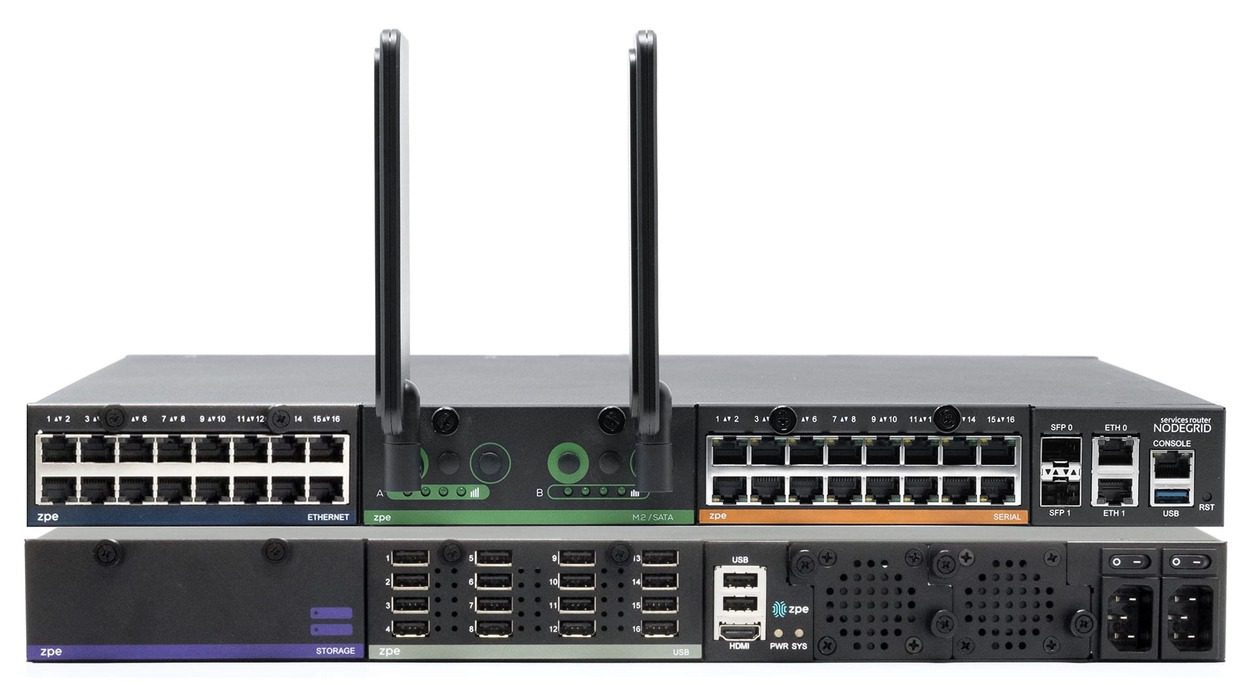
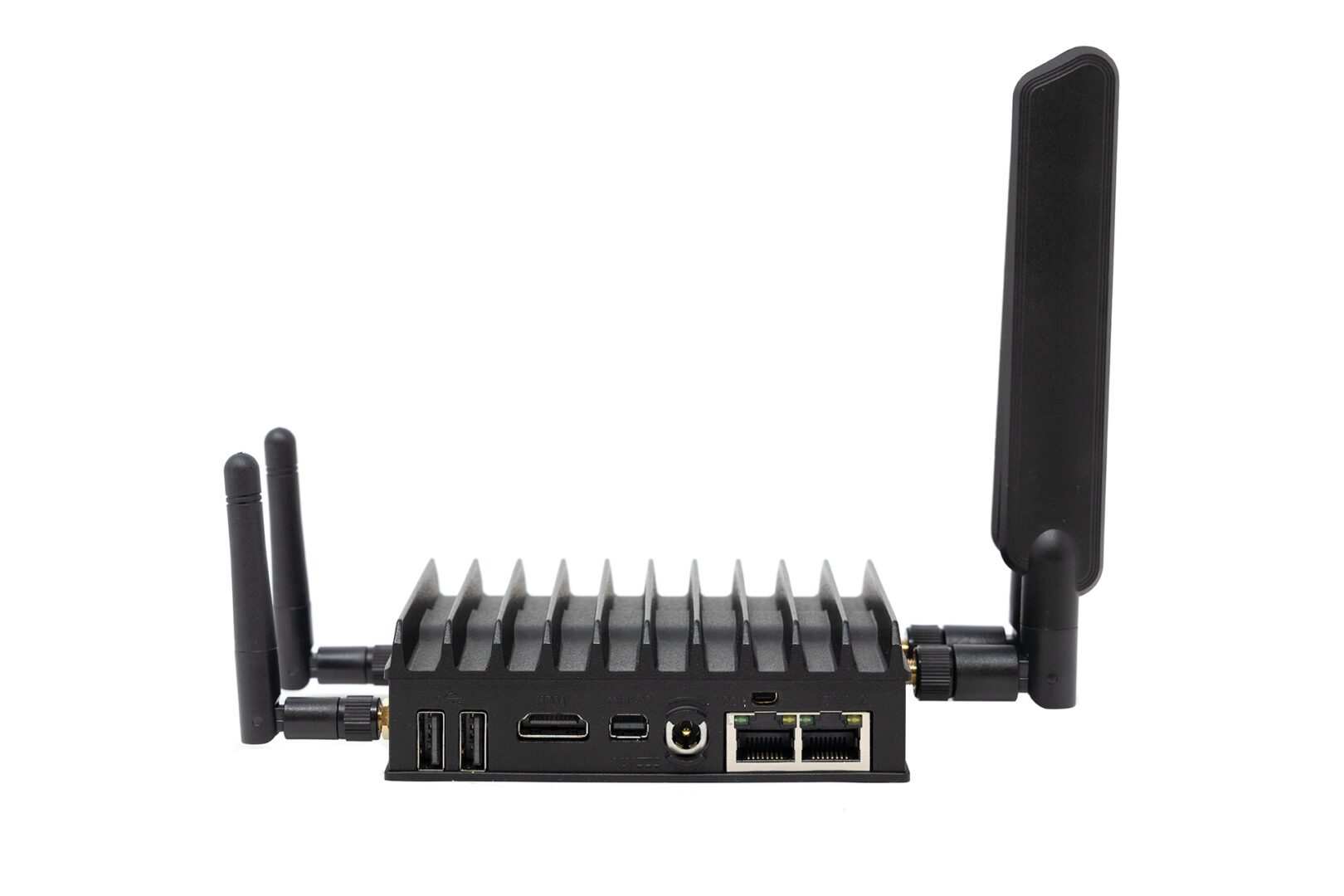
Compact, all-in-one branch gateways like Nodegrid use environmental monitoring, OOB management, and vendor-neutral platforms to simplify retail network management. The Nodegrid Mini SR, for example, is an inexpensive retail branch gateway that’s roughly the size of an iPhone, so you can easily deploy them anywhere in your store without disrupting the customer experience. Despite its small size and low price point, the MSR still delivers Gen 3 OOB management capabilities while supporting Nodegrid environmental monitoring sensors and third-party automation. The Nodegrid platform is also completely vendor-neutral, giving retail network admins a single pane of glass from which to monitor, orchestrate, and optimize the entire distributed network architecture.

Ready to learn more about Nodegrid?

To learn more about about simplifying retail network management with Nodegrid, click here to download the Mini SR datasheet, or contact ZPE Systems today.
Contact Us

What To Look for In a Cloud Edge Gateway Solution

Mini-SR-Rear
Gartner predicts that by 2029 more than 15 billion IoT devices will connect to enterprise infrastructure. Many of these devices will operate outside of the centralized enterprise network, in satellite offices, manufacturing facilities, retail stores, and other remote locations. These remote – or edge – IoT devices need a secure and reliable way to connect to cloud resources and applications.

A cloud edge gateway is a hardware or software solution used to connect edge devices to the cloud. Some edge gateways are also routers that connect the edge location’s network to the WAN (wide area network) or SD-WAN (software-defined wide area network). In addition, many cloud edge gateway solutions also provide management access to connected devices, so administrators can remotely monitor and control edge infrastructure.

Some popular use cases for cloud edge gateways include:

  • Retail stores: Cloud edge gateways give retail stores a fast and secure connection for POS (point of sale) terminals, credit card readers, and security cameras.
  • Remote health facilities: Hospitals and clinics in remote areas use cloud edge gateways to securely and reliably transmit health data from IoT medical devices.
  • Police/emergency response vehicles: Cloud edge gateways enable secure data transmission from police, fire, and EMS vehicles to cloud applications.

In this blog post, we’ll discuss the key characteristics and components of a robust, secure, and reliable cloud edge gateway solution.

What to look for in a cloud edge gateway

Vendor neutrality

In a decentralized network with many remote locations, network solutions like edge gateways are often chosen based on which vendor offered the best deal or had the most compelling sales pitch at the time a new site was opening. This creates a heterogeneous network architecture, with each vendor offering their own platform from which to monitor and manage their solutions. With so many platforms to learn and keep track of, it becomes very challenging for admins to keep networks operating at peak efficiency.

A vendor-neutral cloud edge gateway solution reduces management complexity by seamlessly integrating with the existing edge infrastructure. For example, Nodegrid Services Routers can run other vendors’ software, so admins can keep using the management platform they’re most comfortable with. Or, admins can use the ZPE Cloud network orchestration platform to manage any other vendor solution that’s connected to a Nodegrid device.

Vendor-neutral cloud edge gateways give organizations the freedom to continue expanding to new locations without worrying about integration issues. Vendor neutrality also reduces headaches for network administrators so they can focus on improving efficiency and optimizing performance.

High-speed cellular failover and out-of-band management

Edge IoT devices are used for critical operations, which means they need 24/7 connectivity. Cellular failover provides a secondary internet connection that’s independent of wired network infrastructure. A cloud edge gateway with cellular failover ensures that IoT devices have uninterrupted access to the cloud even if the primary ISP connection goes down. The best solution supports high-speed 4G/5G cellular to reduce the performance impact of failover, as well as providing dual-SIM slots for redundancy.

In addition, admins need management access to edge infrastructure and IoT devices that are independent of both the WAN and the LAN (local area network), so if something like a firmware update causes the local network to go down, they can repair the issue without needing to dispatch an expensive truck roll. Out-of-band (OOB) management uses a secondary network interface (like a 5G cellular SIM) to create an OOB network that’s dedicated to management and troubleshooting. An edge gateway with OOB management ensures that admins have 24/7 high-speed access to remote infrastructure so they can recover from problems faster and reduce downtime.

Secure hardware and software

The security threats to enterprise networks are ceaseless and growing more sophisticated by the day. Many IoT devices and edge locations operate with little-to-no human intervention, which means breaches could go undetected for a long time. In addition, it can be difficult to stay on top of patch schedules or remotely install security updates on so many devices in so many locations, which can leave edge networks vulnerable to attack.

The right cloud edge gateway comes with robust hardware security features like BIOS protection, encrypted disks, and geofencing that prevent malicious actors from using a stolen gateway to hijack edge networks. Its management software should also include Zero Trust security features like SAML 2.0 integration, selectable cryptographic protocols and cipher suite levels, and two-factor authentication (2FA). With a vendor-neutral solution like Nodegrid, admins can even use the cloud edge gateway to push out security updates to connected devices using the ZPE Cloud management platform.

Automation support

It’s growing more difficult for people to simultaneously manage the complex network infrastructures required for modern business operations while ensuring peak performance and 24/7 availability. Network automation solutions help decrease the burden on overworked admins and can improve the performance and reliability of edge networks.

Many edge gateways include some automation features as part of their management software. However, these tend to be limited to baked-in workflows, meaning admins may not be able to use custom scripts or third-party playbooks. The best cloud edge gateway has vendor-neutral automation support so admins can use their choice of automation solutions. For example, Nodegrid edge gateways can directly host automation playbooks from all the major platforms including Ansible and Puppet. Nodegrid also supports custom scripting and third-party integrations for even greater flexibility.

The best cloud edge gateway solution is vendor-neutral, uses high-speed cellular for failover and OOB management, follows Zero Trust best practices to keep the infrastructure secure, and supports all of the major automation tools and scripting languages. With the edge gateway market still being somewhat new, there’s really only one solution that checks all these boxes: the Nodegrid family of cloud edge gateway routers.

Why choose the Nodegrid cloud edge gateway solution?

There are six Nodegrid Services Router models to choose from based on your deployment size, networking requirements, and use case. For example, the Mini SR delivers versatile edge networking capabilities in a device approximately the size of an iPhone, which is perfect for mobile emergency response units or retail branches where space is at a premium.

For larger deployments, such as an edge compute data center or Smart Building system, the Net SR provides a modular solution with options for additional serial console ports, disk space, compute, PoE, and more.

Nodegrid’s vendor-neutral platform is extensible and capable of directly hosting other vendor solutions for automation, security, and other networking functions. Cellular failover and high-speed OOB are delivered via dual- or quad-SIM cellular slots with 5G/4G LTE support. Nodegrid devices are protected by secure hardware features, SAML 2.0 and 2FA support, and advanced authentication, plus the OS is kept up-to-date with frequent patches. Nodegrid is also the only cloud edge gateway with full support for all the top automation and IaC (infrastructure as code) solutions, including Ansible, Chef, and Puppet.

Ready to learn more about the Nodegrid cloud edge gateway solution?

Contact ZPE Systems today to learn more about the Nodegrid cloud edge gateway solution.

Contact Us

Key Automation Infrastructure Components That Enable End-to-End Network Automation

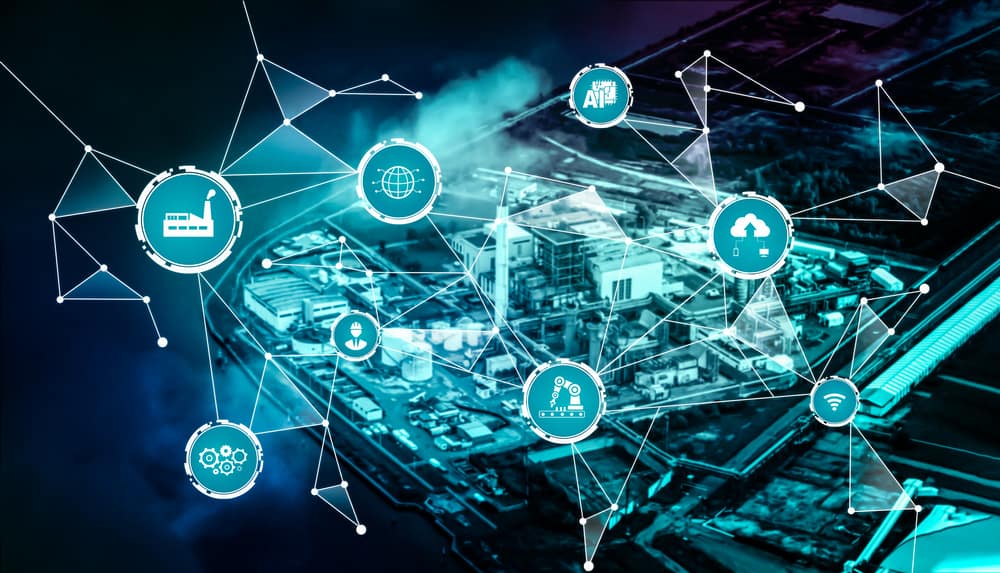
A resilient network containing automation infrastructure components and concepts overlays a busy industrial plant that uses OT automation.

As inflation rises, new business declines, and another COVID-19 surge looms on the horizon, many organizations are bracing for a recession. CIOs and IT managers are having to do more with less—less staff, less budget for upgrades and repairs, and less access to on-site infrastructure. Despite these restrictions, they still need to ensure the 24/7 availability and optimal performance of enterprise network resources as any amount of downtime could severely impact business revenue.

The ability to continue providing digital services in less-than-ideal situations is known as network resiliency. Network automation is a key tool for ensuring resiliency during staffing shortages and lockdowns, and a network automation framework provides the tools and methodologies needed to create a fully-automated network infrastructure.

The four building blocks of a resilient network automation framework include:

  1. IT/OT production infrastructure
  2. Automation infrastructure
  3. Orchestration infrastructure
  4. AIOps

We’ve previously discussed the role of IT/OT production infrastructure in network automation and how an IT/OT convergence strategy accelerates network automation. In this post, we’ll describe the automation infrastructure components that enable end-to-end network automation. Future blogs will explain how the orchestration infrastructure layer and AIOps layer build upon these components to ensure business resiliency.

What is automation infrastructure?

Automation infrastructure is composed of all the hardware and software solutions that enable automation to occur. These solutions target the IT and OT production infrastructure and automate some or all of their workflows.

Key automation infrastructure components

There are a variety of hardware and software solutions that provide automation capabilities for specific workflows, use cases, and deployment models. As part of a resilient network automation framework, the most important automation infrastructure components include:

Gen 3 OOB serial consoles

Serial consoles are typically installed in data centers and used to manage other devices over a serial cable connection. They create an out-of-band management (OOBM) network that’s dedicated to troubleshooting, management, and orchestration traffic, and which is accessible via a secondary internet connection (often using cellular). This secondary connection ensures administrators always have remote management access to critical data center infrastructure even when the primary ISP, WAN link, or production LAN goes down. That means businesses can recover from outages faster and without dispatching expensive truck rolls.

The latest generation of serial consoles, Gen 3, gives administrators the ability to automate workflows on all data center infrastructure. Gen 3 serial consoles are vendor-neutral, which means they can extend their automated management capabilities to any vendor’s device. That vendor neutrality also means that Gen 3 serial consoles support custom scripts and third-party automation tools in addition to whatever automation capabilities are built-in.

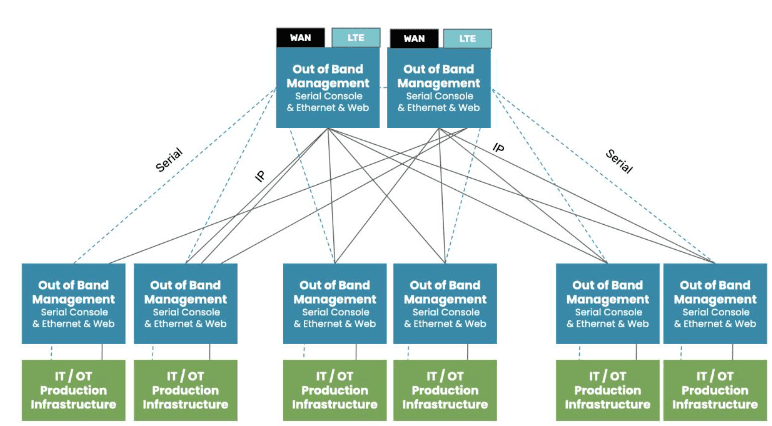
For peak resiliency, data center deployments should follow a two-tier OOB architecture. That means each rack of IT/OT production infrastructure should connect to its own Gen 3 serial console, which provides OOB management access and automation. These top-of-rack serial consoles should then connect to an OOB appliance in the middle or end of the row. This ensures OOBM access for the top-of-rack appliances and creates an additional layer of redundancy and resiliency.

Screenshot 2022-12-05 202130
Another important aspect of Gen 3 serial consoles is security. Since serial consoles provide comprehensive management access to critical infrastructure, they’re a tempting target for cybercriminals. A secure Gen 3 OOBM solution includes:

  • Integration support for third-party security solutions like next-generation firewalls (NGFWs), security service edge (SSE), and SAML 2.0
  • An up-to-date operating system (OS) kernel that’s frequently patched by the vendor when vulnerabilities are identified
  • Onboard firewall functionality to inspect traffic on both the OOB network and the production network
  • Hardware security features like encrypted boot sequences and BIOS protection to prevent unauthorized access on stolen serial consoles

Gen 3 OOB serial consoles are the automation infrastructure components that enable automation and resiliency for data center deployments at the core of enterprise networks.

SD-WAN gateway routers

A gateway router is used to connect a LAN infrastructure to the internet and the enterprise WAN architecture. As part of a resilient network automation framework, all gateway routers should support SD-WAN (software-defined wide area networking).

SD-WAN separates the control and management processes from underlying WAN hardware and virtualizes them as software. SD-WAN uses features like application awareness and guaranteed minimum bandwidth to automatically optimize network performance. An SD-WAN solution can also use automatic load balancing and failover to ensure continuous availability in the event of a localized failure or data center outage.

SD-WAN is usually a cloud-based service that delivers centralized management and orchestration of automated workflows. This service runs on top of the gateway routers deployed at each site.

An SD-WAN gateway router is a key automation infrastructure component for the main office, data center, branch, and edge deployments because it enables automated WAN management and orchestration. An all-in-one cloud-managed gateway router is particularly useful for OT automation in remote facilities like warehouses and factories because it provides SD-WAN capabilities, OOBM, and routing in one multi-function device.

Monitoring, visibility, and analytics

Monitoring and visibility solutions give administrators virtual eyes and ears on remote network infrastructure. As part of a resilient network automation framework, a visibility solution should be vendor neutral so it can dig its probes into any device in a mixed vendor environment. It should also include environmental monitoring sensors that collect data on conditions in the rack.

Device monitoring and environmental sensors give administrators the ability to detect potential issues and respond quickly to prevent outages. Monitoring and visibility solutions also collect valuable data that can feed into the AIOps building block of the network automation framework.

Infrastructure as Code

Infrastructure as Code, or IaC, uses software abstraction to decouple infrastructure configurations from the underlying hardware. Configurations are written as scripts or definition files that automatically provision virtual machines (VMs), containers, or software-defined networking (SDN) devices. An IaC definition file can be deployed repeatedly, which means many identical resources can be spun up quickly while ensuring consistent configurations. An IaC config can also undergo automatic security testing before it’s deployed to any devices to prevent vulnerabilities from affecting production.

Another important aspect of IaC is automatic configuration management. Configuration management solutions like RedHat Ansible allow administrators to define the desired state of a system or network resource. The configuration management tool continuously monitors the resource to detect unauthorized changes, which might be made by a careless sysadmin or could be a sign of a malware infection. As soon as the change is detected, the configuration management solution uses a programmatic playbook to take whatever actions are needed to restore the system to its proper state.

IaC helps ensure network resiliency by reducing human error in device configurations and updates, as well as by enabling the use of pre-production automated security vulnerability scanning and configuration management. Infrastructure as Code also facilitates another key automation infrastructure component—immutable infrastructure.

Immutable infrastructure

In-place system and device updates are a common cause of hangs or failures which can be challenging to resolve remotely. Immutable infrastructure resolves this problem by eliminating updates and configuration changes altogether. Immutable infrastructure refers to virtual systems and network resources that are never changed in place. If an immutable resource has an issue or vulnerability, or if its OS is out of date, an entirely new resource is spun up and the old one is simply deleted.

IaC is an immutable infrastructure best practice because it gives administrators the ability to provision many devices very quickly and with identical configurations. Immutable infrastructure is secure, easy to deploy, and resilient to failure, making it an important part of the network automation framework.

Why Nodegrid is a key automation infrastructure component

The automation infrastructure building block of the network automation framework relies on vendor-neutral OOBM devices like gateway routers and Gen 3 serial consoles that extend automation to converged IT/OT production infrastructure. These devices must also support monitoring and visibility solutions, Infrastructure as Code with configuration management, and immutable infrastructure.

For example, the Nodegrid platform from ZPE Systems includes OOB management hardware for a variety of data centers, branch, and edge deployments. Nodegrid serial consoles, such as the NSCP, can dig their hooks into any device in your data center to enable end-to-end network automation. A Nodegrid Gen 3 OOB serial console can even extend IaC and immutable practices to legacy devices to ensure resiliency without expensive forklift upgrades.

Nodegrid services routers, such as the Mini SR, are compact edge gateways that deliver SD-WAN support, OOBM, and cloud management capabilities to IT/OT infrastructure in smaller branch office and edge data center deployments. Nodegrid SRs can help you consolidate an entire rack of branch infrastructure into a single device to reduce management complexity, CapEx, and OpEx.

Nodegrid out-of-band is delivered via WiFi, Ethernet, or 5G/4G LTE to ensure administrators have fast and reliable access to remote infrastructure. All Nodegrid OOB devices are protected by robust hardware security features like BIOS protection, UEFI Secure Boot, geofencing, disk encryption, and TPM 2.0. Plus, Nodegrid supports integrations with Zero Trust Security solutions like identity and access management (IAM) and SAML 2.0, as well as providing an on-ramp to SSE.

Nodegrid serial consoles and services routers also include interfaces for environmental monitoring sensors to collect crucial data about conditions in your rack. These sensors, as well as any other connected devices, can all be observed and managed from a single, centralized monitoring and reporting platform.

What makes Nodegrid a crucial element of automation infrastructure is its ability to directly host Infrastructure as Code and automated configuration solutions, including Ansible, Chef, Puppet, SaltStack, Monit, and Docker. Nodegrid appliances can then extend the capabilities of the IaC solution to any of the modern, legacy, and mixed-vendor devices it manages.

ZPE’s Network Automation Blueprint

Automation infrastructure works together with IT/OT production infrastructure, orchestration, and AIOps to ensure network resiliency during uncertain times. The Network Automation Blueprint from ZPE Systems provides a reference architecture for achieving Gartner’s definition of hyperautomation as well as meeting the Open Networking User Group (ONUG) Orchestration and Automation recommendations.

In future blog posts, we’ll discuss the remaining two building blocks of the Network Automation Blueprint in depth. In the meantime, you can read about IT/OT production infrastructure or click here to get a sneak peek of the blueprint, which includes a 10-step checklist to get started with automation now.

Want to learn more about key automation infrastructure?

To learn more about Nodegrid as a key automation infrastructure component, contact ZPE Systems today.

Contact Us

What Is Edge Computing for Machine Learning?

Edge computing for machine learning is visualized as an artificial brain on the monitor of a remote industrial machine
Edge computing and machine learning technologies are helping organizations use their data more efficiently and effectively. In this blog, we’ll explain what edge computing is and discuss how it’s used with machine learning to improve performance and keep data secure. We’ll also explore two different edge computing deployment models for machine learning and provide advice on how to manage them.

What is edge computing?

For many modern enterprises, most of their data is no longer generated in a centralized data center or office building. These days, that data comes from IoT devices, “smart” industrial systems, and other remote locations around the globe. Transferring all that data to and from a central data center for processing can introduce latency and negatively impact performance. Transmitting sensitive data over the internet also increases the risk of interception by hackers.

Edge computing moves computational power closer to the source of data so that data doesn’t need to be sent to a separate location for processing. The benefit of edge computing is that data doesn’t need to travel as far, which translates to less latency and improved application performance. Plus, the data stays behind the firewall on the local network, reducing security risks.

What is edge computing for machine learning?

Machine learning (ML) is powered by data, and with data moving to the edge of enterprise networks, machine learning needs to decentralize as well. Edge computing for machine learning places ML applications closer to remote sources of data. The benefits of edge computing for machine learning are the same for edge computing in general, just supercharged.

Machine learning requires data to make intelligent predictions and decisions. In many cases, that data originates from the edge of the network. For example, the healthcare industry uses ML algorithms to analyze health data from smart devices in hospitals and clinics around the world, sometimes in hard-to-reach and politically unstable regions.

Getting patient health data from these remote facilities back to a centralized data center for machine learning processing can be very challenging, especially if the internet infrastructure is outdated or inconsistent. In addition, this data is personal and sensitive, and healthcare organizations are obligated to ensure its protection, so transferring it over uncertain internet connections is too risky.

Instead, organizations can install the ML algorithm on servers in each remote facility, or even on the smart devices themselves. This drastically reduces their reliance on outside network infrastructure for running machine learning workloads, which improves performance and ensures patient health data stays private.

How to deploy edge computing for machine learning

There are two basic deployment models for machine learning at the edge.

A traditional edge machine learning deployment uses one or more racks of heavy-duty servers with high-performance machine learning processing units. This deployment model is best suited to large ML workloads that process massive amounts of edge data.

A “thin” or “nano” edge machine learning deployment runs on smaller servers or multi-purpose devices that share rack space with other edge infrastructure. This deployment model is more cost-effective and works best for smaller ML workloads in buildings where space is limited.

For either deployment model, you need a solution in place for remote management so administrators can maintain and troubleshoot edge infrastructure without traveling on-site. The best way to ensure reliable management access is through out-of-band (OOB) management. OOB management creates a separate network dedicated to remote management and troubleshooting, and that  provides an alternative path to remote infrastructure (typically via cellular LTE) in case the primary ISP or WAN link goes down.

Through that OOB management network, you can orchestrate workloads, push out security patches, and monitor the health and performance of edge infrastructure.

Deploy and manage edge computing machine learning infrastructure with Nodegrid

The Nodegrid Net Services Router (NSR) from ZPE Systems supports both traditional and nano edge computing machine learning deployment models. The NSR is a modular and customizable solution that delivers OOB management, cellular failover, edge routing and switching, and automation in a single device.

You can use the NSR’s serial console modules to monitor, manage, and orchestrate an entire rack of edge machine learning servers. For less intensive workloads, you can use the edge compute module to host ML applications, virtual machines, and Docker images.

Either way, you can take advantage of 5G/4G LTE to ensure fast and reliable OOB access and cellular failover. The NSR is also secured by Zero Trust features like SAML 2.0 integration and BIOS protection to keep edge machine learning data protected.

Ready to learn more about 5G/4G LTE to ensure fast and reliable OOB access?

To learn more about edge computing for machine learning with Nodegrid, contact ZPE Systems today.

Contact Us

Comparing Cellular Failover Router, Gateway & Bridge for Business Continuity

NSRSTACK2-1(1)
Cellular failover is critical for business continuity because it ensures uninterrupted internet access even if the primary ISP connection goes down. When looking for an enterprise cellular failover solution, you’re likely to see the terms “cellular failover router,” “cellular failover bridge,” and “cellular failover gateway” used somewhat interchangeably. These three types of devices offer similar (and often overlapping) capabilities, which can make it difficult to tell which is the best option for your particular use case. In this post, we’ll define and compare these different cellular failover devices before discussing the best option for business continuity.

Cellular failover router vs. cellular failover bridge vs. cellular failover gateway

Let’s define the network functions provided by these devices and describe how cellular failover fits in. We’ll start with bridges, which provide the least amount of functionality.

What is a cellular failover router?

This router connects multiple LANs together but can also forward traffic to and from locations outside the domain. It forwards packets on the network layer of the OSI model (layer 3) using IP addresses. A basic router does not provide access to the internet—it must route traffic through a modem to forward packets outside of the LAN.

A cellular failover router provides a secondary internet connection over which traffic can be routed if the primary ISP link goes down. It includes a cellular modem for internet access as well as IP routing capabilities, giving it more functionality than a cellular failover bridge. Since cellular failover routers combine a modem and router into a single device, they’re often referred to as cellular failover gateways.

What is a cellular failover bridge?

A network bridge connects multiple local area networks (LANs) into a single domain but is not capable of moving data outside of the domain. It forwards frames on the data link layer of the OSI model (layer 2) using MAC addresses (also known as physical or hardware addresses).

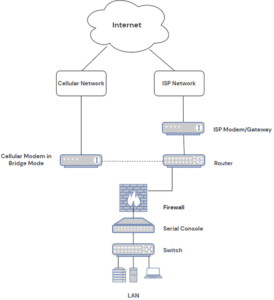
A cellular failover bridge is essentially a device that connects the primary network to the cellular failover network so LAN devices can access that network if the ISP connection goes down. Usually, these come in the form of cellular modems configured in bridge mode. A cellular modem in bridge mode provides internet access via the cellular LTE network and gives devices on the LAN a link (or “bridge”) to cross over to that cellular network. It does not provide routing functionality itself, however, so it needs the primary router for that.

A basic network topology using a cellular modem in bridge mode for failover.

Fig. 1: A basic network topology using a cellular modem in bridge mode for failover.

What is a cellular failover gateway?

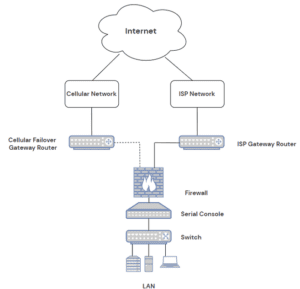
A gateway is a device that connects multiple networks with different transmission protocols together. All traffic flowing into and out of an enterprise network must pass through a gateway. Network gateways combine the functionality of a modem and a router, so they provide both an internet connection and the ability to route packets to and from IP addresses. That’s why cellular failover routers—which combine a cellular internet connection and IP routing—are frequently called cellular failover gateways.

A basic network topology using a cellular failover gateway router

Fig. 2: A basic network topology using a cellular failover gateway router

Cellular failover routers/gateways also function as cellular failover bridges, but the reverse is not true. A cellular failover bridge must rely on an external router for IP-based packet forwarding.

Why choose an integrated cellular failover device?

Generally speaking, the terms cellular failover router, bridge, or gateway refer to standalone devices. Often, they’re designed to provide simple cellular connectivity and rely on the primary router/gateway in order to function, such as Cradlepoint cellular failover adapters. Another option is to get a standalone cellular gateway, such as a Meraki, that you deploy alongside your primary router and fail traffic over to when the primary connection goes down.

In both cases, you’re investing in a single-purpose cellular failover device that must be purchased, installed, and managed in addition to the primary gateway router, network switches, serial consoles, etc. While this may not seem like a big deal in a single-site, centralized enterprise LAN, it grows much more onerous in a large and distributed network with many remote sites and a complicated SD-WAN architecture.

A much better option is to buy an all-in-one device that combines many networking capabilities into one, such as a Nodegrid Services Router. Nodegrid devices include production gateway, routing, and switching functionality in addition to cellular failover, remote out-of-band (OOB) management over serial, and more.

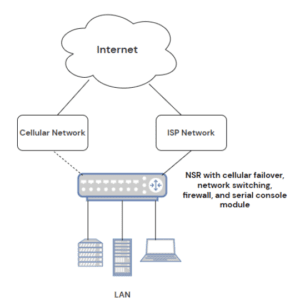
A basic network topology using a Nodegrid Net Services Router with integrated networking, cellular failover, hosted firewall solution, and a serial console module.

Fig. 3: A basic network topology using a Nodegrid Net Services Router with integrated networking, cellular failover, hosted firewall solution, and a serial console module.

The Nodegrid solution is highly customizable, with six integrated routers to choose from depending on your deployment size and use case. The most flexible option is the Nodegrid Net Services Router (NSR) with a modular design that lets you swap out expansion modules to get the exact functionality you need without paying for extras that you don’t. A single Nodegrid device can replace an entire rack of networking equipment, simplifying deployments in branch offices, edge computing data centers, manufacturing plants, and other remote sites.

Plus, Nodegrid’s vendor-neutral hardware and software allow you to consolidate infrastructure management behind a single pane of glass. You can use Nodegrid to orchestrate cellular failover, SD-WAN, DCIM, and more over a dedicated, reliable, and blazing-fast OOB management network.

Ready to learn more about Nodegrid cellular failover router connectivity?

To learn more or see a demo of Nodegrid in action, contact ZPE Systems today.

Contact Us

The Growing Role of Hybrid Cloud in Digital Transformation

cloud in digital transformation

Digital transformation is a broad term for the act of changing and improving your business processes through the implementation of new technologies. The cloud plays a major role in digital transformation because it provides a flexible, scalable, and accessible environment that’s ideal for a wide range of business applications. However, there are still many processes that are better suited for a traditional, on-prem data center or colocation infrastructure due to cost, security, or performance concerns.

Combining public cloud platforms with private infrastructure is known as hybrid cloud infrastructure, and it allows organizations to map their business processes and applications to the environments best suited to run them. In this post, we’ll discuss the role of hybrid cloud in digital transformation and provide tips for managing and orchestrating a hybrid infrastructure.

The importance of hybrid cloud in digital transformation

While the public cloud offers many advantages, there are a variety of reasons why an organization would want or need to keep some services private.

For example, a company doing business in an industry that’s subject to strict data privacy regulations—like finance, defense, or healthcare—may want to keep sensitive data in an on-premises data center so they can maintain complete control over the security and access control measures. At the same time, they might have other processes and applications that aren’t as high-risk and could benefit from the flexibility of cloud infrastructure.

Sometimes, an organization will migrate a workload to the cloud, only to bring it back in-house later. For instance, cloud services can reduce costs for certain applications but can increase costs for others. Most public cloud providers charge extra for data egress—transferring data of their systems and to another cloud or on-premises. That means applications that require a lot of data egress can be much more expensive to run in the cloud. That cost increase may be worthwhile in the long run to achieve optimal scalability and flexibility, but with a recession looming, many organizations are sacrificing those big picture goals to cut costs for short-term survival.

One of the biggest use cases for hybrid cloud in digital transformation is a gradual cloud migration. Digital transformation is a journey, and along the way, many organizations end up in a hybrid state because they’ve successfully moved some of their processes to the cloud but have others that still live in the data center. For example, a business may send some of their data analysis workflows to a business intelligence application in the cloud but then have an on-premises DCIM tool analyzing the same data in the data center. They eventually transition from hybrid cloud to a pure cloud or multi-cloud environment once they’ve finished migrating all their workloads to the cloud.

Hybrid cloud is one of the most popular enterprise infrastructure models because it’s flexible and affordable, allowing organizations to make the digital transformation journey at their own pace and in their own way.

Tips for managing hybrid cloud infrastructure

The most effective hybrid cloud deployment provides a single, seamless digital environment for business applications and resources, with centralized workload and infrastructure orchestration that works across all platforms and data centers. Let’s discuss how to achieve this ideal hybrid cloud deployment.

Vendor-agnostic platforms

To create a seamless environment in which workflows move effortlessly between the cloud and the data center to deliver a simple and unified experience to end-users, you need all your public cloud, private cloud, and data center solutions to work together. The best way to ensure this is by only using vendor-agnostic (vendor-neutral) hardware and software from the very beginning, but for most organizations that ship has already sailed. The next best option is to use a vendor-agnostic management platform that’s able to hook into all those closed solutions and control them equally. These solutions allow you to orchestrate workloads across public cloud, private cloud, and legacy environments without needing to replace all the systems and software already in place.

SD-WAN

A hybrid cloud deployment can create some networking challenges because of the need to orchestrate WAN (wide area networking) connections across multiple clouds and data centers, each of which may have a different networking infrastructure in place. Software-defined wide area networking, or SD-WAN, helps to reduce the complexity of hybrid cloud networking by separating the control and management processes from the underlying WAN hardware.

SD-WAN virtualizes network management functions as software or script-based configurations, which enables centralized and automated deployment. With the aid of a vendor-agnostic management platform, SD-WAN benefits hybrid cloud infrastructure by consolidating control behind a single pane of glass. This gives administrators the ability to easily orchestrate, optimize, and secure the entire distributed network.

Automation

Automation plays a key role in digital transformation because it can speed up workflows while reducing the risk of human error. For example, using automation to deploy new infrastructure means administrators can provision many resources in a short amount of time while ensuring consistent configurations.

Automation also improves security, both by reducing the rate of misconfigurations and by ensuring all infrastructure is patched as soon as possible. Unpatched infrastructure leaves you vulnerable to hacks and ransomware, but keeping track of updates for so many vendor solutions in so many different places can be challenging. Automation can help by ensuring patches are pushed out to hybrid cloud infrastructure solutions as soon as they become available. 

Vendor agnostic platforms, SD-WAN, and automation are key tools that help organizations more effectively utilize a hybrid cloud in their digital transformation journey.

The role of ZPE Systems in digital transformation

ZPE Systems offers a range of vendor-agnostic network management solutions to help your organization achieve digital transformation. The Nodegrid platform can dig its hooks into your legacy and mixed-vendor infrastructure to provide a common interface from which to manage and orchestrate your entire network architecture. Plus, Nodegrid can host or integrate with your choice of SD-WAN solutions to help you consolidate your tech stack while delivering optimized performance and security.

Contact ZPE Systems today

To learn more about the role of hybrid cloud in digital transformation.

Contact Us