Providing Out-of-Band Connectivity to Mission-Critical IT Resources

3 Gaps That Will Leave IT Teams Scrambling This Winter

Winter is Looming – Wolf Howling

Today’s IT teams must maintain a growing infrastructure of on-prem and cloud solutions. These range from physical routers, out-of-band devices, and firewalls, to Zero Trust Security solutions, micro-segmentation tools, and network automation integrations. Despite an abundance of physical and virtual solutions meant to help keep digital services online, many organizations face an overwhelming number of tasks just to sustain everyday operations. 

With the rising risk of recession, organizations will be forced to cut back on resources including staff, training, and tools. This will only worsen the existing challenges teams face in their efforts to maintain their distributed infrastructure. 

In this blog, we’ll explore three gaps that will leave IT teams scrambling this winter, and show you several practical approaches to cope during recession. 

Gap 1: Lack of staff

IT teams have been historically understaffed, and most people can remember at least one significant tech worker hiring campaign from the past decade. Today’s CIOs may in fact be facing the biggest talent gap since 2008. For example, in the cybersecurity sector alone, the 2021 (ISC)2 Cybersecurity Workforce Study reported that despite adding 700,000 cybersecurity professionals to the workforce in 2021, there’s still a gap of more than 2.7 million workers globally, 377,000 of which are needed in the United States. 

Trained staff are a must for managing an organization’s distributed sites, especially as team silos disappear and workers are required to have a breadth of skills. Business leaders increasingly need people who are proficient in networking and programming, so they can maintain normal operations while progressing their digital transformation initiatives such as hyperautomation. It’s a challenge that often comes down to hiring new talent or increasing the skills of existing employees, and both of these approaches require plenty of time and money. 

This issue will only worsen with the coming recession as companies begin to tighten their belts and slash budgets. Major brands have already shed thousands of workers this year, leaving IT teams to make due with existing staff numbers or even reduced headcounts. In the simplest terms, the coming recession will leave companies much less willing or able to invest in staff. 

Gap 2: Lack of tools to reduce workloads

Today’s infrastructure incorporates solutions from many different vendors, but the problem is these often come with their own unique tools that are meant to serve only a specific function. Managing SD-WAN, SASE, ZTNA, orchestration, and out-of-band solutions means jumping between disparate tools, many of which lack integration with one another. This complexity leaves operational teams stuck in a reactionary break/fix posture trying to climb mountains of never-ending support tickets. 

To address this challenge, many Big Tech companies empower their IT teams through digital transformation initiatives, such as using automation to achieve a proactive approach. But this requires additional investments in upskilling staff and acquiring adequate automation infrastructure/tools. For many organizations, a lack of money and resources makes this difficult during normal economic conditions, and will only become exacerbated with the coming recession. IT teams will continue scrambling with their inflated workloads.

Gap 3: Lack of trust in automation

Automation can greatly reduce the risk of human error (and subsequent outages) by handling simple workloads, such as device provisioning and firmware updates. However, companies that do have the resources to implement automation also recognize its limitations. Automation solutions that aren’t optimized leave IT teams with mundane tasks like managing, scheduling, and restarting bots. But to even reach this level of automation requires training staff who typically don’t have a background in programming or development. 

These teams will be unfamiliar with NetOps/DevOps concepts. In order to develop essential automation practices, these employees will need to learn through trial and error. This is a problem because most organizations lack the proper automation infrastructure and tools that allow their IT teams to recover from mistakes. Operational teams in charge of keeping infrastructure running often fear automation for this exact reason — if they make one error, there’s the potential that it will bring down the network, lead to unhappy customers, and cost them their job. 
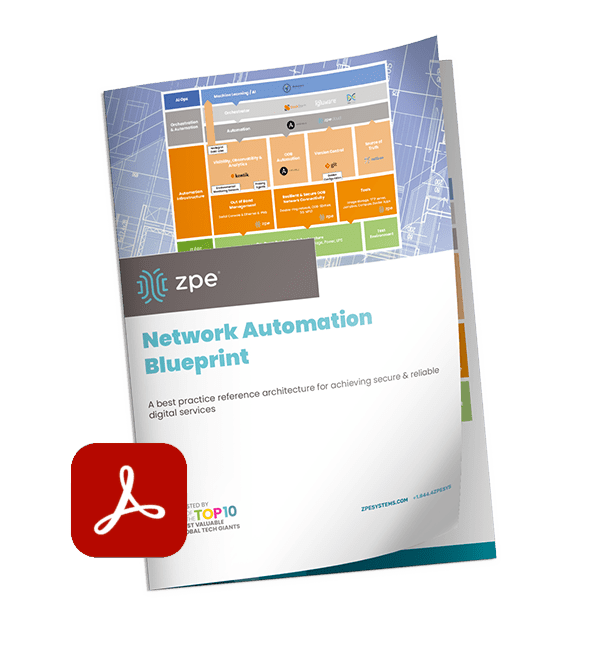
 

BlueprintPDF

Close these gaps with the Network Automation Blueprint

You can close these gaps for good using out-of-band, jump boxes, and tools you already have. After years of working directly with tech giants, we’ve created a best practice reference architecture any company can use to automate their network. This Network Automation Blueprint has been proven by global enterprises to increase capabilities and reduce workloads through trustworthy automation.
Why Cybersecurity-as-a-Platform (CaaP) is the Future of Holistic Security | ZPE Systems

cybersecurity platform zpe

A cybersecurity platform provides a unified interface from which to manage multiple security tools and controls. Traditionally, these platforms only work within a single vendor’s ecosystem of products. However, a new type of solution, called Cybersecurity-as-a-Platform (or CaaP), allows you to integrate your choice of third-party, multi-vendor solutions. In this blog, we’ll discuss the challenge of managing a complex cybersecurity environment and explain how CaaP can help.

Why Cybersecurity-a-a-Platform (CaaP) is the future of holistic security

Modern network security is rapidly evolving and expanding to deal with the increasing sophistication and frequency of cyberattacks. According to the Oracle and KPMG Cloud Threat Report from 2020, the average organization uses over 100 discrete cybersecurity controls. Often these tools come from many different vendors and perform many different functions, requiring specialized training to use each one effectively. This creates a highly complex cybersecurity environment that’s prone to human error.

In addition, there’s a lack of interoperability between products, meaning tools are often disjointed and working independently of each other rather than as a cohesive system. There’s also no centralized control or visibility over these independent solutions, which means administrators need to log in to each one to configure, monitor, and manage their functionality.

This leaves teams without a big-picture overview of their cybersecurity environment, making it impossible to achieve a complete security posture. This need for centralized management and monitoring of discrete security products led to the development of unified cybersecurity platforms.

What is a cybersecurity platform?

A cybersecurity platform is a software solution—typically, but not always, cloud-based—which unifies an ecosystem of security tools and controls behind one management interface. In the past, this has usually been vendor-specific (e.g., Trend Micro providing a single platform from which to manage their own security products). However, this type of platform leaves you locked in to whatever features and functionality are included by the cybersecurity vendor, or their chosen integration partners.

That leaves organizations with one of two choices:

1. Stay within that ecosystem and accept that they may have gaps in their coverage due to a lack of needed functionality. In this case, this means sacrificing the security of their network and systems for the convenience of using a single management system.

2. Add on additional products that must be managed outside of that platform, creating more management complexity for security administrators. In this case, this means sacrificing efficiency and interoperability in the hopes of improving overall security.

In either scenario, the organization is hurting its security posture by making compromises. A better solution is to choose a platform that gives you the freedom to combine the best security products and tools for your unique environment under one convenient management umbrella.

What is Cybersecurity-as-a-Platform (CaaP)?

Cybersecurity-as-a-Platform (CaaP) provides a vendor-agnostic interface from which to control a vast and complicated cybersecurity ecosystem. CaaP doesn’t care who you bought your security tools from or how you plan to use them—it provides the platform from which to integrate, manage, and monitor every component of your cybersecurity toolkit. This includes creating unified dashboards and visualizations that combine data from all your different security monitoring and analytics solutions, so you can get a complete picture of your cybersecurity environment.

How CaaP enables holistic cybersecurity

A unified Cybersecurity-as-a-Platform solution benefits businesses by:

  Reducing data overload – Security analysts must monitor and act on data from a wide variety of sources, including intrusion detection systems (IDS), firewalls, and security information and event management (SIEM) solutions. With so much data to sort through to filter out the false positives from the real threats, analysts can easily become overwhelmed and allow issues to fall through the cracks.

CaaP unifies the data from these individual sources and gives teams a single dashboard from which to view and analyze events. Plus, CaaP supports integrations with tools that can automatically analyze, filter, and remediate security incidents, reducing the risk of human error and freeing up security teams to work on high-priority issues.

  Simplifying security management – It’s very difficult (if not impossible) for a single security analyst to become an expert in 100+ different products, each of which has its own interface, nomenclature, compatibility issues, etc. Plus, simply logging into every one of these tools on a regular basis takes a significant amount of time, making it far too easy for analysts to neglect or forget critical security systems.

With the right Cybersecurity-as-a-Platform, analysts can integrate all their security tools into one common platform, reducing the number of discrete solutions they need to learn, maintain, and support. This both reduces the risk of human error and reduces the workload on overwhelmed security teams.

  Improving security posture – The more complex a system is, the more prone it is to failure. A cybersecurity strategy that relies on the continued operation and effectiveness of over 100 individual moving parts is more likely to fail because an issue with even one of those tools could lead to a breach. Plus, without a centralized view of how these parts work together, there’s no way to get a complete picture of an organization’s security posture.

CaaP gives analysts the ability to monitor and maintain all their security tools in one place, so they can see alerts about new vulnerabilities, apply patches, and more. They can also ensure all these tools are working together as expected so there are no gaps in coverage, and see data and visualizations about the security of the organization as a whole.

Adopt the CaaP approach to security with ZPE Systems

Cybersecurity-as-a-Platform is a unified, tightly integrated solution that rolls up a vast ecosystem of security tools behind one pane of glass. CaaP is the future of holistic security because it empowers efficient security monitoring and management while providing a complete overview of an organization’s security posture. True CaaP, like the Nodegrid solution from ZPE Systems, is completely vendor-neutral. This gives you the freedom to bring in your choice of cybersecurity solutions and automation tools, so you get the best features, functionality, and performance for your unique environment.

Want to learn more about cybersecurity platforms with Nodegrid?

Contact ZPE Systems today!

Contact Us

How SASE Technology Defends Your Network Edge

SASE technology can offer you defense for your network edge

Secure Access Service Edge, or SASE, is a cloud-based service that combines software-defined wide area networking (SD-WAN) with critical network security technologies like CASB, ZTNA, SWG, and FWaaS. SASE technology connects remote, branch office, and edge computing resources directly to web and cloud services, reducing the load on the main firewall while extending enterprise security policies and controls to protect this traffic. In this article, we’ll dive into the specific technology that SASE uses to defend your network edge.

How SASE technology defends your network edge

SASE protects network edge traffic by rolling up an entire network security technology stack into a single, cloud-delivered service. The key security components of a SASE solution include CASB, ZTNA, SWG, and FWaaS.

CASB

A cloud access security broker, or CASB, is a software service that sits between your main enterprise network and your cloud-based infrastructure. A CASB allows you to extend your enterprise security policies to the traffic flowing between your WAN and the cloud so you can ensure consistent protection. A CASB is actually a collection of multiple security technologies, such as:

  • User and Entity Behavior Analytics (UEBA) – Monitors the behavior of users and devices on the network to detect suspicious activity and enforce security policies.
  • Cloud application discovery – Identifies all cloud applications and services in use by the organization and analyzes relative risk levels.
  • Data Loss Prevention (DLP) – Applies data governance policies to prevent the exfiltration of sensitive and proprietary information.
  • Adaptive access control – Uses session context (e.g., originating location, time, behavior) to determine whether to grant access.
  • Malware detection – Scans traffic between the enterprise and the cloud to detect and block viruses and other malware.

ZTNA

Zero trust network access, or ZTNA, connects remote users and devices to enterprise network resources, similar to a VPN. Unlike a VPN, however, ZTNA creates a direct connection to the specific resources requested by the user, rather than granting full access to the network. This prevents remote users from seeing or interacting with any network resources outside of the specific service they’ve explicitly authenticated to.

ZTNA follows the zero trust motto of “never trust, always verify.” It uses technologies like context and role-based identity verification and two-factor authentication (2FA) to prevent unauthorized access. And, since users need to re-authenticate to every enterprise resource, ZTNA is able to prevent malicious actors from discovering valuable systems and data or moving laterally on the enterprise network.

SWG

A secure web gateway, or SWG, is a service that sits between your enterprise network and the public internet. All web-destined traffic passes through the SWG, where enterprise web filtering and application control policies are applied. Traditionally, an SWG is a hardware device that sits in the data center, which means all remote, branch, and edge traffic needs to be backhauled through a single appliance. As part of a SASE solution, an SWG sits in the cloud instead, so remote traffic doesn’t need to pass through the data center. This improves overall network performance, reduces or eliminates bottlenecks, and ensures consistent application of acceptable use policies and application security controls.

FWaaS

Firewall-as-a-Service, or FWaaS, delivers next-generation firewall technology as a cloud-based service. That means remote and cloud-destined traffic can bypass the firewall in your data center, reducing bottlenecks and performance issues. At the same time, FWaaS provides the same level of security and protection as an NGFW, including features like URL filtering, intrusion detection and prevention, and deep packet inspection (DPI). FWaaS gives SASE solutions the ability to protect remote, edge, and cloud-destined traffic with the same policies and controls as the main enterprise network to ensure consistent security and optimal performance.

SASE technology uses CASB, ZTNA, SWG, and FWaaS to defend your network edge. However, you still need a way to direct remote, branch office, and edge traffic to your SASE security stack. That’s where SD-WAN technology comes in.

Accessing SASE technology with SD-WAN

While it’s possible to use standard WAN architectures to connect to SASE technology, the most reliable and efficient way to access SASE is with SD-WAN. SD-WAN uses software abstraction to create a virtual overlay management network on top of your WAN hardware. This virtual management network enables the use of automation and orchestration to manage the remote network traffic.

In a SASE deployment, SD-WAN uses intelligent routing to separate all remote traffic that’s destined for the cloud. Instead of backhauling this traffic through the enterprise firewall, SD-WAN routes it through the SASE technology stack, significantly reducing the load on your data center infrastructure. This improves network and application performance for your entire enterprise without sacrificing security.

SD-WAN solutions may sit on top of traditional WAN infrastructure, or they may replace that hardware entirely, using SD-WAN routers provided by the vendor. However, rather than investing in specialized vendor hardware, an even better approach is to use vendor-neutral network management devices that can host or integrate with every piece of your SASE and SD-WAN technology stack.

For example, the Nodegrid line of vendor-neutral serial consoles and network edge routers are the perfect on-ramp for your SASE solution. Nodegrid can directly host or integrate with third-party SD-WAN solutions like Palo Alto Networks’ Prisma SD-WAN, or you can use ZPE Cloud’s SD-WAN app. Nodegrid also supports seamless integrations with your choice of SASE provider, giving you a unified, centralized SD-WAN and SASE orchestration platform.

SASE learning center:

★   Understanding Key SASE Components & Benefits
★   SASE Implementation: A Step-by-Step Guide for Businesses
★   The SASE Model: Key Use Cases & Benefits

Want to find out more about accessing SASE technology with Nodegrid SD-WAN?

Contact ZPE Systems today!

Creating the Future of Network Automation

The future of network automation will offer more security and adaptability
The future of network management will focus heavily on automation. While many organizations already employ network automation in some form or another, full implementation still lags far behind other areas of IT such as development and infrastructure (server) management.

The current network automation landscape

Currently, network automation focuses on individual tasks and suffers from several limitations that prevent networking teams from using it effectively.

Automating individual network administration workflows

Typical network automation solutions are designed to solve specific challenges by automating individual tasks or workflows. For example, network automation tools, such as Zero Touch Provisioning (ZTP), allow administrators to automatically deploy new device configurations over the network. Automatic device configurations both speed up the provisioning process and decrease the risk of human error.

ZTP automates one individual workflow to solve a specific problem, but it does not eliminate the need for human intervention. Someone still needs to create the configuration script, monitor for deployment errors, and, if necessary, manually troubleshoot failures and other issues. With any network administration workflow, the more a human gets involved in the process, the higher the chances of mistakes, which increases the risk of an outage. Currently, most network solutions don’t allow for enough automation to remove the human element entirely.

Lagging behind infrastructure and software automation

Thanks in part to the popularity of the DevOps methodology, automation has made great leaps forward in the realms of IT infrastructure management, software development, and software testing. For example, technologies like immutable infrastructure and Infrastructure as Code (IaC) make it possible to automate almost every aspect of deploying, managing, scaling, monitoring, and troubleshooting servers and development environments. However, on the networking side of operations, automation is still lagging behind.

There are a few reasons for this delay. First, network architectures still tend to rely on legacy, hardware-based solutions which may not support software-defined networking, immutable principles, or automation paradigms. Second, there’s a network automation skills gap, which means network engineers and administrators don’t have the training or experience needed to work with software-defined networking code and other automation technologies. And third, many network solutions are still closed ecosystems which makes it difficult or impossible to integrate third-party automation and orchestration tools.

The future of network automation will be focused on reducing human intervention, extending virtualization to legacy devices, bridging the network automation skills gap, and eliminating vendor lock-in.

Looking into the future of network automation

In the future, network automation solutions will need to address the above challenges to keep up with the speed, performance, and reliability required for modern business operations. Creating the future of network automation will involve network hyperautomation, legacy modernization, low-code network automation, and vendor agnostic solutions.

Network hyperautomation

Hyperautomation is the practice of automating all (or most) network management workflows to eliminate human intervention. That means every workflow and process needed to achieve a certain outcome is automated, including error correction and other troubleshooting if a particular step fails. Hyperautomation is only achievable with an orchestration platform, which essentially automates your automation. A network orchestration platform gives you a centralized, big-picture overview of your entire network architecture and every automated workflow. This allows you to monitor your hyperautomation processes and, if necessary, manually intervene to fix problems or update workflows. Hyperautomation significantly reduces manual work, which decreases the chances of human error.

Legacy modernization

Obviously, the easiest way to modernize your infrastructure is to simply replace all your legacy hardware with virtualized, cloud-based solutions, but this is unrealistic for most organizations. It’s much less expensive, time-consuming, and disruptive to slowly upgrade your infrastructure over time, but that means you need a way to integrate automated processes with your legacy hardware. A legacy modernization solution (such as ZPE’s Nodegrid Serial Console R-Series) acts as a bridge between your old network hardware and your modern network automation platform.

These solutions directly connect to both your legacy hardware and your upgraded infrastructure, which allows you to manage both from a unified control panel. They also integrate with modern network orchestration platforms, so you can extend automation technology like software-defined networking and hyperautomation playbooks to your legacy devices. This will make it possible to increase your network automation efforts to stay ahead of evolving business requirements and DevOps initiatives.

Low-code network automation

Network automation typically involves software abstraction, which means turning configurations and workflows into software code. Unfortunately, many network administrators and engineers lack programming experience (beyond CLI scripts), which prevents organizations from moving forward with network automation initiatives.

Low-code network automation seeks to bridge the skills gap by reducing the need for manual coding. Low code solutions hide most of the underlying programming behind GUIs (graphical user interfaces) which administrators use to create and manipulate software-defined networking code and automation playbooks. At the same time, engineers who do have programming experience can still access that underlying code to supplement the capabilities of the GUI for more advanced workflows.

Low-code solutions represent a way into the future of network automation for organizations that currently suffer from a lack of resources and expertise. This future is made possible thanks to low code network automation pioneers like Gluware and Anuta ATOM.

Vendor-agnostic solutions

The future of network automation is vendor agnostic (also known as vendor neutral). Current network solutions with closed ecosystems provide some built-in automation capabilities but make it difficult to integrate third-party automation scripts, low code tools, and orchestration platforms. A vendor-agnostic network solution includes open hardware, Linux-based operating systems, and an orchestration platform that supports integrations with your choice of third-party tools and software. Vendor-agnostic solutions make it possible to automate and orchestrate your entire network from one centralized control panel without any gaps in coverage.

Vendor-agnostic platforms also give you the freedom to adopt new network automation solutions without needing to purchase additional proprietary hardware to host them. For instance, AIOps is an emerging technology which uses advanced artificial intelligence algorithms to detect, prevent, and even predict new cybersecurity threats. This network automation technology is better at identifying novel malware and advanced persistent threats than traditional intrusion prevention systems because AI is able to extrapolate and predict new risks based on past data, even if it hasn’t seen that particular attack method before. A vendor-agnostic network platform can host or integrate with third-party AIOps solutions and other cutting edge technology so your organization can stay ahead of the curve.

Creating the future of network automation with ZPE Systems

In the future, network automation will evolve into hyperautomation, legacy devices will be brought under the same management umbrella as modern solutions, low code automation will bridge the skills gap, and vendor-agnostic platforms will make it possible to automate and orchestrate an entire network architecture from one centralized control panel. Luckily, you can create this future now with the help of ZPE Systems.

ZPE’s Nodegrid is a holistic network orchestration platform that helps you overcome network automation challenges with forward-thinking solutions. ZPE Cloud unifies the management of your entire network architecture behind one pane of glass, so you have a complete overview of and control over all your automation. Nodegrid’s vendor-agnostic hardware and software support seamless integrations with your choice of third-party automation workflows, legacy devices, and low-code tools. With Nodegrid, you can accelerate your network automation efforts now and stay ahead of future automation trends.

Network automation learning center:

→   Automating Your Network Operations Does Not Have to Be Difficult
→   Network Automation Best Practices to Implement in 2022
→   The Importance of NetDevOps Automation for Modern Networks

Want to know more about how Nodegrid can create the future of network automation?

Contact ZPE Systems today!

Contact ZPE Systems

Data Center Management Best Practices for NetDevOps Transformation

data center management best practices

The goal of NetDevOps is to take the collaborative, highly efficient processes that work so well in DevOps environments and apply them to networking workflows. The result is a fast, tightly integrated pipeline that delivers high-performance software and services. One of the keys to successful NetDevOps transformation is efficient management of data center and colocation infrastructure, using technologies like Infrastructure as Code (IaC), automation, orchestration, and environmental monitoring. Let’s discuss how these data center management best practices contribute to NetDevOps.

Data center management best practices for NetDevOps transformation

These best practices will help you manage your data center infrastructure more efficiently, and they enable the application of DevOps principles and practices.

Infrastructure as Code/Network as Code

Often, one of the biggest bottlenecks in a software development pipeline is resource provisioning. Spinning up new VMs or nodes with manual configurations is time-consuming, leaving developers sitting around waiting for new environments before they can begin working. Infrastructure as Code, or IaC, aims to streamline the provisioning process by turning all infrastructure configurations into software code. IaC configurations are stored in a centralized repository and can be deployed over and over again, which saves time and ensures consistent configurations across systems—like development, test, and production environments.

Network as Code uses the same technology to manage network device configurations, such as routers and switches. Probably the most commonly used Network as Code technology is zero touch provisioning (ZTP), which deploys device configuration files over the network and executes them automatically. This enables efficient and remote deployments and updates of large-scale and hyperscale data center networks.

Turning data center configurations into software code makes it easier to integrate these workflows into a DevOps pipeline. It also ensures that networking and operations teams can provision new infrastructure at the velocity needed for fast-paced DevOps release cycles.  

Vendor-neutral automation

Automation is one of the foundational principles of NetDevOps because it speeds up processes while reducing the risk of human error. In the data center, automation tools and scripts are used for device configurations, network and power load balancing, system backups, vulnerability scanning, and more. The challenge is in ensuring all these automated components are compatible with your data center infrastructure, especially in multi-vendor, hybrid, and hyperscale environments.

That’s why vendor-neutrality is a major data center management best practice. Using vendor-neutral hardware will make it easier to deploy your choice of automation tools without modifying your scripts for each device. Even better, a vendor-neutral DCIM (data center infrastructure management) solution provides a unified interface from which to create and deploy automation tools while being able to dig its hooks into every component of your data center infrastructure.

Orchestration

Even in a vendor-neutral environment, keeping track of all your automation workflows can be challenging. Data center orchestration is sometimes defined as “automating your automation,” because it reduces the need for administrators to manually execute automated scripts and workflows. This makes automation even more efficient and reduces the workload for administrators, giving them more time to work on new technology initiatives that bring more business value.

Orchestration solutions can also react to situations in real-time, often much faster than human beings are capable of. For example, DCIM orchestration can monitor for usage spikes and perform automatic load balancing before a network administrator has even had time to read the alert message. Data center orchestration makes it easier to maintain optimal performance and respond to changing network conditions.

Environmental monitoring

The environmental conditions in a data center can have a huge impact on the performance and lifetime of your equipment. However, if your infrastructure is housed in remote colocation facilities, you may not have staff on-site to physically monitor things like temperature, humidity, and air quality. Data center environmental risks can cause system shutdowns, performance issues, and equipment failure, so you need a virtual presence to detect and mitigate these threats.

Environmental monitoring systems use sensors to collect data on temperature, humidity, power, airflow, and other important conditions in the rack. Administrators receive automatic alerts when conditions exceed optimal levels, so they can act quickly to remediate the problem. In addition, some systems include analytics and automated playbooks that make it even easier to optimize data center performance. Environmental monitoring ensures that administrators can keep data center infrastructure performing optimally to support NetDevOps pipelines and services.

How Nodegrid empowers data center management best practices

The Nodegrid DCIM orchestration solution delivers everything you need to follow data center management best practices and achieve NetDevOps transformation. Nodegrid’s vendor-neutral hardware and software can directly host your choice of Infrastructure as Code and Network as Code scripts and supports integrations with any third-party automation solution. ZPE Cloud provides centralized DCIM orchestration that unifies all your automation behind one pane of glass, with the ability to “say yes” to any vendor’s hardware. Plus, with Nodegrid’s cloud-managed environmental sensors, you can keep your infrastructure running at peak efficiency to power your NetDevOps transformation.

Learn more about data center management:

→   Top Data Center Infrastructure Management (DCIM) Trends of 2022
→   Data Center Modernization Strategy: How to Streamline Your Legacy Environment
→   Why Choose Nodegrid as Your Data Center Orchestration Tool

Want to find out more about how Nodegrid can help you with these data center management best practices?

Contact ZPE Systems today!

Contact Us