Providing Out-of-Band Connectivity to Mission-Critical IT Resources

AI Orchestration: Solving Challenges to Improve AI Value

AI Orchestration(1)
Generative AI and other artificial intelligence technologies are still surging in popularity across every industry, with the recent McKinsey global survey finding that 72% of organizations had adopted AI in at least one business function. In the rush to capitalize on the potential productivity and financial gains promised by AI solution providers, technology leaders are facing new challenges relating to deploying, supporting, securing, and scaling AI workloads and infrastructure. These challenges are exacerbated by the fragmented nature of many enterprise IT environments, with administrators overseeing many disparate, vendor-specific solutions that interoperate poorly if at all.

The goal of AI orchestration is to provide a single, unified platform for teams to oversee and manage AI-related workflows across the entire organization. This post describes the ideal AI orchestration solution and the technologies that make it work, helping companies use artificial intelligence more efficiently.

AI challenges to overcome

The challenges an organization must overcome to use AI more cost-effectively and see faster returns can be broken down into three categories:

  1. Overseeing AI-led workflows to ensure models are behaving as expected and providing accurate results, when these workflows are spread across the enterprise in different geographic locations and vendor-specific applications.
    .
  2. Efficiently provisioning, maintaining, and scaling the vast infrastructure and computational resources required to run intensive AI workflows at remote data centers and edge computing sites.
    .
  3. Maintaining 24/7 availability and performance of remote AI workflows and infrastructure during security breaches, equipment failures, network outages, and natural disasters.

These challenges have a few common causes. One is that artificial intelligence and the underlying infrastructure that supports it are highly complex, making it difficult for human engineers to keep up. Two is that many IT environments are highly fragmented due to closed vendor solutions that integrate poorly and require administrators to manage too many disparate systems, allowing coverage gaps to form. Three is that many AI-related workloads occur off-site at data centers and edge computing sites, so it’s harder for IT teams to repair and recover AI systems that go down due to a networking outage, equipment failure, or other disruptive event.

How AI orchestration streamlines AI/ML in an enterprise environment

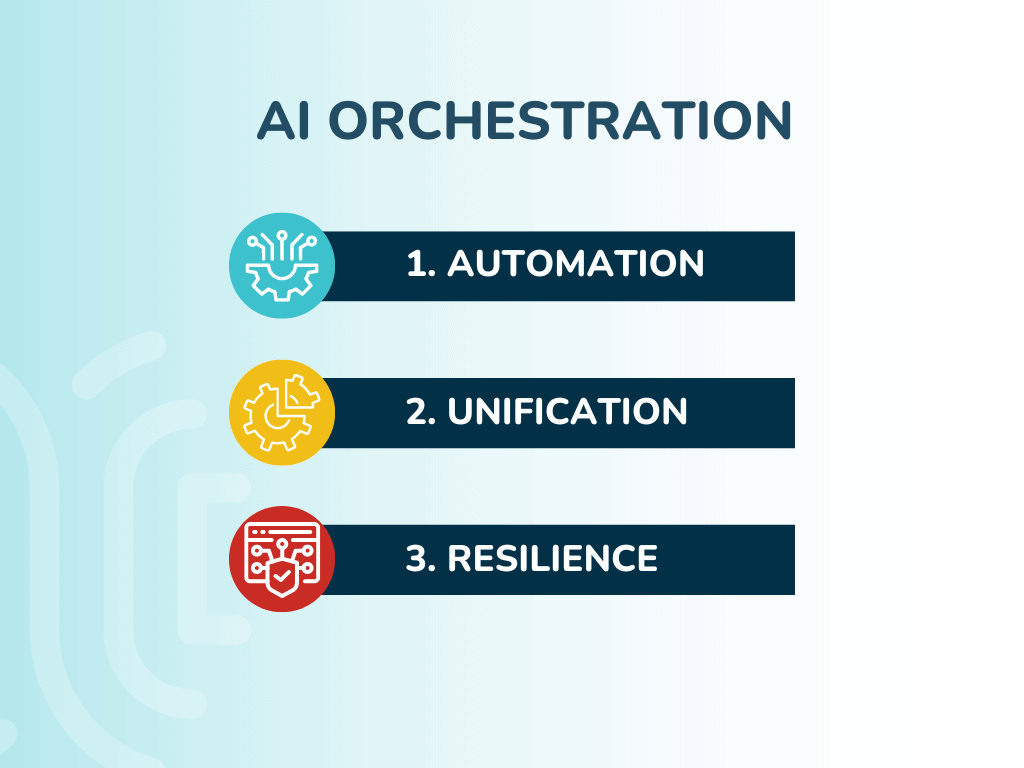
The ideal AI orchestration platform solves these problems by automating repetitive and data-heavy tasks, unifying workflows with a vendor-neutral platform, and using out-of-band (OOB) serial console management to provide continuous remote access even during major outages.

Automation

Automation is crucial for teams to keep up with the pace and scale of artificial intelligence. Organizations use automation to provision and install AI data center infrastructure, manage storage for AI training and inference data, monitor inputs and outputs for toxicity, perform root-cause analyses when systems fail, and much more. However, tracking and troubleshooting so many automated workflows can get very complicated, creating more work for administrators rather than making them more productive. An AI orchestration platform should provide a centralized interface for teams to deploy and oversee automated workflows across applications, infrastructure, and business sites.

Unification

The best way to improve AI operational efficiency is to integrate all of the complicated monitoring, management, automation, security, and remediation workflows. This can be accomplished by choosing solutions and vendors that interoperate or, even better, are completely vendor-agnostic (a.k.a., vendor-neutral). For example, using open, common platforms to run AI workloads, manage AI infrastructure, and host AI-related security software can help bring everything together where administrators have easy access. An AI orchestration platform should be vendor-neutral to facilitate workload unification and streamline integrations.

Resilience

AI models, workloads, and infrastructure are highly complex and interconnected, so an issue with one component could compromise interdependencies in ways that are difficult to predict and troubleshoot. AI systems are also attractive targets for cybercriminals due to their vast, valuable data sets and because of how difficult they are to secure, with HiddenLayer’s 2024 AI Threat Landscape Report finding that 77% of businesses have experienced AI-related breaches in the last year. An AI orchestration platform should help improve resilience, or the ability to continue operating during adverse events like tech failures, breaches, and natural disasters.

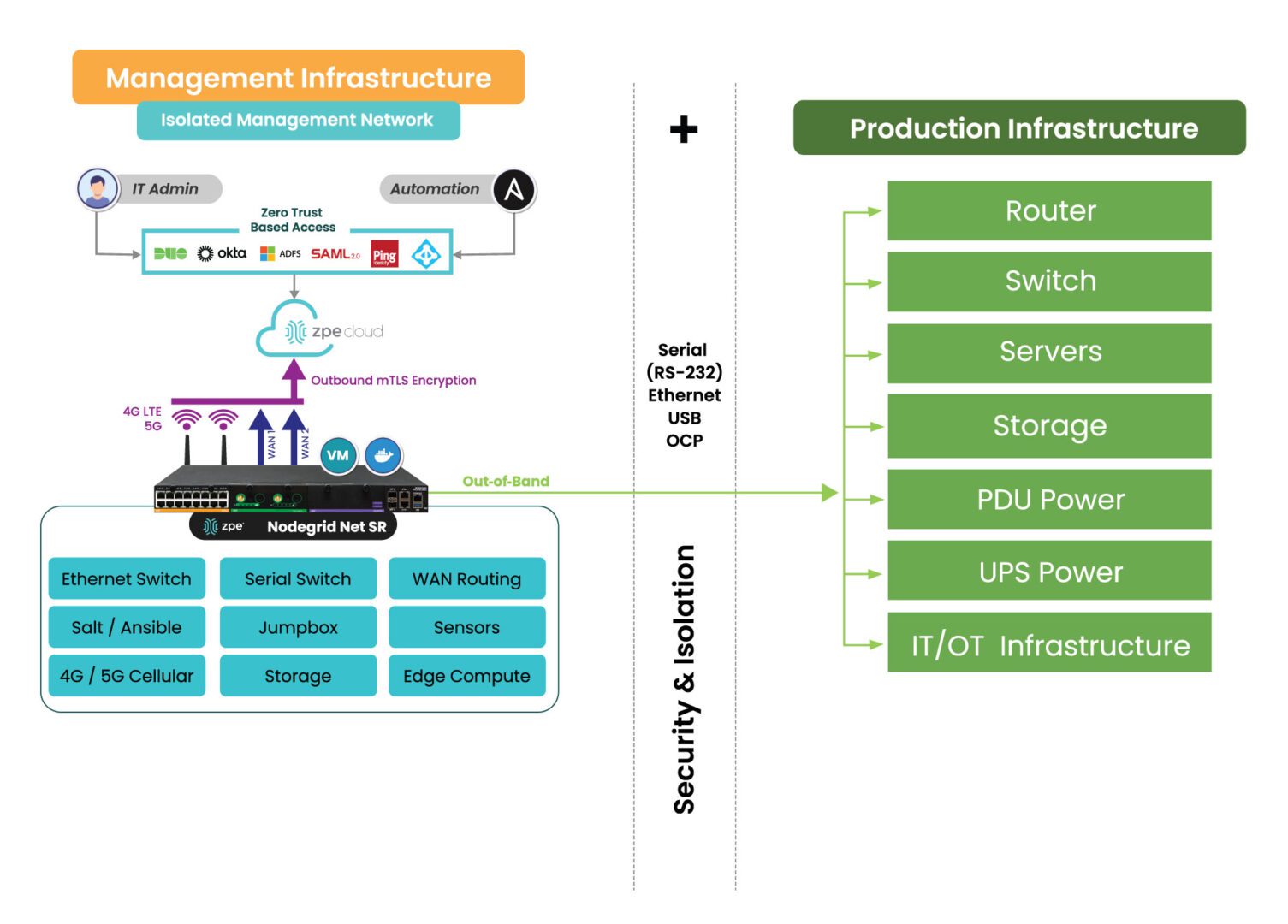
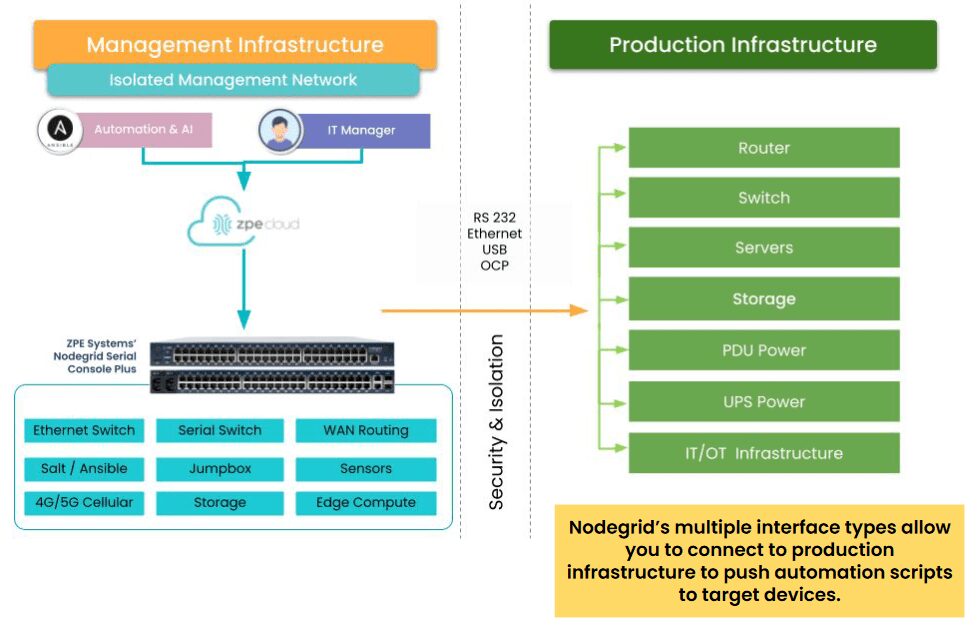
Gen 3 out-of-band management technology is a crucial component of AI and network resilience. A vendor-neutral OOB solution like the Nodegrid Serial Console Plus (NSCP) uses alternative network connections to provide continuous management access to remote data center, branch, and edge infrastructure even when the ISP, WAN, or LAN connection goes down. This gives administrators a lifeline to troubleshoot and recover AI infrastructure without costly and time-consuming site visits. The NSCP allows teams to remotely monitor power consumption and cooling for AI infrastructure. It also provides 5G/4G LTE cellular failover so organizations can continue delivering critical services while the production network is repaired.

A diagram showing isolated management infrastructure with the Nodegrid Serial Console Plus.

Gen 3 OOB also helps organizations implement isolated management infrastructure (IMI), a.k.a, control plane/data plane separation. This is a cybersecurity best practice recommended by the CISA as well as regulations like PCI DSS 4.0, DORA, NIS2, and the CER Directive. IMI prevents malicious actors from being able to laterally move from a compromised production system to the management interfaces used to control AI systems and other infrastructure. It also provides a safe recovery environment where teams can rebuild and restore systems during a ransomware attack or other breach without risking reinfection.

Getting the most out of your AI investment

An AI orchestration platform should streamline workflows with automation, provide a unified platform to oversee and control AI-related applications and systems for maximum efficiency and coverage, and use Gen 3 OOB to improve resilience and minimize disruptions. Reducing management complexity, risk, and repair costs can help companies see greater productivity and financial returns from their AI investments.

The vendor-neutral Nodegrid platform from ZPE Systems provides highly scalable Gen 3 OOB management for up to 96 devices with a single, 1RU serial console. The open Nodegrid OS also supports VMs and Docker containers for third-party applications, so you can run AI, automation, security, and management workflows all from the same device for ultimate operational efficiency.

Streamline AI orchestration with Nodegrid

Contact ZPE Systems today to learn more about using a Nodegrid serial console as the foundation for your AI orchestration platform. Contact Us

Edge Computing Use Cases in Telecom

This blog describes four edge computing use cases in telecom before describing the benefits and best practices for the telecommunications industry.
Telecommunications networks are vast and extremely distributed, with critical network infrastructure deployed at core sites like Internet exchanges and data centers, business and residential customer premises, and access sites like towers, street cabinets, and cell site shelters. This distributed nature lends itself well to edge computing, which involves deploying computing resources like CPUs and storage to the edges of the network where the most valuable telecom data is generated. Edge computing allows telecom companies to leverage data from CPE, networking devices, and users themselves in real-time, creating many opportunities to improve service delivery, operational efficiency, and resilience.

This blog describes four edge computing use cases in telecom before describing the benefits and best practices for edge computing in the telecommunications industry.

4 Edge computing use cases in telecom

1. Enhancing the customer experience with real-time analytics

Each customer interaction, from sales calls to repair requests and service complaints, is a chance to collect and leverage data to improve the experience in the future. Transferring that data from customer sites, regional branches, and customer service centers to a centralized data analysis application takes time, creates network latency, and can make it more difficult to get localized and context-specific insights. Edge computing allows telecom companies to analyze valuable customer experience data, such as network speed, uptime (or downtime) count, and number of support contacts in real-time, providing better opportunities to identify and correct issues before they go on to affect future interactions.

2. Streamlining remote infrastructure management and recovery with AIOps

AIOps helps telecom companies manage complex, distributed network infrastructure more efficiently. AIOps (artificial intelligence for IT operations) uses advanced machine learning algorithms to analyze infrastructure monitoring data and provide maintenance recommendations, automated incident management, and simple issue remediation. Deploying AIOps on edge computing devices at each telecom site enables real-time analysis, detection, and response, helping to reduce the duration of service disruptions. For example, AIOps can perform automated root-cause analysis (RCA) to help identify the source of a regional outage before technicians arrive on-site, allowing them to dive right into the repair. Edge AIOps solutions can also continue functioning even if the site is cut off from the WAN or Internet, potentially self-healing downed networks without the need to deploy repair techs on-site.

3. Preventing environmental conditions from damaging remote equipment

Telecommunications equipment is often deployed in less-than-ideal operating conditions, such as unventilated closets and remote cell site shelters. Heat, humidity, and air particulates can shorten the lifespan of critical equipment or cause expensive service failures, which is why it’s recommended to use environmental monitoring sensors to detect and alert remote technicians to problems. Edge computing applications can analyze environmental monitoring data in real-time and send alerts to nearby personnel much faster than cloud- or data center-based solutions, ensuring major fluctuations are corrected before they damage critical equipment.

4. Improving operational efficiency with network virtualization and consolidation

Another way to reduce management complexity – as well as overhead and operating expenses – is through virtualization and consolidation. Network functions virtualization (NFV) virtualizes networking equipment like load balancers, firewalls, routers, and WAN gateways, turning them into software that can be deployed anywhere – including edge computing devices. This significantly reduces the physical tech stack at each site, consolidating once-complicated network infrastructure into, in some cases, a single device. For example, the Nodegrid Gate SR provides a vendor-neutral edge computing platform that supports third-party NFVs while also including critical edge networking functionality like out-of-band (OOB) serial console management and 5G/4G cellular failover.

Edge computing in telecom: Benefits and best practices

Edge computing can help telecommunications companies:

  • Get actionable insights that can be leveraged in real-time to improve network performance, service reliability, and the support experience.
  • Reduce network latency by processing more data at each site instead of transmitting it to the cloud or data center for analysis.
  • Lower CAPEX and OPEX at each site by consolidating the tech stack and automating management workflows with AIOps.
  • Prevent downtime with real-time analysis of environmental and equipment monitoring data to catch problems before they escalate.
  • Accelerate recovery with real-time, AIOps root-cause analysis and simple incident remediation that continues functioning even if the site is cut off from the WAN or Internet.

Management infrastructure isolation, which is recommended by CISA and required by regulations like DORA, is the best practice for improving edge resilience and ensuring a speedy recovery from failures and breaches. Isolated management infrastructure (IMI) prevents compromised accounts, ransomware, and other threats from moving laterally from production resources to the interfaces used to control critical network infrastructure.

IMI with Nodegrid(2)
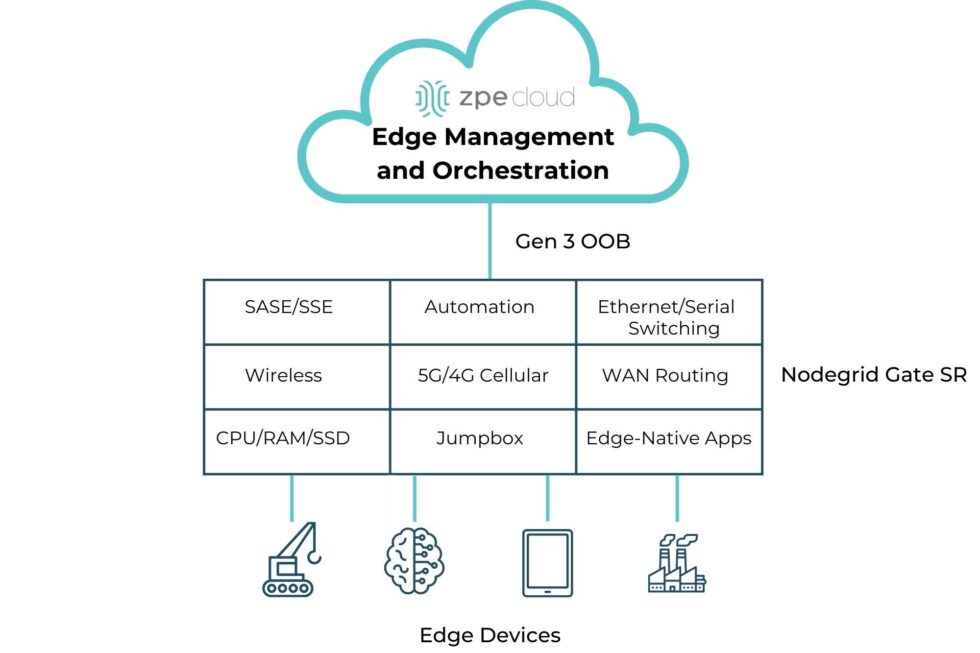
To ensure the scalability and flexibility of edge architectures, the best practice is to use vendor-neutral platforms to host, connect, and secure edge applications and workloads. Moving away from dedicated device stacks and taking a “platformization” approach allows organizations to easily deploy, update, and swap out functions and services on demand. For example, Nodegrid edge networking solutions have a Linux-based OS that supports third-party VMs, Docker containers, and NFVs. Telecom companies can use Nodegrid to run edge computing workloads as well as asset management software, customer experience analytics, AIOps, and edge security solutions like SASE.

Vendor-neutral platforms help reduce hardware overhead costs to deploy new edge sites, make it easy to spin-up new NFVs to meet increased demand, and allow telecom organizations to explore different edge software capabilities without costly hardware upgrades. For example, the Nodegrid Gate SR is available with an Nvidia Jetson Nano card that’s optimized for AI workloads, so companies can run innovative artificial intelligence at the edge alongside networking and infrastructure management workloads rather than purchasing expensive, dedicated GPU resources.
Edge-Management-980×653
Finally, to ensure teams have holistic oversight of the distributed edge computing architecture, the best practice is to use a centralized, cloud-based edge management and orchestration (EMO) platform. This platform should also be vendor-neutral to ensure complete coverage and should use out-of-band management to provide continuous management access to edge infrastructure even during a major service outage.

Streamlined, cost-effective edge computing with Nodegrid

Nodegrid’s flexible, vendor-neutral platform adapts to all edge computing use cases in telecom. Watch a demo to see Nodegrid’s telecom solutions in action.

Watch a demo

Edge Computing Use Cases in Retail

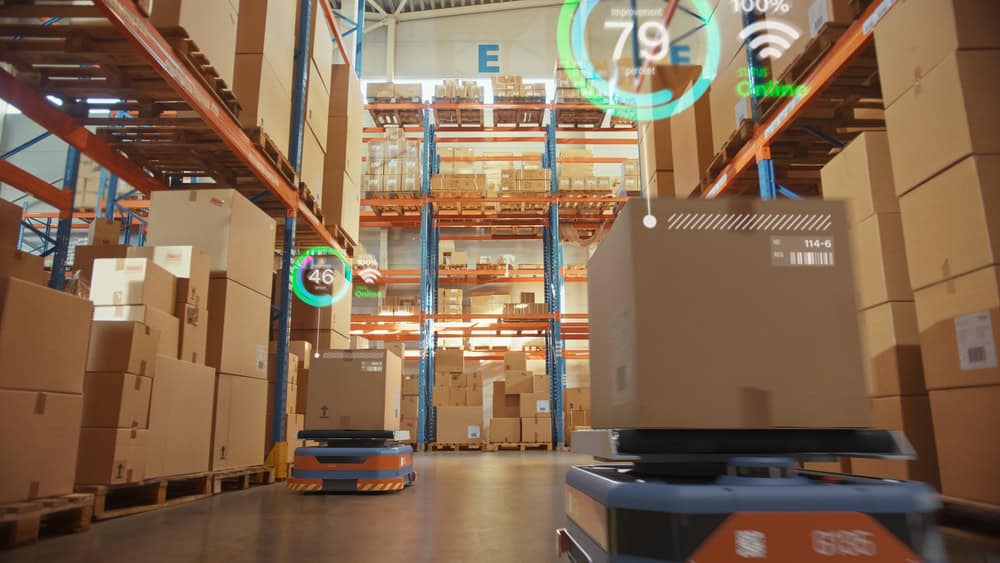
Automated transportation robots move boxes in a warehouse, one of many edge computing use cases in retail
Retail organizations must constantly adapt to meet changing customer expectations, mitigate external economic forces, and stay ahead of the competition. Technologies like the Internet of Things (IoT), artificial intelligence (AI), and other forms of automation help companies improve the customer experience and deliver products at the pace demanded in the age of one-click shopping and two-day shipping. However, connecting individual retail locations to applications in the cloud or centralized data center increases network latency, security risks, and bandwidth utilization costs.

Edge computing mitigates many of these challenges by decentralizing cloud and data center resources and distributing them at the network’s “edges,” where most retail operations take place. Running applications and processing data at the edge enables real-time analysis and insights and ensures that systems remain operational even if Internet access is disrupted by an ISP outage or natural disaster. This blog describes five potential edge computing use cases in retail and provides more information about the benefits of edge computing for the retail industry.

5 Edge computing use cases in retail

.

1. Security video analysis

Security cameras are crucial to loss prevention, but constantly monitoring video surveillance feeds is tedious and difficult for even the most experienced personnel. AI-powered video surveillance systems use machine learning to analyze video feeds and detect suspicious activity with greater vigilance and accuracy. Edge computing enhances AI surveillance by allowing solutions to analyze video feeds in real-time, potentially catching shoplifters in the act and preventing inventory shrinkage.

2. Localized, real-time insights

Retailers have a brief window to meet a customer’s needs before they get frustrated and look elsewhere, especially in a brick-and-mortar store. A retail store can use an edge computing application to learn about customer behavior and purchasing activity in real-time. For example, they can use this information to rotate the products featured on aisle endcaps to meet changing demand, or staff additional personnel in high-traffic departments at certain times of day. Stores can also place QR codes on shelves that customers scan if a product is out of stock, immediately alerting a nearby representative to provide assistance.

3. Enhanced inventory management

Effective inventory management is challenging even for the most experienced retail managers, but ordering too much or too little product can significantly affect sales. Edge computing applications can improve inventory efficiency by making ordering recommendations based on observed purchasing patterns combined with real-time stocking updates as products are purchased or returned. Retailers can use this information to reduce carrying costs for unsold merchandise while preventing out-of-stocks, improving overall profit margins.
.

4. Building management

Using IoT devices to monitor and control building functions such as HVAC, lighting, doors, power, and security can help retail organizations reduce the need for on-site facilities personnel, and make more efficient use of their time. Data analysis software helps automatically optimize these systems for efficiency while ensuring a comfortable customer experience. Running this software at the edge allows automated processes to respond to changing conditions in real-time, for example, lowering the A/C temperature or routing more power to refrigerated cases during a heatwave.

5. Warehouse automation

The retail industry uses warehouse automation systems to improve the speed and efficiency at which goods are delivered to stores or directly to users. These systems include automated storage and retrieval systems, robotic pickers and transporters, and automated sortation systems. Companies can use edge computing applications to monitor, control, and maintain warehouse automation systems with minimal latency. These applications also remain operational even if the site loses internet access, improving resilience.

The benefits of edge computing for retail

The benefits of edge computing in a retail setting include:
.

Edge computing benefits

Description

Reduced latency

Edge computing decreases the number of network hops between devices and the applications they rely on, reducing latency and improving the speed and reliability of retail technology at the edge.

Real-time insights

Edge computing can analyze data in real-time and provide actionable insights to improve the customer experience before a sale is lost or reduce waste before monthly targets are missed.

Improved resilience

Edge computing applications can continue functioning even if the site loses Internet or WAN access, enabling continuous operations and reducing the costs of network downtime.

Risk mitigation

Keeping sensitive internal data like personnel records, sales numbers, and customer loyalty information on the local network mitigates the risk of interception and distributes the attack surface.

Edge computing can also help retail companies lower their operational costs at each site by reducing bandwidth utilization on expensive MPLS links and decreasing expenses for cloud data storage and computing. Another way to lower costs is by using consolidated, vendor-neutral solutions to run, connect, and secure edge applications and workloads.

For example, the Nodegrid Gate SR integrated branch services router delivers an entire stack of edge networking, infrastructure management, and computing technologies in a single, streamlined device. The open, Linux-based Nodegrid OS supports VMs and Docker containers for third-party edge computing applications, security solutions, and more. The Gate SR is also available with an Nvidia Jetson Nano card that’s optimized for AI workloads to help retail organizations reduce the hardware overhead costs of deploying artificial intelligence at the edge.

Consolidated edge computing with Nodegrid

Nodegrid’s flexible, scalable platform adapts to all edge computing use cases in retail. Watch a demo to see Nodegrid’s retail network solutions in action.

Watch a demo

Why Securing IT Means Replacing End-of-Life Console Servers

Rene Neumann – Why Securing IT Means Replacing End of Life Console Servers


The world as we know it is connected to IT, and IT relies on its underlying infrastructure. Organizations must prioritize maintaining this infrastructure; otherwise, any disruption or breach has a ripple effect that takes services offline for millions of users (take 2024’s CrowdStrike outage, for example). A big part of this maintenance is ensuring that all hardware components, including console servers, are up-to-date and secure. Most console servers reach end-of-life (EOL) and need to be replaced, but for many reasons, whether budgetary concerns or the “if it isn’t broken” mentality, IT teams often keep their EOL devices. Let’s look at the risks of using EOL console servers, and why replacing them goes hand-in-hand with securing IT.

The Risks of Using End-of-Life Console Servers

End-of-life console servers can undermine the security and functionality of IT systems. These risks include:

1. Lack of Security Features and Updates

Aging console servers lack adequate hardware and management security features, meaning they can’t support a zero trust approach. On top of this, once a console server reaches EOL, the manufacturer stops providing security patches and updates. The device then becomes vulnerable to newly discovered CVEs and complex cyberattacks (like the MOVEit and Ragnar Locker breaches). Cybercriminals often target outdated hardware because they know that these devices are no longer receiving updates, making them easy entry points for launching attacks.

2. Compliance Issues

Many industries have stringent regulatory requirements regarding data security and IT infrastructure. DORA, NIS2 (EU), NIST2 (US), PCI 4.0 (finance), and CER Directive are just a few of the updated regulations that are cracking down on how organizations architect IT, including the management layer. Using EOL hardware can lead to non-compliance, resulting in fines and legal repercussions. Regulatory bodies expect organizations to use up-to-date and secure equipment to protect sensitive information.

3. Prolonged Recovery

EOL console servers are prone to failures and inefficiencies. As these devices age, their performance deteriorates, leading to increased downtime and disruptions. Most console servers are Gen 2, meaning they offer basic remote troubleshooting (to address break/fix scenarios) and limited automation capabilities. When there is a severe disruption, such as a ransomware attack, hackers can easily access and encrypt these devices to lock out admin access. Organizations then must endure prolonged recovery (like the CrowdStrike outage, or 2023’s MGM attack) because they need to physically decommission and restore their infrastructure.


The Importance of Replacing EOL Console Servers

Here’s why replacing EOL console servers is essential to securing IT:

1. Modern Security Approach

Zero trust is an approach that uses segmentation across IT assets. This ensures that only authorized users can access resources necessary for their job function. This approach requires SAML, SSO, MFA/2FA, and role-based access controls, which are only supported by modern console servers. Modern devices additionally feature advanced security through encryption, signed OS, and tampering detection. This ensures a complete cyber and physical approach to security.

2. Protection Against New Threats

New CVEs and evolving threats can easily take advantage of EOL devices that no longer receive updates. Modern console servers benefit from ongoing support in the form of firmware upgrades and security patches. Upgrading with a security-focused device vendor can drastically shrink the attack surface, by addressing supply chain security risks, codebase integrity, and CVE patching.

3. Ease of Compliance

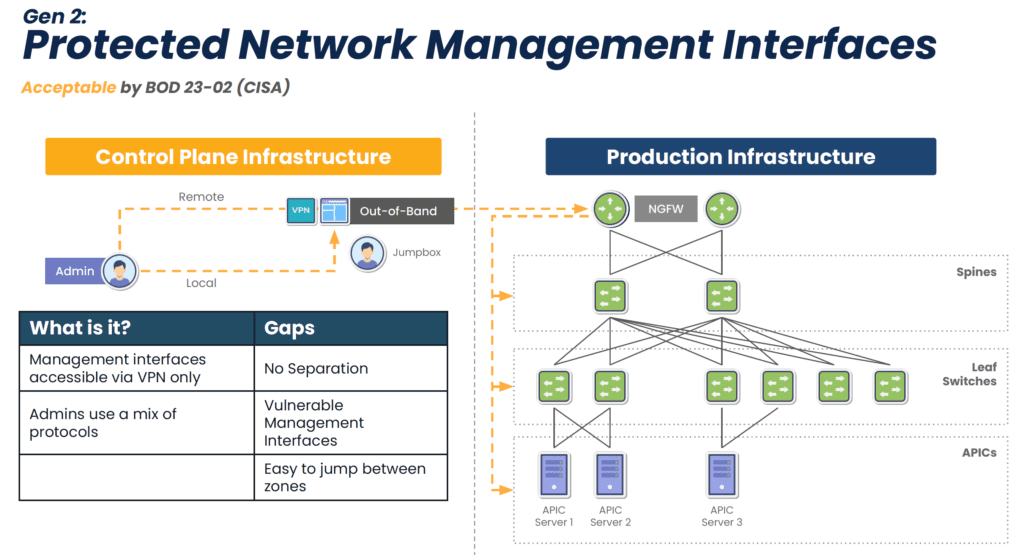
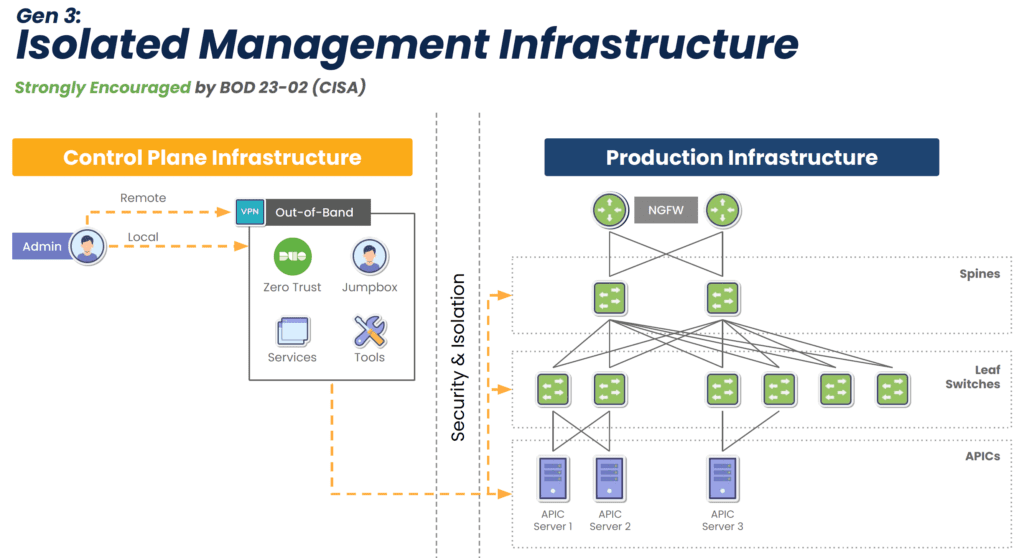
EOL devices lack modern security features, but this isn’t the only reason why they make it difficult or impossible to comply with regulations. They also lack the ability to isolate the control plane from the production network (see Diagram 1 below), meaning attackers can easily move between the two in order to launch ransomware and steal sensitive information. Watchdog agencies and new legislation are stipulating that organizations follow the latest best practice of separating the control plane from production, called Isolated Management Infrastructure (IMI). Modern console servers make this best practice simple to achieve by offering drop-in out-of-band that is completely isolated from production assets (see Diagram 2 below). This means that the organization is always in control of its IT assets and sensitive data.

A network diagram showing Gen 2 out-of-band is vulnerable to the internet

Diagram 1: Though an acceptable approach, Gen 2 out-of-band lacks isolation and leaves management interfaces vulnerable to the internet.

A network diagram showing how Gen 3 out-of-band secures network and management interfaces.

Diagram 2: Gen 3 out-of-band fully isolates the control plane to guarantee organizations retain control of their IT assets and sensitive info.

4. Faster Recovery

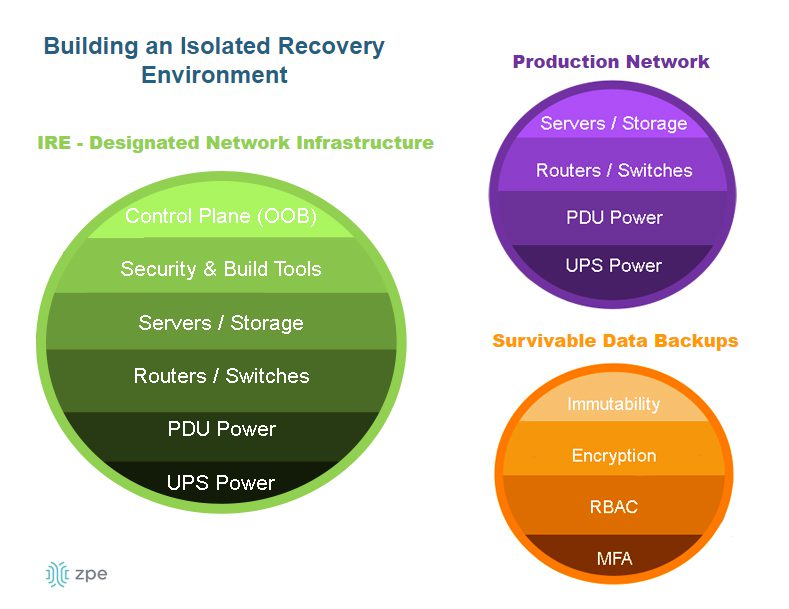
New console servers are designed to handle more workloads and functions, which eliminates single-purpose devices and shrinks the attack surface. They can also run VMs and Docker containers to host applications. This enables what Gartner calls the Isolated Recovery Environment (IRE) (see Diagram 3 below), which is becoming essential for faster recovery from ransomware. Since the IMI component prohibits attackers from accessing the control plane, admins retain control during an attack. They can use the IMI to deploy their IRE and the necessary applications — remotely — to decommission, cleanse, and restore their infected infrastructure. This means that they don’t have to roll trucks week after week when there’s an attack; they just need to log into their management infrastructure to begin assessing and responding immediately, which significantly reduces recovery times.

A diagram showing the components of an isolated recovery environment.

Diagram 3: The Isolated Recovery Environment allows for a comprehensive and rapid response to ransomware attacks.

Get a Walkthrough of IMI and IRE

Let’s cover what IMI and IRE would look like in your environment and walk through some outage recovery scenarios. Use the link below to set up a technical discussion.

Meet Me at Cisco Live Amsterdam 2026

Visit booth C10 at Cisco Live Amsterdam to chat about IMI, IRE, and replacing end-of-life console servers. You can also catch my 10-minute presentation on Wednesday, February 11 at 1:50pm in the Speakers Corner. I’ll cover From Pilot Projects to Global Rollouts: Why Out-of-Band Management is Crucial for Scaling AI Infrastructure, with more concepts and network diagrams showing how to achieve true resilience. Visit our Cisco Live page below to let me know you’re coming. See you at the show!

Rene Neumann presents at Cisco Live Amsterdam 2026

Edge Computing Use Cases in Healthcare

A closeup of an IoT pulse oximeter, one of many edge computing use cases in healthcare
The healthcare industry enthusiastically adopted Internet of Things (IoT) technology to improve diagnostics, health monitoring, and overall patient outcomes. The data generated by healthcare IoT devices is processed and used by sophisticated data analytics and artificial intelligence applications, which traditionally live in the cloud or a centralized data center. Transmitting all this sensitive data back and forth is inefficient and increases the risk of interception or compliance violations.

Edge computing deploys data analytics applications and computing resources around the edges of the network, where much of the most valuable data is created. This significantly reduces latency and mitigates many security and compliance risks. In a healthcare setting, edge computing enables real-time medical insights and interventions while keeping HIPAA-regulated data within the local security perimeter. This blog describes six potential edge computing use cases in healthcare that take advantage of the speed and security of an edge computing architecture.

6 Edge computing use cases in healthcare

Edge computing use cases for EMS

Mobile emergency medical services (EMS) teams need to make split-second decisions regarding patient health without the benefit of a doctorate and, often, with spotty Internet connections preventing access to online drug interaction guides and other tools. Installing edge computing resources on cellular edge routers gives EMS units real-time health analysis capabilities as well as a reliable connection for research and communications. Potential use cases include:
.

Use cases

Description

1. Real-time health analysis en route

Edge computing applications can analyze data from health monitors in real-time and access available medical records to help medics prevent allergic reactions and harmful medication interactions while administering treatment.

2. Prepping the ER with patient health insights

Some edge computing devices use 5G/4G cellular to livestream patient data to the receiving hospital, so ER staff can make the necessary arrangements and begin the proper treatment as soon as the patient arrives.

Edge computing use cases in hospitals & clinics

Hospitals and clinics use IoT devices to monitor vitals, dispense medications, perform diagnostic tests, and much more. Sending all this data to the cloud or data center takes time, delaying test results or preventing early intervention in a health crisis, especially in rural locations with slow or spotty Internet access. Deploying applications and computing resources on the same local network enables faster analysis and real-time alerts. Potential use cases include:
.

Use cases

Description

3. AI-powered diagnostic analysis

Edge computing allows healthcare teams to use AI-powered tools to analyze imaging scans and other test results without latency or delays, even in remote clinics with limited Internet infrastructure.

4. Real-time patient monitoring alerts

Edge computing applications can analyze data from in-room monitoring devices like pulse oximeters and body thermometers in real-time, spotting early warning signs of medical stress and alerting staff before serious complications arise.

Edge computing use cases for wearable medical devices

Wearable medical devices give patients and their caregivers greater control over health outcomes. With edge computing, health data analysis software can run directly on the wearable device, providing real-time results even without an Internet connection. Potential use cases include:
.

Use cases

Description

5. Continuous health monitoring

An edge-native application running on a system-on-chip (SoC) in a wearable insulin pump can analyze levels in real-time and provide recommendations on how to correct imbalances before they become dangerous.

6. Real-time emergency alerts

Edge computing software running on an implanted heart-rate monitor can give a patient real-time alerts when activity falls outside of an established baseline, and, in case of emergency, use cellular and ATT FirstNet connections to notify medical staff.

The benefits of edge computing for healthcare

Using edge computing in a healthcare setting as described in the use cases above can help organizations:

  • Improve patient care in remote settings, where a lack of infrastructure limits the ability to use cloud-based technology solutions.
  • Process and analyze patient health data faster and more reliably, leading to earlier interventions.
  • Increase efficiency by assisting understaffed medical teams with diagnostics, patient monitoring, and communications.
  • Mitigate security and compliance risks by keeping health data within the local security perimeter.

Edge computing can also help healthcare organizations lower their operational costs at the edge by reducing bandwidth utilization and cloud data storage expenses. Another way to reduce costs is by using consolidated, vendor-neutral solutions to host, connect, and secure edge applications and workloads.

For example, the Nodegrid Gate SR is an integrated branch services router that delivers an entire stack of edge networking, infrastructure management, and computing technologies in a single, streamlined device. Nodegrid’s open, Linux-based OS supports VMs and Docker containers for third-party edge applications, security solutions, and more. Plus, an onboard Nvidia Jetson Nano card is optimized for AI workloads at the edge, significantly reducing the hardware overhead costs of using artificial intelligence at remote healthcare sites. Nodegrid’s flexible, scalable platform adapts to all edge computing use cases in healthcare, future-proofing your edge architecture.

Streamline your edge deployment with Nodegrid

The vendor-neutral Nodegrid platform consolidates an entire edge technology stack into a unified, streamlined solution. Watch a demo to see Nodegrid’s healthcare network solutions in action.

Watch a demo

Benefits of Edge Computing

An illustration showing various use cases and benefits of edge computing

Edge computing delivers data processing and analysis capabilities to the network’s “edge,” at remote sites like branch offices, warehouses, retail stores, and manufacturing plants. It involves deploying computing resources and lightweight applications very near the devices that generate data, reducing the distance and number of network hops between them. In doing so, edge computing reduces latency and bandwidth costs while mitigating risk, enhancing edge resilience, and enabling real-time insights. This blog discusses the five biggest benefits of edge computing, providing examples and additional resources for companies beginning their edge journey.
.

5 benefits of edge computing​

Edge Computing:

Description

Reduces latency

Leveraging data at the edge reduces network hops and latency to improve speed and performance.

Mitigates risk

Keeping data on-site at distributed edge locations reduces the chances of interception and limits the blast radius of breaches.

Lowers bandwidth costs

Reducing edge data transmissions over expensive MPLS lines helps keep branch costs low.

Enhances edge resilience

Analyzing data on-site ensures that edge operations can continue uninterrupted during ISP outages and natural disasters.

Enables real-time insights

Eliminating off-site processing allows companies to use and extract value from data as soon as it’s generated.

1. Reduces latency

Edge computing leverages data on the same local network as the devices that generate it, cutting down on edge data transmissions over the WAN or Internet. Reducing the number of network hops between devices and applications significantly decreases latency, improving the speed and performance of business intelligence apps, AIOps, equipment health analytics, and other solutions that use edge data.

Some edge applications run on the devices themselves, completely eliminating network hops and facilitating real-time, lag-free analysis. For example, an AI-powered surveillance application installed on an IoT security camera at a walk-up ATM can analyze video feeds in real-time and alert security personnel to suspicious activity as it occurs.​


Read more examples of how edge computing improves performance in our guide to the Applications of Edge Computing.

2. Mitigates risk

Edge computing mitigates security and compliance risks by distributing an organization’s sensitive data and reducing off-site transmission. Large, centralized data stores in the cloud or data center are prime targets for cybercriminals because the sheer volume of data involved increases the chances of finding something valuable. Decentralizing data in much smaller edge storage solutions makes it harder for hackers to find the most sensitive information and also limits how much data they can access at one time.

Keeping data at the edge also reduces the chances of interception in transit to cloud or data center storage. Plus, unlike in the cloud, an organization maintains complete control over who and what has access to sensitive data, aiding in compliance with regulations like the GDPR and PCI DSS 4.0.
.

To learn how to protect edge data and computing resources, read Comparing Edge Security Solutions.

3. Lowers bandwidth costs

Many organizations use MPLS (multi-protocol label switching) links to securely connect edge sites to the enterprise network. MPLS bandwidth is much more expensive than regular Internet lines, which makes transmitting edge data to centralized data processing applications extremely costly. Plus, it can take months to provision MPLS at a new site, delaying launches and driving up overhead expenses.

Edge computing significantly reduces MPLS bandwidth utilization by running data-hungry applications on the local network, reserving the WAN for other essential traffic. Combining edge computing with SD-WAN (software-defined wide area networking) and SASE (secure access service edge) technologies can markedly decrease the reliance on MPLS links, allowing organizations to accelerate branch openings and see faster edge ROIs.
.

Learn more about cost-effective edge deployments in our Edge Computing Architecture Guide.

4. Enhances edge resilience

Since edge computing applications run on the same LAN as the devices generating data, they can continue to function even if the site loses Internet access due to an ISP outage, natural disaster, or other adverse event. This also allows uninterrupted edge operations in locations with inconsistent (or no) Internet coverage, like offshore oil rigs, agricultural sites, and health clinics in isolated rural communities. Edge computing ensures that organizations don’t miss any vital health or safety alerts and facilitates technological innovation using AI and other data analytics tools in challenging environments..
.

For more information on operational resilience, read Network Resilience: What is a Resilience System?

5. Enables real-time insights

Sending data from the edge to a cloud or on-premises data lake for processing, transformation, and ingestion by analytics or AI/ML tools takes time, preventing companies from acting on insights at the moment when they’re most useful. Edge computing applications start using data as soon as it’s generated, so organizations can extract value from it right away. For example, a retail store can use edge computing to gain actionable insights on purchasing activity and customer behavior in real-time, so they can move in-demand products to aisle endcaps or staff extra cashiers as needed.
.

To learn more about the potential uses of edge computing technology, read Edge Computing Examples.

Simplify your edge computing deployment with Nodegrid

The best way to achieve the benefits of edge computing described above without increasing management complexity or hardware overhead is to use consolidated, vendor-neutral solutions to host, connect, and secure edge workloads. For example, the Nodegrid Gate SR from ZPE Systems delivers an entire stack of edge networking and infrastructure management technologies in a single, streamlined device. The open, Linux-based Nodegrid OS supports VMs and containers for third-party applications, with an Nvidia Jetson Nano card capable of running AI workloads alongside non-AI data analytics for ultimate efficiency.

Improve your edge computing deployment with Nodegrid

Nodegrid consolidates edge computing deployments to improve operational efficiency without sacrificing performance or functionality. Schedule a free demo to see Nodegrid in action.

Schedule a Demo