Providing Out-of-Band Connectivity to Mission-Critical IT Resources

Data Center Environmental Sensors: Everything You Need to Know

According to a recent Uptime Institute survey, severe outages can cost more than $1 million USD and lead to reputational loss as well as business and customer disruption. Humidity, air particulates, and other problems could shorten the lifetime of critical equipment or cause outages. Unfortunately, much of a business’s critical digital infrastructure and services are housed in remote data centers, making it difficult for busy IT teams to keep eyes on the environmental conditions.

Data center environmental sensors can help teams prevent downtime by monitoring conditions in remote infrastructure deployments and alerting administrators to any problems before they lead to equipment failure. This blog explains how environmental sensors work and describes the ideal environmental monitoring solution for minimizing outages.

How data center environmental sensors reduce downtime

Data center environmental sensors are deployed around the rack, cabinet, or cage to collect information about various conditions that could negatively affect equipment like routers, servers, and switches. 

Mitigating environmental risks with data center environmental sensors

Environmental Risk Description How Environmental Sensors Help
Temperature All data center equipment has an optimal operating temperature range, as well as a max temp threshold above which devices may overheat. Environmental sensors monitor ambient temperatures and trigger automated alerts when it gets too hot or too cold in the data center.
Humidity If the air in the data center gets too humid, moisture may collect on the internal components of devices and cause corrosion, shorts, or other failures. Environmental sensors monitor the relative humidity in the DC and alert administrators when there’s a danger of moisture accumulation.
Fire A fire in the data center could burn equipment, raise the ambient temperature beyond acceptable limits, or activate automatic fire suppression controls that damage devices. Environmental sensors detect the heat and smoke from fires, giving DC teams time to shut down systems before they’re damaged.
Tampering A malicious actor who’s able to get past data center security (such as an inside threat) could potentially tamper with equipment to damage or breach it. Tamper detection sensors alert remote teams when data center cabinet doors are opened or a device is physically moved.
Air Particulates Smoke, ozone, and other air particulates could potentially damage data center infrastructure by oxidizing components or clogging vents. Environmental sensors monitor air quality and automatically alert teams when particulates are detected.

These sensors report back to monitoring software that’s either deployed on-premises in the data center or hosted in the cloud. Administrators use this software to view real-time conditions or to configure automated alerts.

Environmental monitoring sensors help reduce outages by giving remote IT teams advance warning that something is wrong with conditions in the data center, enabling them to potentially fix the problem before any systems go down. However, traditional monitoring solutions suffer from a number of limitations.

  1. They need a stable internet connection to allow remote access, so if there’s an ISP outage or unknown failure, teams lose their ability to monitor the situation.
  2. Many of them use on-premises software that requires administrators to connect via VPN to monitor or manage the solution, creating security risks and management hurdles.
  3. Most environmental monitoring systems don’t easily integrate with other remote management tools, leaving administrators with a disjointed patchwork of platforms to wrestle with.

The ideal data center environmental monitoring solution

The Nodegrid data center environmental monitoring platform overcomes these challenges with a combination of out-of-band management, cloud-based software, and a vendor-agnostic architecture.

Nodegrid environmental sensors work with Nodegrid serial consoles to provide remote teams with a virtual presence in the data center. These devices create an instant out-of-band network that uses a dedicated internet connection to provide continuous remote access to all connected sensors and infrastructure. This network doesn’t rely on the primary ISP or production network resources, giving administrators a lifeline to monitor and recover remote data center devices during an outage. The addition of Nodegrid Data Lake also allows teams to collect environmental monitoring data, discover trends and insights, and create better automation to address issues.

Nodegrid’s data center environmental monitoring and infrastructure management software is available on-premises or in the cloud, allowing teams to access critical equipment and respond to alerts from anywhere in the world. Plus, all Nodegrid hardware and software is vendor-neutral, supporting seamless integrations with third-party tools for automation, security, and more.

Schedule a free Nodegrid demo to see our data center environmental sensors and vendor-neutral management platform in action!

American Water Cyberattack: Another Wake-Up Call for Critical Infrastructure

Industrial water treatment plant with water
The October 2024 cyberattack on American Water, one of the largest water and wastewater utility companies in the U.S., signals yet another wake-up call for critical infrastructure security. Because millions of people rely on this critical service for safe drinking water and sanitation, this attack highlights why it’s so important to address cyber vulnerabilities.

Let’s trace the timeline of the attack, how it likely started, and the best practice architecture that could have mitigated or prevented the American Water cyberattack.

Timeline of the October 2024 American Water Cyberattack

  • Initial Intrusion (October 5, 2024)
    The attack on American Water was first detected in early October, when cybersecurity monitoring tools flagged suspicious activity within the company’s IT systems. Employees reported an unusual system slowdown, and automated alerts indicated possible unauthorized access.
  • Rapid Escalation (October 6-7, 2024)
    Within 24 hours of detection, the attackers had moved deeper into the company’s IT environment. In response, American Water initiated emergency protocols, including isolating key systems to prevent further damage. To contain the breach, critical operational technology (OT) systems — responsible for managing water treatment and distribution — were temporarily shut down
  • Public Notification and Response (October 8, 2024)
    American Water notified federal authorities, including the Cybersecurity and Infrastructure Security Agency (CISA), state regulators, and the public. The company reassured customers that water quality had not been compromised, but certain automated operations had been affected, leading to temporary disruptions in water distribution.
  • Ongoing Recovery (October 2024 – Present)
    As the investigation continued, third-party cybersecurity firms were brought in to assess the extent of the breach and assist in recovery. Manual operations were implemented in areas where automated systems were impacted. While the threat was contained, the company faced a lengthy process of system restoration and reconfiguration.

Impact of the Attack

The impact of the American Water cyberattack appears minimal. A class-action lawsuit was recently filed seeking $5-million in damages on behalf of affected customers, but this is the typical fallout that results from a breach. American Water did not shut down any treatment plants, and although they were forced to temporarily shut down their customer portal, pause billing, and revert to some manual processes, there were no water contamination or public health risks that came out of the attack. Per American Water’s FAQ page, it seems business is nearly back to normal.

However, this shouldn’t diminish the need for utilities providers to shore-up their defenses and ensure resilience of their IT architectures. The Oldsmar, Florida incident is an example of how an error or breach can change water treatment chemistry (in this case, adding too much lye to the water supply) and poison a population. There have also been many attempts by U.S. adversaries in which attackers were able to change water chemistry or disrupt automated operations.

Government agencies like the EPA have been warning that attacks on water treatment utilities are increasing. Lawmakers are also calling for inspections of IT systems, such as to ensure best practices are being followed for managing passwords and keeping remote access from Internet exposure, and considering civil and criminal penalties for those who don’t comply.

How the Attack Likely Happened

The American Water cyberattack is still under investigation. Specifics of how it occurred haven’t been released, but several likely scenarios have emerged based on trends in similar attacks:

  • Phishing or Social Engineering:
    Employees may have unknowingly opened a malicious email attachment or clicked a harmful link, allowing attackers access to the internal network, similar to 2023’s Ragnar Locker attacks. Water utilities and other public services often have large workforces, which makes them susceptible to phishing campaigns.
  • Ransomware:
    There are indications that ransomware may have encrypted key files and systems, similar to what happened during the MGM hack. Ransomware attacks on critical infrastructure have increased in recent years, with attackers locking companies out of their own data and demanding payment to restore access.
  • IT/OT Integration Vulnerabilities:
    Water utilities often rely on a hybrid network where both information technology (IT) systems and operational technology (OT) systems are integrated to monitor and control water purification, distribution, and wastewater management. While this setup improves efficiency, it can also create additional vulnerabilities if the two environments are not properly segregated. Once attackers gain access to the IT network, they can use it as a bridge to reach OT systems, which are typically less secure.
  • Internet-Facing Systems:
    In the past, the Chinese-sponsored hacker group Volt Typhoon took advantage of firewalls that were connected both to the internet and to critical control systems. This approach also takes advantage of a lack of control plane segregation, as hackers can remote-in via internet-facing systems and gain management access to critical systems.

The Solution: Isolated Management Infrastructure (IMI)

As with the global CrowdStrike outage, the most important takeaway from the American Water cyberattack is that organizations need the ability to recover fast. Remote access solutions help with this, but it matters how these solutions are architected and which capabilities they offer.

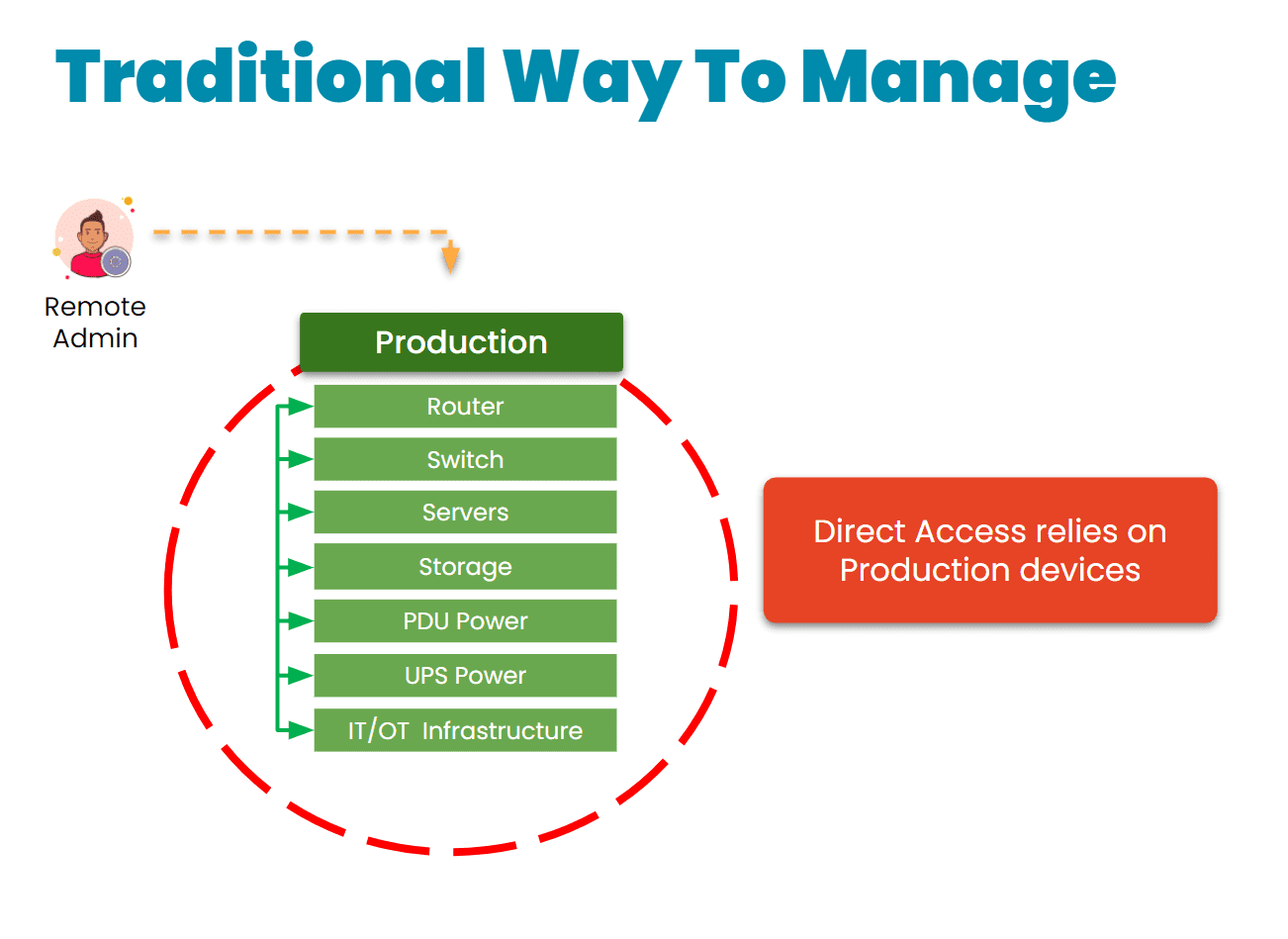
The traditional approach is to gain remote access via a direct link to the affected systems. The problem with this is that when these systems are breached, encrypted, or offline, it’s impossible to remote-into them. This requires teams to physically connect to and revive systems (as with the CrowdStrike incident), or worse – completely replace their infrastructure, as Merck did during the 2017 NotPetya breach.

Traditional remote management via direct link
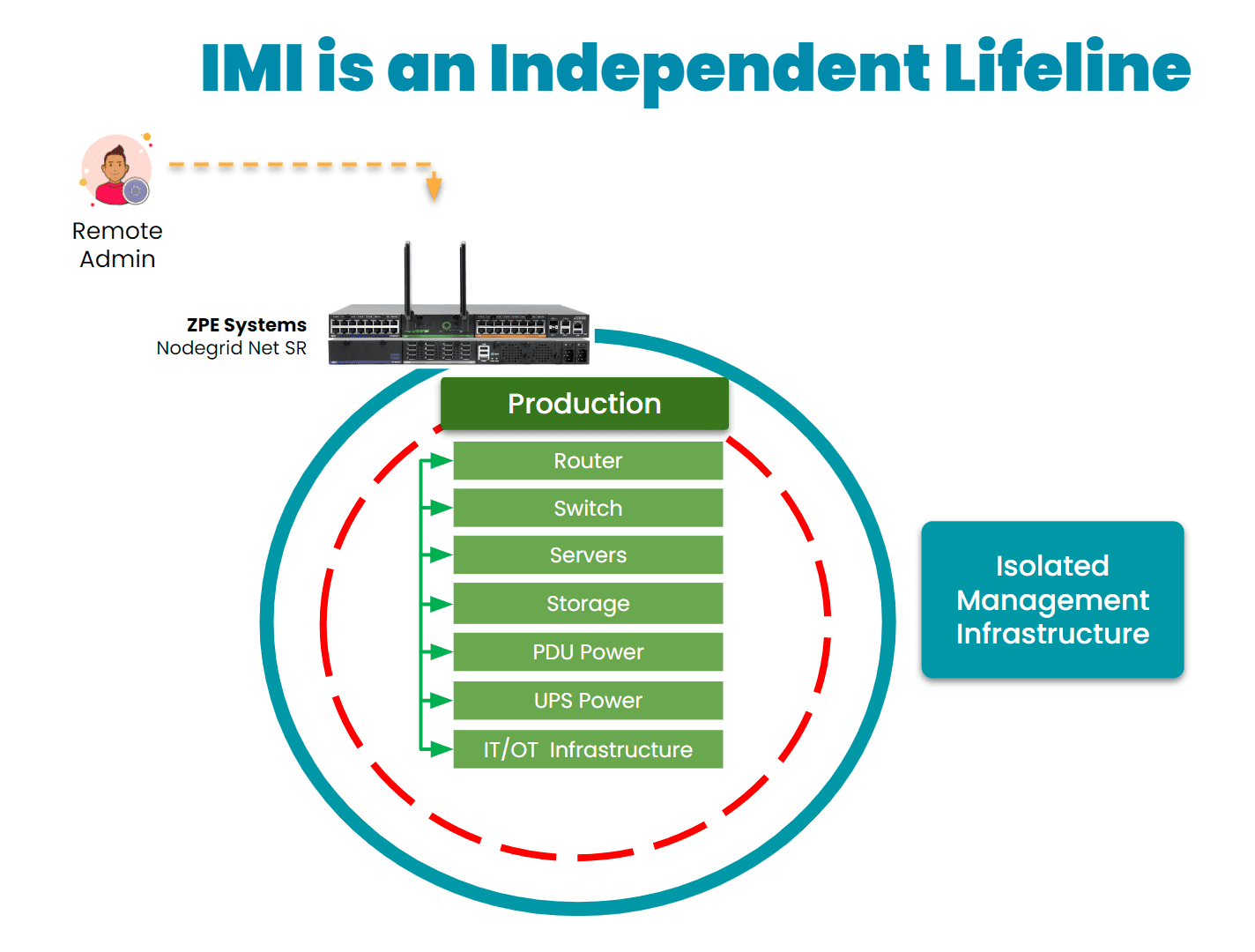
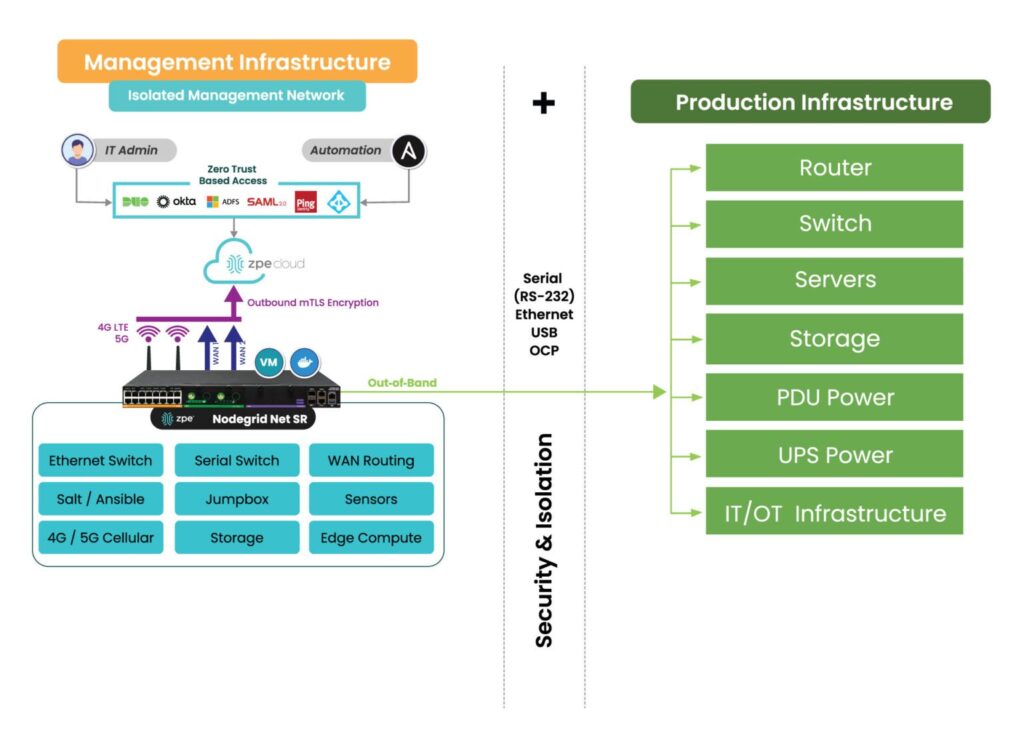
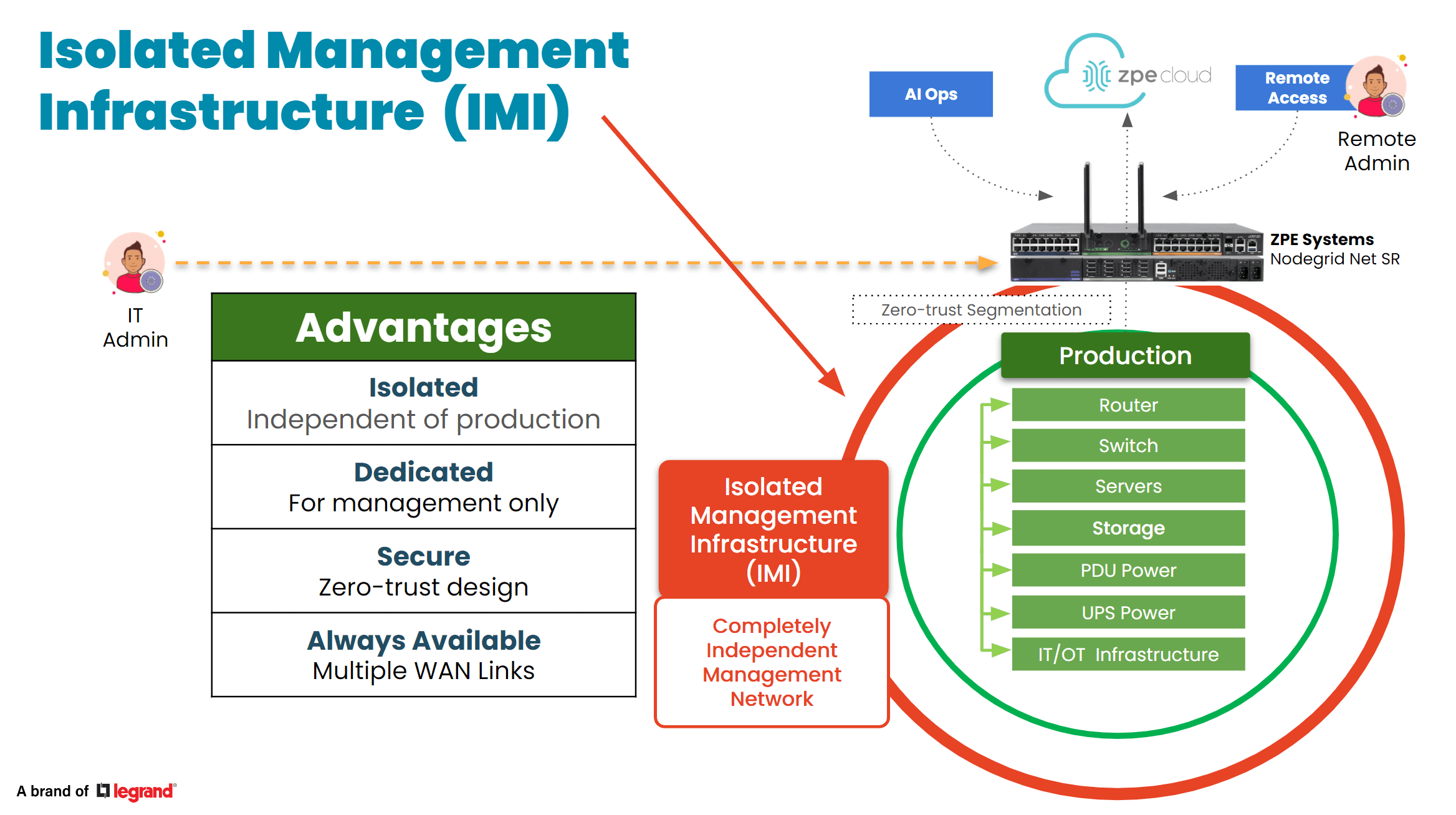
Instead, organizations are turning to a best practice architecture that has been used by hyperscalers and large enterprises for years. This solution is called Isolated Management Infrastructure. IMI creates a management network that is connected to but completely independent of production network equipment, an architecture that resembles out-of-band (OOB) management. This gives teams a lifeline to their main IT and OT systems, including servers, switches, sensors, controllers, and other critical assets, even when their main systems are offline.
IMI is a lifeline to production assets

Here’s how IMI and out-of-band management could have helped mitigate the effects of the American Water attack:

  • Enhanced Containment: By isolating the network used for system control and monitoring, OOB management could have ensured that even if the primary network was compromised, attackers would not have been able to access or disable key operational systems. This would have limited the need to shut down OT systems and prevented widespread operational disruption.
  • Faster Recovery: With isolated management infrastructure, administrators would have been able to access critical systems remotely, even during the attack. This capability enables faster diagnosis of the issue and restoration of services without relying on compromised networks. In the case of a ransomware attack, for example, OOB management can help initiate recovery operations from backups, minimizing downtime.
  • Reduced Attack Surface: By creating an independent network with fewer access points and stricter controls, OOB infrastructure reduces the chances of attackers exploiting vulnerabilities. It’s an additional layer of security that complicates attempts to breach sensitive control systems.
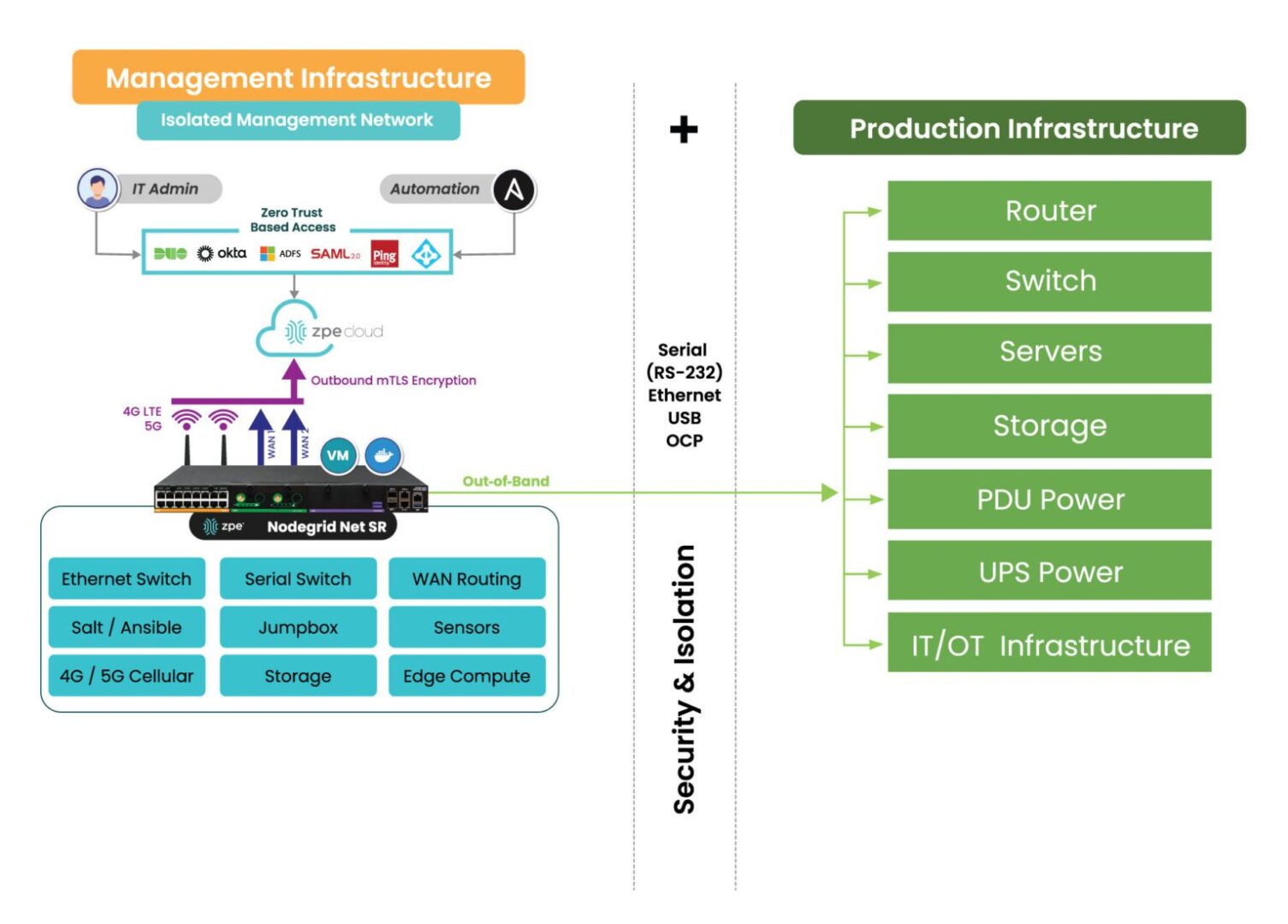
IMI with Nodegrid2

30-year cybersecurity expert James Cabe recently published a walkthrough of how to do this. Read his article, What to do if you’re ransomware’d, to see how to deploy the Gartner-recommended Isolated Recovery Environment that lets you fight through an active attack.

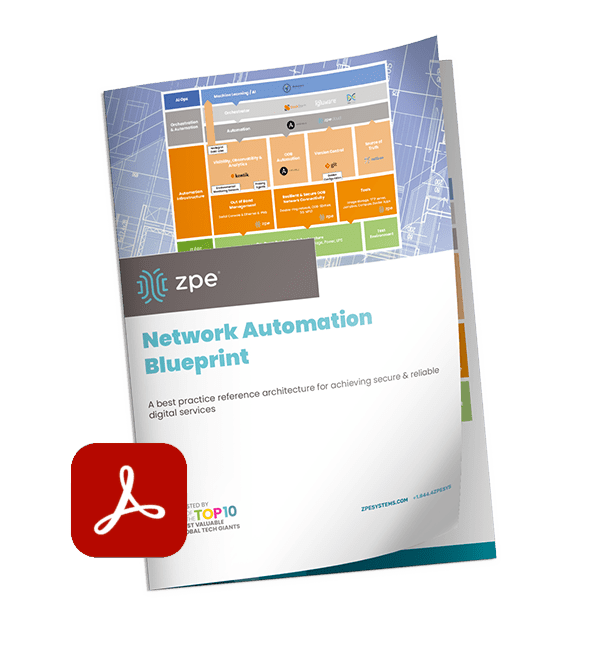
Get the Blueprint for Building IMI

The American Water cyberattack is another wake-up call for critical infrastructure providers to rethink their cybersecurity strategies. Isolated Management Infrastructure is the key approach to retaining control during an attack, but requires the robust capabilities of Generation 3 out-of-band to ensure rapid recovery. To help utilities and essential services fortify their infrastructure, ZPE Systems recently created a blueprint for building IMI. Download the blueprint now to follow the best practices architecture and become resilient against cyberattacks.

Using Isolated Management Infrastructure to Access the Debug Port of Open Compute Project (OCP) Devices in AI Deployments

Data center computers large facility with servers storage. Illustration AI Generative

As artificial intelligence (AI) workloads grow more demanding, data centers are turning to specialized hardware like Open Compute Project (OCP) cards to meet their needs.

OCP cards, known for their open-source architecture and scalability, have become popular in AI-driven infrastructures due to their flexibility and cost-efficiency.

However, managing and troubleshooting these cards — especially in large-scale AI deployments — can pose significant challenges, particularly when it comes to accessing debug ports for diagnostics.

In this post, we’ll explore how isolated management infrastructure (IMI) offers a secure and reliable solution for accessing the debug ports of OCP cards used in AI systems. We’ll also discuss the importance of debugging in AI, the obstacles that come with large-scale deployments, and the role of IMI in overcoming those hurdles.

OCP Cards in AI: A High-Performance Solution

Open Compute Project cards have become central to AI and machine learning (ML) environments due to their powerful compute capabilities, scalability, and open-source design. These cards are often integrated into large data centers tasked with training AI models, running inference operations, and handling massive data streams.

With OCP cards, companies can optimize their data center hardware for specific workloads without being tied to proprietary solutions. This open-source approach allows for flexibility in AI infrastructure, but it also introduces challenges when managing such hardware at scale, especially when components fail or need troubleshooting.

The Importance of Debugging and Monitoring in AI

Debugging and monitoring are critical components of maintaining AI infrastructure. AI model training, in particular, places heavy demands on hardware, making performance consistency a key factor. Any malfunction at the hardware or software level needs to be identified and resolved quickly to avoid costly downtime.

One way to troubleshoot hardware-related problems is by accessing the debug ports of OCP cards. Debug ports provide administrators with direct access to diagnostics, enabling them to monitor system health and perform necessary repairs. However, accessing these ports can be difficult, particularly in AI deployments where hardware is distributed across large data centers.

The Challenges of Accessing Debug Ports in AI Deployments

In a large AI deployment, accessing the debug ports of individual OCP cards can present several obstacles:

  • Physical Access: High-density data centers make it challenging for technicians to reach hardware components physically. In many cases, the OCP cards are housed in remote locations, requiring specialized tools for diagnostics.
  • Security Risks: Allowing unrestricted access to debug ports can introduce security vulnerabilities. If these ports are not properly secured, cyber attackers could exploit them to gain control of critical infrastructure.
  • Network Disruptions: During system failures, it can be difficult to access the network and troubleshoot the issue. When the primary network goes down, relying on that same network to manage hardware can delay recovery efforts and worsen the outage.

These challenges make it essential to adopt a secure, remote solution for managing OCP cards and their debug ports, especially when it comes to AI environments where any downtime can disrupt business-critical operations.

How Isolated Management Infrastructure (IMI) Works

Isolated management infrastructure (IMI) is a dedicated, separate network used exclusively for system management and maintenance. Unlike the primary network that handles day-to-day operations, the management network is isolated to ensure uninterrupted access to critical systems, even during outages or security incidents.

OOB management network isolation with the Nodegrid platform.

Image: Isolated Management Infrastructure physically separates management access from production assets.

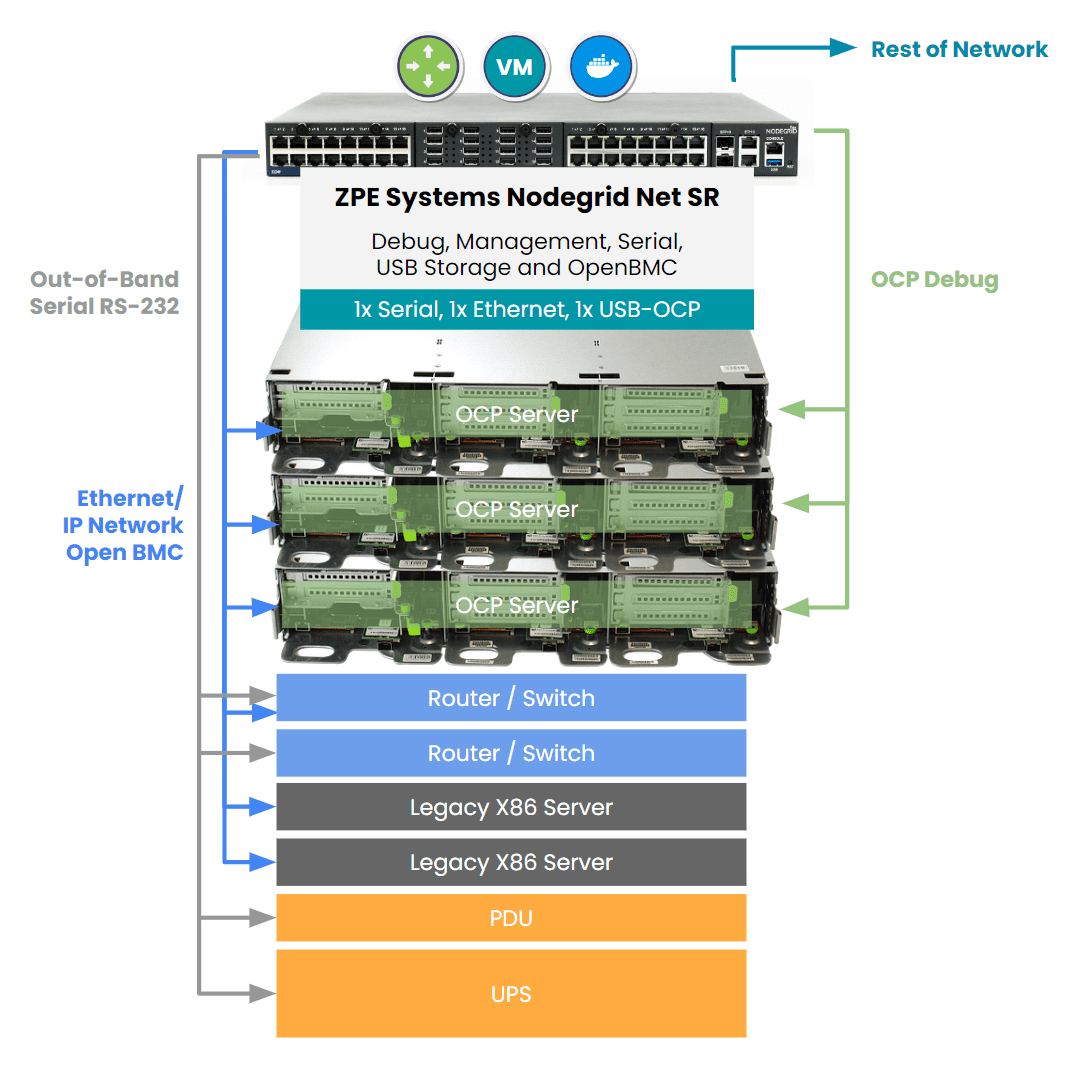
By implementing IMI, administrators can remotely access the debug ports of OCP cards without affecting the main production network. This setup not only secures the debug ports but also ensures that troubleshooting can be done in real-time, even if the primary network is down.

Benefits of Using IMI for OCP Debug Ports:

  • Secure, Controlled Access: Since the management network is isolated, it limits access to only authorized personnel. This reduces the chances of an attacker compromising critical hardware through exposed debug ports.
  • Reduced Downtime: IMI enables administrators to access, troubleshoot, and repair systems quickly, minimizing downtime during failures or performance issues. Even during major network outages, IMI ensures out-of-band (OOB) access to the OCP cards’ debug ports.
  • Lower Security Risks: By separating management traffic from regular operations, IMI reduces the attack surface. It becomes more difficult for hackers to use network vulnerabilities to gain unauthorized access to critical infrastructure.

Out-of-band management for OCP servers

Implementing Isolated Management for OCP Debug Access

To implement isolated management infrastructure for accessing the debug ports of OCP cards, follow these steps:

  • Network Segmentation: Physically separate your management network from the production network. Ensure that management traffic is not routed through the same pathways used for regular operations.
  • Use Out-of-Band Management Devices: Deploy dedicated OOB management hardware that allows for remote access and control of the OCP cards, even when the primary network is unavailable. This can include IPMI (Intelligent Platform Management Interface) or SSH (Secure Shell) for secure communication.
  • Integrate with Monitoring Systems: Combine IMI with automated monitoring and alerting systems. This way, any anomaly detected in the AI environment will trigger a response, allowing administrators to quickly access the OCP card’s debug port for diagnostics.

Security Benefits of Isolated Management Infrastructure

In addition to improving accessibility, IMI enhances security across the board in AI environments. Here’s how: 

  • Limited Access Points: Isolating management infrastructure limits the number of entry points for attackers, significantly reducing the attack surface.
  • Controlled User Access: Only authorized users can access the isolated network, meaning that internal threats and insider attacks are also mitigated.
  • Compliance and Auditing: For industries with strict regulatory requirements, IMI provides clear documentation and control over system access, helping organizations meet compliance standards and pass security audits.

Real-World Example

Consider a scenario in a data center where an AI model’s training process experiences sudden instability. The system administrator, located remotely, uses IMI to securely access the OCP card’s debug port through an OOB management interface.

The problem is quickly diagnosed and resolved without needing physical access to the hardware, minimizing downtime and ensuring that the AI model’s training can continue uninterrupted.

Deploy IMI with Nodegrid to Strengthen AI Environments

As AI infrastructures grow, so do the risks and complexities associated with managing them. The October 2024 cyberattack on American Water, which impacted their operational technology and water distribution, highlights the need for robust, secure, and isolated management networks to avoid large-scale disruptions.

By integrating isolated management infrastructure into your AI data center, you can ensure quick access to critical systems like OCP devices, reduce the impact of system failures, and improve security. ZPE Systems’ Nodegrid is a Gen 3 out-of-band management platform that allows you to deploy IMI in your data center environment, and it’s the only out-of-band management built to manage OCP cards. It can integrate or directly host third-party applications for automation, security, and much more, consolidating an entire tech stack into a single, cost-efficient solution.

Schedule a demo to see how Nodegrid gives remote access to OCP cards and strengthens your AI deployments.

Top 5 Data Center Mistakes and How To Avoid Them

Top 5 Data Center Mistakes and How To Avoid Them

Data center deployments require careful planning and execution. The sheer complexity makes it easy to stumble into common pitfalls that can compromise uptime, security, and scalability. After talking with hundreds of customers, we’ve compiled the top five data center mistakes organizations often make during deployments, with tips on how to avoid them.

1. Overlooking Isolated Management Infrastructure

In the data center, the focus is bringing production infrastructure online, including power, cabling, racks, servers, and network gear. But many project managers and architects say they wished they’d given more attention to setting up proper management infrastructure. This oversight usually leads to business challenges down the line, especially when management access relies on the production infrastructure. When a device fails or goes offline, there’s no choice but to go on-site to manually troubleshoot and recover. Many professionals admit to making this data center mistake and wish that they had considered this early in the planning process. Incorporating something called Isolated Management Infrastructure from the start can avoid this challenge, since it provides a dedicated management plane through which teams can access production gear without relying on the production network. 

Tip: Make management infrastructure a priority in your initial planning stages. This proactive approach can prevent complications later.

IMI

2. Neglecting Automation for Configuration and Scaling

Many data center implementors focus heavily on the “rack and stack” initial setup, but fail to automate processes for configuration and scaling operations. This data center mistake often leads to days’ or weeks’ worth of manual, repetitive work, while also exposing the organization to human error. A lot of people we talked to wish they’d invested just a few weeks into automating essential tasks such as switch setup, VLAN configurations, and IP address assignments, which would have saved them lots of time later on and likely helped to prevent errors. Additionally, if rearchitecting is needed, automated systems allow for quick reimplementation, minimizing the time and complexity involved. 

Tip: Dedicate time to automating routine processes. This investment will pay off in enhanced operational efficiency and reduced human error.

3. Inadequate Out-of-Band Management

When people think of out-of-band (OOB) management, a common misconception is that it is solely about Ethernet switches. However, it’s crucial not to overlook the importance of having management access to your entire device stack. Low-level access can be essential for system recovery and management. The recent CrowdStrike outage is a perfect example – when the failed devices needed to be reimaged, typical out-of-band management solutions were inadequate at providing this type of low-level access. Generation three out-of-band serial consoles, like the Nodegrid Net SR, give Ethernet, serial, and USB access, allowing teams to remote-in at the BIOS level to revive failed devices. Using this kind of comprehensive out-of-band – on a fully isolated management plane – helps teams remotely recover and confidently automate processes.

Tip: Ensure that your OOB strategy includes robust serial console access to enhance system reliability and recovery capabilities.

IMI with Nodegrid2

4. Ignoring Security Best Practices

Zero trust security is no longer just advisable, it’s essential. The typical approach is to establish direct connectivity to devices to configure, troubleshoot, upgrade, etc. But this comes with unnecessary risks, often exposing management ports to the Internet and leaving you at risk of attack. Without a fully isolated management plane and zero trust security controls, how would you recover if you were ransomware’d? This is why it’s essential to implement security controls like role-based access and multi-factor authentication, and ensure complete separation of management and production networks. 

Tip: Prioritize security by adopting a zero-trust approach and implementing rigorous access controls to safeguard your data center.

5. Cutting Corners on Out-of-Band Management

In the race for implementing AI, it’s crucial to invest in AI data center infrastructure. But organizations often cut corners on their ability to manage the underlying infrastructure that powers AI. Management access should not stop at ethernet switches; it should extend to encompass serial console access, PDUs, jump boxes, 5G connectivity, routing, WAN links, and a centralized cloud hub with secure tunnels to colocation sites. Using a comprehensive and centralized platform like Nodegrid consolidates many management devices into one while giving remote control to optimize AI’s underlying infrastructure. Aside from enhancing efficiency, this approach minimizes waste and energy consumption, which addresses environmental, social, and governance (ESG) concerns. 

Tip: Avoid the partial out-of-band management deployment. A complete system not only supports resilience and security but also contributes to sustainability goals.


Addressing these common data center mistakes can significantly enhance operational efficiency, security, and scalability. By prioritizing management infrastructure, automating processes, ensuring adequate out-of-band access, implementing robust security measures, and investing wisely in management systems, organizations can build resilient data centers equipped to meet the demands of today and the future.

See ZPE Cloud in action with this video demo

Senior Sales Engineer Marcel van Zwienen gives you a hands-on demo of ZPE Cloud in this video. Watch Marcel take you from signing in to gaining remote access for troubleshooting, to showing how to apply configuration changes automatically across device fleets. Watch now at the link below.

Use Our Blueprint to Avoid Data Center Mistakes

Our blueprint shows how to deploy an isolated management infrastructure, which gives you secure remote access to recover from outages and automate operations. Download now for the complete guide.

AI Data Center Infrastructure

ZPE Systems – AI Data Center Infrastructure
Artificial intelligence is transforming business operations across nearly every industry, with the recent McKinsey global survey finding that 72% of organizations had adopted AI, and 65% regularly use generative AI (GenAI) tools specifically. GenAI and other artificial intelligence technologies are extremely resource-intensive, requiring more computational power, data storage, and energy than traditional workloads. AI data center infrastructure also requires high-speed, low-latency networking connections and unified, scalable management hardware to ensure maximum performance and availability. This post describes the key components of AI data center infrastructure before providing advice for overcoming common pitfalls to improve the efficiency of AI deployments.

AI data center infrastructure components

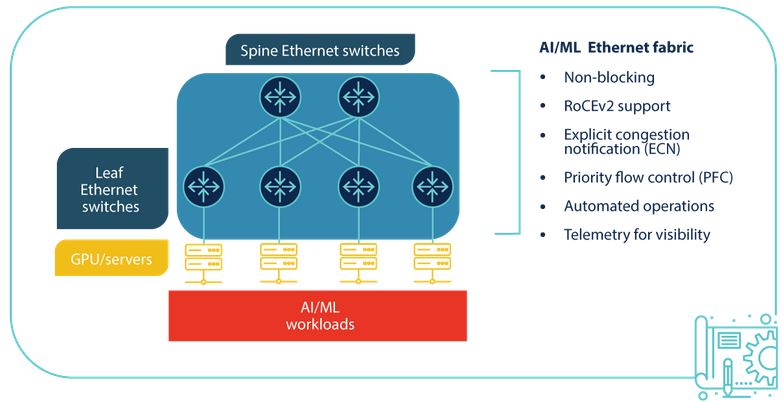
A diagram of AI data center infrastructure.

Computing

Generative AI and other artificial intelligence technologies require significant processing power. AI workloads typically run on graphics processing units (GPUs), which are made up of many smaller cores that perform simple, repetitive computing tasks in parallel. GPUs can be clustered together to process data for AI much faster than CPUs.

Storage

AI requires vast amounts of data for training and inference. On-premises AI data centers typically use object storage systems with solid-state disks (SSDs) composed of multiple sections of flash memory (a.k.a., flash storage). Storage solutions for AI workloads must be modular so additional capacity can be added as data needs grow, through either physical or logical (networking) connections between devices.

Networking

AI workloads are often distributed across multiple computing and storage nodes within the same data center. To prevent packet loss or delays from affecting the accuracy or performance of AI models, nodes must be connected with high-speed, low-latency networking. Additionally, high-throughput WAN connections are needed to accommodate all the data flowing in from end-users, business sites, cloud apps, IoT devices, and other sources across the enterprise.

Power

AI infrastructure uses significantly more power than traditional data center infrastructure, with a rack of three or four AI servers consuming as much energy as 30 to 40 standard servers. To prevent issues, these power demands must be accounted for in the layout design for new AI data center deployments and, if necessary, discussed with the colocation provider to ensure enough power is available.

Management

Data center infrastructure, especially at the scale required for AI, is typically managed with a jump box, terminal server, or serial console that allows admins to control multiple devices at once. The best practice is to use an out-of-band (OOB) management device that separates the control plane from the data plane using alternative network interfaces. An OOB console server provides several important functions:

  1. It provides an alternative path to data center infrastructure that isn’t reliant on the production ISP, WAN, or LAN, ensuring remote administrators have continuous access to troubleshoot and recover systems faster, without an on-site visit.
  2. It isolates management interfaces from the production network, preventing malware or compromised accounts from jumping over from an infected system and hijacking critical data center infrastructure.
  3. It helps create an isolated recovery environment where teams can clean and rebuild systems during a ransomware attack or other breach without risking reinfection.

An OOB serial console helps minimize disruptions to AI infrastructure. For example, teams can use OOB to remotely control PDU outlets to power cycle a hung server. Or, if a networking device failure brings down the LAN, teams can use a 5G cellular OOB connection to troubleshoot and fix the problem. Out-of-band management reduces the need for costly, time-consuming site visits, which significantly improves the resilience of AI infrastructure.

AI data center challenges

Artificial intelligence workloads, and the data center infrastructure needed to support them, are highly complex. Many IT teams struggle to efficiently provision, maintain, and repair AI data center infrastructure at the scale and speed required, especially when workflows are fragmented across legacy and multi-vendor solutions that may not integrate. The best way to ensure data center teams can keep up with the demands of artificial intelligence is with a unified AI orchestration platform. Such a platform should include:

  • Automation for repetitive provisioning and troubleshooting tasks
  • Unification of all AI-related workflows with a single, vendor-neutral platform
  • Resilience with cellular failover and Gen 3 out-of-band management.

To learn more, read AI Orchestration: Solving Challenges to Improve AI Value

Improving operational efficiency with a vendor-neutral platform

Nodegrid is a Gen 3 out-of-band management solution that provides the perfect unification platform for AI data center orchestration. The vendor-neutral Nodegrid platform can integrate with or directly run third-party software, unifying all your networking, management, automation, security, and recovery workflows. A single, 1RU Nodegrid Serial Console Plus (NSCP) can manage up to 96 data center devices, and even extend automation to legacy and mixed-vendor solutions that wouldn’t otherwise support it. Nodegrid Serial Consoles enable the fast and cost-efficient infrastructure scaling required to support GenAI and other artificial intelligence technologies.

Make Nodegrid your AI data center orchestration platform

Request a demo to learn how Nodegrid can improve the efficiency and resilience of your AI data center infrastructure.
 Contact Us

Why Securing IT Means Replacing End-of-Life Console Servers

Rene Neumann – Why Securing IT Means Replacing End of Life Console Servers


The world as we know it is connected to IT, and IT relies on its underlying infrastructure. Organizations must prioritize maintaining this infrastructure; otherwise, any disruption or breach has a ripple effect that takes services offline for millions of users (take 2024’s CrowdStrike outage, for example). A big part of this maintenance is ensuring that all hardware components, including console servers, are up-to-date and secure. Most console servers reach end-of-life (EOL) and need to be replaced, but for many reasons, whether budgetary concerns or the “if it isn’t broken” mentality, IT teams often keep their EOL devices. Let’s look at the risks of using EOL console servers, and why replacing them goes hand-in-hand with securing IT.

The Risks of Using End-of-Life Console Servers

End-of-life console servers can undermine the security and functionality of IT systems. These risks include:

1. Lack of Security Features and Updates

Aging console servers lack adequate hardware and management security features, meaning they can’t support a zero trust approach. On top of this, once a console server reaches EOL, the manufacturer stops providing security patches and updates. The device then becomes vulnerable to newly discovered CVEs and complex cyberattacks (like the MOVEit and Ragnar Locker breaches). Cybercriminals often target outdated hardware because they know that these devices are no longer receiving updates, making them easy entry points for launching attacks.

2. Compliance Issues

Many industries have stringent regulatory requirements regarding data security and IT infrastructure. DORA, NIS2 (EU), NIST2 (US), PCI 4.0 (finance), and CER Directive are just a few of the updated regulations that are cracking down on how organizations architect IT, including the management layer. Using EOL hardware can lead to non-compliance, resulting in fines and legal repercussions. Regulatory bodies expect organizations to use up-to-date and secure equipment to protect sensitive information.

3. Prolonged Recovery

EOL console servers are prone to failures and inefficiencies. As these devices age, their performance deteriorates, leading to increased downtime and disruptions. Most console servers are Gen 2, meaning they offer basic remote troubleshooting (to address break/fix scenarios) and limited automation capabilities. When there is a severe disruption, such as a ransomware attack, hackers can easily access and encrypt these devices to lock out admin access. Organizations then must endure prolonged recovery (like the CrowdStrike outage, or 2023’s MGM attack) because they need to physically decommission and restore their infrastructure.


The Importance of Replacing EOL Console Servers

Here’s why replacing EOL console servers is essential to securing IT:

1. Modern Security Approach

Zero trust is an approach that uses segmentation across IT assets. This ensures that only authorized users can access resources necessary for their job function. This approach requires SAML, SSO, MFA/2FA, and role-based access controls, which are only supported by modern console servers. Modern devices additionally feature advanced security through encryption, signed OS, and tampering detection. This ensures a complete cyber and physical approach to security.

2. Protection Against New Threats

New CVEs and evolving threats can easily take advantage of EOL devices that no longer receive updates. Modern console servers benefit from ongoing support in the form of firmware upgrades and security patches. Upgrading with a security-focused device vendor can drastically shrink the attack surface, by addressing supply chain security risks, codebase integrity, and CVE patching.

3. Ease of Compliance

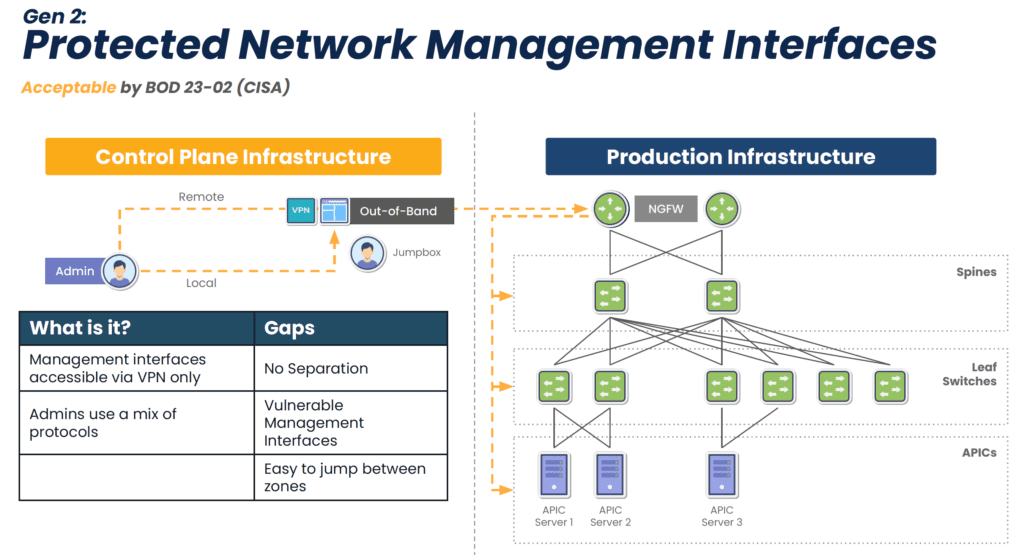
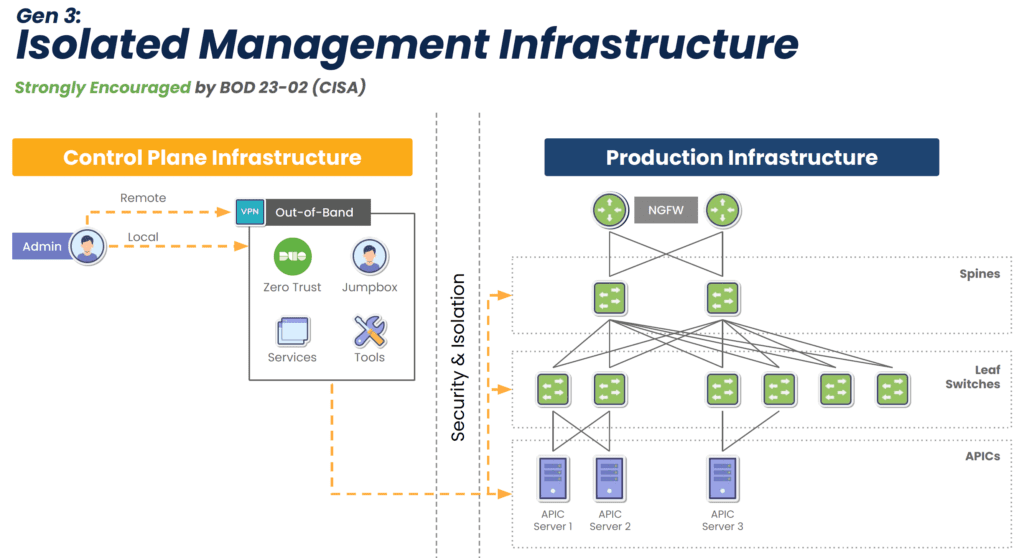
EOL devices lack modern security features, but this isn’t the only reason why they make it difficult or impossible to comply with regulations. They also lack the ability to isolate the control plane from the production network (see Diagram 1 below), meaning attackers can easily move between the two in order to launch ransomware and steal sensitive information. Watchdog agencies and new legislation are stipulating that organizations follow the latest best practice of separating the control plane from production, called Isolated Management Infrastructure (IMI). Modern console servers make this best practice simple to achieve by offering drop-in out-of-band that is completely isolated from production assets (see Diagram 2 below). This means that the organization is always in control of its IT assets and sensitive data.

A network diagram showing Gen 2 out-of-band is vulnerable to the internet

Diagram 1: Though an acceptable approach, Gen 2 out-of-band lacks isolation and leaves management interfaces vulnerable to the internet.

A network diagram showing how Gen 3 out-of-band secures network and management interfaces.

Diagram 2: Gen 3 out-of-band fully isolates the control plane to guarantee organizations retain control of their IT assets and sensitive info.

4. Faster Recovery

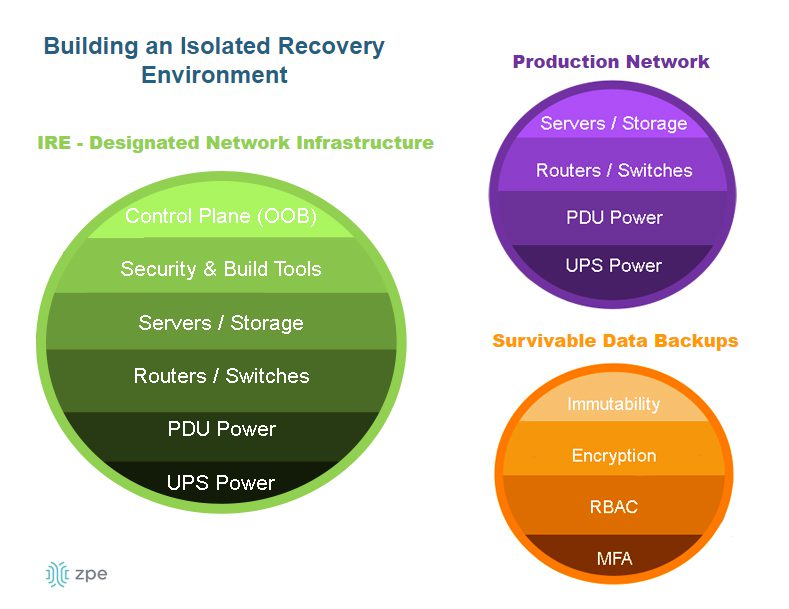
New console servers are designed to handle more workloads and functions, which eliminates single-purpose devices and shrinks the attack surface. They can also run VMs and Docker containers to host applications. This enables what Gartner calls the Isolated Recovery Environment (IRE) (see Diagram 3 below), which is becoming essential for faster recovery from ransomware. Since the IMI component prohibits attackers from accessing the control plane, admins retain control during an attack. They can use the IMI to deploy their IRE and the necessary applications — remotely — to decommission, cleanse, and restore their infected infrastructure. This means that they don’t have to roll trucks week after week when there’s an attack; they just need to log into their management infrastructure to begin assessing and responding immediately, which significantly reduces recovery times.

A diagram showing the components of an isolated recovery environment.

Diagram 3: The Isolated Recovery Environment allows for a comprehensive and rapid response to ransomware attacks.

Get a Walkthrough of IMI and IRE

Let’s cover what IMI and IRE would look like in your environment and walk through some outage recovery scenarios. Use the link below to set up a technical discussion.

Meet Me at Cisco Live Amsterdam 2026

Visit booth C10 at Cisco Live Amsterdam to chat about IMI, IRE, and replacing end-of-life console servers. You can also catch my 10-minute presentation on Wednesday, February 11 at 1:50pm in the Speakers Corner. I’ll cover From Pilot Projects to Global Rollouts: Why Out-of-Band Management is Crucial for Scaling AI Infrastructure, with more concepts and network diagrams showing how to achieve true resilience. Visit our Cisco Live page below to let me know you’re coming. See you at the show!

Rene Neumann presents at Cisco Live Amsterdam 2026