Providing Out-of-Band Connectivity to Mission-Critical IT Resources

Home » Edge Computing » Page 7

99.999% Uptime for a Top-10 Engineering School

Providing low-level remote access and automation saves hundreds of hours per month for the university’s small IT team

One of the largest universities in the United States fosters academics and research for nearly 40,000 students, staff, and researchers. The university sits among the top 10 schools for engineering, and heavily integrates technology into all disciplines, including engineering, computer sciences, and agricultural studies.

The university received a grant to expand, update, and connect their network of campuses, while enhancing infrastructure and mobility, resiliency, and campus amenities.  But having more than 200 on-campus buildings presents a challenge. The campus is home to academic facilities as well as a hospital, airport, 60,000-seat sports stadium, and dozens of leased spaces for local businesses. This makes the university equivalent to a small city, and its network infrastructure is what keeps it all connected.

Their small IT team was responsible for maintaining more than 10,000 management devices, most of which were long past EOL and frequently failing. They needed a refresh, but with a solution that could also reduce the hundreds of hours they spent every month on travel and on-site work. To maximize their day-to-day efficiency, they required a solution that could overcome these operational gaps:

  • Reducing the 100-150 hours of monthly travel times, by giving engineers the ability to fully access their stack remotely
  • Reducing the 80-120 hours of monthly on-site work required to maintain the 99.999% SLA, by automating manual jobs such as patching and firmware upgrades
  • Expanding their management headroom and use-case adaptability, by migrating to IPv6 and reducing the existing 6RU device stack

Download the full case study to see how ZPE’s Nodegrid hardware and software solved these problems.

EngineeringSchoolCover

Download the full case study

Problems and Gaps

The university is one of the largest in the United States. It sits among the nation’s top 50 schools for research expenditures, and heavily integrates technology into all disciplines, including engineering. Its main campus is home to more than 200 buildings that sit on over 2,500 acres of land. The campus is essentially a small city, and the university’s network infrastructure keeps it all connected.

This network infrastructure, however, was well beyond EOL and in disrepair. But rather than simply upgrade to newer devices, the university’s small IT team wanted to improve the overall quality of life well into the future. This meant addressing three gaps:

  • Inefficient management at scale — Each engineer spent an average of ten hours per month on travel alone, just to traverse the campus’ wide footprint and get to each MDF/IDF closet.
  • Too much focus on ops — The aging infrastructure was on the brink of collapse and required each engineer to spend eight hours per month in on-site work, just to keep devices running.
  • Too many devices — The infrastructure includes roughly 10,000 devices to manage, which was exhausting IP on their limited IPv4 network and too rigid to fit in tight spaces, like their remote farm closets and research labs.

Solution

The university deployed the full lineup of Nodegrid devices, including the Nodegrid Serial Console, Nodegrid Services Routers, and Nodegrid Manager. These allowed them to overcome all three gaps using remote management, automation, and consolidated functionality, to save engineers hundreds of hours every month. Download the full case study to see the complete solution and benefits.

Need Help Replacing End-of-Life Gear?

Check out our complete products and services package to make your EOL transition seamless. Choose from a variety of Synopsys-validated devices, get a generous trade-in discount, and let our engineers install and configure into your environment. Click below to explore this offer and more customer case studies.

Network Automation Cost Savings Calculator

automation cost savings calculator
Many organizations feel continuous financial pressure to cut costs and streamline operations due to economic factors like the ongoing threat of a recession and global supply chain interruptions. Network automation can help companies across all industries save money during lean financial times. A recent Cisco and ACG Research study found that network automation can reduce OPEX by 55% by streamlining workflows such as device provisioning and service ticket management. Though they aren’t mentioned in the study, additional savings are generated by using automation to avoid outages and accelerate recovery efforts.

This post discusses how to save money through automation and provides a network automation cost savings calculator for a more customized estimate of your potential ROI.


Table of contents

How network automation provides cost savings

Network automation reduces costs by streamlining operations, preventing outages, and aiding in backup and recovery workflows.

Network automation saves money by solving problems

Problem: High OPEX

Solution: Automation tackles repetitive tasks like new installs and ticketing operations, which helps you generate revenue sooner and reduce the time and resources spent on maintaining operations.

Problem: Too many outages

Solution: Automation allows teams to be proactive by leveraging critical data to identify potential problems before they cause outages, freeing them from the typical break/fix approach.

Problem: Slow recovery

Solution: Automation speeds up processes like backups, snapshotting, and device re-imaging, which makes networks more resilient by accelerating recovery from outages and ransomware.

Reduces OPEX

The focus of the Cisco/ACG study was the economic benefits of streamlining network operations through automation. For example, the OPEX (operational expenditure) involved in spinning up a new branch is too high because deployments require so much work, time, and staff. Using automation to provision and deploy new resources can significantly reduce the time it takes to spin up a new branch, which means the site could start generating revenue much sooner. Using automation to monitor device health and environmental conditions could extend the life expectancy of critical (and expensive) equipment while reducing the number of on-site staff needed to maintain that equipment.

Network automation reduces OPEX by increasing the efficiency of repetitive or tedious tasks like new installs, incident management, and device monitoring. Crucially, automation does so without reducing the quality of service for end users and often only improves the speed, reliability, and overall experience.

Prevents outages

Network downtime is an expense that cash-strapped businesses can’t afford to bear. According to a recent ITIC survey, a single hour of downtime costs most organizations (91%) over $300,000 in lost business, with 44% of enterprises reporting outage costs exceeding $1 million. However, preventing downtime is difficult when most network teams are caught in a reactive break/fix cycle because they lack the staffing, resources, and technology required to maintain visibility and identify issues before they occur.

Network automation solves this problem using advanced machine learning algorithms to analyze monitoring data and identify potential issues before they cause outages. For example, AIOps (artificial intelligence for IT operations) solutions provide real-time analysis of infrastructure, network, and security logs. AIOps is adept at recognizing patterns and detecting anomalies in data so that it can identify issues before they affect the performance or reliability of the network.

Accelerates recovery

While network automation helps to reduce downtime, it can’t eliminate outages altogether. When outages do occur, recovery is often a long, drawn-out process involving a lot of manual work, during which time revenue and customer faith may be lost. Network resilience is the ability to quickly recover from ransomware, equipment failures, and other causes of downtime with as little impact as possible on end users and business revenue. Automation speeds up recovery efforts in a few critical ways:

  • Streamlined backups – Automation makes performing regular backups and snapshots easier, reducing the risk of gaps or inaccuracies.
  • Reduced imaging delays – Automatic provisioning ensures that clean systems are spun up quickly so that business can resume as soon as possible.
  • Faster failover – Automatic network failover and routing technologies can reroute traffic around downed nodes before a human admin has time to respond, providing a more seamless end-user experience.

Network automation is a direct source of cost savings because it reduces OPEX without negatively impacting the business or customer experience. Automation also indirectly saves money by helping organizations avoid outages through proactive monitoring and maintenance. In addition, network automation technologies make businesses more resilient by speeding up recovery efforts when breaches and failures do occur.

Network automation cost savings calculator

ZPE Systems provides network and infrastructure automation solutions for any use case, pain point, or technological need. ZPE’s vendor-neutral platform allows you to extend automation to every device on your network, including legacy and mixed-vendor solutions, so that you can achieve true end-to-end automation (a.k.a. hyperautomation). For a customized estimation of how much money you can save by automating your network operations with ZPE Systems, check out our network automation cost savings calculator.

Ready to Learn More?

For help with the network automation cost savings calculator or to learn more about automating your network operations, contact ZPE Systems today.

Contact Us

Cisco 2900 EOL: Replacement Options

cisco 2900 eol

The Cisco ISR 2900 series of branch routers went EOS (end-of-sale) on the 9th of December 2017, and Cisco concluded support on the 31st of December 2022. In this guide, we’ll compare migration options for the Cisco ISR 2900 EOL models to help you select a solution that supports your business use case, deployment size, and future growth.

Disclaimer: This comparison was written by a third party in collaboration with ZPE Systems using data gathered from publicly available data sheets and admin guides, as of 5/12/2023. Please email us if you have corrections or edits, or want to review additional attributes: Matrix@zpesystems.com


Table of Contents

Cisco ISR 2900 overview

The Cisco ISR 2900 is a line of enterprise gateway routers designed for branch and edge networking. It’s a modular solution that can be expanded with optional Network Interface Modules (NIMs) and Service Modules (SMs) for more functionality. There are two primary use cases for the 2900:

Converged branch networking – The ISR 2900 easily integrates with Cisco’s SD-WAN, SD-Branch, cloud security, and DNA network management software, can be extended with optional modules for added hardware capabilities, and supports NFV (network functions virtualization) for all-in-one branch networking.

Out-of-band (OOB) management – Using serial port modules, the ISR 2900 turns into an out-of-band (OOB) serial console solution that provides remote management access to the control plane of branch infrastructure.

The ISR 2900 is officially EOL as of the 31st of December 2022. The EOL models include all 2901, 2911, 2921, and 2951 ISR product SKUs.

Looking for replacement options for your other Cisco ISR EOL products? Read our guide to Cisco ISR EOL Replacement Options.


Cisco 2900 EOL replacement options

The discontinuation of the Cisco 2900 has left many organizations looking for migration options. Let’s compare two direct replacements from Cisco before discussing alternative options that deliver better branch management capabilities and greater opportunities for automation.

Cisco ISR 1100

Cisco ISR 1100 is a series of enterprise branch routers, though in this comparison we’re only looking at the models that support SD-WAN and thus serve as direct replacements for the discontinued 2900 models. The capabilities of the 1100 series vary, mostly because only some of the models are modular. For example, the fixed form-factor 1100-4G/4G LTE models have cellular functionality but offer fewer networking and security features. Conversely, the 1161X-8P and 112x-8P models are modular and can be extended with optional modules (like cellular for the 1161X or terminal server ports for the 112x-8P).

Even with these expansions, the compact ISR 1100s are best suited for smaller deployments in branch offices or small, provider-managed edge data centers. If your organization uses the ISR 2900 for converged branch networking, the 1100s are the closest Cisco replacement, though it supports OOB serial modules as well.

Cisco Catalyst C8300

The Cisco Catalyst C8300 series is a modular branch and edge networking solution, though due to its large size, it’s sometimes used as a primary on-premises gateway router. There are four models to choose from – two 2RU units with 2 SM and 2 NIM slots, and two 1RU units with 1 SM and 1 NIM slot. Each chassis comes with 6 embedded Layer3 Ethernet ports (1 Gbps and/or 10 Gbps) as well as a console port and USB port. All other port configurations and capabilities come via Cisco expansion modules, including options for 5G/4G cellular.

The Catalyst C8300 is a big, robust solution that’s designed for medium to large deployments such as campuses, colocation sites, and AI/machine learning data centers. The C8300 is primarily a converged branch networking solution like the ISR 1100 series, but it provides OOB management with optional serial cards.

Cisco 2900 replacement option comparison table


Cisco ISR 2900 (EOL)

Cisco ISR 1100

Cisco Catalyst 8300

Nodegrid Net SR

Nodegrid Serial Console Plus

Form Factor

1-2 RU

Desktop-1RU

1-2 RU

1 RU

1 RU

Max IPsec Throughput

Not defined

Up to 18.8 Gbps

Up to 18.8 Gbps

600 Mbps – 1.2 Gbps

600Mbps

Total Onboard WAN or LAN 10/100/1000 Ports

2-3

4-6

4-6

2

2

Total Onboard WAN or LAN 10Gbps Ports

0

0

0-2

2

2

WAN Ports

2-3

0-6

2-6

1+, configurable

0-4

LAN Ports

2-3

0-6

2-6

4-84

0-4

Slots

2-3

0-1

2-4

5

0

Default Memory

512 MB

4 GB

8 GB

8 GB

4 GB

Max Memory

2 GB

8 GB

32 GB

64 GB

16 GB

Compute

UCS-E Card

On-board, Compute card

On-board

OOB Capabilities

Requires Serial Card

Requires Serial Card

Requires Serial Card

Included

Included

Environmental Monitoring

N/A

N/A

N/A

Included

Included

For users looking for a Cisco solution to replace their EOL ISR 2900, the ISR 1100 series and Catalyst C8300 are the closest direct replacements. However, both product lines suffer from a major limitation – they aren’t vendor-neutral.

While Cisco routers integrate with some third-party partners, they do not support custom or third-party applications for automation and orchestration, which limits you to the automation offered by Cisco’s software. This lack of open integrations increases the chances that a Cisco solution won’t be able to hook into all the hardware and software components of a distributed and multi-vendor network architecture.

For example, if you utilize different SD-WAN and next-generation firewall (NGFW) vendors at some of your remote sites, Cisco’s automation may not extend to these devices. That means you’ll need to send out technicians to all remote sites (which could number in the dozens or hundreds) just to set up these services when you otherwise could have deployed them automatically.

Want to learn more about breaking free of locked ecosystems? Read The Benefits of Vendor Agnostic Platforms in Network Management

When network solutions like the Cisco 2900 go EOL, it’s the perfect opportunity to look for alternative options that provide the functionality you need without locking you into an ecosystem or limiting your automation capabilities.

Cisco 2900 direct replacement options from ZPE Systems

ZPE Systems provides a line of vendor-neutral solutions for branch and edge networking called Nodegrid. The Nodegrid Net Services Router (NSR) and Nodegrid Serial Console Plus (NSCP) serve as direct replacements for Cisco 2900 EOL products.

Nodegrid Net Services Router (NSR)

The Nodegrid NSR is a modular branch networking solution that you can customize to increase your terminal server ports, storage space, processing power, or switch ports. The NSR delivers converged branch networking capabilities like SD-WAN, SD-Branch, and NFVs, plus it can host your choice of custom and third-party applications for automation, security, and more.

While the NSR is the perfect converged branch solution to replace the Cisco ISR 2900, it also provides 3rd generation (or Gen 3) OOB management. That means Nodegrid’s OOB network is completely vendor-neutral and can extend automation capabilities to all your legacy and mixed-vendor infrastructure for efficient deployments, management, and orchestration.

Want to see the Nodegrid converged branch networking solution in action? Watch a Demo

Nodegrid Serial Console Plus (NSCP)

The NSCP is a robust, scalable branch networking and out-of-band serial console solution. The NSCP comes in 16-, 32-, 48-, and 96-port models, so you can choose the solution that’s right-sized to your deployment and use case. Plus, you can get built-in 5G/4G LTE and Wi-Fi options for failover and out-of-band.

Like the NSR, the NSCP is also an open platform that can run your choice of software to expand your capabilities and reduce your tech stack. Like the NSR, the NSCP delivers Gen 3 OOB management of all connected infrastructure, enabling true end-to-end automation in data centers, branches, and other remote sites. The NSCP is the perfect replacement for enterprises utilizing the Cisco 2900 for out-of-band management, though it also provides converged branch networking capabilities at any scale.

All Nodegrid devices run the open, Linux-based Nodegrid OS which can host your choice of third-party or custom applications, freeing you from vendor lock-in. You can even integrate infrastructure orchestration tools like Puppet, Chef, and Ansible to extend automation to end devices, regardless of vendor. This is what makes Nodegrid the world’s first Gen 3 branch networking solution.

Want to see how Nodegrid stacks up against Cisco’s replacement options? Click here to download the services routers comparative matrix.

Global support and supply chain

Leaving a trusted ecosystem behind to adopt alternative options can be risky, so it’s important to find a vendor that offers the support you need to make the transition and keep your operations running smoothly. ZPE Systems offers global product support using the “follow the sun” model, which means you get support when you need it, regardless of your timezone. You also won’t have to worry about supply chain issues causing stock shortages – ZPE supplies hyperscalers in 10K+ units per quarter and has great, consistent supply chain control.

Need to replace your Cisco 2900 EOL?

To learn more about replacing your Cisco 2900 EOL solution with the vendor-neutral Nodegrid platform and our shipping in as little as two weeks, contact ZPE Systems today. Contact Us

Cisco 2900 EOL product tables with migration SKUs

Cisco 2900 EOL Model

In Scope Features

Replacement Product (modular form factor)

Cisco ISR 2901

Cisco ISR 2911

Cisco ISR 2921

Cisco ISR 2951

Serial Console Module, Routing, 16 serial ports

ZPE-NSR-816-DAC with 1 x 16 port serial module 1 x ZPE-NSR-16SRL-EXPN

Cisco ISR 2901

Cisco ISR 2911

Cisco ISR 2921

Cisco ISR 2951

Serial Console Module, Routing, 32 serial ports

ZPE-NSR-816-DAC with 2×16 port serial module 2x ZPE-NSR-16SRL-EXPN

Cisco ISR 2901

Cisco ISR 2911

Cisco ISR 2921

Cisco ISR 2951

Serial Console Module, Routing, 48 serial ports

ZPE-NSR-816-DAC with 3×16 port serial module 3x ZPE-NSR-16SRL-EXPN

Cisco ISR 2901

Cisco ISR 2911

Cisco ISR 2921

Cisco ISR 2951

Serial Console Module, Routing, 60 serial ports

ZPE-NSR-816-DAC with 4×16 port serial module 4x ZPE-NSR-16SRL-EXPN

80 serial port option – no Cisco equivalent

Serial Console Module, Routing, 80 serial ports

ZPE-NSR-816-DAC with 5×16 port serial module 5x ZPE-NSR-16SRL-EXPN


Cisco 2900 EOL Model

In Scope Features

Replacement Product (fixed form factor)

Cisco ISR 2901

Cisco ISR 2911

Cisco ISR 2921

Cisco ISR 2951

Serial Console Module, Routing, 16 serial ports

ZPE-NSCP-T16R-STND-DAC

Cisco ISR 2901

Cisco ISR 2911

Cisco ISR 2921

Cisco ISR 2951

Serial Console Module, Routing, 32 serial ports

ZPE-NSCP-T32R-STND-DAC

Cisco ISR 2901

Cisco ISR 2911

Cisco ISR 2921

Cisco ISR 2951

Serial Console Module, Routing, 48 serial ports

ZPE-NSCP-T48R-STND-DAC

96 serial port option – no Cisco equivalent

Serial Console Module, Routing, 96 serial ports

ZPE-NSCP-T96R-STND-DAC

Want to see how Nodegrid compares to other serial console solutions?

Key Automation Infrastructure Components That Enable End-to-End Network Automation

A resilient network containing automation infrastructure components and concepts overlays a busy industrial plant that uses OT automation.

As inflation rises, new business declines, and another COVID-19 surge looms on the horizon, many organizations are bracing for a recession. CIOs and IT managers are having to do more with less—less staff, less budget for upgrades and repairs, and less access to on-site infrastructure. Despite these restrictions, they still need to ensure the 24/7 availability and optimal performance of enterprise network resources as any amount of downtime could severely impact business revenue.

The ability to continue providing digital services in less-than-ideal situations is known as network resiliency. Network automation is a key tool for ensuring resiliency during staffing shortages and lockdowns, and a network automation framework provides the tools and methodologies needed to create a fully-automated network infrastructure.

The four building blocks of a resilient network automation framework include:

  1. IT/OT production infrastructure
  2. Automation infrastructure
  3. Orchestration infrastructure
  4. AIOps

We’ve previously discussed the role of IT/OT production infrastructure in network automation and how an IT/OT convergence strategy accelerates network automation. In this post, we’ll describe the automation infrastructure components that enable end-to-end network automation. Future blogs will explain how the orchestration infrastructure layer and AIOps layer build upon these components to ensure business resiliency.

What is automation infrastructure?

Automation infrastructure is composed of all the hardware and software solutions that enable automation to occur. These solutions target the IT and OT production infrastructure and automate some or all of their workflows.

Key automation infrastructure components

There are a variety of hardware and software solutions that provide automation capabilities for specific workflows, use cases, and deployment models. As part of a resilient network automation framework, the most important automation infrastructure components include:

Gen 3 OOB serial consoles

Serial consoles are typically installed in data centers and used to manage other devices over a serial cable connection. They create an out-of-band management (OOBM) network that’s dedicated to troubleshooting, management, and orchestration traffic, and which is accessible via a secondary internet connection (often using cellular). This secondary connection ensures administrators always have remote management access to critical data center infrastructure even when the primary ISP, WAN link, or production LAN goes down. That means businesses can recover from outages faster and without dispatching expensive truck rolls.

The latest generation of serial consoles, Gen 3, gives administrators the ability to automate workflows on all data center infrastructure. Gen 3 serial consoles are vendor-neutral, which means they can extend their automated management capabilities to any vendor’s device. That vendor neutrality also means that Gen 3 serial consoles support custom scripts and third-party automation tools in addition to whatever automation capabilities are built-in.

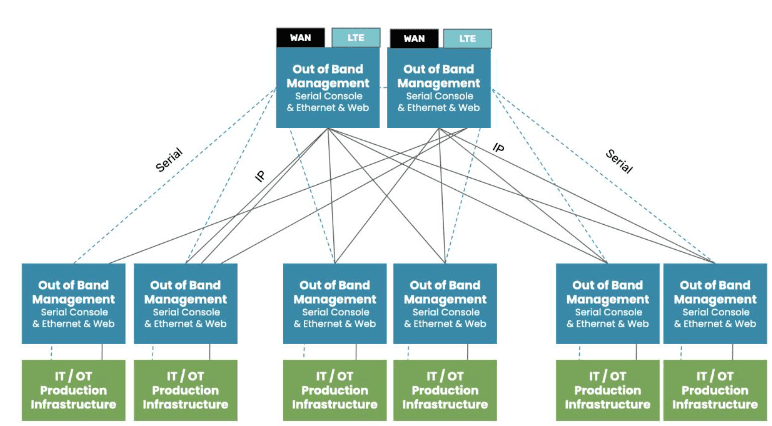
For peak resiliency, data center deployments should follow a two-tier OOB architecture. That means each rack of IT/OT production infrastructure should connect to its own Gen 3 serial console, which provides OOB management access and automation. These top-of-rack serial consoles should then connect to an OOB appliance in the middle or end of the row. This ensures OOBM access for the top-of-rack appliances and creates an additional layer of redundancy and resiliency.

Screenshot 2022-12-05 202130
Another important aspect of Gen 3 serial consoles is security. Since serial consoles provide comprehensive management access to critical infrastructure, they’re a tempting target for cybercriminals. A secure Gen 3 OOBM solution includes:

  • Integration support for third-party security solutions like next-generation firewalls (NGFWs), security service edge (SSE), and SAML 2.0
  • An up-to-date operating system (OS) kernel that’s frequently patched by the vendor when vulnerabilities are identified
  • Onboard firewall functionality to inspect traffic on both the OOB network and the production network
  • Hardware security features like encrypted boot sequences and BIOS protection to prevent unauthorized access on stolen serial consoles

Gen 3 OOB serial consoles are the automation infrastructure components that enable automation and resiliency for data center deployments at the core of enterprise networks.

SD-WAN gateway routers

A gateway router is used to connect a LAN infrastructure to the internet and the enterprise WAN architecture. As part of a resilient network automation framework, all gateway routers should support SD-WAN (software-defined wide area networking).

SD-WAN separates the control and management processes from underlying WAN hardware and virtualizes them as software. SD-WAN uses features like application awareness and guaranteed minimum bandwidth to automatically optimize network performance. An SD-WAN solution can also use automatic load balancing and failover to ensure continuous availability in the event of a localized failure or data center outage.

SD-WAN is usually a cloud-based service that delivers centralized management and orchestration of automated workflows. This service runs on top of the gateway routers deployed at each site.

An SD-WAN gateway router is a key automation infrastructure component for the main office, data center, branch, and edge deployments because it enables automated WAN management and orchestration. An all-in-one cloud-managed gateway router is particularly useful for OT automation in remote facilities like warehouses and factories because it provides SD-WAN capabilities, OOBM, and routing in one multi-function device.

Monitoring, visibility, and analytics

Monitoring and visibility solutions give administrators virtual eyes and ears on remote network infrastructure. As part of a resilient network automation framework, a visibility solution should be vendor neutral so it can dig its probes into any device in a mixed vendor environment. It should also include environmental monitoring sensors that collect data on conditions in the rack.

Device monitoring and environmental sensors give administrators the ability to detect potential issues and respond quickly to prevent outages. Monitoring and visibility solutions also collect valuable data that can feed into the AIOps building block of the network automation framework.

Infrastructure as Code

Infrastructure as Code, or IaC, uses software abstraction to decouple infrastructure configurations from the underlying hardware. Configurations are written as scripts or definition files that automatically provision virtual machines (VMs), containers, or software-defined networking (SDN) devices. An IaC definition file can be deployed repeatedly, which means many identical resources can be spun up quickly while ensuring consistent configurations. An IaC config can also undergo automatic security testing before it’s deployed to any devices to prevent vulnerabilities from affecting production.

Another important aspect of IaC is automatic configuration management. Configuration management solutions like RedHat Ansible allow administrators to define the desired state of a system or network resource. The configuration management tool continuously monitors the resource to detect unauthorized changes, which might be made by a careless sysadmin or could be a sign of a malware infection. As soon as the change is detected, the configuration management solution uses a programmatic playbook to take whatever actions are needed to restore the system to its proper state.

IaC helps ensure network resiliency by reducing human error in device configurations and updates, as well as by enabling the use of pre-production automated security vulnerability scanning and configuration management. Infrastructure as Code also facilitates another key automation infrastructure component—immutable infrastructure.

Immutable infrastructure

In-place system and device updates are a common cause of hangs or failures which can be challenging to resolve remotely. Immutable infrastructure resolves this problem by eliminating updates and configuration changes altogether. Immutable infrastructure refers to virtual systems and network resources that are never changed in place. If an immutable resource has an issue or vulnerability, or if its OS is out of date, an entirely new resource is spun up and the old one is simply deleted.

IaC is an immutable infrastructure best practice because it gives administrators the ability to provision many devices very quickly and with identical configurations. Immutable infrastructure is secure, easy to deploy, and resilient to failure, making it an important part of the network automation framework.

Why Nodegrid is a key automation infrastructure component

The automation infrastructure building block of the network automation framework relies on vendor-neutral OOBM devices like gateway routers and Gen 3 serial consoles that extend automation to converged IT/OT production infrastructure. These devices must also support monitoring and visibility solutions, Infrastructure as Code with configuration management, and immutable infrastructure.

For example, the Nodegrid platform from ZPE Systems includes OOB management hardware for a variety of data centers, branch, and edge deployments. Nodegrid serial consoles, such as the NSCP, can dig their hooks into any device in your data center to enable end-to-end network automation. A Nodegrid Gen 3 OOB serial console can even extend IaC and immutable practices to legacy devices to ensure resiliency without expensive forklift upgrades.

Nodegrid services routers, such as the Mini SR, are compact edge gateways that deliver SD-WAN support, OOBM, and cloud management capabilities to IT/OT infrastructure in smaller branch office and edge data center deployments. Nodegrid SRs can help you consolidate an entire rack of branch infrastructure into a single device to reduce management complexity, CapEx, and OpEx.

Nodegrid out-of-band is delivered via WiFi, Ethernet, or 5G/4G LTE to ensure administrators have fast and reliable access to remote infrastructure. All Nodegrid OOB devices are protected by robust hardware security features like BIOS protection, UEFI Secure Boot, geofencing, disk encryption, and TPM 2.0. Plus, Nodegrid supports integrations with Zero Trust Security solutions like identity and access management (IAM) and SAML 2.0, as well as providing an on-ramp to SSE.

Nodegrid serial consoles and services routers also include interfaces for environmental monitoring sensors to collect crucial data about conditions in your rack. These sensors, as well as any other connected devices, can all be observed and managed from a single, centralized monitoring and reporting platform.

What makes Nodegrid a crucial element of automation infrastructure is its ability to directly host Infrastructure as Code and automated configuration solutions, including Ansible, Chef, Puppet, SaltStack, Monit, and Docker. Nodegrid appliances can then extend the capabilities of the IaC solution to any of the modern, legacy, and mixed-vendor devices it manages.

ZPE’s Network Automation Blueprint

Automation infrastructure works together with IT/OT production infrastructure, orchestration, and AIOps to ensure network resiliency during uncertain times. The Network Automation Blueprint from ZPE Systems provides a reference architecture for achieving Gartner’s definition of hyperautomation as well as meeting the Open Networking User Group (ONUG) Orchestration and Automation recommendations.

In future blog posts, we’ll discuss the remaining two building blocks of the Network Automation Blueprint in depth. In the meantime, you can read about IT/OT production infrastructure or click here to get a sneak peek of the blueprint, which includes a 10-step checklist to get started with automation now.

Want to learn more about key automation infrastructure?

To learn more about Nodegrid as a key automation infrastructure component, contact ZPE Systems today.

Contact Us

How an IT/OT Convergence Strategy Accelerates Network Automation

An ITOT convergence strategy visualized with many digital services organized together in a data center.
In the face of a looming recession, Covid-19 uncertainty, global political instability, and an increasing frequency of natural disasters, network resiliency should be on every organization’s mind. Network resiliency is the ability to continue providing services and connectivity even during disruptions, such as when buildings are locked down or layoffs reduce the number of staff available to maintain or operate the technology. Network automation is the key to ensuring continuous, consistent, and streamlined management during tumultuous times.

A network automation framework provides all the tools and processes needed to create an efficient, resilient, fully automated network infrastructure. The four building blocks of a resilient network automation framework include:

  1. IT/OT production infrastructure
  2. Automation infrastructure
  3. Orchestration infrastructure
  4. AIOps

In this blog, we’ll discuss why an IT/OT convergence strategy is critical for forming the foundation of a network automation framework. Future posts will discuss the other three building blocks and how they work together to ensure business resiliency.

What is IT/OT convergence?

IT/OT convergence is exactly what it sounds like—bringing your information technology (IT) and operational technology together under unified management.

Operational technology, or OT, controls equipment interacting with the physical world, such as industrial machinery or HVAC systems. OT automation runs on specialized industrial computers, such as programmable logic controllers (PLCs) and supervisory control and data acquisition systems (SCADAs). Those computers are usually completely isolated from IT networks, which means operators have no way to access them remotely. If operators can’t get onsite, whether due to a Covid-19 lockdown or natural disaster, they lose the ability to manage OT.

For example, Southern California is home to many high tech manufacturing plants, especially in the aerospace and defense industries. Due to the effects of climate change, there’s been an increase in the frequency and severity of wildfires in this region, leading to more frequent evacuation orders and plant closures. That means operators can’t access their computer systems to control and monitor OT devices, forcing these businesses to pause their operations.

In addition, OT control systems aren’t usually within the purview of IT management because they use specialized computers and automation software that needs to be operated and supported by OT experts. That means IT infrastructure automation and OT infrastructure automation are siloed, which can lead to cost and management inefficiencies. With recession anxieties running high, many organizations are looking for ways to reduce such inefficiencies by converging their IT and OT infrastructure.

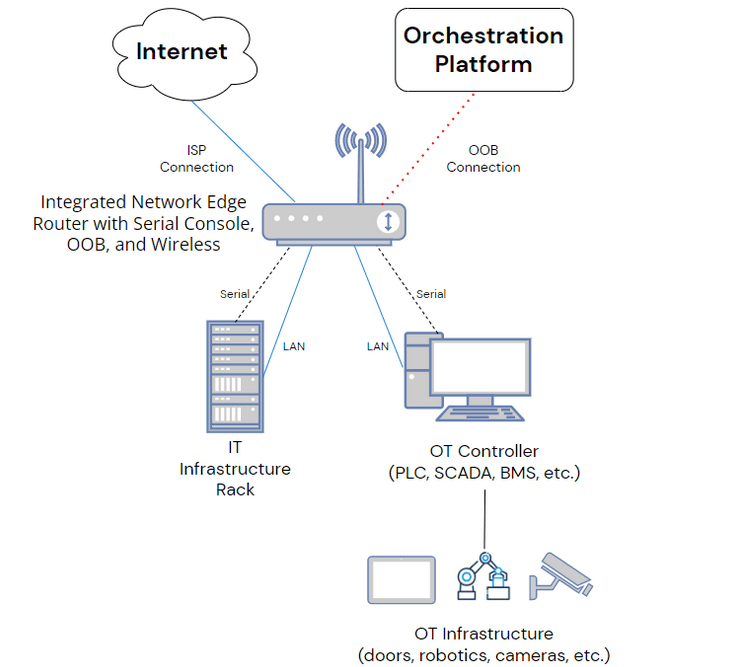
IT/OT convergence involves bringing your operational technology under the same management and automation umbrella as your IT network infrastructure. In a converged IT/OT infrastructure, OT control systems like PLCs and SCADAs connect to the same management hardware (e.g., serial consoles or cloud-managed gateway routers) as IT servers and network devices. This gives administrators a single platform from which to orchestrate automation across both IT and OT infrastructure.

What does IT/OT convergence look like?

IT and OT equipment being managed
First, you have the IT and OT equipment being managed. On the IT side, this includes things like servers, storage, security appliances, and SD-WAN devices. On the OT side, you have devices like environmental sensors, cameras, and power distribution units, as well as industrial computers used to monitor and control physical equipment. Some examples of those industrial systems include:

  • Programmable logic controllers (PLCs), which control industrial machines, robotic devices, and other manufacturing processes.
  • Supervisory control and data acquisition (SCADA), which is a control system for high-level supervision of industrial processes, including PLCs.
  • Building management systems (BMSs) which manage building equipment such as HVAC, fire suppression, lighting, and automatic doors.

These IT devices and OT computers all connect to common management hardware. For large deployments, these might be high-density serial consoles; in smaller deployments, these might be network edge routers with integrated serial console management functionality. This management hardware then connects to an orchestration platform that’s used to monitor, deploy, and manage automation across the converged IT/OT infrastructure.

How an IT/OT convergence strategy accelerates network automation

Bringing operational technology onto IT networks makes it possible for operators to remotely access their OT systems when they’re unable to come onsite. That means that your business can continue to function even during pandemic lockdowns, extreme weather events, or wars that prevent your staff from entering the building.

IT/OT convergence also allows you to bring operational technology under the same management umbrella as IT, so you can use the automation tools you’re already familiar with on the IT side to automate your OT. This reduces the overall management complexity of the IT/OT infrastructure and facilitates holistic orchestration of a fully automated—or even hyperautomated—enterprise network. This level of automation can help organizations reduce wasteful processes, eliminate redundancies, and increase operational efficiency so they can weather recessions and other economic difficulties.

Building IT/OT convergence into a resilient network automation framework

Your IT and OT infrastructure represent the target devices that are automated as part of a network automation framework. For maximum resiliency, your IT/OT convergence strategy should include:

Out-of-band (OOB) connectivity

Out-of-band (OOB) connectivity provides an alternative path to remote IT and OT infrastructure when the primary ISP connection goes down. In addition, OOB management devices (like serial consoles) directly connect to IT/OT devices, so administrators can manage them without an IP address or LAN connectivity. While OOB is not itself a component of IT/OT infrastructure, it’s a crucial element of the management devices and orchestration solution you’ll use to converge your IT and OT infrastructure.

Wired and wireless connectivity

Your converged IT/OT management solution also needs to support a variety of wired and wireless connectivity options to ensure resilience and flexibility. For example, if the ISP’s wired network infrastructure is disrupted due to extreme weather or warfare, you should be able to fail over to a 5G or 4G cellular connection. Or you may have some devices that lack RJ-45 ports, which means you need a management solution that supports USB. The goal is for your management solution to be adaptable to any scenario so that sudden changes or unforeseen issues don’t cripple your network operations.

Power control with UPS backup

As a remote network infrastructure, one of the most frustrating issues to deal with is a device that locks up after a system crash or failed firmware update. Often, a power cycle is all that’s needed to fix the problem, but that requires an on-site technician, which means an expensive and time-consuming truck roll. To ensure network resiliency while reducing the incidence of truck rolls, you need an IT/OT management solution that includes rack PDUs and IPMI options to facilitate remote power control of all connected devices.

In addition, an uninterruptible power supply (UPS) improves resiliency by providing backup power in case of an outage. This gives network teams time to investigate the problem and (hopefully) implement a fix before losing power. As part of the network resilience framework, all UPS units should hook into the management solution to allow for automated monitoring, optimization, and troubleshooting.

Environmental Sensors

Environmental sensors are used to monitor conditions in the location where IT and OT infrastructure is deployed. Traditionally, these sensors monitor racks in remote data centers, but they’re especially critical for IT/OT infrastructure that resides in less-ideal locations. For example, environmental sensors can provide data on the temperature and humidity levels in remote warehouses, offshore oil rigs, outdoor “smart city” deployments, and other locations when environmental conditions can’t be controlled.

Environmental sensors alert administrators when conditions grow too extreme for IT/OT equipment to function optimally. That means that teams can respond quickly and prevent equipment failures from bringing down critical resources. In addition, your infrastructure orchestration solution can analyze the data from these sensors to predict future issues or recommend optimizations to improve efficiency and resiliency.

How Nodegrid accelerates IT/OT convergence

The most successful IT/OT convergence strategy relies on vendor-agnostic platforms that can connect to both IT and OT infrastructure. For example, the Nodegrid solution includes management hardware that can connect to modern and legacy devices in a mixed vendor IT/OT infrastructure, such as the Nodegrid Serial Console Plus (NSCP) for large and hyperscale data center deployments and the Nodegrid Net Services Router (NSR) for flexible edge and branch deployments. These devices allow you to use the ZPE Cloud management platform to extend automation and orchestration to all your IT and OT targets to create a unified, efficient, and resilient converged network infrastructure.

ZPE’s Network Automation Blueprint

IT/OT production infrastructure works together with automation infrastructure, orchestration, and AIOps to ensure network resiliency during uncertain times. The Network Automation Blueprint from ZPE Systems provides a reference architecture for achieving Gartner’s definition of hyperautomation as well as meeting the Open Networking User Group (ONUG) Orchestration and Automation recommendations.

In future blog posts, we’ll discuss the remaining three building blocks of the Network Automation Blueprint in depth. In the meantime, click here to get a sneak peek of the blueprint, which includes a 10-step checklist to get started with automation now.

Ready to learn more about implementing an IT/OT convergence strategy?

To learn more about implementing an IT/OT convergence strategy with Nodegrid, contact ZPE Systems today.

Contact Us

What Is Edge Computing for Machine Learning?

Edge computing for machine learning is visualized as an artificial brain on the monitor of a remote industrial machine
Edge computing and machine learning technologies are helping organizations use their data more efficiently and effectively. In this blog, we’ll explain what edge computing is and discuss how it’s used with machine learning to improve performance and keep data secure. We’ll also explore two different edge computing deployment models for machine learning and provide advice on how to manage them.

What is edge computing?

For many modern enterprises, most of their data is no longer generated in a centralized data center or office building. These days, that data comes from IoT devices, “smart” industrial systems, and other remote locations around the globe. Transferring all that data to and from a central data center for processing can introduce latency and negatively impact performance. Transmitting sensitive data over the internet also increases the risk of interception by hackers.

Edge computing moves computational power closer to the source of data so that data doesn’t need to be sent to a separate location for processing. The benefit of edge computing is that data doesn’t need to travel as far, which translates to less latency and improved application performance. Plus, the data stays behind the firewall on the local network, reducing security risks.

What is edge computing for machine learning?

Machine learning (ML) is powered by data, and with data moving to the edge of enterprise networks, machine learning needs to decentralize as well. Edge computing for machine learning places ML applications closer to remote sources of data. The benefits of edge computing for machine learning are the same for edge computing in general, just supercharged.

Machine learning requires data to make intelligent predictions and decisions. In many cases, that data originates from the edge of the network. For example, the healthcare industry uses ML algorithms to analyze health data from smart devices in hospitals and clinics around the world, sometimes in hard-to-reach and politically unstable regions.

Getting patient health data from these remote facilities back to a centralized data center for machine learning processing can be very challenging, especially if the internet infrastructure is outdated or inconsistent. In addition, this data is personal and sensitive, and healthcare organizations are obligated to ensure its protection, so transferring it over uncertain internet connections is too risky.

Instead, organizations can install the ML algorithm on servers in each remote facility, or even on the smart devices themselves. This drastically reduces their reliance on outside network infrastructure for running machine learning workloads, which improves performance and ensures patient health data stays private.

How to deploy edge computing for machine learning

There are two basic deployment models for machine learning at the edge.

A traditional edge machine learning deployment uses one or more racks of heavy-duty servers with high-performance machine learning processing units. This deployment model is best suited to large ML workloads that process massive amounts of edge data.

A “thin” or “nano” edge machine learning deployment runs on smaller servers or multi-purpose devices that share rack space with other edge infrastructure. This deployment model is more cost-effective and works best for smaller ML workloads in buildings where space is limited.

For either deployment model, you need a solution in place for remote management so administrators can maintain and troubleshoot edge infrastructure without traveling on-site. The best way to ensure reliable management access is through out-of-band (OOB) management. OOB management creates a separate network dedicated to remote management and troubleshooting, and that  provides an alternative path to remote infrastructure (typically via cellular LTE) in case the primary ISP or WAN link goes down.

Through that OOB management network, you can orchestrate workloads, push out security patches, and monitor the health and performance of edge infrastructure.

Deploy and manage edge computing machine learning infrastructure with Nodegrid

The Nodegrid Net Services Router (NSR) from ZPE Systems supports both traditional and nano edge computing machine learning deployment models. The NSR is a modular and customizable solution that delivers OOB management, cellular failover, edge routing and switching, and automation in a single device.

You can use the NSR’s serial console modules to monitor, manage, and orchestrate an entire rack of edge machine learning servers. For less intensive workloads, you can use the edge compute module to host ML applications, virtual machines, and Docker images.

Either way, you can take advantage of 5G/4G LTE to ensure fast and reliable OOB access and cellular failover. The NSR is also secured by Zero Trust features like SAML 2.0 integration and BIOS protection to keep edge machine learning data protected.

Ready to learn more about 5G/4G LTE to ensure fast and reliable OOB access?

To learn more about edge computing for machine learning with Nodegrid, contact ZPE Systems today.

Contact Us