Providing Out-of-Band Connectivity to Mission-Critical IT Resources

A Guide to SD-WAN Deployment Models
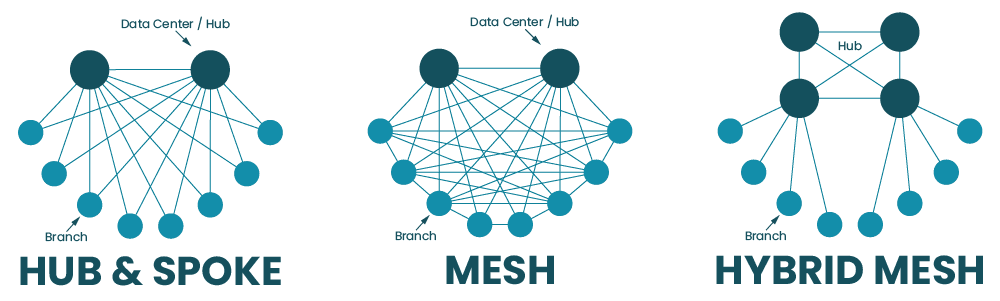
SD-WAN

Software-defined wide area networking, or SD-WAN, uses software abstraction to create a virtual overlay network that sits on top of the underlying WAN infrastructure. This gives organizations greater control over distributed network architectures and enables a high degree of automation. SD-WAN can be deployed in a hub-and-spoke model or a variety of mesh topologies depending on the organization’s requirements and capabilities.

In this guide are the most common SD-WAN deployment models with diagrams, pros and cons, and best practices to help organizations choose the right topology.

Hub-and-spoke SD-WAN deployment models

In the hub-and-spoke model, large data centers serve as centralized hubs that all SD-WAN traffic must flow through. The spokes are the campuses, branch offices, and edge sites that connect to each hub in order to access the enterprise WAN.
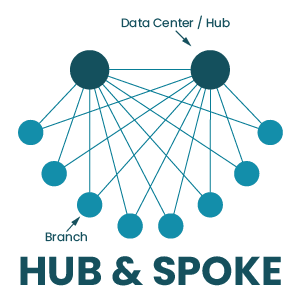
Hub & Spoke

The hub-and-spoke SD-WAN deployment model can be executed in a couple of different ways:

Spoke-to-hub only

In this SD-WAN deployment model, the spokes for a particular hub are unable to communicate with each other, they can only interact with the central hub. The networking logic for this deployment model is relatively simple compared to the others. It’s also useful when spoke sites need to be isolated from each other for security, privacy, or regulatory reasons.

Spoke-to-spoke via hub

In this deployment, spoke sites can communicate with each other, but all of their traffic must pass through the central hub first. Again, this makes SD-WAN networking logic a little simpler than allowing direct communication between sites. It also allows spoke traffic to pass through a centralized firewall first so that traffic can be inspected and security policies can be applied without needing to deploy firewall appliances at each spoke site.

Hub-and-spoke pros and cons

The hub-and-spoke approach is relatively easy to deploy and manage because all SD-WAN traffic must flow through a limited number of hub data centers. There’s no need to configure, secure, and load-balance network traffic between the numerous spoke sites that comprise an enterprise network, so organizations that are adopting SD-WAN for the first time tend to favor this approach.

However, since all spoke traffic needs to pass through a centralized hub, this creates bottlenecks that can impact network performance for all connected sites. Centralized hubs also represent single points of failure for the spokes that rely on them for enterprise network access – if a hub goes down due to a cybersecurity breach, ISP outage, or equipment failure, then spokes will lose their ability to communicate with each other or access enterprise network resources. Plus, since all traffic and data are aggregated in centralized hubs, they present attractive targets to cybercriminals, who can easily get all the valuable data they want in a single location instead of needing to move around the network.

Hub-and-spoke best practices

If you’re considering the hub-and-spoke approach, it’s important to have a business continuity plan that accounts for hub failures. For example, you should have some sort of network failover option (such as cellular LTE) in case the ISP connection goes down. You should also be able to redirect traffic from one hub to another if the first hub gets overloaded or experiences a failure. In addition, hubs should be deployed with out-of-band (OOB) management so network admins have 24/7 management access even if the SD-WAN connection goes down.

Learn more about Out-of-band (OOB) management.

Mesh SD-WAN deployment models

In the mesh deployment model, campuses, branch offices, and edge sites have some ability to communicate with each other directly, without their traffic needing to pass through a hub first. The degree to which sites can interact with each other depends on the type of mesh topology that’s deployed.

Full mesh deployment

In a full mesh deployment, there is any-to-any communication between edge and branch sites using overlay tunnels. There are often still hub data centers to handle requests for centralized enterprise resources, but most other requests are handled by services deployed at the network edge (either at the sites themselves or in the cloud).
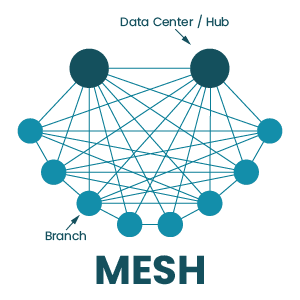
Mesh

Full mesh pros and cons

The full mesh topology enables faster communication between sites. It also allows organizations to deploy applications and services at the edge of the network where data is being generated and used, which is known as edge computing. There are also no single points of failure in the full mesh SD-WAN architecture, which reduces the risk of an outage and shortens the duration of outages that do occur. In addition, data and applications are distributed across many different locations, which can limit the damage caused by security breaches – instead of finding all your valuable data in a single server, cybercriminals have to jump around the network, increasing the chances they’ll be caught.

However, the full mesh topology is the most challenging to implement, manage, and optimize because there are so many moving parts involved. Each site needs a full stack of networking and security solutions because they aren’t relying on a centralized hub. Increasing the complexity of the SD-WAN architecture also increases the risk that mistakes will be made during configurations, deployments, and updates.

Partial mesh deployment

In this topology, some spokes can directly communicate with each other, and some services are deployed at the edge. However, there isn’t a full decentralization of applications and security, so some traffic still needs to pass through a hub.

Partial mesh pros and cons

Many organizations arrive at a partial mesh deployment on their journey from a hub-and-spoke deployment to a full mesh. A partial mesh topology reduces some of the load on centralized hubs and firewalls by moving certain services to the edge and allowing some direct site-to-site communications, which can improve performance. The organization can still rely on some centralized security functionality, reducing the number of security appliances or cloud-based services needed to protect the edge.

However, a partial mesh doesn’t completely address the limitations of a more centralized hub-and-spoke deployment. Hubs still represent potential bottlenecks and points of failure in the SD-WAN architecture. Plus, there’s still a lot of data centralization, meaning that storage and data processing servers in hubs will make attractive targets to hackers.

Hybrid mesh deployment

In a hybrid mesh, many hubs are deployed in a mesh topology, which means there is frequent communication and a high level of redundancy. However, branch and edge sites are still deployed as spokes, which means all their traffic goes through the hub mesh.
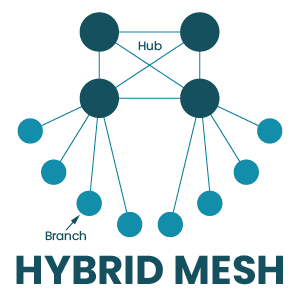
Hybrid Mesh

Hybrid mesh pros and cons

A hybrid mesh deployment ensures that no single hub acts as a single point of failure, enabling a high degree of redundancy and load balancing. Spoke sites can’t directly interact with each other, which reduces the complexity of the SD-WAN topology and decreases the number of security appliances to purchase and manage. Bottlenecking is also less of an issue because traffic from spokes doesn’t have to pass through a single designated hub, and can instead be distributed across multiple hubs.

However, a hybrid mesh topology is still fairly centralized, so you don’t get all the security and performance benefits of a decentralized full mesh deployment. Hubs are still valuable targets for cybercriminals, edge sites still need to send data to hubs for processing, and spokes cannot access enterprise network resources without going through the hub mesh. If that hub mesh is unavailable for any reason, spoke sites will be completely cut off.

Regional mesh

A regional mesh allows organizations to implement different deployment models for different regions. For instance, one region may have a spoke-to-spoke deployment, while another has a partial mesh. When traffic from one region needs to go to another, it must pass through a regional hub first.

Regional mesh pros and cons

The regional mesh model gives large or highly distributed organizations the flexibility to use deployments that meet the specific requirements of each region. For example, there may be a cluster of branch offices that process classified data for the defense industry, so the organization uses the spoke-to-hub-only deployment to isolate those sites from the rest of the enterprise network. In another region, the org may run a lot of edge computing for machine learning applications and need there to be fast and seamless communication between edge data centers. In that case, they might deploy a full mesh topology in that specific region.

However, this flexibility can also create a lot of management complexity. Admins need to learn, manage, and troubleshoot different configurations, network logic, and security rules for different regions. Plus, each region is subject to the downsides and limitations of whichever deployment model is used there. In addition, regional hubs often still act as potential bottlenecks and points of failure between each region and the enterprise network.

Mesh best practices

All of the best practices for the hub-and-spoke model also apply to mesh SD-WAN deployments. There are a couple of additional considerations for organizations considering a more decentralized deployment, including:

Cloud-delivered security – Mesh deployments typically require security solutions deployed at the edge, so that traffic doesn’t need to pass through a centralized firewall. However, purchasing appliances for each location is expensive and adds to the complexity of the architecture. Solutions like SSE (Security Service Edge) allow you to use your SD-WAN technology to send edge traffic through security services in the cloud. SSE takes many of the capabilities of traditional security appliances and combines them into a cloud-delivered stack, so organizations can get enterprise-level protection without needing to deploy additional hardware or route traffic through a central bottleneck.

Network automation – Manually configuring and controlling a complex mesh network increases the risk of human error. Luckily, SD-WAN’s software abstraction makes it easier to use automated scripts and playbooks to handle a lot of the tedious, repetitive tasks that are prone to mistakes such as device configurations and ACL (access control list) updates. Automation also means that work can get done faster and without putting additional pressure on overworked network teams.

Centralized orchestration – Mesh topologies have so many moving parts, and needing to manage each one of them separately makes it impossible to holistically control, optimize, and secure the deployment. Centralized orchestration gives network teams a common interface they can use to create, organize, deploy, monitor, and troubleshoot automated and manual SD-WAN workflows. That means the orchestrator should be vendor-neutral so it can dig its hooks into every device, application, and service in every SD-WAN site in your deployment.

Vendor neutrality – On that note, vendor neutrality is also a best practice because of how it simplifies and strengthens automation infrastructure. Many vendors lock you into using specific tools, applications, and devices, which makes automation pipelines more complicated and brittle — if one component breaks, the whole infrastructure goes down. Using vendor-neutral tools and orchestration platforms means you don’t have to inflate your toolkit or overcomplicate your automation pipeline, improving resiliency.

Choosing the right SD-WAN deployment model

Every SD-WAN topology comes with its own advantages and limitations, so organizations must assess their requirements and capabilities to determine which one to deploy. For example, if your team doesn’t have any SD-WAN experience, then jumping right into a full mesh deployment may not be practical. If you need your edge sites to have real-time data processing abilities (for example, in healthcare applications), then you may want to consider a less centralized mesh topology.

  Pros Cons
Hub-and-spoke
  • Easy to deploy
  • Reduced management complexity
  • Creates bottlenecks
  • Hubs are single points of failure
  • Centralized data is a target for hackers
Full mesh
  • Enables edge computing
  • No single points of failure
  • Decentralized data limits the blast radius of breaches
  • Complex implementation and management
  • Increases risk of human error
  • Requires edge or cloud-delivered security solutions
Partial mesh
  • Reduces some load on centralized hubs
  • Easier to deploy than a full mesh
  • Enables edge computing
  • Hubs can still create bottlenecks
  • Hubs are still potential points of failure
  • There is still some data centralization
Hybrid mesh
  • Enables a high degree of redundancy among hubs
  • Not as complex as a full mesh
  • Reduces bottlenecks
  • There is still some data centralization
  • There is still some bottlenecking
  • Hub mesh is still a point of failure
Regional mesh
  • Flexible and customizable
  • Addresses specific needs of individual sites and regions
  • Each regional hub is a potential point of failure
  • Variety of topologies creates a lot of management complexity
  • Subject to the downsides and limitations of all the deployment models in use

Ready to learn more about SD-WAN deployment models?

For more guidance on how to choose and implement SD-WAN deployment models, contact the experts at ZPE Systems. Contact Us

How to build a secure isolated recovery environment (SIRE)

An illustration of someone paying a ransom for their encrypted data, showing what can happen if an organization does not implement an isolated recovery environment (IRE).

Ransomware is one of the biggest cybersecurity threats to enterprises. Sophos reports that in 2024, 59% of organizations suffered a ransomware attack, and the average cost to recover (excluding ransom payment) was $2.73 million. The frequency of ransomware attacks is so high that it’s no longer a question of ‘if,’ but ‘when’ an organization will be hit. Since ransomware encrypts critical data, applications, and systems, an attack can be extremely disruptive to business. During prolonged downtime, revenue slows or stops altogether, recovery costs skyrocket, and the company’s reputation and customers’ trust are severely damaged.

To reduce ransomware recovery times, companies must shift their focus away from prevention and detection and instead invest more time and money into recovery strategies. Ransomware recovery is especially challenging because of how easily its malicious code can spread from production into backup data and systems. What’s needed, according to the experts at Gartner, is a designated, secure isolated recovery environment (SIRE) that’s fully separated from the production infrastructure.

What is a secure isolated recovery environment (SIRE)?

A recovery environment is made up of systems and network resources that are dedicated to recovering from ransomware and other cybersecurity breaches. The recovery environment is where teams work to restore data and rebuild applications before they’re pushed back to the production network.

Many organizations implement a recovery environment by creating an isolated VLAN on the enterprise network. However, if the recovery environment has any dependencies on the production network, there’s a risk that ransomware will cut off access. For example, if malware infects authentication systems, routers, or switches, then admins might lose access to the recovery VLAN. In addition, production dependencies provide a way for ransomware to jump to the recovery environment, reinfecting systems and spoiling recovery efforts.

A secure isolated recovery environment (SIRE) uses a designated network infrastructure that’s completely separate from the production environment. The SIRE uses tools like Retention Lock, role-based access control (RBAC), and out-of-band (OOB) management to ensure that admins can quickly recover critical business services without the risk of reinfection. Let’s discuss these components in greater detail, as well as how to implement them to create an IRE.

How to build a secure isolated recovery environment

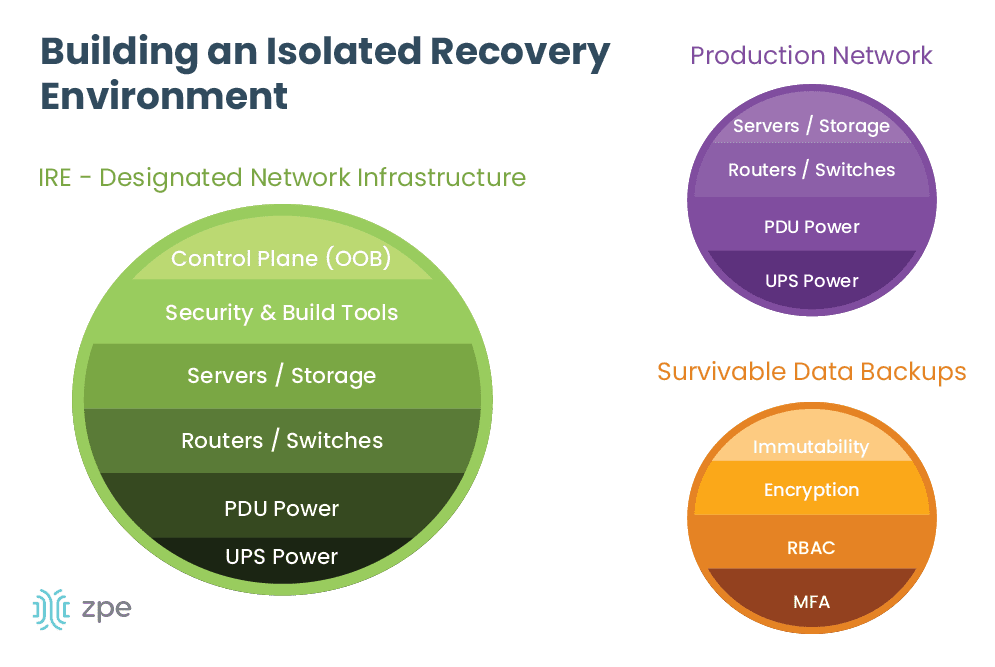
The ideal SIRE is built around three concepts: survivable data, separation and isolation, and designated infrastructure.

build an isolated recovery environment

Survivable data

Ransomware earned its name because it encrypts data and systems and demands a ransom (typically in the form of cryptocurrency) to get the decryption key. However, there’s no guarantee that the attackers will provide a valid decryption key upon receiving their bounty, so it’s best to avoid the cost and risk altogether by ensuring you have clean backup data. These backups are known as survivable data – data that can’t be removed or encrypted by attackers.

To ensure your backup data is survivable, you should implement:

  • Immutability: Something is considered immutable if it can’t be changed in any way, such as immutable infrastructure. Immutable data backups can’t be modified once they’re in place, which makes it impossible for ransomware and other malware to encrypt or corrupt the files. Data immutability can be enforced with tools such as Retention Lock.
  • Encryption: For backup data to be survivable, it must be encrypted both in transit and at rest. This is sort of like fighting fire with fire – if your data is already encrypted, it will be much harder for ransomware to apply its own encryption. Plus, encrypting data in transit makes it harder for attackers to intercept and steal it as it’s moving between your production, backup, and recovery environments.
  • RBAC: Role-based access control, or RBAC, refers to policies that restrict access based on an account’s role or function (e.g., ‘administrators,’ or ‘human resources’). Ideally, only the key personnel involved in recovery operations (their role may be ‘recovery engineers,’ for example) will have access to backup systems, which limits the risk that over-privileged accounts will be compromised and used to exfiltrate data.
  • MFA: Multi-factor authentication, or MFA, forces users to prove their identity in multiple ways before they can access a system or application. For example, an admin may need to provide their username and password, plus a six-digit code sent to their authorized mobile device or email address, to prove that they are who they say they are. If an attacker steals an admin’s username and password, MFA prevents them from being able to access, steal, or encrypt backup systems.

Separation and isolation

Recovery efforts need to take place in an isolated environment so there’s no risk that malware will cross over from the production network. Newly recovered systems, applications, and data also need to be scanned and verified to ensure they’re clean before they’re reintegrated into production. The only way to achieve this is by building a completely isolated environment using a designated network infrastructure.

Designated infrastructure

The SIRE needs to be both physically and logically separated from the production network to ensure there’s a completely clean environment in which to perform system, application, and data restoration. That means the SIRE should have its own routers, switches, storage devices, compute options, and power. In addition, the SIRE needs its own out-of-band (OOB) control plane that’s accessible via a dedicated network interface (such as 4G or 5G cellular). This will ensure that admins have continuous remote access to the SIRE even if the LAN or WAN goes down due to configuration errors or other problems.

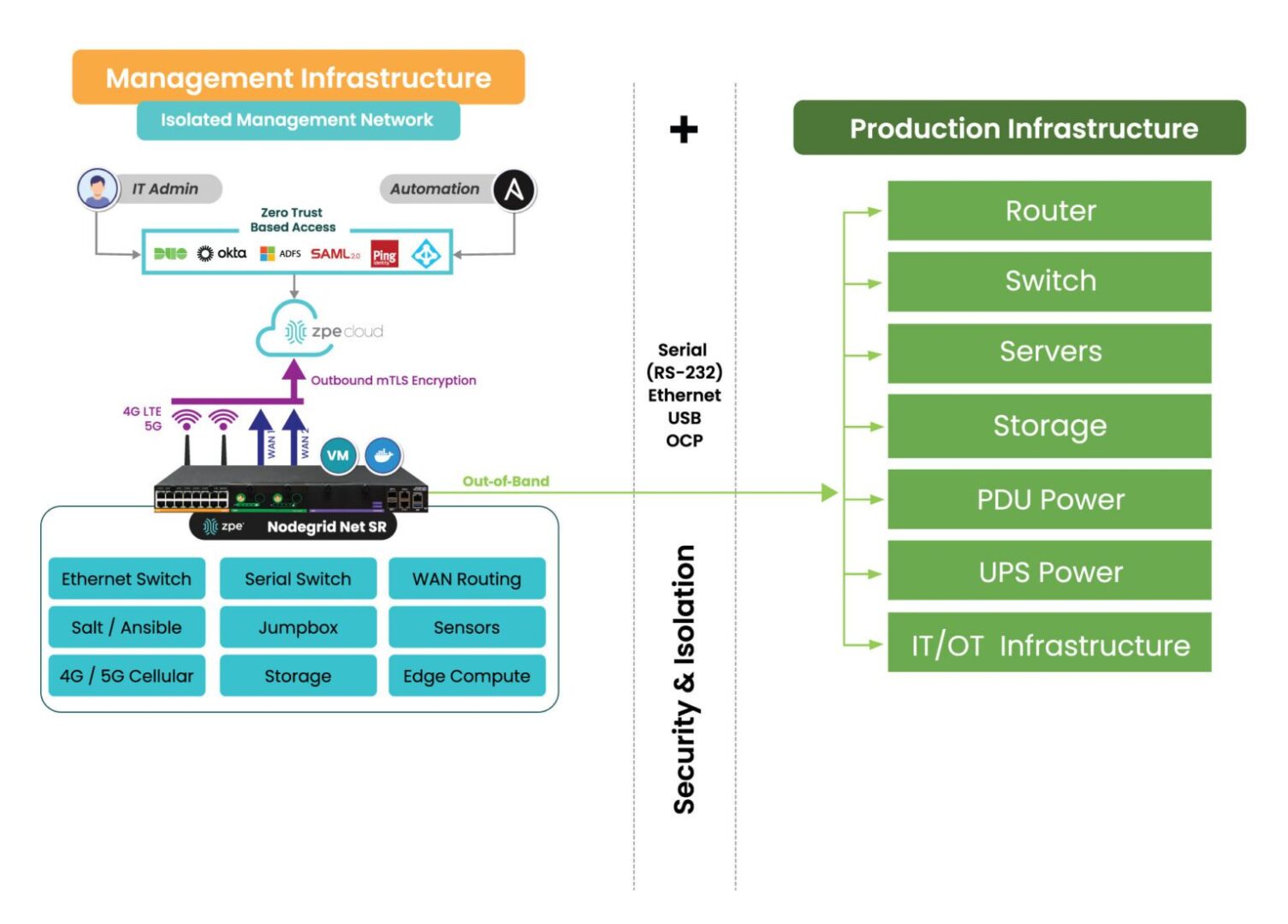
How the Nodegrid Net SR isolates and protects the management network.

Image: Deploying a SIRE is only possible through the use of a dedicated control plane, or Isolated Management Infrastructure shown here.

Teams will also need access to their security and build tools in the SIRE, so these need to be configured and ready to go before an attack occurs. Organizations also must ensure the secure isolated recovery environment has enough storage to handle all of the backup data and server rebuilds.

Additional resources for building a secure isolated recovery environment (SIRE)

A secure isolated recovery environment (SIRE) ensures that admins have a dedicated environment in which to rebuild and restore critical business services during a ransomware attack. Survivable data backups, complete isolation, and designated infrastructure are needed to maintain the integrity of recovery operations and prevent reinfection.

For more information about how to recover from ransomware using a secure isolated recovery environment, download our whitepaper, 3 Steps to Ransomware Recovery.

Implementing and using a SIRE requires Isolated Management Infrastructure. IMI provides the management foundation and is a best practice recommended by CISA, because it fully separates admin access from relying on production infrastructure. Through IMI, teams gain a host of capabilities including out-of-band management and remote access, which not only help with ransomware recovery, but also for break/fix troubleshooting, device monitoring, and outage recovery. The ZPE Systems team created the blueprint that organizations can use to implement this crucial IMI foundation.

To get the blueprint for building Isolated Management Infrastructure, download the Network Automation Blueprint.

Want to see the Secure Isolated Recovery Environment in action?

Our engineers are ready to show you what it takes to recover from ransomware. Click the button to get in touch, and we’ll walk you through IMI, out-of-band, and the Secure Isolated Recovery Environment.

Contact Us

SD-WAN Benefits: Your Definitive Guide

Illustration of a variety of devices connected to a complex enterprise WAN that needs SD-WAN benefits like centralized orchestration and enhanced security.
SD-WAN, or software-defined wide area networking, is on the rise as organizations grow more distributed and networks get more complicated. SD-WAN’s market share was an estimated $3.4 billion in 2022 and is predicted to increase to $13.7 billion by 2027. Orgs leverage SD-WAN to reduce MPLS costs, improve WAN performance, facilitate greater automation and orchestration capabilities, and improve their security posture. This post explains how SD-WAN works in addition to its benefits.

How does SD-WAN work?

SD-WAN uses software abstraction to decouple WAN control functions from the underlying hardware. When possible, it leverages traditional MPLS to handle requests for enterprise resources in the data center, but it can also use less-expensive cellular and public internet links to handle cloud-destined traffic. SD-WAN uses virtualized and cloud-based security technologies to securely connect remote sites to SaaS, web, and cloud resources, reducing MPLS bandwidth and eliminating the need for VPNs.

SDWan Gateway
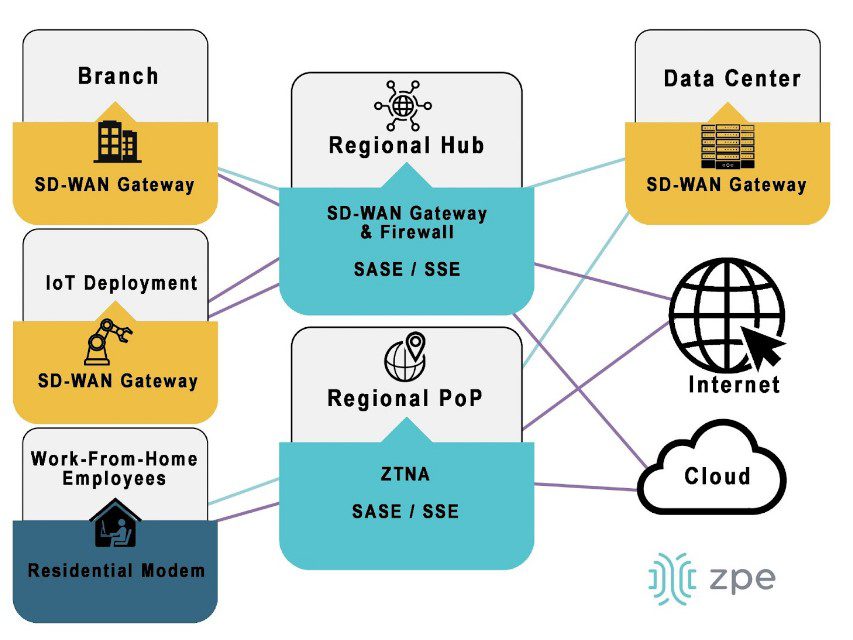
Organizations install SD-WAN gateways at campuses, branches, data centers, and any other business locations accessing the WAN architecture. These gateways virtualize WAN management at their sites, giving admins control via centralized software (which is often cloud-based).

Regional points-of-presence (PoPs) act as SD-WAN gateways for employees working from home, giving them access to enterprise network resources without a VPN. Often, major SD-WAN providers have an existing network of regional PoPs to take advantage of, but large or especially geographically diverse organizations may also wish to deploy their own PoPs in specific areas.

There are several different SD-WAN deployment architectures for companies to choose from depending on their specific requirements and capabilities. Learn more in A Guide to SD-WAN Deployment Models.

SD-WAN benefits guide

SD-WAN benefits organizations with complex and highly-distributed networks in the following ways:

SD-WAN Benefits

Reduces costs

  • MPLS bandwidth reduction
  • Fewer circuit installations
  • Faster branch deployments

Improves performance

  • Fewer data center bottlenecks
  • Faster issue response
  • Holistic performance monitoring

Enables automation & orchestration

  • Automated configurations
  • Policy-based workflow automation
  • Centralized orchestration

Enhances branch security capabilities

  • On-ramp to SSE technology
  • Enterprise policy extension
  • Secure access for remote users

SD-WAN reduces costs

MPLS bandwidth is far more expensive than standard broadband, fiber, or cellular, often hundreds of dollars per megabit per month. For branches with existing MPLS circuits installed, SD-WAN reduces bandwidth costs by redirecting traffic that’s destined for the cloud or internet across less-expensive channels, reserving the MPLS for enterprise traffic alone.

For some branch networking use cases, such as IoT (internet of things) deployments relying entirely on cloud-based software and data processing, organizations may opt to forgo a new MPLS installation and rely solely on SD-WAN and cloud-based security solutions. Not only does this save money on installation costs and bandwidth, but it significantly reduces the time it takes to spin up a new branch, enabling that branch to generate revenue sooner.

SD-WAN improves performance

SD-WAN uses technologies like application awareness and guaranteed minimum bandwidth to provide efficient, intelligent routing for improved performance. For example, in organizations with SASE (secure access service edge) deployments, SD-WAN automatically separates cloud- and SaaS-destined traffic to flow through the cloud-based SASE stack instead of the central firewall. This reduces the load on the firewall and ensures improved performance for users who do need to access enterprise resources, while at the same time providing a “shortcut” for remote users trying to reach the cloud.

SD-WAN also responds to availability and performance issues much faster than human admins are capable of, automatically redirecting traffic to avoid bottlenecks or downed nodes to ensure a seamless end-user experience. In addition, SD-WAN’s software abstraction makes it easier to centralize WAN management, giving admins full visibility into every part of the WAN architecture for holistic performance monitoring.

SD-WAN enables automation & orchestration

SD-WAN’s software abstraction opens up many automation opportunities because WAN configurations and workflows are no longer tied to the underlying hardware. For example, device, system, and service configurations can be written as scripts or playbooks and deployed automatically to reduce the time and effort required to spin up a new branch. Policy-based automation can handle additional tasks such as load balancing and failover, and route automation faster and more efficiently than human beings can.

SD-WAN also makes it possible to bring the WAN under one management platform for holistic monitoring and centralized orchestration. This gives admins control over large, distributed, and complex WAN architectures. For example, a centralized SD-WAN platform makes it easier to orchestrate traffic across hybrid cloud architectures because admins can monitor and manage WAN workflows across their various branches, private clouds, and public clouds.

SD-WAN automation and orchestration reduce the number of tedious, manual workflows that fall on overworked networking teams. This helps to decrease the rate of human error in device and security configurations, which in turn decreases the risk that mistakes will cause outages or be exploited by cybercriminals. Centralized SD-WAN orchestration also helps organizations improve their security posture by providing more holistic visibility into things like patch statuses, system changes, and traffic patterns.

SD-WAN enhances branch security capabilities

Another way SD-WAN improves network security is by making it easier to enforce security policies at branches and edge sites without deploying additional hardware or backhauling traffic through a central firewall. Since the SD-WAN control plane is decoupled from the underlying WAN hardware, organizations can also deploy advanced security technologies with fewer device compatibility issues.

SD-WAN enables organizations to use cloud-based security solutions like SSE (security service edge). SD-WAN’s intelligent, application-aware routing can automatically separate traffic from branches and other remote sites based on whether it’s destined for enterprise data center resources or resources that live in the cloud. Cloud-destined traffic is then diverted through the SSE stack, bypassing the main firewall and reducing bottlenecks at the data center.

SSE’s security stack typically includes Firewall-as-a-Service (FWaaS) technology which provides the same (or better) capabilities as a hardware appliance. SSE is also used to extend enterprise security and access control policies to traffic between remote sites and the cloud.

In addition, the SSE stack supports Zero Trust Network Access (ZTNA), which provides secure remote access to enterprise and cloud resources to WFH employees and other systems outside the WAN. In this way, ZTNA is similar to a VPN, only more secure. ZTNA only lets remote users see and interact with one specific resource at a time, and makes them re-authenticate if they wish to access something else. If a remote user account is compromised, this re-authentication step increases the chances that unusual behavior or failed multi-factor authentication (MFA) attempts will trigger an account lock, decreasing the blast radius of an attack.

When SD-WAN and SSE are married together under a single orchestration platform, the result is SASE (secure access service edge). Organizations can purchase a complete SASE solution, or use a vendor-neutral platform to combine the SD-WAN and SSE solutions of their choice for greater customization.

Learn more about SD-WAN benefits

SD-WAN helps organizations reduce MPLS-related costs, improve WAN performance, enable greater automation and orchestration capabilities, and improve overall network security. Learn more about SD-WAN from the branch networking experts at ZPE Systems.

SD-WAN Learning center

Ready to learn more about SD-WAN benefits?

To see how a vendor-neutral orchestration platform simplifies branch management and accelerates SD-WAN benefits, request a free demo of the Nodegrid solution from ZPE Systems.

Contact Us

Simplifying Retail Network Management

Retail network management is visualized with interconnecting icons of networked retail services displayed in front of a retail warehouse

Fast and reliable networks are critical to the success of retail operations. Without network access, stores can’t process payments, handle customer data, or update inventory, which makes outages highly disruptive. According to a recent study, downtime could cost over $300,000 per hour in lost business, which is why it’s crucial that admins have the necessary tools to effectively monitor, manage, and optimize retail networks. This blog discusses some of the specific challenges involved in retail network management and how the right edge gateway solution can help overcome these difficulties.

Retail network management challenges

Managing a retail network comes with unique challenges, especially as the size and geographical distribution of the organization grows. Examples of these challenges include:

  1. Extending fast, reliable connectivity to the entire store for payment processing machines, inventory scanners, and other crucial devices. This is especially challenging in big box stores and other locations with large footprints as well as service-based chains with mechanics’ bays, drive-thrus, and other outdoor or semi-outdoor devices.
    .
  2. Maintaining optimal environmental conditions for networking equipment that’s often installed in closets, storage rooms, warehouses, and other out-of-the-way locations. The priority is typically to keep these devices hidden from customers, so they’re kept in areas that may not be climate controlled and may not have staff physically checking them every day. This increases the risk of environmental issues (like heat and humidity) causing a device failure and means no one is likely to notice the issue until it’s too late.
    .
  3. Remotely troubleshooting and recovering from issues without any on-site technicians. If the ISP connection, WAN, or LAN go down, there’s often no way to remotely access on-site equipment to diagnose and fix the problem. That means network outages require truck rolls to solve, with stores losing money waiting for technicians to travel on-site.
    .
  4. Efficiently monitoring and managing a distributed retail network architecture made up of many different network solutions and platforms. The lack of centralized management increases the risk of human error and makes it difficult to preemptively address potential problems or optimize the speed and performance of the network.

Retail network management teams need a robust solution that addresses these particular challenges. For example, they need small and powerful network devices that use centralized management to reduce management complexity. They also need a way to monitor environmental conditions and recover from outages without having to be on-site.

Simplifying retail network management

Now, let’s discuss how a robust branch gateway solution can help organizations address these challenges.

Compact, all-in-one networking

The layout of a retail store is carefully planned to ensure an optimal experience for customers, which means networking devices need to be as unobtrusive as possible. The ideal branch gateway for retail is compact and combines multiple networking functions, reducing the number of devices that need to be installed. Retail notoriously operates on a small profit margin, so the branch gateway also needs to be affordable without sacrificing performance.

Environmental monitoring

Environmental monitoring sensors collect data on conditions like temperature, humidity, and air quality in the location where networking equipment is installed. These sensors typically connect to the retail branch gateway via USB and report back to the management platform, giving admins the ability to remotely monitor the environment. This is crucial when most retail networks are managed by admins in a centralized office which may be hundreds or thousands of miles away from the stores themselves. Environmental monitoring allows them to identify and resolve potential problems before they cause device failures and outages. For example, if environmental sensors detect high temperatures, admins can get on-site personnel to turn up the air conditioning or call in an HVAC repair before devices overheat and bring down the network.

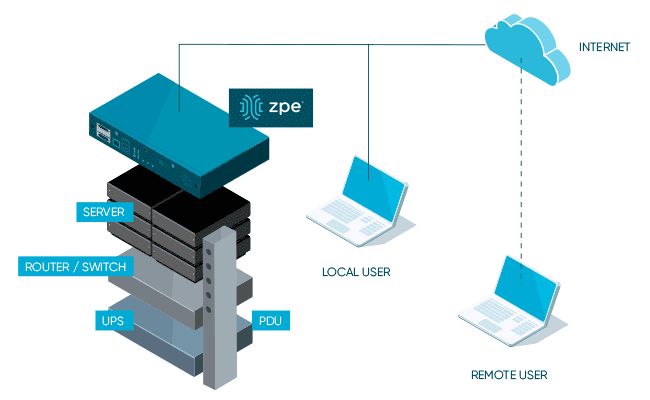
Out-of-band (OOB) management

Out-of-band (OOB) management uses redundant network interfaces (often cellular) to provide an alternative path to remote infrastructure. A branch gateway with OOB allows admins to remotely connect to devices in the store without relying on an IP address from the LAN, which means they’ll always have access even if the production network goes down. Without OOB management, the retail location goes offline for hours or even days waiting for a technician to arrive on-site, diagnose, and repair the issue. With OOB, admins can remotely access the infrastructure to restore services, often so fast that customers don’t even notice. That means they can remotely recover from more outages without truck rolls, saving time and money.

Vendor-neutral orchestration

A vendor-neutral branch gateway can interface with all the other devices in a retail network infrastructure, even if they’re from a different vendor’s ecosystem. This gives admins a single platform from which to monitor and manage every device in the store. Even better is when all of the branch gateways in the entire retail network architecture hook into a single, centralized, cloud-based orchestration platform. Admins can then monitor, control, and optimize network infrastructure for all the retail locations from one place for ultimate efficiency.

In addition, a vendor-neutral retail network management platform enables the use of third-party automation solutions. Automation reduces the risk of human error and makes it easier for teams to effectively manage and optimize even complex retail network architectures.

Retail network management with Nodegrid

Compact, all-in-one branch gateways like Nodegrid use environmental monitoring, OOB management, and vendor-neutral platforms to simplify retail network management. The Nodegrid Mini SR, for example, is an inexpensive retail branch gateway that’s roughly the size of an iPhone, so you can easily deploy them anywhere in your store without disrupting the customer experience. Despite its small size and low price point, the MSR still delivers Gen 3 OOB management capabilities while supporting Nodegrid environmental monitoring sensors and third-party automation. The Nodegrid platform is also completely vendor-neutral, giving retail network admins a single pane of glass from which to monitor, orchestrate, and optimize the entire distributed network architecture.

Ready to learn more about Nodegrid?

To learn more about about simplifying retail network management with Nodegrid, click here to download the Mini SR datasheet, or contact ZPE Systems today.

Contact Us

The Importance of Remote Site Monitoring for Network Resilience

remote site monitoring

Enterprise networks are huge and complex, with infrastructure hosted in many different facilities across a wide geographic area. Though most network infrastructure isn’t housed in the same location as the core business, it’s still vital to the business’s continual operation. Remote site monitoring gives network admins a virtual presence in remote sites like data centers, manufacturing facilities, electrical substations, water treatment plants, and oil pipelines.

Most organizations already have some form of remote infrastructure monitoring, but traditional solutions come with major limitations that make it difficult for networking teams to maintain 24/7 uptime. In this blog, we’ll discuss the importance of remote site monitoring, analyze the limitations of traditional solutions, and explain how the ideal remote monitoring platform improves network resilience.

The importance of remote site monitoring

Many organizations have reduced their IT staff due to the economic recession, leaving networking and infrastructure teams stretched too thin. When there aren’t enough eyes on remote infrastructure, enterprise networks are more vulnerable to breaches, hardware failures, and other major causes of network outages. With the average cost of downtime rising above $100k in 2022, and cyberattacks causing major disruptions to oil pipelines in recent years, this is a problem that’s too expensive to ignore.

The limitations of traditional remote site monitoring solutions

Many organizations rely on remote site monitoring solutions that are fragmented and vendor-specific. Admins have to log in to one platform to view monitoring data for a remote site’s wireless access points, for example, and a different platform to monitor IoT devices in the warehouse. These complex and repetitive tasks can lead to fatigue and negligence, especially for overworked and understaffed networking teams. At an even higher level, this makes it difficult to see the relationships between different systems and solutions or get a complete picture of the overall health of the enterprise network.

Another limitation of traditional solutions is that they’re often affected by the same issues as the infrastructure they’re monitoring. For example, if the LAN goes down in a remote office and the on-premises security appliance can’t get an IP address, then admins won’t be able to remotely access that appliance to view the monitoring logs. This can significantly delay or even prevent remote diagnostic and recovery efforts, leading to expensive truck rolls.

The problem gets even worse if the remote site is inaccessible due to natural disasters, conflicts, or other external factors. Network teams need a way to get eyes on the problem, diagnose the root cause, and deploy fixes without physically seeing or touching the affected infrastructure.

The ideal remote site monitoring solution

To avoid these limitations and ensure network resilience, the ideal remote site monitoring solution should consider the following factors:

Vendor-neutral and centralized

A vendor-neutral monitoring platform can collect and analyze logs from every component of your infrastructure. This gives admins complete coverage, so nothing falls between the cracks.

Another benefit of vendor neutrality is that it enables unified, centralized monitoring. That means networking teams only need to log in to a single portal to observe the entire distributed enterprise architecture.

Out-of-band

Deploying remote site monitoring on an out-of-band (OOB) network means that it won’t rely on production LAN, WAN, or ISP infrastructure. This ensures that admins always have access to vital monitoring data even during an outage, making it easier to remotely diagnose the issue.

Plus, using an OOB management solution for monitoring improves network resilience even further by giving admins a direct connection to remote infrastructure that doesn’t require an IP address. That means they can still access and fix remote devices during an outage.

Automated

Automated monitoring solutions help to ensure that admins are quickly notified of potential issues and that possible remediation steps are taken even if nobody is available right away. Some solutions can, for example, automatically refresh DHCP on a device that lost its IP address or re-direct traffic to a secondary resource when the primary server stops responding.

Automated monitoring solutions help to reduce the workload on understaffed networking teams without sacrificing resilience.

Building network resilience with ZPE Systems

A centralized, vendor-neutral remote site monitoring solution with out-of-band management and automation support helps to ensure network resilience even when IT staff is reduced or remote sites become inaccessible. The Network Automation Blueprint from ZPE Systems provides a reference architecture for achieving network resilience with OOB, automation, monitoring, and more.

Ready to learn more?

To learn more about remote site monitoring and network resilience, contact ZPE Systems today.

Contact Us

Upgrade Network Infrastructure With Minimal Business Interruption

upgrade network infrastructure

Outdated network infrastructure poses a significant risk to the security and continuity of business operations. According to NTT’s “2020 Global Network Insights Report,” obsolete devices contain nearly twice as many security vulnerabilities as currently supported solutions. Outdated network hardware is also more likely to fail, and the ability to recover from a failure is severely hampered by a lack of vendor support. However, network upgrades can be highly disruptive, so many organizations delay network upgrades to avoid business interruption. They don’t realize that their outdated devices are like ticking time bombs that could bring down their network at any moment. In this post, we’ll provide advice that helps answer the question: How do I upgrade network infrastructure without disrupting business operations?

Why and when to upgrade network infrastructure

Obsolete network infrastructure no longer receives updates and security patches from the vendor. That means any vulnerabilities that exist on the device will remain open, giving cybercriminals time to find and exploit them. In addition, older network solutions often lack the advanced security features like SSO and MFA, which are required for Zero Trust.

Even supported legacy devices suffer from limitations that can prevent a business from achieving its technological goals. For instance, legacy devices may not support automation, making it difficult to achieve NetDevOps transformation. Plus, as enterprise networks grow more distributed, there’s a need for solutions that support SD-WAN and SD-Branch technology.

Sometimes the solutions themselves aren’t terribly outdated, it’s just that business requirements have changed in such a way that the existing infrastructure can’t support. For example, an organization may migrate some applications and systems to the cloud, so they need networking solutions that support hybrid environments. In addition, the mix of old and new devices and cloud and on-premises resources increases management complexity and prevents teams from effectively leveraging network orchestration.

Obsolete devices, outdated security, limited automation support, and changing business requirements are all important reasons to upgrade network infrastructure. However, these upgrades must be approached with a thoughtful strategy to reduce the impact on the performance and availability of business resources.

How to upgrade network infrastructure with minimal business interruption

Vendor agnostic platforms are the key to smooth network infrastructure upgrades. Vendor agnostic (a.k.a. vendor neutral) network management platforms support integrations with all or most viable and established network solutions, including legacy devices.

Vendor-neutral management devices, such as the Nodegrid Serial Console, support both legacy and modern Cisco pinouts. That means Nodegrid provides a single, unified platform from which to manage all the outdated devices you already have as well as any new solutions you add to your infrastructure. This reduces management complexity for network administrators, giving them more time to focus on optimizing performance and planning future network upgrades.

Additionally, a vendor-neutral network orchestration platform can use that management device to extend modern automation and orchestration to legacy hardware. A truly vendor-agnostic platform, such as Nodegrid Manager (for on-premises and private cloud deployments) or ZPE Cloud (for public cloud and hybrid deployments) can run third-party automation playbooks and custom Python scripts. This gives network administrators the unprecedented ability to implement a fully-automated NetOps environment even while still rolling out infrastructure upgrades.

The final piece of the puzzle is vendor-neutral Zero Touch Provisioning (ZTP). ZTP gives you the ability to deploy new devices efficiently and securely in remote data centers, branch offices, and edge compute sites. ZTP devices are provisioned automatically over the network, reducing the need for onsite deployments or pre-staging. A vendor-neutral ZTP solution like Nodegrid can extend ZTP to other vendors’ devices so you can quickly deploy upgraded infrastructure.

Nodegrid delivers vendor-neutral management, orchestration, and ZTP so you can upgrade network infrastructure with minimal business interruption.

Need Help Upgrading Your Network Infrastructure?

Contact ZPE Systems to learn how to upgrade your network infrastructure with Nodegrid.

Contact Us