Network outages are extraordinarily expensive and disruptive to business, with recent EMA research finding that outages cost an average of $14,056 per minute in 2024. While these outages have numerous possible causes, two of the largest and most preventable are human error and configuration issues. Enterprise networks keep growing bigger and more complicated, with factors like network decentralization, the use of network automation solutions, and the constant threat of cybersecurity breaches contributing to management complexity and the risk of costly mistakes.
Oxidized is an open-source network configuration backup and change management tool that can help prevent human errors and malicious actors from disrupting network services. It also accelerates recovery from equipment failures and ransomware attacks without increasing network complexity. This guide explains how Oxidized network backups can improve resilience, or the ability to withstand adversity and continue business operations with minimal disruption.
What is Oxidized, and how does it work?
Oxidized is a lightweight tool that automatically backs up network device configurations and tracks changes. It supports more than 130 operating systems and easily integrates with third-party network management tools like LibreNMS.
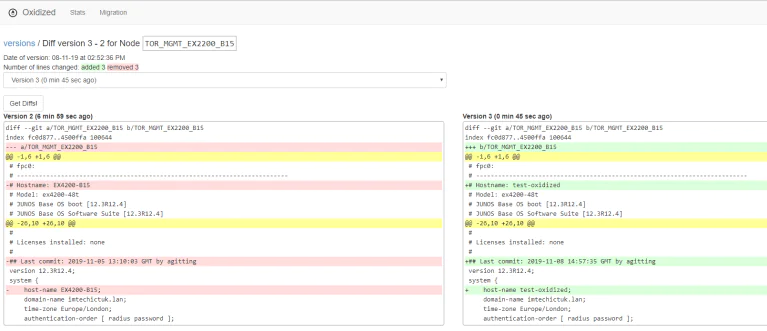
Oxidized uses REST APIs to pull configurations from network devices and send them to a Git repository or network management platform. Administrators can configure it to make backups according to a specific schedule, and it automatically pulls a new version (called a diff version) whenever a device’s configuration is changed. Teams can view diff versions in the Oxidized web UI as well as whichever Git repository or management platform the backups are being sent to.
Viewing diff versions in the Oxidized web UI. Source
How Oxidized network backups improve resilience
Network resilience is the ability to minimize business disruptions when adverse events occur, such as ransomware attacks, botched updates, natural disasters, and equipment failures. Oxidized network backups improve resilience in numerous ways. For example:
Administrators can easily roll-back device configurations to a previous version if a change causes problems. This significantly shortens the duration of outages or service degradations.
Teams can quickly deploy known-good configurations to replacement devices when equipment failures or ransomware breaches happen, significantly accelerating recovery times.
Configurations can be monitored with version control to prevent unauthorized changes from proliferating unnoticed, helping teams stop ransomware and other malicious actors in their tracks.
Enhancing network resilience with out-of-band management
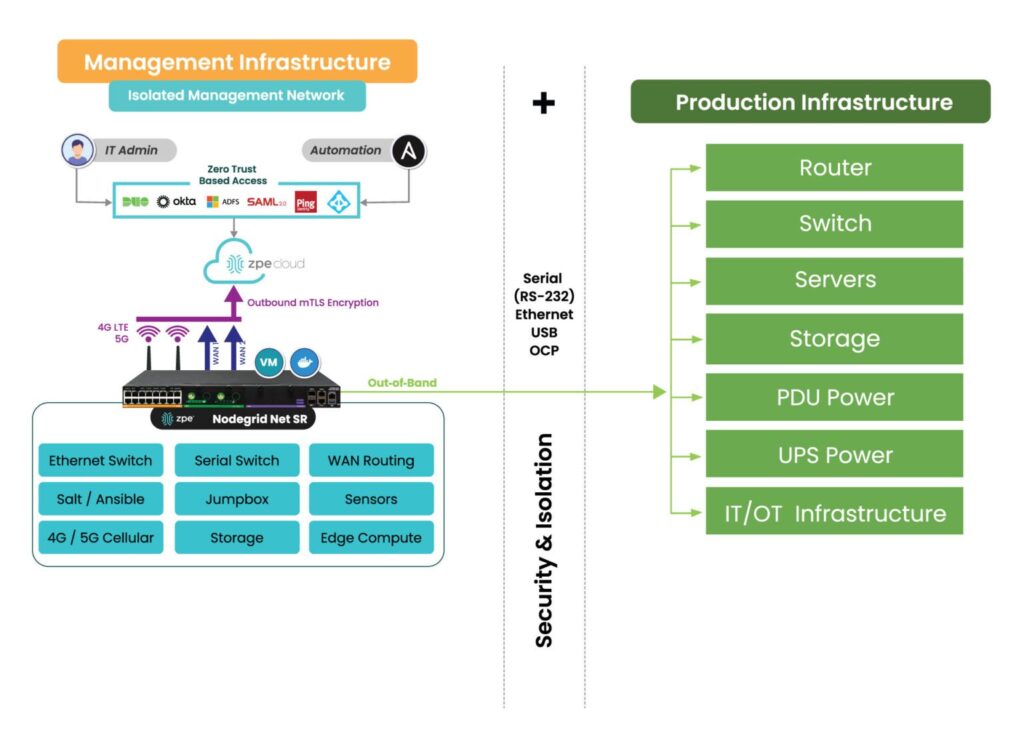
Network backups are crucial, but they’re only one piece of the resilience puzzle. Another best practice for minimizing business disruption is to isolate the network control plane with out-of-band (OOB) management. OOB moves all network management and infrastructure control functions to an entirely separate network that runs parallel with the production (or in-band) network but doesn’t rely on any of the same infrastructure or services. It allows teams to perform management, troubleshooting, backup, and recovery workflows remotely on a dedicated connection, such as secondary Fiber or cellular LTE, that remains available even if the in-band network goes down from an equipment failure, ISP outage, or ransomware attack.
By isolating management interfaces and workflows on a separate network, OOB management helps prevent malicious software or people from accessing them from a breached production system. For example, running Oxidized backups on the OOB network ensures that teams can safely deploy configs to new or rebuilt equipment without risking ransomware reinfection, speeding up recovery times and reducing financial impacts.
Minimize business disruption with Oxidized + Nodegrid
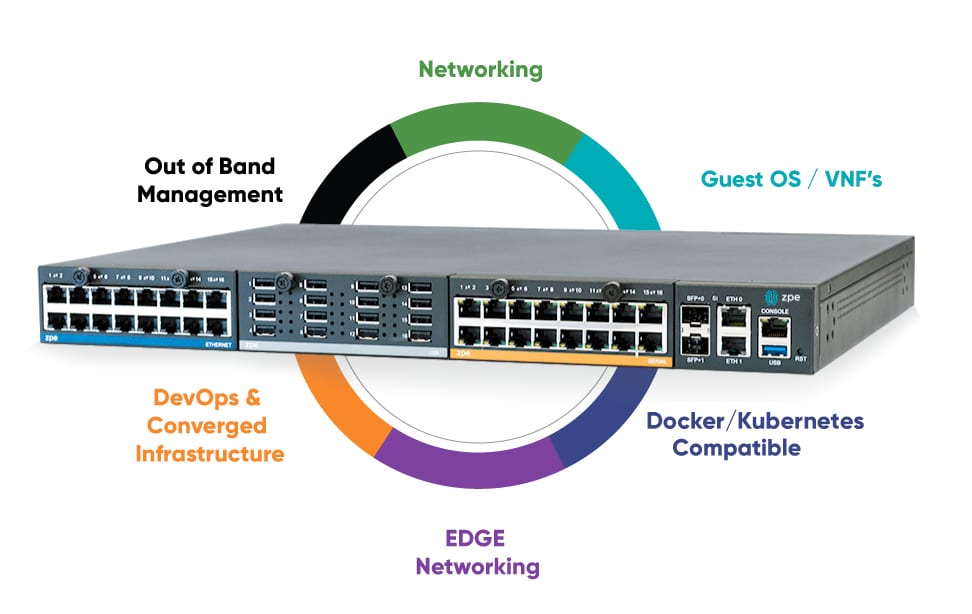
OOB management network isolation with the Nodegrid platform.
Nodegrid’s open architecture and extensible management software allow you to integrate, host, and run your choice of third-party services and solutions. You can use it to deploy network automation, run next-generation firewall software, host recovery tools, or even deliver services while the primary network or systems are down. With the combination of Oxidized network backups and Nodegrid OOB, you can minimize the impact of adverse events without driving up costs or complexity.
Deploying Oxidized network backups with Nodegrid OOB helps reduce the duration, expense, and hassle of downtime. Schedule a Nodegrid demo to learn more.
Serial console redirection involves sending a server’s keyboard and video signals through the serial port as well as the normal endpoints (USB and video), allowing them to be used in headless mode. It gives administrators remote access to pre-boot functions, such as the BIOS menu, that are typically unavailable to them with software-based remote access solutions. This is important because it allows remote teams to install new operating systems, troubleshoot hung servers, and perform other critical hardware management tasks without costly on-site visits. It also means administrators can control remote servers with out-of-band (OOB) serial consoles, devices that streamline remote infrastructure management and improve network resilience.
Why enable serial console redirection?
The primary reason to redirect keyboard control over the serial port is to gain remote access to pre-boot menus and functions. Typically, systems administrators remotely manage servers using a software-based remote access client that only works while the OS is running. While this is sufficient for most remote administration workflows, it means that admins can’t do anything with the server until it has booted to the operating system, which poses several problems:
Administrators cannot remotely install the OS on a new or recovered server without someone on-site to physically enter commands and select options with a keyboard and mouse. This is especially problematic when the OS needs to be reinstalled after a crash or ransomware breach, because it forces companies to send teams on-site or pay for expensive managed services, driving up the cost and duration of outages.
Remote teams are powerless to intervene if the server hangs during a reboot or update. Again, they have to either travel on-site or pay for managed services just to press a few keys or access troubleshooting tools.
Remotely installing new UEFI/BIOS versions or making any configuration changes can be tricky. Many server vendors provide software utilities that allow admins to push out BIOS updates over the network, but it can be very difficult to troubleshoot any problems that arise. In multi-vendor environments, teams may also find it tedious to coordinate updates across multiple tools with different interfaces and commands.
There are also IPMI-based (intelligent platform management interface) remote management tools that provide full remote control but add another component to the tech stack that must be maintained and secured, creating additional complexity.
Serial console redirection and out-of-band management
Another major advantage of serial console redirection is that it enables out-of-band (OOB) management. OOB creates an entirely separate network that runs parallel with your production (or in-band) network but doesn’t rely on the same network infrastructure or services. OOB management allows administrators to remotely manage servers and other infrastructure on a dedicated connection, such as secondary fiber or cellular LTE, that will remain available even if the in-band network goes down from an equipment failure, ISP outage, or ransomware attack.
OOB serial consoles
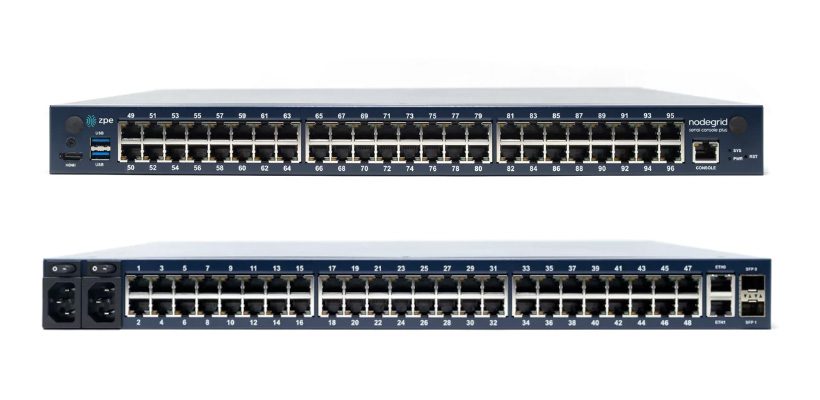
The Nodegrid Serial Console Plus provides unified serial console management for many servers and infrastructure devices.
Serial console redirection also allows teams to manage servers with serial consoles, also known as console servers, console server switches, or terminal servers. One of these devices can be used to manage several pieces of data center equipment, so sysadmins don’t need to connect to each server individually.
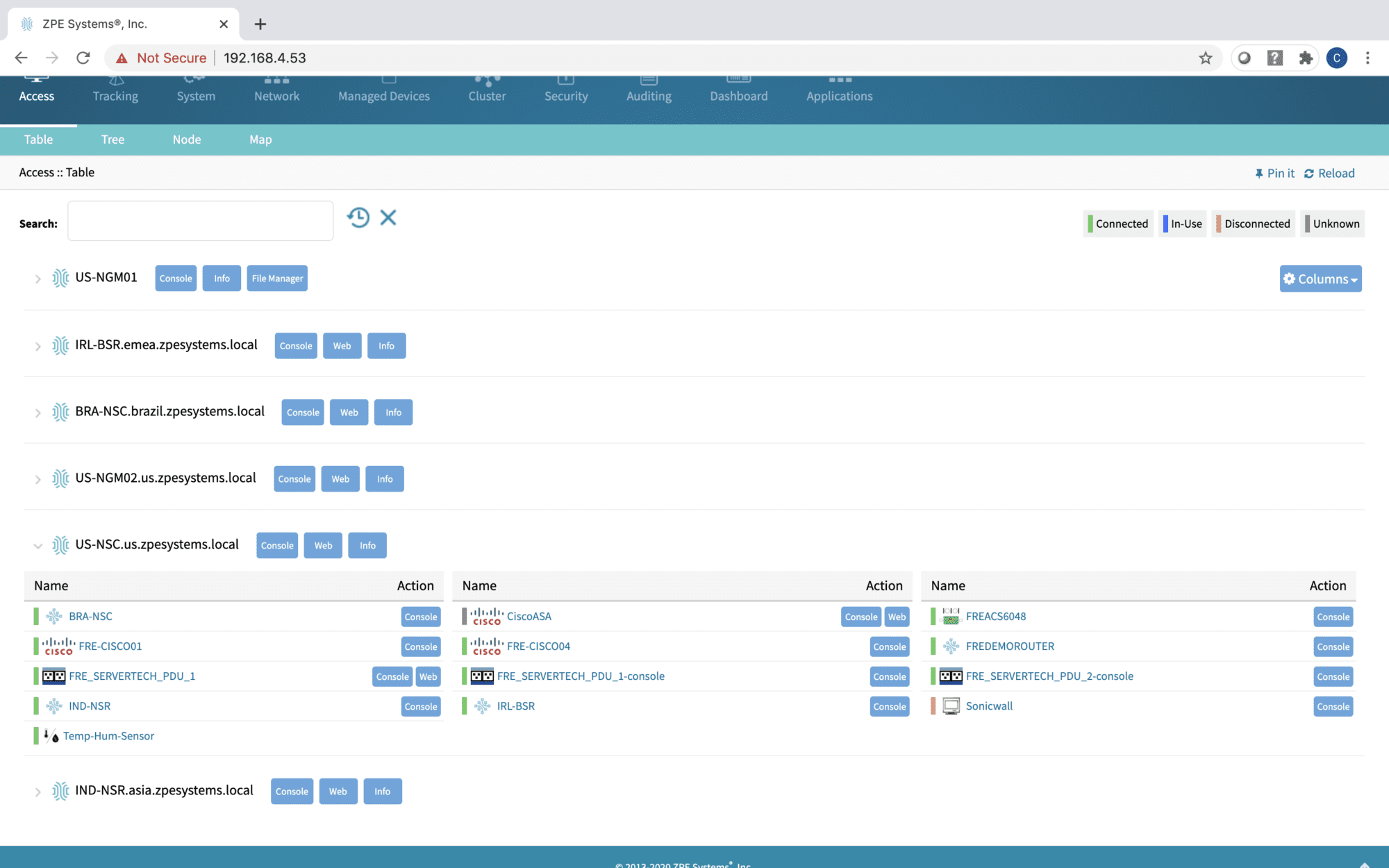
The management interface for the Nodegrid Serial Console Plus allows admins to manage many servers and infrastructure devices from one convenient location.
The management interface for the Nodegrid Serial Console Plus allows admins to manage many servers and infrastructure devices from one convenient location.
Serial consoles also create an OOB network without the need to deploy a bunch of redundant devices and services. Solutions like the Nodegrid Serial Console from ZPE Systems provide additional functionality like power control, giving remote teams the ability to power-cycle a hung device or turn systems back on after a power failure. OOB serial consoles help improve management efficiency and overall resilience without driving up costs or complexity.
Learn more about serial consoles and OOB management:
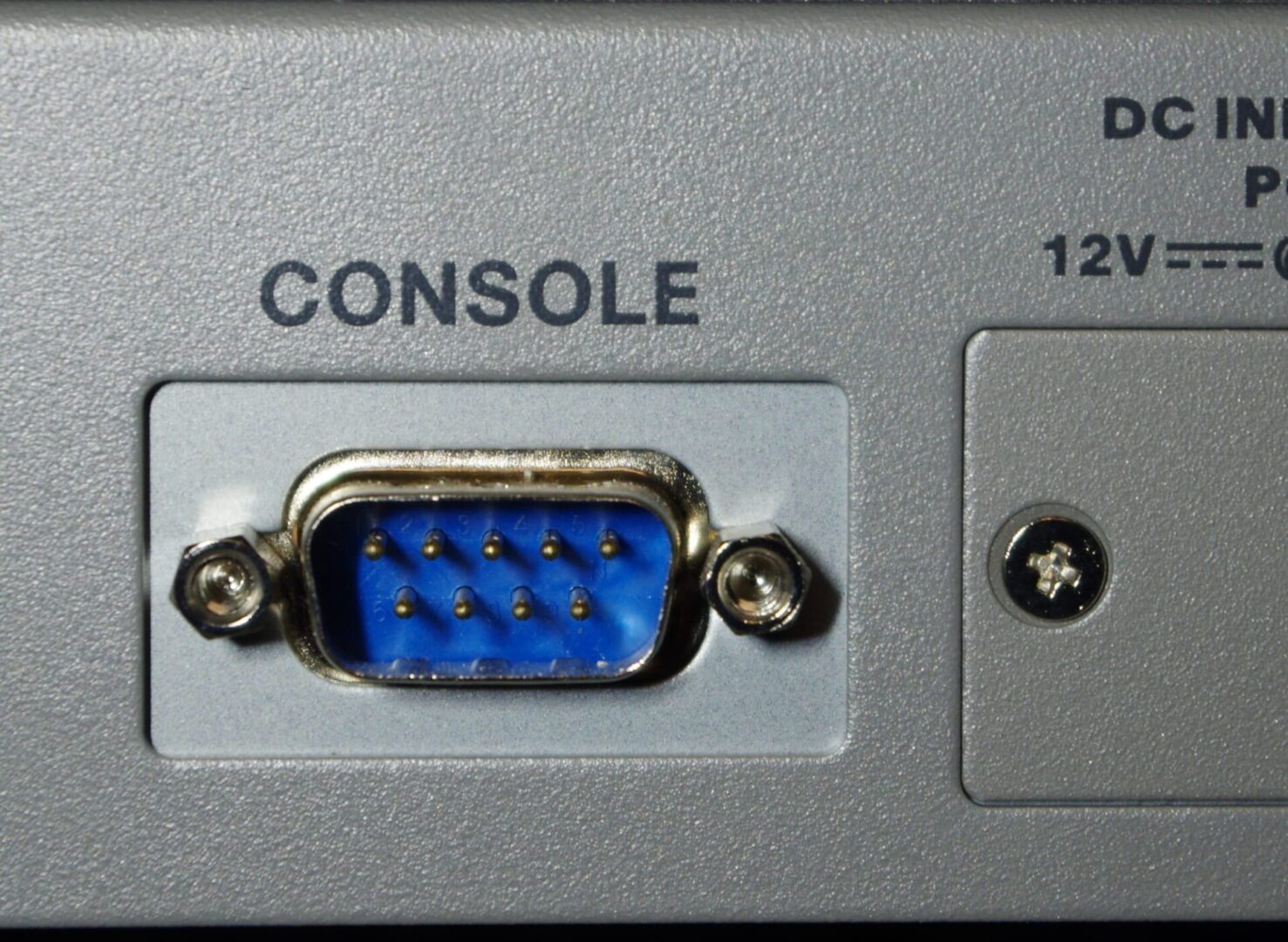
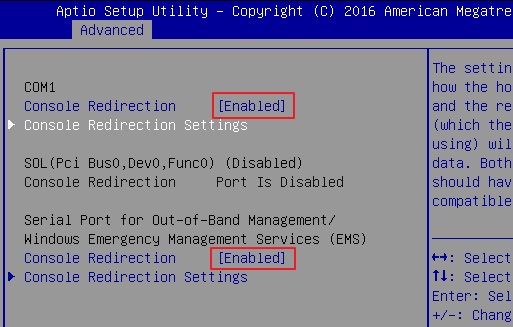
Serial console redirection is typically configured in the server’s UEFI (Unified Extensible Firmware Interface) or BIOS (Basic Input/Output System) settings. As such, it’s important to consult the vendor-provided documentation for instructions on how to enable it for your server hardware.
Serial console redirection enabled in BIOS. Source: ASRock Rack
Additionally, some Windows and Linux-based operating systems need to be configured for serial console management. It’s best to look up the OS-specific instructions on the vendor’s website, but here are a few links to get you started:
Configuring serial console redirection is relatively straightforward, and it allows sysadmins to remotely control and troubleshoot servers even when the OS isn’t available. It also enables the use of OOB serial consoles like the Nodegrid solution from ZPE Systems, which streamlines remote management workflows and reduces the business impact of system failures.
Nodegrid consolidates a sysadmin’s entire management tech stack into a single appliance for greater operational efficiency.
Nodegrid consolidates a sysadmin’s entire management tech stack into a single appliance for greater operational efficiency.
Nodegrid is a Gen 3 out-of-band management platform that provides vendor-neutral control over mixed-vendor infrastructure. It can integrate or directly host third-party applications for automation, security, and much more, consolidating an entire tech stack into a single, cost-efficient solution.
Serial console redirection with Nodegrid improves operational efficiency and network resilience. Schedule a demo to see a Nodegrid Serial Console in action!
The serial console port on a Linux device allows administrators to manage the machine via the command line interface (CLI), without a keyboard, mouse, or monitor attached. Serial console management is useful for performing administrative tasks on headless Linux servers (meaning, those without ports for a keyboard or monitor) and embedded Linux systems like routers and storage devices.
While it’s possible to directly connect a laptop or Intel NUC jump box to the serial console port on a Linux device with a serial cable, this only allows you to manage one machine at a time, so it’s inefficient at scale. A serial console server (also known as a serial console or console server) provides multiple managed serial ports that administrators can connect to Linux machines, as well as many other devices. It unifies the management of all connected machines so administrators can control them all from one place, significantly streamlining infrastructure workflows.
Enterprise serial consoles for Linux provide additional capabilities like out-of-band (OOB) management, infrastructure automation, and embedded security. This guide compares the best solutions to help you choose the right console server for your enterprise.
How to use the serial console port on a Linux device
The Linux kernel does not support serial console capabilities by default, so it must be configured to output console messages to the serial port first. This involves modifying the bootloader to specify new kernel options, formatted like so:
console=device,options

device:         tty0 for the foreground virtual console
                ttyX for any other virtual console
                ttySx for a serial port
                lp0 for the first parallel port
                ttyUSB0 for the first USB serial device

options:        depend on the driver. For the serial port this
                defines the baudrate/parity/bits/flow control of
                the port, in the format BBBBPNF, where BBBB is the
                speed, P is parity (n/o/e), N is number of bits,
                and F is flow control ('r' for RTS). Default is
                9600n8. The maximum baudrate is 115200.
For more information on configuring the Linux serial console, read guides from docs.kernel.org, RedHat, or Ubuntu.
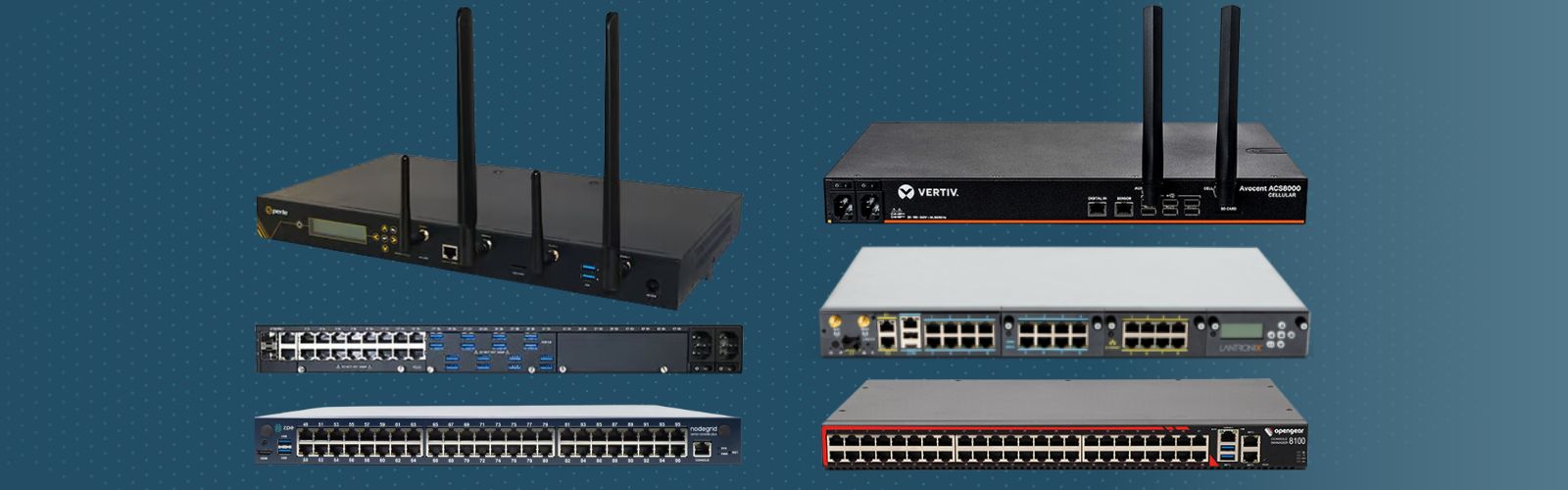
Comparing the best serial consoles for Linux
ZPE Nodegrid
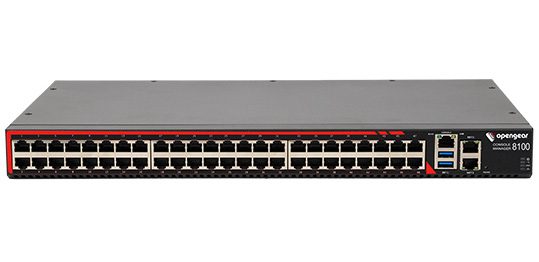
Opengear CM8100
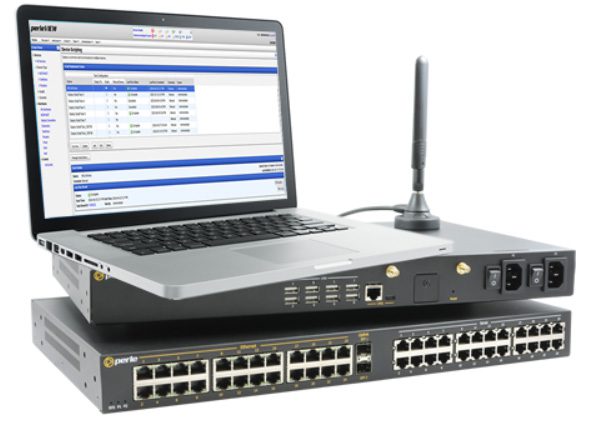
Perle IOLAN SCG LWM
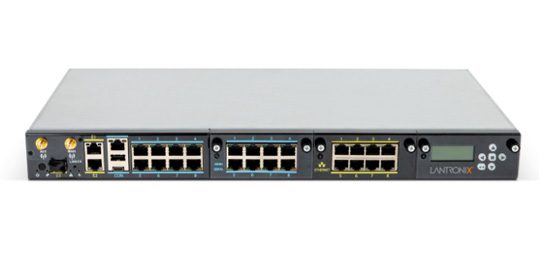
Lantronix LM83X
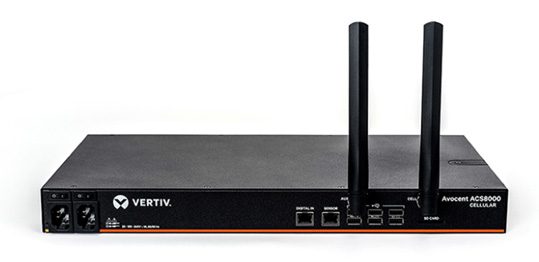
Vertiv Avocent ACS8000
Cellular OOB
✔
✖
✔
✔
✔
ZTP for End Devices
✔
✔
✔
✔
✔
Guest OS
✔
✔
✖
✖
✖
3rd Party Automation
✔
✔
✖
✖
✖
Embedded Firewall
✔
✔
✔
✖
✔
3rd Party Security
✔
✖
✔
✖
✖
All of these solutions provide remote out-of-band management and consolidated control for Linux infrastructure. They also offer automation capabilities via zero-touch provisioning (ZTP), automatically deploying configurations over the network as soon as new devices come online. Some important differentiating features include cellular capabilities for OOB and failover, advanced security features like an embedded firewall and VPN support, and the ability to host and integrate third-party automation tools.
1. Nodegrid Serial Console
Nodegrid is a family of serial console server solutions from ZPE Systems. Nodegrid provides up to 96 managed serial ports while only taking up a single unit of rack space (Patent No. 9,905,980), significantly reducing the number of management devices needed to control large data center deployments. The Nodegrid Serial Console Plus (NSCP) comes with built-in 4G/5G LTE and Wi-Fi for failover and OOB management, while the S Series has auto-sensing serial ports for mixed legacy/modern environments. The NSCP-Core Edition is a low-cost alternative for break-fix deployments that provides Gen 3 security and OOB serial console management.
The Nodegrid platform runs on the open, Linux-based Nodegrid OS and uses Intel x86 processors, allowing it to natively run VM and Docker applications for other vendors’ software. That means you can host third-party NetOps automation solutions like Ansible and Chef, and even extend that automation to legacy equipment. Nodegrid also provides device auto-discovery and ZTP.
Nodegrid serial consoles include an embedded firewall with a multi-site IPsec VPN and advanced authentication support to protect the OOB network. It also comes with unique hardware security features like geofencing, BIOS protection, and UEFI Secure Boot to prevent malicious actors from hijacking the management network with a stolen device.
Pros:
Up to 96 managed serial ports in a 1U appliance
Fast OOB with 4G/5G LTE and Wi-Fi options
2 Ethernet and 2 10GB SFP+ ports (NSCP) or 2 Ethernet and 1 1GB SFP+ (NSCP-Core)
Intel x86 CPU and lots of RAM for 3rd-party Docker and VM apps
The Opengear CM8100 serial console has up to 48 ports in a 1U model or 96 ports in a 2U model. It only uses Ethernet for failover and OOB, without any options for cellular or Wi-Fi. It runs an embedded Linux operating system that is programmable and extensible with third-party integrations.
With an upgraded “Automation” edition of its Lighthouse software, Opengear console servers gain ZTP, RESTful APIs, Docker containers, and Python scripts for infrastructure automation capabilities. The CM8100 comes with a stateful firewall that provides IP filtering and port forwarding. It supports IPsec & OpenVPN and advanced authentication, but not 2FA or SAML 2.0.
Pros:
Programmable and extensible
Gateway router features
Stateful firewall
2 Ethernet ports (16 & 32 port models) or 2 Ethernet or 2 SFP+ (48 & 96 port models)
Cons:
Automation and ZTP require software upgrade
No support for 2FA or SAML 2.0
No cellular or Wi-Fi access
Perle IOLAN SCG
The Perle IOLAN SCG serial console supports up to 48 managed serial ports. While its fixed-form-factor models only support copper Ethernet for networking and OOB, the SCG also has a modular version with options for Wi-Fi, cellular, and analog modem.
IOLAN SCG console servers contain an underpowered 500 MHz core 32-bit ARM processor and little storage or memory headroom for automation, though Perle’s management software can extend ZTP to end devices. The solution does include a robust embedded firewall and support for two-factor authentication.
Pros:
Programmable and extensible
Gateway router features
Stateful firewall
Cons:
Automation and ZTP require software upgrade
No support for 2FA or SAML 2.0
No cellular or Wi-Fi access
Lantronix LM83X
The Lantronix LM83X serial console is a modular solution with three expansion bays, supporting up to 104 managed serial ports. It has versatile options for 4G LTE, analog modem, fiber, DSL, or satellite for OOB and failover.
The LM83X’s ARM CPU architecture prevents it from running VMs and Docker containers for automation or third-party software. The Lantronix Control Center software does not support any third-party integrations, though it does provide some built-in automation and playbook capabilities. The LM83X offers some advanced authentication support and IP filtering but lacks an embedded firewall or VPN.
Pros:
Manages up to 104 serial devices with expansion cards
Flexible OOB and failover options
Robust device monitoring tools
Cons:
Can’t run Guest OS or 3rd-party apps
No support for 3rd-party integrations
No embedded firewall
Vertiv Avocent ACS8000
The Vertiv Avocent ACS8000 provides up to 48 managed serial ports, with faster-than-average minimum port speeds of 1200 bps. It uses 4G LTE for OOB and failover and has an updated Linux operating system.
While the ACS8000 has ZTP for end devices, its ARM architecture does not support VMs, Docker apps, or third-party automation and orchestration. The proprietary DSViewTM software offers some automation capabilities for event logging and notifications but is not extensible with third-party integrations. The ACS8000 has an embedded firewall and IPSec VPN support, but lacks advanced authentication features.
Pros:
Fast minimum port speeds
4G cellular for OOB and failover
Environmental sensor port
Cons:
No support for Docker or third-party orchestration
Software is not extensible
Lacks advanced authentication features
How to choose the best serial console for your Linux environment
These solutions all provide remote out-of-band management and consolidated infrastructure control for Linux devices. However, Nodegrid goes above and beyond by offering a truly vendor-neutral platform that supports third-party integrations and direct hosting of other vendors’ automation and orchestration software. Plus, only Nodegrid secures the automated control plane with robust on-board hardware security protection and a full suite of firewall, encryption, and authentication features like 2FA and SAML.
Ready to replace your outdated console servers?
We know that replacing outdated, EOL devices takes a lot of effort. That’s why ZPE now offers a complete package of budget-friendly products and engineering services to help. Click here to see how we make it easy to upgrade to the best serial console for Linux.
Which Nodegrid serial console is right for you?
NSCP
S Series
NSCP-CE
NSR
Use Cases
Hyperscale data centers and cloud service providers
Mixed legacy, modern, and multi-vendor environments
Break-fix solution for data centers, colocations, and branches
Passive optical networking (PON) is a high-speed broadband technology that enables the delivery of multiple services over a single fiber optic cable. XGS-PON – 10G Symmetrical PON – offers speeds of up to 10 Gbps downstream and 10 Gbps upstream (hence the term ‘symmetrical’), making it ideal for applications such as video streaming, online gaming, and cloud computing.
What Problems Does PON Solve for Out-of-Band Management?
PON addresses the issue of efficiency in terms of both uplink costs and bandwidth usage. Traditional POTS lines and dedicated circuits rely on legacy infrastructure that requires regular maintenance. This infrastructure must scale as more out-of-band devices are added to the network, which increases costs and energy consumption. On top of this, using a 10G uplink for a serial console’s 10K traffic is like throwing away 99% of that high bandwidth. Per Gartner’s Market Guide for Optical Transport Systems report (Published 20 November 2023) the best way to “lower cost and energy per transported bit” is by using technologies such as passive optical networking.
Because PON uses passive optical splitters that have no moving parts or powered components between the central hub and end users, PON is much more efficient for deploying serial consoles close to target assets. These out-of-band devices can be deployed in large quantities and close to the network edge, with up to 256 devices sharing one uplink. This reduces cabling and power requirements, and is ideal for MSP and campus operators, where there are many out-of-band devices distributed over long distances.
More About PON: GPON and XGS-PON Technologies
Passive Optical Networking (PON) leverages time-division multiplexing (TDM) and different wavelengths of light to transmit and receive data on a single fiber strand. This allows efficient communication among up to 256 devices over a single fiber. Initially developed for fiber-to-the-home (FTTH) deployments, PON technology has evolved to facilitate the addition of network nodes with minimal infrastructure changes. GPON (gigabit-capable PON)and XGS-PON use different frequencies for upstream and downstream data transmission. The upstream headend, known as the Optical Line Terminal (OLT), manages and coordinates the time slots allocated to downstream Optical Network Units (ONUs) for data transmission.
GPON and XGS-PON Support on ZPE Systems’ Nodegrid SR Gateway
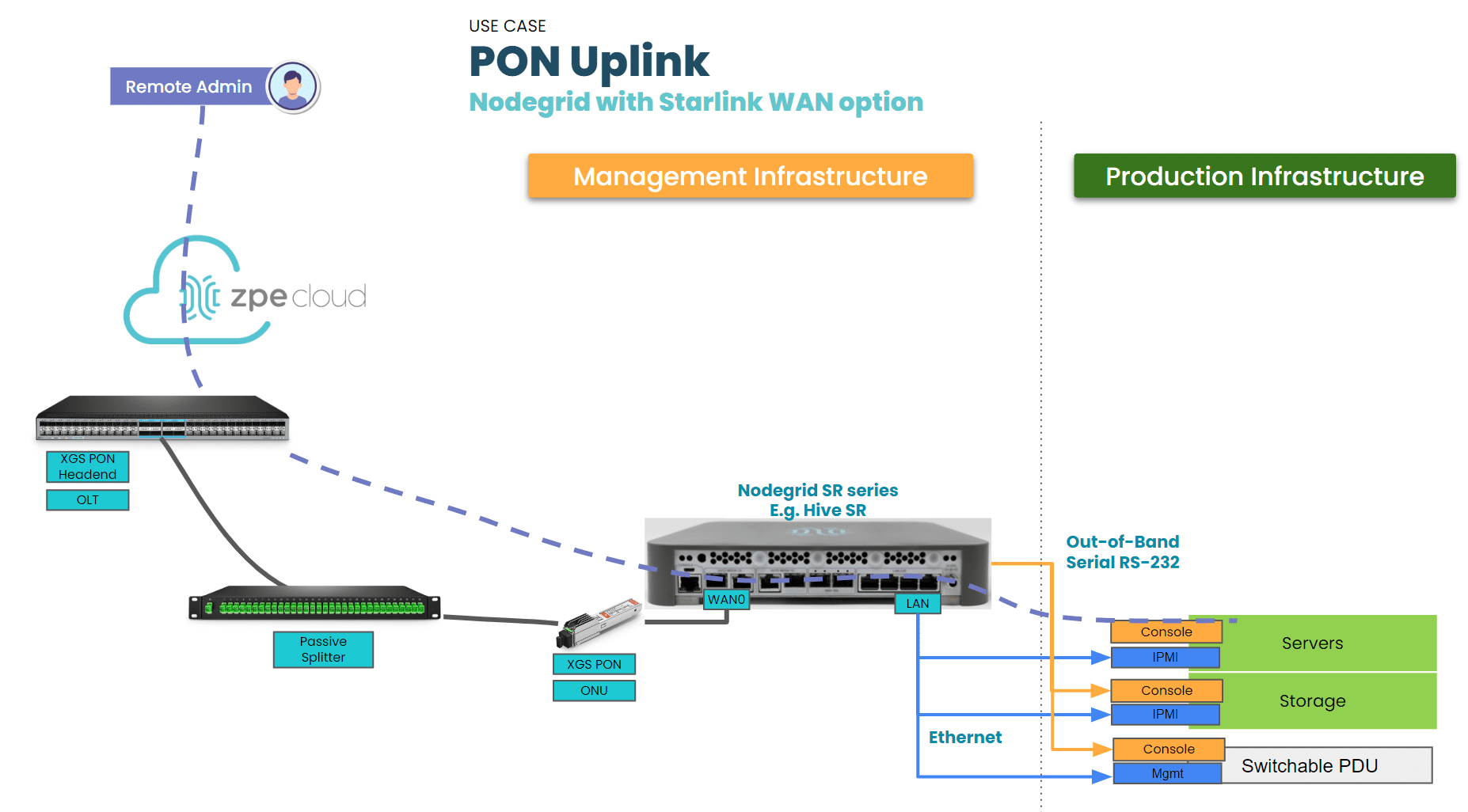
ZPE Systems’ Nodegrid SR appliances, which are used as out-of-band access nodes or complete branch gateways, now support GPON and XGS-PON technology (patent pending) via SFP and SFP+ ports. The Nodegrid SR family is offered in multiple form factors to be right-sized for deployments in branch offices, factories, smart buildings, and industrial environments (such as for SCADA).
Having support for GPON and XGS-PON means network engineers now have a flexible choice of high-speed uplink technologies. This versatility makes the Nodegrid SR gateway suitable for edge deployments, where it can establish an OOBI-WAN™ (out-of-band infrastructure WAN) link, and for data centers, where it enhances uplink efficiency. Given the low bandwidth requirements of serial console and out-of-band communications, PON technology is well-suited for these applications. A single fiber strand can be shared among hundreds of out-of-band and serial console devices using passive optical splitters. Organizations can deploy out-of-band devices close to the racks and edges of the network in a cost- and energy-efficient manner. Additionally, ZPE devices support ONU SFPs compatible with third-party OLT headends, ensuring broad interoperability and integration.
Benefits of Using XGS-PON with ZPE Systems’ Nodegrid SR Gateway
The benefits of using XGS-PON with ZPE Systems’ Nodegrid SR gateway include:
High-Speed Connectivity: XGS-PON delivers symmetrical speeds of up to 10 Gbps, making it ideal for high-bandwidth applications like video streaming, online gaming, and cloud computing. This ensures consistent and high-quality service for end-users.
Cost-Effectiveness: Deploying XGS-PON is a cost-effective solution for delivering high-speed broadband services, especially in scenarios where upgrading existing infrastructure may be challenging.
Scalability: The Nodegrid SR Gateway, acting as an ONU, can connect up to 256 serial consoles through a single fiber strand. PON’s use of asymmetric wavelengths and TDM enables multiple devices to share the same fiber strand efficiently. Optical splitters, which require no external power, facilitate the sharing of fiber between multiple ONUs, which makes scaling much more cost and energy efficient.
Reliability: The Nodegrid SR gateway is proven by service providers worldwide. Its robust design and compatibility with various network configurations make it a reliable choice for delivering high-quality broadband services.
Figure 1: ZPE Nodegrid SR gateway with XGS-PON ONU support
XGS-PON Enhances Efficiency of Out-of-Band
XGS-PON is a significant advancement over traditional, copper-based uplinks. The integration of XGS-PON support in the ZPE Systems Nodegrid SR Gateway allows network architects to deploy a dedicated out-of-band ring that is not only high-speed but also cost-effective, energy-efficient, and capable of covering longer distances. PON technology, with its ability to handle the lower data rates of out-of-band transmissions, is an ideal uplink medium for serial console transmission. The combination of XGS-PON and the Nodegrid SR Gateway provides a powerful and flexible solution for modern network infrastructure.
Be one of the first to try PON on the Nodegrid SR Gateway
Set up a demo for a deeper dive into PON use cases and how it can benefit your organization.
Console servers – also known as serial consoles, console server switches, serial console servers, serial console routers, or terminal servers – are critical for data center infrastructure management. They give administrators a single point of control for devices like servers, switches, and power distribution units (PDUs) so they don’t need to log in to each piece of equipment individually. It also uses multiple network interfaces to provide out-of-band (OOB) management, which creates an isolated network dedicated to infrastructure orchestration and troubleshooting. This OOB network remains accessible during production network outages, offering remote teams a lifeline to recover systems without costly and time-consuming on-site visits.
Console server hardware for large data center deployments
Large and hyperscale data centers can include hundreds or even thousands of individual devices to manage. Teams typically use infrastructure automation, like infrastructure as code (IaC), because managing devices at such a large scale is impossible to do manually. The best console server hardware for high-density data centers will include plenty of managed serial ports, support hundreds of concurrent sessions, and provide support for infrastructure automation.
Click here to compare the hardware specs of the top providers, or read below for more information.
Nodegrid Serial Console Plus (NSCP)
The Nodegrid Serial Console Plus (NSCP) from ZPE Systems is the only console server providing up to 96 RS-232 serial ports in a 1U rack-mounted form factor. Its quad-core Intel processor and robust (as well as upgradable) internal storage and RAM options, as well as its Linux-based Nodegrid OS, support Guest OS and Docker containers for third-party applications. That means the NSCP can directly host infrastructure automation (like Ansible, Puppet, and Chef), security (like Palo Alto’s next-generation firewalls and Secure Access Service Edge), and much more. Plus, it can extend zero-touch provisioning (ZTP) to legacy and mixed-vendor devices that otherwise wouldn’t support automation.
The NSCP also comes packed with hardware security features including BIOS protection, UEFI Secure Boot, self-encrypted disk (SED), Trusted Platform Module (TPM) 2.0, and a multi-site VPN using IPSec, WireGuard, and OpenSSL protocols. Plus, it supports a wide range of USB environmental monitoring sensors to help remote teams control conditions in the data center or colocation facility.
Advantages:
Up to 96 managed serial ports in a 1U appliance
Intel x86 CPU and 4GB of RAM for 3rd-party Docker and VM apps
Extends ZTP and automation to legacy and mixed-vendor infrastructure
Supports a wide range of USB environmental monitoring sensors
Wi-Fi and 5G/4G LTE options available
Supports over 1,000 concurrent sessions
Disadvantages:
USB ports limited on 96-port model
Opengear CM8100
The Opengear CM8100 comes in two models: the 1G version includes up to 48 managed serial ports, while the 10G version supports up to 96 serial ports in a 2U form factor. Both models have a dual-core ARM Cortex processor and 2GB of RAM, allowing for some automation support with upgraded versions of the Lighthouse management software. They also come with an embedded firewall, IPSec and OpenVPN protocols for a single-site VPN, and TPM 2.0 security.
Advantages:
10G model comes with software-selectable serial ports
Supports OpenVPN and IPSec VPNs
Fast port speeds
Disadvantages:
Automation and ZTP require Lighthouse software upgrade
No cellular or Wi-Fi options
96-port model requires 2U of rack space
Perle IOLAN SCG (fixed)
The IOLAN SCG is Perle’s fixed-form-factor console server solution. It supports up to 48 managed serial ports and can extend ZTP to end devices. It comes with onboard security features including an embedded firewall, OpenVPN and IPSec VPN, and AES encryption. However, the IOLAN SCG’s underpowered single-core ARM processor, 1GB of RAM, and 4GB of storage limit its automation capabilities, and it does not integrate with any third-party automation or orchestration solutions.
Data center deployments that include a mix of legacy and modern solutions from multiple vendors benefit from console server hardware that includes software-selectable serial ports. This feature allows administrators to manage devices with straight or rolled RS-232 pinouts from the same console server.
Click here to compare the hardware specs of the top providers, or read below for more information.
Nodegrid Serial Console S Series
The Nodegrid Serial Console S Series has up to 48 auto-sensing RS-232 serial ports and 14 high-speed managed USB ports, allowing for the control of up to 62 devices. Like the NSCP, the S Series has a quad-core Intel CPU and upgradeable storage and RAM, supporting third-party VMs and containers for automation, orchestration, security, and more. It also comes with the same robust security features to protect the management network.
Advantages:
Includes 14 high-speed managed USB ports
Intel x86 CPU and 4GBof RAM for 3rd-party Docker and VM apps
Supports a wide range of USB environmental monitoring sensors
Extends ZTP and automation to legacy and mixed-vendor infrastructure
Robust on-board security features like BIOS protection and TPM 2.0
Supports 250+ concurrent sessions
Disadvantages
Only offers 1Gbps and Ethernet connectivity for OOB
Opengear OM2200
The Opengear OM2200 comes with 16, 32, or 48 software-selectable RS-232 ports, or, with the OM2224-24E model, 24 RS-232 and 24 managed Ethernet ports. It also includes 8 managed USB ports and the option for a V.92 analog modem. It has impressive storage space and 8GB of DDR4 RAM for automated workflows, though, as with all Opengear solutions, the upgraded version of the Lighthouse management software is required for ZTP and NetOps automation support.
Advantages:
Optional managed Ethernet ports
Optional V.92 analog modem for OOB
64GB of storage and 8GB DDR4 RAM
Disadvantages:
Automation and ZTP require Lighthouse software upgrade
No cellular or Wi-Fi options
Comparison Table: Console Server Hardware for Mixed Environments
Nodegrid S Series
Opengear OM2200
Serial Ports
16 / 32 / 48x Software Selectable RS-232
14x USB-A serial
16 / 32 / 48x Software Selectable RS-232 8x USB 2.0 serial
(OM2224-24E) 24x Software Selectable RS-232 and 24x Managed Ethernet
A full-featured console server solution may be too complicated and expensive for certain use cases, especially for organizations just looking for “break-fix” OOB access to remotely troubleshoot and recover from issues. The best console server hardware for this type of deployment provides fast and reliable network access to managed devices without extra features that increase the price and complexity.
Click here to compare the hardware specs of the top providers, or read below for more information.
Nodegrid Serial Console Core Edition (NSCP-CE)
The Nodegrid Serial Console Core Edition (NSCP-CE) provides the same hardware and security features as the NSCP, as well as ZTP, but without the advanced automation capabilities. Its streamlined management and affordable price tag make it ideal for lean, budget-conscious IT departments. And, like all Nodegrid solutions, it comes with the most comprehensive hardware security features in the industry.
Advantages:
Up to 48 managed serial ports in a 1U appliance
Extends ZTP and automation to legacy and mixed-vendor infrastructure
Robust on-board security features like BIOS protection and TPM
Supports a wide range of USB environmental monitoring sensors
Analog modem and 5G/4G LTE options available
Supports over 100 concurrent sessions
Disadvantages
Supports automation only via ZPE Cloud
Opengear CM7100
The Opengear CM7100 is the previous generation of the CM8100 solution. Its serial and network interface options are the same, but it comes with a weaker, Armada 800 MHz CPU, and there are options for smaller storage and RAM configurations to reduce the price. As with all Opengear console servers, the CM7100 doesn’t support ZTP without paying for an upgraded Lighthouse license, however.
Advantages:
Can reduce storage and RAM to save money
Supports OpenVPN and IPSec VPNs
Fast port speeds
Disadvantages:
Automation and ZTP require Lighthouse software upgrade
No cellular or Wi-Fi options
96-port model requires 2U of rack space
Comparison Table: Console Server Hardware for Break-Fix Deployments
Modular console server hardware for flexible deployments
Modular console servers allow organizations to create customized solutions tailored to their specific deployment and use case. They also support easy scaling by allowing teams to add more managed ports as the network grows, and provide the flexibility to swap-out certain capabilities and customize their hardware and software as the needs of the business change.
Click here to compare the hardware specs of the top providers, or read below for more information.
Nodegrid Net Services Router (NSR)
The Nodegrid Net Services Router (NSR) has up to five expansion bays that can support any combination of 16 RS-232 or 16 USB serial modules. In addition to managed ports, there are NSR modules for Ethernet (with or without PoE – Power over Ethernet) switch ports, Wi-Fi and dual-SIM cellular, additional SFP ports, extra storage, and compute.
The NSR comes with an eight-core Intel CPU and 8GB DDR4 RAM, offering the same vendor-neutral Guest OS/Docker support and onboard security features as the NSCP. It can also run virtualized network functions to consolidate an entire networking stack in a single device. This makes the NSR adaptable to nearly any deployment scenario, including hyperscale data centers, edge computing sites, and branch offices.
Advantages:
Up to 5 expansion bays provide support for up to 80 managed devices
8GB of DDR4 RAM
Robust on-board security features like BIOS protection and TPM 2.0
Supports a wide range of USB environmental monitoring sensors
Wi-Fi and 5G/4G LTE options available
Optional modules for various interfaces, extra storage, and compute
Disadvantages
No V.92 modem support
Perle IOLAN SCG L/W/M
The Perle IOLAN SCG modular series is customizable with cellular LTE, Wi-Fi, a V.92 analog modem, or any combination of the three. It also has three expansion bays that support any combination of 16-port RS-232 or 16-port USB modules. Otherwise, this version of the IOLAN SCG comes with the same security features and hardware limitations as the fixed form factor models.
Advantages:
Cellular, Wi-Fi, and analog modem options
Supports ZTP for end devices
Comprehensive firewall functionality
Disadvantages
Very limited CPU, RAM, and flash storage
Does not support third-party automation
Comparison Table: Modular Console Server Hardware
Nodegrid NSR
Perle IOLAN SCG R/U
Serial Ports
16 / 32 / 48 / 64 / 80x RS-232 with up to 5 serial modules
16 / 32 / 48 / 64 / 80x USB with up to 5 serial modules
Get the best console server hardware for your deployment with Nodegrid
The vendor-neutral Nodegrid platform provides solutions for any use case, deployment size, and pain points. Schedule a free Nodegrid demo to learn more.
Want to see Nodegrid in action?
Watch a demo of the Nodegrid Gen 3 out-of-band management solution to see how it can improve scalability for your data center architecture.
Data center scalability is the ability to increase or decrease workloads cost-effectively and without disrupting business operations. Scalable data centers make organizations agile, enabling them to support business growth, meet changing customer needs, and weather downturns without compromising quality. This blog describes various methods for achieving data center scalability before providing tips and best practices to make scalability easier and more cost-effective to implement.
How to achieve data center scalability
There are four primary ways to scale data center infrastructure, each of which has advantages and disadvantages.
4 Data center scaling methods
Method
Description
Pros and Cons
1. Adding more servers
Also known as scaling out or horizontal scaling, this involves adding more physical or virtual machines to the data center architecture.
✔ Can support and distribute more workloads
✔ Eliminates hardware constraints
✖ Deployment and replication take time
✖Requires more rack space
✖ Higher upfront and operational costs
2. Virtualization
Dividing physical hardware into multiple virtual machines (VMs) or virtual network functions (VNFs) to support more workloads per device.
✔ Supports faster provisioning
✔ Uses resources more efficiently
✔ Reduces scaling costs
✖ Transition can be expensive and disruptive
✖ Not supported by all hardware and software
3. Upgrading existing hardware
Also known as scaling up or vertical scaling, this involves adding more processors, memory, or storage to upgrade the capabilities of existing systems.
✔ Implementation is usually quick and non-disruptive
✔ More cost-effective than horizontal scaling
✔ Requires less power and rack space
✖ Scalability limited by server hardware constraints
✖ Increases reliance on legacy systems
4. Using cloud services
Moving some or all workloads to the cloud, where resources can be added or removed on-demand to meet scaling requirements.
✔ Allows on-demand or automatic scaling
✔ Better support for new and emerging technologies
✔ Reduces data center costs
✖ Migration is often extremely disruptive
✖ Auto-scaling can lead to ballooning monthly bills
✖ May not support legacy software
It’s important for companies to analyze their requirements and carefully consider the advantages and disadvantages of each method before choosing a path forward.
Best practices for data center scalability
The following tips can help organizations ensure their data center infrastructure is flexible enough to support scaling by any of the above methods.
Run workloads on vendor-neutral platforms
Vendor lock-in, or a lack of interoperability with third-party solutions, can severely limit data center scalability. Using vendor-neutral platforms ensures that teams can add, expand, or integrate data center resources and capabilities regardless of provider. These platforms make it easier to adopt new technologies like artificial intelligence (AI) and machine learning (ML) while ensuring compatibility with legacy systems.
Use infrastructure automation and AIOps
Infrastructure automation technologies help teams provision and deploy data center resources quickly so companies can scale up or out with greater efficiency. They also ensure administrators can effectively manage and secure data center infrastructure as it grows in size and complexity.
For example, zero-touch provisioning (ZTP) automatically configures new devices as soon as they connect to the network, allowing remote teams to deploy new data center resources without on-site visits. Automated configuration management solutions like Ansible and Chef ensure that virtualized system configurations stay consistent and up-to-date while preventing unauthorized changes. AIOps (artificial intelligence for IT operations) uses machine learning algorithms to detect threats and other problems, remediate simple issues, and provide root-cause analysis (RCA) and other post-incident forensics with greater accuracy than traditional automation.
Isolate the control plane with Gen 3 serial consoles
Serial consoles are devices that allow administrators to remotely manage data center infrastructure without needing to log in to each piece of equipment individually. They use out-of-band (OOB) management to separate the data plane (where production workflows occur) from the control plane (where management workflows occur). OOB serial console technology – especially the third-generation (or Gen 3) – aids data center scalability in several ways:
Gen 3 serial consoles are vendor-neutral and provide a single software platform for administrators to manage all data center devices, significantly reducing management complexity as infrastructure scales out.
Gen 3 OOB can extend automation capabilities like ZTP to mixed-vendor and legacy devices that wouldn’t otherwise support them.
OOB management moves resource-intensive infrastructure automation workflows off the data plane, improving the performance of production applications and workflows.
Serial consoles move the management interfaces for data center infrastructure to an isolated control plane, which prevents malware and cybercriminals from accessing them if the production network is breached. Isolated management infrastructure (IMI) is a security best practice for data center architectures of any size.
How Nodegrid simplifies data center scalability
Nodegrid is a Gen 3 out-of-band management solution that streamlines vertical and horizontal data center scalability.
The Nodegrid Serial Console Plus (NSCP) offers 96 managed ports in a 1RU rack-mounted form factor, reducing the number of OOB devices needed to control large-scale data center infrastructure. Its open, x86 Linux-based OS can run VMs, VNFs, and Docker containers so teams can run virtualized workloads without deploying additional hardware. Nodegrid can also run automation, AIOps, and security on the same platform to further reduce hardware overhead.
Nodegrid OOB is also available in a modular form factor. The Net Services Router (NSR) allows teams to add or swap modules for additional compute, storage, memory, or serial ports as the data center scales up or down.
Want to see Nodegrid in action?
Watch a demo of the Nodegrid Gen 3 out-of-band management solution to see how it can improve scalability for your data center architecture.
ZPE Systems delivers innovative solutions to simplify infrastructure managment at the datacenter, branch, and edge.
Learn how our Zero Pain Ecosystem can solve your biggest network orchestration pain points.