Providing Out-of-Band Connectivity to Mission-Critical IT Resources

Home » Uncategorized » Page 2

How Enterprise Network Security Software has Evolved for the Edge

Enterprise Network Security Software.

Modern enterprise networks are no longer contained to a single building or LAN. They’re highly distributed, with branch offices, remote employees, and global data centers that communicate and work together. That’s why traditional enterprise network security software—designed for on-premises infrastructure and castle-and-moat protection strategies—often struggles to secure the edge.

The challenge of traditional enterprise network security software at the edge

For years, enterprise network security followed the castle-and-moat approach. All the enterprise’s valuable systems and data are kept on the internal network (a.k.a. the castle), and a firewall creates a security perimeter (a.k.a. the moat) around those resources. This is easier to do when everything is housed in the same location. This becomes challenging (if not impossible) when those resources are spread across large geographical and logical distances.

For example, organizations may have a hard time extending their enterprise security policies to users, devices, and applications that aren’t on the main network. That goes beyond remote workers to also include cloud platforms and remote edge data centers. Some teams overcome this challenge by creating separate policies, but then they’re left with the logistical nightmare of updating and maintaining these policies across many different systems and locations. Due to errors or negligence, inconsistent security policies can leave gaps in your network security coverage.

In addition, traditional network security requires all remote traffic to be backhauled through the main firewall for inspection, creating a network bottleneck. That means all network requests worldwide must travel to the central data center, even if the traffic is ultimately destined for remote or cloud resources. This added network load can cause latency, timeouts, and other performance issues for the entire enterprise.

Challenges like these led to the evolution of enterprise network security software for edge deployments.

How enterprise network security software has evolved for the edge

Edge computing is all about moving resources closer to the users, systems, and applications that need them. Enterprise network security software for the edge does the same thing—it places security policies and controls in the cloud or small regional data centers, so remote systems and users don’t need to be routed back to the central network. The leading solution for edge security is Security Service Edge, or SSE.

SSE rolls up multiple security technologies into one integrated, cloud-based platform. Traffic from the edge is routed through the SSE security stack using SD-WAN (software-defined wide area networking). If that traffic is bound for cloud- or web-based resources, it’s allowed to bypass the central network entirely. Zero Trust Network Access (ZTNA) ensures safe and secure access if the traffic is destined for resources on the enterprise network.

Let’s discuss the specific technology that makes SSE the best solution for edge network security.

Zero Trust Network Access (ZTNA)

Zero Trust Network Access allows remote users and systems to access resources on the enterprise network, similar to a VPN. ZTNA is more secure than VPNs because it only gives users access to one specific resource at a time. They cannot jump around the network without re-authenticating and re-verifying trust. That means the lateral movement of a compromised account is limited, with malicious actors needing to re-verify their identity repeatedly, increasing their chances of getting caught.

ZTNA gives edge users and devices seamless access to the enterprise resources they need while reducing the risk of remote connections. It allows you to apply zero trust security principles to your network’s edge to ensure consistent security across your enterprise.

Firewall as a Service (FWaaS)

Firewall as a Service delivers network firewall capabilities as a cloud-based service. Incoming and outgoing edge traffic is routed through the FWaaS instead of the physical firewall in the data center, reducing the load on the enterprise network. FWaaS solutions for SSE typically include features like:

  • ❖URL/IP filtering
  • ❖Intrusion detection and prevention
  • ❖Network monitoring
  • ❖Deep packet inspection (DPI)

A Firewall as a Service is entirely cloud-based, which means you don’t need to deploy any additional hardware to edge locations. This also makes FWaaS easily scalable, allowing you to protect new branch offices or add additional features with the click of a button. FWaaS delivers powerful firewall functionality to the edge without expensive hardware or network bottlenecks.

Cloud Access Security Broker (CASB)

A Cloud Access Security Broker allows you to extend your enterprise security policies to cloud resources and traffic. The CASB acts as a gatekeeper between your enterprise network and the cloud, enforcing zero trust policies on any traffic flowing between the two. In an SSE solution, the CASB performs many functions, such as:

  • Analyzing the behavior of users and entities to determine if they’re trustworthy before allowing access to cloud resources. This is also known as User and Entity Behavior Analytics, or UEBA.
  • Using firewall and antivirus technology to detect malicious software (malware) and block it from entering the enterprise network
  • Using enterprise data governance policies to prevent data exfiltration, which is known as Data Loss Prevention (DLP).
  • Discovering, identifying, and analyzing all the enterprise’s cloud resources to determine relative risk. This is known as Cloud Discovery.

The CASB is what an SSE solution uses to extend your enterprise security policies to remote and cloud-based systems. This allows you to maintain precise and consistent zero trust policies across your distributed infrastructure, so your edge doesn’t become a weakness in your defense strategy.

SSE is powerful because it combines a complete security stack into one cloud-based service. That means you don’t have to force your edge resources into the perimeter created by traditional enterprise network security software.

Connecting your edge to SSE solutions

There’s still one critical component that’s missing: the technology that connects your edge resources and traffic to the SSE stack in the cloud. The most reliable and efficient on-ramp to an SSE solution is SD-WAN technology. SD-WAN creates a virtual overlay network on top of your WAN hardware, which enables automation and orchestration of remote, edge traffic management. SD-WAN uses intelligent routing to automatically separate edge traffic destined for the cloud, allowing it to bypass your firewall and flow through your SSE stack instead.

For example, the Nodegrid SD-WAN solution from ZPE Systems allows seamless integrations with SSE solutions. Placing Nodegrid Services Routers in your edge locations creates an access on-ramp to SSE and provides powerful branch networking functionality.

Learn more about securing your edge with SSE:

Top Security Service Edge Use Cases & Benefits for Enterprises
Security Service Edge (SSE) Implementation Guide for Enterprises
SSE Magic Quadrant: Key Takeaways of the 2022 Report

Want to learn more about network security software?

Watch a free demo of Nodegrid in action to see for yourself how enterprise network security software has evolved for the edge. Or get in contact with us!


Contact us!

Actualizing Edge Computing Benefits in Your Enterprise

Edge Computing Benefits
Edge computing is poised as the next critical technology to propel a business into the future. Edge computing delivers greater speed and reliability by decentralizing enterprise resources and placing them closer to their employees, partners, and/or customers. However, some unique challenges are involved in managing and securing this kind of highly-distributed network architecture. In this blog, we’ll explain how to overcome these hurdles so you can actualize edge computing benefits in your enterprise.

Edge computing benefits, challenges, and solutions

Edge computing involves moving critical resources and digital workflows out of the centralized data center and closer to the people and devices who use them. Edge computing often occurs in remote locations far from the main data center, such as manufacturing plants in developing nations, oil rigs in the deep ocean, or hospitals in rural areas. Edge computing places the processing power needed for applications and analytics closer to these remote endpoints, which provides the following benefits.

Main edge computing benefits

  • Reduced latency: Users and devices in remote locations are physically and logically closer to the resources they need, reducing latency and improving performance.
  • ★ Increased bandwidth: Less remote traffic is routed through the centralized data center, so more bandwidth is available to the edge locations and the main enterprise.
  • ★ Simplified compliance: Individual locations may have different regulatory requirements, and edge computing allows you to store and process data locally, making it easier to ensure compliance.

Edge computing challenges

On its face, edge computing seems relatively simple—all you have to do is install some servers and GPUs in a remote, edge location. However, the edge’s very nature creates challenges you can’t ignore. Many edge locations do feel like the edge of the world. They may be hard to reach, have inhospitable weather conditions, or even sit in an active warzone. Deploying engineers for equipment installations, troubleshooting, or even simple maintenance is complex. It also means you’re not guaranteed to have a reliable internet connection to access and manage edge resources. Remote edge technology is also harder to monitor, which increases the risk of tampering by malicious actors. Plus, extreme weather or collateral damage from warfare could physically damage your infrastructure. These factors could cause you to lose expensive equipment and valuable data.

Edge computing solutions

To actualize edge computing benefits in your enterprise, you need to anticipate the above challenges by implementing the following solutions:

  • Out-of-band (OOB) management OOB management provides an alternative path to your critical remote infrastructure when the primary network is down. An OOB management solution for edge computing uses a high-speed wireless connection (such as 4G/5G cellular) which is less likely to be affected by extreme weather or the destruction of underground infrastructure.
  • SD-WAN SD-WAN (or software-defined wide area networking) provides a resilient connection between your edge computing resources and enterprise network. SD-WAN helps ensure constant availability at the edge by using intelligent routing that automatically redirects traffic to available resources during an outage.
  • Automation Automation makes it easier to deploy and manage infrastructure at the edge. For example, Zero Touch Provisioning allows administrators to automatically deploy device configurations over the WAN, reducing the need for on-site technicians.
  • Virtual presence A virtual presence allows you to monitor your edge infrastructure’s condition remotely. For instance, environmental monitoring sensors provide data on temperature, humidity, and airflow so you can prevent damage to your valuable equipment. Proximity and tampering sensors can also alert you if an unauthorized individual attempts to access your hardware.
  • Security You must implement local security when you move compute resources to the edge. For example, an edge firewall will enable traffic inspection and intrusion detection without the need to route all edge traffic through the security stack in your central data center. Often, it’s easiest to run security applications as a VM on an edge system.

OOB management, SD-WAN, automation, a virtual presence, and edge security are critical for the success of edge computing. However, that doesn’t mean you must buy five new solutions for each edge location. Ideally, you’ll use a consolidated edge networking solution that rolls up all the functionality you need in one compact device. This will allow you to easily deploy and manage your edge computing resources while reducing your technology footprint in remote locations where space and budgets may be limited.

Unlock edge computing benefits with Nodegrid

Every edge computing use case is different. You may have several small data centers worldwide with dozens of racks. Or, you might have many nano data centers, each with a single device running all your edge compute applications. No matter what your edge architecture looks like, ZPE Systems has a solution to help you unlock edge computing benefits. For example, the Nodegrid Net Services Router (NSR) is a compact, all-in-one edge networking solution that’s customizable to your requirements. With swappable modules for OOB management, 5G/4G cellular, storage, and compute, you can run an entire edge computing deployment from one device. Nodegrid’s vendor-neutral platform supports integrations with your choice of third-party automation, orchestration, and security providers. Or, you can host applications for automation, SD-WAN, security, and more on a single device. You can even run VMs directly from your NSR to further streamline your edge operations. Plus, you can connect Nodegrid’s environmental monitoring sensors to any Nodegrid device. You can maintain visibility on your critical remote infrastructure with sensors for temperature, humidity, proximity, airflow, smoke, and particulates.

Want to learn more about computing benefits with Nodegrid?

Nodegrid is a consolidated, all-in-one device, so you can enable edge computing benefits without buying many separate solutions. Contact us today or call 1-844-4ZPE-SYS for a free demo.
Request a Demo Today

Comparing In-Band Management VS OOB Management

in band vs out-of-band management
In a previous blog, we discussed the differences between out-of-band (OOB) networks and out-of-band (OOB) management. An OOB network is a separate network used to manage, orchestrate, and troubleshoot the primary production network. OOB management is the term for the network management that occurs on the out-of-band network. This differs from in-band management, which takes place on the main network alongside production traffic.

In this blog, we’ll compare In-band vs out-of-band management and explain why modern enterprise networks need out-of-band.

What is In-band management?

In-band management is the network management that occurs on the same channel as data communications. Network administrators connect to the device they want to manage (e.g., a router, switch, etc.) using protocols like Telnet/SSH or SNMP. In-band management requires the administrator to connect over the primary LAN interface—or the WAN, for remote network management.

The in-band network management workflow must compete with production traffic for bandwidth since they use the same network architecture. In addition, if the primary LAN, WAN, or ISP experiences problems or goes offline, administrators lose the ability to connect to network devices for troubleshooting remotely. That means they need to physically connect to the serial ports on affected devices, which could be hundreds or thousands of miles away.

What is OOB management?

Out-of-band (OOB) management takes place on a separate channel known as an out-of-band network. This keeps management and orchestration workflows from adding latency to the production network. It can also provide a redundant connection to manage remote network infrastructure in case the primary WAN, LAN, and/or ISP goes down.

An OOB network may have its own LAN architecture, with a jump box (also known as a jump server) providing management access. This box connects to both the In-band and OOB network, so administrators can remotely connect to the jump server from the primary LAN and use it to access OOB management. Ideally, this secondary LAN is wholly isolated from the primary, with its own DNS, DHCP, and other critical network services. This will allow engineers to troubleshoot even if those services are unavailable on the primary LAN. However, administrators will be cut off if any of these services goes down on the OOB network.

Another approach to OOB management uses serial consoles (also known as console servers, serial console routers, serial console switches, or terminal servers). Serial consoles connect to the networking infrastructures via managed serial ports, giving administrators management access to many different devices from one centralized system. Unlike a jump box, serial consoles have a direct serial connection to the devices they manage, which means administrators can still view and troubleshoot this infrastructure even if critical network services are down.

An OOB serial console provides two or more network interfaces, so you can connect them to the primary ISP/WAN and a secondary network (such as a DSL, dial-up, or cellular connection). This secondary network acts as a failover if the primary goes down, giving engineers an alternative path to critical infrastructure. It also creates a dedicated out-of-band network for management and orchestration, leaving the production network free for critical business traffic.

Comparing In-band vs Out-of-band management

Many organizations still use In-band management simply because it’s easier and doesn’t require any extra hardware. To get out-of-band management, you must purchase, configure, and install dedicated hardware on top of your in-band infrastructure. However, while sticking with In-band management may save you some time and money now, it’s sure to cost you in the long run. In-band management negatively impacts the performance of the production network and doesn’t provide access to remote equipment if the primary LAN or WAN goes down.

In Band Management vs OOB Management
In band management OOB management
Management traffic creates latency on the production network Allows for complex management and orchestration workflows without impacting performance on the production network
Can’t remotely troubleshoot if the WAN or LAN goes down Provides an alternative path to critical remote infrastructure even if WAN or LAN services are unavailable
No additional hardware needed Requires additional hardware
Easy to set up May involve more complicated network configurations

Why you need OOB management

Modern businesses expect 24/7 availability of network resources. When an outage occurs, your engineers need to be able to quickly troubleshoot and restore services so you can keep your SLAs and avoid lost business. This is especially difficult when your critical infrastructure is housed off-site in remote data centers.

As your enterprise network grows in size, complexity, and geographic distribution, there is a need for greater automation and orchestration so engineers can keep up. Automation reduces the risk of human error, improving the network’s reliability and security.

However, complex network automation and orchestration workflows often require more resources and bandwidth. Running network automation tasks through In-band management creates performance issues on the production network, such as an increase in latency and dropped packets. OOB management is required if you want to take advantage of automation without negatively impacting the speed and reliability of your primary network.

When using In-band management, a WAN outage or remote equipment failure means wasting valuable time and money on truck rolls or on-site managed services. Out-of-band management gives network administrators a dedicated, redundant path to remote equipment so they can diagnose and fix issues without ever leaving the office. They can begin troubleshooting as soon as a failure occurs, allowing your organization to recover quickly and reducing the negative impact of an outage on customers and shareholders.

Learn more about In-band vs Out-of-band management

OOB management is superior to In-band management because it allows for resource-intensive network automation and orchestration without impacting production performance. OOB management also empowers network administrators to remotely troubleshoot and recover from outages, even if the primary WAN or LAN is offline.

Read more about OOB management:

→   How to Choose Secure Out-of-Band Management
→   Why Out-of-Band Remote Access is Critical for Branch Networking
→   Why You Need a Next-Gen OOB Console Server

Want to learn more about In-band vs Out-of-band management?

Contact ZPE Systems at 1-844-4ZPE-SYS to see a live demo of how Nodegrid OOB management solution makes OOB easy to deploy on top of existing infrastructure, with hardware/software that help automatically configure networks, and more.

Contact US

What is a Serial Console’s Role in Modern Enterprise Networks?

what is a serial console

Serial consoles have been used to manage business networks since the 80s, but things have changed significantly since then. What is a serial console’s role in modern enterprise networks? In this blog, we discuss the history and evolution of serial consoles as well as the exciting functionality provided by the latest generation.

What is a serial console?

A serial console—a console server, terminal server, serial console router, or serial console switch—is a networking device used to manage other devices. It connects to servers, switches, routers, and other equipment using the serial port (hence the name). Network administrators can then use the serial console to access all connected devices in the data center, server room, or network closet in which it’s installed.

Serial consoles allow admins to manage critical infrastructure without needing to log in to each separate device individually. A serial console also provides out-of-band (OOB) management, creating a completely separate network that’s dedicated to infrastructure management and troubleshooting. OOB management allows you to remotely troubleshoot, monitor, and administer your infrastructure, and more.

How serial consoles have evolved over time

A basic serial console—also called a Generation 1 serial console—provides consolidated remote access to critical infrastructure. It uses a secondary network connection (such as a dial-up modem or cellular SIM card) so admins can control and troubleshoot equipment without relying on the main production network. Using a Gen 1 serial console, admins can access each connected device’s CLI (command line interface).

Gen 1 serial consoles are relatively limited in control, security, and automation. For example, many Gen 1 serial consoles can only manage devices from the same vendor (or a small pool of supported manufacturers). A Gen 1 serial console also lacks in-depth security features like hardware encryption, and generally can’t integrate with third-party Zero Trust Security policies and controls. Plus, most Gen 1s completely lack automation capabilities, or limit you to basic CLI scripts for single tasks.

Gen 2 serial consoles

Frustration over these limitations led to significant advancements in the second generation of serial consoles, or Gen 2. With Gen 2 serial consoles, admins get more control, added security features, and expanded automation capabilities.

For instance, most Gen 2 consoles offer management functionality for third-party devices. These serial consoles also have some built-in security features like Trusted Platform Module (TPM) and frequently support advanced authentication methods like AD/LDAP, Kerberos, and RADIUS. Gen 2 serial consoles also allow for greater automation using Python scripts, APIs, and zero touch provisioning (ZTP).

While Gen 2 serial consoles offer more multi-vendor support than their extremely limited predecessors, they still fall short of true vendor neutrality. For instance, managing third-party and legacy devices often requires expensive adapters or complicated configuration tweaks. Many Gen 2 serial consoles also lack support for Zero Trust integrations such as SAML 2.0 (e.g., Okta, Ping, DUO), making it impossible to completely secure your out-of-band network.

Finally, while Gen 2 serial consoles introduce more automation capabilities, their closed architectures make it impossible to implement end-to-end NetDevOps automation. For example, you might only be able to use one specific scripting language or an approved set of playbooks. It’s also common for Gen 2 serial consoles to only support ZTP of connected devices from the same vendor, so you’re either limited in your automated provisioning capabilities or your choice of infrastructure solutions.

Gen 1 serial consoles provide remote, out-of-band management of multiple devices using CLI commands and scripts over a serial connection. Gen 2 evolved to incorporate more devices, more security features, and more automation capabilities. However, the serial console needed to develop even further to handle the needs of a modern enterprise network.

What is a serial console’s role in modern enterprise networks?

Today’s enterprise network is larger, more complex, and more distributed than Gen 1 serial console developers could have possibly imagined. Network administrators and engineers need to monitor, manage, and troubleshoot infrastructure devices from many different vendors in many different locations. Networks are also constantly threatened by cybercriminals using sophisticated hacking techniques and state-of-the-art malware. Plus, modern businesses must ensure near-constant availability and optimal network performance to stay competitive. Gen 1 and Gen 2 serial consoles simply can’t deliver the control, security, and resilience required by enterprise networks today.

The new Gen 3 serial console addresses older generations’ limitations through true vendor neutrality, multi-layered zero trust security, and end-to-end automation capabilities.

Total infrastructure control

Gen 3’s complete vendor neutrality makes it possible to extend your automation capabilities—including zero touch provisioning—to every physical and virtual asset in your environment, regardless of manufacturer. Gen 3 serial consoles also give network administrators a virtual presence in remote network locations (like data centers and branch offices) through which they can monitor environmental conditions in the rack, power-cycle and enter the BIOS menu of devices, manage power load distribution, and more.

This control is delivered via high-speed OOB (such as a 5G/4G cellular SIM card), giving you 24/7 remote access to critical enterprise infrastructure, even during an ISP outage. Plus, Gen 3 serial consoles use centralized cloud management, which means engineers can manage and troubleshoot remote infrastructure from anywhere, anytime.

A Gen 3 serial console is based on an open architecture, x86 OS, that supports integrations with your choice of infrastructure solutions, cloud services, and automation toolkits. It also includes flexible port configurations and legacy pinouts to control a variety of devices, such as PDUs, IPMI devices, and environmental monitoring sensors.

Comprehensive security

On a hardware level, Gen 3 serial consoles use features like encrypted disks, UEFI secure boot, and TPM 2.0 to ensure unauthorized users can’t access management functionality. Additionally, the OS is frequently updated and patched against new security vulnerabilities before they can be exploited. The Gen 3 serial console also automatically checks the integrity of all newly integrated hardware and software to ensure there are no backdoor vulnerabilities.

A Gen 3 serial console’s vendor-neutral platform supports easy integrations with a variety of zero trust security controls. For instance, you can manage user access to a Gen 3 serial console through third-party Identity and Access Management (IAM) solutions, allowing you to follow zero trust best practices like 2FA, SSO, and dynamic trust verification. A Gen 3 serial console can also integrate with on-premises and cloud-based network security solutions such as next-generation firewalls (NGFW), Secure Access Service Edge (SASE), and Security Service Edge (SSE).

A Gen 3 console includes robust onboard security features, which reduces the risk of an attacker using a stolen serial console to access your management network (and ultimately, your production systems and data). Its open architecture also enables integration with zero trust security controls and providers.

End-to-end automation

The open architecture of a Gen 3 serial console makes it possible to integrate with your choice of infrastructure automation and orchestration tools, or directly host VMs and Docker containers so you can run your own tools. With a Gen 3 serial console, you can use solutions like Ansible, Chef, Puppet, or Kubernetes to automate deployments. You can also use any API you want to automate any workload you need to, no matter how complex.

Gen 3’s advanced automation capabilities enable full pipeline automation so you can achieve NetDevOps transformation. Gen 3 serial consoles also facilitate immutable infrastructure, allowing faster and more agile deployments, updates, and replacements of critical network resources.

With a Gen 3 serial console, you can create a fully-automated network environment. This allows engineers to work more efficiently and reduces the risk of human error causing an outage or security breach.

Nodegrid Serial Console Plus (NSCP)

A Gen 3 serial console, like the Nodegrid Serial Console Plus (NSCP), gives you complete remote control over every component of your network infrastructure, regardless of location or manufacturer. Nodegrid also secures your OOB management network using zero trust security best practices and comprehensive onboard features. Finally, the Gen 3 NSCP allows you to automate whatever tools you want to use, so you can efficiently manage a complex enterprise network without sacrificing speed, security, or control.


Learn more about Gen 3 serial consoles:

→   Comparing the Best Console Servers for Data Centers in 2022
→   What Makes a Gen 3 Serial Console?
→   Why You Need a Next-Gen OOB Console Server

What is a serial console’s role in modern enterprise networks?

Schedule a demo of the Gen 3 Nodegrid Serial Console Plus to see for yourself!

Demo

What Is Hybrid Cloud Infrastructure: Expectations vs. Reality

what is hybrid cloud infrastructure

Hybrid cloud deployments allow you to combine the best features of public cloud, private cloud, and on-premises infrastructure. But what exactly goes into hybrid cloud infrastructure, and how is it achieved? In this blog, we’ll compare the expectations of a hybrid cloud to the realities of implementation and provide advice on overcoming these challenges.

What is hybrid cloud infrastructure?

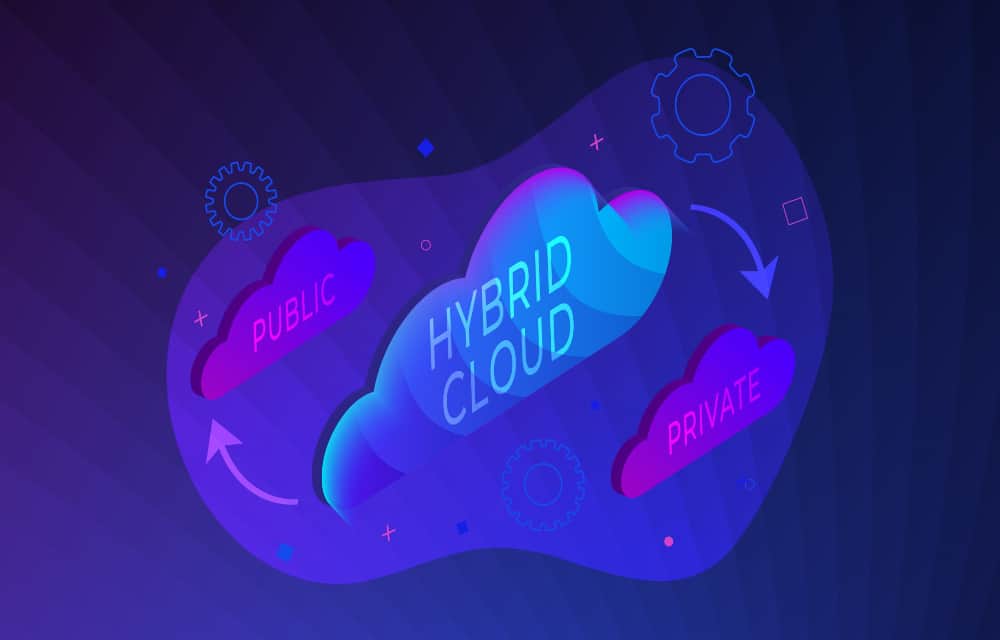
Hybrid cloud infrastructure involves using a combination of public cloud, private cloud, and on-premises data center environments. True hybrid cloud architecture allows you to move workloads back and forth among these environments safely and securely.

  • A public cloud is what most people think of when they hear cloud computing. Public cloud services are decoupled from the underlying infrastructure and delivered as a web-based application or platform. The actual compute resources are shared amongst many other customers. Examples of a public cloud include Microsoft 365 and Google Apps.
  • Private cloud infrastructure is owned and managed by a third-party provider, but other customers do not share the hardware you use. You rent dedicated storage and compute resources, but have no physical access to or control over the infrastructure. Examples of a private cloud include Microsoft Azure and Amazon Virtual Private Cloud (VPC).
  • An on-premises data center is a data center that your organization has complete control over. It may or may not be on the same premises as your headquarters office. Not all hybrid cloud infrastructures include on-premises environments—only public and private clouds are required.

The public cloud offers many benefits for enterprises, such as scalability and cost savings. However, organizations frequently need greater control over certain data and resources. For example, any company working with healthcare information, or providing services to the federal government, must follow strict privacy and security regulations. That’s why many organizations opt to keep some of their resources in on-premises data centers or private clouds.

That said, keeping these resources isolated from your public cloud services, applications, and data is not always feasible. There’s a need for interoperability and orchestration of workloads among mixed architectures. In a hybrid cloud infrastructure, there is a virtual service that acts as a managed “bridge” between different environments. This allows you to move workloads, applications, data, and other resources around as needed to ensure peak performance without compromising security.

Hybrid cloud infrastructure: expectations vs. reality

The expectation for hybrid cloud infrastructure is that all of your systems, services, and applications will work together seamlessly. Your data and other resources will be portable, so you can move them from one cloud to another without compatibility issues or other headaches. Most importantly, you’ll have a centralized, web-based platform to orchestrate workloads across your heterogenous environment. The reality of hybrid cloud, however, is often much more complicated.

Vendor lock-in

One major hurdle to implementing a hybrid network environment is closed ecosystems. Vendor lock-in can prevent your legacy on-premises solutions from interoperating with cloud hardware and software, and vice-versa. Data and applications designed for traditional infrastructure may be incompatible with cloud platforms. And not only do these systems all need to communicate and work together, but you also need an orchestration platform that can dig its hooks into disparate vendor solutions and control them equally.

Issues with vendor interoperability could force you to rebuild your entire stack just to enable hybrid orchestration. To get around this expensive and time-consuming challenge, you need a hybrid cloud infrastructure orchestration platform that’s based on an open architecture for true vendor neutrality. This will allow you to manage workloads across cloud and legacy environments without replacing the systems and software already in place.

Infrastructure complexity

Hybrid cloud infrastructure reduces the number of physical servers and storage devices you’re responsible for, so you might assume this will reduce the complexity of your network operations. This isn’t necessarily the case. The virtual and physical hardware responsibility is shifted to the cloud vendor, but your team will still need to know how to configure, monitor, and maintain all your cloud services.

In a hybrid cloud infrastructure, there are often many different platforms from different vendors. That means you need people who are experts in all these systems. Plus, you’ll also need a more complex network architecture to support a seamless hybrid cloud environment. That often means purchasing more boxes from more vendors, which your team must also learn to configure and maintain.

One way to reduce the complexity of your hybrid cloud infrastructure is by consolidating your networking stack. For example, you can use high-density serial console switches that provide out-of-band (OOB) management interfaces, network failover, environmental monitoring, and network switching. Similarly, you can look for modular, multi-function devices that allow you to create a custom box that includes all the specific hardware and functionality you need.This will reduce the number of devices in your rack and provide administrators with a single platform to manage all this functionality.

Spiraling costs

Cloud services are often less expensive to deploy and scale than on-premises infrastructure. Instead of a large up-front cost to purchase and install new hardware solutions, you typically pay a smaller recurring fee. When you need more resources, you simply upgrade your services for additional cost without needing to buy and configure more hardware.

The issue is that these recurring fees can begin to snowball over time, especially if you keep increasing your contract. Many cloud services often come in bundles or packages, meaning you can’t just pick and choose the functionality you need a la carte. So, you could end up paying for features you don’t even need.

Plus, you’ll incur additional costs if you need to rebuild part or all of your on-premises stack to enable hybrid cloud orchestration. The same goes for the networking technology that’s required for hybrid integrations. These expenses can be reduced by following the advice above—using a completely vendor-neutral hybrid cloud orchestration platform. Plus, consolidating and streamlining your infrastructure in as many ways as possible, such as with the hardware itself, but also with the software and management layers. For example, an OS allows you to easily/seamlessly integrate many different solutions, and a management platform allows you to manage everything from a normalized UI—rather than having to spend money on many different specialists.

Implementing a hybrid cloud infrastructure is often more challenging than organizations expect. However, by using vendor-neutral solutions and consolidating your tech stack, you can avoid vendor lock-in, reduce the complexity of your infrastructure, and keep costs in check.

Ready to simplify hybrid cloud infrastructure?

The Nodegrid infrastructure management solution from ZPE Systems enables true hybrid cloud orchestration. Nodegrid’s open architecture and vendor-neutral hardware can get its hooks into all your legacy, on-premises, and cloud solutions, so you have total control over your hybrid environment. With the ZPE Cloud management platform, you can monitor and orchestrate your entire infrastructure from behind one pane of glass.

Plus, Nodegrid’s consolidated networking hardware can help you reduce the complexity of your tech stack while still delivering all the features and functionality you need. Some of the world’s biggest tech companies are benefiting from this, by using Nodegrid to deploy and manage their hybrid infrastructures.

What is hybrid cloud infrastructure, and how can Nodegrid help you achieve it? 

Contact ZPE Systems to learn more.
Contact Us

Ingram Micro Signs Distribution Agreement with ZPE Systems

ZPE Systems + Ingram Micro

Ingram Micro Signs Distribution Agreement with ZPE Systems for Belgium, Netherlands, Luxembourg

The Netherlands, July 18, 2022Ingram Micro today announced a partnership with ZPE Systems Inc., a leader in network infrastructure management and orchestration solutions. This agreement gives partners access to ZPE’s portfolio of hardware, software, and cloud products, which includes the best-in-class Nodegrid Serial Console server, the Nodegrid SR family of services routers, the ZPE Cloud management & orchestration platform, and Nodegrid sensors.

For customers managing data centers or distributed edge and branch locations, ZPE Systems solves network and automation complexity while addressing the increasing demand to make IT more secure, reliable, and scalable. For resellers, this means having the ability to offer a proven yet flexible open platform to address customers’ evolving needs, with modular, Intel-based hardware providing limitless WAN/LAN connectivity, easy 5G upgradeability, Generation 3 out-of-band remote access and automation, and the power to host third-party applications and virtualized network functions.

Cybersecurity

Legacy network devices do not meet modern requirements for securing, automating, and scaling enterprise networks, due to interoperability issues and closed architectures. As customers struggle against security and downtime-inducing network challenges, this partnership will enable them to deploy ZPE’s Cybersecurity-as-a-platform (CAAP) to address disaster recovery, human error, and ransomware using best-of-breed vendor solutions of their choice. They can deploy these solutions directly on the programmable Nodegrid hardware and software, manage from anywhere via ZPE Cloud, and ultimately extend the capabilities of infrastructure, connectivity, and cybersecurity teams.

“IT systems are more connected but also more distributed,” said Marcel van Zwienen, Senior Sales Engineer, ZPE Systems. “Companies in every industry are now demanding fully customized environments that address their specific requirements. With this partnership, customers can now use ZPE’s platform to do exactly that. They can mix and match physical and virtual solutions of their choice for reliable, secure global networking.”

The Linux-based Nodegrid OS, which runs on every Nodegrid Serial Console and Services Router device, enables multi-vendor freedom in IT. This allows infrastructure, connectivity, and cybersecurity teams to deploy and manage their choice of hardware, software, and SaaS solutions — from cooling and smart PDUs, to switches and servers, to NGFWs, SD-WAN, and SASE integrations. The Nodegrid platform integrates with new and existing infrastructure, providing secure Generation 3 out-of-band access, NetDevOps automation capabilities, and enterprise-grade security that address modern business demands.

Edge

“Partnering with Ingram Micro adds tremendous value to ZPE ​​Systems’ Edge Transformation Partner Program,” said Steven Jehring, Vice President, Global Sales, ZPE Systems. “Partners gain more financing options, while customers gain the freedom to choose a partner that can address their unique needs. Ingram Micro provides top-notch support, pre-sales services, and global fulfillment capabilities that will be crucial to accelerating partner sales and transforming customer networks at the data center and edge.”

Become a ZPE Systems Partner

To learn more or become a ZPE Systems partner, click the button below.


About Ingram Micro Inc.

Ingram Micro helps businesses Realize the Promise of Technology™. It delivers a full spectrum of global technology and supply chain services to businesses around the world. Deep expertise in technology solutions, mobility, cloud, and supply chain solutions enables its business partners to operate efficiently and successfully in the markets they serve. Unrivaled agility, deep market insights and the trust and dependability that come from decades of proven relationships, set Ingram Micro apart and ahead. More at http://meta.ingrammicro.com.


Read the source version on Dutch IT Channel.