Providing Out-of-Band Connectivity to Mission-Critical IT Resources

Why ISPs Need Out-of-Band Management (and Why Serial Consoles Still Matter)

Picture this: It’s 2 a.m. and your core router crashes. Your NOC scrambles to respond, but your team has a big problem: the production network is down, so they can’t even reach the device. On top of downtime, you’re facing the potential for SLA breaches, penalties, and customer churn.

This scenario is inevitable for ISPs. But it doesn’t have to come with all the stress. This is where having a dedicated out-of-band (OOB) management strategy comes in. Here’s a look at why out-of-band is mission-critical for any size ISP, and why serial consoles still matter.


The ISP Management Paradox

ISPs live in a constant state of dependency: The network they’re responsible for managing is the same network they depend on for access. When that network goes down, so does their ability to fix it.

This paradox is why OOB management is more than a nice-to-have. Without a separate management plane, ISPs are forced to fly blind during outages, unable to access gear, troubleshoot, or recover services until technicians arrive on-site. That delay translates directly into lost revenue and frustrated customers.


Why Serial Consoles Still Matter

Some might argue that in today’s world of cloud-native networks and SDN, serial ports are a thing of the past. But there are a few big reasons why every ISP needs to take advantage of them:

  • Direct, low-level access: Serial consoles provide the most reliable way to recover a device, bypassing higher-level services that might be unavailable.
  • Protocol independence: Unlike SSH or web GUIs, serial access doesn’t depend on the production network stack. It just works.
  • Isolated recovery path: When everything else is down, serial consoles are still ready to help bring critical infrastructure back online.

For ISPs, ignoring serial consoles means ignoring the most battle-tested path to fast recovery.


OOB is More Than a Backup Connection

OOB is typically thought of as nothing more than a backup link. But that mindset undersells its value. Modern OOB is strategic. Sure, it helps maintain business continuity by providing a physically and logically separate management plane that stays operational even when production is down. But beyond recovery, OOB serves as a tool for everyday operations.

ISPs use OOB for routine maintenance, firmware upgrades, and configuration changes without touching the production network. It provides a safe, isolated path to test or roll back updates, push new templates, or stage infrastructure changes, all without risking service disruption. In other words, OOB isn’t just your parachute in an emergency, it’s also the workbench for keeping your network in top shape.

IMI per CISA

ZPE Systems’ out-of-band follows the best practice of Isolated Management Infrastructure (recommended by CISA BOD 23-02 for security), which gives administrators a dedicated environment to recover from disasters as well as perform routine changes.

Everyday uses of modern OOB:

  • Push or roll back configuration updates
  • Perform firmware and patch management
  • Grant temporary access to vendors without exposing the production network
  • Conduct compliance checks and audits in isolation
  • Test changes before pushing them into production

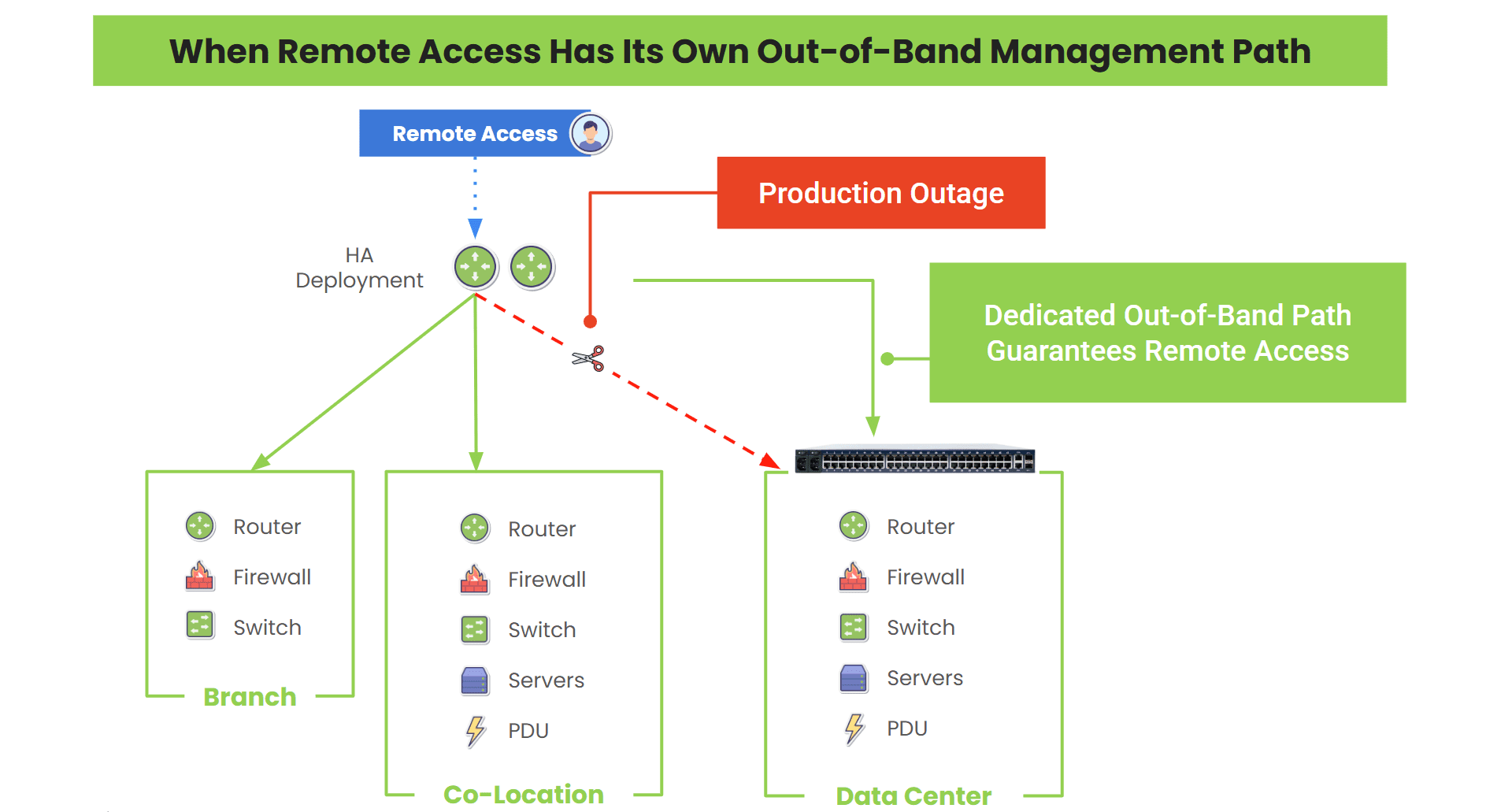
Imagine this: Your OOB network leverages LTE, 5G, or even Starlink to maintain secure connectivity to the NOC or ZPE Cloud. That path remains accessible even during an outage, an active cyberattack, or a rollback gone wrong. This OOB path guarantees management access during outages and for everyday ops, so engineers get uninterrupted access to fix devices, roll back to a golden image, etc.

Nodegrid with Starlink

ZPE’s Nodegrid devices can use 4G/5G or Starlink for remote access, with out-of-band networks that can be set up in less than an hour.

Out-of-Band Benefits for ISPs

The payoff for an ISP building a dedicated OOB network is huge:

  • Fast recovery times: Remediate instantly without waiting for truck rolls.
  • SLA compliance: Reduce downtime and meet customer expectations.
  • Secure access without risk: Manage gear without exposing the production network to threats or human errors.
  • Device consolidation: Nodegrid replaces six legacy management devices with one to simplify infrastructure.
  • Industry-leading security: Built-in protections that meet ISP-grade compliance needs.

Why Secure Out-of-Band Matters

OOB isn’t without risk. Traditional solutions may be improperly secured, which can open a backdoor into your most critical systems. But ZPE has built OOB with security at the core. Here are some built-in best practices that make Nodegrid the most secure out-of-band:

  • Isolation by design: Physical and logical separation prevents OOB from being a vulnerability.
  • Zero Trust enforcement: Role-based, least-privilege access ensures accountability and limits insider threats.
  • FIPS compliance: Validated encryption keeps data and commands secure to prevent interception.

Migrate With Zero Downtime Using This Guide

By combining classic serial access with modern OOB best practices, ISPs gain a recovery framework that’s both reliable and adaptable.

The easiest way to migrate is by deploying Nodegrid. This drop-in replacement integrates serial console access, secure OOB, and centralized management that are purpose-built for ISP environments. Download the migration guide now to bring industry-leading resilience to your ISP network.

Lower Costs, Greater Resilience: Supporting Business Continuity For A Leading Asian Retailer

A leading retailer in Asia, who serves beauty and wellness products across the region, needed to address the growing complexity of their infrastructure. As they scaled, it became increasingly difficult to manage critical functions that edge sites relied on. This put business continuity in jeopardy and hindered their ability to quickly open new revenue-generating locations.

That’s when ByteBridge, one of ZPE’s trusted partners, proposed a solution only achievable by deploying Nodegrid. Read the full case study to see how this uniquely tailored management architecture delivered benefits like:

  • Streamlined ops: Monitoring, remote access, power management, and more from a single portal.
  • Lower TCO: Combined serial, Ethernet, 4G into one compact Nodegrid device.
  • Wireless resilience: Automatic cellular failover for continuity during primary internet outages.
ZPE Systems – ByteBridge and ZPE case study

When Every Branch Matters: How a Credit Union Reinforced Network Resilience

When Every Branch Matters: How a Credit Union Reinforced Network Resilience

For many credit unions, digital transformation has expanded well beyond core banking systems. They depend on resilient IT infrastructure for everything from interactive teller machines, to cloud-hosted apps and remote employee access. But for their IT teams, this brings a growing list of challenges: more branches, more network equipment, and more pressure to minimize downtime. And often, they need to solve these challenges without adding staff.

That’s where the cracks begin to show.

One mid-sized U.S. credit union faced a similar dilemma. They had to support more than 200 branch locations, but with only two IT staff. Routine network issues meant spending hours in the car, sometimes just to power cycle a device. Troubleshooting tasks or regular firmware updates easily consumed entire workdays. Combating outages was even worse because they lacked a reliable management path outside of the primary network. Long outages meant long workdays and lots of stress, not to mention the customer-facing issues like lost trust and reputation damage.

But instead of patching the problem, they made a bold move.

They adopted Nodegrid and ZPE Cloud, the out-of-band management solution that enables complete visibility and control, even when the main network fails. For the credit union’s IT team, this enabled them to perform all their jobs – from provisioning to troubleshooting, to device reboots – via remote session. The results? Drastically reduced travel costs, faster incident response times, and peace of mind knowing that every branch was protected by a resilient management backbone.

Download the full case study to see how they transformed their branch operations and set the foundation for secure, scalable growth.

Credit Union case study thumbnail

Out-of-Band Management vs FMEA: Bridging IT Recovery with Risk Mitigation

Ahmed Algam – OOB vs FMEA

Out-of-Band Management vs FMEA: Bridging IT Recovery with Risk Mitigation

By Ahmed Algam

When it comes to mission-critical infrastructure, failure isn’t a possibility, it’s an eventuality. That’s why tools like FMEA (Failure Mode and Effects Analysis) exist in product validation and operational reliability.

But in IT, identifying risks isn’t enough. You have to be able to recover from them.

Let’s talk about where FMEA theory meets OOB (Out-of-Band) practice.

What is FMEA?

FMEA is a structured approach used to answer:

  • What can fail? (Failure Mode)
  • What happens if it does? (Effect)
  • How likely is it to occur?
  • How well can we detect or respond?
  • What actions can reduce risk?

Each failure scenario is scored across three dimensions:

  • Severity – How bad is the impact?
  • Occurrence – How likely is it to happen?
  • Detection – How easily can it be caught before causing damage?

The goal: Mitigate or eliminate high-risk scenarios before they cause downtime.

Where Out-of-Band Management Comes In

Now apply FMEA to IT infrastructure. Picture this:

  • A router that locks up after a patch
  • A firewall pushed with a bad config
  • A top-of-rack switch that loses uplink
  • A server stuck in BIOS after reboot

If your management tools are all in-band, you’re blind.

But with OOB, you keep access even when the network goes dark, using:

  • 4G/5G LTE fallback
  • Serial console access
  • IPMI, Redfish, or BIOS-level control
  • Out-of-band logging and alerting

How OOB Scores on the FMEA Scale

FMEA Parameter Out-of-Band Impact
Failure Mode Network, power, or OS-level outage
Effect Production outage, loss of remote access
Detection OOB alerts via console logs, PDU telemetry, heartbeat monitoring
Occurrence Reduced with safe, controlled remote management
Severity Reduced since recovery actions are possible remotely
Control Remote reboot, BIOS/IPMI access, serial console, file upload

Real-World FMEA Meets Out-of-Band Management

One customer thought they had OOB covered. They plugged a 4G modem into their Cisco router to allow remote access in case of failure.

But when the router failed, their “OOB” path failed with it because their monitoring agent was installed inside the network.

Once we showed them how to move the agent to the true OOB path (outside the primary network), it was an immediate “aha!” moment.

In FMEA terms:
They reduced Occurrence and improved Detection just by separating in-band from out-of-band.

Check out some more real-world stories like this one by reading my other article, 3 Real Lessons in Network Resilience.

Design for Recovery with ZPE

At ZPE Systems, we believe resilience starts with visibility and control, even when everything else fails. That’s the purpose of our Nodegrid platform:

  • Secure, isolated access to remote infrastructure
  • Cellular, Wi-Fi, and wired failover for real redundancy
  • Integrations with top monitoring and automation platforms
  • Smart, adaptive OOB architecture built to support FMEA-driven design

If Your FMEA Requires Recovery, We Can Help!

If your environment depends on high uptime, fast response, and remote visibility, Nodegrid is your bridge between failure analysis and real recovery.

Use the form below to contact us and let’s talk about your FMEA goals.

Yes, You Can Have A Complete Out-of-Band Management Solution In One Device!

Vishal Gupta – Out-of-band in one device

Out-of-Band (OOB) management used to be a last resort, a ‘break glass’ tool for gaining access to failed IT. But many organizations are now realizing that out-of-band is a strategic weapon that can do much more than get them out of a jam. It can help patch systems within 48 hours, test config changes and firmware updates, and monitor infrastructure health to prevent failures and stay proactive.

But there’s one big problem that stops teams from putting together an out-of-band infrastructure: there are too many devices to piece together and manage.

Traditionally, teams have built OOB environments using multiple devices from different vendors:

  • Routers provided secure connectivity and routing logic.
  • WAN routers served as modular access points.
  • Cellular devices offered LTE/5G backup and remote cellular access when wired networks failed.
  • Serial console servers were added to gain terminal-level access to switches, firewalls, and other appliances.
  • Firewalls or VPN concentrators (for security-conscious teams) were deployed to secure management plane access through encrypted tunnels.
Devices required for OOB
And this handful of infrastructure provides only basic remote access for troubleshooting or recovery. For teams who want to become proactive, they need additional devices like automation servers, Ethernet switches, computing, and storage. This stitched-together model is unsustainable in modern IT environments because it adds complexity that teams can’t manage.

The Complexity of Multi-Device OOB Environments

For teams managing a few sites, juggling devices may be feasible. But when there are dozens, hundreds, or thousands of locations, the cracks begin to show:

1. Operational Complexity

Every device has its own OS, firmware, and configuration syntax. Pushing a global policy change like updating SSH access rules or hardening TLS settings requires custom playbooks for each platform. Over time, this increases the risk of misconfigurations and creates blind spots in security audits.

2. Troubleshooting Bottlenecks

When a site goes dark, support teams need rapid access to console ports, environmental telemetry, and WAN connectivity diagnostics. But a fragmented toolset makes root-cause analysis a game of guesswork – Did the router fail? Does the modem have signal? Is the serial port offline?

3. Inefficient Use of Space and Power

Remote cabinets and edge environments have very limited (if any) rack space. You might have 1RU or less of space, but three devices that need to be installed. Even if you get crafty and manage to squeeze them in, having multiple devices increases power draw, thermal output, and points of failure. This isn’t scalable, especially in cramped environments like cell towers, retail stores, or substations.

4. Increased Procurement and Support Costs

Assembling out-of-band networks from multiple vendor devices simply makes more work for procurement teams, who face long lead times and inconsistent licensing models. But that’s just the beginning. Costs pile up when you need to maintain this infrastructure. It’s extremely expensive to have a separate contract for each cellular device at every location, for example, which can easily add up to hundreds of thousands of dollars every year. Or, having third-party maintenance contracts for existing devices that have gone EOL.

Why Teams Dream of a Single-Box Solution

Remember when the smartphone hit the market? Rather, when it became commonplace and developers started making an app for everything? There were so many single-function devices  and items that you didn’t need anymore – phone, alarm clock, digital camera, calculator, notepad, mp3 player, flashlight – the list goes on.

Networking and IT teams are dreaming of something similar for their infrastructure. At every expo and conference in recent years, we talked with thousands of people who said that out-of-band adds too much extra equipment (and work) that they don’t want to deal with.

So, what do they want? Something that “just works,” according to those we talked to recently at RSA Conference 2025. They want to be able to deploy one box that securely comes online, can be configured remotely/automatically, and doesn’t require a bunch of other devices for automation or computing or cellular. Here are some popular wish-list use cases:

  • Remote Sites & Branch Offices: A single appliance that can offer serial access to critical equipment, cellular WAN failover, and environmental monitoring in space-constrained sites.
  • Colocation Data Centers: One platform that combines console access, VPN tunneling, and rack telemetry to reduce hardware costs and footprints.
  • Industrial & OT Environments: Ruggedized devices with extended temperature ranges, shock resistance, and power redundancy ideal for energy, utilities, and manufacturing.

Imagine their surprise when we say, “That’s our box. We do what nobody else can.”

ZPE Systems’ Nodegrid is Single-Box Out-of-Band Management and More

ZPE Systems developed this all-in-one capability and offers devices in a variety of sizes, up to 1RU. This platform is called Nodegrid and it combines the many functions we discussed, plus the ability to host third-party apps/tools, run Ansible and custom automation, and provide centralized management via on-prem deployment or ZPE Cloud connection.

ZPE Combines all the functions of OOB into one device

All-in-One Capabilities

One Nodegrid device handles all the functions of traditional, dedicated devices, including:

  • Serial console server (for direct access to routers, switches, firewalls)
  • Cellular modem (LTE/5G with dual SIM failover)
  • Ethernet routing and switching
  • Secure VPN or SD-WAN capability
  • USB out-of-band storage or keyboard-video-mouse (KVM) options

On top of these, Nodegrid runs VMs, Docker containers, apps, and automation solutions. It replaces up to nine traditional devices and fits neatly in 1RU or less of space.

Here’s how our customer Vapor IO used Nodegrid to free up 5RU and automate their deployments. Read Vapor IO case study .

Centralized Management and Policy Enforcement

Administrators can deploy and manage thousands of units through a single orchestration platform, via Nodegrid Manager (on-prem) or ZPE Cloud (SaaS). This lets them easily enforce access policies, audit activity, and automate firmware updates without relying on disparate interfaces.

Isolated Management Infrastructure Best Practices

Nodegrid provides what is called Isolated Management Infrastructure (IMI), which is an industry best practice for maintaining resilience. Unlike traditional out-of-band, which relies in part on production systems, IMI creates a completely separate management network that remains accessible and online even if the production network completely fails. This lets teams access and recover their systems during an active cyberattack or outage. IMI has been used by hyperscalers for more than a decade and is now being written into new laws around the world.

Hardened Security

The Nodegrid and ZPE Cloud platform have the industry’s highest security. You can read the full security assurance document that covers the hardware, software, and cloud security features, as well as the third-party certifications. Here are some of the highlights: secure boot, signed OS, self-encrypted disk, three Synopsys validations, ISO27001, FIPS 140-3, SOC 2 Type 2.

Automation-Ready

Nodegrid integrates with Ansible, Terraform, and Python APIs, enabling Infrastructure-as-Code (IaC) workflows and automated responses to network incidents. Automation can run natively on the Nodegrid device, or stored in ZPE Cloud and pushed down where needed.

Schedule a Demo

The days of piecing together out-of-band solutions are coming to a close. The overhead, security gaps, and physical constraints are driving a clear trend: simplify the edge, secure the core, and consolidate the tools.

ZPE Systems helps you do all three of these. To get hands-on with our products or chat with an engineer about your specific use case, schedule a demo at the link below.

Schedule a Demo


See Nodegrid in Action!

Senior Sales Engineer Marcel van Zwienen put together this 20-minute video giving you a first-hand look at Nodegrid’s interface. He shows you how ZPE Cloud makes it easy to monitor, troubleshoot, and update devices even if they’re thousands of miles away. Don’t miss it!

Watch Video

Marcel van Zwienen gives a walkthrough of ZPE Cloud for remote device management.

“That’s So Obvious Now…” – 3 Real Lessons in Network Resilience

Ahmed Algam – Thats So Obvious Now

3 Real Lessons in Network Resilience

By Ahmed Algam

Failure is a necessary part of life. It shines a light on things that you didn’t give enough attention to, so you can learn and grow. The same goes for life in IT. We do a lot of planning to prevent failure, but it inevitably shows up and reveals the flaws in our plans. We don’t like failure, but we kind of need it.

Over the past few months, I’ve seen many real-world examples of this. These incidents drove home a hard truth about architecting for network resilience:

Out-of-Band (OOB) access isn’t optional. It’s essential.

Here are three short but very real stories that made this point crystal clear.

1. The Power Outage That Didn’t Stop Us

Our Fremont office went dark. Completely dark. There was a power outage and our provider failed to give us a heads-up, so it took us by surprise.

No power meant routers, ESXi hosts, Proxmox servers, backup systems, and even Wi-Fi were knocked offline. It was a total blackout.

But we weren’t scrambling. We had architected a true out-of-band path using LTE. Even with the production network down, we still had a way in.

From miles away, we diagnosed the problem, rebooted critical infrastructure, and got things running again before most people even noticed.

Lesson: Your recovery plan is only as good as your last mile. If your failover path isn’t truly independent, it’s not a plan – it’s wishful thinking.

2. The Engineer Who Locked Himself Out

A partner’s network went down during a routine change. Not uncommon. What was uncommon? The fact that they had no access to fix it.

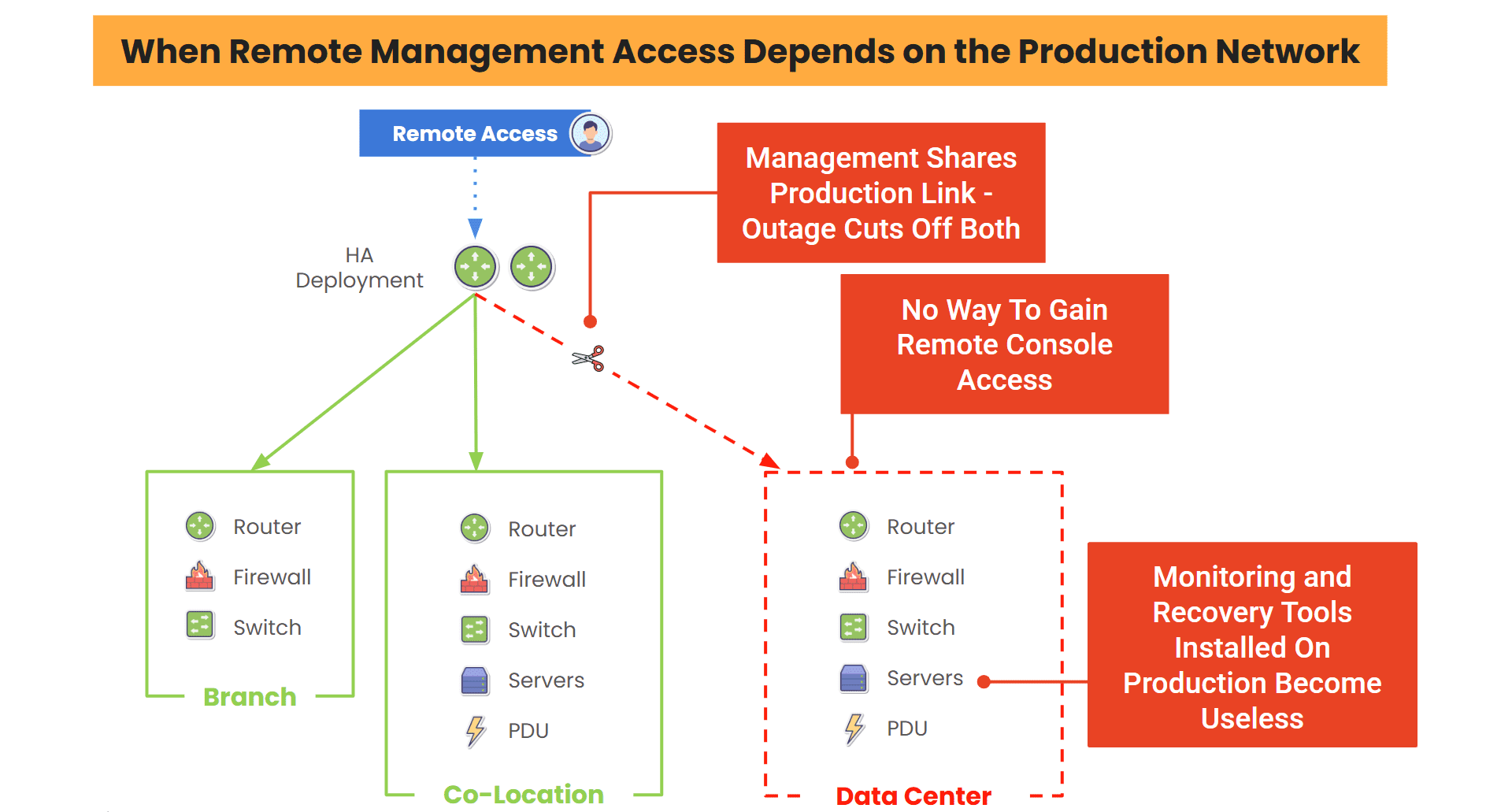
All their management traffic – SSH, APIs, everything – was routed through the same production network that had just failed. When that network died, so did their ability to reach any routers or switches. The team was flying blind.

We got the call, helped them recover, and discussed IMI best practices afterward.

Lesson: Never mix management and user traffic. You need a control plane that exists outside your data plane, especially when uptime is mission-critical.

3. “That’s So Obvious Now…” – The Failover Fail

A customer had the right idea: install a 4G modem as a failover path. This is common, and it’s a great way to gain access in case the main path goes down.

But the modem was physically wired into their primary Cisco router.

When that router failed (power surge), so did the modem. To make things worse, their monitoring agent was running in-band. So when the network collapsed, their monitoring did, too. No visibility, no access, no control.

We pointed out this problem. Then we suggested running the agent on dedicated OOB gear instead. Their response?

That’s so obvious now…but I didn’t even think about it.

Lesson: Monitoring doesn’t help if it goes down with everything else. Build it into your OOB infrastructure. Make it resilient, not just present.

What I Want You To Take Away From These Stories

Resilience isn’t just about having backup tools or extra hardware. It’s about designing for failure.

It’s about building your architecture so that even if the core goes dark, you still have eyes and hands on the network.

Out-of-Band isn’t a Luxury. It’s your Lifeline. Make sure to Architect it like one.

Here Are Resources to Help Build Your OOB Lifeline


Get Hands-On Help From Our Engineers

My colleagues have years of experience architecting these resilience practices. Please use the form to send us a message and get help with your specific use case.