Providing Out-of-Band Connectivity to Mission-Critical IT Resources

Home » Archives for March 2021

ZPE Systems Announces the New Edge Transformation Partner Program

Edge Transformation Partner Program

Fremont, CA, March 31, 2021 – ZPE Systems, Inc., a leading innovator of network devices and cloud-based infrastructure management solutions trusted by the world’s top companies, officially launched the Edge Transformation Partner Program. This program is designed for enterprise solution providers and integrators interested in differentiating their offering for distributed branch, edge, campus, and colocation applications.

In order to expand an already growing partner ecosystem, this program features a drastically different engagement model and incentive structure to help partners build a profitable Nodegrid practice.

According to ZPE Systems’ CEO and Co-Founder Arnaldo Zimmermann, “Together, Palo Alto Networks virtual’ firewalls and our Nodegrid SR solutions give customers a secure and streamlined infrastructure, with centralized management that puts everything in one place — firewalls, servers, routers and even power controls.”

ZPE Systems is a customer first culture, so driving partner and customer success is the cornerstone of the Edge Transformation Partner Program. ZPE Systems emphasizes partner quality over quantity, with recruiting practices based on technical competency and strategic commitment. In return, partners leverage proven differentiators for cloud and edge networking, and can deliver customers the highest ROI.

As enterprises continue to expand beyond the data center, they must retire legacy solutions and optimize performance at edge networks. ZPE Systems’ Nodegrid platform helps partners modernize customer networks, with all-in-one solutions that are easy to deploy, secure, and manage — a growing requirement at the edge. Delivering the best ROI is a top priority, and partners can unlock endless value-add opportunities using Nodegrid’s modular hardware, extensible software, and integrated ZPE Cloud platform.

Partners can take advantage of emerging, best-in-class technologies thanks to ZPE Systems’ strategic alliances. These include partnerships with industry leaders such as Intel, Palo Alto Networks, Cisco, VMware, and others who help guide networking into the future.

“Our channel strategy is to recruit a small number of solution providers and strategic partners who are interested in developing their brand and capabilities around ZPE Systems’ Nodegrid ecosystem,” says Steven Jehring, ZPE Systems’ head of Channel and Strategic Partners. “Our priority is to create the best customer experience, and our enterprise edge platform makes this simple. It enables solution providers to offer complete implementations that are fully integrated with leading technologies from our strategic partners and alliances.”

For complete details of the Edge Transformation Partner Program, or to submit an application, please visit partners.zpesystems.com.

About ZPE Systems, Inc.

ZPE Systems frees enterprises from today’s networking challenges.

Cumbersome environments, frequent downtime, and inefficient management are no match for ZPE Systems’ Nodegrid, a vendor-neutral platform that lays the groundwork for open networking. Created by visionary engineers, Nodegrid’s patented hardware, software, & cloud offerings empower companies to transform their networks into business value creators.

Intel-based serial consoles & modular services routers deliver unparalleled power to datacenter & branch applications, while the Linux-based Nodegrid OS replaces vendor lock-in with limitless flexibility. With ZPE Cloud for fast & secure provisioning, it’s the only networking platform to streamline the stack using virtualization, prevent downtime using automation, and offer convenience using in-depth remote management capabilities.

ZPE collaborates with best-in-class technology partners, to add value by integrating with SD-WAN, firewall, IoT, and other solutions. The world’s top companies trust ZPE Systems to provide advanced out-of-band management, Secure Access Service Edge (SASE) platforms, and SD-Branch networking.

Based in Fremont, California, and with offices in Ireland, India, and Brazil, ZPE Systems is ready to help enterprises take the work out of networking.

Visit the ZPE Systems website to explore Nodegrid.
www.zpesystems.com

What Is the Network Edge, and How Do You Manage It? Watch Our Webinar

What is the network edge?

The network edge consists of systems that are not part of the data center. Think of a typical enterprise network: the data center is at the core, and then there are locations distributed across a market, area, or region, or even across the globe. These distributed locations are considered to be at the network edge, because they require infrastructure that connects them back to the data center and to the rest of the enterprise.

The network edge can cover everything from branch office locations, retail shops, and university campuses, to smart city infrastructures, factories, and faraway mining locations.

The network edge includes critical remote infrastructure

At the business-need level, the network edge must provide its customers with the appropriate experience. This can mean authenticating account info for ATM users, processing in-store transactions for shoppers, or providing real-time sensor readings to drilling crews. All of these require critical remote infrastructure to be in place.

Critical remote infrastructure includes the systems that can communicate with the data center, cloud, and/or other edge locations in order to provide the intended user experience.

Why is network edge infrastructure so important?

The network edge is part of the backbone of distributed enterprise. It’s what allows operations to happen quickly and efficiently outside of the data center. Having the right edge infrastructure in place means the difference between smooth operations that keep customers happy, and constant slowdowns and outages that hamper business growth or even lead to severe losses.

As an example, consider what can happen at a popular retailer’s newly-opened branch location. By using solutions that aren’t optimized for the edge, such as MPLS lines and many disparate devices, the customer experience can be very unresponsive. When it takes 20 minutes or more to check product availability, or several minutes just to process a purchase, the simple logistics slow down business and limit the amount of revenue that the day can bring. Even if shoppers don’t abandon their carts, slow infrastructure means slow business.

But with the right edge infrastructure in place, business changes dramatically. Processing tasks can be performed quickly at the edge instead of having to rely on slow MPLS lines to communicate back to HQ. Customers can get product updates in real time, and transactions can be completed in seconds. Optimized infrastructure is the key to meeting demand at the network edge.

Why you need the best edge network management tools

Just as critical as edge network infrastructure are the tools you use to manage it.

Having distributed locations poses challenges because of physical and geographic limitations. These challenges are only compounded as you deploy your edge farther away and in more remote locations. And with typical management solutions, you’re forced to spend monumental sums of time and money performing on-site support — for even the smallest troubleshooting tasks.

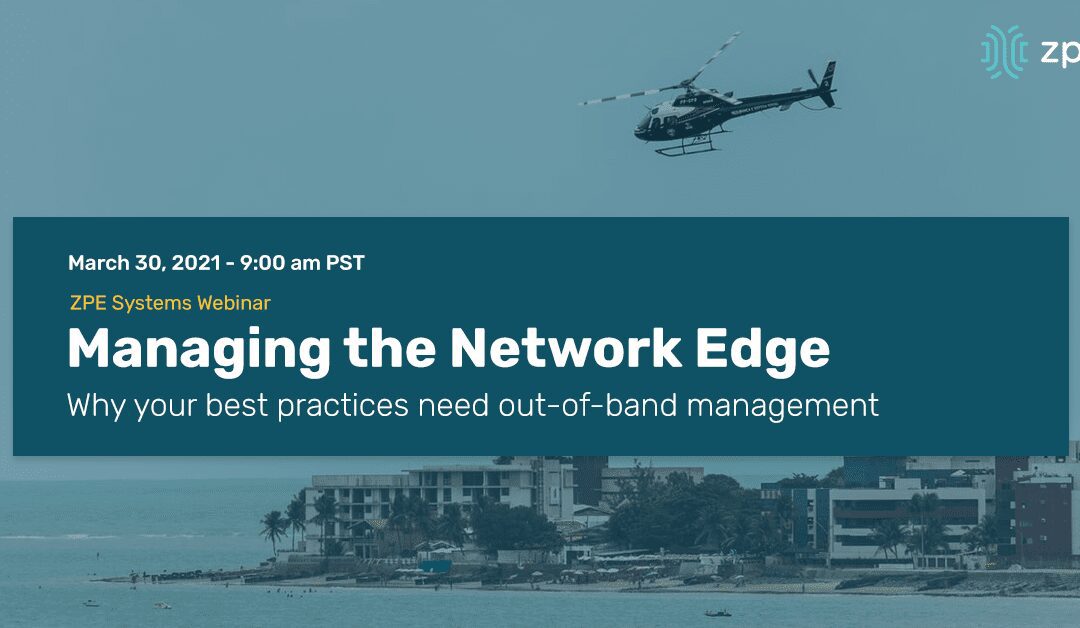
Consider this real-world example: an offshore drilling company requires strong connectivity, which means each rig needs a networking stack. Managing these stacks used to require on-site support, which came with extreme costs and risks. On-call IT teams had to be dispatched via helicopter, sometimes traveling more than 100 miles out to sea to simply cycle device power or install a firmware upgrade.

Luckily, the company deployed out-of-band management, which allowed them to gain remote control of their networking infrastructure. They no longer needed to spend thousands on support or put employees at risk. Their out-of-band solution let them perform even complex troubleshooting and recovery tasks from thousands of miles away.

Want to learn more about this customer and how you can save at the edge?

Watch our free webinar, Managing the Network Edge.

Webinar: Managing the Network Edge: Why your best practices need out-of-band management

Webinar: Managing the Network Edge

Not at Cisco Live? Join our free webinar

Setting up POPs, colocations, and remote networks is a lot of work, and ongoing maintenance sinks your resources. But out-of-band management and converged solutions give you on-demand control of your edge. Don’t worry about downtime — instantly respond and keep your critical infrastructure running.

Sign up using the form below. Our experts will show you:

  • Why you should focus on the edge
  • How out-of-band saves on response times & costs
  • How converged solutions add resilience to your edge


Win Apple AirPods!

Attend the webinar and you’ll be automatically entered into our Apple AirPods giveaway!

About our Speakers

Jim Wilson – ZPE Systems
VP Global Sales & Customer Success

Our moderator, Jim Wilson, knows how to make business succeed with better networking. For more than 25 years, Jim has taken a hands-on approach to help design out-of-band, failover, & other network solutions for global Fortune 500 companies. He led regional services for a major storage provider in the U.S., and his skillset in hardware & software prove invaluable to the success of ZPE’s customers.

Jim Wilson 1200×1588

Rene Neumann – ZPE Systems
EU Solutions Engineering Manager

Rene Neumann is the Solutions Engineering Manager at ZPE Systems. He has helped some of the largest companies in the world such as Amazon, Apple, Societe-Generale, and Exxon-Mobil rebuild customer satisfaction with better networking. His IT & data center expertise spans 22 years. Using ZPE’s powerful platform of consolidated devices and intuitive software, Rene continues to improve network architecture for companies across the globe.

ZPE Systems – Rene Neumann

Sven Launspach – Kaemi GmbH
CEO 

Sven Launspach is the founder and managing director of KAEMI GmbH, an integrated IT/OT infrastructure and managed service provider based in Berlin, Germany. One of KAEMI’s guiding principles is: “We take care of connectivity, so that the customer can concentrate entirely on its core business.” His expertise includes managed services, SD-WAN, multi-cloud applications, and NFV/SDN. As a Consultant previously, he has led digitization projects for Lufthansa, which saved millions of euros in operating costs. He is particularly in demand for sharing his thoughts in conferences and IT events. He is also managing director of Consultpool GmbH & Co. KG who offer high skill consulting especially for DAX companies.

Sven Launspach

What Is Edge Networking, and Is It the Future?

We’re entering the era of edge networking

Edge networking is critical to the future. Organizations continue to expand, and analysts predict that the data center won’t be the only workhorse when it comes to enterprise networking. In fact, some estimate that in a couple years, more than 50% of data will be generated outside the data center or cloud.

Continue reading to learn more about the edge, why it’s the future, and how you can address four key components of edge networking.

What is the ‘edge’?

The edge includes systems that are close to where end devices and third party services interact with your network. Think IoT cameras, self-service kiosks, mobile apps, POS systems, and other things that interact at the last mile of your network.

What is edge networking?

With increasing focus on the edge comes confusion. This stems from the fact that edge networking is typically seen as something completely different than edge computing. That’s because they are technically very different, even though they are part of the same space.

Think of a traditional enterprise network setup. You have the data center at the core, and then branch offices distributed across different locations.

  • Edge networking refers to the tunnels that connect these branches to each other, to the data center, and to distributed cloud service applications.
  • Edge computing means putting parts of the core, such as data processing, storage, load balancing, etc. at or nearer to these branches.

However, the lines are blurring between these two as they are increasingly implemented together. For the sake of this blog post, we’ll combine them and refer to both using one term: edge networking.

There’s a growing need for edge networking

If 2020 was any indication, you likely know firsthand about the growing need for better edge networking capabilities. You may even still struggle with recent changes. You have to make sure your widespread network can handle rapid shifts in customer demand. You also need to accommodate your staff, who are likely no longer working from centralized office locations but instead from home or on the go. Connectivity is more distributed than it’s ever been, and 2020 was a catalyst for this growing trend.

You’ve witnessed this shift in the real world and faced new challenges of traditional enterprise network configurations. This is because the legacy core-to-edge infrastructure was not designed for such widespread networking. If you haven’t already, you will eventually experience significant drawbacks if you don’t move toward more ‘edgified’ infrastructure and solutions.

  • Drawback #1: Slowdowns — Imagine peak demand at your edge locations, and then multiply that by a factor of five, ten, or more. This is what the future has in store, and your traditional setup won’t be able to handle all of this data. With so much information flooding back to the core, your data center will become inundated trying to process it all. This means slowdowns, even catastrophic failures, that can take down both the customer experience and your staff’s ability to keep operations running.
  • Drawback #2: Security breaches — The threat landscape is constantly evolving. With more edge connections comes a greater attack surface, and if you continue using traditional solutions, you’ll have to be constantly mindful of your network’s security. Vulnerabilities will present themselves with your physical devices, virtual assets, and integrations, each of which may allow for exploitation across your network. This will force you to spend monumental sums of time and money trying to protect your business and your customers.
  • Drawback #3: Obsolete solutions — Edge networking is a young market, which means edge solutions will come and go. This volatility means you’ll need a network that can adapt fast, but traditional configurations are too rigid. If you standardize with one vendor’s solutions, you’re left locked into using only their offerings. This could easily leave you with obsolete solutions that will continue costing you.

These are just a few of the reasons why you need to adopt edge networking.

What does the future hold for edge networking?

Edge networking of the future will allow you to accommodate growing, constantly evolving requirements. But if you’re supposed to move away from the traditional setup, where the core consists of data center functions and the edge simply funnels data back to the core, what will networking look like?

  • The edge will become the data center. Because there are increasing requirements for responsive edge experiences, processing will be placed near or at the edge. This will allow you to relieve your data center while optimizing distributed connections for customers and staff.
  • Security will be built in. With an ever-growing network, you’ll have to accommodate more connections. Protecting your business and customer data will involve implementing security from the ground up. This will mean deploying hardware and software that will come with more built-in safeguards, and that will allow you to implement thorough protection through Zero Trust Security practices.
  • You’ll be more adaptable than ever. A volatile solutions market will force you to continually adapt. The firewall that’s perfect one day might be obsolete the next, and the same will be true for SD-WAN, management, machine learning, and other solutions. The key to this flexibility will be in having an infrastructure that emphasizes extensibility and software-defined networking.

Do you want a head start on the future of edge networking?

Download our ebook, The Future of Edge Networking, and discover four ways you can achieve the network of the future.