Providing Out-of-Band Connectivity to Mission-Critical IT Resources

Out-of-Band Management Vendor Comparison
Out-of-Band Management Vendor Comparison

Having a resilient data center network is a top priority for the modern enterprise. Network failures can lead to costly downtime, security vulnerabilities, and operational disruptions. To mitigate these risks, companies invest in out-of-band management, cellular failover, next-generation firewalls (NGFWs), and automation. But, it can be hard to know what’s just a feature and what makes a truly resilient infrastructure solution. To help navigate this, we put together this out-of-band management vendor comparison that breaks down how Opengear, Perle, and Lantronix compare to ZPE Systems.

Out-of-Band Management

Out-of-band (OOB) management is critical for maintaining network access during outages or cyber incidents. OOB typically gives admins access via dedicated serial ports, and it’s mainly used during emergencies when devices or services fail and need to be restored. However, because of digital transformation initiatives like hybrid-cloud, Infrastructure-as-Code, and AI adoption, OOB’s requirements have evolved past simple remote troubleshooting. It must seamlessly integrate into diverse, multi-vendor environments, provide flexible automation, and be able to scale without adding management complexity.

Feature
Vendor Support
Automation
Central Management
Best Fit
ZPE Systems
Multi-vendor, modular
API-first, REST/GraphQL, dynamic
ZPE Cloud, Nodegrid Manager
Enterprise networks with or without multi-vendor requirements
Opengear
Broad, but hardware-centric
Template-driven
Lighthouse
Enterprise networks, secure access
Perle
Cisco-focused
Minimal
PerleVIEW
Simple serial access in Cisco-heavy networks
Lantronix
Multi-vendor
Rules-based engine
ConsoleFlow
SMBs or labs needing basic remote access

Takeaway: ZPE Systems’ open architecture and ability to scale in diverse environments give it the edge, as it’s better suited to meet OOB’s modern requirements.

Isolated Management Infrastructure

Resilience requires a dedicated, autonomous layer for management. Isolated Management Infrastructure (IMI) is that layer. Unlike traditional OOB, IMI provides a physically and logically separated control plane that remains operational even when the production network is compromised. It’s essential for running services like monitoring, DNS, or firewalls independently from the primary network. Very few vendors offer true IMI support as part of their core platform.

Feature
Isolation Architecture
Service Hosting
Security Controls
Best Fit
ZPE Systems
Native, air-gapped IMI
Hosts NGFWs, DNS, monitoring tools
Zero-trust: ACLs, MFA, logging
Zero-trust, isolated control environments
Opengear
Shared infrastructure
Requires external appliances
Standard access controls
Hybrid legacy/OOB networks
Perle
Not designed for isolation
External tools only
Standard VPN/SSH
Traditional IT needing remote access
Lantronix
Not designed for isolation
External tools only
Basic security model
SMBs without IMI requirements

Takeaway: Most vendors still treat management like traditional OOB, where it’s a tool for recovery and not proactive resilience. ZPE Systems is purpose-built for IMI, allowing businesses to maintain critical operations during outages or attacks.

Cellular Failover

Through outages, it’s no longer enough to just have a backup link. Cellular failover must ensure secure, intelligent, and seamless continuity. Many vendors provide cellular hardware, but few integrate the security, automation, and multi-carrier intelligence needed for real resilience.

Feature
Carrier & Network Support
Security & Routing
Failover Intelligence
Best Fit
ZPE Systems
5G, dual SIM, multi-carrier on most models
Built-in firewall, VPN, smart routing
Policy-based, API-driven
Secure, automated enterprise continuity
Opengear
5G, dual SIM (CM8100 model only)
Firewall rules, basic routing
Scriptable with limited logic
Backup WAN for branches
Perle
5G on select models
VPN/IPsec support
Basic primary/backup switch
Industrial/edge connectivity focus
Lantronix
5G on LM models
ACLs, event-based failover
Rules engine with logic
Retail and edge with simple failover

Takeaway: While other vendors provide failover as a backup connection with limited intelligence, ZPE Systems stands out by combining carrier agility, security, and orchestration in one platform designed for business continuity.

Firewall Support

Organizations require more than just basic OOB access; they need platforms that can host advanced security services like Next-Generation Firewalls (NGFWs), DNS, and monitoring tools. Here’s how ZPE Systems compares to other OOB vendors in this regard:

Feature
NGFW Hosting Capability
Virtualization Support
Extensibility
Best Fit
ZPE Systems
Hosts Palo Alto, Juniper, etc.
VMs & containers for security apps
Hosts DNS, monitoring, ZTNA, SD-WAN
Consolidated edge security platform
Opengear
Not supported
Containers
External tools required
Secure remote access nodes
Perle
Not supported
None
External tools required
Basic OOB without NGFWs
Lantronix
Not supported
None
External tools required
Lightweight remote deployments

Takeaway: While Opengear, Perle, and Lantronix provide OOB management solutions with some integrated firewall features, ZPE Systems stands out by offering a platform capable of hosting full-fledged NGFWs and other security services. This extensibility allows organizations to consolidate their infrastructure, reduce hardware sprawl, and enhance security within an isolated management environment.

Automation

Automation used to be a “nice to have” capability. Now, it’s critical for reducing human error, accelerating incident response, and enabling self-healing networks.

Feature
Automation Model
Third-Party Integration
Scalability
Best Fit
ZPE Systems
API-driven, rule-based automation
Terraform, Ansible, ServiceNow
Enterprise-wide via Nodegrid Manager, ZPE Cloud
Large teams automating infra-wide
Opengear
Template/config-based
REST API, SNMP
Scales with Lighthouse
IT admins with site-level automation
Perle
Limited scripting
SNMP, CLI
Central via PerleVIEW
Static, low-touch environments
Lantronix
Rules engine with triggers
RESTful APIs
ConsoleFlow supports moderate scaling
Rules-based automation for edge sites

Takeaway: Most vendors focus on limited scripting or rules-based logic meant for small and simple deployments, not for scalable operations. ZPE Systems offers enterprise-wide automation that integrates with modern DevOps tools, enabling intelligent, self-healing infrastructure. For teams aiming to automate across distributed environments or achieve lights-out operations, ZPE Systems is the ideal solution.

Final Recommendation

OOB tools from Opengear, Perle, and Lantronix provide point solutions that help you react to network issues. On the other hand, ZPE Systems helps you achieve proactive resilience through isolation, service hosting, and automation. For organizations looking to stay one step ahead of outages, cyberattacks, and downtime, ZPE Systems offers a secure and scalable fabric.

Click the button to set up a demo and explore ZPE Systems’ single-box Nodegrid solution.

Rollback Gone Wrong: How Out-of-Band Management Saved Our Engineering Backbone

Ahmed Algam – Rollback Gone Wrong
My name is Ahmed Algam. I am an IT & Systems Administrator for ZPE Systems – A Brand of Legrand, with over 20 years of experience in network administration, system infrastructure, Microsoft ERP solutions, and enterprise IT management. I have a B.S. in Computer Science and will soon complete my Master’s of Information and Data Science.

Every IT person knows that network updates are routine. Sometimes they can work perfectly, and other times, the update messes things up and you have to roll back to the last good configuration.

But what do you do when the rollback goes wrong?

Here’s my first-hand experience with this exact scenario.

We recently implemented what was intended to be a routine update for our engineering network. The change timeframe, internal signoff, test coverage, and rollback strategy were all set up. Every step was even pre-documented. The setup was textbook.

But if you’ve been in IT for more than five minutes, you know that upgrades don’t always fail in the first stage.

The initial steps had gone smoothly and we had a sense of confidence. But midway through, this one failed. It damaged a core routing service and stopped our ability to reach our remote sites.

No big deal. We had a step-by-step rollback plan that we validated in the lab. We even walked through it with a dry run.

Then things took an unexpected turn.

Our rollback failed!

Why? In the background, one dependent service was automatically upgraded. This silently triggered a chain reaction. We found ourselves dealing with Entra ID login loops, DHCP failures, and version mismatches across multiple services. Our internal DNS collapsed. With DNS gone, so was access to our identity provider, our management tools, and even our door badge system.

The access control system was no longer available to us. It was one of those nights. The rollback was supposed to save us, but what could save us from the rollback?

Luckily, we had out-of-band management

We were saved by Out-of-Band (OOB) management through our ZPE architecture.

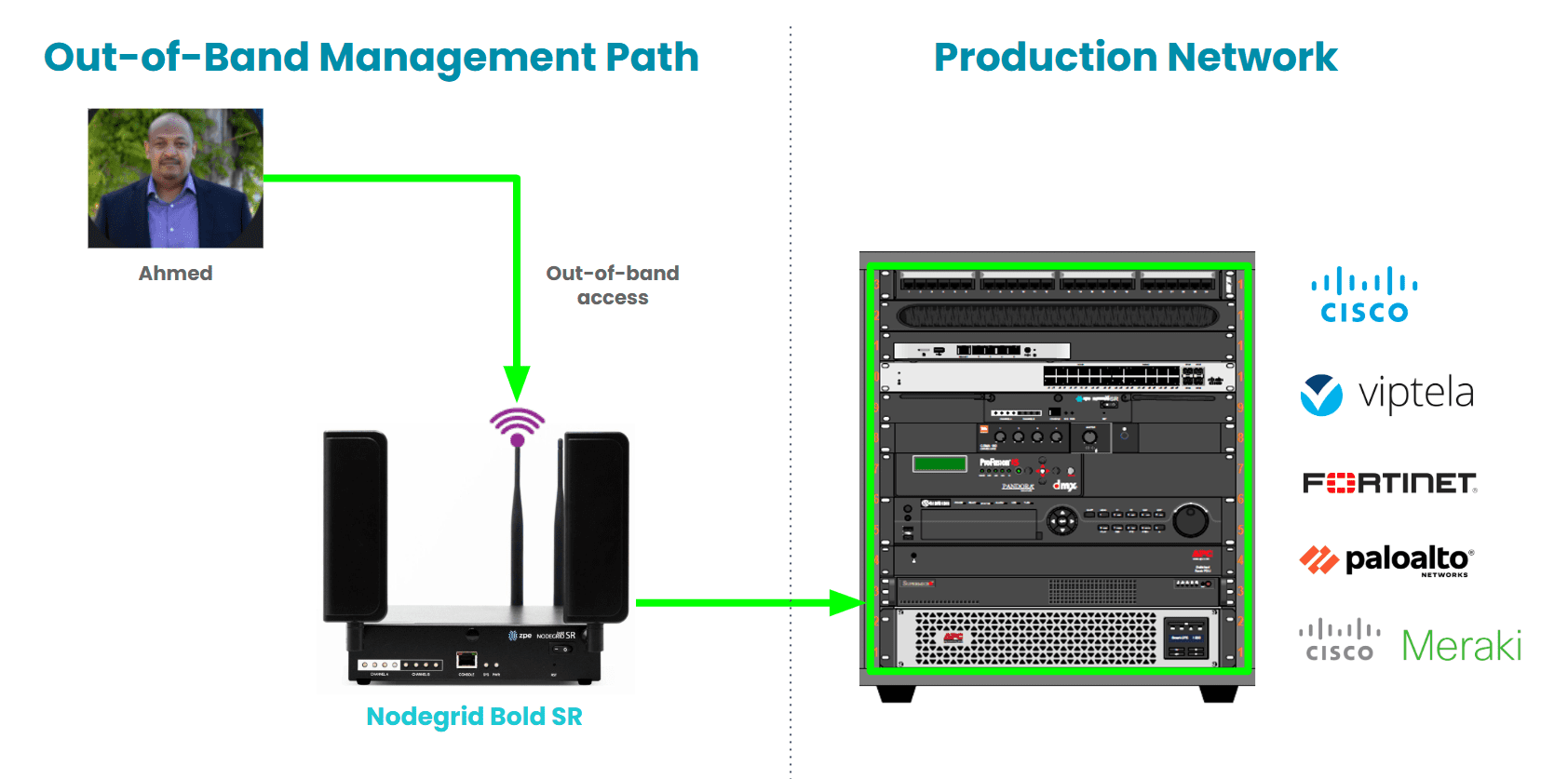
We used secure OOB serial and cellular failover. That gave us direct control of the devices, even when the core network was down and identity services were unreachable. We stayed operational.

Ahmed Algam uses out-of-band management to recover from a failed rollback

Image: The out-of-band management path is a dedicated access network. It acts as a safety net for instances when a rollback fails and recovery processes must take place.

Fortunately, we had already segmented the engineering network from the business network. That isolation meant the failure didn’t spread. We could take our time rebuilding the broken pieces without impacting customer operations or internal productivity tools.

All services were back up and running within a few hours.

What did we learn?

I’m posting this because a lot of IT teams, particularly those in growth-stage businesses, neglect early architecture segmentation or OOB access. It is considered a “Phase 2” assignment. However, it’s the only way out should things go wrong, which they will.

Here’s what we learned:

  • The quality of your assumptions determines how well your rollback strategy works. A rollback that depends on “nothing else changes” is fragile by design.
  • DNS, Identity (like Entra ID), and VPN are interdependent. They form a delicate triangle, and when one goes, the others often follow.
  • Out-of-Band is a fundamental design need, not just a catastrophe recovery tool. If you’re managing remote or critical infrastructure, there is no substitute for direct, independent access.
  • Documentation is important. Access is more important. All the runbooks in the world won’t help if you can’t reach the system that runs them.

Prepare for failure. Walk through your worst-case scenario. Don’t count on luck to save you.

Watch this demo on how to roll back and recover

My colleague Marcel put together this demo video which shows how to access, configure, and recover infrastructure, even if you’re thousands of miles away.

Marcel van Zwienen gives a walkthrough of ZPE Cloud for remote device management.

Set Up Your Own Out-of-Band Management With Starlink

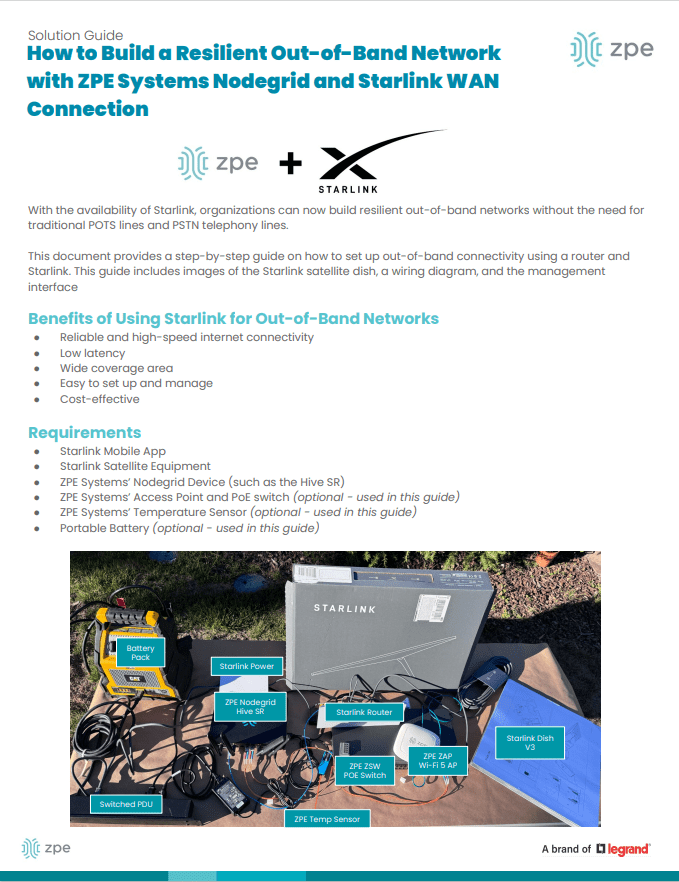
Download this guide on how to set up an out-of-band network using Starlink. It includes technical wiring diagrams and a guided walkthrough.

You can download it here: How to Build Out-of-Band With Starlink

Starlink setup guide

Why Gen 3 Out-of-Band Is Your Strategic Weapon in 2025

Mike Sale – Why Gen 3 Out-of-Band is Your Strategic Weapon

I think it’s time to revisit the old school way of thinking about managing and securing IT infrastructure. The legacy use case for OOB is outdated. For the past decade, most IT teams have viewed out-of-band (OOB) as a last resort; an insurance policy for when something goes wrong. That mindset made sense when OOB technology was focused on connecting you to a switch or router.

Technology and the role of IT have changed so much in the last few years. There’s a lot more pressure on IT folks these days! But we get it, and that’s why ZPE’s OOB platform has changed to help you.

At a minimum, you have to ensure system endpoints are hardened against attacks, patch and update regularly, back up and restore critical systems, and be prepared to isolate compromised networks. In other words, you have to make sure those complicated hybrid environments don’t go off the rails and cost your company money. OOB for the “just-in-case” scenario doesn’t cut it anymore, and treating it that way is a huge missed opportunity.

Don’t Be Reactive. Be Resilient By Design.

Some OOB vendors claim they have the solution to get you through installation day, doomsday, and everyday ops. But if I’m candid, ZPE is the only vendor who can live up to this standard.   We do what no one else can do! Our work with the world’s largest, most well-known hyperscale and tech companies proves our architecture and design principles.

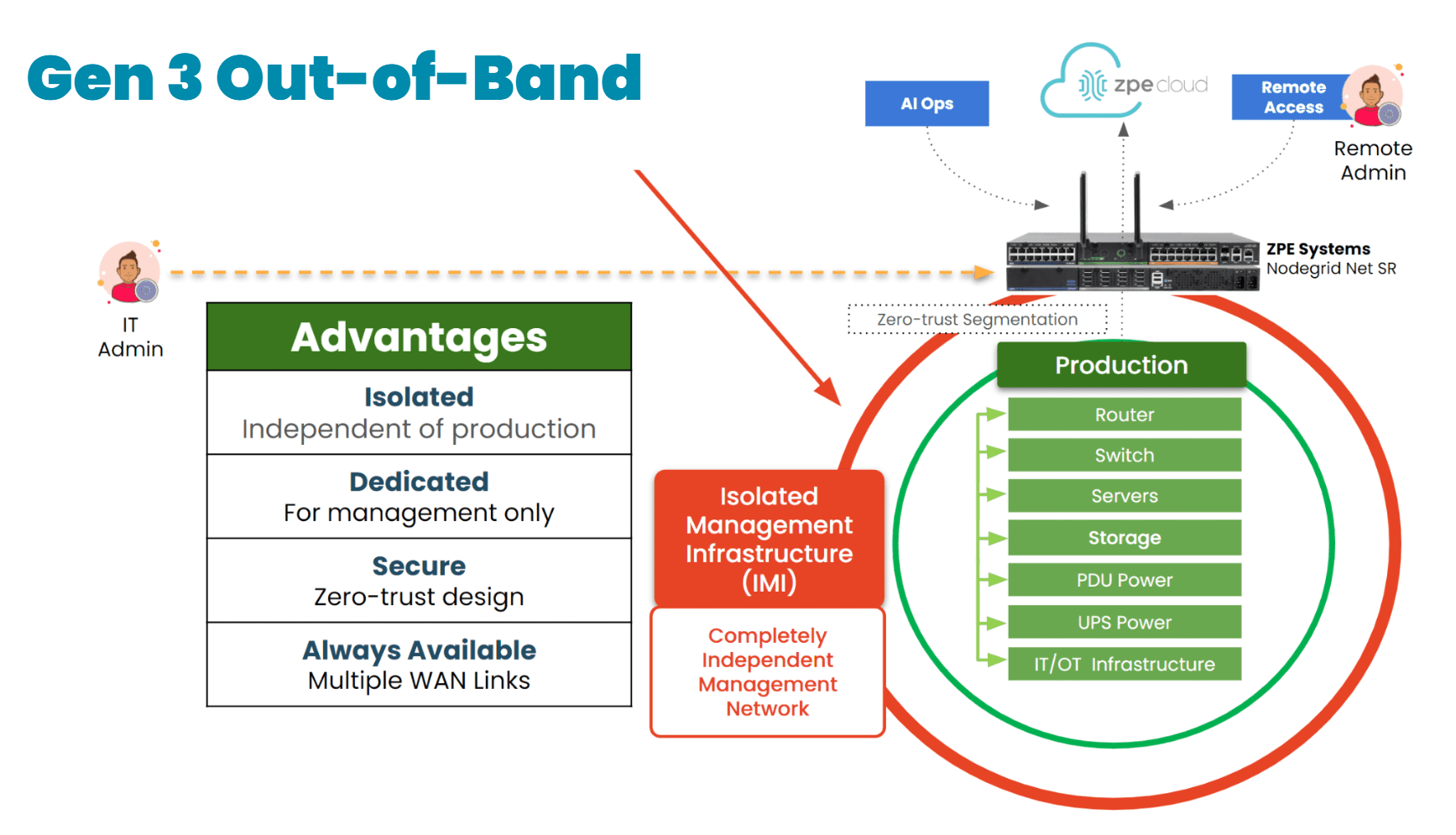
This Gen 3 out-of-band (aka Isolated Management Infrastructure) is about staying in control no matter what gets thrown at you.

OOB Has A New Job Description

Out-of-band is evolving because of today’s radically different network demands:

  • Edge computing is pushing infrastructure into hard-to-reach (sometimes hostile) environments.
  • Remote and hybrid ops teams need 24/7 secure access without relying on fragile VPNs.
  • Ransomware and insider threats are rising, requiring an isolated recovery path that can’t be hijacked by attackers.
  • Patching delays leave systems vulnerable for weeks or months, and faulty updates can cause crashes that are difficult to recover from.
  • Automation and Infrastructure as Code (IaC) are no longer nice-to-haves – they’re essential for things like initial provisioning, config management, and everyday ops.

It’s a lot to add to the old “break/fix” job description. That’s why traditional OOB solutions fall short and we succeed. ZPE is designed to help teams enforce security policies, manage infrastructure proactively, drive automation, and do all the things that keep the bad stuff from happening in the first place. ZPE’s founders knew this evolution was coming, and that’s why they built Gen 3 out-of-band.

Gen 3 Out-of-Band Is Your Strategic Weapon

Unlike normal OOB setups that are bolted onto the production network, Gen 3 out-of-band is physically and logically separated via Isolated Management Infrastructure (IMI) approach. That separation is key – it gives teams persistent, secure access to infrastructure without touching the production network.

This means you stay in control no matter what.

Gen 3 out-of-band management uses IMI

Image: Gen 3 out-of-band management takes advantage of an approach called Isolated Management Infrastructure, a fully separate network that guarantees admin access when the main network is down.

Imagine your OOB system helping you:

  • Push golden configurations across 100 remote sites without relying on a VPN.
  • Automatically detect config drift and restore known-good states.
  • Trigger remediation workflows when a security policy is violated.
  • Run automation playbooks at remote locations using integrated tools like Ansible, Terraform, or GitOps pipelines.
  • Maintain operations when production links are compromised or hijacked.
  • Deploy the Gartner-recommended Secure Isolated Recovery Environment to stop an active cyberattack in hours (not weeks).


Gen 3 out-of-band is the dedicated management plane that enables all these things, which is a huge strategic advantage. Here are some real-world examples:

  • Vapor IO shrunk edge data center deployment times to one hour and achieved full lights-out operations. No more late-night wakeup calls or expensive on-site visits.
  • IAA refreshed their nationwide infrastructure while keeping 100% uptime and saving $17,500 per month in management costs.
  • Living Spaces quadrupled business while saving $300,000 per year. They actually shrunk their workload and didn’t need to add any headcount.

OOB is no longer just for the worst day. Gen 3 out-of-band gives you the architecture and platform to build resilience into your business strategy and minimize what the worst day could be.

Mike Sale on LinkedIn

Connect With Me!

When IT Goes Dark: What I Wish I Knew 20 Years Ago

Ahmed Algam

“No one ever tells you this part…”

My name is Ahmed Algam. I am a Network & Systems Administrator for ZPE Systems – A Brand of Legrand, with over 20 years of experience in network administration, system infrastructure, Microsoft ERP solutions, and enterprise IT management. I have a B.S. in Computer Science and will soon complete my Master’s of Information and Data Science.

In the early days of my IT career, I learned how to build systems from scratch, configure networks, and apply patches.

Like many, I was trained to focus on the obvious goals: keep things running, keep everything secure, and automate what I can.

But what no one taught me? What to do when everything goes dark – literally.

That’s exactly what happened recently.

ZPE’s Fremont branch lost power unexpectedly and without notice from our provider.

One by one, our services went down

  • ESXi Hosts
  • Backup Servers
  • VPN Tunnels
  • Core Routers and Switches

Here is the part that I wish I knew 20 years ago…

You won’t be rescued by dashboards, spreadsheets, or documentation when IT goes dark. What WILL save you is system design, specifically out-of-band management.

And for which I am lucky that design did save us.

Without Out-of-band (OOB), I would have had to spend the whole night at the office manually rebooting, configuring, and troubleshooting everything. It’s a nightmare for IT admins because you might get the call while you’re attending your kids’ sporting events, attending college courses, or spending quality time with your family. IT emergencies can really intrude on your life outside of work. It’s just part of the job.

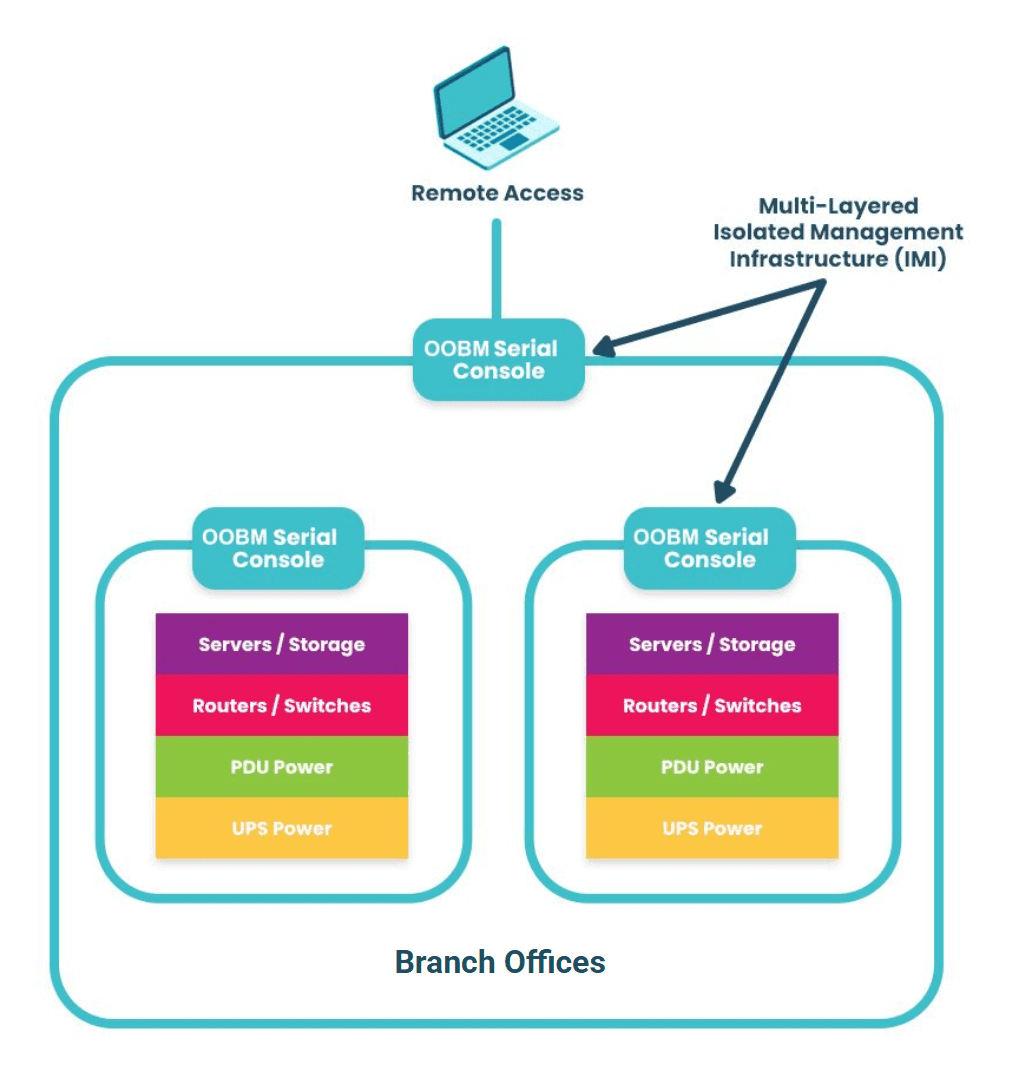
But I was so grateful to have OOB because it gave me a separate path dedicated to recovery, which was just what I needed. I was able to instantly remote-into my infrastructure without leaving home.

IMI and OOBM are a dedicated path to system recovery

Image: Isolated Management Infrastructure uses out-of-band management (OOBM) serial consoles to access production devices when they are offline.

Within minutes, I was able to:

  • Remotely connect through our OOB console
  • Restart critical infrastructure
  • Monitor recovery independently of the production path

I didn’t have to head for the office or change the plans I had with my family. With our OOB system in place, I knew that I could fix the problem, have services restored before sunrise, and still get a good night’s sleep.

This wasn’t luck

It was the result of:

  • Planning for the worst-case scenario, not just the routine
  • Having OOB in all essential areas
  • Testing access methods instead of assuming they’ll just work
  • Separating management traffic from production flows
  • Staying calm with an architecture designed to withstand chaos


Even highly-skilled IT teams come to a full standstill during disruptions

It has nothing to do with a lack of talent or skill. The reason is their inability to access the malfunctioning systems.

So here’s my advice to every IT professional:

  • Now is the time to prepare for the worst
  • Make an OOB network
  • Separate management paths from production (and test access!)

    Because when the lights go out, that’s when real IT begins.

    Starlink setup guide

    Here’s How You Can Set Up Out-of-Band Management

    My colleagues recently created this guide on how to set up an out-of-band network using Starlink. It includes technical wiring diagrams and a guided walkthrough.

    You can download it here: How to Build Out-of-Band With Starlink

    Out-of-Band vs. Isolated Management Infrastructure: What’s the Difference?

    Out-of-band vs IMI
    To stay ahead of network outages, cyberattacks, and unexpected infrastructure failures, IT teams rely on remote access tools. Out-of-band (OOB) management is traditionally used for quick access to troubleshoot and resolve issues when the main network goes down. But in the past decade, hyperscalers and leading enterprises have developed a more advanced approach called Isolated Management Infrastructure (IMI). Although IMI incorporates OOB, it’s important to understand the distinction between the two, especially when designing infrastructure to be resilient and scalable.

    What is Out-of-Band Management?

    Out-of-Band Management has been around for decades. It gives IT administrators remote access to network equipment through an independent channel, serving as a lifeline when the primary network is down.

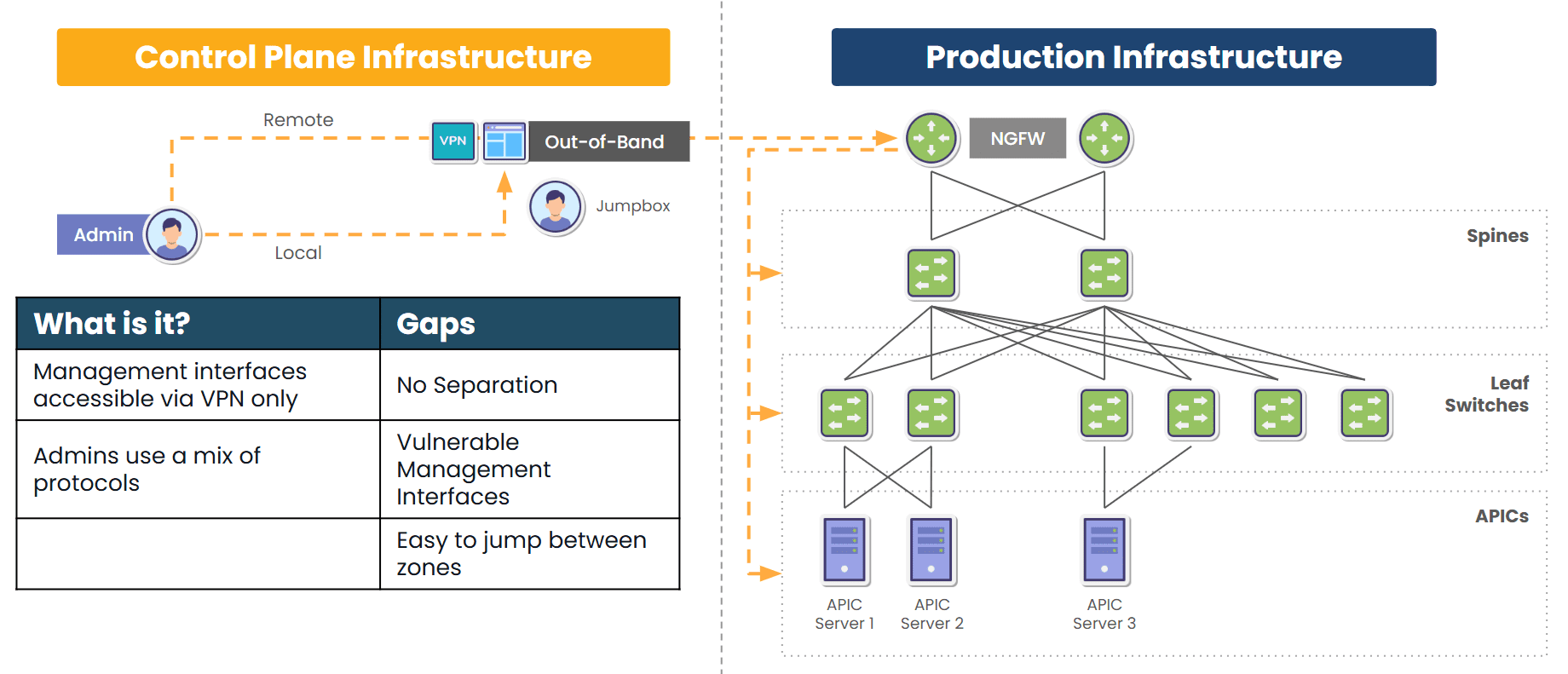
    Traditional out-of-band provides a secondary path to production equipment

    Image: Traditional out-of-band solutions provide a secondary path to production infrastructure, but still rely in part on production equipment.

    Most OOB solutions are like a backup entrance: if the main network is compromised, locked, or unavailable, OOB provides a way to “go around the front door” and fix the problem from the outside.

    Key Characteristics:

    • Separate Path: Usually uses dedicated serial ports, USB consoles, or cellular links.
    • Primary Use Cases: Though OOB can be used for regular maintenance and updates, it’s typically used for emergency access, remote rebooting, BIOS/firmware-level diagnostics, and sometimes initial provisioning.
    • Tools Involved: Console servers, terminal servers, or devices with embedded OOB ports (e.g., BMC/IPMI for servers).

    Business Impact:

    From a business standpoint, traditional OOB solutions offer reactive resilience that helps resolve outages faster and without costly site visits. It also reduces Mean Time to Repair (MTTR) and enhances the ability to manage remote or unmanned locations.

    However, solutions like ZPE Systems’ Nodegrid provide robust capability that evolves out-of-band to a new level. This comprehensive, next-gen OOB is called Isolated Management Infrastructure.

    What is Isolated Management Infrastructure?

    Isolated Management Infrastructure furthers the concept of resilience and is a natural evolution of out-of-band. IMI does two things:

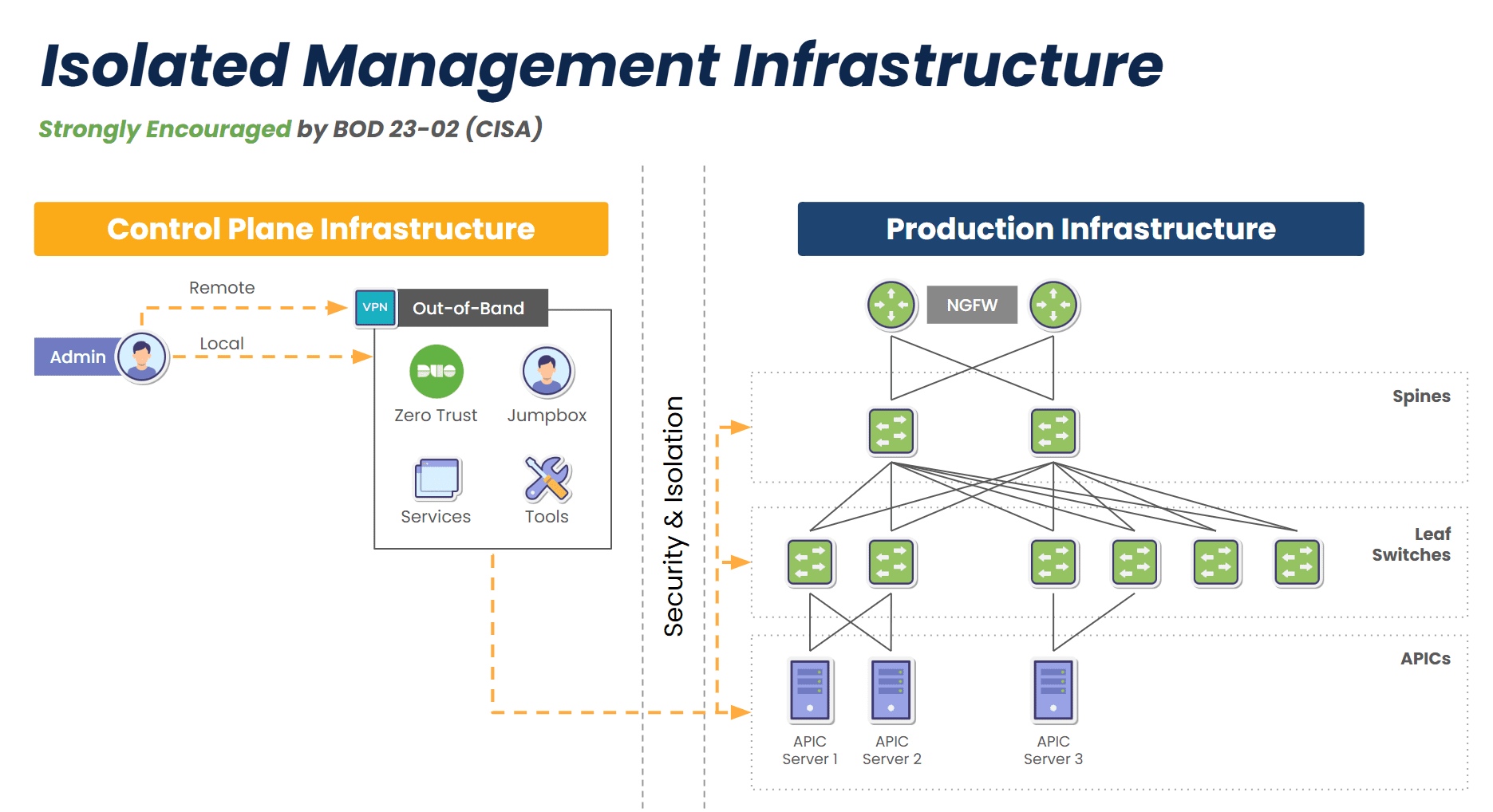
    1. Rather than just providing a secondary path into production devices, IMI creates a completely separate management plane that does not rely on any production device.
    2. IMI incorporates its own switches, routers, servers, and jumpboxes to support additional critical IT functions like networking, computing, security, and automation.

    Isolated management infrastructure provides a fully separate management path

    Image: Isolated Management Infrastructure creates a completely separate management plane and full-stack platform for maintaining critical services even during disruptions, and is strongly encouraged by CISA BOD 23-02.

    IMI doesn’t just provide access during a crisis – it creates a separate layer of control and serves as a resilience system that keeps core services running no matter what. This gives organizations proactive resilience from simple upgrade errors and misconfigurations, to ransomware attacks and global disruptions like 2024’s CrowdStrike outage.

    Key Characteristics:

    • Fully Isolated Design: The management plane is physically and logically isolated from the production network, with console access to all production devices via a variety of interfaces including RS-232, Ethernet, USB, and IPMI.
    • Backup Links: Uses two or more backup links for reliable access, such as 5G, Starlink, and others.
    • Multi-Functionality: Hosts network monitoring, DNS, DHCP, automation engines, virtual firewalls, and all tools and functions to support critical services during disruptions.
    • Automation: Provides a safe environment for teams to build, test, and integrate automation workflows, with the ability to automatically revert back to a golden image in case of errors.
    • Ransomware Recovery: Hosts all tools, apps, and services to deploy the Gartner-recommended Secure Isolated Recovery Environments (SIRE).
    • Zero Trust and Compliance Ready: Built to minimize blast radius and support regulated environments, with segmentation and zero trust security features such as MFA and Role-Based Access Controls (RBAC).

    Business Impact:

    IMI enables operational continuity in the face of cyberattacks, misconfigurations, or outages. It aligns with zero-trust principles and regulatory frameworks like NIST 800-207, making it ideal for government, finance, and healthcare. It also provides a foundation for modern DevSecOps and AI-driven automation strategies.

    Comparing Reactive vs. Proactive Resilience


    Purpose
    Deployment
    Services Hosted
    Typical Vendors
    Best For
    Out-of-Band
    Recover access when production is down
    Console servers or cellular-based devices
    None (access only)
    Opengear, Lantronix
    Legacy networks, branch recovery
    IMI
    Maintain operations even when production is down
    Full-stack platform (compute, network, storage)
    Firewalls, monitoring, DNS, etc.
    ZPE Systems (Nodegrid), custom-built IMI
    Modern, zero-trust, AI-driven environments

    Why Businesses Should Care

    For CIOs and CTOs

    IMI is more than a management tool – it’s a strategic shift in infrastructure design. It minimizes dependency on the production network for critical IT functions and gives teams a layered defense. For organizations using AI, hybrid-cloud architectures, or edge computing, IMI is strongly encouraged and should be incorporated into the initial design.

    For Network Architects and Engineers

    IMI significantly reduces manual intervention during incidents. Instead of scrambling to access firewalls or core switches when something breaks, teams can rely on an isolated environment that remains fully operational. It also enables advanced automation workflows (e.g., self-healing, dynamic traffic rerouting) that just aren’t possible in traditional OOB environments.

    Get a Demo of IMI

    Set up a 15-minute demo to see IMI in action. Our experts will show you how to automatically provision devices, recover failed equipment, and combat ransomware. Use the button to set up your demo now.

    Watch How IMI Improves Security

    Rene Neumann (Director of Solution Engineering) gives a 10-minute presentation on IMI and how it enhances security.

    Cisco Live 2024 – Securing the Network Backbone