Providing Out-of-Band Connectivity to Mission-Critical IT Resources

Why Securing IT Means Replacing End-of-Life Console Servers

Rene Neumann – Why Securing IT Means Replacing End of Life Console Servers


The world as we know it is connected to IT, and IT relies on its underlying infrastructure. Organizations must prioritize maintaining this infrastructure; otherwise, any disruption or breach has a ripple effect that takes services offline for millions of users (take 2024’s CrowdStrike outage, for example). A big part of this maintenance is ensuring that all hardware components, including console servers, are up-to-date and secure. Most console servers reach end-of-life (EOL) and need to be replaced, but for many reasons, whether budgetary concerns or the “if it isn’t broken” mentality, IT teams often keep their EOL devices. Let’s look at the risks of using EOL console servers, and why replacing them goes hand-in-hand with securing IT.

The Risks of Using End-of-Life Console Servers

End-of-life console servers can undermine the security and functionality of IT systems. These risks include:

1. Lack of Security Features and Updates

Aging console servers lack adequate hardware and management security features, meaning they can’t support a zero trust approach. On top of this, once a console server reaches EOL, the manufacturer stops providing security patches and updates. The device then becomes vulnerable to newly discovered CVEs and complex cyberattacks (like the MOVEit and Ragnar Locker breaches). Cybercriminals often target outdated hardware because they know that these devices are no longer receiving updates, making them easy entry points for launching attacks.

2. Compliance Issues

Many industries have stringent regulatory requirements regarding data security and IT infrastructure. DORA, NIS2 (EU), NIST2 (US), PCI 4.0 (finance), and CER Directive are just a few of the updated regulations that are cracking down on how organizations architect IT, including the management layer. Using EOL hardware can lead to non-compliance, resulting in fines and legal repercussions. Regulatory bodies expect organizations to use up-to-date and secure equipment to protect sensitive information.

3. Prolonged Recovery

EOL console servers are prone to failures and inefficiencies. As these devices age, their performance deteriorates, leading to increased downtime and disruptions. Most console servers are Gen 2, meaning they offer basic remote troubleshooting (to address break/fix scenarios) and limited automation capabilities. When there is a severe disruption, such as a ransomware attack, hackers can easily access and encrypt these devices to lock out admin access. Organizations then must endure prolonged recovery (like the CrowdStrike outage, or 2023’s MGM attack) because they need to physically decommission and restore their infrastructure.


The Importance of Replacing EOL Console Servers

Here’s why replacing EOL console servers is essential to securing IT:

1. Modern Security Approach

Zero trust is an approach that uses segmentation across IT assets. This ensures that only authorized users can access resources necessary for their job function. This approach requires SAML, SSO, MFA/2FA, and role-based access controls, which are only supported by modern console servers. Modern devices additionally feature advanced security through encryption, signed OS, and tampering detection. This ensures a complete cyber and physical approach to security.

2. Protection Against New Threats

New CVEs and evolving threats can easily take advantage of EOL devices that no longer receive updates. Modern console servers benefit from ongoing support in the form of firmware upgrades and security patches. Upgrading with a security-focused device vendor can drastically shrink the attack surface, by addressing supply chain security risks, codebase integrity, and CVE patching.

3. Ease of Compliance

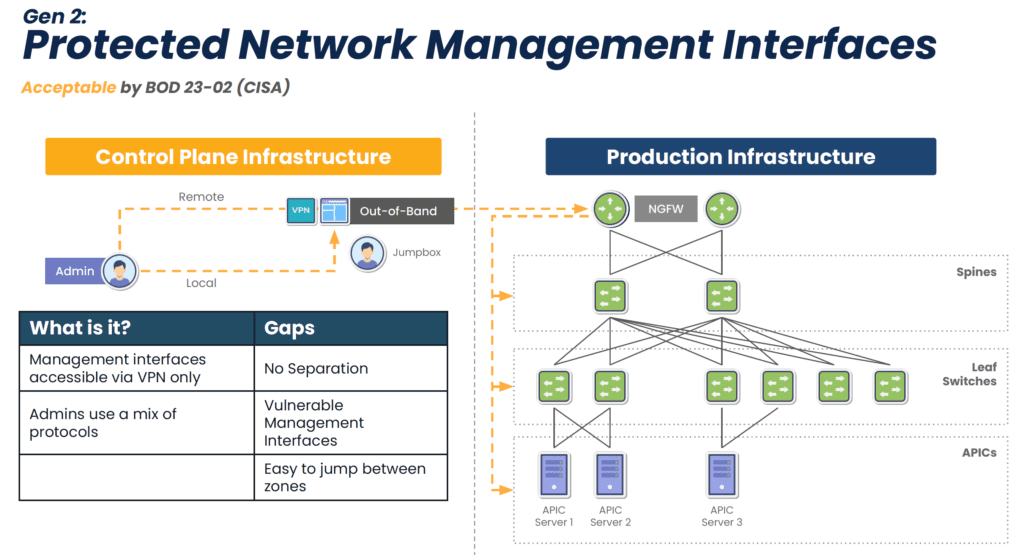
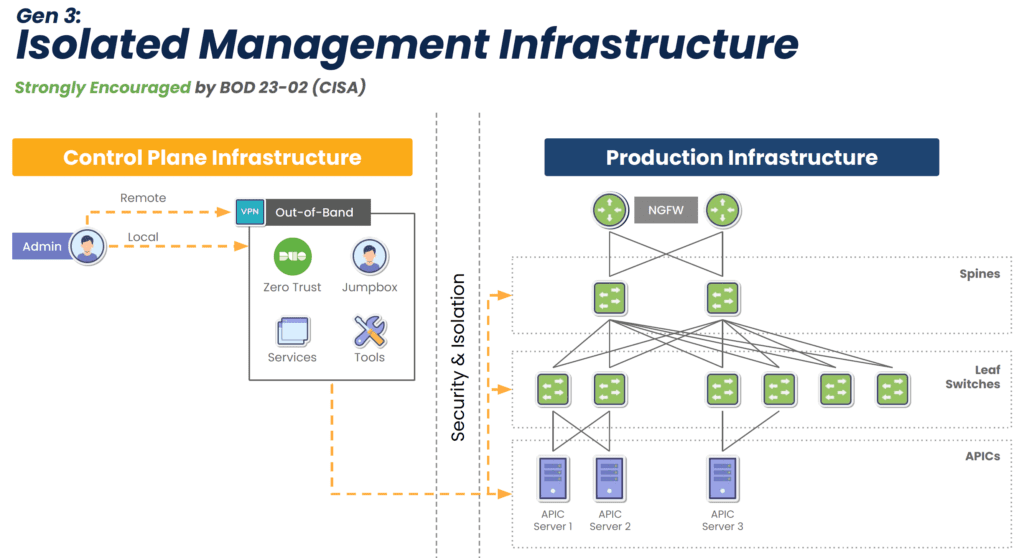
EOL devices lack modern security features, but this isn’t the only reason why they make it difficult or impossible to comply with regulations. They also lack the ability to isolate the control plane from the production network (see Diagram 1 below), meaning attackers can easily move between the two in order to launch ransomware and steal sensitive information. Watchdog agencies and new legislation are stipulating that organizations follow the latest best practice of separating the control plane from production, called Isolated Management Infrastructure (IMI). Modern console servers make this best practice simple to achieve by offering drop-in out-of-band that is completely isolated from production assets (see Diagram 2 below). This means that the organization is always in control of its IT assets and sensitive data.

A network diagram showing Gen 2 out-of-band is vulnerable to the internet

Diagram 1: Though an acceptable approach, Gen 2 out-of-band lacks isolation and leaves management interfaces vulnerable to the internet.

A network diagram showing how Gen 3 out-of-band secures network and management interfaces.

Diagram 2: Gen 3 out-of-band fully isolates the control plane to guarantee organizations retain control of their IT assets and sensitive info.

4. Faster Recovery

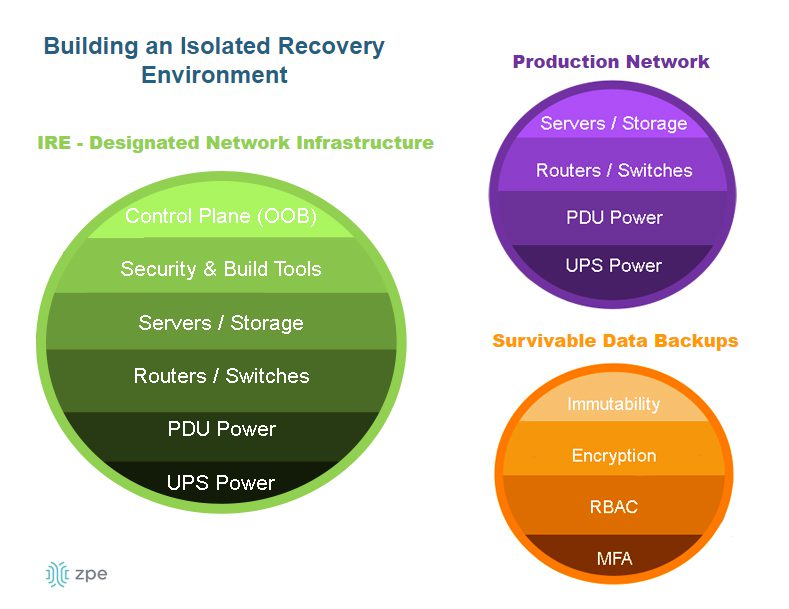
New console servers are designed to handle more workloads and functions, which eliminates single-purpose devices and shrinks the attack surface. They can also run VMs and Docker containers to host applications. This enables what Gartner calls the Isolated Recovery Environment (IRE) (see Diagram 3 below), which is becoming essential for faster recovery from ransomware. Since the IMI component prohibits attackers from accessing the control plane, admins retain control during an attack. They can use the IMI to deploy their IRE and the necessary applications — remotely — to decommission, cleanse, and restore their infected infrastructure. This means that they don’t have to roll trucks week after week when there’s an attack; they just need to log into their management infrastructure to begin assessing and responding immediately, which significantly reduces recovery times.

A diagram showing the components of an isolated recovery environment.

Diagram 3: The Isolated Recovery Environment allows for a comprehensive and rapid response to ransomware attacks.

Get a Walkthrough of IMI and IRE

Let’s cover what IMI and IRE would look like in your environment and walk through some outage recovery scenarios. Use the link below to set up a technical discussion.

Meet Me at Cisco Live Amsterdam 2026

Visit booth C10 at Cisco Live Amsterdam to chat about IMI, IRE, and replacing end-of-life console servers. You can also catch my 10-minute presentation on Wednesday, February 11 at 1:50pm in the Speakers Corner. I’ll cover From Pilot Projects to Global Rollouts: Why Out-of-Band Management is Crucial for Scaling AI Infrastructure, with more concepts and network diagrams showing how to achieve true resilience. Visit our Cisco Live page below to let me know you’re coming. See you at the show!

Rene Neumann presents at Cisco Live Amsterdam 2026

Critical Entities Resilience Directive

Critical Entities Resilience Directive
The Critical Entities Resilience (CER) Directive is an EU regulation designed to prevent disruption to the services considered essential to society or the economy. The CER Directive outlines the obligations of critical entities to prepare for any potential hazard, including natural disasters, human errors, terrorist attacks, and cybersecurity breaches. EU Member States have until 17 October 2024 to adopt and publish resilience measures required for their critical entities, and those measures officially take effect from 18 October 2024. Member States must identify and notify critical entities by July 2026; these entities then only have ten months to comply with CER requirements. With such a tight timeframe to demonstrate compliance with the Critical Entities Resilience Directive, organizations that might be deemed critical should begin preparing their resilience strategies now.

Citation: Directive (EU) 2022/2557 of the European Parliament and of the Council of 14 December 2022 on the resilience of critical entities and repealing Council Directive 2008/114/EC

Who does the Critical Entities Resilience Directive apply to, and why does it matter?

The CER Directive covers eleven sectors and subsectors that provide services essential to society, the economy, public health & safety, or preserving the environment. These include:

In-Scope Sectors Covered by the CER Directive

Sector Subsectors
Energy
  • Electricity
  • Heating and cooling
  • Oil & gas
  • Hydrogen
Transport
  • Air
  • Rail
  • Water
  • Road
  • Public transportation
Banking
  • Deposit, lending, and credit institutions
Financial Market Infrastructure
  • Trading venues
  • Clearing systems
Health
Drinking Water
  • Drinking water suppliers
  • Drinking water distributors
Waste Water
  • Collection
  • Treatment
  • Disposal
Digital Infrastructure
Public Administration
Space
  • Operators of ground-based infrastructure for space-based services
Food Production, Processing, and Distribution
  • Large-scale industrial food production and processing
  • Food supply chain services
  • Food wholesale distributors

The Critical Entities Resilience Directive is one of several new EU regulations (such as DORA and NIS2) created to establish consistent guidelines for resilience in sectors where any service disruption has a significant negative impact on society or the economy. Whereas DORA applies primarily to financial institutions and supporting services, and NIS2 focuses on cybersecurity threats, the CER Directive is broader in scope and addresses other, non-digital threats to resilience such as natural disasters and global health crises (e.g., COVID-19).

The penalties for noncompliance will vary by Member State but are likely to include fines, public notification, remediation, and withdrawal of authorization.

CER Directive requirements for critical entities

Most of the CER Directive requirements apply to Member States, outlining how the designated authorities will adopt and enforce resilience measures and support critical entities in achieving compliance. However, there are five key provisions that relevant organizations should be aware of as they prepare for their identification as critical entities.

1. Article 4: Strategy on the resilience of critical entities

EU Member States have until 17 January 2026 to adopt a strategy outlining the guidelines and procedures for critical entities to achieve and maintain a high level of resilience. Essentially, this strategy will describe the requirements for CER Directive compliance in each Member State and provide guidance on how to meet those requirements. Potentially critical entities can prepare by examining existing resilience frameworks and regulations to anticipate the policies, tools, and procedures that will likely be required.

2. Article 5: Risk assessment by Member States

Member States have until 17 January 2026 to perform a risk assessment of all essential services. These assessments must account for natural and human-made risks, including accidents, natural disasters, public health emergencies, terrorist attacks, and antagonistic threats. Member States will then use the risk assessments to identify critical entities within each sector.

3. Article 12: Risk assessment by critical entities

Critical entities must perform risk assessments using similar criteria to Article 5 within nine months of being notified of their designation as critical and at least every four years afterward. If an organization already conducts risk assessments according to other similar resilience guidelines or frameworks, Member States have the authority to decide whether or not those assessments meet CER Directive compliance requirements.

4. Article 13: Resilience measures of critical entities

Critical entities must take the appropriate technical, security, and policy measures to ensure resilience, including a comprehensive strategy for service continuity and disaster recovery. Examples of resilience measures outlined by the CER Directive include:

CER Directive Resilience Measures

Requirements Examples
Adopt disaster risk reduction and climate adaptation measures Using an environmental monitoring system to detect and respond to rising temperatures, humidity, and other relevant conditions
Ensure adequate physical protection of the premises and critical infrastructure, including fencing, barriers, perimeter monitoring tools, detection equipment, and access controls Installing proximity sensors in data center racks to automatically notify security teams if an unauthorized user physically tampers with remote infrastructure
Respond to, resist, and mitigate service disruptions Deploying out-of-band (OOB) serial consoles with cellular capabilities to ensure continuous remote management access to critical infrastructure
Recover from incidents using business continuity measures to resume provisioning essential services Building a resilience system containing all the infrastructure and tools needed to rebuild and recover while still delivering core services
Manage employee security by classifying personnel who exercise critical functions, establishing access rights and controls, and performing background checks as needed Adopting zero-trust security policies and controls that assign access privileges according to role (role-based access control, or RBAC)

5. Article 15: Incident notification

Critical entities must notify the competent authority of any incidents that have or could significantly disrupt essential services within 24 hours of detection. The significance of a disruption is determined according to the following parameters:

  • How many users the disruption affects;
  • How long the disruption lasts;
  • The geographical area the disruption affects.

The incident notification must explain the nature, cause, and potential consequences of the disruption, including any cross-border implications.

How Nodegrid simplifies CER Directive compliance

Nodegrid is a Gen 3 out-of-band management platform that makes the perfect foundation for a resilience system. Nodegrid OOB separates the control plane from the data plane to ensure continuous remote management access to critical infrastructure even during production network outages. Vendor-neutral serial consoles and integrated branch service routers directly host third-party software for security, automation, recovery, and more, reducing hardware overhead at each site while ensuring teams have access to all the tools they need to restore essential services.

Looking to Upgrade to a Nodegrid serial console?

Prepare for the Critical Entities Resilience Directive by replacing your discontinued, EOL serial console with a Gen 3 out-of-band solution from Nodegrid.

Click here to learn more!

DORA Act: 5 Takeaways For The Financial Sector

Thumbnail – DORA Act 5 Takeaways for the Financial Sector

The Digital Operational Resilience Act (DORA) is a regulatory initiative within the European Union that aims to enhance the operational resilience of the financial sector. Its main goal is to prevent and mitigate cyber threats and operational disruptions. The DORA Act outlines regulatory requirements for the security of network and information systems “whereby all firms need to make sure they can withstand, respond to and recover from all types of ICT-related disruptions and threats” (DORA Act website).

Who and What Are Covered Under the DORA Act?

The DORA Act is a regulation that covers all financial entities within the European Union (EU). It recognizes the critical role of information and communication technology (ICT) systems in financial services. DORA applies to financial services including payments, securities, credit rating, algorithmic trading, lending, insurance, and back-office operations. It establishes a framework for ICT risk management through technical standards, which are being released in two phases, the first of which was published on January 17, 2024. The DORA Act will go into effect in its entirety on January 17, 2025.

With cyberattacks constantly in the news cycle, it’s no surprise that governing bodies are putting forth standards for operational resilience. But without combing through this lengthy piece of legislation, what should IT teams start thinking about from a practical standpoint? Here are 5 takeaways on what the DORA Act means for the financial sector.

DORA Act: 5 Takeaways for the Financial Sector

1. Shore-up your cybersecurity measures

The DORA Act emphasizes strengthening cybersecurity measures within the financial sector. It requires financial institutions, such as banks, stock exchanges, and financial infrastructure providers, to implement robust cybersecurity controls and protocols. These include adopting advanced authentication mechanisms, encryption standards, and network segmentation to protect sensitive financial data and critical infrastructure from cyber threats. Part of this will also require organizations to apply system patches and updates in a timely manner, which means automated patching will become necessary to every organization’s security posture.

2. Implement resilience systems

Operational resilience is a key focus area of the DORA Act, aiming to ensure the continuity of essential financial services in the face of cyber threats, natural disasters, and other operational disruptions. Financial institutions are required to develop comprehensive business continuity plans, establish redundant systems and backup facilities, and conduct regular stress tests to assess their ability to withstand and recover from various scenarios. Implementing a resilience system helps with this, as it provides all the infrastructure, tools, and services necessary to continue operating during major incidents.

3. Conduct regular scans for vulnerabilities

The DORA Act mandates financial institutions to implement robust risk management practices to identify, assess, and mitigate cyber risks and operational vulnerabilities. This includes conducting regular assessments, vulnerability scans, and penetration tests, and developing incident response procedures to quickly address threats. This is all part of taking a proactive approach to identify and mitigate cyber incidents, and reduce the impact that adverse events have on financial stability and consumer confidence.

4. Collaborate and share information with industry peers

The DORA Act encourages financial institutions to share cybersecurity threat intelligence, incident data, and best practices with industry peers, regulators, and law enforcement agencies. The ability to monitor systems and collect data will be crucial to this approach, and will require systems that can rapidly (and securely) deploy apps/services during ongoing incidents. This will help financial institutions to better understand emerging threats, coordinate responses to cyber incidents, and strengthen collective defenses against threats and operational disruptions.

5. Segment physical and logical systems to pass regular audits

Through the DORA Act, regulators are empowered to conduct regular assessments, audits, and inspections of systems. This will ensure that financial institutions are implementing adequate controls and safeguards to protect against cyber threats and operational disruptions. A crucial part to this will involve physical and logical separation of systems, such as through Isolated Management Infrastructure, as well as implementing zero trust architecture across the organization. These will help bolster resilience by eliminating control dependencies between management and production networks, which will also help to streamline audits.

Get the blueprint to help you comply with the DORA Act

DORA’s requirements are meant to help IT teams better protect sensitive data and the integrity of financial systems as a whole. But without a proper network management infrastructure, their production networks are too sensitive to errors and vulnerable to attacks. ZPE has created the blueprint that covers these 5 crucial takeaways outlined in the DORA Act. The architecture outlined in this blueprint has been trusted by Big Tech for more than a decade, as it allows them to deploy modern cybersecurity measures, physically and logically separated systems, and rapid recovery processes. Download the blueprint now.

Network Resilience: What is a Resilience System?

A digital web of interconnected network resilience concepts being selected by a business person in a suit.

Network resilience means being able to withstand or recover from adversity, service degradation, and complete outages with minimal business disruption. The longer business-critical services are down, or systems are breached, the greater the risk of significant financial, reputational, and legal consequences. A resilience system is a set of technologies that enable an organization to continue operating while teams work to repair failures and recover from cyberattacks. But what exactly is a resilience system, and what does it look like? This guide to network resilience defines resilience systems, provides example use cases, compares them to related technologies like backups and redundant systems, and describes the key components required to build them.

What is a resilience system?

A resilience system provides all the infrastructure, tools, and services necessary to continue operating, if in a degraded state, during major incidents. It also includes everything needed to recover data, rebuild systems, perform security testing, and continue delivering core business functionality. A resilience system is typically isolated from the production network, preventing cybercriminals from finding and compromising it and ensuring teams have continuous access even if the primary network goes down.

Resilience system use cases

Some examples of the challenges that resilience systems help overcome include:

1. Ransomware recovery

In a ransomware attack, cybercriminals infect systems with malware that spreads throughout the network and encrypts any data it encounters. Modern ransomware now uses packaged attacks that move at machine speed, instantly incapacitating entire networks. Organizations completely lose access to critical systems and data until they pay a ransom, often in untraceable cryptocurrency. Ransomware is an exceptionally tenacious form of malware and tends to reinfect backup data and rebuilt systems, significantly hampering recovery efforts and increasing the duration and cost of the attack. The best practice for resilience systems is to isolate them on an out-of-band (OOB) network, inaccessible to hackers who have breached the production in-band network. Doing so creates a safe, isolated recovery environment (IRE) where teams can restore critical data and systems without the risk of reinfection. The resilience system includes all the tools and hardware needed to restore critical business services and infrastructure. An IRE significantly accelerates ransomware recovery and minimizes downtime, so businesses can avoid paying ransoms and reduce the overall cost of attacks.

2. Network outages

Enterprise network architectures and supply chains are highly complex, with lots of moving parts that rely on external vendors to maintain availability. Just one of those vendors dropping the ball could take the entire organization offline, severely impacting network resilience. For example, in 2023, an expired cryptographic certificate caused Cisco’s Viptela SD-WAN appliances to fail on reboot, completely taking down affected networks until the issue was resolved. With a resilience system, Viptela customers could have potentially avoided this downtime by failing over to alternative network resources. For example, a resilience system with integrated cellular failover allows branches to continue connecting to and delivering critical business services while also providing a lifeline for remote teams to access and recover failed systems. A resilience system also provides observability and automatic notifications so teams are instantly alerted to issues like certificate expirations and can respond quickly to recover critical services.

3. Shift to remote work

Incidents like ransomware attacks and equipment failures happen frequently enough that companies can create detailed plans and proactively implement solutions to minimize their impact, but not all adverse events are so predictable. When the COVID-19 pandemic struck, the massive shift to remote work strained the network resources of most organizations. Instead of maintaining a limited number of branch offices, teams suddenly had to treat every employee as a new branch, leading to performance degradation and outages as they scrambled to reinforce the business’s remote capabilities. A resilience system gives teams the tools and resources they need to provision additional infrastructure, manage networking logic, deploy new security solutions, and more, even while the primary network is offline or under a heavy load. A resilience system is the key to quickly adjusting network performance and security to adapt to sudden changes like a transition to fully remote operations.

Do backups and redundancy equate to network resilience?

The short answer is no; backups and redundancy do not equate to network resilience, though they do contribute to making systems more resilient.

  • Backups are copies of data, configurations, and application code used to do a hot or cold restore when a production system fails. The underlying infrastructure must remain operational for teams to access and use backups, and unless additional resilience measures are taken, it’s easy for backups to become infected or compromised, severely hampering recovery efforts.
  • Redundancy involves duplicating critical systems, services, and applications as a failsafe in case the primaries go down. Organizations can “fail over” to the redundancies to continue critical business operations during outages. However, redundant systems are just as susceptible to failures and infections without additional resilience measures like out-of-band management and isolated management infrastructure.

Backups and redundancy are part of network resilience but alone are not enough to ensure business continuity. Resilience systems focus on maintaining the architecture of the production network while adding the ability to recover or adapt to adversity. The next section discusses all the tools and technologies that make up network resilience systems.

What does a resilience system look like?

There are four key components that go into a resilience system.

Key Components of a Resilience System

Alternative Networking

Full-stack routing and switching, Wi-Fi, VoIP, virtualization, software-defined network overlays for SDN & SD-WAN

Alternative Compute

Full-stack compute, containers, virtual machines, and any other resources needed to run applications and deliver services

Storage & Storage Recovery

Enough storage to recover systems and applications as well as support content delivery

Automation

Tools like zero-touch provisioning (ZTP) to facilitate speedy recovery while minimizing human error

Alternative networking and compute resources ensure the organization can failover in the event of a network failure or continue delivering services when production servers are unavailable. Teams also need enough storage to restore backup data, build new systems, and support the content delivery network (CDN). Automation solutions like zero-touch provisioning (ZTP), configuration management, and security validation tools accelerate the recovery process while mitigating the risk of human error. Combined, these components enable teams to reduce the frequency, severity, and duration of outages, improving overall network resilience.

Network resilience with ZPE Systems

A resilient network will continue delivering critical business services in the face of any challenge, whether from cybercriminals, supply chain issues, global events, or even plain human error. A resilience system is isolated from the production network to ensure security and availability, and it consists of all the tools and technologies needed to troubleshoot, recover, and deliver your most crucial data, applications, and infrastructure. The Nodegrid platform from ZPE Systems is the perfect foundation for a resilience system. Nodegrid is a vendor-neutral, out-of-band management solution capable of running your choice of third-party software. Nodegrid allows you to build a highly customizable IRE containing all the tools needed to safely recover from ransomware. You can even use Nodegrid to deliver services while the primary network or systems are down, making it your all-in-one network resilience multi-tool.

Want to ensure network resilience by accelerating ransomware recovery?

Minimize the business impact of ransomware with the help of our whitepaper, 3 Steps to Ransomware Recovery. Learn how to follow Gartner’s best practices to build an Isolated Recovery Environment

Download Whitepaper

Out-of-Band Management: What It Is and Why You Need It

Thumbnail – What is out-of-band management

This scenario is every IT professional’s worst nightmare: it’s the middle of the night, a remote site on the other side of the country has gone offline, and nobody knows why. A single minute of downtime can cost anywhere from several hundred dollars to tens of thousands of dollars, and the nearest tech is a six-hour plane ride away. Consider 2024’s CrowdStrike outage and the devastation caused for banks, airports, and many other organizations.

A bar chart showing the average hourly cost of downtime by industry.
Data Source: SolarWinds

Out-of-band management offers the solution: a way for teams to access critical remote infrastructure during outages and breaches without “out-of-chair” expenses. Out-of-band management allows organizations to recover remote infrastructure faster, reducing the duration and expense of downtime.

This guide to out-of-band management answers critical questions about what this technology is, why you need it, and how to choose the right solution.

What is out-of-band management?

Out-of-band management (OOBM) involves controlling network infrastructure and workflows on an out-of-band network. An out-of-band network is an entirely separate network that runs parallel with your production (or in-band) network but doesn’t rely on any of the same infrastructure or services. OOBM allows teams to administer network infrastructure remotely on a dedicated connection, such as secondary Fiber or cellular LTE, that will remain available even if the in-band network goes down from an equipment failure, ISP outage, or ransomware attack.

A diagram showing how out-of-band management works.

The biggest reason to use out-of-band management is to ensure continuous, uninterrupted access to critical remote infrastructure even when the primary network is down. OOBM allows teams to recover from outages and cyberattacks faster and more cost-efficiently because they can access, troubleshoot, and restore systems without rolling trucks or hiring on-site services.

Out-of-band management provides a lifeline for teams to access critical remote infrastructure when the production network is offline. It allows them to immediately begin troubleshooting and repairing the issue to restore services ASAP. With OOBM, companies save money on recovery expenses, and minimize the duration and business impact of downtime.

What is an OOBM serial console?

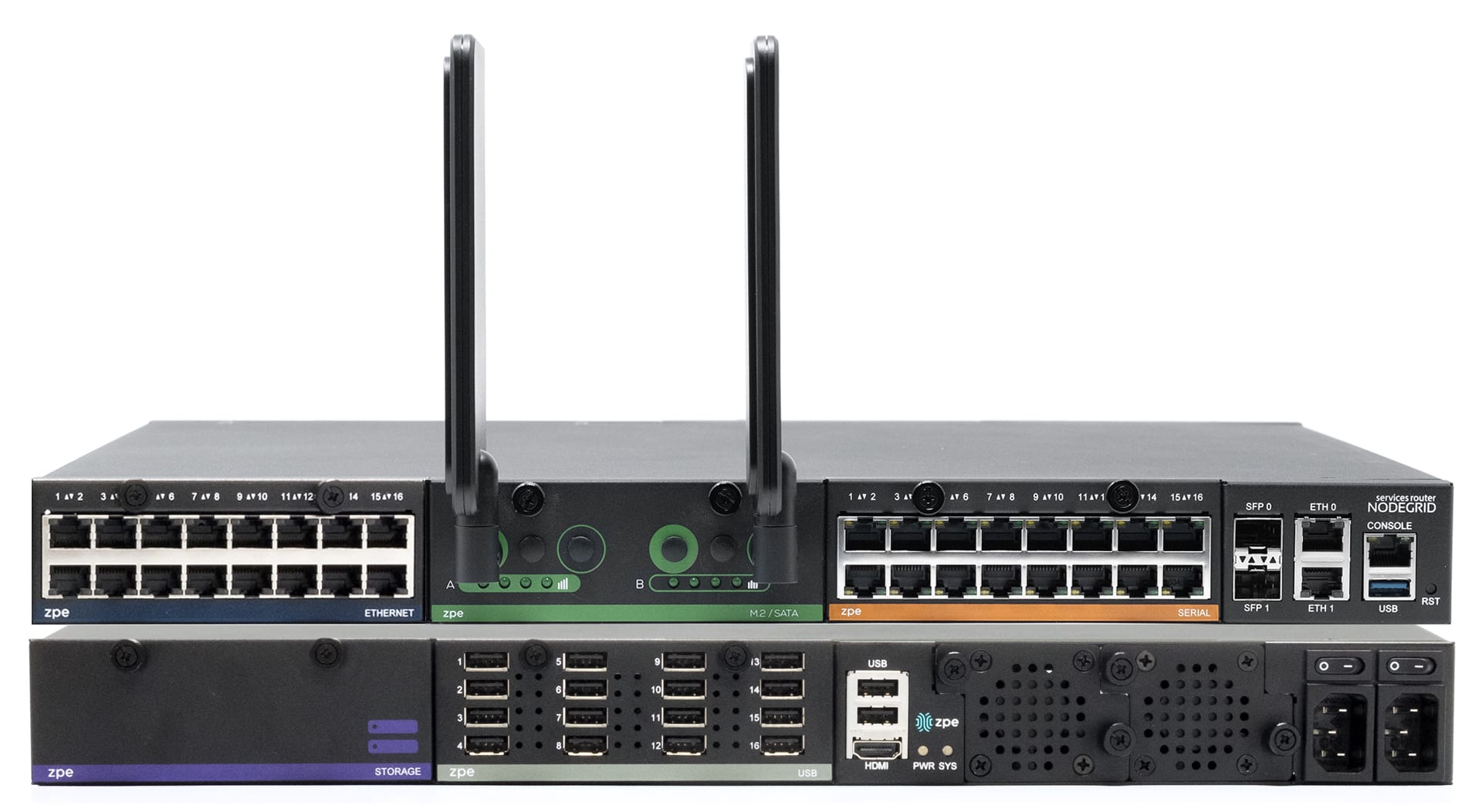
Front and back views of the Nodegrid out-of-band management serial console.

Some organizations use OOBM jump boxes (or jump servers) that are connected to both the in-band and out-of-band networks, allowing administrators to “jump” from one network to the other for management. Examples of low-cost jump boxes include the Intel NUC and the Raspberry Pi. However, OOBM jump boxes are security risks because they do not effectively isolate the management infrastructure, plus they require an entire duplicate infrastructure of devices and services to create the out-of-band network. The best practice for security, resilience, and efficiency is to deploy an all-in-one, out-of-band management solution.

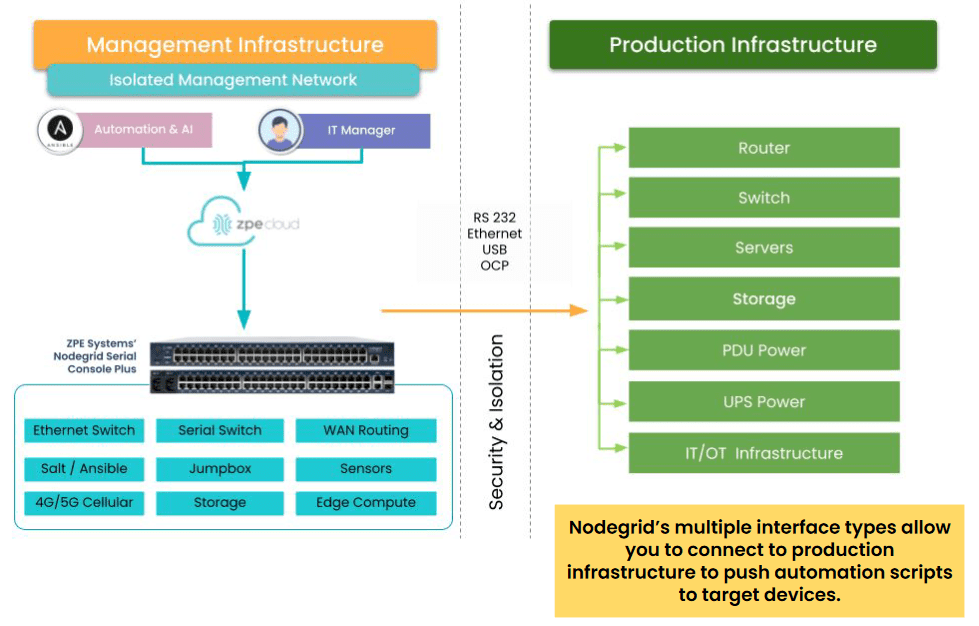
An out-of-band management solution uses hardware devices known as serial consoles, which connect to infrastructure devices via their management port (usually RS232 Serial, Ethernet, or USB). Serial consoles are known by lots of other names, including terminal servers, console servers, console server switches, serial routers, and serial switches.

The serial console has dedicated network interfaces to provide an Internet connection for remote management access, often fiber or 4G/5G cellular LTE, so they don’t connect to or rely upon the primary production network at all. This gives teams the ability to continuously monitor and administer critical remote infrastructure even during an ISP or WAN outage that would make a jump box inaccessible.

 Administrators remotely access an OOBM serial console via this dedicated link and, from there, can view and manage all connected infrastructure from a single, convenient software platform. This software is typically deployed on-premises and runs as a VM (virtual machine)  either on the serial console itself or on a separate machine, but there are some cloud-based OOBM network management software tools.

Out-of-band management software varies from provider to provider, with most offering second-generation (or Gen 2) solutions that provide some built-in automation capabilities but do not support vendor-neutral integrations with third-party tools. Newer, third-generation (or Gen 3) solutions use an open, x86 Linux-based operating system to allow easy integrations with other vendors’ software for automation, orchestration, security, monitoring, and more.

The benefits of out-of-band management

Out-of-band management can help you:

  • Improve network performance: Performing resource-intensive management, automation, and orchestration workflows on the out-of-band network reduces the strain on the production network for better speed and reliability.
  • Accelerate ransomware recovery: The OOBM network can be used to create an isolated recovery environment (IRE) where teams can safely rebuild and recover from ransomware attacks without the risk of reinfection, reducing the duration and expense of ransomware-related outages.
  • Streamline repairs and rebuilds: OOBM provides the ability to deploy the tools and applications needed to isolate, cleanse, rebuild, and restore services that have been affected by failures and ransomware.

The security and resilience benefits of out-of-band management are discussed further below.

How does out-of-band management improve security and resilience?

Network breaches and ransomware attacks occur so frequently that most businesses know it’s no longer a question of “if,” but “when” they’ll be hit. Once cybercriminals compromise a device or account and can move around the network, it’s only a matter of time before they find the management interfaces and take complete control over critical infrastructure.

OOBM and management infrastructure isolation

Serial consoles create an out-of-band network by directly connecting to the management port of infrastructure devices and moving all control functions off of the production LAN. This isolates the management plane from the data plane, which is part of a cybersecurity best practice known as isolated management infrastructure (IMI). An IMI further segments the management network and routes management ports to terminate on top-of-rack, OOBM serial switches, creating multiple layers of isolated management. The isolated management plane is always remotely accessible to engineers via the OOBM connection, but it remains hidden from any cybercriminals who may breach the production network.

Multi Layered OOB IMI – ZPE Systems


OOBM and ransomware recovery

Out-of-band management also improves security and resilience by aiding in ransomware recovery. According to a Sophos survey, 70% of companies hit by ransomware take longer than two weeks to recover, due in no small part to the pervasive nature of the malware used and how frequently rebuilt systems and recovered data get reinfected. Today’s ransomware attacks are now pre-packaged and move at machine speed – meaning instantly – across infrastructure, bringing entire businesses down before they’ve even realized they’re under attack. The longer the business is offline, the more revenue (and customer trust) is lost, causing recovery costs to skyrocket.

An IMI using out-of-band management gives teams an isolated recovery environment (IRE) where they can recover data and rebuild systems without the risk of reinfection. The IRE allows organizations to get services back online faster to reduce the financial and reputational consequences of ransomware attacks.

A diagram showing the components of an isolated recovery environment.

Resilience is defined as the ability to continuously operate and deliver services, if in a degraded fashion, even while undergoing major failures and breaches. Out-of-band management improves resilience by ensuring that teams have continuous access to critical remote infrastructure no matter what’s going wrong with the production environment. OOBM serial consoles also isolate the management infrastructure to protect it from attackers on the primary network and provide a safe environment for teams to recover from ransomware.

Why choose Nodegrid for out-of-band management?

Many network teams think of out-of-band as being a huge expense and time sink. Setting up  proper infrastructure for OOBM and IMI typically requires 6 or more boxes at each business site for routing, switching, firewall, storage, cellular access, and a jump box. The Nodegrid platform from ZPE Systems reduces the cost and headache of out-of-band management by combining all these functions and more into a single box. Teams can easily drop a Nodegrid box in each site at a fraction of the cost of deploying a traditional OOBM network.

A diagram showing ZPE’s multi-function capabilities for IMI in branch and edge sites.

The first Gen 3 OOBM solution

Nodegrid is the first and only Gen 3 out-of-band management solution. Nodegrid OOBM devices use the x86 Linux-based NodegridOS, which is capable of running VMs and Docker containers to host your choice of third-party applications for automation, orchestration, security, SD-WAN, and more. Nodegrid’s ability to host other vendors’ software ensures that teams have access to all the tools they need to troubleshoot and recover infrastructure from within the IMI environment, making it the perfect network resilience multi-tool.

Nodegrid OOBM software is available as an on-premises solution or a highly scalable cloud-based app, and both support easy integrations with tools for monitoring, automated configuration management, and more. This enables teams to consolidate and streamline their workflows, maximizing efficiency while reducing the risk of human error.

Nodegrid’s other key features include:

  • Built-in 5G/4G LTE and Wi-Fi options for OOB and network failover
  • OOB support over IPMI, ILO, DRAC, CIMC, vSerial, and KVM
  • Robust hardware security like BIOS protection, UEFI Secure Boot, and an encrypted solid-state disk
  • SAML 2.0 and two-factor authentication (2FA)
  • Support for legacy and mixed-vendor infrastructure without expensive adapters

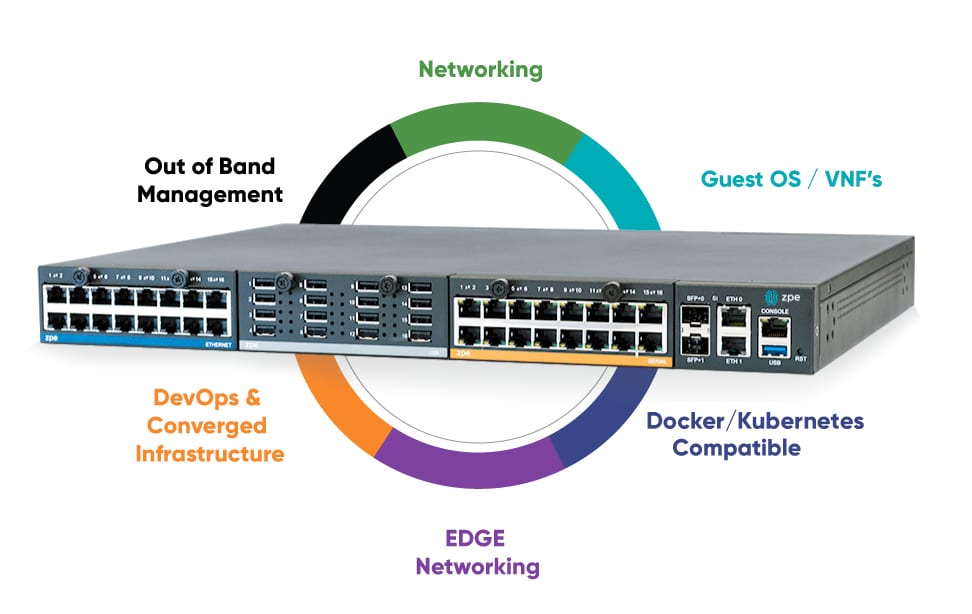
ZPE Systems offers a wide range of out-of-band management devices to fit any deployment size and use case, including the 96-port Nodegrid Serial Console Plus (NSCP) for large and hyperscale data centers, and the Nodegrid Gate SR, which combines branch gateway routing and OOB serial console functionality for remote business sites like retail stores and manufacturing plants.

Nodegrid OOB serial console comparison


Guest OS
Docker Apps
Wi-Fi
Cellular (Dual-SIM)
Serial Ports
Data Sheet
Nodegrid Serial Console S Series
1
1-2
No
1
16, 32 or 48
Nodegrid Serial Console Plus (NSCP)
1
1-2
Yes
1
16, 32, 48 or 96

Nodegrid OOB network edge router comparison


Guest OS
Docker Apps
Wi-Fi
Cellular (Dual-SIM)
Serial Ports
Data Sheet
Nodegrid Link SR
1
1-2
Yes
1
1
Nodegrid Bold SR
1
1-2
Yes
1-2
8
Nodegrid Hive SR
1-2
1-3
Yes
1-2
8
Nodegrid Gate SR
1-3
1-4
Yes
1-2
8
Nodegrid Net SR
1-6
1-4
Yes
1-4
16-80
Nodegrid Mini SR
1
1-2
Yes
1
Via USB

Get scalable network resilience with the only Gen 3 out-of-band management solution

Only Nodegrid OOBM delivers network control, security, automation, and resilience with a completely vendor-neutral platform. To see Nodegrid out-of-band management in action, request a free demo.

Request a Demo

IT Infrastructure Management Best Practices

A small team uses IT infrastructure management best practices to manage an enterprise network

A single hour of downtime costs organizations more than $300,000 in lost business, making network and service reliability critical to revenue. The biggest challenge facing IT infrastructure teams is ensuring network resilience, which is the ability to continue operating and delivering services during equipment failures, ransomware attacks, and other emergencies. This guide discusses IT infrastructure management best practices for creating and maintaining more resilient enterprise networks.
.

What is IT infrastructure management? It’s a collection of all the workflows involved in deploying and maintaining an organization’s network infrastructure. 

IT infrastructure management best practices

The following IT infrastructure management best practices help improve network resilience while streamlining operations. Click the links on the left for a more detailed look at the technologies and processes involved with each.

Isolated Management Infrastructure (IMI)

• Protects management interfaces in case attackers hack the production network

• Ensures continuous access using OOB (out-of-band) management

• Provides a safe environment to fight through and recover from ransomware

Network and Infrastructure Automation

• Reduces the risk of human error in network configurations and workflows

• Enables faster deployments so new business sites generate revenue sooner

• Accelerates recovery by automating device provisioning and deployment

• Allows small IT infrastructure teams to effectively manage enterprise networks

Vendor-Neutral Platforms

• Reduces technical debt by allowing the use of familiar tools

• Extends OOB, automation, AIOps, etc. to legacy/mixed-vendor infrastructure

• Consolidates network infrastructure to reduce complexity and human error

• Eliminates device sprawl and the need to sacrifice features

AIOps

• Improves security detection to defend against novel attacks

• Provides insights and recommendations to improve network health for a better end-user experience

• Accelerates incident resolution with automatic triaging and root-cause analysis (RCA)

Isolated management infrastructure (IMI)

Management interfaces provide the crucial path to monitoring and controlling critical infrastructure, like servers and switches, as well as crown-jewel digital assets like intellectual property (IP). If management interfaces are exposed to the internet or rely on the production network, attackers can easily hijack your critical infrastructure, access valuable resources, and take down the entire network. This is why CISA released a binding directive that instructs organizations to move management interfaces to a separate network, a practice known as isolated management infrastructure (IMI).

The best practice for building an IMI is to use Gen 3 out-of-band (OOB) serial consoles, which unify the management of all connected devices and ensure continuous remote access via alternative network interfaces (such as 4G/5G cellular). OOB management gives IT teams a lifeline to troubleshoot and recover remote infrastructure during equipment failures and outages on the production network. The key is to ensure that OOB serial consoles are fully isolated from production and can run the applications, tools, and services needed to fight through a ransomware attack or outage without taking critical infrastructure offline for extended periods. This essentially allows you to instantly create a virtual War Room for coordinated recovery efforts to get you back online in a matter of hours instead of days or weeks. A diagram showing a multi-layered isolated management infrastructure. An IMI using out-of-band serial consoles also provides a safe environment to recover from ransomware attacks. The pervasive nature of ransomware and its tendency to re-infect cleaned systems mean it can take companies between 1 and 6 months to fully recover from an attack, with costs and revenue losses mounting with every day of downtime. The best practice is to use OOB serial consoles to create an isolated recovery environment (IRE) where teams can restore and rebuild without risking reinfection.
.

Network and infrastructure automation

As enterprise network architectures grow more complex to support technologies like microservices applications, edge computing, and artificial intelligence, teams find it increasingly difficult to manually monitor and manage all the moving parts. Complexity increases the risk of configuration mistakes, which cause up to 35% of cybersecurity incidents. Network and infrastructure automation handles many tedious, repetitive tasks prone to human error, improving resilience and giving admins more time to focus on revenue-generating projects.

Additionally, automated device provisioning tools like zero-touch provisioning (ZTP) and configuration management tools like RedHat Ansible make it easier for teams to recover critical infrastructure after a failure or attack. Network and infrastructure automation help organizations reduce the duration of outages and allow small IT infrastructure teams to manage large enterprise networks effectively, improving resilience and reducing costs.

For an in-depth look at network and infrastructure automation, read the Best Network Automation Tools and What to Use Them For

Vendor-neutral platforms

Most enterprise networks bring together devices and solutions from many providers, and they often don’t interoperate easily. This box-based approach creates vendor lock-in and technical debt by preventing admins from using the tools or scripting languages they’re familiar with, and it makes a fragmented, complex architecture of management solutions that are difficult to operate efficiently. Organizations also end up compromising on features, ending up with a lot of stuff they don’t need and too little of what they do need.

A vendor-neutral IT infrastructure management platform allows teams to unify all their workflows and solutions. It integrates your administrators’ favorite tools to reduce technical debt and provides a centralized place to deploy, orchestrate, and monitor the entire network. It also extends technologies like OOB, automation, and AIOps to otherwise unsupported legacy and mixed-vendor solutions. Such a platform is revolutionary in the same way smartphones were – instead of needing a separate calculator, watch, pager, phone, etc., everything was combined in a single device. A vendor-neutral management platform allows you to run all the apps, services, and tools you need without buying a bunch of extra hardware. It’s a crucial IT infrastructure management best practice for resilience because it consolidates and unifies network architectures to reduce complexity and prevent human error.

Learn more about the benefits of a vendor-neutral IT infrastructure management platform by reading How To Ensure Network Scalability, Reliability, and Security With a Single Platform

AIOps

AIOps applies artificial intelligence technologies to IT operations to maximize resilience and efficiency. Some AIOps use cases include:

  • Security detection: AIOps security monitoring solutions are better at catching novel attacks (those using methods never encountered or documented before) than traditional, signature-based detection methods that rely on a database of known attack vectors.
  • Data analysis: AIOps can analyze all the gigabytes of logs generated by network infrastructure and provide health visualizations and recommendations for preventing potential issues or optimizing performance.
  • Root-cause analysis (RCA): Ingesting infrastructure logs allows AIOps to identify problems on the network, perform root-cause analysis to determine the source of the issues, and create & prioritize service incidents to accelerate remediation.

AIOps is often thought of as “intelligent automation” because, while most automation follows a predetermined script or playbook of actions, AIOps can make decisions on-the-fly in response to analyzed data. AIOps and automation work together to reduce management complexity and improve network resilience.

Want to find out more about using AIOps and automation to create a more resilient network? Read Using AIOps and Machine Learning To Manage Automated Network Infrastructure

IT infrastructure management best practices for maximum resilience

Network resilience is one of the top IT infrastructure management challenges facing modern enterprises. These IT infrastructure management best practices ensure resilience by isolating management infrastructure from attackers, reducing the risk of human error during configurations and other tedious workflows, breaking vendor lock-in to decrease network complexity, and applying artificial intelligence to the defense and maintenance of critical infrastructure.

Need help getting started with these practices and technologies? ZPE Systems can help simplify IT infrastructure management with the vendor-neutral Nodegrid platform. Nodegrid’s OOB serial consoles and integrated branch routers allow you to build an isolated management infrastructure that supports your choice of third-party solutions for automation, AIOps, and more.

Want to learn how to make IT infrastructure management easier with Nodegrid?

To learn more about implementing IT infrastructure management best practices for resilience with Nodegrid, download our Network Automation Blueprint

Request a Demo